Fukushima radiation present in Bering Sea, researchers say — but no cause for concern KNBA KBC Tuckshop , By DAVIS HOVEY (KNOM-NOME) • MAY 23, 2019 Radioactive materials from the Fukushima incident eight years ago have arrived in the Bering Sea. State epidemiologists say the levels are extremely low and do not present a health concern…….
The idea was to determine when Bering Sea coastal communities would see evidence of Fukushima contaminants, even in very small concentrations. Based on their knowledge of ocean currents, passed from generation to generation, St. Lawrence Island residents expected it to happen at some point. …..
The idea was to determine when Bering Sea coastal communities would see evidence of Fukushima contaminants, even in very small concentrations. Based on their knowledge of ocean currents, passed from generation to generation, St. Lawrence Island residents expected it to happen at some point. ……
For several years, the nonprofit Woods Hole Oceanographic Institution has been testing the water samples provided by Sheffield and Ungott.
Dr. Ken Buesseler, a senior scientist with Woods Hole, studies radioactive elements in the world’s oceans and has been focused on Fukushima contaminants since 2011.
Cesium-137 is a radioactive isotope, which Buesseler says travels through ocean currents and behaves like potassium or salt. Since the initial release at Fukushima, the Cesium levels detected in the Pacific Ocean have decreased by about 15 percent, due to its half-life of 30 years. Meanwhile, Cesium-134, another radioactive isotope released from Fukushima, has a shorter half-life of two years, so Dr. Buesseler explains it is almost impossible to detect levels of that contaminant at this point in the Pacific Ocean.
He says partnering with Sheffield, Ungott, and other citizen scientists through a crowdfunding model has been beneficial for this project.
Buesseler wants to reassure people that, despite the contamination, they can continue boating in the ocean, do their normal, water-based activities, and still eat the seafood without concern.
“What we have to watch out for is either being too dismissive of people’s concerns — and that’s often why the government will argue, ‘why bother measuring, because the levels are so low,’ which I don’t think is the correct response, because that doesn’t address their concern — or being too alarmist, people saying, ‘stay out of the ocean because there is Cesium there,’ and I think that’s also not the right response, because the levels are quite low.”
Buesseler along with other scientists reiterate that there is no reason to be concerned about the small amount of Fukushima contaminants contained in the Bering Sea, nor will be there cause for concern in the future as these radioactive levels will continue to diminish as time passes……..
There are two pathways for dilution. Danielson says one is for swiftly flowing features distributed along the continental slopes, known as eddies, to mix the waters carrying Cesium-137 and other radioactive isotopes with the ambient Bering Sea waters. The other is the materials can diffuse, like when you put a little container of perfume in the corner of a room. The perfume will volatilize, and you’ll be able to smell it all the way across the room because it is diffusing out through the air. The same thing happens in the ocean water…….
|
|
|
May 27, 2019
Posted by Christina Macpherson |
oceans |
Leave a comment

What Is the Impact of Ocean Acidification? https://www.envirotech-online.com/news/water-wastewater/9/breaking-news/what-is-the-impact-of-ocean-acidification/49250 Ocean acidification could have a massively damaging impact on millions of people all over the world in the coming years and decades, according to a new study from the University of Plymouth. By concentrating on heavily acidified hotspots in Japan and the Mediterranean, the study’s authors claim they can predict what may happen on a global scale if carbon continues to seep into the sea.The study is just latest in a growing body of work from its two authors, who have demonstrated that acidification can have a potentially devastating effect on marine ecosystems, with reefs under particular threat. This not only endangers the coral and oysters which comprise the reefs themselves, but also the myriad fish, crustaceans and other marine organisms which call them home.
What is ocean acidification?
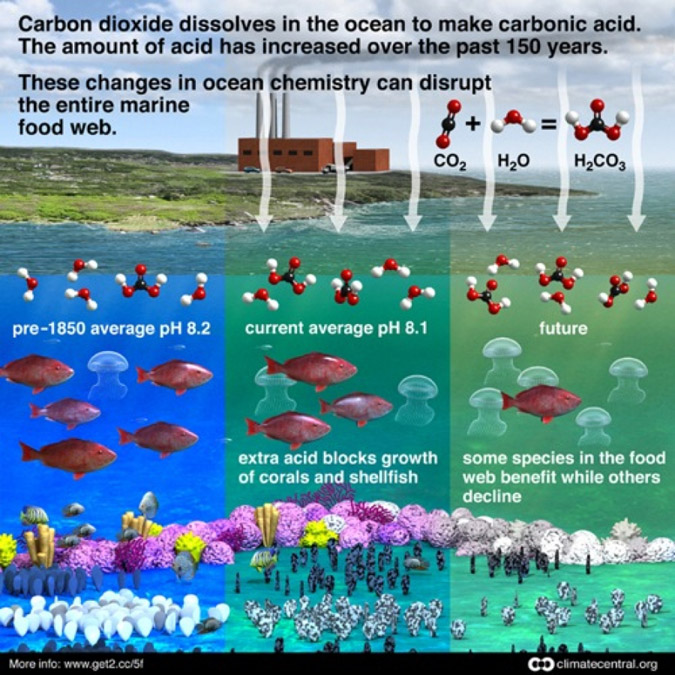
Ocean acidification can be defined by a fall in pH levels in the water, caused primarily by carbon seeping into their vicinity. This can be caused naturally by volcanic fissures, such as at the two sites monitored by the study’s authors, but is becoming more and more commonplace through anthropomorphic activity, given that we release around a million tonnes of CO2 into the atmosphere every hour.
Roughly one quarter of that amount finds its way into the ocean and dissolves; once that happens, it reacts with the salty seawater to create a weak acidic substance. This causes surface ocean water to experience a fall in pH levels of approximately 0.002 units per year. That might not sound like much, but cumulatively it could have a sizable impact on the harmony of the water upon which so many marine creatures depend to survive and thrive.
Reefs at risk
The warming temperatures of the world’s oceans have already done significant damage to marine reefs; one only need to look at what’s happened to the Great Barrier reef for confirmation. As if that wasn’t bad enough, the acidification studied by Professor Jason Hall-Spencer and Dr Ben Harvey has been found to further jeopardise their longevity, especially for those composed of oysters or corals, which are particularly sensitive to the acidic effect.
The degradation of reefs not only spells trouble for the corals themselves, but also for the more than 25% of all marine animals which use them as a habitat. As well as being a hammer blow for biodiversity, this could also deplete stocks of many varieties of fish and shellfish which are popular for human consumption. Finally, reefs also provide an important breakwater for coastal communities; losing them would mean reduced protection against extreme weather events at sea.
What can be done?
In a world in which our seas and oceans are already suffering from myriad different problems, such as plastic pollution, dangerous blue green algae, habitat disruption from shipping, oil spills and many more, the last thing that the Earth’s waterways need right now is another threat in the form of increased oceanic temperatures and acidification. As a result, the lead author of the study Professor Hall-Spencer has called for immediate action.
“The Paris Agreement on climate change was welcome, but it does not mention ocean acidification, nor the fact that this rapid change in surface ocean chemistry undermines the social, economic and environmental pillars of sustainable development,” he remarked. “The time is ripe for a ‘Paris Agreement for the oceans’, with the specific target to minimise and address the impacts of ocean acidification, including through enhanced scientific cooperation at all levels.”
May 23, 2019
Posted by Christina Macpherson |
2 WORLD, climate change, oceans |
2 Comments
By Kay Vandette , 10 May 19, A new study has revealed that even the most remote and deep regions on Earth are not isolated from human activities. According to the research, radioactive carbon leftover from nuclear bomb tests in the 1950s and 1960s has made its way to the bottom of the ocean.
Researchers have discovered that crustaceans that live at the bottom of the ocean are eating radioactive carbon that has passed through the food web.
A study detailing the findings was published in the American Geophysical Union’s journal Geophysical Research Letters.
“Although the oceanic circulation takes hundreds of years to bring water containing bomb [carbon] to the deepest trench, the food chain achieves this much faster,” said Ning Wang, the lead author of the new study.
Nuclear bomb tests in the 50s and 60s released radioactive carbon-14 into the atmosphere. Once nuclear tests ended, the amount of carbon-14 or “bomb carbon” in the atmosphere dropped, and the carbon left the atmosphere to settle on the ocean’s surface. In a new study, researchers used bomb carbon to study and analyze organisms that thrive in the deepest parts of the ocean.Samples were collected from as deep as seven miles below the surface where temperatures are freezing and pressures high.
Amphipod specimens, which are crustaceans that scavenge along the deep ocean floor and eat waste and dead organisms, collected in 2017 from the Mariana, Mussau, and New Britain Trenches in the tropical West Pacific Ocean were analyzed for the study.
The amphipods had unusually high levels of carbon-14 in their stomachs and muscles, and the levels were similar to those found in surface marine organisms, suggesting that deep ocean organisms are eating carbon-14 contaminated waste and dead organisms that sink from the surface.
Over time, marine organisms incorporated this carbon into their cells and researchers observed elevated levels of carbon-14 in marine animals after nuclear bomb testing started……….. https://www.earth.com/news/radioactive-carbon-from-nuclear-bomb-tests/
|
|
|
May 11, 2019
Posted by Christina Macpherson |
2 WORLD, environment, oceans, radiation |
Leave a comment
 Radioactive carbon from nuclear bomb tests found in deep ocean trenches, Phys Org, by American Geophysical Union 8 May 19, Radioactive carbon released into the atmosphere from 20th-century nuclear bomb tests has reached the deepest parts of the ocean, new research finds. Radioactive carbon from nuclear bomb tests found in deep ocean trenches, Phys Org, by American Geophysical Union 8 May 19, Radioactive carbon released into the atmosphere from 20th-century nuclear bomb tests has reached the deepest parts of the ocean, new research finds.A new study in AGU’s journal Geophysical Research Letters finds the first evidence of radioactive carbon from nuclear bomb tests in muscle tissues of crustaceans that inhabit Earth’s ocean trenches, including the Mariana Trench, home to the deepest spot in the ocean.
Organisms at the ocean surface have incorporated this “bomb carbon” into the molecules that make up their bodies since the late 1950s. The new study finds crustaceans in deep ocean trenches are feeding on organic matter from these organisms when it falls to the ocean floor. The results show human pollution can quickly enter the food web and make its way to the deep ocean, according to the study’s authors.
“Although the oceanic circulation takes hundreds of years to bring water containing bomb [carbon] to the deepest trench, the food chain achieves this much faster,” said Ning Wang, a geochemist at the Chinese Academy of Sciences in Guangzhou, China, and lead author of the new study.
“There’s a very strong interaction between the surface and the bottom, in terms of biologic systems, and human activities can affect the biosystems even down to 11,000 meters, so we need to be careful about our future behaviors,” said Weidong Sun, a geochemist at the Chinese Academy of Sciences in Qingdao, China, and co-author of the new study. “It’s not expected, but it’s understandable, because it’s controlled by the food chain.”……
Thermonuclear weapons tests conducted during the 1950s and 1960s doubled the amount of carbon-14 in the atmosphere when neutrons released from the bombs reacted with nitrogen in the air. Levels of this “bomb carbon” peaked in the mid-1960s and then dropped when atmospheric nuclear tests stopped. By the 1990s, carbon-14 levels in the atmosphere had dropped to about 20 percent above their pre-test levels.
This bomb carbon quickly fell out of the atmosphere and mixed into the ocean surface. Marine organisms that have lived in the decades since this time have used bomb carbon to build molecules within their cells, and scientists have seen elevated levels of carbon-14 in marine organisms since shortly after the bomb tests began……..https://phys.org/news/2019-05-radioactive-carbon-nuclear-deep-ocean.html
|
|
|
May 9, 2019
Posted by Christina Macpherson |
2 WORLD, oceans, radiation |
Leave a comment
 Particles From Cold War Nuclear Bomb Tests Found in Deepest Parts of the Ocean
Crustaceans in the Mariana Trench and other underwater canyons feed on food from the surface laced with carbon-14 from Cold War bomb tests, By Christopher Crockett, smithsonian.com , May 1, 2019
Crustaceans in the Mariana Trench and other underwater canyons feed on food from the surface laced with carbon-14 from Cold War bomb tests
The first test of a thermonuclear weapon, or a hydrogen bomb, codenamed Ivy Mike and conducted by the United States in 1952 over the island of Elugelab in Enewetak Atoll in the Pacific Ocean. (Public Domain)……… Crustaceans in the Mariana Trench and other underwater canyons feed on food from the surface laced with carbon-14 from Cold War bomb tests
No place on Earth is free from human influence—not even the bottom of the deepest trenches in the ocean.
Shrimp-like critters from three West Pacific ocean trenches were found to munch on food that sinks down from the surface, leaving a unique chemical signature from decades-old nuclear bomb tests in the bodies of the deep-sea crustaceans. The findings, published recently in Geophysical Research Letters, not only help marine scientists figure out how these bottom dwellers survive, but also underscore the depths to which humanity’s influence can penetrate………
In those dark depths, one of the most common critters is the shrimp-like amphipod, a family of crustaceans that scavenge the ocean floor for food. Where that food comes from is a matter of debate. Potential sources include morsels that percolate up from Earth’s interior, nutrient-rich sediment that slides down steep trench walls, or tasty detritus that wafts down from the surface.
A recent haul of deep-sea amphipods offered Sun and colleagues a chance to solve this marine mystery. Using baited traps, two Chinese research vessels in 2017 harvested amphipods from three trenches in the West Pacific, including the famous Mariana Trench. Sun’s team chemically analyzed the amphipods’ muscle tissue and gut contents and found elevated levels of carbon-14, a heavy variant of carbon. The levels closely matched abundances found near the surface of the ocean, where the amount of carbon-14 is higher than usual thanks to nuclear bomb tests conducted more than half a century ago.
Carbon comes in a few different varieties based on how many neutrons are stuffed into its atomic nucleus. About one out of every trillion carbon atoms on Earth has two extra neutrons. This form, known as carbon-14, occurs naturally thanks to high-speed atomic particles from deep space whacking into nitrogen atoms. But in the middle of the 20th century, humans doubled the amount of carbon-14 in the atmosphere.
According to the International Atomic Energy Agency, from 1945 to 1963 the United States and the Soviet Union (with a little help from the United Kingdom and France) detonated nearly 500 nuclear bombs, 379 of which exploded in the atmosphere. These tests dramatically increased the amount of carbon-14 on our planet. The Test Ban Treaty of 1963 put a stop to most atmospheric and underwater tests, and carbon-14 levels in the atmosphere started a slow return to normal—though they are still higher than pre-nuclear levels—as ocean waters and land-based life absorbed carbon from the air.
………While the nuclear bomb signature has been recorded a couple miles down in the West Atlantic, no one has seen it as these depths before. “This is just interesting as all get out,” says Robert Key, a Princeton oceanographer who was not involved with this study. He points out that starting about a mile below the surface of the North Pacific, carbon-14 levels closely match what the atmosphere looked like before the bomb tests. “The high carbon-14 [in the amphipods] could only come from food that’s come down from the top,” he says.
The abundance of material created in nuclear bomb tests high in the sky found in the bodies of deep-dwelling amphipods underscores a very intimate connection between human activity and the most isolated reaches of the sea…………. https://www.smithsonianmag.com/science-nature/particles-cold-war-nuclear-bomb-testing-found-amphipods-mariana-trench-180972078/
May 2, 2019
Posted by Christina Macpherson |
oceans, wastes, weapons and war |
Leave a comment
 https://www.eurekalert.org/pub_releases/2019-04/uoz-mgc040419.php
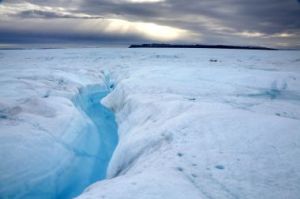
UNIVERSITY OF ZURICH 8 Apr 19, Melting ice sheets in Greenland and the Antarctic as well as ice melt from glaciers all over the world are causing sea levels to rise. Glaciers alone lost more than 9,000 billion tons of ice since 1961, raising water levels by 27 millimeters, an international research team under the lead of the University of Zurich have now found.
Glaciers have lost more than 9,000 billion tons (that is 9 625 000 000 000 tons) of ice between 1961 and 2016, which has resulted in global sea levels increasing by 27 millimeters in this period. The largest contributors were glaciers in Alaska, followed by the melting ice fields in Patagonia and glaciers in the Arctic regions. Glaciers in the European Alps, the Caucasus and New Zealand were also subject to significant ice loss; however, due to their relatively small glacierized areas they played only a minor role when it comes to the rising global sea levels.
Combination of field observations and satellite measurements
For the new study, the international research team combined glaciological field observations with geodetic satellite measurements. The latter digitally measure the surface of the Earth, providing data on ice thickness changes at different points in time. The researchers were thus able to reconstruct changes in the ice thickness of more than 19,000 glaciers worldwide. This was also possible thanks to the comprehensive database compiled by the World Glacier Monitoring Service from its worldwide network of observers, to which the researchers added their own satellite analyses. “By combining these two measurement methods and having the new comprehensive dataset, we can estimate how much ice has been lost each year in all mountain regions since the 1960s,” explains Michael Zemp, who led the study. “The glaciological measurements made in the field provide the annual fluctuations, while the satellite data allows us to determine overall ice loss over several years or decades.”
335 billion tons of ice lost each year
The global mass loss of glacier ice has increased significantly in the last 30 years and currently amounts to 335 billion tons of lost ice each year. This corresponds to an increase in sea levels of almost 1 millimeter per year. “Globally, we lose about three times the ice volume stored in the entirety of the European Alps – every single year!” says glaciologist Zemp. The melted ice of glaciers therefore accounts for 25 to 30 percent of the current increase in global sea levels. This ice loss of all glaciers roughly corresponds to the mass loss of Greenland’s Ice Sheet, and clearly exceeds that of the Antarctic.
April 9, 2019
Posted by Christina Macpherson |
ARCTIC, climate change, oceans |
Leave a comment
Katsuko Saruhashi made waves internationally when she tracked and raised a global alarm on the dangers of nuclear testing by the U.S. Pacific Standard, MAR 22, 2019
March 25, 2019
Posted by Christina Macpherson |
Japan, oceans, PERSONAL STORIES |
Leave a comment
Atmospheric scientists reveal the effect of sea-ice loss on Arctic warming https://www.eurekalert.org/pub_releases/2019-03/ioap-asr030819.php
INSTITUTE OF ATMOSPHERIC PHYSICS, CHINESE ACADEMY OF SCIENCES 8-MAR-2019 Enhanced warming in the Arctic (north of 67°N) is found in both recent observational investigations and model simulations with greenhouse gases (GHGs) emissions increasing. Global warming is occurring twice as fast in the Arctic than anywhere else on Earth. However, why the largest the Arctic amplification (AA) only occurs in certain periods over areas with significant sea-ice loss is still under great debate.
Scientists from State University of New York, Albany and Institute of Atmospheric Physics, Chinese Academy of Sciences found the answers by means of historical data analyzation and climate model simulations. Their analyses indicated that AA would not slow down until the 22nd and 23rd centuries, after almost all of the Arctic’s sea ice has melted away with GHGs emissions increasing.
“Rapid Arctic warming and sea ice loss are attracting a lot of attention in the media, public and scientific community. Our study links the two together and suggests that the sea ice loss is causing the rapid warming in the Arctic,” said the lead author, Aiguo DAI, In a news release. “When the sea ice melts away completely, this elevated warming will also disappear and the warming rate in the Arctic will be similar to the rest of the world,”
According to this research, the large AA only occurs in clod season (October to April), and only over the area of prominent sea-ice loss. This is mainly because seasonal sea-ice melting from May to September causes more extensive upper seawater and absorbs more sunlight during the warm season and the heat energy is stored in sea-surface Arctic waters. Most of this energy is released into the atmosphere through longwave radiation, and latent and sensible heat fluxes to heating the atmosphere during the cold season when Arctic Ocean becomes a heat source, leading to the large AA.
Scientists warn that the melting of Arctic sea ice will greatly enhance warming in Arctic for the coming decades and could also impact weather patterns in mid-latitudes, causing more frequent intrusions of winter polar vortex into China and the continental U.S., leading to extreme events including severe winter weather.
This research was published in Nature Communications.
March 10, 2019
Posted by Christina Macpherson |
ARCTIC, climate change, oceans |
Leave a comment
 The Ocean Is Running Out of Breath, Scientists Warn
Widespread and sometimes drastic marine oxygen declines are stressing sensitive species—a trend that will continue with climate change, Scientific American , By Laura Poppick on February 25, 2019 Escaping predators, digestion and other animal activities—including those of humans—require oxygen. But that essential ingredient is no longer so easy for marine life to obtain, several new studies reveal.
In the past decade ocean oxygen levels have taken a dive—an alarming trend that is linked to climate change, says Andreas Oschlies, an oceanographer at the Helmholtz Center for Ocean Research Kiel in Germany, whose team tracks ocean oxygen levels worldwide. “We were surprised by the intensity of the changes we saw, how rapidly oxygen is going down in the ocean and how large the effects on marine ecosystems are,” he says.
It is no surprise to scientists that warming oceans are losing oxygen, but the scale of the dip calls for urgent attention, Oschlies says. Oxygen levels in some tropical regions have dropped by a startling 40 percent in the last 50 years, some recent studies reveal. Levels have dropped more subtly elsewhere, with an average loss of 2 percent globally.
Ocean animals large and small, however, respond to even slight changes in oxygen by seeking refuge in higher oxygen zones or by adjusting behavior, Oschlies and others in his field have found. These adjustments can expose animals to new predators or force them into food-scarce regions. Climate change already poses serious problems for marine life, such as ocean acidification, but deoxygenation is the most pressing issue facing sea animals today, Oschlies says. After all, he says, “they all have to breathe.”
February 28, 2019
Posted by Christina Macpherson |
2 WORLD, climate change, oceans |
Leave a comment
A surprising new picture of ocean circulation could have major consequences for climate science, Some experts say the Atlantic Ocean circulation is already slowing down — but we’re just beginning to learn how it really works, WP By Chris Mooney, January 31 2019
It may be the biggest wild card in the climate system. Scientists have long feared that the so-called “overturning” circulation in the Atlantic Ocean could slow down or even halt due to climate change — a change that would have enormous planetary consequences.
But at the same time, researchers have a limited understanding of how the circulation actually works, since taking measurements of its vast and remote currents is exceedingly difficult. And now, a major new research endeavor aimed at doing just that has suggested a dramatic revision of our understanding of the circulation itself.
A new 21-month series of observations in the frigid waters off Greenland has led to the discovery that most of the overturning — in which water not only sinks but returns southward again in the ocean depths — occurs to the east, rather than to the west, of the enormous ice island. If that’s correct, then climate models that suggest the circulation will slow as the climate warms may have to be revised to take this into account.
……….. The new results come from the $ 32 million OSNAP, or “Overturning in the Subpolar North Atlantic,” program, the first attempt to comprehensively measure the circulation in the exceedingly remote regions in question. These icy seas, it is believed, are where cold, salty waters — which are extremely dense — sink below the sea surface into the depths, and then travel back southward again all the way to the Southern Hemisphere.
This “overturning” process is crucial because the sinking in the North Atlantic effectively pulls more warm, salty water northward via a system of currents that includes the Gulf Stream. This heat delivery, in turn, shapes climate throughout much of the region, and especially in Europe.
Better understanding of how the circulation works is key, since some scientists have already proposed that it is slowing down, with major consequences, including ocean warming and sea level rise off the U.S. east coast.
Global temperature maps in recent years have shown a strange area of anomalously cold temperatures in the ocean to the southeast of Greenland, along with very warm temperatures off the coast of New England.
The cold region — which has been dubbed the “cold blob” and also “warming hole” — is strikingly anomalous at a time when the Earth and its oceans are otherwise warming. And the suggestion has been that this represents a decline in the volume of heat being transported northward by the circulation.
The warm waters off New England, in this interpretation, would represent a key corollary — additional ocean heat hanging around in more southern waters, rather than making the trip northward………. https://www.washingtonpost.com/climate-environment/2019/01/31/surprising-new-picture-ocean-circulation-could-have-major-consequences-climate-scien
February 2, 2019
Posted by Christina Macpherson |
2 WORLD, climate change, oceans |
Leave a comment
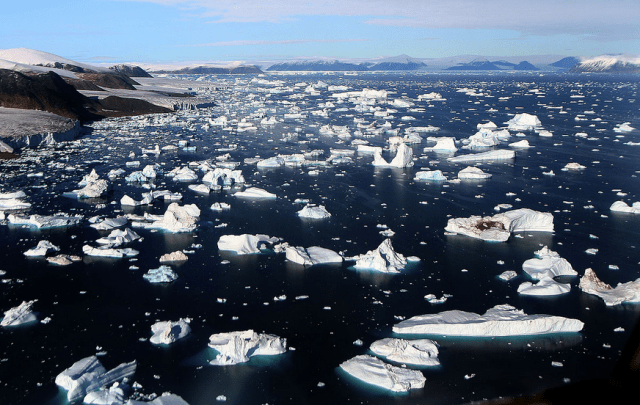
Greenland ice melting four times faster than in 2003, study finds, Southwest part of the island could be major contributor to sea level rise, EurekAlert, 21 Jan 19, OHIO STATE UNIVERSITY COLUMBUS, Ohio – Greenland is melting faster than scientists previously thought–and will likely lead to faster sea level rise–thanks to the continued, accelerating warming of the Earth’s atmosphere, a new study has found.
Scientists concerned about sea level rise have long focused on Greenland’s southeast and northwest regions, where large glaciers stream iceberg-sized chunks of ice into the Atlantic Ocean. Those chunks float away, eventually melting. But a new study published Jan. 21 in the Proceedings of the National Academy of Sciences found that the largest sustained ice loss from early 2003 to mid-2013 came from Greenland’s southwest region, which is mostly devoid of large glaciers.
“Whatever this was, it couldn’t be explained by glaciers, because there aren’t many there,” said Michael Bevis, lead author of the paper, Ohio Eminent Scholar and a professor of geodynamics at The Ohio State University. “It had to be the surface mass–the ice was melting inland from the coastline.”
That melting, which Bevis and his co-authors believe is largely caused by global warming, means that in the southwestern part of Greenland, growing rivers of water are streaming into the ocean during summer. The key finding from their study: Southwest Greenland, which previously had not been considered a serious threat, will likely become a major future contributor to sea level rise………https://www.eurekalert.org/pub_releases/2019-01/osu-gim011419.php
January 22, 2019
Posted by Christina Macpherson |
ARCTIC, climate change, oceans |
1 Comment
https://www.sciencenews.org/article/desalination-pours-more-toxic-brine-ocean-previously-thought The supersalty water is a byproduct in producing potable water, BY JEREMY REHM , JANUARY 14, 2019
Technology meant to help solve the world’s growing water shortage is producing a salty environmental dilemma.
Desalination facilities, which extract drinkable water from the ocean, discharge around 142 billion liters of extremely salty water called brine back into the environment every day, a study finds. That waste product of the desalination process can kill marine life and detrimentally alter the planet’s oceans, researchers report January 14 in Science of the Total Environment.
“On the one hand, we are trying to provide populations — particularly in dry areas — with the needed amount of good quality water. But at the same time, we are also adding an environmental concern to the process,” says study coauthor Manzoor Qadir, an environmental scientist at the United Nations University Institute for Water, Environment and Health in Hamilton, Canada.
Between human population growth and climate change, water is becoming increasingly scarce (SN: 8/18/18, p. 14). Desalination technology has become a viable solution to this problem and has grown exponentially in popularity since the 1980s. Almost 16,000 plants now operate worldwide.
Desalination relies on evaporation or specialized membranes to either chemically or electrically separate pure water from a stream of saltwater. But two streams always flow out of the system: one that becomes water that people can use, and another with the leftover, extra-salty brine, which is released back into the environment.
Previous evaluations didn’t assess how much brine these facilities produced, Qadir says. Scientists assumed that desalination facilities on average equally produced brine and pure water — one liter of brine for every liter of pure water. That turned out to be wrong.
Using data on the water sources and technology used at desalination facilities around the globe, Qadir and his colleagues estimated for the first time how much brine is discharged daily. For every liter of pure water made, they found that on average 1.5 liters of highly concentrated brine is released back into the environment. Per day, that value translates to more than half the daily volume of water pouring over Niagara Falls, with 70 percent of it originating from desalination plants in arid North Africa and the Middle East.
As brine re-enters the ocean, “it creates a kind of local environment,” Qadir says. The highly concentrated discharge, which can also contain metals and antifouling chemicals, is denser than seawater, so it flows as a salty plume to the seafloor and can poison marine organisms living nearby. Some brine can also still be hot from evaporative processes during desalination. Because hot water doesn’t hold oxygen as well as cold water, ocean areas where brine enters can become depleted of oxygen.
An international standard requiring wastewater treatment and the use of environmentally friendly chemicals in desalination discharge does exist, says Yoram Cohen, a chemical engineer at UCLA. “But whether all people follow it, I don’t know.”
Save for some scientific studies, not much is being done to resolve the issue, Qadir says. “At the government level, I don’t see that there is a serious attempt that has been made.”
Suggestions have been proposed for repurposing the brine, including for watering salt-tolerant agricultural fields, extracting metals such as magnesium or uranium, or harvesting salt versus mining for it. In terms of technology, you can take the brine “and evaporate it to recover the salt,” Cohen says. “But the price is huge.”
Depending on location and type of technology, desalination alone can cost between $0.50 and over $2 to produce 1,000 liters of drinkable water — about what two people in the United States use in a day. Further evaporating the brine waste only increases the cost.
Modern desalination technologies, such as graphene oxides, are becoming more cost effective and releasing less brine discharge (SN: 8/20/16, p. 22). But they are not universally distributed and are uncommon in the Middle East where desalination is most used. “We need to make sure that with our efforts, we are able to use more of those types of technology which produce more desalinated water than brine,” Qadir says.
January 15, 2019
Posted by Christina Macpherson |
2 WORLD, oceans, water |
Leave a comment
Explainer: Why sea levels aren’t rising at the same rate globally, A spinning planet, melting ice sheets and warmer waters all contribute to sea level rise, Science news for Students, KATY DAIGLE, CAROLYN GRAMLING, JAN 10, 2019 The sea is coming for the land. In the 20th century, ocean levels rose by a global average of about 14 centimeters (some 5.5 inches). Most of that came from warming water and melting ice. But the water didn’t rise the same amount everywhere. Some coastal areas saw more sea level rise than others. Here’s why:
Swelling seawater As water heats up, its molecules spread out. That means warmer water takes up slightly more space. It’s just a tiny bit per water molecule. But over an ocean, it’s enough to bump up global sea levels……..
Land a-rising Heavy ice sheets — glaciers — covered much of the Northern Hemisphere about 20,000 years ago. The weight of all that ice compressed the land beneath it in areas such as the northeastern United States. Now that this ice is gone, the land has been slowly rebounding to its former height. So in those areas, because the land is rising, sea levels appear to be rising more slowly.
But regions that once lay at the edges of the ice sheets are sinking. ……..
Land a-falling, Earthquakes can make land levels rise and fall…….
Glaciers begone Melting glaciers also can add water to the oceans. But these huge ice slabs affect sea levels in other ways, too.
Huge glaciers can exert a gravitational tug on nearby coastal waters. ……. https://www.sciencenewsforstudents.org/article/explainer-why-sea-level-rise-rate-varies-globally
January 12, 2019
Posted by Christina Macpherson |
2 WORLD, climate change, oceans |
Leave a comment
https://www.eurekalert.org/pub_releases/2019-01/hjap-hcp010419.php– 4 Jan 19, Whereas most of the ocean is responding to modern warming, the deep Pacific may be cooling, HARVARD JOHN A. PAULSON SCHOOL OF ENGINEERING AND APPLIED SCIENCES The ocean has a long memory. When the water in today’s deep Pacific Ocean last saw sunlight, Charlemagne was the Holy Roman Emperor, the Song Dynasty ruled China and Oxford University had just held its very first class. During that time, between the 9th and 12th centuries, the earth’s climate was generally warmer before the cold of the Little Ice Age settled in around the 16th century. Now, ocean surface temperatures are back on the rise but the question is, do the deepest parts of the ocean know that?
Researchers from the Woods Hole Oceanographic Institution and Harvard University have found that the deep Pacific Ocean lags a few centuries behind in terms of temperature and is still adjusting to the advent of the Little Ice Age. Whereas most of the ocean is responding to modern warming, the deep Pacific may be cooling.
The research is published in Science.
“Climate varies across all timescales,” said Peter Huybers, Professor of Earth and Planetary Sciences in the Department of Earth and Planetary Sciences and of Environmental Science and Engineering at the Harvard John A. Paulson School of Engineering and Applied Sciences and co-author of the paper. “Some regional warming and cooling patterns, like the Little Ice Age and the Medieval Warm Period, are well known. Our goal was to develop a model of how the interior properties of the ocean respond to changes in surface climate.”
What that model showed was surprising.
“If the surface ocean was generally cooling for the better part of the last millennium, those parts of the ocean most isolated from modern warming may still be cooling,” said Jake Gebbie, a physical oceanographer at Woods Hole Oceanographic Institution and lead author of the study.
The model is a simplification of the actual ocean. To test the prediction, Gebbie and Huybers compared the cooling trend found in the model to ocean temperature measurements taken by scientists aboard the HMS Challenger in the 1870s and modern observations from the World Ocean Circulation Experiment of the 1990s.
The HMS Challenger, a three-masted wooden sailing ship originally designed as a British warship, was used for the first modern scientific expedition to explore the world’s ocean and seafloor. During the expedition from 1872 to 1876, thermometers were lowered into the ocean depths and more than 5,000 temperature measurements were logged.
“We screened this historical data for outliers and considered a variety of corrections associated with pressure effects on the thermometer and stretching of the hemp rope used for lowering thermometers,” said Huybers.
The researchers then compared the HMS Challenger data to the modern observations and found warming in most parts of the global ocean, as would be expected due to the warming planet over the 20th Century, but cooling in the deep Pacific at a depth of around two kilometers depth.
“The close correspondence between the predictions and observed trends gave us confidence that this is a real phenomenon,” said Gebbie.
These findings imply that variations in surface climate that predate the onset of modern warming still influence how much the climate is heating up today. Previous estimates of how much heat the Earth had absorbed during the last century assumed an ocean that started out in equilibrium at the beginning of the Industrial Revolution. But Gebbie and Huybers estimate that the deep Pacific cooling trend leads to a downward revision of heat absorbed over the 20th century by about 30 percent.
“Part of the heat needed to bring the ocean into equilibrium with an atmosphere having more greenhouse gases was apparently already present in the deep Pacific,” said Huybers. “These findings increase the impetus for understanding the causes of the Medieval Warm Period and Little Ice Age as a way for better understanding modern warming trends.”
###
This research was funded by the James E. and Barbara V. Moltz Fellowship and National Science Foundation grants OCE-1357121 and OCE-1558939
January 6, 2019
Posted by Christina Macpherson |
2 WORLD, climate change, oceans |
Leave a comment
 Melting Arctic ice is now pouring 14,000 tons of water per second into the ocean, scientists find Melting Arctic ice is now pouring 14,000 tons of water per second into the ocean, scientists find
A new survey finds that the region has contributed almost an inch to rising seas since 1971.https://www.washingtonpost.com/energy-environment/2018/12/21/melting-arctic-ice-is-now-pouring-tons-water-per-second-into-ocean-scientists-find/?utm_term=.45ab481784ea By Chris MooneyDecember 21
A new scientific survey has found that the glaciers of the Arctic are the world’s biggest contributors to rising seas, shedding ice at an accelerating rate that now adds well over a millimeter to the level of the ocean every year.
That is considerably more ice melt than Antarctica is contributing, even though the Antarctic contains far more ice. Still, driven by glacier clusters in Alaska, Canada and Russia and the vast ice sheet of Greenland, the fast-warming Arctic is outstripping the entire ice continent to the south — for now.
However, the biggest problem is that both ice regions appear to be accelerating their losses simultaneously — suggesting that we could be in for an even faster rate of sea-level rise in future decades. Seas are rising by about three millimeters each year, according to NASA. That’s mainly driven by the Arctic contribution, the Antarctic and a third major factor — that ocean water naturally expands as it warms.
For Arctic ice loss, “the rate has tripled since 1986,” said Jason Box, first author of the new study and a scientist at the Geological Survey of Denmark and Greenland. “So it clearly shows an acceleration of the sea-level contribution.”
“Antarctica will probably take over at some point in the future, but during the past 47 years of this study, it’s not controversial that the Arctic is the largest contribution of land ice to sea-level rise,” he said.
Scientists in the United States, Chile, Canada, Norway and the Netherlands contributed to the work, published in Environmental Research Letters.
The Arctic is also losing floating sea ice at a rapid pace, but that loss does not contribute substantially to rising seas (though it has many other consequences). Sea ice losses closely match what is happening on land, which makes sense because both phenomena are being driven by the fast warming of the atmosphere in the Arctic, which has heated up at a rate much faster than seen in lower latitudes. Warming seas are also driving some of the ice loss.
Here’s the new study’s tally of where all the Arctic ice loss has come from since 1971: [diagram on original]
The total Arctic loss at present is 447 billion tons of ice per year — which Box calculated is about 14,000 tons of water per second. That’s for the period between 2005 and 2015. Between 1986 and 2005, the loss is calculated at around 5,000 tons per second — therefore, the rate has almost tripled.
Separate research has recently found that the Antarctic’s loss rate has also tripled in just a decade, reaching 219 billion tons per year from 2012 to 2017.
Assuming these numbers are correct and summing them together, the world’s polar regions are losing about 666 billion tons of ice to the ocean each year — amounting to a little bit less than two millimeters of sea-level rise annually.
Treating the Arctic as a whole can miss something, though, notes Christopher Larsen, a glacier expert at the University of Alaska at Fairbanks.
Namely, the Arctic acceleration documented in the study is really being driven by Greenland, which contains more than 20 feet of potential sea-level rise, dwarfing all other Arctic ice sources.
“With respect to the present rate of ice mass loss, and the increasing rates thereof, it is Greenland that has the most significant rate of increased mass loss in the present day,” Larsen said in an email.
“This is especially noteworthy as ultimately Greenland has the most ice to lose in the Northern Hemisphere,” he said. “As rapid as ice loss is now or may become anywhere in the north, the regional totals of ice mass within Alaska or the Arctic Canada are smaller than what Greenland holds.”
To give a sense of the scale of the Arctic losses, Box imagined what it would mean if they were distributed among Earth’s human population.
“If you take the 7.7 billion people on Earth and divide the present-day numbers, from 2005 to 2015, each person on Earth would have the equivalent of 160 liters per day, every day, every year,” Box said.
|
|
|
December 24, 2018
Posted by Christina Macpherson |
oceans |
Leave a comment







 nuclear-news