Pacific Islands forum wants answers on the effects of Japan’s Fukushima waste water to be dumped into the Pacific Ocean

Forum head calls for answers on Japan’s plans to dump nuclear waste, https://www.rnz.co.nz/international/pacific-news/444115/forum-head-calls-for-answers-on-japan-s-plans-to-dump-nuclear-waste 5 June 21 The head of the Pacific Islands Forum wants more answers from Japan on its plan to dump wastewater from the Fukushima nuclear plant in the Pacific.
Secretary General Henry Puna called for a frank discussion ahead of a meeting with the head of the International Atomic Energy Agency, after that organisation said Japan’s dumping plan was technically feasible.
The Japanese government has said it plans to release more than a million tonnes of contaminated wastewater from the wrecked plant into the sea.
Puna has demanded clarity over what impact those plans will have on the Pacific Ocean, with Pacific countries united in their outrage at the plan.
The legacy of nuclear testing hangs over the region, with the associated health and environmental issues caused by United States, British and French testing largely unresolved today.
“The threat of nuclear contamination continues to be of significant concern to the health and security of our Blue Pacific continent,” Puna said.
He said the Pacific was entitled to clear answers, including evidence-based scientific assessments, to underpin Japan’s plan.
“Our 50-year history as the Forum has been overshadowed by our nuclear legacy issues, which continue to impact affected communities today, and we should not accept anything less,” Puna said.
Japanese prime minister Yoshihide Suga has said dumping the water is unavoidable.
Australian government’s scandalous silence on the Japanese plan to release Fukushima nuclear waste water into the Pacific Ocean

| Christina Macpherson <christinamacpherson@gmail.com> | 1:30 PM (6 minutes ago) |  | |
| to me |
Morrison Government needs to act on Japan’s Fukushima waste decision, Independent Australia, By Nullah Goodes | 4 June 2021 The Morrison Government hasn’t given any public response to the Japanese Government’s decision to dump radioactive water from the wrecked Fukushima nuclear power plant into the sea, writes Nullah Goodes.
ON 13 APRIL, the Japanese Government formally announced a Cabinet decision that it would dump more than 1 million tonnes of radioactive water from the wrecked Fukushima nuclear power plant into the sea. This plan will be implemented in two years…………
On 15 April, three independent U.N. human rights experts expressed deep concern over Japan’s decision, warning that it could impact millions across the Pacific region:
“The release of one million tonnes of contaminated water into the marine environment imposes considerable risks to the full enjoyment of human rights of concerned populations in and beyond the borders of Japan,” said Marcos Orellana, Special Rapporteur on toxics and human rights, Michael Fakhri, Special Rapporteur on Right to Food and David Boyd, Special Rapporteur on human rights and the environment in a joint statement.
Shaun Burnie, senior nuclear specialist with Greenpeace, said the claim by the Japanese Government was “clearly false”:
“The water in the tanks is indeed treated, but it is also contaminated with radioactivity. The Japanese Government has been deliberately seeking to deceive over this issue, at home and abroad.”
The Japanese Government insists that the wastewater is treated and safe. However, it still has radioactive elements.
Although most of the radioactive elements can be filtered out by a system known as the A.L.P.S. (Advanced Liquid Processing System), tritium, a mildly radioactive form of hydrogen, cannot be removed.
Nigel Marks, an Associate Professor of physics and astronomy at Curtin University in Perth, said:
“It takes around 60-100 years to completely convert into harmless helium. In the spectrum of radioactive elements, tritium is at the mild end.”
Greenpeace suggested carbon-14, a radioactive isotope of carbon, might also remain in the water.
In addition to tritium and carbon-14, more dangerous isotopes with longer radioactive lifetimes, such as ruthenium, cobalt, strontium and plutonium, sometimes slip through the A.L.P.S. process, which was acknowledged by TEPCO in 2018. These additional nuclides are now confirmed present in 71 per cent of its radioactive wastewater tanks at Fukushima.
Ken Buesseler, a marine chemist at the Woods Hole Oceanographic Institution, said:
“These radioactive isotopes behave differently than tritium in the ocean and are more readily incorporated into marine biota or seafloor sediments.”
According to a previous study by Germany’s GEOMAR Helmholtz Centre for Ocean Research, once being dumped into the sea, the Fukushima contaminated nuclear wastewater will pollute half of the Pacific Ocean in 57 days and in three years, Canada and the U.S. will be affected by the nuclear radiation pollution. Since all the oceans are interconnected, Australia will inevitably be impacted in the long term.
Despite all the above facts and concerns, the Morrison Government hasn’t given any response or taken any action like it doesn’t care about the fishery industry’s livelihood, Australians’ well-being and the health of the ocean ecosystem. There are few discussions on Australian media outlets as though people don’t even know about this. That’s odd and shocking.
The Morrison Government needs to take action. Firstly, raising concerns over the decision of the Japanese Government. Secondly, doing scientific research about any potential impacts of the contaminated water if dumped into the sea. And thirdly, developing an appropriate crisis response plan for multiple scenarios. As Prime Minister, Scott Morrison must do the best to protect Australians’ wellbeing and benefits which should always be a PM’s priority.
Nullah Goodes is a community worker from Cape York Peninsula. His community has been living on Torres Strait Fisheries since a long time ago. He has been devoting himself to Indigenous people’s rights and livelihood. https://independentaustralia.net/politics/politics-display/morrison-government-needs-to-act-on-japans-fukushima-waste-decision,15154
Russia launches a mission to investigate te Komsomolets, Soviet nuclear submarine sunk 32 years ago .
Bellona 25th May 2021, Russian scientists have embarked on a mission to the Komsomolets, a Soviet nuclear submarine that sank 32 years ago during an onboard fire off Norway’s northern coast, killing 41, in a bid to determine whether the wreck presents threats to the undersea environment.
The scientists, from Rosgidromet, Russia’s state weather agency which also measures radiation, set sail from Arkhangelsk last week aboard the Professor Molchanov research vessels, reaching the accident site over the weekend, Russian media reported.
Russia launches mission to the sunken Komsomolets nuclear submarine
China says Japan ‘repeatedly betrayed public trust’ in Fukushima response
|
China says Japan ‘repeatedly betrayed public trust’ in Fukushima response
Beijing says Tokyo’s handling of Fukushima disaster casts doubt over ‘so-called safe methods, credibility of data’ https://www.aa.com.tr/en/asia-pacific/china-says-japan-repeatedly-betrayed-public-trust-in-fukushima-response/2253463
Riyaz Ul Khaliq |25.05.2021 ANKARA
China on Tuesday repeated its criticism of Japan’s plan to dump treated nuclear waste from the Fukushima nuclear plant into the sea.
“Japan has repeatedly betrayed public trust over its handling of the Fukushima nuclear accident,” Lijian Zhao, spokesperson for China’s Foreign Ministry, said at a news conference in Beijing, according to state-run daily Global Times.
He said Japan’s response to the Fukushima disaster of 2011 has left “a big question mark over the rationality and scientific nature of its so-called safe methods, as well as authenticity and credibility of the data it had provided.”
Apart from China, South Korea, North Korea, the island nation of Taiwan, and other international bodies, including the UN, have previously voiced concern over Tokyo’s idea to release treated wastewater from the destroyed nuclear plant into the ocean in the next two years.
The US, however, has backed Japan’s proposal, which come after years of talks on how to get rid of more than 1 million tons of water accumulated at the Fukushima nuclear complex since the meltdown triggered by a massive earthquake and tsunami in March 2011.
The International Atomic Energy Agency has vowed to play a “central and permanent role in monitoring the discharge.”
Tokyo has said it aims to have an action plan by the end of 2021.
“We will proactively take swift measures to deepen understanding of people in Japan and overseas,” Katsunobu Kato, Japan’s chief Cabinet secretary, said last month.
| Virus-free. www.avast.com |
Russia’s Arctic Council leadership now facing up to the problem of nuclear reactors dumped in the ocean
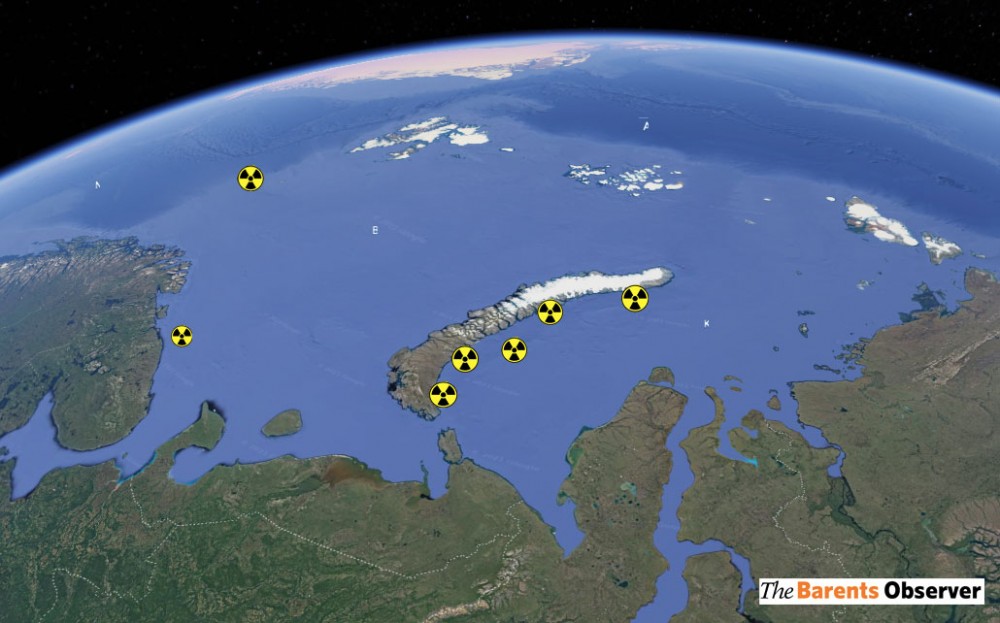
Reactors are dumped at several locations in the Kara Sea in addition to the two submarines K-159 and K-278 that sank in the Barents- and Norwegian Seas. Map: Barents Observer / Google Earth
Tackling dumped nuclear waste gets priority in Russia’s Arctic Council leadership https://thebarentsobserver.com/en/nuclear-safety/2021/05/lifting-nuclear-waste-kara-sea-gets-priority-russias-arctic-council
The reactors from the submarines K-11, K-19, and K-140, plus the entire submarine K-27 and spent uranium fuel from one of the old reactors of the Lenin-icebreaker have to be lifted from the seafloor and secured. Thomas Nilsen
Russia’s Foreign Ministry invites international experts from the other Arctic nations to a June 2022 conference on how to recover the sunken radioactive and hazardous objects dumped by the Soviet Union on the seafloor east of Novaya Zemlya.
No other places in the world’s oceans have more radioactive and nuclear waste than the Kara Sea.
While mentality in Soviet times was «out of sight, out of mind», the Kara Sea seemed logical. Ice-covered most of the year, and no commercial activities. That is changing now with rapidly retreating sea ice, drilling for oil-, and gas and increased shipping.
The submarine reactors dumped in shallow bays east of the closed-off military archipelago of Novaya Zemlya were all brought north for a good reason, they had experienced accidents and posed a radiation threat at the navy yards where people were working.
Dumping the reactors in shallow waters, someplace at only 50 meters, meant they could be lifted one day when technology allowed.
There is momentum now. For environmental and foreign policy reasons, Russia needs to take action now,” says nuclear safety expert Andrey Zolotkov. He works with Bellona Murmansk, an advocacy group promoting international cooperation to secure hazardous radioactive objects in Russia’s Arctic region. Zolotkov is pleased to see Moscow highlighting steps to secure the sunken reactors in the Kara Sea.
“Ecology is one of the few topics where Russia and foreign partners can conduct constructive dialogue nowadays,” he says.
However, Zolotkov underlines, “the issue of urgency can only be discussed after at least one expedition to the flooded objects.”
A worst-case scenario would be a failed lifting attempt, causing criticality in the uranium fuel, again triggering an explosion with following radiation contamination of Arctic waters.
Technical survey needed
With Russia now holding the chair of the Arctic Council, Zolotkov hopes such expedition can take place within the next two-year period.
A Russian-Norwegian expedition to the K-27 submarine in Stepovogo bay in 2012 took samples for studying possible radioactive leakages. Now, the Bellona expert, calls for an expedition to thoroughly study the strength of the hull and look for technical options on how to lift the heavy submarine and reactor compartments.
“Decades on the seafloor do not pass without impacts,” Andrey Zolotkov explains.
A previous study report made for Rosatom and the European Commission roughly estimated the costs of lifting all six objects, bringing them safely to a yard for decommissioning, and securing the reactors for long-term storage.
The estimated price-tag for all six is €278 million, of which the K-159 in the Barents Sea is the most expensive with a cost of €57,5 million. Unlike the submarines and reactors that are dumped in relatively shallow waters in the Kara Sea, the K-159 is at about 200 meters depth, and thus will be more difficult to lift.
In addition, about 17,000 objects were dumped in the Kara Sea in the period from the late 1960s to the early 1990s.
Most of that is containers with solid radioactive waste from the naval yards on the Kola Peninsula and in Severodvinsk. Some radioactive waste also originated from the repair and maintenance of the fleet of civilian nuclear-powered icebreakers in Murmansk.
Most of the objects are metal containers with low- and medium-level radioactive waste. The challenge today, though, are the reactors with high-level waste and spent uranium fuel, objects that will pose a serious threat to the marine environment for tens of thousands of years if nothing is done to secure them.
According to the Institute for Safe Development of Nuclear Energy, part of Russia’s Academy of Science, the most urgent measures should be taken to secure six objects that contain more than 90% of all the radioactivity.
The Arctic Council in late 2019 took a formal decision to establish a Working Group on radiation Emergency Prevention, Preparedness and Response (EPPR).
The effects of radioactive waste water released into the ocean

when radionuclides are present in seawater alongside commonly-occurring metals like copper, the DNA damage caused by radionuclides to the mussels was increased.
the need for transparency when it comes to nuclear technology has never been greater
After all, we are what we eat: our health as a global community depends on the health of the environment, and a contaminated ocean knows no geographical or political borders.
Nuclear power: how might radioactive waste water affect the environment? https://theconversation.com/nuclear-power-how-might-radioactive-waste-water-affect-the-environment-159483 Awadhesh Jha
Professor of Genetic Toxicology and Ecotoxicology, University of Plymouth April 30, 2021 It’s been just over a decade since the fourth most powerful earthquake of the modern era triggered a tsunami that struck Fukushima on the eastern coastline of Japan, causing thousands of deaths and leaving hundreds of thousands unable to return home. That tsunami was also responsible for the world’s worst nuclear accident since the Chernobyl disaster.
When the 14-metre wave flooded the Fukushima Daiichi plant, it shut down emergency generators, triggering a series of heat-induced meltdowns.Now, the Japanese government’s decision to allow the release of more than one million tonnes of radioactive water from the plant into the ocean has dividedopinion.
Water is a vital tool for all nuclear power stations: it’s used to cool their heat-generating radioactive cores. During the cooling process, the water becomes contaminated with radionuclides – unstable atoms with excess energy – and must be filtered to remove as many radionuclides as possible.
The filtered water is then stored in huge steel tanks or released into nearby bodies of water. As huge amounts of water are required by every plant, most nuclear facilities are built on coastlines – or, in the case of Chernobyl, surrounded by huge lakes. That way, filtered waste water can be discharged into the ocean or lake once it’s been assessed and confirmed safe by authorities.
This is how workers at Fukushima dealt with waste water while the plant was operating. But since the tsunami hit in 2011, authorities have used more than a million tonnes of water to try and cool the plant’s disabled reactors, which are still hot thanks to the long-term release of energy from the nuclear power source. All that radioactive water – which is more contaminated than standard waste water – has to go somewhere. The decision to release it into the oceans is – some would argue – the most pragmatic long-term solution.
What could the impacts be?
The process of filtering and diluting the huge amounts of water to meet safety standards will take a few years to complete. Then, we’d usually expect the water to be released gradually in small volumes through coastal pipelines. That way, any potential effects of releasing the radioactive waste will be minimised. However, the fact is that we don’t know exactly what those effects will be on marine – or human – life, given the sheer volume of water set to be released from the Fukushima plant.
Our own research has shown that a number of marine species could have their DNA damaged through extended exposure to radionuclides in seawater. It’s important to note that our conclusions are mostly drawn from studies in the lab, rather than in the real world; when a nuclear accident takes place, human safety takes priority and biological assessment often takes place decades after the original event.
That being said, our experiments with both marine and freshwater mussels found that when radionuclides are present in seawater alongside commonly-occurring metals like copper, the DNA damage caused by radionuclides to the mussels was increased. Much, much more research is needed to understand the effects of exposure to different types of radionuclides on different species.
In the meantime, anger towards Japan’s decision from fishing communities is understandable. In a world where global dependence on fisheries for food is increasing – and at least 10% of the world’s population depend on fisheries for their livelihood – a potentially contaminated environment could result in a contaminated food chain, raising consumer concerns.
We also know that around 95% of cancers in humans are triggered by exposure to toxic substances present in the environment, food included. If these substances damage genetic material within our cells, that damage must be repaired. Otherwise, the damaged cell either dies or divides. And when the latter happens, the damage – which can cause genetic mutations – is passed on to dividing cells in a process that may lead to diseases like cancer.
If that genetic damage happens to egg or sperm cells, it may be passed down from parent to child, triggering new diseases in future generations. To neutralise these complex threats, it’s key to ensure that only safe levels of nuclear waste are being released into the ocean.
Where do we go from here?
As new nuclear plants emerge in the effort to tackle climate change, the need for transparency when it comes to nuclear technology has never been greater: especially if we are to build public confidence in the benefits of nuclear energy.
When nuclear reactors are mentioned, it’s disasters which tend to spring to mind. Yet considering the long history of nuclear power generation, serious accidents – involving loss of life and severe damage to the environment – are extraordinarily rare. The huge amounts of data gathered from each disaster site have enabled powerful advances in nuclear security, making future accidents even less likely. Meanwhile, waste from the world’s nuclear reactors is being managed safely every day, although long-term solutions to waste disposal still pose a challenge.
Rapidly developing technology like nuclear fusion – mimicking the Sun’s way of generating energy by fusing hydrogen atoms to form helium, and converting that helium into energy – may eventually slash generation of nuclear waste. There’s also room for improvement of our existing nuclear facilities to help minimise waste generation: for example, by forcing radioactive byproducts to decay faster.
But while we still rely on nuclear power, the most urgent priority is to set internationally accepted regulations for radiation exposure levels across different species. After all, we are what we eat: our health as a global community depends on the health of the environment, and a contaminated ocean knows no geographical or political borders.
Radioactive water release – Fukushima nuclear disaster continues to haunt the world

Radioactive water: Japan’s Fukushima nuclear disaster haunts the world a decade later, Geo News, 7 May 21, ”…. In a recent development, Japan decided to dump radioactive water stored at the disaster-hit Fukushima Daiichi nuclear power plant into the Pacific Ocean.
Scores of Pakistani fishermen recently protested this decision of Japan outside the Gawadar Press Club……….
Radioactive water could contaminate fish exports from Pacific ocean
Geo News got in touch with renowned Pakistani physicist Dr AH Nayyar to talk about Japan’s decision.
Dr Nayyar recalled the 1986 Chernobyl nuclear disaster while discussing the Fukushima disaster.
“They could not stop Chernobyl and radioactive clouds once they hovered over Europe from Soviet Union. Radioactivity found its way inside human skin and the world paid the price,” he said, adding that as far as Fukushima is concerned, it will be a first experiment of its own kind.
Dr Nayyar pointed out releasing radioactive water into the ocean could mean that if radioactive elements sit in marine life, it will soar chances of it infiltrating into humans via catchments and exports. “When radioactive particles decay, they cause cancer in the human body,” he said.
“People were skeptical in buying fresh milk and powder imported from Europe post 1986 Chernobyl disaster. It could be the same with fish coming from the Pacific ocean. They will have to be carefully examined if they carry radioactive particles. However, waters from the Pacific Ocean will not intrude into the Arabian Sea,” Dr Nayyar concluded……….
Currently, it is stored in gigantic water tanks, but the plant’s operator, Tepco, appraised that these tanks are expected to fill up by 2022.
The water is contaminated as it comes in contact with fuel before leaking into damaged basements and tunnels, where it mixes with groundwater that flows through the site from hills above. The combination results in excess contaminated water that is pumped out and treated before being stored in huge tanks crowding the site.
About 1.3 million tonnes of radioactive water – or enough to fill 500 Olympic-sized swimming pools – are currently stored in these tanks, In 2018, Tepco admitted it had not filtered all dangerous materials out of the water, despite saying for years they had been removed, according to a Reuters report.
Unacceptable and irresponsible, say China, South Korea to Japan
In a statement, China’s foreign ministry called the move “extremely irresponsible” and said it reserved the right to take further action.
South Korea’s government said the plan was “totally unacceptable” and that it would lodge a formal complaint with Japan.
Voices are rising within Japan as well. Greenpeace Japan said it “strongly condemned” the decision.
“The Japanese government has once again failed the people of Fukushima,” Kazue Suzuki, a climate change and energy campaigner at Greenpeace Japan, said in a statement. “The government has taken the wholly unjustified decision to deliberately contaminate the Pacific Ocean with radioactive wastes. Rather than using the best available technology to minimize radiation hazards by storing and processing the water over the longer term, they have opted for the cheapest option.” https://www.geo.tv/latest/349126-radioactive-water-japans-fukushima-nuclear-disaster-haunts-the-world-a-decade-later
The toll on marine life of radioactive water poured into the Pacific Ocean.
Beyond Nuclear 2nd May 2021, Tepco and the Japanese government are once more preparing to “dispose” of 1.25 million tonnes — translating to hundred of millions of gallons — of radioactive water accumulating at the Fukushima Daiichi nuclear power plant site by pouring it into the Pacific Ocean. I say “accumulating” because this water, needed to constantly cool the stricken reactors that exploded and melted down during and after March 11, 2011 — and that also runs down neighboring hillsides and across the site, picking up radioactive contamination — will continue to accumulate.
This is not a one-stop-toss. Citizens groups and fishing unions have been up in arms about this ever since it was first mooted. The actual dumping of the water always seems to be about two years away, and is always threatened as
the only “solution,” which it is not. It is almost certainly the cheapest solution, but not the only choice.
Even if we never ate the fish that comes out of the Pacific; and even if the fish and higher marine mammal predators never ate each other; contaminating sea life with radioactive toxins is wrong. We made it. Why dump it on creatures who had nothing whatever to do with its production and never needed to turn on a light?
This is not the only instance of total disregard for marine life when it comes to nuclear power. Just by using what is known as the “once-through” cooling intake system at coastal nuclear power plants, the toll on sea life is immense.
Billions of fish, fingerlings and spawn are drawn into the plant with the cooling water (the water rate can be as high as a million gallons a minute) and duly pulverized. Their “remains” are discharged at the other end as sediment. No fishing license required. New nuclear power plants promise to be even bigger marine predators.
Fission folly
Millions of fish to be destroyed by UK’s new nuclear stations, but Centre for Environment, Fisheries and Aquaculture Science (Cefas) is in the pay of nuclear firm EDF.
| Climate News Network 4th May 2021, The high fatality rate which the cooling systems of two British nuclear power stations may impose on marine life is worrying environmentalists, who describe the heavy fish toll they expect as “staggering”. The twostations, Hinkley Point C, under construction on England’s west coast, and Sizewell C, planned for the eastern side of the country, will, they say, kill more than 200 million fish a year and destroy millions more sea creatures. But the stations’ builders say their critics are exaggerating drastically. Objectors to the fish kill had hoped that the UK government agency tasked with conserving fish stocks in the seas around Britain, the Centre for Environment, Fisheries and Aquaculture Science (Cefas), would be on their side. They have been disappointed to learn that Cefas is a paid adviser to the French nuclear company EDF, which is building the stations, and would raise no objections to the company’s method of cooling them with seawater. https://climatenewsnetwork.net/uk-nuclear-plants-will-exact-heavy-fish-toll/ |
Malaysia needs to speak out on releasing nuclear waste into the sea
Malaysia needs to speak out on releasing nuclear waste into the sea https://www.theedgemarkets.com/article/malaysia-needs-speak-out-releasing-nuclear-waste-seaBernama/Bernama
May 02, 2021 KUALA LUMPUR : Malaysia needs to play its role as a member of the United Nations Environment Programme (UNEP) by speaking out on the long-term effect of releasing treated water from nuclear power plants into the ocean.
Co-founder of Project Ocean Hope, Mogesh Sababathy said actions need to be taken to ensure environmental sustainability, especially for marine life, is not threatened.
“Even though the nuclear waste will be diluted in water, its radioactive concentration should also be considered. And even when diluted, toxic is still toxic and it can still affect everyone.
“Hence, Malaysia needs to play its role and speak out on this issue at an international level, as this involves people’s security and health, as well as marine life in the region,” he told Bernama.
The Japanese government has recently approved a plan to release more than one million tonnes of treated water from the ruined Fukushima nuclear plant into the sea.
The plan also has the support of the International Atomic Energy Agency (IAEA), which says the release is comparable to the disposal of waste water from other nuclear plants globally.
Mogesh argued that this method will affect the world’s food chain security. “Nuclear radioactive is capable of affecting marine life and killing organisms, thus threatening the economic source of those who rely on it.
“It’s undeniable that Malaysia is far removed from Fukushima but we still share the same ocean. It is not impossible for the waste to drift to our country,” he said.
He hopes the relevant international bodies will study and develop safer alternative to dispose radioactive nuclear waste without harming the environment.
South Korean fishermen protest against the dumping of Fukushima wastewater into the Pacific Ocean
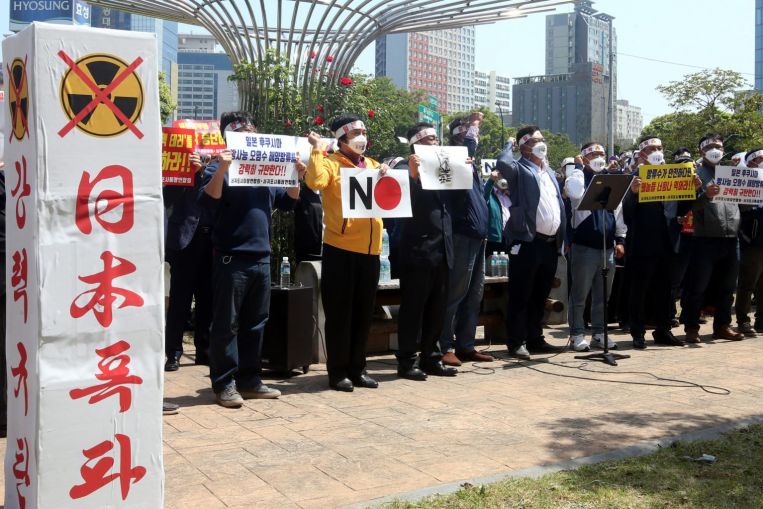
S.Korean fishermen hold boat protests against Japan nuclear plans, Reuters 30 Apr 21, Hundreds of South Korean fishermen across the country held protests on Friday calling on Japan to reverse its decision to release contaminated water from its crippled Fukushima nuclear plant into the sea.
About 800 fishermen participated in rallies at ports in nine cities, according to South Korea’s National Federation of Fisheries Cooperatives.
At one port, at Gungpyeong on the west coast, fishermen held anti-Japan banners and chanted slogans such as “Withdraw Japan’s decision” and “Condemn irresponsible nuclear attack”. Twenty fishing boats with banners denouncing Japan’s decision sailed near the port.
“My father bequeathed this sea to me and I’m going to pass it on to my son, who is also fishing,” said Park Re-seung, chief of Yongdu-ri fishing village, who has worked in the fishing industry for 38 years. “Why is Japan doing this? How could they do such a bad thing against the sea? Don’t they eat fish?”…….
“For us, this issue is about making our living,” Park added. “If the customers continue to see the news of the water release, they wouldn’t be even buying fishes that we caught here.” https://www.reuters.com/business/environment/skorean-fishermen-hold-boat-protests-against-japan-nuclear-plans-2021-04-30/
‘If it’s safe, dump it in Tokyo’ – Pacific Islanders don’t want Fukushima waste water
Guardian 26th April 2021, If it’s safe, dump it in Tokyo. We in the Pacific don’t want Japan’s
nuclear wastewater. To Pacific peoples, who have carried the
disproportionate human cost of nuclearism in our region, this is yet
another act of catastrophic and irreversible trans-boundary harm that our
region has not consented to.
While Japan’s plan is for the water to be
diluted first and discharged over the course of about 30 years, and the
Japanese government has tried its hardest to convince the wider public of
the treated water’s safety through the use of green mascots and backing
from American scientists, Pacific peoples are once again calling it for
what it is: an unjust act.
“We need to remind Japan and other nuclear
states of our Nuclear Free and Independent Pacific movement slogan: if it
is safe, dump it in Tokyo, test it in Paris, and store it in Washington,
but keep our Pacific nuclear-free,” said Motarilavoa Hilda Lini, Vanuatu
stateswoman and veteran activist of the Nuclear Free and Independent
Pacific (NFIP) movement, after Japan’s announcement. “We are people of
the ocean, we must stand up and protect it.”
Decision on Fukushima waste water should be in consultation with international agencies, not just a decision by Japan alone.
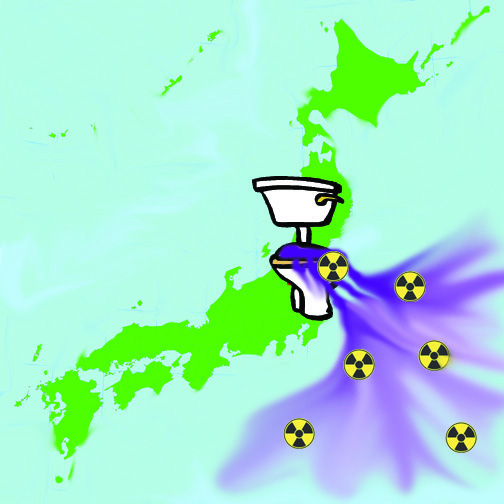
Disposal of Fukushima nuclear wastewater should be assessed under framework of intl agencies, not let world pay: FM, By Global Times, 21 Apr 21, China’s Foreign Ministry said on Wednesday the disposal of Fukushima nuclear wastewater should be assessed and discussed under the framework of international agencies including the UN, the WHO, and the IAEA, urging the Japanese government to correct its irresponsible decision to dump of the wastewater to the ocean and avoid involving people all around the world in paying for its wrongdoings.
The remarks came after South Korean Foreign Minister Chung Eui-yong expressed opposition to the move, and said on Tuesday that Seoul will work closely with international agencies to deal with Japan.
At a routine press conference, China’s Foreign Ministry spokesperson Wang Wenbin stressed that before dumping nuclear-contaminated water, there should be a discussion with neighboring countries and an evaluation within the framework of international agencies including the United Nations, the World Health Organization, and the International Atomic Energy Agency.
Wang added that Japan’s decision to dump the nuclear-contaminated water is not only opaque, unscientific, unlawful, irresponsible and unethical, but also at risk of being condemned by the world.
“A ban has been placed on black scorpionfish caught off Fukushima waters from entering markets due to the detection of excessive radioactive materials. And this is the second time that fish have been found with excessive radioactive materials in Fukushima waters since February,” said Wang.
All of these signs point to the fact that disposal of radionuclides is complicated and difficult, noted Wang, adding that the Fukushima nuclear power plant accident has been bringing harm to its surroundings for the past decade since it happened. ……..
Wang said that the methods of the wastewater disposal concern the safety of the Asia-Pacific region, the global ecological environment, and the lives and the health of people in all countries. The data should be evaluated and consultations held with all parties whose interests are bound to it.
“We noticed that Japan’s Tokyo Electric Power Company intends to submit a progress plan for wastewater disposal in May. We express strong opposition and serious concern to the matter as Japan unilaterally pushes forward the plan without consultation with the international community especially neighboring countries,” Wang said.
“Please don’t let people all over the world pay for Japan’s wrongdoings,” he added. https://www.globaltimes.cn/page/202104/1221712.shtml
Japan’s government bans shipments of black rockfish from Fukushima, due to highlevels of radioactive cesium
Fish radioactive report prompts Fukushima ban, http://global.chinadaily.com.cn/a/202104/21/WS607f7f4ea31024ad0bab93e5.html
By WANG XU in Tokyo China Daily 2021-04-21 The Japanese government banned shipments of black rockfish from Fukushima on Monday, after a radioactive substance was found to be more than five times higher than acceptable levels in the fish caught off the prefecture.
The Fukushima prefectural government said 270 becquerels of radioactive cesium were detected per kilogram of the black rockfish, which had been caught at a depth of 37 meters near the city of Minamisoma, Fukushima, on April 1.
The amount of radioactive cesium is five times more than the limit set by a local fisheries cooperative of 50 becquerels per kg. It is also sharply higher than Japan’snational standard in general foods of 100 becquerels per kg.
In response, Japan’s national nuclear emergency response headquarters on Monday ordered a ban on the shipment of the fish caught off the waters of Fukushima.
Early in February, radioactive cesium 10 times above permitted levels in Japan were detected in the same area.
Scientific research showed the amount of cesium in foods and drinks depends upon the emission of radioactive cesium through the nuclear power plant, mainly through accidents. High levels of radioactive cesium in or near one’s body can cause nausea, vomiting, diarrhea, bleeding, coma, and even death.
Monday’s restrictions came a week after Japan’s government decided to release radioactive water from the crippled Fukushima Daiichi nuclear plant into the sea despite fierce opposition from fishing crews at home and concern from the international community.
“The (Japanese) government’s decision is outrageous,” said Takeshi Komatsu, an oyster farmer in Miyagi prefecture, north of Tokyo. “I feel more helpless than angry when I think that all the efforts I’ve made to rebuild my life over the past decade have come to nothing.”
South Korea strongly criticized the decision to release the contaminated water, with its Foreign Ministry summoning the Japanese ambassador. President Moon Jae-in ordered officials to explore petitioning an international court over the issue.
Alaska to increase its radiation testing of seafood..

A Decade After Fukushima Nuclear Disaster, Alaska Expands Seafood Monitoring High North News, Apr 21 2021
State environmental regulators announced Monday they’re expanding radiation testing of commercially harvested Alaska seafood using a gamma radiation detector at a state laboratory in Anchorage, according to APM.
A devastating earthquake and tsunami off the coast of Japan in 2011 crippled the Fukushima Dai-ichi nuclear plant, which released radioactive material into the air and ocean…….. https://www.highnorthnews.com/en/decade-after-fukushima-nuclear-disaster-alaska-expands-seafood-monitoring
1 This Month


Tell the Ukrainian Government to Drop Prosecution of Peace Activist Yurii Sheliazhenko

Petition to revoke the licensing of the Near Surface Nuclear Disposal Facility (NSDF) at Chalk River. https://www.ourcommons.ca/petitions/en/Petition/Details?Petition=e-7247


of the week – STOP SMALL MODULAR REACTORS IN CANADA
To see nuclear-related stories in greater depth and intensity – go to https://nuclearinformation.wordpress.com
-
Archives
- March 2026 (204)
- February 2026 (268)
- January 2026 (308)
- December 2025 (358)
- November 2025 (359)
- October 2025 (376)
- September 2025 (258)
- August 2025 (319)
- July 2025 (230)
- June 2025 (348)
- May 2025 (261)
- April 2025 (305)
-
Categories
- 1
- 1 NUCLEAR ISSUES
- business and costs
- climate change
- culture and arts
- ENERGY
- environment
- health
- history
- indigenous issues
- Legal
- marketing of nuclear
- media
- opposition to nuclear
- PERSONAL STORIES
- politics
- politics international
- Religion and ethics
- safety
- secrets,lies and civil liberties
- spinbuster
- technology
- Uranium
- wastes
- weapons and war
- Women
- 2 WORLD
- ACTION
- AFRICA
- Atrocities
- AUSTRALIA
- Christina's notes
- Christina's themes
- culture and arts
- Events
- Fuk 2022
- Fuk 2023
- Fukushima 2017
- Fukushima 2018
- fukushima 2019
- Fukushima 2020
- Fukushima 2021
- general
- global warming
- Humour (God we need it)
- Nuclear
- RARE EARTHS
- Reference
- resources – print
- Resources -audiovicual
- Weekly Newsletter
- World
- World Nuclear
- YouTube
-
RSS
Entries RSS
Comments RSS
 nuclear-news