Russia aims to lift old dead nuclear submarines from the bottom of the Barents and Kara Seas by 2030
 | |||

Russia to Lift Radioactive Time Bombs From Ocean Floor in 2030, https://www.themoscowtimes.com/2021/10/04/russia-to-lift-radioactive-time-bombs-from-ocean-floor-in-2030-a75207 Two rusty nuclear submarines will be raised from the sea beds of the Barents and Kara Seas and brought to a shipyard for safe decommissioning. By The Barents Observer 4 Oct 21, The November-class K-159 submarine sank in late August 2003 while being towed in bad weather from the closed naval base of Gremikha on the eastern shores of the Kola Peninsula toward the Nerpa shipyard north of Murmansk.
Researchers have monitored the wreck ever since, fearing leakages of radioactivity from the two old nuclear reactors onboard could contaminate the important fishing grounds in the Barents Sea. A joint Norwegian-Russian expedition examined the site in 2014 and concluded that no leakage has so far occurred from the reactors to the surrounding marine environment.
However, the bad shape of the hull could eventually lead to radionuclide leakages. A modeling study by the Norwegian Institute of Marine Research said that a pulse discharge of the entire Caesium-137 inventory from the two reactors could increase concentrations in cod in the eastern part of the Barents Sea up to 100 times current levels for a two-year period after the discharge. While a Cs-137 increase of 100 times in cod sounds dramatic, the levels would still be below international guidelines, but tell that to the market buying the fish.
Now, Russia’s nuclear corporation Rosatom has announced the date for lifting the K-159 to 2030.
“As indicated in the strategy for the development of the Arctic, 2030, not earlier,” Anatoly Grigoriev, head of Rosatom’s international technical assistance project, told Interfax.
Grigoriev said Atomflot, the state operator of civilian nuclear-powered icebreakers whose technical base is just north of Murmansk, could become the contractor for the lifting.
The Rosatom official added that the K-27, a submarine dumped in the Kara Sea in 1982, is also included on the list of nuclear objects on the Arctic seabed to be salvaged by 2030.
The submarine was dumped at a depth of 33 meters in the Stepovogo fjord on the eastern shores of Novaya Zemlya.
Last month, divers from the Center for Underwater Research of the Russian Geographical Society conducted a survey of the submarine’s hull. Metal pieces were cut free and the thickness of the hull was measured, along with other inspections of the submarine that has been corroding on the seabed for nearly 40 years.
Based on the examination, a detailed plan will be worked out on how to conduct the salvage with destabilizing the uranium fuel in the reactors in such a way that a new chain reactor could be restarted with a worst-case scenario of triggering direct contact between the uranium fuel and seawater.
CNMI House slams Japan’s plan to dump nuclear waste into Pacific
CNMI House slams Japan’s plan to dump nuclear waste into Pacific, https://www.rnz.co.nz/international/pacific-news/452916/cnmi-house-slams-japan-s-plan-to-dump-nuclear-waste-into-pacificThe CNMI House of Representatives has a introduced a joint resolution that condemns Japan’s plan to dump treated nuclear waste from the destroyed Fukushima nuclear plant into the Pacific Ocean.
Introduced by Representaive Sheila Babauta, the joint resolution opposes any other government’s actions related to nuclear testing, storage, and waste disposal in the Pacific and reaffirm everyone’s fundamental right to a safe and healthy living environment.
The resolution states that the Pacific Ocean is a resource and home for many in the Commonwealth, broader Oceania, and many in Japan who rely on it to provide food, economic subsistence, a means of travel, and so many other aspects of life that can be easily threatened by human activities such as pollution and nuclear exercises.
Japan announced in April a plan to start dumping in two years into the Pacific more than a million tons of treated but still radioactive wastewater from the Fukushima nuclear plant, which was destroyed in the 2011 Tohoku earthquake and tsunami.
Babauta, who chairs the House’s Natural Resources Committee, said the people of Oceania have throughout history been disproportionately impacted by foreign powers’ nuclear activities within the Pacific region.
In 1979, Japan also proposed a plan to dump about 10,000 drums of nuclear waste in the Pacific.
Babauta said UN Special Rapporteurs released a statement expressing deep disappointment in Japan’s latest decision, saying “the release of one million tons of contaminated water into the marine environment imposes considerable risks to the full enjoyment of human rights of concerned populations in and beyond the borders of Japan.”
The sunken nuclear submarines: Russia’s ‘slow-motion Chernobyl’ at sea
One of them is the K-27, once known as the “golden fish” because of its high cost. The 360ft-long (118m) attack submarine (a submarine designed to hunt other submarines) was plagued with problems since its 1962 launch with its experimental liquid-metal-cooled reactors, one of which ruptured six years later and exposed nine sailors to fatal doses of radiation. In 1981 and 1982, the navy filled the reactor with asphalt and scuttled it east of Novaya Zemlya island in a mere 108ft (33m) of water. A tugboat had to ram the bow after a hole blown in the ballast tanks only sank the aft end.
The K-27 was sunk after some safety measures were installed that should keep the wreck safe until 2032. But another incident is more alarming. The K-159, a 350ft (107m) November-class attack submarine, was in service from 1963 to 1989. The K-159 sank with no warning, sending 800kg (1,760lb) of spent uranium fuel to the seafloor beneath busy fishing and shipping lanes just north of Murmansk. Thomas Nilsen, editor of The Barents Observer online newspaper, describes the submarines as a “Chernobyl in slow motion on the seabed”.

While the vast size of the oceans quickly dilutes radiation, even very small levels can become concentrated in animals at the top of the food chain through “bioaccumulation” – and then be ingested by humans. But economic consequences for the Barents Sea fishing industry, which provides the vast majority of cod and haddock at British fish and chip shops, “may perhaps be worse than the environmental consequences”, says Hilde Elise Heldal, a scientist at Norway’s Institute of Marine Research.
But an accident while raising the submarine, on the other hand, could suddenly jar the reactor, potentially mixing fuel elements and starting an uncontrolled chain reaction and explosion. That could boost radiation levels in fish 1,000 times normal or, if it occurred on the surface, irradiate terrestrial animals and humans, another Norwegian study found.
Russia’s ‘slow-motion Chernobyl’ at sea https://www.bbc.com/future/article/20200901-the-radioactive-risk-of-sunken-nuclear-soviet-submarines, By Alec Luhn, 2nd September 2020
Beneath some of the world’s busiest fisheries, radioactive submarines from the Soviet era lie disintegrating on the seafloor. Decades later, Russia is preparing to retrieve them.
By tradition, Russians always bring an odd number of flowers to a living person and an even number to a grave or memorial. But every other day, 83-year-old Raisa Lappa places three roses or gladiolas by the plaque to her son Sergei in their hometown Rubtsovsk, as if he hadn’t gone down with his submarine during an ill-fated towing operation in the Arctic Ocean in 2003.
Continue readingWith its reprocessing plant in La Hague, France has the highest radioactive discharges at sea in Europe.

With its reprocessing plant in La Hague, France has the highest radioactive discharges at sea in Europe. And these discharges are not decreasing, despite the commitments made in 1998, in Sintra, Portugal, by
the Member States of the OSPAR Convention for the protection of the North-East Atlantic.
But the results of the citizen surveillance ofradioactivity in the environment carried out by ACRO for more than 25years, show that the account is not there: the discharges from the Orano reprocessing plant in La Hague are visible. all along the Channel coast and, in the summer of 2021, they could still be detected as far as the Danish border.
The association therefore urges France to respect its international commitments by significantly reducing its radioactive discharges at sea. It will, for its part, maintain its vigilance.
ACRO 29th Sept 2021
Will Fukushima’s Water Dump Set a Risky Precedent?
Will Fukushima’s Water Dump Set a Risky Precedent? IEEE Spectrum
Questions raised over new norms the disaster’s radioactive wastewater cleanup efforts may foster, RAHUL RAO 24 SEP 2021 Since the Japanese earthquake and tsunami in March 2011, groundwater has been trickling through the damaged facilities at the Fukushima Daiichi nuclear power plant, filtering through the melted cores and fuel rods and becoming irradiated with a whole medley of radioisotopes. Japanese authorities have been pumping that water into a vast array of tanks on-site: currently over a thousand tanks, and adding around one new tank per week.
Now, Japanese authorities are preparing to release that water into the Pacific Ocean. Even though they’re treating and diluting the water first, the plan is meeting with vocal protests. From that opposition and from scientists’ critiques of the process, the ongoing events at Fukushima leave an unprecedented example that other nuclear power facilities can watch and learn from.
The release is slated to start in 2023, and potentially last for decades. This month, observers from the International Atomic Energy Agency have arrived in the country to inspect the process. And efforts are also underway to build an undersea tunnel that will discharge the water a kilometer away from the shore.
Before they do that, they’ll treat the water to cleanse it of radioactive contaminants. According to the authorities’ account of the situation, there’s one major contaminant that their system cannot cleanse: tritium.
It’s actually normal for nuclear power plants to release tritium into the air and water in their normal operations. In fact, pre-disaster, Fukushima Daiichi held boiling-water reactors, the lowest-tritium type of nuclear reactors. The Japanese government’s solution is to dilute the tritium-contaminated water down to comparable levels. That’s part of the reason the discharge will likely last several decades.
“While one can argue whether such release limits are appropriate in general for normally operating facilities, the planned release, if carried out correctly, does not appear to be outside of the norm,” says Edwin Lyman, director of nuclear power safety at the Union of Concerned Scientists.
Even so, the plan has—perhaps expectedly—encountered some rather vocal opposition. Some of the loudest cries have come from within Japan, particularly from the fishing industry. Radiation levels in seafood from that coast are well within safety limits, but fishing cooperatives are concerned the plan is (once again) putting their reputations at stake………….
can the events at Fukushima offer other energy facilities around the world any lessons at all?
For one, they’re a good show of the need for emergency planning. “Every nuclear plant should be required to analyze the potential for such long-term consequences,” says Lyman. “New nuclear plants, if built, should incorporate such evaluations into their siting decisions.”
But there’s other things experts say that facilities could learn. For example, something that hasn’t always been present in the Fukushima matter—working against it—has been transparency.
Authorities at the plant haven’t fully addressed the matter of non-tritium contaminants, according to Ken Buesseler, a marine radiochemist at Woods Hole Oceanographic Institution who has studied radioactivity in the ocean off Fukushima. Some contaminants—like caesium-137 and strontium-90—were present in the initial disaster in 2011. Others—like cobalt-60 and cerium-144—entered the water later.
It isn’t something the authorities have completely ignored. “Japan plans to run the water again through the decontamination process before release, and the dilution will further reduce the concentrations of the remaining isotopes,” says Lyman.
But Buesseler isn’t convinced that it will be enough. “Theoretically, it’s possible to improve the situation a lot,” he says. “In practice, they haven’t done that.” Japanese authorities insist they can do so, but their ability, he says, hasn’t been independently verified and peer-reviewed……….
“I’d hate to see every country that has radioactive waste start dumping waste into the ocean,” he says. “It’s a transboundary issue, in a way. It’s something bigger than Japan, and something different from regular operation. I think they need to be at least open about that, getting international approval.”
Here, Lyman agrees. “This situation is unique and the decision to release the water into the sea should not set a precedent for any other project.”
But even taking all of that into account, some believe that, if anything, this is an example of a time when there simply is no choice but to take drastic action.
“I believe that this action is necessary to avoid potentially worse consequences,” says Lyman. https://spectrum.ieee.org/fukushima-wastewater-cleanup-questions
Scientists still don’t know how far melting in Antarctica will go – or the sea level rise it will unleash
Chen Zhao and Rupert Gladstone
The Antarctic ice sheet is the largest mass of ice in the world, holding around 60% of the world’s fresh water. If it all melted, global average sea levels would rise by 58 metres. But scientists are grappling with exactly how global warming will affect this great ice sheet.
Russia developing more floating nuclear power plants
A Russian plan to build more floating nuclear power plants advanced this
month after two subsidiaries of Rosatom, Russia’s state nuclear
corporation, signed a cooperation agreement to power a remote mining
facility on Siberia’s northeastern tip. The new waterborne facilities
will come on the coattails of the Akademik Lomonosov, the audacious
experiment on floating nuclear power that Rosatom connected to a remote
port in Chukotka in 2019 after spending more than a decade constructing it,
amid objections from environmentalists.
Bellona 17th Sept 2021
Russia advances on plans for new floating nuclear plants
Nuclear-powered submarines have ‘long history of accidents

Nuclear-powered submarines have ‘long history of accidents’, Adelaide environmentalist warns, ABC By Daniel Keane 17 Sept 21,
The plan to build nuclear-powered submarines in South Australia has alarmed anti-war and environmental campaigners, one of whom says the vessels have a “long history” of involvement in accidents across the globe.
Key points:
- Prime Minister Scott Morrison said the nuclear submarines would be built in Adelaide
- The Greens and other environmental groups say that raises serious public safety concerns
- SA’s former nuclear royal commissioner says the risks can be managed
Prime Minister Scott Morrison unveiled a deal to construct the new fleet of at least eight submarines, declaring a new era of strategic alignment with the United States and United Kingdom, and a new trilateral security partnership called AUKUS.
All Australians benefit from the national interest decisions to protect Australians and to keep Australians safe,” Mr Morrison said.
But Friends of the Earth Australia’s anti-nuclear spokesperson Jim Green said the plan was more likely to compromise public safety than enhance it.
I’m worried about the security and proliferation aspects of this, I’m deeply concerned as an Adelaidean. A city of 1.3 million people is not the place to be building nuclear submarines,” he said.
“North-western Adelaide could be a target in the case of warfare. Of course, that’s a very low risk but if it does happen, the impacts would be catastrophic for Adelaide.
“You should build hazardous facilities away from population centres, partly because of the risk of accidents and partly because of the possibility that a nuclear submarine site could be targeted by adversaries.”
Dr Green said the question of what would become of the spent fuel remained unanswered, and there was “a long history of accidents involving nuclear submarines”.
Many — but not all — of those occurred in submarines built in the former Soviet Union, including the infamous K-19, which was subsequently dubbed “The Widowmaker” and became the subject of a Hollywood film.
After its reactor suffered a loss of coolant, members of the crew — more than 20 of whom died in the next two years — worked in highly radioactive steam to prevent a complete meltdown.
Two US naval nuclear submarines — USS Thresher and USS Scorpion — currently remain sitting at the bottom of the Atlantic Ocean, at depths of more than two kilometres, after sinking during the 1960s.
More than 200 mariners died in the disasters, and neither vessels’ reactors, nor the nuclear weapons on board the Scorpion, have ever been recovered.
Two years ago, 14 Russian naval officers were laid to rest after they were killed in a fire on a nuclear-powered submersible in circumstances that were not fully revealed by the Kremlin.
Dr Green said Australia’s “nuclear power lobby” had “been quick off the mark”, and was already using the Prime Minister’s announcement to push for further involvement with the nuclear fuel cycle, including atomic energy and waste storage.
“The South Australian Nuclear Fuel Cycle [Royal] Commission, in its 2016 report, estimated a cost of $145 billion to construct and operate a nuclear waste repository,” he said.
“No country in the world has got a repository to dispose of high-level nuclear waste, and the only repository in the world to dispose of intermediate-level nuclear waste, which is in the United States, was shut for three years from 2014 to 2017 because of a chemical explosion.”…………….https://www.abc.net.au/news/2021-09-17/nuclear-submarines-prompt-environmental-and-conflict-concern/100470362
Russia aims to dominate the Arctic, with nuclear ice-breakers
Moscow eyes ‘mastering’ Arctic waters with nuclear icebreaker fleet, Daily Sabah, BY FRENCH PRESS AGENCY – AFP, 8 Sept 21,
ABOARD THE ’50 YEARS OF VICTORY’ TRANSPORTATION SEP 08, 2021 11:24 AM GMT+3 s ice cover in the Arctic recedes with climate change, Russia is hard at work to secure supremacy in the warming region with a fleet of giant nuclear-powered icebreakers.
Moscow sees the development of the Arctic as a historic mission and already has huge projects to exploit its natural resources.
Its next big plan is for year-round use of the Northern Sea Route (NSR), a shipping lane through Arctic waters Russia hopes could rival the Suez Canal.
Here are some key facts about Russia’s plans for the Arctic:
Historic ambitions
As an icebreaker called the “50 Years of Victory” left the port of Murmansk for the North Pole this summer, its captain told an Agence France-Presse (AFP) journalist on board that Russia has a special role to play in the Arctic.
“A third of our territory lies above the Arctic Circle. Our ancestors have long mastered frozen waters. We are continuing this successfully,” Dmitry Lobusov said.
President Vladimir Putin has made the development of the Arctic a strategic priority and state companies such as Gazprom Neft, Norilsk Nickel and Rosneft already have major projects in the Arctic to extract oil, gas and minerals.
“The Arctic region has enormous potential,” Russian Deputy Prime Minister Alexander Novak said earlier this month.
“In terms of resources, we’re talking about 15 billion tons of oil and 100 trillion cubic meters of gas. Enough for tens if not hundreds of years,” he said.
Suez alternative
The NSR links the Pacific to the Atlantic through Russian Arctic waters.
It is not currently navigable year-round without the help of icebreakers, though in summer some specialized classes of ships can pass through.
With the ice cover receding, Moscow is aiming for year-round navigation by 2030…………..
Growing fleet
Rosatom, which already has a fleet of five icebreakers and a container ship, is building four more nuclear-powered vessels within the next five years.,,,,,,,,,,,
Environmental worries
Environmental groups have slammed the race for hydrocarbons and the increased presence of nuclear reactors in the Arctic – an already fragile ecosystem dramatically affected by climate change.
Greenpeace has said that “the incident-ridden history of Russian nuclear icebreakers and submarines” should cause alarm.,,,, https://www.dailysabah.com/business/transportation/moscow-eyes-mastering-arctic-waters-with-nuclear-icebreaker-fleet
Pacific environmentalists call on Japan not to empty radioactive wastewater into the Pacific
This year marks the 76th anniversary of the first use of nuclear weapons
for the purpose of war. As the world solemnly observes the tragic
anniversary of the bombings of Hiroshima and Nagasaki, we wish to highlight
the Pacific’s own and often overlooked nuclear history that followed.
Asguardians of the world’s largest ocean, we emphasise again our continuing
concern for our region and the irreparably damages on our people and the
environment from 318 nuclear weapons tests undertaken by the United States,
United Kingdom and France.
Today, we acknowledge that our region has still not healed from this trauma and that we did not consent. Given this legacy, we call on Japan to not repeat this brutality through its proposed act of
discharging over a million tonnes of radioactive wastewater from Fukushima.
Pasifika Environews 6th Sept 2021
200 million fish + millions of other sea creatures will be killed by cooling systems of Hinkley Point C and Sizewell C nuclear power stations
The high fatality rate which the cooling systems of two British nuclear
power stations may impose on marine life is worrying environmentalists, who
describe the heavy fish toll they expect as “staggering”.
The twonstations, Hinkley Point C, under construction on England’s west coast,
and Sizewell C, planned for the eastern side of the country, will, they
say, kill more than 200 million fish a year and destroy millions more sea
creatures.
But the stations’ builders say their critics are exaggerating
drastically. In a detailed rebuttal of the objectors’ arguments, Cefas
denies any conflict of interest between advising EDF about the damage the
stations would do to the marine environment and its own duty to protect
fish stocks – and it claims that the loss of millions of fish would not
affect stocks overall.
Good Men Project 16th Aug 2021
UK Nuclear Plants Will Exact Heavy Fish Toll
Collaboration between Russia and Europe finally cleans up the most dangerous nuclear ship in the Arctic.
After 27 Years, Lepse No Longer Poses a Nuclear Threat to the Arctic, High North News, PETER B. DANILOV 17 June 21, Last week, the Russian service ship Serebryanka delivered the last spent-fuel bundles from the Lepse floating maintenance base to an Atomflot storage site in Murmansk, completing the final stage of securing the nuclear waste……. To ensure the dismantling of the Lepse floating maintenance base, it was necessary to specially develop new technologies and equipment and make innovative decisions,” said FSUE Atomflot Director General Mustafa Kashka.
In July 2020, the Lepse floating maintenance base’s main batch of spent nuclear fuel was unloaded at the Nerpa shipyard. A total of 620 spent-fuel bundles were extracted and unloaded.
Lepse was regarded as the most dangerous nuclear vessel in the north and the Norwegian environmental NGO Bellona began the work of securing the spent nuclear fuel onboard the vessel in 1994.
……….. The project to dismantle and dispose of the Lepse Floating Maintenance Base is multilaterally implemented.
In 1996, the project was included in the EU’s TACIS program (Technical Assistance to the Commonwealth of Independent States), which involved the allocation of funds for the inspection of the state of spent nuclear fuel.
Since 2008, the project has been carried out in the framework of a Grant Agreement between the European Bank for Reconstruction and Development (EBRD), Rosatom, and JSC NFC Logistics Centre (the project’s customer and coordinator).
The EBRD has provided 54 million euros from the Northern Dimension Environmental Partnership Fund (NDEP). https://www.highnorthnews.com/en/after-27-years-lepse-no-longer-poses-nuclear-threat-arctic
NFLA report on UK plutonium policy amid new concerns over plutonium dumped in the Irish Sea
| |||
| |||
NFLA publishes report on UK plutonium policy amid new concerns over plutonium remobilisation in the Irish Sea https://www.nuclearpolicy.info/news/nfla-report-uk-plutonium-policy-concerns-plutonium-remobilisation-irish-sea/
The UK & Ireland Nuclear Free Local Authorities (NFLA) publishes today on its website an expert overview of national plutonium policy and recent concerns over the potential for plutonium remobilisation in the Irish Sea. (1)
The report was developed by the NFLA Policy Advisor, Pete Roche, and was first published on the website ‘No2nuclearpower.org.uk’. (2) Recent research on this area was also presented by Pete to the most recent meetings of the NFLA English Forum and NFLA All Ireland Sustainable Energy Forum. (3)
The report notes that the Nuclear Decommissioning Authority (NDA) expects the Magnox Reprocessing Plant at Sellafield to close this year (2021) – one year later than previously planned. This follows on from the closure of the Thermal Oxide Reprocessing Plant (THORP) in November 2018. Reprocessing, which NFLA has always argued has been completely unnecessary, is the chemical separation of plutonium and unused uranium from spent nuclear waste fuel.
When reprocessing ends there will be around 140 tonnes of separated civil plutonium stored at Sellafield – the world’s largest stockpile. Since 2008, the NDA has been discussing how to deal with this embarrassment, given that it is highly toxic, poses a permanent risk of proliferation, and will cost taxpayers around £73 million a year to store for the next century. (3) 13 years later, after much dithering, the UK Government has failed to make any decisions, but still appears to favour the re-use option, which would probably involve transporting weapons-useable plutonium or Mixed Oxide Fuel (MoX) fuel to reactor sites, such as Hinkley Point C and Sizewell B (and C if it is ever built) with an armed escort.
The report looks at this sorry saga and the options for dealing with this stockpile. NFLA believe that the plutonium should be immobilised and stored safely. NDA is continuing to investigate how immobilisation and reuse might be implemented, arguing that using the material as MOX fuel in light water reactors is the most mature option from a technical and licensing perspective. The UK government says it can only make a decision when it can be underpinned with sufficient evidence.
When reprocessing ends there will be around 140 tonnes of separated civil plutonium stored at Sellafield – the world’s largest stockpile. Since 2008, the NDA has been discussing how to deal with this embarrassment, given that it is highly toxic, poses a permanent risk of proliferation, and will cost taxpayers around £73 million a year to store for the next century. (3) 13 years later, after much dithering, the UK Government has failed to make any decisions, but still appears to favour the re-use option, which would probably involve transporting weapons-useable plutonium or Mixed Oxide Fuel (MoX) fuel to reactor sites, such as Hinkley Point C and Sizewell B (and C if it is ever built) with an armed escort.
The report looks at this sorry saga and the options for dealing with this stockpile. NFLA believe that the plutonium should be immobilised and stored safely. NDA is continuing to investigate how immobilisation and reuse might be implemented, arguing that using the material as MOX fuel in light water reactors is the most mature option from a technical and licensing perspective. The UK government says it can only make a decision when it can be underpinned with sufficient evidence.
The NFLA report also highlights its concerns that plutonium particles dumped in the Irish Sea from Sellafield could remobilise. Low-level aqueous radioactive waste has been discharged from the Sellafield site into the Irish Sea for more than 50 years.
Unfortunately, it has since emerged that a proportion of such sediment associated radioactivity has remobilised, and is being actively transported around the Irish Sea, while the remainder is temporarily “sequestered” in the seabed but subject to any future disturbance mechanisms such as storm, wave and seismic activity. In addition, a proportion of dissolved nuclides did not necessarily remain dissolved in liquid form in the water column, but it could become incorporated into organic particles and deposited into sedimentary environments where they could be temporarily sequestered, but subsequently recycled back into the environment by dredging, trawling storm and seismic activity.
For NFLA, there remains real concern that this ‘Sellafield Mudpatch’ in the Irish Sea could be disturbed if either a deep-underground coal mine is developed off the coast of Cumbria, or similarly if a deep-underground radioactive waste repository is built under the Irish Sea again off the Cumbrian coast. It calls for the NDA and Radioactive Waste Management (RWM) to study these issues urgently before any such development is ever considered to be developed.
FLA Steering Committee Chair Councillor David Blackburn said:
“This report on the NFLA policy outlines one of the most embarrassing and perplexing elements of UK nuclear policy – what to do with its world record plutonium stockpile. The NFLA report highlights there are no easy answers, but delays on pursuing sensible immobilisation options have cost money and lead to further storage challenge. This report also highlights ongoing scientific and environmental alarm about building deep-underground facilities off the Cumbria coast that could remobilise plutonium and other dangerous particles that lie on the Irish Sea. Real caution and detailed research are required before any decisions are made. I urge councillors and council waste management officers to reads this important report.”
Ends – for more information please contact Sean Morris, NFLA Secretary, on 07771 930196.
Pacific Ocean was once a garbage dump for nuclear waste, now Japan’s doing it again
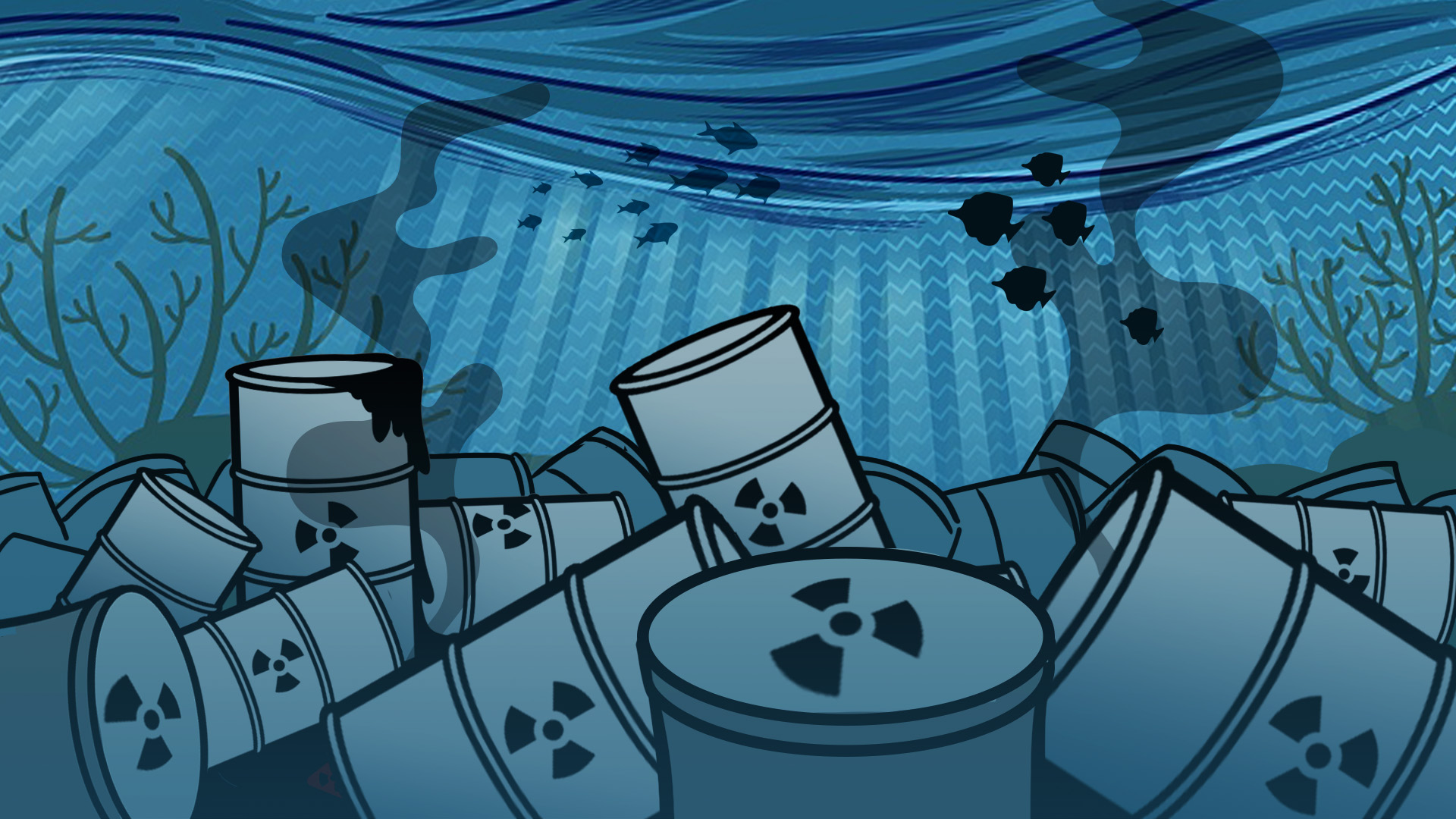
| Pacific Ocean was once a garbage dump for nuclear waste, now Japan’s doing it again. CGTN, Zeng Ziyi 11 June 21, ”………… Japan’s plan, which looked to dilute the contaminated water and pump them into the Pacific Ocean, drew swift condemnations from neighboring countries and environmental organizations. Kazue Suzuki, an energy campaigner at Greenpeace Japan, said the government’s decision has discounted radiation risks and looked over the fact that enough storage space is available in Fukushima and surrounding districts. “Rather than using the best available technology to minimize radiation hazards by storing and processing the water over the long term, they have opted for the cheapest option, dumping the water into the Pacific Ocean,” Suzuki said. In March, a panel of UN experts said that Japan’s nuclear wastewater poses major environmental as well as human rights risks, and any decision to discharge it into the Pacific Ocean cannot be an “acceptable solution.” The panel also pointed out that there’s a lack of meaningful public participation in the decision-making process, especially the populations and communities who are most affected. The Japanese government insists that radioactive elements in the water will be treated and diluted to safe levels before releasing. So far, this plan has received support from the International Atomic Energy Agency (IAEA), which points out that other countries have done so in the past. Besides, Japan’s allies, including the U.S., have also back Tokyo’s decision. The assurance buys little confidence among Pacific nations, whose economies depend heavily on the environment of the ocean. In a statement rebuking Japan’s decision, the Republic of Marshall Islands government pointed out that its entire nation consists of coastal communities whose primary food source comes from surrounding marine life. Sheila Jack Babauta, House member of the Commonwealth of Northern Mariana Islands, said the Pacific Ocean already faces major threats such as unregulated commercial fishing and the activities of the U.S. military, which have severely damaged the environment of the ocean.”We are part of the Pacific, we are intimately connected to the ocean, and therefore, we must be included in all decisions that impact ocean health, ocean sustainability, and ocean recovery,” Babauta told CGTN. “The dumping of nuclear waste is extremely irresponsible and disrespectful to our Pacific Ocean.”Since the dawn of the nuclear age, people of the Pacific island countries have suffered the horrific consequences of nuclear experiments carried out at their doorstep. Continued exposure to radiation has caused many survivors of the initial blasts to develop different types of illnesses, most commonly cancer and reproductive health issues. Even today, their descendants are still suffering the effects of radiation. .The U.S. detonated dozens of nuclear devices in a series of nuclear weapons tests at several test sites sprawling across the atolls of RMI between the 1940s and 1950s, including in the air and underwater. The detonations vaporized at least three atolls – ringlets of islands made of coral – and rendered many more uninhabitable. Ocean dumping of nuclear waste continued to be carried out by Britain, France, and others until 1972 when growing public pressure worldwide gave birth to the London Convention, which prohibited the practice.”The threat of nuclear contamination continues to be of significant concern to the health and security of our Blue Pacific continent,” said Henry Puna, Secretary General of the Pacific Islands Forum, in an address to the IAEA earlier this month.”Our 50-year history as the Forum has been overshadowed by our nuclear legacy issues, which continue to impact affected communities today, and we should not accept anything less.”………https://news.cgtn.com/news/2021-06-11/How-the-Pacific-became-a-garbage-dump-for-nuclear-waste-110rY09VsqY/index.html |
Fukushima waste water dumped in Pacific Ocean – a critical environmental issue threatening marine pollution

Is Japan’s Nuclear Wastewater Dumping Reckless? THE ASEAN POST, Anna Malindog-Uy6 June 2021
it is important to speak about one of the most critical environmental issues that might cause marine pollution in the Pacific Ocean and beyond soon.
It can be recalled that a few months back, Japan alarmingly announced that it will release around 1.25 million tons of contaminated water or wastewater from the destroyed Fukushima nuclear power plant into the sea. These 1.25 million tons of wastewater can fill up around 500 Olympic-sized swimming pools.
What’s pretty disquieting is the fact that, thus far, there has never been any precedent in the world or actual practice of discharging such a huge volume of wastewater into the sea. Even the International Atomic Energy Agency (IAEA), though not opposed to Japan’s decision, has no relevant experience in this regard.
Accordingly, it will be hard to assess the long-term effects of such dumping of radioactive waste into the sea. Likewise, according to some reports, no independent testing of the water will be allowed as previously promised. ………
Perplexing
But one perplexing thing about all this is the fact that the United States (US) seems to be in agreement with this decision. In a tweet, US Secretary of State, Antony Blinken said “We thank Japan for its transparent efforts in its decision to dispose of the treated water.” This is a bit idiosyncratic and out of the ordinary given that the US continues to ban the import of farm and seafood products from the Fukushima region just like some other countries, precisely because of fears that these marine and agricultural products are contaminated with radioactive materials.,……….
Protests
Nevertheless, countries in East Asia like South Korea, China, and even Taiwan are protesting against Japan’s unilateral decision to dump radioactive waste into the Pacific Ocean. This is because it will be hazardous to marine ecosystems and resources, and will affect the fishing industries of these countries. ……….
Roque, an expert on international law said that “I can only repeat the principles of International Environmental Law that I hope all countries will comply with. The first principle is we are one ecosystem. The second principle is that we are interconnected and the third principle is that the polluter must pay.”……….
it’s not only neighbouring countries that have expressed their opposition and resistance to the plan of dumping wastewater into the sea. Even the Japanese people themselves are opposed to it.
For instance, the local fisherfolks of Fukushima have publicly announced their opposition to the plan saying, “…the said plan will undo the years of work rebuilding their industry’s reputation since the plant was destroyed and ruined by the huge tsunami in March 2011.”
In a Yahoo Japan survey, 41.5 percent of the 31,035 respondents disagreed with the government’s plan.
Conclusion
The unilateral plan of the Japanese government to dump wastewater in the Pacific Ocean needs to be reconsidered and studied further. Japan should at least show the necessary courtesy to consult and discuss its decision with its immediate neighbours like South Korea, China, Taiwan, and even beyond East Asia given the seriousness of the matter.
It should be noted that the bodies of water in Asia are very much connected and pollutants originating from the Fukushima water will no doubt reach other nearby areas, affecting local marine and the coastal environments and people’s health. Thus, as a responsible member of the community of nations, Japan should think twice before proceeding with its plan and prudently consult with countries that will directly be affected by such a decision.
However, Japan being a privileged country may not heed the call of its neighbours probably because it has the backing of the US. But if something goes wrong with the said plan, developing countries like the Philippines will surely be adversely affected and left on their own to suffer the negative consequences. ……
It is also quite shocking that the international media and even the mainstream media in the Philippines is downplaying this issue which is of great importance.
Another baffling issue is why has the IAEA sanctioned Japan’s decision when not much study has been done yet on the effects of dumping such a huge volume of radioactive wastewater into the sea. ……..https://theaseanpost.com/article/japans-nuclear-wastewater-dumping-reckless
1 This Month


Tell the Ukrainian Government to Drop Prosecution of Peace Activist Yurii Sheliazhenko

Petition to revoke the licensing of the Near Surface Nuclear Disposal Facility (NSDF) at Chalk River. https://www.ourcommons.ca/petitions/en/Petition/Details?Petition=e-7247


of the week – STOP SMALL MODULAR REACTORS IN CANADA
To see nuclear-related stories in greater depth and intensity – go to https://nuclearinformation.wordpress.com
-
Archives
- March 2026 (204)
- February 2026 (268)
- January 2026 (308)
- December 2025 (358)
- November 2025 (359)
- October 2025 (376)
- September 2025 (258)
- August 2025 (319)
- July 2025 (230)
- June 2025 (348)
- May 2025 (261)
- April 2025 (305)
-
Categories
- 1
- 1 NUCLEAR ISSUES
- business and costs
- climate change
- culture and arts
- ENERGY
- environment
- health
- history
- indigenous issues
- Legal
- marketing of nuclear
- media
- opposition to nuclear
- PERSONAL STORIES
- politics
- politics international
- Religion and ethics
- safety
- secrets,lies and civil liberties
- spinbuster
- technology
- Uranium
- wastes
- weapons and war
- Women
- 2 WORLD
- ACTION
- AFRICA
- Atrocities
- AUSTRALIA
- Christina's notes
- Christina's themes
- culture and arts
- Events
- Fuk 2022
- Fuk 2023
- Fukushima 2017
- Fukushima 2018
- fukushima 2019
- Fukushima 2020
- Fukushima 2021
- general
- global warming
- Humour (God we need it)
- Nuclear
- RARE EARTHS
- Reference
- resources – print
- Resources -audiovicual
- Weekly Newsletter
- World
- World Nuclear
- YouTube
-
RSS
Entries RSS
Comments RSS
 nuclear-news