Every USA State could move to 100% renewable energy
 Visualizing What Would Happen If Every State Transitioned To Renewable Energy, Co-Exist, 10 April 14 Imagine a world where we could get past the politics and have clean energy. These maps show what that would mean for each state. Just for a minute, forget the administrative headache and upfront costs of switching entire states–or even countries–to 100% renewable energy. How would a world of renewable energy-powered homes and businesses be different? If Michigan switched to wind, water, and solar, the state would see annual energy savings of $4,300 per person, 64,300 long-term construction jobs, and 46,200 operations jobs. Health costs would drop dramatically. It’s a similar story throughout the U.S.
In a new interactive map, The Solutions Project shows off all the potential upsides of a country operating solely on renewables. An organization made up of prominent scientists, business leaders, and cultural ambassadors (like actor Mark Ruffalo), the Solutions Project aims to explain the benefits of transitioning to renewables from both a business and science perspective.
Ruffalo, the most public-facing leader of the Solutions Project–and a long-time environmental advocate–first became interested in creating a comprehensive renewable energy plan because of frustrations about the way people talk about the energy space, focusing more on problems than potential fixes……..
The Solutions Project is doing more than just nice-looking maps and infographics. According to Jacobson, the group is building renewable energy transition plans for each state, identifying the states most likely to adopt those plans, and then talking to relevant policymakers. In California, there is a measure inside the Democratic Party to integrate that state’s renewable energy plan into the party platform. “We’re just getting off the ground in terms of implementation,” says Jacobson.
Check out the interactive renewable energy map here. http://www.fastcoexist.com/3027734/visualized/visualizing-what-would-happen-if-every-state-transitioned-to-renewable-energy
Europe can have an integrated, competitive, energy market , with renewables
 Only renewables can create an integrated, competitive EU energy market http://www.euractiv.com/sections/energy/only-renewables-can-create-integrated-competitive-eu-energy-market-301456 , 9 April 14 The European Commission’s state aid decision on 9 April has put renewable energy support schemes in the firing line, and threatened attainment of the 2030 climate and energy goals, even though renewable energy has created – and not obstructed – competition, writes Martin Schoenberg.
Martin Schoenberg is head of policy atClimate Change Capital, an environmental asset manager and advisor.
Is there really a contradiction between national-level state intervention to promote renewable energy and the internal market for energy? Depends on how you look at it. I would argue there is not. Continue reading
A solar energy powerhouse is developing fast: it’s Chile
 Chile An Emerging Solar PV Powerhouse http://www.energymatters.com.au/index.php?main_page=news_article&article_id=4257 Chile installed 150MW of solar panels in the first quarter of this year and has a further 380MW of PV under construction.
According to GTM Research’s Latin America PV Playbook, Q2 2014; the 150MW tally is triple the amount that any Latin American country has ever installed in a single quarter.
A major contributor to the impressive first quarter total was SunEdison’s 50.7 MW San Andres solar farm; the largest merchant solar plant in Latin America to date. SunEdison recently announced it has sold a majority stake in the facility to a group of investors.
GTM Research forecasts Chile will install 244 megawatts of PV this year; some of which support the nation’s energy-hungry mining industry. Last year, Chile’s renewable energy capacity jumped 40 percent to just over one gigawatt. The nation’s renewable energy target demands utilities source 20 percent of their power from renewable sources – excluding hydro – by 2025.
GTM Research considers Latin America to be the “global frontier” for unsubsidized solar markets.
“With high insolation levels and growing demand, it is positioned to be one of the most attractive regions on the planet for solar development.”
Chile has a population of more than 17 million. According to Wikipedia, its electricity generation sector relies mainly on hydro-electric power (33% of installed capacity as of May, 2012), oil (13%), gas (30%) and coal (20%). Much of its fossil fuel is imported.
The nation’s newly elected president, Michelle Bachelet, this week announced a proposed carbon tax. Under the proposal, thermal power plants with a generation capacity of at least 50 megawatts will pay a tax of $5 per metric tonne of carbon dioxide emitted. The carbon tax would be the first to be implemented in South America.
The world will be changed by China’s renewable energy revolution
 China’s Renewable Energy Revolution Has Global Implications, Clean Technica John Mathews and Hao Tan, 8 April 14, China’s renewable energy revolution is powering ahead, with the year 2013 marking an important inflection point where the scales tipped more towards electric power generated from water, wind and solar than from fossil fuels and nuclear. This means that its energy security is being enhanced, while carbon emissions from the power sector can be expected to soon start to fall.
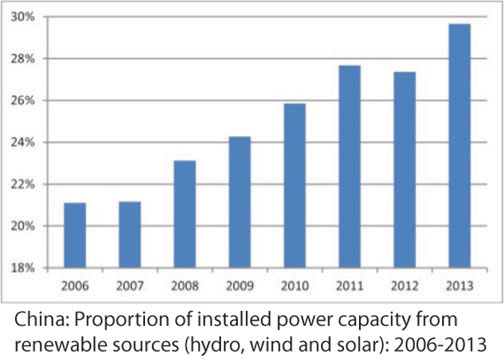
China’s energy revolution, which underpins its transformation into the world’s largest manufacturing system (the new “workshop of the world”), continues to astonish all observers, and terrify some. China is known widely as the world’s largest user and producer of coal, and the world’s largest emitter of carbon dioxide and other greenhouse gases. This is true. Less noticed has been the fact that China is also building the world’s largest renewable energy system – which by 2013 stood at just over 1 trillion kilowatt-hours – already nearly as large as the combined total of electrical energy produced by the power systems of France and Germany.1
The energy landscape continues to give the clearest indication of the trends in industrial dynamics and prospects for the future. China is powering ahead with renewables while at the same time it expands its reliance on fossil fuels; the US by contrast is further locking in its dependence on fossil fuels. The distinction is critical………
We need to sketch in the background to China’s energy revolution, so that the enormity of its commitment to renewables may be appreciated. ……. While coal for thermal power continues to rise, the overall consumption of coal appears to be ‘capped’ at 3,500 million tonnes – a desperate measure taken no doubt in response to the blackening skies and poisoning of water and air
In just the space of eight years, China has become the world’s most important generator of wind power, with the world’s largest capacity and the largest addition of new power capacity in the year 2013. The increase in all three sources of renewables – hydro, wind and solar PV – is shown in Fig. 3, in terms of the proportion of power generated by renewables and its relentless rise (apart from a dip in 2012, following world recession in 2011).
The proportion reached by 2013, of close to 30% of electrical energy generated from renewable sources (hydro, wind and solar), is what gives China its international influence in renewables – and it demonstrates a relentless trend towards greater reliance on manufacturing systems for production of, e.g. wind turbines and solar cells, as opposed to the reliance elsewhere on alternative fossil fuels such as coal seam gas and shale oil…….
The sharp rise in renewables reflects particularly the new commitment to wind power – and it looks set to continue through industrial logistic dynamics. We will develop an argument below for the significance of this date……….
3. Investment trends
Expenditure in building new power generating infrastructure can reveal more than data on capacity and generating additions. The CEC has released investment data for 2013, which reveal the following trends. In terms of investment, China spent more on its grid in 2013 than on new power generation facilities………The significance of this is that China is spending on infrastructure to accommodate more renewable power facilities, as well as on the facilities themselves. Of the new generation facilities, investment in new energy sources accounted for more than 40% of the total investment in new power generation facilities…….
Thus our conclusion that in 2013, China’s leading edge of change in its electric power system is now more “green” than “black”. We have demonstrated above that this is unambiguously so in terms of capacity added and in terms of investment, while in terms of new generation of electrical energy thermal still marginally outranks renewables (180 billion kWh generated to 160 billion kWh)………
at the leading edge, for the year 2013 alone, China added 94 GW of new capacity, of which 55.3 GW came from renewables (59%), and just 36.5 GW (or 39%) came from thermal sources – a dramatic reversal of past trends;…….
our analysis that China’s carbon emissions are set to peak and then to fall – and fall faster than in the US or in Europe……..http://cleantechnica.com/2014/04/08/chinas-renewable-energy-revolution-global-implications/
Solar energy growing, solar prices falling
 There are more and more places across the globe where renewable energy is being installed without any subsidy, or the renewables are being installed because they’re cheaper than the available fossil fuel technology,
Cheap Solar Power Is Fueling Global Renewable Energy Growth: Report http://www.huffingtonpost.com/2014/04/07/solar-power-renewable-energy-growth_n_5107150.html 7 April 14
The share of total global electricity production generated by renewable energy is climbing, mainly because solar photovoltaic systems are becoming less expensive, according to a report released Monday by the United Nations Environment Programme and Bloomberg New Energy Finance.
Wind, solar and other renewables, excluding hydropower, were 8.5 percent of total global electric power generation last year, up from 7.8 percent in 2012, the report says. Continue reading
China’s motives in developing renewable energy
China is serious in its pursuit of renewables, because it seems to believe that its future prosperity depends on building the industries that produce power – complementing its activities in searching for fossil fuels supplies all around the world. There is a lesson here for all other developing countries, and notably for India and Brazil. And not only developing countries.
China’s Renewable Energy Revolution Has Global Implications, Clean Technica John Mathews and Hao Tan, 8 April 14, “……The motives Finally, we need to ask what are the motives for China’s dramatic shift to a renewables trajectory? The common assumption is that it is concern over climate change (global warming) that drives the shift. Important as this motive is, we believe it is the least likely of the explanations for China’s shift. We believe the more plausible explanation for China’s new trajectory – and for the determination with which it is being pursued – is energy security and industrial development. Continue reading
Global growth in new renewable energy projects
Almost half of new electricity is now clean and green http://www.newscientist.com/article/dn25368-almost-half-of-new-electricity-is-now-clean-and-green.html 07 April 2014 by Fred Pearce That’s a lot of clean power. Almost half of new electricity generation is now renewable, and the costs of wind and solar power are falling sharply. It “should give governments confidence to forge a robust climate agreement” next year, says Achim Steiner, director of the United Nations Environment Programme (UNEP).
This comes a week before the Intergovernmental Panel on Climate Change’s assessment of how to prevent dangerous climate change. The IPCC will stress the importance of quickly converting to renewables.
The latest annual Global Trends in Renewable Energy Investment, published today by UNEP, reveals that 44 per cent of all generating capacity installed last year around the world was renewable. That is despite a 14 per cent decline in renewables investment, and in new electricity generally.
But the politics of green energy are changing fast. China is now the world’s leader, having overtaken Europe. Last year, China invested $56 billion in green power.
Going clean
The green bubble seems to have burst in cash-strapped Europe, which was the vanguard of renewable energy for more than a decade. The continent cut investment by 44 per cent.
The only big exception was the UK, which increased investment by 12 per cent despite rumblings of discontent in the governing Conservative party. For the first time, the UK outspent Germany, with projects like the giant Westermost Rough wind farm leading the way.
Japanese investment also soared, increasing by 80 per cent. This was thanks to a rush to install solar panels, after nuclear power stations were closed following the 2011 Fukushima disaster.
Renewables kept 1.2 billion tonnes of carbon dioxide from being emitted in 2013, says report author Ulf Moslener of the Frankfurt School of Finance & Management in Germany. Aside from hydroelectric dams, photovoltaic solar panels and onshore wind turbines are the biggest contributors.
The cost of generating solar power has fallen by 25 per cent since 2009, and the cost of wind power has fallen 53 per cent over the same period. As a result, the report says a growing number of such projects are being built without any subsidy. What’s more, share prices in clean-energy companies, which have been in free fall since the start of the global recession, rose 54 per cent last year.
China is No.1 in renewable energy investment
 U.S. Lags Behind China in Renewables Investments, Clean Technica, 6 April 14 By Bobby Magill Follow @bobbymagill Don’t let all those Texas wind farms and massive installations of solar panels in California fool you. The U.S. is not the world leader in clean energy investment.
China is.
China Is #1 In Renewable Energy Investment, US #2, Japan #3 (CHART) With record-breaking solar installations in the US, and solar actually coming in as the #2 source of new electricity capacity in 2013, you might think the US was the #1 market in the world for renewable energy investment. Of course, if you follow how much renewable energy China is installing… or if you just read the headline above, you know otherwise. Here are more details from Climate Central:
For the second year, an annual Pew Charitable Trusts report, “Who’s Winning the Clean Energy Race?”, shows that China is the world leader in clean energy investment, with $54 billion in investments in renewables in 2013, well above total U.S. investment of $36.7 billion. No other clean energy market in the world is operating at that scale,” Phyllis Cuttino, director of Pew’s clean energy program, said during a teleconference Thursday, referring to China.
The report was released just days after the Intergovernmental Panel on Climate Change released the second part to its fifth assessment report, which states unequivocally that people will have to adapt to a world in which human fossil fuel emissions have caused the climate to change, threating lives across the globe as temperatures and seas rise and extreme weather becomes more frequent. Developing renewable energy is seen as one of the primary ways to reduce humans’ impact on the climate.
The Pew report says China’s efforts to slash poverty, expand economic development and solve its air pollution problems have driven the country to invest heavily in clean energy…………
Zwindler said the solar and wind power industries worldwide are in a transition period as subsidies for renewables are scaled back, especially in Germany and Italy, but he is confident renewables will be able to compete in the future with few subsidies.
“It does not take place in all places at the same time,” he said. “If you’re in a sunny part of the world with high electricity prices, putting solar on your roof clearly can make more sense.” http://cleantechnica.com/2014/04/05/china-1-renewable-energy-investment-us-2-japan-3-chart/
Utah’s renewable energy hat trick
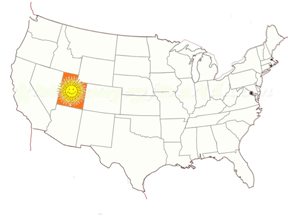 Utah embraces trio of renewable energy firsts By Amy Joi O’Donoghue, Deseret News, April 4 2014 SALT LAKE CITY — Utah turned a page in the renewable energy handbook this week, embracing a triad of “firsts” that is positioning the state for a future with fewer carbon emissions.
On Thursday, state officials joined Salt Lake County Mayor Ben McAdams and the Utah Clean Air Partnership to unveil the state’s first electric fast-charging station for public use along the Wasatch Front.
The direct current charging station has a 480-volt rate that is able to charge in 10 to 40 minutes and is a key step along the way to boosting the infrastructure for electric vehicle owners, McAdams said.
Earlier in the week, Scatec Solar announced plans to start construction later this year on an 80-megawatt solar plant in Iron County — a first in that area. When complete, it will deliver power to PacifiCorp and be the state’s largest commercial solar field.
And Wednesday, Utah Clean Energy was picked by the U.S. Department of Energy and the National Renewable Energy Laboratory to operate one of six new regional wind energy resource centers in the nation.
In the case of the local nonprofit advocacy organization, it will operate the Four Corners Wind Resource Center, guiding a consortium of industry, government and other groups to promote development of wind energy resources against a best-practices backdrop.
The hat trick in renewable energy signals a new momentum for some. “This says to me that market forces are moving forward,” said Samantha Mary Julian, director of theUtah Office of Energy Development. “We have been seeing one activity after the other. It is really cool and exciting. Utah is starting to take hold of renewable energy efficiencies and clean transportation.”…… http://www.deseretnews.com/article/865600250/Utah-embraces-trio-of-renewable-energy-firsts.html
Norway’s wealth fund, and renewable energy
 Norway wealth fund to ramp up renewable energy investments,
* Government says fund should invest more in renewable energy
* Says sum should rise to between $5-8.3 billion
* Critics say ramp-up is inadequate
* Plans to get rid of fund’s independent ethics council
* Government may struggle to win consensus on ethics reforms (Adds reactions)
By Camilla Knudsen and Gwladys Fouche
Fri Apr 4, 2014 OSLO, April 4 (Reuters) – Norway’s $860 billion oil fund should scale up its investments in renewable energy and weigh the risk to future returns posed by climate change, the financeministry said on Friday, a shift green groups said was insufficient. Continue reading
Trade forecast for USA Renewable Energy sector
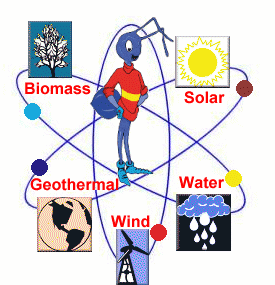 ACORE Releases Renewable Energy in America Outlook domestic fuel, April 4, 2014 by Joanna Schroeder The American Council On Renewable Energy (ACORE) has released The Outlook for Renewable Energy in America: 2014, jointly authored by U.S. renewable energy trade associations from the power, thermal, and fuel sectors. The Outlook assesses the renewable energy marketplace and forecasts the future of each renewable energy technology sector, from the perspectives of each of the associations, and provides a list of policy recommendations by the respective associations that would encourage continued industry growth.
“ACORE applauds the unity of the renewable industry community and this united front as reflected in The Outlook for Renewable Energy in America: 2014,” said ACORE President and CEO, Michael Brower. “The report demonstrates the many public and private sector opportunities that exist at the national, regional and local levels for continued industry advancement and investment; however, they are not one-size-fit-all solutions for every renewable technology.”
Bower noted that the articles in the report detail specific market drivers for the biofuel, biomass, geothermal, hydropower, solar, waste and energy sectors………….The Outlook for Renewable Energy in America: 2014 shows the potential of America’s renewable energy economy to extend beyond one fuel choice or pipeline, to provide the country with an unparalleled opportunity to reinvigorate the U.S. economy while protecting our environment. http://domesticfuel.com/2014/04/04/acore-releases-renewable-energy-in-america-outlook/
Barefoot power solar powering up remote villages
Impact corner: innovative solutions in the renewable energy sector http://www.theguardian.com/sustainable-business/impact-corner-innovative-solutions-renewable-energy-sector Affordable, reliable renewable energy is still a luxury in many parts of the world. Barefoot Power and Hybrid Social Solutions tackle the challenges Tomohiro Nagasaki Guardian Professional, Friday 4 April 2014 Access to safe and affordable sources of energy still remains a luxury for 1.5 billion people in the world. Both product innovation and distribution innovation are challenges in ensuring off-grid access to clean, safe and affordable energy.
BCtA member Barefoot Power addresses this problem by offering solar lighting products which are simple to use and come with a complete set of solar panels, batteries, wires, and (in most products) phone charging adapters. Barefoot’s products are designed at their headquarters in Australia, and manufactured and assembled in China. In order to maintain high quality standards, the company works closely with factories to oversee the quality control process. Barefoot’s lighting products are expected to bring durable and efficient lighting systems to 10 million people by 2015.
In doing business with base of the pyramid populations, having the right strategy for product distribution is often the key to successfully reaching customers. Hybrid Social Solutions, based in the Philippines, specialises in last-mile distribution of solar appliances in the country’s rural communities. The company takes an innovative approach of combining product distribution with the provision of financing, training on the use of solar appliances, and technical support to end-users to ensure their sustainable use of solar products. The company is able to offer such a holistic solution to the end-users through its partnerships with community-based NGOs, cooperatives, and microfinance institutions for providing financing, capacity building, and maintenance support services.
Tomohiro Nagasaki provides impact measurement as a consultant for the Business Call to Action.
Launched at the United Nations, the Business Call to Action (BCtA) is a global alliance hosted by the United Nations Development ProgrammeHeadquarters in New York. Follow: @BCtAInitiative
Copy on this page is provided by Business Call to Action, supporter of the role of business in development hub
Wind energy blasts ahead in Germany

 Germany boosts wind power at green energy summit, DW 4 April 14, State and federal politicians have renegotiated planned reforms to Germany’s Renewable Energy Act at a summit in Berlin. They agreed to drop proposed limits on the country’s wind power facilities. Germany’s wind power industry has emerged victorious at Tuesday’s (01.04.2014) energy summit in Berlin. The talks brought together German Chancellor Angela Merkel and the country’s 16 state premiers.
The country is planning a shift away from fossil fuels and nuclear power. “We have now made the first big step to safeguard the energy transition,” said German Economics and Energy Minister, Sigmar Gabriel.
Gabriel’s initial plans to reform the country’s Renewable Energy Act (known locally as the EEG) had included drastically reducing subsidies for renewable energy power systems and capping the rollout of domestic wind power to 2500 megawatts per year.
But, southern German states like Baden-Württemberg rejected the plans. They argued that this would effectively destroy the renewable energy technology market they have built over years. States like Lower Saxony and Schleswig-Holstein were also angry, saying the new plans would reduce their ability to create power in the wind-intensive northern states.
Wind energy blasts ahead
According to Gabriel, federal and state ministers have now moved from a top limit to a flexible cap. That means more wind farms will profit from subsidies…….
The balancing act continues
German Chancellor Angela Merkel confirmed her view at the meeting that the “renewable energy surcharge needs to be limited, while at the same time a path for the energy turnaround needs to be ensured.”
Both goals have been met with this new compromise, says Merkel, but there are challenges ahead……..
So far, big energy users in Germany have been excluded from paying the surcharge. The European Commission in Brussels is investigating the EEG law on these grounds.
Sigmar Gabriel says that he will continue to support this exemption, in order to help German industry. After the summit Gabriel thanked the states for their support during the EU investigation. “We are in agreement on what we have to achieve with Brussels, namely, that we have to continue to exempt energy-intensive industry in Germany from this surcharge in a way that doesn’t breach competition regulations.”
The altered draft bill reforming the Renewable Energy Act will be discussed by the German cabinet next week. http://www.dw.de/germany-boosts-wind-power-at-green-energy-summit/a-17536470
A good business case for renewable energy
 IRENA: Making A Business Case for Renewable Energy , WSJ By ASA FITCH, 3 April 14 Solid progress has been made in the past three years promoting renewable energy as a policy choice, especially in parts of the developing world where demand is expected to grow rapidly, although more must be done to make clean energy a significant share of the global mix, according to the director general of the International Renewable Energy Agency.
Renewable technologies are quickly becoming cheaper, IRENA director general Adnan Amin said this week, which is making things like solar, wind and geothermal power increasingly practical.
IRENA, an organization established by international treaty and based in Abu Dhabi, has grown its membership from 70 countries when it started operations three years ago this month to more than 130 today, which Mr. Amin said was another way to measure how interest in renewables has grown.
“The secret to renewables is going to be how fast we can get to scale, draw down the costs of the technology, create business models that can work in different environments, and utilize the fast-moving innovation processes for renewables,” Mr. Amin said. “All of that is coming together, and what we are seeing is remarkable progress has already been made, but the rate of change is accelerating.” Continue reading
Strong start to USA renewable energy sources in 2014
|
by Renew Grid on March 26, 2014 For the first two months of this year, renewable energy sources accounted for 91.9% of the 568 MW of new installed U.S. electrical generating capacity, according to a report from the Federal Energy Regulatory Commission (FERC). Coal, oil and nuclear provided none, while natural gas and 1 MW of “other” resources provided the balance.
In February alone, wind and solar made up 80.9% of new domestic capacity, with five new “units” of wind providing 99 MW and 12 units of solar providing 92 MW. In addition, one new unit of natural gas provided 45 MW. Citing the FERC statistics, the SUN DAY Campaign, a renewable energy advocacy group, notes renewable energy sources, including hydropower, now account for 16.14% of total installed U.S. operating generating capacity: hydro – 8.45%, wind – 5.26%, biomass – 1.37%, solar – 0.73% and geothermal steam – 0.33%. This is more than nuclear (9.26%) and oil (4.05%) combined. |
1 This Month
10 June – Assessing Canada’s Investments in Small Modular Nuclear Reactors – https://zoom.us/meeting/register/IiqHA5feRhaEBycOLNTJlA#/registration


Cuba Is Not a Failed State – It Is a Besieged State
PETITION: “Global Appeal to Endorse Palestinian Right of Return of Refugees”
To see nuclear-related stories in greater depth and intensity – go to https://nuclearinformation.wordpress.com
-
Archives
- June 2026 (79)
- May 2026 (306)
- April 2026 (356)
- March 2026 (251)
- February 2026 (268)
- January 2026 (308)
- December 2025 (358)
- November 2025 (359)
- October 2025 (376)
- September 2025 (257)
- August 2025 (319)
- July 2025 (230)
-
Categories
- 1
- 1 NUCLEAR ISSUES
- business and costs
- climate change
- culture and arts
- ENERGY
- environment
- health
- history
- indigenous issues
- Legal
- marketing of nuclear
- media
- opposition to nuclear
- PERSONAL STORIES
- politics
- politics international
- Religion and ethics
- safety
- secrets,lies and civil liberties
- spinbuster
- technology
- Uranium
- wastes
- weapons and war
- Women
- 2 WORLD
- ACTION
- AFRICA
- Atrocities
- AUSTRALIA
- Christina's notes
- Christina's themes
- culture and arts
- Events
- Fuk 2022
- Fuk 2023
- Fukushima 2017
- Fukushima 2018
- fukushima 2019
- Fukushima 2020
- Fukushima 2021
- general
- global warming
- Humour (God we need it)
- Nuclear
- RARE EARTHS
- Reference
- resources – print
- Resources -audiovicual
- Weekly Newsletter
- World
- World Nuclear
- YouTube
-
RSS
Entries RSS
Comments RSS
 nuclear-news