Utility scale solar farms contribute to bird diversity
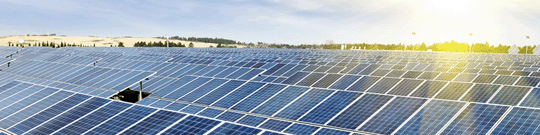
New research has shown that solar parks can play a positive role in promoting bird diversity in the agricultural landscape of Central Europe. The scientists said solar farms offer food availability and nesting sites.
JANUARY 9, 2024 LIOR KAHANA, PV Magazine
A European group of researchers has conducted a study on the impact of solar parks on birds in a Central European agricultural landscape. They surveyed 32 solar park plots and 32 adjacent control plots in Slovakia during a single breeding season.
“We selected ground-mounted photovoltaic power plants with an area of at least 2 hectares,” the researchers explained. “All of the studied solar parks had fixed-tilt solar racks, one of which also had panels mounted on biaxial trackers, and were developed at least eight years earlier. Seventeen solar parks were developed on arable land, and 15 parks were developed on grassland.”…………………………………………………………………..
According to the research group, bird species richness, diversity, and invertebrate-eater species richness and abundance were higher in the solar parks than in the control plots. Among the reasons provided by the research group is the food availability for insectivorous birds, as the PV panels attract various species of water-seeking aquatic insects.
“As food availability and accessibility is low in winter, it can be assumed that solar parks can have a positive impact on farmland birds outside the breeding season, as they can serve as stopover, foraging and roosting sites during migration and wintering as the ground under the solar panels can remain snow-free in winter,” the academics explained……………………………..
They presented their analysis in the study “Solar parks can enhance bird diversity in the agricultural landscape,” published in the Journal of Environmental Management. The research was a collaborative work of scientists from Slovakia’s Slovak Academy of Sciences, Gemer-Malohont Museum, Comenius University in Bratislava, Catholic University in Ružomberok, Slovak Ornithological Society/BirdLife Slovakia, and Belgium’s University of Antwerp. https://www.pv-magazine.com/2024/01/09/utility-scale-solar-farms-contribute-to-bird-diversity/
Nuclear weapons test treaty fears sink plans for major wind farm
UK Ministry of Defence objected to 315MW array over fears nuclear monitoring station would be affected by vibrations
5 January 2024 By Cosmo Sanderson , Recharge,
The UK’s obligations to monitor nuclear weapons testing have helped scupper a proposal for a Scottish wind farm over fears it could affect a nearby monitoring station.
The Scottish government rejected a proposal from British developer Community Windpower for a planned 315MW array made up of 45 turbines near the border with England last month.
The reasons for this included the potential impact of the wind farm on the nearby Eskdalemuir Seismic Array, a seismological monitoring station that forms part of the UK’s obligations under a multilateral treaty to ban nuclear weapons testing…………..(Subscribers only) more https://www.rechargenews.com/wind/nuclear-weapons-test-treaty-fears-sink-plans-for-major-wind-farm/2-1-1579329
More than half of eligible schools enlist in new solar scheme in Ireland
More than half of eligible schools enlist in new solar scheme in Ireland.
Ireland’s Department of Education says that just over 900 schools out of
1,600 eligible facilities have signed up to participate in the
government’s first round of the Solar for Schools Programme, a nationally
funded scheme to cover the costs of 6 kW roof-mounted solar installations.
Panels would be connected to the electricity grid, leading to €1,200
($1,310) to €1,600 per annum in savings, according to the government.
Schools from 11 districts could sign up in the first application round
which opened in mid-November and is expected to reach completion in May
this year.
PV Magazine 2nd Jan 2024
‘Renewable surge powers all UK homes in 2023’
Renewable electricity production in the UK reached a significant milestone
in 2023, generating more than 90 terawatt hours (TWh) of power from wind,
hydro and solar sources. This amount surpasses the energy needed to power
all of the UK’s 28 million homes.
Energy Live News 2nd Jan 2024
CSIRO says wind and solar much cheaper than nuclear, even with added integration costs
The big mover – and one that is significant in the context of the Australian debate on the energy transition, and the federal Coalition’s insistence that nuclear is the answer to most questions – is the cost of nuclear and small modular reactors.

Giles Parkinson 21 December 2023 ReNewEconomy
The CSIRO has published the latest edition of its important GenCost report, and responded to critics by dialling in near term integration costs for wind, solar and storage. But the result is just the same – renewables are clearly Australia’s cheapest energy option, and the story for nuclear just got a whole ot worse.
The annual GenCost report, prepared in collaboration with the Australian Energy Market Operator since 2018, is an important guide to where Australia’s energy transition is at and where it should be heading, but over the past has become the target of attack from conservative naysayers and the pro-nuclear lobby.
CSIRO has defended its methodology, but to satisfy the critics has added in pre-2030 integration costs – including the new transmission lines being built to connect new generation – and finds that the story is much the same.
“While this change leads to higher cost estimates, variable renewables (wind and solar) were still found to have the lowest cost range of any new-build technology,” the CSIRO says, noting that this includes all integration costs up to and including 90 per cent renewables.
In the past year, cost of solar and offshore wind has fallen, the cost of battery storage has remained steady, but the cost of other technologies such as onshore wind and pumped hydro has increased.
The big mover – and one that is significant in the context of the Australian debate on the energy transition, and the federal Coalition’s insistence that nuclear is the answer to most questions – is the cost of nuclear and small modular reactors.
The CSIRO has been attacked by the pro-nuclear lobby, including conservative media and right wing think tanks, for what the lobby claims are inflated cost estimates, but the CSIRO says recent events have backed its numbers. In fact, they make clear that nuclear SMR costs are worse than thought.
CSIRO economist Paul Graham points to the collapse of a major deal this year involving the most advanced SMR projects in the US, the NucScale projects in Utah, which were withdrawn because of soaring costs.
Graham says it is significant because, as NuScale was listed and had to abide by strict regulatory disclosure rules, it had to be “honest” about the anticipated costs of SMRs.
And these were nearly double what was previously thought. In fact they ended up at the equivalent of $A31,000/MW, according to NuScale filings, and much higher than the $A19,000/MW estimated by the CSIRO in its previous report, and for which it was accused of inflating.
“The UAMPS (Utah utility) estimate implies nuclear SMR has been hit by a 70 per cent cost increase which is much larger than the average 20% observed in other technologies,” the CSIRO writes.
“The cancellation of this project is significant because it was the only SMR project in the US that had received design certification from the Nuclear Regulatory Commission which is an essential step before construction can commence.” Graham says that all other claims on nuclear SMR costs are just marketing and sales talk.
The reality, however, is that talk of nuclear SMRs as a solution for Australia’s energy transition and near term emissions targets are a distraction, given that the SMR technology is simply not available, and unlikely to be so for two decades.
The CSIRO report says some interesting things about the costs of wind and solar, technologies which are available and which do work. It says the costs of these technologies will continue to fall in coming years after the various price shocks that have affected the technologies over the last couple of years.
By including the costs of transmission and storage that is underway now and committed out to 2030 adds 40 to 60 per cent to the 2023 cost of deploying high shares of wind and solar, although that also ignores the technologies cost falls that will occur over time……………………………………………………………………………………….more https://reneweconomy.com.au/csiro-says-wind-and-solar-much-cheaper-than-nuclear-even-with-added-integration-costs/
German nuclear plant to be replaced by Europe’s biggest battery.
PreussenElektra, operator of the decommissioned Brokdorf nuclear power
plant in northern German state Schleswig-Holstein, which was taken offline
at the end of 2021, wants to transform the site into a power storage
facility, reports NDR.
Initial plans could see a 100-megawatts (MW) battery
plant operating on a site close to the nuclear power station in 2026. A
second phase would add 700-megawatts of capacity, hosted on the 12-hectare
site of the nuclear power plant itself. (No storage duration was cited).
The company hopes to have the entire project online in 2036, but is waiting
for authorisation to begin dismantling the decommissioned reactor.
Renew Economy 15th Dec 2023
Chernobyl, site of world’s worst nuclear disaster, could soon be home to an exciting new project: ‘Tolerable exposure levels for limited periods of time’
Jeremiah Budin, November 20, 2023 , https://news.yahoo.com/chernobyl-world-worst-nuclear-disaster-213000130.html
Chernobyl, the site of the world’s most well-known nuclear disaster, has been essentially abandoned since the infamous reactor meltdown of 1986 — with good reason, as the site has been contaminated by radiation.
Nonetheless, Ukraine now plans to give Chernobyl a makeover that will have it generate power once again. But this time, it’s going to be a massive wind farm.
The current plan, according to a report from Popular Mechanics, is to turn Chernobyl into a one-gigawatt wind farm, which would be one of the largest in Europe. At full capacity, the wind farm could power up to 800,000 homes in nearby Kyiv, Ukraine’s capital, according to the report.
As for whether it will actually be safe for workers to spend time in the radiated zone, the answers are somewhat unclear. According to the International Atomic Energy Agency, there is still radioactive material in the atmosphere, but it exists at “tolerable exposure levels for limited periods of time.”
However, there were also reports of Russian soldiers experiencing radiation sickness as recently as last year after digging into the dirt near the power plant. Russian forces seized the Chernobyl site during its invasion of Ukraine and held it for several weeks before abandoning it.
The Ukrainian government and Notus Energy, the German company that has been brought on to build out the project, are reportedly still assessing how to move forward safely. While there are certainly concerns around the projects, the Chernobyl site also comes with big upsides, as there is already a lot of power plant infrastructure in place. Furthermore, no residents will be displaced by the project, as the radiation zone is still basically a ghost town.
There is also a nice symmetry to the site of one of the world’s worst-ever power-related disasters being rehabilitated into a modern power plant that can produce clean, renewable energy that allows Ukraine to transition away from harmful dirty energy sources.
It could “become a symbol of clean, climate-friendly energy, providing Kyiv with green electricity,” said Oleksandr Krasnolutskyi, Ukraine’s deputy ecology minister.
Portugal made great strides in renewable energy.
This week Portugal made strides to meet its 2045 deadline, by producing
more renewable energy than it needed for 149 hours straight – a new record.
Portugal aims to generate 85% of its electricity from renewable sources by
2030 and be carbon neutral by 2045 – five years earlier than most European
nations.
Positive News 10th Nov 2023
Solar panel advances will see millions go off grid, scientists predict

Solar energy costs have fallen 90 per cent over the last decade, while new discoveries have seen efficiency rates rise
More than 30 million homes in Europe could meet all their energy needs
using rooftop solar panels alone, according to a new study. Researchers
from the Karlsruhe Institute of Technology in Germany found that more than
50 per cent of Europe’s 41 million freestanding homes could have been
self-sufficient in 2020 using just solar and batteries, with this figure
expected to rise to 75 per cent by 2050.
Advances with solar technology
mean that it will also make it economically viable for a portion of these
freestanding single-family homes to abandon the electrical grid altogether
in the coming decades. Rather than abandoning the grid altogether, however,
the researchers said it would make more sense at a macroeconomic scale for
households to remain connected and feed excess energy back to other users
during times of overproduction.
Independent 3rd Nov 2023
https://www.independent.co.uk/tech/solar-panels-cost-renewable-energy-b2440891.html #nuclear #antinuclear #nuclearfree #NoNukes
South Australia is leading the world on the integration of wind and solar.
There is little doubt that South Australia is leading the world on the
integration of wind and solar. Now, it’s about to take an even bolder
leap into a deep green energy future through its hydrogen jobs plan.
The state has sourced more than 70 per cent of its electricity demand from wind
and solar over the past year, and when RenewEconomy interviewed state
energy minister Tom Koutsantonis on Sunday afternoon for its Energy
Insiders podcast, it was nearing the end of a 60-hour period where it
average more than 100 per cent wind and solar. Earlier that day, the state
had reached a stunning new peak of 264 per cent “potential” wind and
solar, the combination of renewable energy actually produced, and the
renewable energy curtailed by the lack of a market.
South Australia response to the this excess of green energy is to encourage even more, with
another bold step that it hopes will make it a global leader in green
hydrogen, just as it has done with renewables.
Renew Economy 25th Oct 2023 #Australia #nuclear #antinuclear #nuclearfree #NoNukes
Dunkelflaute (or… can we keep the lights on when the wind doesn’t blow and the sun doesn’t shine?)
Prof. Andrew Blowers tackles this question in the BANNG column for Regional Life, October, 2023 https://www.banng.info/news/dunkelflaute/—
The Blackwater estuary is a place where sea, land and sky meet. It is a vast natural environment where wind and sun provide unlimited resources that are transforming our energy supply as we shift from fossil fuels to low carbon renewables, in the desperate race to avert impending climate catastrophe.
There is one problem with a carbon free energy future built on wind and sun. That problem is Dunkelflaute, a German word meaning ‘dark doldrums’, times when there is little wind and sunlight. Think of those short, dark and windless days in mid-winter when lights and heating are on all day and the demand for power rises and the energy supply system is fully stretched. As we become more dependent on intermittent sources of electricity supply can we keep the lights on?
The answer must be ‘yes’, since not to have light is unthinkable in our modern society. But, how? For some, the answer lies in nuclear power which provides ‘firm power’, continuous generation able to meet baseload whenever Dunkelflaute persists. The Government recently proclaimed that ‘Nuclear is the critical baseload of the future energy system’. But, even if it were true, it hardly justifies the plans for massive investment in outmoded, dangerous and costly nuclear power plants that cannot conceivably be delivered until well into the next decade – if then. Installing big, inflexible nuclear will just get in the way of the flexible supply and demand management system for the future
‘Firm power which cannot be switched off when you don’t need it will be as much of a problem as variable power which cannot be switched on when you do. What is called for is flexibility, in huge quantities and of all types’. (Michael Liebreich quoted in Carbon Brief)
That future lies in wind and solar backed up by green power and by long duration storage (including battery, hydrogen and pumped hydro-electric). Distributed local heat and power systems, interconnectors with other countries and reducing and managing demand through energy efficiency and smart metering will all contribute to an energy system that meets net zero by the middle of the century.
It is already happening. At its present moment of hubris nuclear is already doomed. On the Blackwater estuary, the hulk of Bradwell A provides a forlorn epitaph to a bygone era. #nuclear #antinuclear #nuclearfree #NoNukes
World may have crossed solar power ‘tipping point’
The world may have crossed a “tipping point” that will inevitably make
solar power our main source of energy, new research suggests. The study,
based on a data-driven model of technology and economics, finds that solar
PV (photovoltaics) is likely to become the dominant power source before
2050 – even without support from more ambitious climate policies.
However, it warns four “barriers” could hamper this: creation of stable
power grids, financing solar in developing economies, capacity of supply
chains, and political resistance from regions that lose jobs.
The researchers say policies resolving these barriers may be more effective
than price instruments such as carbon taxes in accelerating the clean
energy transition. The study, led by the University of Exeter and
University College London, is part of the Economics of Energy Innovation
and System Transition (EEIST) project, funded by the UK Government’s
Department for Energy Security and Net Zero and the Children’s Investment
Fund Foundation (CIFF).
“The recent progress of renewables means that
fossil fuel-dominated projections are no longer realistic,” Dr Femke
Nijsse, from Exeter’s Global Systems Institute.
Exeter University 17th Oct 2023 #nuclear #antinuclear #nuclearfree #NoNukes
‘Cottage industry’: Gurus say nuclear no match for solar energy

Hans van Leeuwen https://www.afr.com/companies/energy/cottage-industry-gurus-say-nuclear-no-match-for-solar-energy-20231013-p5ebxp
Hans van Leeuwen covers British and European politics, economics and business from London. He has worked as a reporter, editor and policy adviser in Sydney, Canberra, Hanoi and London. Connect with Hans on Twitter. Email Hans at hans.vanleeuwen@afr.com
London | The debate on nuclear power is a distraction from solar, which is about to tip into exponential growth that will sweep aside all other energy sources, say Australia’s much-garlanded pair of leading solar inventors.
Andrew Blakers and Martin Green, often dubbed the “fathers of photovoltaics”, described nuclear energy as “a cottage industry”, with no chance of reaching economies of scale in any useful timeframe.
Solar, though, “is going to take over energy it is in a way that will be utterly astonishing for most people”, Professor Blakers said.
“It is going to do it as fast as we went from film photography to digital photography. In the space of 20 years, basically we’re going to flip from solar being a few per cent to solar being everything but a few per cent. It really is the fastest energy change in all of history by a large margin,” he said.
The two men were in London to collect the latest in a string of prizes for their work on PERC solar photovoltaic technology, which has brought down the cost of solar panels by 80 per cent in the past decade.
At Buckingham Palace on Thursday (Friday AEDT), the King awarded them and their colleagues Aihua Wang and Jianhua Zhao with the Queen Elizabeth Prize for Engineering.
Professor Green described nuclear as “pie in the sky” – including the small modular reactor technologies that have enthused the British government and the opposition in Australia as countries race to transition to green energy.
“They are going to have a few prototypes up by 2030, but it really needs the economy of volume to get the prices down to where they’re projecting,” he said. “So you need to be selling hundreds of these things, not just a few sample ones.”
He also said that the history of power generation had been about reducing costs by making things bigger. “It’s going against historical trend, I think, imagining that you can do things cheaply by making a lot of [smaller ones].”
Professor Blakers said nuclear was simply not in the net-zero race. “This year, it looks like the world will do about 500 gigawatts of solar and wind – maybe 400 gigawatts of solar, 100 gigawatts of wind. Hydro will do about 20 gigawatts, nuclear will do approximately one, gas and coal maybe 50,” he said.
“Solar has been growing at 20 per cent a year for a long time. If it continues to grow at this level, we will completely decarbonise the world by the early 2040s. This is how fast it’s happening. It’s so cheap compared with anything else.”
Nuclear, meanwhile, had not increased its capacity in the past 13 years, he said, adding no more than a gigawatt a year.
“You cannot grow an industry from one to multi-thousand gigawatts, which is what you’d need per year, in any reasonable timeframe. It’s impossible unless you put it on a war footing,” he said.
“You just don’t have enough engineers, scientists, raw materials, the factories, the factories to build the factories, the factories to build the factories to build the factories – it just doesn’t happen.”
Grids: the big hurdle
Both men were convinced that battery technologies and costs would continue to fall, driving increasingly rapid growth. The one big obstacle in Australia was transmission.
“Basically, you need a lot of new transmission to bring the new solar and wind into cities. And we’re not building it,” Professor Blakers said.
“Transmission only becomes important once you get up to 30, 40 per cent solar-wind. We’re currently 33 per cent solar-wind, and we will be 75 per cent by 2030. We don’t have a transmission problem yet. But in two years’ time, we’ll have a major one, and everyone can see that.”
He said initiatives to increase compensation to land owners should overcome the remaining community resistance.
Professor Green said the growth of solar energy use would not unseat China’s dominance of the supply chain for solar panels.
“Solar is basically going to demolish the market for coal and gas. And the geopolitical question is whether India, Europe and the US would tolerate having 80 or 90 per cent of the global solar industry coming out of China,” he said.
“It’s very hard to see other countries competing with China. The momentum they’ve got.”
He said India might become a major manufacturer, but its industry’s development would not be as co-ordinated and co-operative as China’s had been.
China, though, would have to address the demand of its customers for higher environmental and social standards – creating an opportunity for Australia to become a player in providing green-friendly metallurgical-grade silicon. #nuclear #antinuclear #NuclearFree #NoNukes #NuclearPlants
Wind and solar are only forms of power generation rising globally, study finds.

Independent, Stuti Mishra 8 Oct 23,
China leads the charge by contributing to 43 per cent of the global
growth in solar energy generation.
. Electricity data from 78 countries that
represented 92 per cent of global electricity demand for the first half of
2023 was analysed in the study released by environmental think-tank Ember
on Thursday. It found that while overall emissions remained stable, with a
slight 0.2 per cent increase, wind and solar power generation surged ahead.
Independent 6th Oct 2023
Chart: China’s solar export dominance grows with surging European orders
#nuclear #antinuclear #nuclear-free #NoNukes
China’s solar export dominance grows with surging European orders. The
country produces 80 percent of the world’s solar panels, and Europe is
now buying over half of the panels it exports.
Canary Media 29th Sept 2023
1 This Month

of the week – Shut Down Drone Warfare!


Tell the Ukrainian Government to Drop Prosecution of Peace Activist Yurii Sheliazhenko

Petition to revoke the licensing of the Near Surface Nuclear Disposal Facility (NSDF) at Chalk River. https://www.ourcommons.ca/petitions/en/Petition/Details?Petition=e-7247
To see nuclear-related stories in greater depth and intensity – go to https://nuclearinformation.wordpress.com
-
Archives
- April 2026 (7)
- March 2026 (251)
- February 2026 (268)
- January 2026 (308)
- December 2025 (358)
- November 2025 (359)
- October 2025 (376)
- September 2025 (257)
- August 2025 (319)
- July 2025 (230)
- June 2025 (348)
- May 2025 (261)
-
Categories
- 1
- 1 NUCLEAR ISSUES
- business and costs
- climate change
- culture and arts
- ENERGY
- environment
- health
- history
- indigenous issues
- Legal
- marketing of nuclear
- media
- opposition to nuclear
- PERSONAL STORIES
- politics
- politics international
- Religion and ethics
- safety
- secrets,lies and civil liberties
- spinbuster
- technology
- Uranium
- wastes
- weapons and war
- Women
- 2 WORLD
- ACTION
- AFRICA
- Atrocities
- AUSTRALIA
- Christina's notes
- Christina's themes
- culture and arts
- Events
- Fuk 2022
- Fuk 2023
- Fukushima 2017
- Fukushima 2018
- fukushima 2019
- Fukushima 2020
- Fukushima 2021
- general
- global warming
- Humour (God we need it)
- Nuclear
- RARE EARTHS
- Reference
- resources – print
- Resources -audiovicual
- Weekly Newsletter
- World
- World Nuclear
- YouTube
-
RSS
Entries RSS
Comments RSS
 nuclear-news