Saudi Arabia to learn from Canadian renewable energy success story
 renewable sources generate up to 65 percent of Canada’s electricity. Solar and wind are the country’s two fastest growing sources.According to him, Solar photovoltaic capacity reached 1,210 megawatts of cumulative installed capacity in 2013. The Canadian Solar Industry Association forecasts that annual capacity will increase three folds by 2025. By then, the Canadian solar industry will support more than 35,000 jobs, displacing 15 to 31 million tons of greenhouse gas emissions per year.
Canada has two of the largest solar farms in the world
Saudi Arabia, Canada to hold renewable energy seminar http://www.arabnews.com/economy/news/651686 29 Oct 14, A Canadian trade delegation, headed by Canada’s Deputy Minister of International Trade Simon Kennedy arrived in Saudi Arabia on Monday to meet several Saudi officials and major firms with a special focus on renewable energy in Saudi Arabia.
Canadian Ambassador Thomas MacDonald said Canada’s first renewable energy mission, which is focused on solar technology, will visit the King Abdullah City for Atomic and Renewable Energy (KACARE), the Saudi Electricity Company (SEC), ACWA Power and other industry leaders. Continue reading
Nanyang Technological University Singapore leads te way with a hybrid micro grid for renewable energy
NTU to build region’s first renewable energy integration demonstration micro-grid Phys Org 29 Oct 14 Nanyang Technological University Singapore (NTU Singapore) will be building a hybrid micro-grid which will integrate multiple large-scale renewable energy sources. The first in the region, the hybrid micro-grid will test and demonstrate the integration of solar, wind, tidal-current, diesel, storage and power-to-gas technologies, and ensure these energy sources operate well together.

To be built under the new Renewable Energy Integration Demonstrator- Singapore (REIDS) initiative, the hybrid micro-grid will be located offshore at Semakau Landfill and is expected to produce power in the megawatt (MW) range, which will be suitable for small islands, isolated villages, and emergency power supplies. This will be able to power around 250 HDB 4-room apartments, which together consume a peak of 1 MW.
This initiative is supported by the Singapore Economic Development Board (EDB), and the National Environment Agency (NEA). The S$8 million initial micro-grid infrastructure will also facilitate the development and commercialisation of energy technologies suited for tropical conditions to be developed by NTU Singapore together with 10 world leading companies…….http://phys.org/news/2014-10-ntu-region-renewable-energy-micro-grid.html
European Union heading to meet its 2020 renewable energy targets
EU on track to meet 2020 renewable energy targets, Hydroworld, BRUSSELS 10/28/2014 By Michael Harris Online Editor Greenhouse gas emissions within the European Union fell by almost 2% between 2012 and 2013, putting the EU close to its 2020 reduction target, according to data released this week by the European Environment Agency.
“According to latest estimates, EU greenhouse gas emissions in 2013 fell by 1.8% compared to 2012 and reached the lowest levels since 1990,” an EU statement said. “So not only is the EU well on track to reach the 2020 target, it is also well on track to overachieve it.”
Hydroelectric power has been an integral component of the EU’s efforts in cutting its greenhouse gas emissions and producing 20% of its power with renewable sources.
The EEA’s analysis of member states’ own projections show the EU is likely to cut its greenhouse gas emissions by at least 21% of 1990 levels by 2020, surpassing its 20% target. Meanwhile, the report shows 14% of the EU’s energy was generated by renewable sources in 2012, which is ahead of its projections to hit the 20% mark by the end of the decade.
“Our analysis shows that Europe is on track towards its 2020 targets,” EEA executive director Hans Bruyinickx said. “Even against the backdrop of economic recession in recent years, we can see that policies and measures are working and have played a key role in reaching this interim result.”…….The EU has said that it’s longer-term objectives include decarbonizing Europe’s greenhouse gas emissions by between 80% and 95% by 2050. http://www.hydroworld.com/articles/2014/10/eu-on-track-to-meet-2020-renewable-energy-targets.html
Germany’s new style decentralised energy industry
 Germany embracing renewable energy Power production from renewables has tripled in Germany within the past decade, mostly from wind and solar. Yahoo News 29 Oct 14
“……..Last year, renewables accounted for 24 per cent of the country’s electricity.The German government introduced generous subsidies to kick-start the sector, amounting to 16 billion euros last year. But the government claims the program has already saved billions in fuel costs for the heavily import-reliant country.
“We have created new businesses worth 40 billion euros per year,” Ecologic Institute analyst Andreas Kraemer said.”We have created additional employment for up to 400,000 people. They all pay taxes, they all pay social security charges.”
German households and small business pay the largest share for the renewable turnaround.They pay around 29 euro cents per kilowatt hour and much of that goes towards a renewable energy surcharge.
Big industrial users are exempt from the surcharge and pay just 3.5 cents per kilowatt hour……..
A new-look energy market The energy turnaround has clouded the future for the dominant utility companies in Germany.Germany’s big four, Vattenfall, E.on, RWE and EnBW, have enjoyed an oligopoly driven by nuclear power and fossil fuels………
Investors look for exposure to renewables market The makeup of the German energy market already looks very different, with hundreds of companies and cooperatives being formed in a decentralised industry.
While banks, industry, and project developers own 40 per cent of renewable installations, farmers and private investors own half.A number of new investment vehicles have formed to take advantage of the new industry. Crowd funding start up Bettervest has financed 14 projects since its inception a year ago.
Company spokesman Julien Schroder-Gianoncelli said investors are attracted by the projects and the returns,\. “We are offering 5-10 per cent in interest, which is pretty good at the moment,” he said.
Ceramic Fuel Cells believes Germany’s regulations, incentives and market make it the place to be. Mr Obernitz said that, for the time being at least, there are no incentives available in Australia.
“I’m not sure if that is going to change,” he said.
“We would favour that because we have invented the technology in Australia, and it’s something that will change the world.”……… https://au.news.yahoo.com/vic/a/25372077/germanys-renewable-energy-incentives-and-regulations-attracting-australian-companies/
Wind power is beating nuclear power in UK
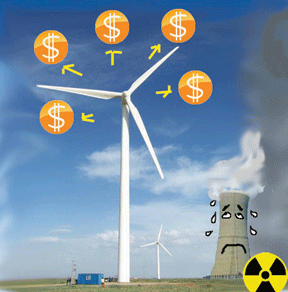 Wind farms outstrip nuclear power BBC News, By Roger Harrabin, 21 Oct 14 BBC environment analyst The UK’s wind farms generated more power than its nuclear power stations on Tuesday, the National Grid says.
The energy network operator said it was caused by a combination of high winds and faults in nuclear plants………Wind made up 14.2% of all generation and nuclear offered 13.2%.
It follows another milestone on Saturday, when wind generated a record amount of power – 6,372 MW, according to National Grid.
This formed nearly 20% of the the UK’s electricity, albeit at a time at the weekend when demand is relatively low………The government is offering more generous subsidies to nuclear than wind in the long term.
But Jennifer Webber, a spokeswoman for RenewableUK, the trade body, said: “Wind power is often used as a convenient whipping boy by political opponents and vested interests.
“All the while, it’s been quietly powering millions of homes across the UK and providing a robust response to its vocal detractors.” http://www.bbc.com/news/business-29715796
As UK’s nuclear energy gets billions of pounds subsidy, Europe’s citizen energy movement is growing
 Citizens’ energy movement calls for support as nuclear gets billions of pounds subsidy http://www.foe.co.uk/blog/citizens-energy-movement-calls-support-nuclear-gets-billions-pounds-subsidy Susi Scherbarth 15 October 2014 Last week the European Commission gave the UK the green light to billions of pounds of subsidies for Hinkley nuclear power plant, and the European Parliament approved a Spanish oil baron, Miguel Arias Cañete, as the EU’s next climate and energy chief.
This hardly bodes well when EU leaders are due to agree climate and energy targets for the year 2030 at a summit next week.
But against this, Europe’s citizens energy movement is providing reasons for optimism. Continue reading
World Bank leader calls for development banks to mobilise climate funds
 Development banks should mobilize climate funds: World Bank’s Kim BY VALERIE VOLCOVICI REPORTING BY VALERIE VOLCOVICI,; EDITING BY ROS KRASNY AND FRANCES KERRY) WASHINGTON Thu Oct 16 (Reuters) – The World Bank and other multilateral financeinstitutions should pool their resources to help developing countries combat and adapt to climate change, helping smooth the path to a global climate agreement in Paris next year, World Bank President Jim Yong Kim said on Thursday.
One important disagreement looming over the climate talks is how countries will reach an agreed target of raising $100 billion in annual funding for climate change projects in developing countries by 2020, Kim told the Reuters Global Climate Change Summit.
The World Bank, other multilateral organizations, climate funds and regional development banks can help mobilize money prior to the Paris talks to give developing countries confidence in the negotiating process, he said.
“We are doing everything we can to really make sure that issue doesn’t stop the proceedings,” Kim said.
“Can we take all of the money that is floating around out there, and put it together in a package that would make the developing countries feel a lot better about the available financing for tackling both mitigation and adaptation?”……….
Beyond the financing question, Kim said strong signs of an agreement between the United States and China on climate would set a “strong foundation” for the Paris meeting.
He added that a declaration by 74 countries and over 1,000 private companies announced at the U.N. Climate summit in September, in support of carbon pricing measures such asmarkets and taxes, could also bolster prospects for success in Paris.
Kim said the decision by China, the world’s biggest carbon emitter, to sign the declaration was a surprise to World Bank officials, and had raised the pressure on other countries……..http://www.reuters.com/article/2014/10/16/us-climatechange-summit-worldbank-idUSKCN0I52QK20141016
Wind and solar power developments Europe, Japan, USA, Canada
 World: http://geoharvey.wordpress.com/ 17 Oct 14

¶ Wind power is blowing gas and coal-fired turbines out of business in the Nordic countries. Nordic wholesale forward power prices have almost halved since 2010 to little over €30 per MWh as capacity increases while demand stalls due to stagnant populations, low economic growth and improved efficiency. [AsiaOne]
¶ Japan’s utilities say they are being swamped by green power and the grid does not have enough capacity to cope with the rocketing levels of electricity from the growing crop of solar power plants. Yet the same utilities are pushing to restart the nation’s mothballed nuclear reactors. [The Japan Times]
¶ EU leaders are likely to agree a new decade of climate and energy policy next week despite the “legitimate concerns” of several nations, Europe’s climate boss said on Thursday. European Union leaders have set themselves a deadline of the end of October to agree on green energy goals for 2030 to follow on from 2020 policy. [Reuters UK]
¶ Business and political leaders around the world, most notably in the United States and China, are pressing for action to avert the potentially huge financial repercussions of climate change. But this year, the most vocal climate change sceptic in the Group of 20 leading industrialised nations is its current host, Australia. [Daily Mail]
¶ Orix Corp, a Tokyo-based finance and leasing company, will continue to pursue the development of its 800 MW solar PV pipeline in Japan, despite recent reports of some utilities restricting grid access for new solar projects. Half of the projects are already under development or in operation and the rest will proceed as planned. [pv magazine]
¶ Innergex Renewable Energy Inc has announced that the Mesgi’g Ugju’s’n Wind Farm, LP has obtained the government decree from the Quebec government for a 150 MW wind project located in the Gaspé Peninsula, in Quebec. This concludes the project’s environmental approval process so construction may begin. [Stockhouse]
¶ Sweden has called on the EU to adopt a greenhouse gas emission reduction target of 50% by 2030s, 10 percentage points higher than current proposals. The call from Stockholm’s new centre-left government comes less than a week before EU leaders are set to gather to discuss the bloc’s climate and energy strategy. [RTCC]
¶ Italian utility Enel is considering phasing out 23 “obsolete” thermal power plants in Italy in the near future, accounting for 11 GW or 43% of the company’s existing thermal generation capacity. The decommissioning procedure for nine plants has already started, Starace added, listing units with a combined capacity of 2.2 GW. [ICIS]
¶ The UK’s National Audit Office has begun an investigation into the controversial subsidy regime for the planned new Hinkley Point C nuclear plant. The financial watchdog will be checking whether the guaranteed prices of £92 a megawatt hour – double the current cost of electricity – represented “value for money”. [The Guardian]
¶ Energy watchdog Ofgem has named five new potential interconnector projects that could link the UK with France, Ireland, Norway and Denmark. Together with the ElecLink and Nemo projects that Ofgem has already assessed, the schemes could provide up to 7.5 GW of additional electricity capacity in the UK. [reNews]
Renewable energy systems shown to have lower carbon footprint – life cycle analysis
Life cycle analysis confirms renewables’ lighter footprint http://www.greenbiz.com/blog/2014/10/17/life-cycle-analysis-confirms-renewables-lighter-footprint By Sustainable Business News October 17, 2014 For years, some critics of renewable energy have contended that it’s really no better than fossil fuels when you consider the entire life cycle that goes into making their components.
They even say there may not be enough copper, steel and other resources to build all the solar panels and wind turbines needed for a low-carbon future. But comprehensive research recently released shows how far off their thinking is from reality.
It takes an enormous amount of energy to both build and then fuel fossil fuel power plants over their 40-plus year lifetime, and during all those years they pump out pollution that seriously harms the health of people and the environment. How do wind turbines and solar panels compare?
Wind turbines and solar PV Continue reading
World’s cheapest energy source is wind – new EU Report
 Wind is the World’s Cheapest Source of Energy According to EU Report, Inhabitat, by Beverley Mitchell, 10/14/14 A report prepared for the European Commission has found that onshore wind power provides the cheapest source of energy once external factors such as air quality, health impacts and expenditure, and the costs of climate change are taken into consideration. The report’s authors found that onshore wind costs around $133 per MW/h to produce, whereas gas and coal cost up to $208 and $295 per MW/h each. However, continuing a controversy that shadowed the Commission last year, extracts from the report have already been published that fail to include the external costs, which is where many of the subsidies to coal, gas and nuclear are made.
America’s EPA plans for renewable energy are too modest
 EPA Clean Power Plan Underestimates Power of Renewable Energy to Reduce Carbon Emissions, Union of Concerned Scientists,October 14, 2014 Steve Clemmer, director of energy research, Clean Energy UCS released a new analysis today showing that strengthening the contribution from renewable energy can significantly increase the emissions reductions from the EPA’s 2014 Clean Power Plan. We found that increasing non-hydro renewable energy sources from about 6 percent of U.S. electricity sales today to 23 percent by 2030—or nearly twice as much renewable energy as the EPA proposed—could raise the reductions in U.S. power plant carbon emissions from the EPA’s estimated 30 percent below 2005 levels by 2030 to 40 percent. We also found that increasing renewables to these levels is affordable, resulting in little impact on electricity prices and lowering natural gas prices for both utilities and consumers.
The EPA’s renewable energy targets are modest
This post is part of a series on th eEPA Clean Power Plan.
To establish emission rate reduction targets for each state, the EPA proposed four “building blocks” to identify cost-effective ways to reduce emissions from existing power plants. In addition to increasing renewable energy, these building blocks included improving efficiency at existing coal plants, fuel switching from coal to natural gas, increasing energy efficiency in homes and business, and including the generation from new and “at-risk” nuclear power plants. Importantly, the EPA gives the states flexibility in deciding how much of each building block to include, with some limitations.
Unfortunately, the EPA’s proposed approach for renewables — based on averaging the 2020 targets of existing state renewable electricity standards (RES) within each of six regions nationwide — resulted in very modest targets. Our analysis shows that the EPA’s targets include less renewable energy than what the Energy Information Administration (EIA) projects will occur by 2020 under a business as usual scenario (i.e. without the carbon rule), and only slightly more by 2030 (Figure 1).
The EPA’s proposed approach also produced several counter-intuitive results at the state level. For example,seven states had less renewable generation in 2030 under EPA’s targets than they have today. And 17 of the 29 states with RESs have lower targets under the EPA’s approach than what is required to meet their existing laws. The EPA’s approach also does not capture any of the recent or projected growth in renewables between 2012 and 2017…….http://blog.ucsusa.org/epa-clean-power-plan-underestimates-power-of-renewable-energy-to-reduce-carbon-emissions-682
How to Achieve 100 Percent Renewable Energy – new handbook
 New Handbook: 100 Percent Renewable Energy Both Practicable and Affordable, Triple Pundit, Andrew Burger | Friday October 10th, 2014 Advances in renewable energy technology, in concert with new triple bottom line-based approaches to government and business, are key enablers of a transition from polluting fossil fuels to locally-appropriate mixes of distributed, renewable energy systems. The renewable energy transition will not only benefit ecosystems and the environment; well designed and executed policies, regulations, public-private partnerships and inclusive, collaborative business models can address societies’ most pressing social and economic challenges as well.
Powering societies wholly on renewable energy technologies widely available today is not only possible, it’s affordable, according to a policy handbook produced by the World Future Council and E3 Analytics.
Appropriately titled, How to Achieve 100 Percent Renewable Energy, the WFC-E3 policy handbook uses eight case studies organized according to four themes – cities and communities; regions and states; national governments; and island governments – to illustrate how innovative policies are promoting and paving the way to “fully fossil- and nuclear-free” societies.
A policy framework for achieving 100 percent renewable energy
When WFC and E3 write about societies achieving 100 percent renewable energy, they mean “that all energy needed within the electricity, heat and transport sector in the particular region is coming from renewable sources.”
No doubt, many will take issue with the WFC-E3 report’s contention that societies can rely entirely on today’s renewable solar, wind, ocean, geothermal and bio-derived resources and technologies to meet all their energy needs. In their How to Achieve 100 Percent Renewable Energy handbook, WFC and E3 lay out a framework of policies that organizations at successively larger degrees of geopolitical scope and scale are using today to achieve that goal……….
In Achieving 100 Percent Renewable Energy, WFC and E3’s research team highlight five key findings that resulted from their analysis of the eight case studies included in the policy handbook:
- 100 percent renewable energy is both financially and economically advantageous, generating a wide range of benefits for both citizens and governments. The benefits range from savings on fossil fuel imports, improved energy and economic security, as well as reduced energy and electricity costs for governments, local residents and businesses.
- The goal of achieving 100 percent renewable energy is not only for wealthy or industrialized countries – it is taking root in countries and jurisdictions in all four corners of the globe, including in Africa, the Asia-Pacific region, as well as Latin America. 100% RE provide a plethora of development benefits that have a high priority among governments across the world. Since almost 3 billion people suffer from both, erratic or no access to electricity and reliance on inefficient and polluting solid biomass fuels for cooking, 100% reliable, affordable and efficiently used renewables are the only realistic, long-term options for ensuring a more decent livelihood for all.
- The report finds that transitioning to 100 percent renewable energy can also make economies more resilient, reducing their exposure to external factors such as rising fossil fuel prices. In times of geopolitical tensions and climate change, this is one of the key drivers for governments to take action.
- In addition to cost savings, going 100 percent renewable generates new economic activity and improves quality of life. Case studies suggest that demonstrating a clear commitment to transitioning 100% to renewable energy can help stimulating job creation, create new business models and opportunities as well as generate new sources of domestic revenue for both citizens and businesses.
- The case study analyses suggest that a significant expansion of RE in both the transport and heating/cooling sectors will need to become a strategic priority for governments to achieve the 100 percent goal. In line with this, the analyses show that achieving 100 percent renewable energy on a sustainable basis will likely require storing excess energy in the form of either heat or electricity in individual homes and businesses and that this will require a higher level of integration between these different sectors than in the past. The total generation supplied by electricity systems should be greater than 100 percent the majority of the time to allow the transport and heating sector to be integrated.http://www.triplepundit.com/2014/10/wfc-e3-100-percent-renewable-energy-practicable-affordable/
MdAmerican to power equivalent of 1 million households with Wind Energy
MidAmerican Energy Plans To Invest Additional $280 Million In Wind Generation WOWT NBC Omaha 10 Oct 14 MidAmerican Energy Company today announced plans to develop one new wind farm site in Adams County and expand a second site in O’Brien County in 2015 – an additional investment of up to $280 million for the nation’s leader in ownership of wind-powered generation among rate-regulated utilities.
If approved, the company’s proposed wind project would result in installation of up to 67 wind turbines. The project, scheduled for completion by the end of 2015, would add up to 162 megawatts of new wind generation capacity in Iowa……..
Coupled with projects currently underway in Grundy, Madison, O’Brien and Webster counties, MidAmerican Energy will have approximately 3,500 megawatts of wind generation capability in Iowa by year-end 2015 – enough capability to provide energy for the equivalent of approximately 1.05 million average Iowa households. With the completion of this newest project, MidAmerican Energy will have invested more than $6 billion for wind generation development in Iowa, making wind approximately 40 percent of its electric generator nameplate capacity. http://www.wowt.com/home/headlines/MidAmerican-Energy-Plans-to-Invest-Additional-280-Million-In-Wind-Generation-278797921.html
US Energy Dept funding Concentrated Solar Power (CSP) research
US Energy Department to fund CSP research Renewable Energy Focus 08 October 2014 DoE allocates $25 Million to support research and development of concentrating solar power.
The US Energy Department has announced $25 million in funding to advance concentrating solar power (CSP) system technologies. This investment will fund research and development projects to improve the performance and increase the efficiency of all components of CSP plants, ultimately lowering the cost of solar electricity.
“Investments to improve the efficiency and lower the costs of concentrating solar power technologies enhance our ability to deliver affordable solar-generated electricity to American families and businesses, while also moving us closer to achieving President Obama’s goal of doubling renewable energy generation again by the end of the decade,” said David Danielson, Assistant Secretary for Energy Efficiency and Renewable Energy.
Chile forms the top market for renewable energy
Chilean geography makes nation the top market for renewable energy, Chicago Tribune
By Matt Craze, Bloomberg News,Bloomberg SANTIAGO, Chile — With the sunniest desert on Earth, a windswept coast and limited fossil fuel supplies, northern Chile has become the world’s top market for renewable energy.
The government of President Michelle Bachelet has approved 76 solar and wind projects since taking power March 11. Renewable energy developers are pursuing contracts to deliver electricity to mines run by by companies including Anglo American and BHP Billiton, which consume a third of the country’s power.
“Chile is the market with the highest level of activity in the world,” Ben Warren, head of Ernst & Young’s renewables team, said in a telephone interview from London………
“Despite being a small market we attracted all of the players because we have significant growth rates,” Finat said. “We have clear economic rules and political stability. And there is a gigantic amount of untapped renewable energy resources.” http://www.chicagotribune.com/sns-wp-blm-news-bc-chile07-20141007-story.html
1 This Month
Chernobyl: The Lost Tapes – A good documentary on Chernobyl on SBS available On Demand for the next 3 weeks– https://www.sbs.com.au/ondemand/tv-program/chernobyl-the-lost-tapes/2352741955560

of the week–London Campaign for Nuclear Disarmament

Tell the Ukrainian Government to Drop Prosecution of Peace Activist Yurii Sheliazhenko
To see nuclear-related stories in greater depth and intensity – go to https://nuclearinformation.wordpress.com
-
Archives
- April 2026 (114)
- March 2026 (251)
- February 2026 (268)
- January 2026 (308)
- December 2025 (358)
- November 2025 (359)
- October 2025 (376)
- September 2025 (257)
- August 2025 (319)
- July 2025 (230)
- June 2025 (348)
- May 2025 (261)
-
Categories
- 1
- 1 NUCLEAR ISSUES
- business and costs
- climate change
- culture and arts
- ENERGY
- environment
- health
- history
- indigenous issues
- Legal
- marketing of nuclear
- media
- opposition to nuclear
- PERSONAL STORIES
- politics
- politics international
- Religion and ethics
- safety
- secrets,lies and civil liberties
- spinbuster
- technology
- Uranium
- wastes
- weapons and war
- Women
- 2 WORLD
- ACTION
- AFRICA
- Atrocities
- AUSTRALIA
- Christina's notes
- Christina's themes
- culture and arts
- Events
- Fuk 2022
- Fuk 2023
- Fukushima 2017
- Fukushima 2018
- fukushima 2019
- Fukushima 2020
- Fukushima 2021
- general
- global warming
- Humour (God we need it)
- Nuclear
- RARE EARTHS
- Reference
- resources – print
- Resources -audiovicual
- Weekly Newsletter
- World
- World Nuclear
- YouTube
-
RSS
Entries RSS
Comments RSS
 nuclear-news