Germany models the way to cut greenhouse gases, for a coal-free, nuclear-free future
 The international community has at its disposal more than sufficient renewable resources and the technical capabilities to sustainably harvest these sources. And given the total cost calculations mentioned earlier, we have a moral responsibility to do so. The time for a transition, then, is now. An Energiewende by any other name will still smell as sweet
How Germans Go Green Germany is laying out a model for how to gut greenhouse gas emissions.US News.com By Michael Shank and Johann Saathoff Dec. 9, 2014 With the German government’s reaffirmation this month of carbon emissions reduction goals of 40 percent by 2020, and its courageous commitment to phase out coal, the country is now leading the world with an aggressive and unparalleled climate action plan. This sets a new bar for nations gathering in Lima, Peru, for climate talks.
Germany’s energy transition, or Energiewende, and its aggressive goal of achieving 100 percent renewable energy by 2050 is a direct result of experiencing, firsthand, the risks that come with dirtier and more dangerous fuels. Germany first targeted nuclear and now it’s targeting coal – and for good reason.
Phasing out nuclear energy was a decision based on two factors Germans found so convincing that they now won’t even accept nuclear power as a bridge technology: the Chernobyl nuclear catastrophe and the question of nuclear waste storage.
The decision to opt-out of nuclear power started with Chernobyl, and the nuclear contamination of Germany 28 years ago, and it ended with the Fukushima disaster. By then, nuclear power had lost all traction with the German public. Additionally, there was no conclusive evidence of how to deal with nuclear waste responsibly. This meant that the true cost of producing a kilowatt-hour of nuclear energy remained unknown, leaving most Germans skeptical.
That nuclear rationale is relevant to Germany’s current response to coal. While coal’s catastrophic risks may not be as immediately visible as Chernobyl or Fukushima, the costs are equally immense. Both nuclear and coal come with an incredibly high capacity to contaminate natural resources. And nuclear and coal pollutants don’t disappear over time. They accumulate and contaminate quickly and the consequences will be borne most heavily by future generations.
On nuclear, disposing radioactive waste in deep rock formations with high radiation density and little geological activity is not a sustainable option. Leaks are likely and already occurring. On coal, a vast quantity of heavy metals, toxins and radioactive substances are emitted by all power plants that use coal for electricity generation. Even the most modern and effective filters do not enable coal-fired power plants to be zero emission.
Coal-fired power plants, in particular, emit large amounts of greenhouse gases that have a direct impact on global warming and the inevitable rise of sea levels, as well as extreme weather events. And coal’s contaminating potential is indiscriminate, transcending boundaries and borders, and equally culpable for catastrophic consequences…………….
A responsible alternative, then, if carbon taxes and trading mechanisms are unfeasible or fallible, is to ramp up renewable energy investments, as Germany has done with its Energiewende and will continue to do. And why not: The international community has at its disposal more than sufficient renewable resources and the technical capabilities to sustainably harvest these sources. And given the total cost calculations mentioned earlier, we have a moral responsibility to do so. The time for a transition, then, is now. An Energiewende by any other name will still smell as sweet. http://www.usnews.com/opinion/blogs/world-report/2014/12/09/germany-commits-to-alternative-energy-not-coal-or-nuclear
Report from global power group -Solar, wind, cost-competitive for peak energy
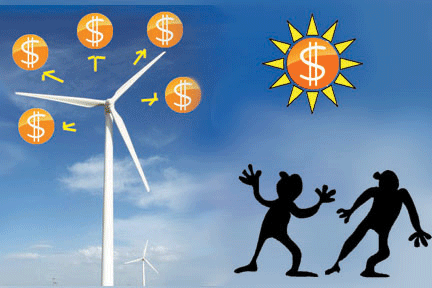 Solar, wind cost-competitive for peak energy, study finds,CBC News 8 Dec 14, Solar and wind power are increasingly cost-competitive with conventional forms of electrical power, including coal and nuclear, even without subsidies, according to a new study.
“The economics of alternative energy have changed dramatically in the last decade,” said George Bilicic, global head of the power energy and infrastructure group at Lazard Ltd. and author of the report.
“Utilities still require conventional technologies to meet the energy needs of a developed economy, but they are using alternative technologies to create diversified portfolios of power generation resources. The cost for utilities to generate energy from photovoltaic technologies has fallen by nearly 20 per cent in the past year, and nearly 80 per cent in the last five years, he said.
China’s entry into the solar panel business has helped push down the cost of solar technologies.
‘What’s most interesting about renewable and the mature area right now is utility-scale wind on land and utility-scale solar on land’– George Bilicic, Lazard
As a source of peak energy — that is, power at times when there is the greatest demand on the electrical grid — photovoltaics are more flexible and cost-competitive than conventional technologies, Bilicic said.
“What’s most interesting about renewable and the mature area right now is utility-scale wind on land and utility-scale solar on land. That is the most financeable and the most cost-effective,” he said in an interview with CBC’s The Exchange with Amanda Lang.
Lazard has published the study, called Levelized Cost of Energy Analysis, since 2008 and has a perspective on the fall prices.
It found land-based wind power has dropped in price — as much as 60 per cent in the last five years, though off-shore power remains expensive……….http://www.cbc.ca/news/business/solar-wind-cost-competitive-for-peak-energy-study-finds-1.2781609
Nuclear power outdone by renewable energy in Scotland
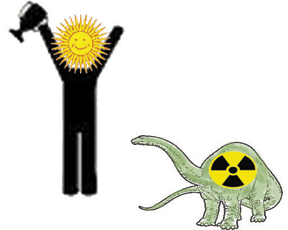
 Renewable energy overtakes nuclear as Scotland’s top power source, Guardian, Jessica Shankleman 27 Nov 14 Clean energy produced more power in Scotland than nuclear, coal or gas for the first time, in first half of 2014 industry figures show, reports BusinessGreen
Renewable energy in Scotland from wind farms, hydro power plants and other clean technologies provided the single largest source of electricity to the country for the first time, in the first half of 2014, new industry figures will show on Thursday.
Analysis by the trade body Scottish Renewables shows that renewables produced nearly one third more power than nuclear, coal or gas in the first six months of the year, generating a record 10.4 terawatt hours (TWh) during the six-month period.
The analysis was compiled by comparing Energy Trends data produced by the Department of Energy and Climate Change (Decc) on renewable energy output with figures produced by National Grid on coal, gas and nuclear power.
Many renewable energy sources do not feed into the National Grid, and instead are part of a local distribution network, meaning it is difficult for National Grid to compare how renewables are fairing compared to traditional sources of energy.
Niall Stuart, chief executive of Scottish Renewables, said the record figures marked “an historic” moment for the renewable energy industry, as well as a major milestone for the Scottish government’s plans to generate 100% of its electricity from renewable sources by 2020…….
Scotland’s Business, energy and tourism minister, Fergus Ewing, said the figures highlight the potential that renewable energy has to replace nuclear power.
“The fact that energy from renewables has exceeded that from nuclear in the first half of 2014, highlights the vast potential of renewable generation to provide a safe, secure and cost-effective means of electricity generation for this country, together with appropriate levels of thermal generation,” he said. “It is vital that appropriate support for renewables in Scotland is maintained following the introduction of electricity market reform in the UK.”…….http://www.theguardian.com/environment/2014/nov/27/renewable-energy-overtakes-nuclear-as-scotlands-top-power-source
China’s very rapid renewable energy growth- IRENA reports

 IRENA Says China Can Nearly Quadruple Renewable Energy By 2030 Clean Technica, November 25th, 2014 by Joshua S Hill A new report published Monday by the International Renewable Energy Agency (IRENA) has shown that China can increase its use of renewable energy from 13% to 26% by 2030, representing a nearly fourfold increase if the economic powerhouse is able to pull it off.
“As the largest energy consumer in the world, China must play a pivotal role in the global transition to a sustainable energy future,” said Adnan Z. Amin, Director-General of IRENA, at a launch event in Beijing. “China’s energy use is expected to increase 60 per cent by 2030. How China meets that need will determine whether or not the world can curb climate change.”
The report, Renewable Energy Prospects: China, was compiled by IRENA in association with the China National Renewable Energy Centre, and is part of IRENA’s renewable energy roadmap,REmap 2030, which aims to provide a plan to double the global share of the renewable energy mix by 2030.
Following the recent announcement made between China and the US, this report (and others like it) acquire even more significance, as China looks to be actively seeking ways to increase its renewable energy share……..
Economic Growth and Renewable Energy
Fears that economic growth must be stifled in favour of cleaner, more renewable sources of energy have recently been laid to rest, thanks partially to another report published recently that focused on China. The study, China and the New Climate Economy, showed that “China can achieve economic development, energy security and reduce pollution at the same time.”…….http://cleantechnica.com/2014/11/25/irena-says-china-can-nearly-quadruple-renewable-energy-2030/
Farming sunlight and wind in the California desert
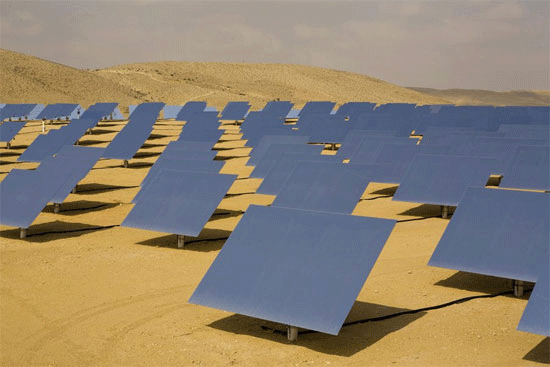 Renewable Energy Farms Spread Through California Deserts NewsWeek, BY ELIJAH WOLFSON / NOVEMBER 24, 2014 “…….. , part of the interconnected swatches of desert land in California that, combined, make up the largest wilderness area in the Lower 48. It’s also about to become host to the biggest renewable-energy projects in the world.
Already, 13 of them are built or on the way. There’s the Desert Sunlight Solar Farm, under construction just east of Joshua Tree National Park; its solar photovoltaic cells will cover over 4,000 acres of public land administered by the federal Bureau of Land Management (BLM). When completed in 2015 (assuming things go as planned), it is expected to peak at a nominal power of 550 megawatts—making it the most powerful solar farm on the planet. There’s also the McCoy Solar Energy Project, in the middle of the Mojave. When it’s done, it will be even bigger and more powerful than Desert Sunlight, covering 7,700 acres of BLM land and 470 acres of private land, and with an electrical production capacity of 750 megawatts.
Then there are the wind farms. These produce less power than their solar brethren and take up much more space. The Ocotillo Wind Energy Facility, for example, covers 12,436 acres at the edge of the Anza-Borrego Desert State Park, near the border with Mexico, and produces 315 megawatts of power……..
And these new wind and solar farms—cities, call them, since they aren’t like any farm you’ve seen—are only going to multiply in the coming years. The need for clean energy is expected to increase dramatically in the next decade, particularly after the U.S. and China recently announced a historic agreement to lower greenhouse gas emissions in their respective countries. At the core of the pact are two sets of commitments: The U.S. will lower emissions 26 to 28 percent by 2025 from the initial 2005 baselines, while China has agreed to set an emissions peak for 2030 and then commit to lowering emissions……….
It’s cheaper to have a big mass—having power all come from one source,” says Elkin. “But the advantages of having a more distributed rooftop-type solar is that you can provide the power generation really close to being used. It’s more efficient.” He says we are probably headed toward a mix, with “microgrids” providing neighborhoods with access to small, local solar farms.
Until then, though, achieving emissions reductions at the scale of what has been agreed to between the U.S. and China “is not going to happen without some level of large-scale renewable-energy development,” says Helen O’Shea, director of the National Resources Defense Council’s Western Renewable Energy Project.
And Michael Gerrard, director of the Sabin Center for Climate Change Law at Columbia University, says that if conservationists keep fighting that, they will be missing the forest for the trees. “We are facing a mass extinction,” he says. “The only pathway to solve that problem involves a massive increase in renewable energy. Unfortunately, many new renewable-energy facilities have been slowed down or stopped because of their adverse effects on certain species. I think we can no longer have the luxury of doing that.”ttp://www.newsweek.com/renewable-energy-farms-populate-california-286644
Google shows its ignorance about renewable energy
Why Google gave up on renewables (hint, they don’t understand energy), REneweconomy By Karel Beckman on 25 November 2014 The two scientists responsible for Google’s failed attempt to launch a renewable energy revolution have written an article explaining what, according to them, went wrong with their project. They have come to the conclusion that fighting climate change with today’s renewable energy technologies won’t work – but they present no evidence for it, writes Energy Post editor Karel Beckman.
Critics of renewable energy are having a field day in the blogosphere. It has now been proven beyond doubt, they cry, that “renewables simply won’t work”. Why not? Well, because Google says so.
Some years ago, in 2007, to be exact, Google embarked on an ambitious project to develop reneweable energy sources that would generate electricity more cheaply than coal-fired power. Google’s hope was that in this way the buildup of CO2 in the atmosphere could be halted and reversed. However, in 2011, after four years of trying, the company gave up the project, known as RE<C.
The two engineers who were responsbile for Google’s venture into renewables, Ross Koningstein and David Fork, have now written an article in which they try to explain what went wrong – and what lessons can be drawn from it……..they argue that renewables “won’t work” to effectively tackle climate change. They don’t say renewables won’t work, period. But even this first claim appears doubtful on the basis of the evidence offered in the article………
by 2011, they note, “it was clear that RE<C would not be able to deliver a technology that could compete economically with coal.”
Unfortunately, the reader has to take this assertion at face value. The authors do not cite any figures or published research. Nor do they make it clear whether these were all the “innovative technologies” they investigated or what they mean in the first place by “investigated”………..
They add this notable remark: “Let’s face it, businesses won’t make sacrifices and pay more for clean energy based on altruism alone. Instead, we need solutions that appeal to their profit motives.” Well, yes – unless of course we introduce regulations or put a price on carbon, for example, but such possibilities appear to lie outside the authors’ frame of reference.
The two Google-men have also come to the surprising – to them – discovery that in the electricity market “the value of generated electricity varies … depending on how easily it can be supplied to reliably meet local dmeand.” Thus, they write, dispatchable power can have added value to cover peak demand. Indeed. Distributed power, on the other hand, “can also be worth more as it avoids the costs and losses associated with transmission and distribution”.
These amazing insights into the nature of the electricity market have led them to a positive conclusion. Here, they write, “we see an apportunity for change. A distributed, dispatchable power source could prompt a switchover if it could undercut …end-user prices.” But, they add, “unfortunately, most of today’s clean generation sources can’t provide power that is both distributed and dispatchable. Solar panels, for example, can be put on every rooftop but can’t provide power if the sun isn’t shining.”
So what about solar PV-with-storage? Koningstein and Fork appear not to be aware that such a solution may be possible. Nor do they seem to have heard of microgrids or to have thought of a combination of solar and electric cars. They merely sigh that “if we invented a distributed, dispatchable power technology, it coud transform the energy marketplace and the roles by utilities and their customers”. They can’t think of any possible solution, though: we “don’t have the answers”. The technologies required to reverse climate change “haven’t been invented yet”, they write……..
what do Koningstein and Fork think that researchers in the energy sector are doing right now? Did they try to find out how much is being spent on cleantech research worldwide? Or what technologies are actually being developed? If so, they show no signs of it. Indeed, they seem to know very little about what’s going on in the energy sector. Perhaps it is too much expect Google to solve the world’s energy problems – they could search the internet a bit better. http://reneweconomy.com.au/2014/why-google-gave-up-on-renewables-hint-they-dont-understand-energy-12048
Portugal now gets almost 60% of its energy from renewable sources
Portugal switching to greener energy with more than 50 per cent from renewable sources http://www.abc.net.au/news/2014-11-20/portugals-rise-in-renewable-energy-market/5906758 By Emily Stewart Portugal has a population of just 11 million people but it is punching above its weight in renewable energy industries.
Almost 60 per cent of its energy needs came from renewable sources last year, a 20 per cent increase from 2012.
Carlos Pimenta is considered the country’s renewable guru. The former Portuguese and European Parliament member was a negotiator for the Kyoto protocol and with Al Gore a founder of the GLOBE organisation.
He said the energy market has changed dramatically since its liberalisation. “If you go back 10 years you have centralised gas, oil and electricity with big utilities on top and consumers on bottom paying the bill,” he said.”Nowadays you have thousands of families that produce part of their own electricity… hundreds of small wind farms, solar farms, small biomass that feed-in to the grid.”
Official Portuguese figures show the annual fossil fuel bill has been slashed by 800 million euros through the rise of renewables.
Former state energy company triples renewable energy output Continue reading
How the South African government shafts renewables, in its policy fixated on nuclear power
 Nuclear fixation shafts renewables, Mail &Guardian, Africa 21 NOV 2014 00:00 SIPHO KINGS The third window is waiting to be signed off but the energy department is preoccupied elsewhere Within two years, South Africa could have a further 1 200 megawatts (MW) of renewable energy entering the grid. The bidders have been selected and the companies are waiting for financial sign-off so they can start building.
But policy uncertainty and a new focus on nuclear energy are responsible for a nearly 18-month delay in the government giving them the go-ahead, industry insiders say.
In the wake of the 2009 energy crisis, the energy department set out an ambitious renewable energy programme: independent power producers (IPPs) would build the capacity to produce 3 725MW of electricity. This was split into three bidding opportunities, or windows, with companies bidding for a certain allocation in each.
The first two were hailed as great successes and, for the past three years, South Africa has been listed as one of the top five destinations for investment in renewable energy. Wind energy is already producing 660MW. Updated plans envision 9?800MW of solar, 3 300MW of concentrated solar and 4 400MW of wind energy by 2030.
But the third window has been delayed repeatedly. Several concerned individuals, working for renewable companies and unwilling to disclose their names for fear of jeopardising their relationship with the government, said political considerations were to blame.
“We have been told that the new minister’s [Tina Joemat-Pettersson] mandate is strongly towards nuclear energy,” said one………..
The renewable energy companies, the majority of which provide wind and photovoltaic power, are incurring costs all the time. These include leasing the land on which the power stations will be built, which is spread out across the Eastern, Western and Northern Cape.
If the delays continued, the sources said, there would be a point beyond which companies would be unable to recoup their costs, even if they started producing power soon. “We are not far from that point,” warned one renewable company employee. ………
A chance to reindustrialise
Groups such as Cosatu have hailed renewable energy as a chance to “reindustrialise” the country and companies are required to spend up to 70% of their budgets locally. Hundreds of millions of rands have been spent building factories to produce parts locally, such as the R300-million wind tower factory in Atlantis outside Cape Town. Solar panel factories alone have created 500 jobs.
This week the South Africa Renewable Energy Council said delaying the third window would have “extremely adverse consequences” for the industry and could also jeopardise the planned fourth renewable window.
Unlike South Africa’s centralised and state-owned power plants, renewables are financed by the private sector. The government, through Eskom, signs an agreement to buy their electricity at the rate presented in their bid. But they carry the risk.
The owner of one solar company said: “The worst thing for investors is uncertainty. The first two windows attracted so much investment and goodwill because the government was decisive. That is being thrown out of the window.”
If the third window was delayed, and there was another window to come, companies would hesitate to gamble with their money, they said………
Policy uncertainty
Twenty-six renewable energy projects have already been connected to the grid. The more than 60 projects have brought in R120-billion in foreign direct investment. Many of these are ahead of schedule, such as the 96MW Jasper solar plant near Upington in the Northern Cape.
It is the continent’s largest solar photovoltaic power plant. It has been built in the time that costs of the coal-fired Medupi and Kusile power stations, which are currently five years behind schedule, have nearly tripled.
But industry insiders are adamant that, if the policy uncertainty is not cleared up, the initial promise shown by the renewable programme will falter.
The department of energy was not available to respond to questions. http://mg.co.za/article/2014-11-20-nuclear-fixation-shafts-renewables
World’s largest renewable energy developer? SunEdison on track for this title
 SunEdison To Be World’s Largest Renewable Energy Developer http://www.energymatters.com.au/renewable-news/sunedison-first-wind-em4596/ November 19, 2014 SunEdison, Inc. (NYSE: SUNE) and TerraForm Power, Inc. (Nasdaq: TERP) have announced the signing of a USD $2.4 billion agreement to acquire First Wind, one of the USA’s leading developers, owners and operators of wind farms.
SunEdison says it will purchase over 1.6 GW of First Wind pipeline and backlog projects for Terraform Power, which are expected to be operational in 2016-2017. Also included in the transaction is an additional 6.4 GW of project development opportunities.
SunEdison’s portion of the total transaction is $1.5 billion, with Terraform Power acquiring First Wind’s operating portfolio for an enterprise value of $862 million. TerraForm Power is a yieldco* that is majority owned by SunEdison.
“The acquisition of First Wind transforms both SunEdison and TerraForm Power into diversified renewable energy companies and will make SunEdison the leading renewable power plant developer in the world,” said Ahmad Chatila, President and Chief Executive Officer of SunEdison.
First Wind is understandably quite chuffed about the acquisition as well.
“We are excited to become part of the SunEdison team,” said Paul Gaynor, Chief Executive Officer of First Wind. “This new strategic organization will allow us to join with SunEdison to develop and invest in new, long-term-contracted, well-sited and well-run renewable energy projects that deliver clean energy to homes and businesses across the country and internationally.”
Announcements of major milestones, projects, deals and technology advancements from SunEdison have rapidly flowed in 2014. Just since the beginning of October this year, SunEdison has announced:
- new polysilicon technology.
- zero white space solar panels.
- its Renewable Operations Center portfolio surpassing 3 gigawatts.
- a joint venture in China.
- several major solar projects in California.
- signing of an MoU to develop 5GW of solar projects in India.
- the closing of $130 million in financing for one of the largest solar power plants in Latin America.
- awarded 150 megawatts of solar projects in Karnataka India .
- completed 3 more school installations in California.
- a partnership to develop up to 300 megawatts of utility scale solar in the Philippines.
SunEdison has solar installations, manufacturing plants, and 39 offices located throughout North America, Europe and Asia
* A yieldco is a publicly traded company formed to own operating assets that produce a predictable cash flow.
Source: SunEdison
Brazil becoming world’s top market for biopower
Biopower, also known as biomass power or bioenergy, is the use of any organic material to generate electricity. The U.S. has long been the global leader, but the report suggests outdated infrastructure and a bloated existing capacity that has saturated the market will lead to Americans being overtaken in four years’ time……http://www.ibtimes.com/brazil-overtake-us-leading-market-renewable-energy-metric-1724500
Denmark’s challenge: aiming for 100% reneweable energy by 2050
Denmark Aims for 100 Percent Renewable Energy, Justin Gillis, NYT, NOV. 10, 2014 COPENHAGEN — Denmark, a tiny country on the northern fringe of Europe, is pursuing the world’s most ambitious policy against climate change. It aims to end the burning of fossil fuels in any form by 2050 — not just in electricity production, as some other countries hope to do, but in transportation as well.
Now a question is coming into focus: Can Denmark keep the lights on as it chases that lofty goal?
Lest anyone consider such a sweeping transition to be impossible in principle, the Danes beg to differ. They essentially invented the modern wind-power industry, and have pursued it more avidly than any country. They are above 40 percent renewable power on their electric grid, aiming toward 50 percent by 2020. The political consensus here to keep pushing is all but unanimous……….
The trouble, if it can be called that, is that renewable power sources like wind and solar cost nothing to run, once installed. That is potentially a huge benefit in the long run………
Throughout Europe, governments have come to the realization that electricity markets are going to have to be redesigned for the new age, but they are not pursuing this task with urgency. ……..http://www.nytimes.com/2014/11/11/science/earth/denmark-aims-for-100-percent-renewable-energy.html?_r=0
India to invest $100 billion in renewable energy
 India Eyes $100 Billion Investment In Renewable Energy Clean Technica, November 9th, 2014 by Smiti Mittal The new Indian government is taking serious initiatives to boost the power sector, which is in dire need of financial and structural reforms. A large number of these reforms will be implemented in the renewable energy sector.
India’s minister for coal, power, and renewable energy last week announced that his government would push for an unprecedented $100 billion investment in the renewable energy sector over the next few years. With this plan, he also announced seemingly impossible solar energy capacity addition targets for the next five years………http://cleantechnica.com/2014/11/09/india-eyes-100-billion-investment-renewable-energy/
Renewable energy threatened as US Republicans take over in the Senate

 Republican wins in the US Senate bode ill for renewable energy, PV Magazine 05. NOVEMBER 2014 | BY: CHRISTIAN ROSELUNDRepublican control of both houses of the U.S. legislature is expected to lead to renewed attacks on clean energy policies and environmental law in general. However, this may not effect the course of key policies by U.S. President Barak Obama. In Tuesday’s election, the Republican Party gained at least seven seats in the U.S. Senate to bring it to a majority position. The party also increased its majority in the U.S. House of Representative, giving it control of both houses of the U.S. legislature.
While this new political landscape will have an impact on energy legislation, environmental groups have pointed out that it may not have as large an impact on clean energy policies, many of which are being pursued directly by the Obama Administration without congress.
A key area of concern for the solar industry has been the 30% solar investment tax credit (ITC), which is set to reduce at the end of 2016. The Solar Energy Industries Association (SEIA) announced an effort to extend the ITC at the Solar Power International trade show in Las Vegas in October, and Friends of the Earth (FOE) says that this changing landscape complicates that task.
“Obviously formerly Majority Leader (Harry) Reed was very supportive of tax credits for renewable energy,” FOE Climate and Energy Program Director Benjamin Schreiber told pv magazine. “I don’t think this is a death knell for the ITC, but it makes it more difficult for sure.”
Schreiber notes that past extensions of renewable energy tax credits were part of bundled changes to the tax code, which makes it harder to read any individual politician’s support for specific policies. However, he also notes that many House Republicans have been vocal in their opposition to renewable energy subsidies………
“Anything that Congress is going to do to undermine that rule from moving forward is going to have to be signed off on by the president,” explains Schreiber. He describes past efforts to derail the policy as “political theater”.
Additionally, a Republican majority in the Senate gives the party greater control over budget issues, and Schreiber expects them to use this to reduce funding for clean energy programs both at the Department of Energy and the Department of Defense.
Perhaps the greatest concern is that a Republican majority will further tilt the playing field against renewables by increasing support for fossil fuel production. …….
USA MidWest can get 40% or more of its electricity from wind and solar energy
40% Renewable Energy Integration No Trouble For Midwest Clean Technica November 7th, 2014 by Joshua S Hill A new study conducted by the Minnesota Department of Commerce in coordination with the Midwest regional independent grid operator Mid-continent Independent System Operator (MISO) has found that the state of Minnesota could obtain 40% or more of its electricity from wind and solar energy without suffering any grid reliability issues.
The report, which builds on real-world situations like the states of Iowa and South Dakota generating more than 25% of their energy from wind during 2013, is another splash of cold water in the faces of those who attempt to dismiss renewable energy as being somehow impractical.
Minnesota currently derives 16% of its electricity from wind and solar energy, which means an increase to 40% would not only be a boost to the renewable energy industry, but would push the state towards 70% of its emissions reductions required from existing power plants under the EPA’s Clean Power Plan.
The primary finding from the report (PDF) is that “the addition of wind and solar (variable renewable) generation to supply 40 percent of Minnesota’s annual electric retail sales can be reliably accommodated by the electric power system.”
The American Wind Energy Association (AWEA) made the following statement in the wake of the report:……. http://cleantechnica.com/2014/11/07/renewable-energy-integration-trouble-midwest/
Developments towards India’s first offshore wind project
MOU signed for the first ever Indian offshore wind project, Renewable Energy Magazine Robin WhitlockThursday, 06 November 2014 A Memorandum of Understanding (MOU) has been signed to establish a Joint Venture Company for India’s first demonstration offshore wind power project along the Gujarat coast…….Prime Minister Shri Narendra Modi’s message in the US was loud and clear that renewable energy is the way to go, it dovetails world’s concerns about climate change and it clearly enhances India’s energy security. Considering the country’s 7600 km long coastal line , Shri Goyal added that the opportunities for scaling up are humongous. The Minister also suggested for building partnership with Defence, Coast guard and Shipping to ensure seamless and time bound approval process…….Onshore wind power development is the fastest growing renewable energy option in India and has now reached a commercial stage with more than 22 GW of installed cap acity supported by funding from private investment. The country has around 7,600 kilometres of coastline, offering a huge potential for offshore wind power development. To this end, the Ministry has now taken the initiative by announcing a Draft National Offshore Wind Energy Policy as well as preparing a Draft Cabinet note on National Offshore Wind Energy Policy which will be circulated for inter-ministerial comments.http://www.renewableenergymagazine.com/article/mou-signed-for-the-first-ever-indian-20141106
1 This Month
Chernobyl: The Lost Tapes – A good documentary on Chernobyl on SBS available On Demand for the next 3 weeks– https://www.sbs.com.au/ondemand/tv-program/chernobyl-the-lost-tapes/2352741955560

of the week–London Campaign for Nuclear Disarmament

Tell the Ukrainian Government to Drop Prosecution of Peace Activist Yurii Sheliazhenko
To see nuclear-related stories in greater depth and intensity – go to https://nuclearinformation.wordpress.com
-
Archives
- April 2026 (114)
- March 2026 (251)
- February 2026 (268)
- January 2026 (308)
- December 2025 (358)
- November 2025 (359)
- October 2025 (376)
- September 2025 (257)
- August 2025 (319)
- July 2025 (230)
- June 2025 (348)
- May 2025 (261)
-
Categories
- 1
- 1 NUCLEAR ISSUES
- business and costs
- climate change
- culture and arts
- ENERGY
- environment
- health
- history
- indigenous issues
- Legal
- marketing of nuclear
- media
- opposition to nuclear
- PERSONAL STORIES
- politics
- politics international
- Religion and ethics
- safety
- secrets,lies and civil liberties
- spinbuster
- technology
- Uranium
- wastes
- weapons and war
- Women
- 2 WORLD
- ACTION
- AFRICA
- Atrocities
- AUSTRALIA
- Christina's notes
- Christina's themes
- culture and arts
- Events
- Fuk 2022
- Fuk 2023
- Fukushima 2017
- Fukushima 2018
- fukushima 2019
- Fukushima 2020
- Fukushima 2021
- general
- global warming
- Humour (God we need it)
- Nuclear
- RARE EARTHS
- Reference
- resources – print
- Resources -audiovicual
- Weekly Newsletter
- World
- World Nuclear
- YouTube
-
RSS
Entries RSS
Comments RSS
 nuclear-news