40% drop in renewable energy prices predicted for next few years
Renewable energy costs expected to drop 40% in next few years Solar price drops won’t be affected by plummeting oil prices By Lucas Mearian Computerworld | Jan 29, 2015 The cost of generating power from renewable energy sources has reached parity or dropped below the cost of fossil fuels in many parts of the world, according to a new report from the International Renewable Energy Agency (IRENA).
IRENA’s report, “Renewable Power Generation Costs in 2014, states that biomass, hydropower, geothermal and onshore wind are all competitive with or cheaper than coal, oil and gas-fired power stations, even without financial support and despite falling oil prices. The report was released at IRENA’s annual conference in Abu Dhabi this month.
Solar photovoltaic (PV) power generation is leading the cost decline, with solar PV module costs falling 75% since the end of 2009 and the cost of electricity from utility-scale solar PV falling 50% since 2010.
In a separate report issued by Deutsche Bank this month, the cost to generate power through solar power was predicted to drop by 40% over the next three to four years. Deutsche Bank has also reported that the cost of rooftop solar power is expected to beat coal and oil-fired plant energy costs in just two years……….
The most competitive utility-scale solar PV projects are delivering electricity for $.08/kWh without financial support from governments, and lower prices are possible with inexpensive financing costs from solar providers.
“It has never been cheaper to avoid dangerous climate change, create jobs, reduce fuel import bills and future-proof our energy system with renewables,” Amin said. “This requires public acknowledgement of the low price of renewables, an end to subsidies for fossil fuels, and regulations and infrastructure to support the global energy transition.” http://www.computerworld.com/article/2877310/renewable-energy-costs-expected-to-drop-40-in-next-few-years.html
India’s solar plants above canals save water
INDIA BUILDS SOLAR PLANTS ATOP CANALS TO SAVE LAND, WATER. https://jpratt27.wordpress.com/2015/01/25/india-builds-solar-plants-atop-canals-to-save-land-water/As India moves to ramp up investment in solar power, it is exploring innovative places to install solar plants, including across the top of canals.
Last weekend, U.N. Secretary General Ban Ki-moon inaugurated a new “canal-top” solar energy plant in Vadodara district in India’s western state of Gujarat. “I saw more than glittering panels – I saw the future of India and the future of our world,” said Ban. “I saw India’s bright creativity, ingenuity and cutting-edge technology.”

Experts identify two major advantages in building solar plants atop canals: efficient and cheap land use, and reduced water evaporation from the channels underneath. business-standard.com
Prime Minister Narendra Modi supports climate action, ready for big expanse in renewable energy
We very much support India’s ambitious goal for solar energy and stand ready to speed this advancement with additional financing,” Obama said during the news conference at Hyderabad House.
 Modi Shifts on Climate Change With India Renewables Goal, Bloomberg By Reed Landberg and Natalie Obiko Pearson Jan 26, 2015 Prime Minister Narendra Modi said India is ready to expand its use of renewable energy as a way to reduce greenhouse gas pollution, a signal that his government is moving toward joining an international deal on global warming.
After a meeting with U.S. President Barack Obama in New Delhi, the prime minister said that his nation along with all others has an obligation to act on reducing the fossil-fuel emissions blamed for damaging the climate.
The remarks represent a shift in India’s tone on global warming………….
Environmental groups led by the World Resources Institute in Washington said Modi appeared to be moving toward a nationwide goal on renewables, expanding its current program of reaching 100 gigawatts of solar energy by 2022.
“This announcement builds on the recent progress on climate made between the U.S. and China,” Continue reading
Americans embracing rooftop solar : it makes sense economically
America’s nuclear power utilities seek big ratepayer bailouts by nirsnet JAN 23, 2015
“……….Americans aren’t stupid. Solar power simply makes sense, from any angle you look at it: it makes sense environmentally, it makes sense economically. Not only is solar now cheaper than grid electricity in 42 of the 50 largest U.S. cities, but “the numbers show money spent on a residential solar system earns a better return than investing in Standard and Poor’s 500 index fund.”
A new solar installation–mostly rooftop solar–is being installed every 2.5 minutes in the U.S. now; last year it was every four minutes, next year it will be 90 seconds. When it gets to every 15 seconds–or 1/2 million homes/year–which could happen as early as 2018, the 20th century utility business model of mammoth and dirty baseload power plants pumping out electricity to the masses will be upended as the 21st century smart grid based on distributed generation and technological advancement emerges.

The Exelons and FirstEnergys of the world are clinging to an outmoded business model based on an outdated electricity generation and distribution system that is being overtaken by modern technology and the ingrained American trait of independence and self-sufficiency. If Americans can provide themselves and their families with their own electricity, and the cost is competitive, they’re going to do that. That people now actually save money by installing rooftop solar is just accelerating the trend.
That’s how you get the Tea Party forming coalitions with environmental groups in states like Florida and Georgia to encourage solar power. When “Green Tea” coalitions exist and grow in strength–and even Fox News covers it favorably–-you know it’s pretty much game over for the utilities that can’t shake themselves free of their 20th century stylings. The last time nuclear power was on a roll was the disco era of polyester and platform shoes. A retro return to that low point in fashion history is far likelier than the nuclear power industry ever returning to relevance.
This post is based on reporting that first appeared in several articles on NIRS’ blogGreenWorld, atwww.safeenergy.org http://www.dailykos.com/story/2015/01/23/1359730/-America-s-nuclear-power-utilities-seek-big-ratepayer-bailouts#
Canada’s record breaking wind energy results

 Record-setting year for Canadian wind industry http://www.renewableenergyfocus.com/view/41133/record-setting-year-for-canadian-wind-industry/19 January 2015
1,871 MW of wind energy capacity was installed in five provinces in Canada in 2014.
For the second consecutive year, Canada has set a record for the installation of new wind energy capacity. According to the Canadian Wind Energy Association (CanWEA), a total of 1,871 MW of wind energy capacity was installed in five provinces in Canada in 2014, with most growth centred in Ontario (999 MW), Quebec (460 MW) and Alberta (350 MW).
Canada ended 2014 with nearly 9,700 MW of installed wind energy capacity, producing enough electricity to meet the needs of more than 3 million average Canadian homes every year.
In Scotland, renewable energy beats nuclear power
 Renewable energy in Scotland exceeds nuclear, PennEnergy January 19, 2015 Source: Vattenfall In the first months of 2014 renewable energy in Scotland exceeded nuclear and became the top source of electricity.
The same period saw wind output rise by 20 percent, while hydro generation climbed by 50 percent………..
Although onshore wind and hydro power are indisputable leaders in Scotland’s renewable energy mix, there is significant growth potential in offshore wind, tidal and solar power.In October 2014, the Scottish Government gave the green light for 500 wind turbines spread across four offshore wind farms in the Forth and Tay region. http://www.pennenergy.com/articles/pennenergy/2015/01/renewable-energy-in-scotland-exceeds-nuclear.html
Renewable energy on the way to beating fossil fuels, even without sibsidies
 Renewables Competitive With Fossil Fuels :IRENA http://www.energymatters.com.au/renewable-news/irena-renewables-cost-em4650/ January 20, 2015 [Good graphs] The International Renewable Energy Agency (IRENA) says the cost of generating power from some renewable energy sources has reached parity or is cheaper than cost of fossil fuels.
The Renewable Power Generation Costs in 2014 report states biomass, hydro, geothermal and onshore wind are all competitive with or cheaper than coal, oil and gas-fired power stations – and that’s even without subsidies.
Individual wind projects are consistently generating electricity for USD 0.05 per kilowatt-hour without financial support, compared to USD 0.045 to 0.14/kWh for fossil-fuel power plants.
Solar PV is rapidly closing the gap; with solar panel costs falling 75 per cent since the end of 2009 and utility-scale solar PV electricity generation costs plummeting 50 per cent since 2010.
IRENA notes a recent utility scale PV tender in Dubai was costed at just just 0.06USD/kWh…
Residential solar power systems are now as much as 70% cheaper than in 2008.
Between 2010 and 2014, the average LCOE (levelized cost of electricity) of residential systems in Australia declined by 52% and residential electricity price parity has been reached in parts of the nation. The report states the LCOE of solar PV in Australia is highly competitive due to the country’s excellent solar resources.
“Now is the time for a step-change in deployment for renewables,” said Adnan Z. Amin, Director-General of IRENA. “It has never been cheaper to avoid dangerous climate change, create jobs, reduce fuel import bills and future-proof our energy system with renewables. This requires public acknowledgement of the low price of renewables, an end to subsidies for fossil fuels, and regulations and infrastructure to support the global energy transition.”
The report says there are no technical barriers to the increased integration of variable renewable resources.
” At low levels of penetration, the grid integration costs will be negative or modest, but can rise as penetration increases. Even so, when the local and global environmental costs of fossil fuels are taken into account, grid integration costs look considerably less daunting, even with variable renewable sources providing 40% of the power supply. In other words, with a level playing field and all externalities considered, renewables remain fundamentally competitive.”
In terms of small scale off-grid and remote power, renewables now offer the best economic solution compared to diesel-fired generation – and this is despite the reduction in oil prices at the end of last year and the beginning of 2015.
The International Renewable Energy Agency (IRENA) is the global hub for renewable energy cooperation and information exchange. It consists of 138 members (137 States and the European Union), including Australia. Renewable Power Generation Costs in 2014 can be downloaded here (PDF).
USA: Number of solar energy jobs equals number of coal industry jobs
 There are about as many solar jobs as coal jobs in the US, Vox January 18, 2015 Rooftop solar power is fairly labor-intensive. You need people to design and manufacture panels. Then people to market the panels to households. Then people to come and install them on rooftops…..the solar industry employed roughly 174,000 people in 2014, according to a survey from the non-profit Solar Foundation. And the industry is expected to add another 36,000 jobs this year, as rooftop installations keep rising at a rapid clip.
To put this in perspective, 174,000 is pretty comparable to the number of workers employed by the US coal industry, if you add up everyone employed in coal mining (about 80,000), plus coal transportation and coal power plants.
Nebraska Senators Introduce Bills to Advance Renewable Energy
Senators Introduce Bills to Advance Renewable Energy in Nebraska LINCOLN, Neb. 2 KNOP, 17 Jan 15 — State senators announced Friday that they will introduce five bills intended to advance Nebraska’s renewable energy industry, increase economic development and provide property tax benefits.
“These bills will help to incentivize growth and investment in Nebraska over surrounding states and also remove barriers to renewable energy development in our state,” said Sen. Jeremy Nordquist, who is sponsoring one of the bills.
Nordquist’s bill would create a Nebraska production tax credit for renewable electric generation facilities and would allow the credit to be transferable. Surrounding states, including Iowa and Oklahoma, already offer a credit against state income tax for each kilowatt hour of electricity that a renewable energy generation facility produces.
“Without a state production tax credit in place, surrounding states have a competitive advantage over Nebraska,” Nordquist said “This would put Nebraska on a level playing field by helping our state compete for projects designed to export electricity out of the state as well as benefiting Nebraska ratepayers by providing cheaper available electricity for in-state utilities.”
“A state production tax credit is essential to leveling the playing field and enabling our state to become a net exporter of energy instead of importer,” said Jon Crane, President of Bluestem Energy. Sen. Al Davis will introduce a bill to broaden the existing Nameplate Capacity Tax to include projects using solar, biomass or landfill gas as the fuel source. In 2010, the Legislature created the Nameplate Capacity Tax, which is a flat excise tax that replaces the heavily front-loaded personal property tax that early wind energy projects paid……….
Sen. Ken Haar will introduce a bill to simplify the existing process for the Nebraska Power Review Board to consider a renewable energy export facility. …………
Sen. Heath Mello will introduce a bill to simplify the Community-Based Energy Development, (CBED) process. …….
Sen. Ken Schilz will introduce a bill that would require the Nebraska Energy Office to prepare a comprehensive, forward-looking energy plan for Nebraska by the end of 2015 that would be
updated every two years………http://www.knopnews2.com/home/headlines/Senators-Introduce-Bills-to-Advance-Renewable-Energy-in-Nebraska-288829681.html
Fossil fuel energy growth to be beaten by renewables in 2015
Renewable Energy Growth To Outstrip Fossil Fuels Clean Technica January 16th, 2015 by Joshua S Hill Renewable energy consumption is set to grow over the next few years, and according to a new report from the Economist Intelligence Unit, said growth will outstrip growth in the fossil fuel industry.
Despite this growth, non-fossil fuels are faced with political challenges that may hamper their ability to flourish.
Renewables are a growing commodity that, to the surprise of nobody, is taking up a lot of the attention of utilities and energy companies the world over. Add to that the declining reliance upon fossil fuels such as coal and oil — be it for environmental reasons, or for fear of investing in an energy strategy which may very well end up stranded — and renewable energy is a sure fire win.
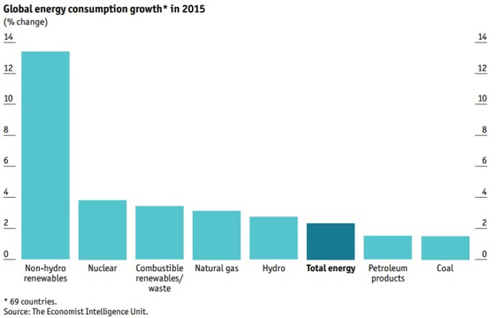
However, as the report’s authors write, “non-fossil fuels lack the overarching policy support they need to make faster progress globally.”
The report, which investigated six industries and their prospects for 2015, highlighted the massive part China is having on the global energy scene…….http://cleantechnica.com/2015/01/16/renewable-energy-growth-outstrip-fossil-fuels/
Renewable energy in USA cost competitive – can triple by 2030
US can more than triple its renewable energy says IRENA report, Renewable Energy  Magazine Robin Whitlock, 15 January 2015 27 percent renewable energy is both technically possible and cost-effective by 2030 according to the International Renewable Energy Agency (IRENA). The US can increase its renewable energy capacity from 7.5 percent of the energy mix in 2010 to 27 percent by 2030 according to a new report by the International Renewable Energy Agency (IRENA) entitled Renewable Energy Prospects: United States of America released this week on Monday 12th January. The report, which is part of IRENA’s ongoing REmap 2030 study, also says the US can increase its use of renewable energy in power generation from 14 percent to almost 50 percent by 2030, thereby making the country the world’s second largest renewable energy user after China.
“As the second largest energy consumer in the world, the US must continue to play a leading role in the global transition to a sustainable energy future” said Adnan Z. Amin, Director-General of IRENA. “The recent agreement between the US and China to reduce greenhouse gas emissions is a ground-breaking step, but this report aims even higher, showing that more can be done at limited cost.”
Current policies in place in the US would only enable the share of renewable energy to reach 10 percent by 2030. REmap 2030 estimates that an annual investment of $86 billion would be required between now and 2030 to enable this figure to rise to 27 percent, an increase of $38 billion annually beyond business-as-usual. The higher renewable share will result in annual savings of $30 billion to $140 billion by 2030 when accounting for factors such as human health and reduced emissions.
“REmap 2030 shows that the US could install significantly higher amounts of renewables – and that it can do so affordably” added Mr. Amin. “Even in a country with cheap shale gas like the US, renewable energy is still cost competitive and reduces air pollution, enhances energy security, benefits the economy, and plays a leading role in fighting climate change.”……….http://www.renewableenergymagazine.com/article/us-can-more-than-triple-its-renewable-20150115
Large-scale wave energy systems reliable – could spur economic growth in the Pacific Northwest
Wave energy integration costs should compare favorably to other energy sources, Energy Central Jan 14 – Energy Weekly News A new analysis suggests that large-scale wave energy systems developed in the Pacific Northwest should be comparatively steady, dependable and able to be integrated into the overall energy grid at lower costs than some other forms of alternative energy, including wind power.
The findings, published in the journal Renewable Energy, confirm what scientists have expected – that wave energy will have fewer problems with variability than some energy sources and that by balancing wave energy production over a larger geographic area, the variability can be even further reduced……….
Another strength of wave energy, the study suggested, is that its short-term generation capacity can be predicted with a high degree of accuracy over a time scale ranging from minutes to hours, and with some accuracy even seasonally or annually.
The Pacific Northwest has some of the nation’s best wave energy resources, and as a result is home to the Northwest National Marine Renewable Energy Center, supported by the U.S. Department of Energy .
Wave energy in the region is expected to spur economic growth, help diversify the energy portfolio, reduce greenhouse gas emissions and reduce transmission losses, the study noted,,,,,,,,,,,, http://www.energycentral.com/generationstorage/futureandalternativegeneration/news/en/34894133/Wave-energy-integration-costs-should-compare-favorably-to-other-energy-sources
Women on the move – into employment in renewable energy
 An increasing female presence in Renewable energy By Sarah Brooks Linked In 12 Jan 15 The energy sector has always been regarded as male dominated. As of 2013, females contributed to just 21% of the workforce for traditional energy sources such as oil, gas and petroleum. However in the renewables sector females appear to be getting ahead. In Scotland alone 28% of the employees of the renewable energy industry were female.
As the renewable industry is considered to be a relatively new source of energy and is still continuously undergoing development and investment, it opens up opportunities for females who would not normally be given a chance to work in the energy sector. Scotland are leading in the renewable sector in the UK, in 2012 almost 30% of electricity generated came from renewable sources compared to just 8% in England and Wales.

If the rest of the UK continue to develop similar to Scotland the number of careers for women within the sector will only increase. Although females are beginning to enter the energy workforce, it is questioned whether these are still mainly in sales and business based roles rather than technical. As of 2010, only 6% of the engineering workforce in the UK were female. Granting this, in 2013 16% of the graduates in engineering degrees were female, which was a small improvement from years prior.
This slight growth over the recent years can be shown through the fact in 2013 50% of the females employed by engineering industries were aged 25-30 years old. This is indication there will be a gradual influx of a younger generation of females into technical roles within the renewable sector as engineers begin to graduate and build their careers within the industry. Initiatives are in place to help encourage and support females to pursue engineering and technical roles. A survey carried out by Atkins in 2013 on females in engineering careers found over 50% of the sample felt they were put off at school for pursuing engineering as it being portrayed as ‘too difficult’ and ‘male dominated’………
Despite the renewable energy industry still being largely dominated by males, there is still huge opportunity for females to get on board not only in business support roles but technical too. With females being gradually encouraged to pursue an engineering career we can expect to see a gradual influx of women in the renewable workforce over the next few years…….https://www.linkedin.com/pulse/increasing-female-presence-renewable-energy-sarah-brooks
Renewable energy powers municipalities in Sweden
Municipalities in Sweden powering cities from renewable energy sources Phys Org, 13 Jan 15 By relying on district heating combined with heat and power production, municipalities in Sweden power their cities from renewable energy sources. Nordic countries have achieved a great independence from fossils because of their widespread district heating systems. District heating is a smart way to avoid using fossil fuels to heat buildings. It is typically based on wood, peat and other biofuels, or household waste. But other non-fossil fuel sources, such as deep thermal heat—sourced from between 100 to 500 meters below the ground—or recycled heat from industries can be used as well.
Two Swedish experts talk to youris.com about ways of removing carbon-based fuels from the heating equation, and what other municipalities can learn from their experience. One of them is Karin Ericsson, a senior lecturer at the Department of Environmental and Energy Systems of Lund’s University. Her research field is energy system analysis and bioenergy in Europe. The other is Mats Didriksson, who is director for the business area energy of Kraftringen, an energy company owned by four municipalities in Southern Sweden near the city of Lund.
What is the history of the development of district heating in Sweden?………
What can cities in other countries learn from Sweden’s experiences?………..http://phys.org/news/2015-01-municipalities-sweden-powering-cities-renewable.html
Ontario’s Grand Renewable Wind Project
Grand Renewable Wind Project Completed http://www.energymatters.com.au/renewable-news/grand-renewable-wind-em4640/ January 13, 2015 The 149 megawatt Grand Renewable Wind facility in Ontario is now complete and has commenced operations.
Consisting of 67 2.3 MW Siemens turbines, the wind farm will create enough clean electricity to power approximately 50,000 Ontario homes. All electrical output will be sold under a 20-year power purchase agreement with the Ontario Power Authority.
Grand Renewable is a joint venture between Samsung Renewable Energy, Inc., Pattern Energy Group Inc. the Six Nations of Grand River; comprised of the Mohawk, Seneca, Oneida, Cayuga, Onondaga and Tuscarora nations.
“The Six Nations Elected Council is committed to ensuring we enter into sustainable development projects that not only enrich our economy but are also socially and environmentally responsible,” said Chief Ava Hill, Six Nations Elected Council.
The Six Nations community owns 10% of the project.
More than 500 workers were employed on site during peak of construction, most of whom were Ontarians. 12 full-time permanent positions have been created for ongoing operations and maintenance. Construction of the project began in September 2013.
Samsung says it is making a $5-billion investment in Ontario, “to create the world’s largest cluster of wind and solar power. Our investments will create 900 direct renewable energy manufacturing jobs and 9,000 high-skilled jobs in Ontario.”
Yet to be constructed is Samsung’s 100 megawatt Grand Renewable Solar Project (GRS), the largest solar farm of its type in Canada and one of the largest in North America.
Grand Renewable Wind is the second wind farm in Ontario to reach operational status for Pattern Energy, which says it also has two other facilities under construction and two in late stage development; totaling 1,269 megawatts to be installed in the province by 2018.
The electricity from Grand Renewable Wind will make a significant contribution to Ontario’s clean energy goals.
According to Ontario’s Ministry of Energy, 20,000 MW of renewable energy will be online by 2025, representing about half of Ontario’s installed capacity. The province’s 2013 Long-Term Energy Plan (LTEP) estimates 10,700 MW of wind, solar and bioenergy capacity will be operational by 2021.
Further details of the Grand Renewable Wind and Grand Renewable Solar projects can be viewed here.
1 This Month

of the week – Shut Down Drone Warfare!


Tell the Ukrainian Government to Drop Prosecution of Peace Activist Yurii Sheliazhenko

Petition to revoke the licensing of the Near Surface Nuclear Disposal Facility (NSDF) at Chalk River. https://www.ourcommons.ca/petitions/en/Petition/Details?Petition=e-7247
To see nuclear-related stories in greater depth and intensity – go to https://nuclearinformation.wordpress.com
-
Archives
- April 2026 (114)
- March 2026 (251)
- February 2026 (268)
- January 2026 (308)
- December 2025 (358)
- November 2025 (359)
- October 2025 (376)
- September 2025 (257)
- August 2025 (319)
- July 2025 (230)
- June 2025 (348)
- May 2025 (261)
-
Categories
- 1
- 1 NUCLEAR ISSUES
- business and costs
- climate change
- culture and arts
- ENERGY
- environment
- health
- history
- indigenous issues
- Legal
- marketing of nuclear
- media
- opposition to nuclear
- PERSONAL STORIES
- politics
- politics international
- Religion and ethics
- safety
- secrets,lies and civil liberties
- spinbuster
- technology
- Uranium
- wastes
- weapons and war
- Women
- 2 WORLD
- ACTION
- AFRICA
- Atrocities
- AUSTRALIA
- Christina's notes
- Christina's themes
- culture and arts
- Events
- Fuk 2022
- Fuk 2023
- Fukushima 2017
- Fukushima 2018
- fukushima 2019
- Fukushima 2020
- Fukushima 2021
- general
- global warming
- Humour (God we need it)
- Nuclear
- RARE EARTHS
- Reference
- resources – print
- Resources -audiovicual
- Weekly Newsletter
- World
- World Nuclear
- YouTube
-
RSS
Entries RSS
Comments RSS
 nuclear-news