UK wind power surges: UK on track to meet renewable energy targets
Gas use in the UK fell by more than a fifth from 2005 to 2012, as energy efficiency increased across the economy and green energy took up more of the burden.
Under European Union targets, the UK must produce 15% of its energy from renewable sources by 2020, and is one of a small number of big member states to be judged on track to meet all of its energy and climate commitments by the European environment agency.
This was confirmed on Thursday by the Office for National Statistics, which found that 15% of the UK’s electricity came from renewable sources in 2013. This puts the UK about halfway towards its commitments, because the overall energy target includes transport and heating, as well as electricity generation. For the UK to meet its EU goals, electricity generation from renewable sources is likely to have to increase to above 30% by 2020……..
The rise in renewables while gas use fell also highlights the competition that clean energy represents to gas. Gas companies have been keen to emphasise the fuel as a “greener” alternative to coal – it burns more cleanly, producing much less carbon dioxide and none of some other pollutants associated with coal – and as a “transition” fuel that can help the move to a low-carbon economy alongside the use of renewable.
However, many in the green sector are concerned that investment in renewable alternatives could suffer if gas is prioritised. Many of Europe’s biggest players in renewable energy are power companies that still generate large amounts of their output from fossil fuels.
Renewable UK, the trade association for the wind industry, said renewable power generators were “doing their bit” towards the UK’s targets, but that fossil fuel use in transport and heating remained relatively high. For renewables to cut transport emissions too, through electric cars, the next government needs to show support for wind power, they said…….
Gordon Edge, Renewable UK’s director of policy said: “Onshore and offshore wind farms have been growing rapidly and are now generating more than half of our clean electricity. The question is whether the UK will make fast enough progress on renewable heat and renewable transport as well – that’s looking less certain. If there’s a shortfall in those areas, we’ll need to generate more renewable electricity to hit the target.
“The cheapest way to do this would be to install more onshore wind, which is why it’s utterly baffling that the Conservative party is proposing to cap the development of onshore wind if they’re elected in May.”………http://www.theguardian.com/environment/2015/feb/20/uk-on-track-to-meet-its-renewable-energy-targets
Big Solar Energy is taking off, as corporations discover its advantages
At corporations, the mentality has shifted from being willing to spend a little more money to use green power to viewing the shift to green power as a way to save money.
renewable energy—for so long a flaky, small-scale enterprise—has developed into an industrial-strength solution that affords big companies the opportunity to lock in the cost of electricity over a period of 20 to 25 years
Each of these new, large-scale transactions will displace and obviate the need for power produced from fossil fuels.
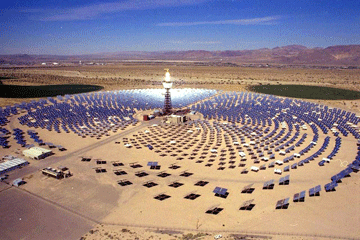
 Big Solar: Renewable energy finally makes sense as a utility—and that’s why it’s becoming a threat to coal. http://www.slate.com/articles/business/the_juice/2015/02/apple_kaiser_permanente_solar_investments_renewable_energy_is_finally_a.html
Once the technologies were proven, and the costs began to come down, investors and operators stepped in. Companies put up plants, and then made deals with utilities to buy the output—often at a price above the cost of electricity created by coal plants. Utilities complied in part because of state requirements that they source a certain percentage of their electricity from renewable sources.
Now we’re entering a new stage. Companies in sectors such as technology, health care, and consumer products—all big consumers of power—are striking deals to purchase huge amounts of renewable energy from newly constructed plants
This is different than companies putting up a solar array, or buying some carbon offsets, or making token greenness gestures. They are conjuring into existence new infrastructure that can’t help but replace coal. Continue reading
USA’s Tea Party – 85 groups join movement for solar energy!
Floridians for Solar Choice, the group behind the initiative, is an inchoate alliance of libertarians, Christian Coalition conservatives, liberal environmentalists, and eighty-five Tea Party groups
 Greening the Tea Party, New Yorker BY CAROLYN KORMANN 18 Feb 15 The solar-energy business is booming. The average cost of installing solar panels has dropped by half since 2010, and a new solar electric system is now installed somewhere in the United States every four minutes.
The growth extends well beyond the rooftops of American homes and small businesses; last week, Apple announced that it is investing in an eight-hundred-and-fifty-million-dollar solar farm in Monterey County, California, which it says will power its operations in the state by the end of 2016. Although solar is still small, supplying less than one per cent of the country’s electricity, its growth has alarmed the energy industry’s old guard—coal, oil, and utility companies. Continue reading
California’s solar industry boosting jobs
Report: California adds nearly 7,500 solar jobs to its nation-leading total http://www.sacbee.com/news/business/article10468988.html BY MARK GLOVER MGLOVER@SACBEE.COM 02/16/2015
California’s solar industry added nearly 7,500 jobs in 2014, boosting its nation-leading total to 54,690, according to a new report by the Washington, D.C.-based Solar Foundation.
That represented a 15.8 percent gain over 47,223 reported in 2013. Nearly 60 percent of the current jobs are in the solar installation sector, according to the report.
Massachusetts was a distant second in the 2014 job rankings, with 9,400 solar industry jobs.
“California’s solar industry has once again proven to be a powerful engine of economic growth and job creation,” Andrea Luecke, foundation president and executive director, said in a statement accompanying the figures.
The report also noted that California is projected to add nearly 10,000 more solar industry jobs in 2015.
The foundation said there were 2,094 solar companies in California as of November 2014, also No. 1 nationally. The Golden State also topped the nation in the number homes powered by solar energy, at more than 2.38 million.
Nationally, the foundation said 173,807 held jobs in the solar industry near the end of 2014, up 21.8 percent from the previous year.
Community renewable energy for Britain
 Buy into renewables! New Internationalist,
One way to decrease this demand is to use household or community-owned renewables instead of commercial energy plants for power.
At the moment, this is rare in Britain, because the cheap bank loans which could fund renewable energy aren’t made available to individuals or community groups (while fossil fuel investors have no problem getting hold of them).
Community projects often cost under $15 million, and ‘at that level, banks aren’t really interested,’ explains Emma Bridge, chief executive of community generator association, Community Energy England (CEE).
Crowd-sourcing and community funding schemes such as Trillion Fund can pay for some renewables, but when it comes to bigger renewable projects, current laws don’t give communities much in the way of rights to buy and profit from them.
Renewables face not only a funding problem, but a legal problem too, especially in places where laws don’t allow members of the public to buy shares in private power plants.
The ‘right to invest’ clause in the most recent version of the Infrastructure Bill (currently working its way through parliament) only lets the public ask for 5-per-cent ownership on large wind-turbine projects, even when they are in public backyards.
Lord Cameron of Dillington’s remark when debating the bill was that 10-per-cent public wind-turbine ownership would let members of the activist public stop wind-turbine construction.
In Denmark, where there is currently a fracking ban in place, the opposite is true. Most of Denmark’s wind-power energy source is community-owned and wind power provides most of the country’s power on some days.
Profits from wind-energy bills go towards local community funds, thanks to a law requiring up to 20-per-cent public ownership of wind turbines.
‘For a long time, Britain has been one of the worst-performing countries in Europe when it comes to utilizing renewable energy,’ says Paul Monaghan, sustainability advisor at Co-operative Energy.
The British consumer-managed energy supplier thinks 25 per cent should be the minimum amount of public ownership offered for larger renewable power projects.
Instead, the government will soon remove British landowners’ right to prevent frackers from trespassing beneath homes.
Allowing more public ownership of renewables can be seen as a way of safeguarding public access to electricity and water in the face of fracking and dwindling traditional oil and gas reserves. http://newint.org/blog/2015/02/13/buy-renewables/#sthash.0uTfDW2S.dpuf
Google’s big investment in renewable energy, $US1.5 billion and more
 Google joins Apple in turning to renewable energy, SMH February 12, 2015 Matt O’Brien Google has spent $US1.5 billion ($1.95 billion) around the world on clean energy projects cutting the pollution from millions of users clicking on search links, watching YouTube videos and sending emails, but now it’s found a powerful electricity source close to home. The company will announce Wednesday that it is buying power from the Altamont Pass, one of the nation’s oldest, largest and most iconic wind farms that is about to get a Google-funded makeover.
The tech giant has no plans to brand the blades with its multicolored logo, but its 20-year power purchase agreement with Florida-based NextEra Energy will dramatically transform the rolling, treeless landscape that connects the Bay Area with the Central Valley here. About 770 old turbines from the 1980s will be replaced this year by 48 new machines producing twice as much energy, enough to power Google’s corporate campus in Mountain View with 100 percent renewable power.
It’ll be majestic,” said Sam Arons, an energy strategist at Google. “Today there are many small turbines of all different sizes, all different vintages. It’s kind of a hodgepodge out there. Once this project is done, you’ll see a lot of tall, sleek, majestic turbines that will really de-clutter the landscape.”
Google’s involvement is the latest green power play from a company that has spent a decade dropping money on wind, solar and geothermal projects from West Texas to South Africa and the Netherlands, and is an investor in Ivanpah, the massive solar thermal power plant built by BrightSource Energy in the Mojave Desert. Google says it operates with 35 percent renewable power worldwide.
Last year, it spent $US3.2 billion to acquire Nest Labs, maker of the slick “learning thermostat.” It also quietly named John Woolard, the former CEO of Brightsource, as a vice president for energy. It has several previous deals with NextEra – for wind farms in Iowa, North Dakota and Oklahoma – and recently invested in Utah’s largest solar plant.
But unlike most of those projects, Google’s Altamont venture is more than a capital investment. Just 50 miles from Mountain View, it will do more to reduce the Googleplex’s carbon footprint than any of the quirky projects on the corporate campus, from the 1.9-megawatt solar array to the plant fueled by landfill gas.
Google is the second Silicon Valley tech giant this week to announce a major local green energy project. On Tuesday, Apple announced an $US850 million agreement to buy power and help build a 280-megawatt solar farm in Monterey County……..
The price of wind has declined very, very substantially over the past couple of years and the technology has improved,” said Ryan Wiser, a staff scientist who studies electricity markets at the Lawrence Berkeley National Laboratory. “The cost of wind energy is so low that it’s not as if these companies are taking an enormous financial risk in locking into these agreements. The price is stable.” http://www.smh.com.au/environment/climate-change/google-joins-apple-in-turning-to-renewable-energy-20150211-13cdge.html
Solar Powering your home, and perhaps the grid, too, with new Tesla battery
 This new Tesla battery will power your home, and maybe the electric grid too, WP, By Brian Fung February 12 Tesla is working on a battery that can power your home and even help large-scale utilities store energy more efficiently, according to company chief executive Elon Musk.
On an investor call Wednesday, Musk said the designs for a home or business battery are already complete and will likely be unveiled to the public “in the next month or two.” Production could be as little as six months away, he added…..
Tesla’s battery and charging technology could ultimately wind up saving you money on your electric bill. Although many of today’s homes draw energy directly from the electricity grid, the spread of cheap solar panels means it’s never been easier to generate some of your own energy. Storing renewables efficiently has been a big bottleneck for consumers and for utilities alike, but if Tesla’s stationary battery takes off, it could change the way electricity is priced and traded on a market scale…….http://www.washingtonpost.com/blogs/the-switch/wp/2015/02/12/this-new-tesla-battery-will-power-your-home-and-maybe-the-electric-grid-too/?tid=pm_business_pop
Renewable Energy + Storage a better option for Ontario than Nuclear Power
Is nuclear refurbishment Ontario’s best option?, Corporate Knights, BY TYLER HAMILTON FEBRUARY 11, 2015 A renewables and energy storage combo could do the job and shouldn’t be ignored, a Navius Research analysis argues. ances are slim that shiny new nuclear plants will be built in Ontario. High upfront costs and a history of delays and cost overruns are among the reasons “new builds” will likely never happen in the province.
But there remains widespread debate over plans to refurbish existing reactors at the Darlington Nuclear Generating Station in Clarington, about an hour east of Toronto.
Ontario Power Generation, the province-owned electricity generator, is determined to rebuild the cores of four reactors at the Darlington site. Together, the four reactors represent about 3,500 megawatts of generating capacity and refurbishing them will extend their lives by about 30 years.
The utility estimates the project will carry a final price tag of $12.9 billion once completed a little over a decade from now. Is that a deal for Ontario ratepayers, or is there a better, less risky, and just as climate-friendly alternative?
Let’s put aside the standard anti-nuclear talking points about the risk of a Fukushima-style accident or the challenges and unknown costs involved with storing highly toxic nuclear waste far into the future. A new case study done by Vancouver-based Navius Research calls into question the wisdom of Ontario’s refurbishment plan in a world where solar power and energy storage costs are falling dramatically.
The Navius report, using a detailed model of Ontario’s electricity system that accounts for the current mix and performance of energy generation, simulated the grid for a full year under a variety of different conditions to see how it would respond.
It found that renewables in combination with the right amount of energy storage – in this case, compressed air energy storage (CAES) – and a small amount of natural gas generation would result in “equivalent GHGs and quite similar electricity system costs” compared to nuclear refurbishment……..
the findings are compelling enough that it should give Ontario pause before taking the plunge with Darlington, …….http://www.corporateknights.com/channels/utilities-energy/nuclear-refurbishment-ontarios-best-option/
Vermont’s largest city , Burlington, now on 100% renewable energy
Burlington, Vermont Now Runs on 100 Percent Renewable Energy, Triple Pundit, Leon Kaye | Monday February 9th, Burlington, Vermont, has been making waves for becoming the first city in the U.S. to be powered 100 percent by renewables. (Some may say Greenburg, Kansas was the first, but we are talking about a town of 800 people versus 42,000 in Burlington.) Reliant on coal a generation ago, Vermont’s largest city has slowly revamped its energy portfolio, culminating in the purchase of a hydropower plant late last year.
This milestone may not be surprising considering Vermont’s progressive politics and buy-in from residents who overall supported the plan of the local utility,Burlington Electric. But the fact that Burlington has been able to do this without raising rates since 2009 — while saving the city about $20 million over the next 20 years — creates a case study for communities that are interested in investing in renewables but skittish about making such an aggressive move………http://www.triplepundit.com/2015/02/burlington-vermont-runs-100-renewable-energy
Israel way behind in renewable energy
Israel lags in recycling and renewable energy
Israel near bottom of OECD recycling and renewable energy rankings; has largest per capita public water usage.
 The war on solar, which is real, is really a war over what kind of energy system we will have in the 21st century. Will it be the 21st century model we at GreenWorld and NIRS advocate, based on clean renewable energy, distributed generation and the rest? Or will it be a continuation of the 20th century model of large baseload power plants, whether they be coal or nuclear? That’s the fundamental issue and how it is resolved may well determine the future of our planet.
 Clean energy vs nuclear: the battle intensifies http://safeenergy.org/2015/02/06/clean-energy-vs-nuclear/ Michael Mariotte February 6, 2015
In theory, the USA’s “all of the above” energy policy has a certain amount of appeal: why should government pick winners and losers? Why not–since no one knows the future–as a matter of policy pursue all energy sources?
One obvious issue is the availability of sufficient resources to effectively support all energy sources.
But there is a much more fundamental problem that makes “all of the above” a PR tagline, not a real energy policy: some energy sources are simply incompatible with others.
Specifically, the 20th century “baseload” power approach of electricity generation and distribution–reliant on large nuclear and coal plants–does not work in a 21st century energy system based on clean, distributed generation, energy efficiency, and a smart grid.
That’s a problem, especially for those who want to end fossil fuels and view both nuclear power and renewables as having a role to play in fighting climate change. The choice isn’t clean energy versus coal; it’s clean energy versus fossil fuels and nuclear because the baseload power model–which is the only model in which nuclear works–prevents the integration of all but a small percentage of renewables into the grid.
Germany and some other European countries already have reached that point. And some U.S. states are getting there rapidly.
Naive nuclear backers may not understand this reality, but the nuclear utilities (which are the same, by the way, as the fossil fuel utilities) do understand it. That’s why the nuclear industry isn’t going after natural gas, which is its main competitor in many locations at the moment. Instead, as this long and well-done article, titled Why the nuclear industry targets renewables instead of gas, from Midwest Energy News points out, the nuclear industry is going after renewables–and in a big way.
Others, focused more on fossil fuels, have noticed the same trend from the flip side. The Institute for Energy Economics and Financial Analysis (IEEFA) this week points out that while the media has been obsessed with the notion of a “war on coal,” the real war going on is the war on solar power. While IEEFA takes on the issue from the viewpoint of the fossil fuel industry going after solar, remember: the nuclear and fossil fuel utilities are one and the same. Continue reading
The unstoppable success of renewable energy in Germany
 Renewable energy continues to gain momentum in Germany,http://www.hydrogenfuelnews.com/renewable-energy-continues-gain-momentum-germany/8521078/ Stephen Vagus , Hydrogen Fuel News, 05 February 2015.
German Energiewende appears to be on track as the country continues to support clean power
Germany’s transition toward renewable energy, also called its Energiewende, has received some criticism over the past few years. The country is distancing itself from fossil-fuels and nuclear power, hoping to derive the majority of its electrical power from renewable sources in the coming years. A new report from Agora Energiewende, shows that the country’s transition may be right on track, despite concerns that the transition is too costly for the country.
Report predicts that Germany will receive 80% of its energy from renewable sources by 2050
According to the report, Germany is on track to meet its renewable energy goals by 2025. Beyond that, Germany is expected to receive as much as 60% of its power from renewable sourced by 2035, and 80% of its energy from renewables by 2050. The report also shows that clean energy accounts for the majority of Germany’s power, ahead of coal. The report also shows that Germany’s economy has grown by 40% since 1990, while demand for electrical power has been falling over the past several years.
Solar energy continues to receive support from German government
The German government has been showing strong support for various forms of clean power, but has been particularly interested in solar and wind power. Germany had once offered aggressive incentives meant to support the adoption of solar energy, but the country’s feed-in tariffs had proven so successful that they were considered financially unstable for the government. Though these incentives have been reduced, solar energy continues to thrive throughout Germany.
Wind energy is gaining traction in the country
Wind power has also become quite popular in Germany. Several German states have begun embracing wind energy, using large and small-scale wind farms to meet their electricity needs. Offshore wind projects have also found support from the German government. These projects have the potential to generate a large amount of electrical power and will not take up land within Germany. The government has also been promoting clean transportation, highlighting hydrogen fuel cells as the potential future of the auto industry.
Roodfop solar will get a boost from high efficiency concentrating solar cells
High efficiency concentrating solar cells move to the rooftop, EurekAlert, 5 Feb 15 ULTRA-HIGH EFFICIENCY SOLAR CELLS SIMILAR TO THOSE USED IN SPACE MAY NOW BE POSSIBLE ON YOUR ROOFTOP THANKS TO A NEW MICROSCALE SOLAR CONCENTRATION TECHNOLOGY DEVELOPED BY AN INTERNATIONAL TEAM OF RESEARCHERS.
“Concentrating photovoltaic (CPV) systems leverage the cost of high efficiency multi-junction solar cells by using inexpensive optics to concentrate sunlight onto them,” said Noel C. Giebink, assistant professor of electrical engineering, Penn State. “Current CPV systems are the size of billboards and have to be pointed very accurately to track the sun throughout the day. But, you can’t put a system like this on your roof, which is where the majority of solar panels throughout the world are installed.”
Giebink notes that the falling cost of typical silicon solar cells is making them a smaller and smaller fraction of the overall cost of solar electricity, which also includes “soft” costs like permitting, wiring, installation and maintenance that have remained fixed over time. Improving cell efficiency from about 20 percent for silicon toward greater than 40 percent with multi-junction CPV is important because increasing the power generated by a given system reduces the overall cost of the electricity that it generates………http://www.eurekalert.org/pub_releases/2015-02/ps-hec020515.php
Solar energy leads the pack as Britain’s renewable energy surges ahead
Britain’s Renewable Energy Sector Is Surging — Mostly Thanks To Solar, Business Insider TOMAS HIRST JAN 9 2015 The UK’s renewable energy sector is quietly booming and much of the gains are being driven by a single technology — solar panels…… a report released by the UK government shows that the prospects for the sector are quickly improving.
Firstly, the UK’s embarrassingly low share of renewable energy is showing signs of significant improvement. Renewables’ share of electricity generation increased from 13.6% in 2013 Q3 to 17.8% in 2014 Q3. To put that into context, the figure was below 8% in the first quarter of 2011……..
A big part of the gains in recent years have come from two sources in particular — bio-energy and solar………
the stand-out story of the past few years has been the rise and rise of solar. As the report states:
“Solar photovoltaic (PV) capacity was the largest contributor to the increase on a year earlier, increasing by 1.9 gigawatts [equal to one billion watts], with the majority of this coming from large-scale schemes.”
While those figures are encouraging, there is still a great deal of potential yet to be exploited. An analysis undertaken by the government in 2012 suggested that by 2020 solar panels could potentially produce as much as 20 gigawatts of electricity — an amount that would almost double the total current output from the sector.
Although that represents the maximum potential it nevertheless is indicative of the possibilities that are opening up from developments in solar. In particular, technological advances have made solar panels much more efficient than ever before. This has meant that over the past decade the cost of solar energy has plummeted by over 50%………..http://www.businessinsider.com.au/solar-energy-is-driving-a-renewable-energy-sector-boom-in-britain-2015-1
India’s energy future is in renewables: nuclear costly and dirty
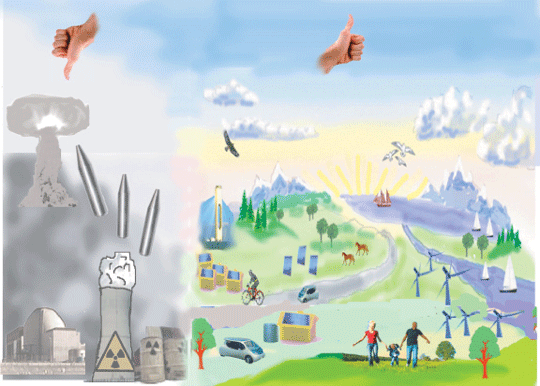
 Nuclear Energy is past its expiry date, renewal energy is the future. ABP Live, Food and trade policy analyst Devinder Sharma Wed, Jan 28, 2015 “……..Prime Minister Narendra Modi is now laying stress on renewal and clean sources of energy, and has promised to generate 100,000 MW from solar power in next few years. This is heartening by all standards.
This brings me to the media excitement that I see all around from the so-called ‘breakthrough’ that has been achieved in Indo-US nuclear deal. With India accepting to shoulder the liability, with the assurance of putting together an insurance pool and thereby allowing the suppliers of nuclear equipment to go Scott free in case of a nuclear mishap, the question that nuclear energy is safe and clean is itself being defeated. Why should nuclear suppliers insist on not being held responsible in case of a nuclear accident if the technology is safe?
I don’t understand why and how nuclear energy is being called safe and clean……….
Let’s look at the cost involved. According to the Union of Concerned Scientists: “Between 2002 and 2008, cost estimates for new nuclear power plant construction rose from between $ 2 billion and $ 4 billion per unit to $9 billion per unit, while experience with new construction has seen costs continue to soar.” With the costs rising, the nuclear suppliers have been seeking government subsidies, including loan guarantees, tax credits. Interestingly, some estimates point to the huge burden on taxpayers, stating that the plants cost more to taxpayers than the market value of power generated. Nuclear energy today is the most expensive.
With such an expensive source of energy, I don’t think Indian industry can be viable and competitive unless of course massive subsidies are provided to keep the nuclear plants running. If India can provide for massive subsidy support, I wonder why the same investment can’t be made for harnessing solar and wind energy. Let us not forget that way back in 1985 Forbes magazine had categorically termed the US nuclear industry “the largest managerial disaster in business history.” And this also points to the managerial failure to find a safe burial for the nuclear waste generated……..
the huge potential that exists in non-conventional energy resources. In solar alone, India is presently producing only 0.5 per cent of the estimated potential of 750 GW. This estimate is based on the wastelands that can be used for solar power generation. But I see no reason why rooftop solar power generation cannot replace the household (as well as commercial establishments like hotels/hospitals/malls) use of electricity.
In case of wind, Energy Minister Piyush Goyal has already given a green signal for stepping up the existing capacity, by promising to put up 10,000 MW of wind power installations every year. Add to this the massive potential that exists in biogas and biomass, India can easily chart a new pathway in meeting its growing energy needs. Given that the crude oil prices have fallen drastically, and are expected to stay low, the challenge to build up the country’s energy needs from clean, safe and non-conventional resources is immense and untapped. http://www.abplive.in/author/devindersharma/2015/01/28/article487692.ece/Nuclear-Energy-is-past-its-expiry-date-renewal-energy-is-the-future.
1 This Month

of the week – Shut Down Drone Warfare!


Tell the Ukrainian Government to Drop Prosecution of Peace Activist Yurii Sheliazhenko

Petition to revoke the licensing of the Near Surface Nuclear Disposal Facility (NSDF) at Chalk River. https://www.ourcommons.ca/petitions/en/Petition/Details?Petition=e-7247
To see nuclear-related stories in greater depth and intensity – go to https://nuclearinformation.wordpress.com
-
Archives
- April 2026 (114)
- March 2026 (251)
- February 2026 (268)
- January 2026 (308)
- December 2025 (358)
- November 2025 (359)
- October 2025 (376)
- September 2025 (257)
- August 2025 (319)
- July 2025 (230)
- June 2025 (348)
- May 2025 (261)
-
Categories
- 1
- 1 NUCLEAR ISSUES
- business and costs
- climate change
- culture and arts
- ENERGY
- environment
- health
- history
- indigenous issues
- Legal
- marketing of nuclear
- media
- opposition to nuclear
- PERSONAL STORIES
- politics
- politics international
- Religion and ethics
- safety
- secrets,lies and civil liberties
- spinbuster
- technology
- Uranium
- wastes
- weapons and war
- Women
- 2 WORLD
- ACTION
- AFRICA
- Atrocities
- AUSTRALIA
- Christina's notes
- Christina's themes
- culture and arts
- Events
- Fuk 2022
- Fuk 2023
- Fukushima 2017
- Fukushima 2018
- fukushima 2019
- Fukushima 2020
- Fukushima 2021
- general
- global warming
- Humour (God we need it)
- Nuclear
- RARE EARTHS
- Reference
- resources – print
- Resources -audiovicual
- Weekly Newsletter
- World
- World Nuclear
- YouTube
-
RSS
Entries RSS
Comments RSS
 nuclear-news