100% renewable energy for Hawaii by 2040
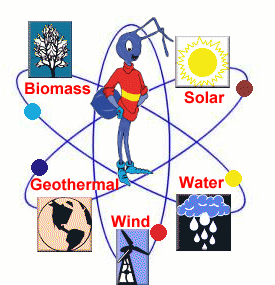 Hawaii aims for 100% renewable energy by 2040, REneweconmy By Ari Phillips on 13 March 2015 Hawaii is on track to pass legislation this year requiring the state to go 100 percent renewable by 2040.
Earlier this month, committees in the Hawaii House and Senate both unanimously recommended bills that would raise the state’s Renewable Portfolio Standard (RPS) from the current target of 70 percent by 2030 to the ultimate goal of 100 percent by 2040. Hawaii has 100% renewabl eenergy had an RPS since 2001, and right now the state gets just over 21 percent of its power from renewable sources — a 12 percent increase in just six years.
“Even our utility is saying we can hit 65 percent by 2030, so 100 percent is definitely doable,” Sen. Mike Gabbard (D), sponsor of the Senate bill, SB 2181, and chair of Hawaii’s Energy and Environment Committee, told ThinkProgress. “This is huge for our state’s future. Each year, we spend $3 to $5 billion importing fossil fuels to power our economy. Our electricity bills are roughly three times the national average.”
The Aloha state is 2,500 miles from Los Angeles — about the same distance as New York City to L.A. — and its energy situation bears little resemblance to the mainland’s. Along with Alaska and Texas, it is one of only three states to have its own electricity grid — in fact, it has three of them for three different islands. In 2013, the state had the highest electricity prices in the nation due to its heavy reliance on imports. More than two-thirds of electricity generation on the island archipelago comes from imported oil; in the rest of the U.S., oil accounts for less than one percent of electricity generation.
As recently six years ago, more than 90 percent of Hawaii’s yearly electricity generation came from coal and oil. With renewable technologies rapidly advancing, Hawaii’s abundant solar, wind, hydro, and geothermal sources are moving in quickly as replacements for costly fossil fuels.
“We are on the leading edge of the 21st century renewable energy transformation,” Chris Lee (D), Sponsor of the House version of the bill, HB 623, and chair of the House Energy and Environment Committee, told ThinkProgress. Lee said he’s been pushing for a 100 percent RPS bill for three years, but that this is the first year there’s been overwhelming support to move forward……….http://reneweconomy.com.au/2015/hawaii-aims-for-100-renewable-energy-by-2040
The advance of solar energy about to disrupt fossil fuel industries
 Is renewable energy ready to disrupt fossil fuels? CNBC Leslie Shaffer | @LeslieShaffer1 18 Mar 15 Prices of fossil fuels may be plumbing multi-year lows, but that’s not likely to keep them from being displaced by the advance of renewable energy, especially solar, analysts said.
“Renewable energy technologies are far further advanced than many may believe: solar photovoltaic (PV) and on-shore wind have a track record of successful deployment, and costs have fallen dramatically in the past few years,” Alex Thursby, chief executive of the National Bank of Abu Dhabi (NBAD), said in a report published this month. “In many parts of the world, indeed, they are now competitive with hydrocarbon energy sources.”
Read MoreFive crazy things being powered by the sun
Over the past few years, more than 50 percent of new investment in electricity generation capacity has been from renewable sources, with around $260 billion a year invested in renewable-energy technology over the past five years, said the report, which was prepared for NBAD by the University of Cambridge and PwC.
The cost of solar PV is down more than 80 percent since 2008 and modern wind turbines produce around 15 times more electricity than in the 1990s, it said………
The development of cost efficient electricity-storage technology may be the missing link on wider adoption, Deutsche Bank said.
“Solar plus storage is the next killer app that could significantly accelerate global solar penetration,” it said, adding it expects “significant progress” on improving the cost within five years.
—By CNBC.Com’s Leslie Shaffer; Follow her on Twitter @LeslieShaffer1 http://www.cnbc.com/id/102510242
IAE finds that renewable energy and efficiency are significantly reducing greenhouse gas emissions
Renewable energy sources really making a difference! http://www.enn.com/business/article/48343 Global emissions of carbon dioxide from the energy sector stalled in 2014, marking the first time in 40 years in which there was a halt or reduction in emissions of the greenhouse gas that was not tied to an economic downturn, according to new data from the International Energy Agency (IEA).
“This gives me even more hope that humankind will be able to work together to combat climatechange, the most important threat facing us today,” said IEA Chief Economist Fatih Birol, recently named to take over from Maria van der Hoeven as the next IEA Executive Director.
Global emissions of carbon dioxide stood at 32.3 billion tonnes in 2014, unchanged from the preceding year. The preliminary IEA data suggest that efforts to mitigate climate change may be having a more pronounced effect on emissions than had previously been thought.
“This is both a very welcome surprise and a significant one,” added Birol. “It provides much-needed momentum to negotiators preparing to forge a global climate deal in Paris in December: for the first time, greenhouse gas emissions are decoupling from economic growth.”
Renewable Energy Target to be raised in Norway and Sweden
Norway and Sweden agree to raise renewable energy target http://af.reuters.com/article/energyOilNews/idAFL5N0WF0YY20150313 Fri Mar 13, 2015 OSLO, (Reuters) – Norway and Sweden agreed on Friday to increase a joint 2020 renewable energy target by almost 8 percent under a subsidy scheme which could lead to higher energy prices for consumers.
Under the new target, the two Nordic countries aim to raise the amount of electricity they produce in total from renewable energy sources such as wind, hydro or biomass to 28.4 terawatt-hours (TWh) per year by 2020 from 26.4 TWh.
The changes to the common support scheme need to be approved by lawmakers in both countries before it comes into effect.
Norway and Sweden launched the first cross-border renewable support scheme in the world in 2012. Producers receive electricity certificates depending on how much green power they produce, which they can sell on the market for profit.
However, the system is financed by electricity end-users, as the costs of the certificates are added to electricity bills, meaning consumers in Norway and Sweden contribute to paying for rises in renewable energy production.
Higher renewables output could also increase pressure on already low Nordic power prices, hurting revenues of such power producers as Vattenfall or Statkraft.
Nordic spot power prices fell to 29.61 euros per megawatt-hour (MWh) in 2014, the lowest since 2007, partly due to more renewable power being added, sluggish demand and warm weather.
However, the wind power industry welcomed the news.
“It’s a big boost for the Nordic electricity certificate market. There will be additional 2 TWh to fight for,” said Andreas Thon Aasheim, an advisor at Norwegian wind power association Norwea, referring to the additional renewable output agreed by the two countries.
Norway lags Sweden on wind power production, but the Norwegian government has agreed to harmonise depreciation rules for wind power projects to bring them into line with Sweden. (Reporting by Nerijus Adomaitis; editing by Nina Chestney and David Evans)
 we will need to reduce the power and influence of the fossil fuel companies, kicking their representatives out of government and moving subsidies away from polluting fuels and towards clean energy. Divestment campaigns shouldn’t just call for an end to fossil fuel funding but galvanize a shift in public investments into cleaner alternatives: not corporate renewable schemes but community energy, sustainable local transport and energy efficiency projects.
We can’t just sit back and expect the falling price of solar and wind to sweep away the old energy order. Renewable energy could be a powerful tool for dismantling the current failed system – but we need to use it wisely, and not let it fall into the wrong hands!
 Whose renewable future? New Internationalist MARCH 2015 Is big business poised to capture the renewables revolution? Danny Chivers draws up the battle lines. “……..This increasing reliance on companies, not governments, as providers of energy services and infrastructure is driven by a global economic system based on market ‘liberalization’, profit maximization and endless growth. It’s a trend that we need to reverse if we want renewable energy truly to be a force for good.
Luckily, alternative models are appearing all over the world. Renewable energy co-operatives have hundreds of thousands of members and are building and installing their own solar, wind and small-scale hydro projects from Indonesia to Costa Rica. Continue reading
China’s wind power developing fast, much greater capacity than its nuclear power
 China’s wind farms can now produce more energy than all of America’s nuclear plants Quartz, 9 Mar 15 China is building more than a third of the world’s nuclear reactors currently under construction, and has plans to triple its nuclear power capacity by 2020. That has some observers worried about the country’s opaque and politicized nuclear safety regulations.

Despite the government’s ambitious goals to keep developing its nuclear energy capacity, for the foreseeable future, nuclear is unlikely to match wind in China.
The danger of big corporations controlling renewable energy systems
Whose renewable future? New Internationalist MARCH 2015 Is big business poised to capture the renewables revolution? Danny Chivers draws up the battle lines.
 “……Who has power over power?
As wind and solar technology gets cheaper – and if low oil prices and increasing climate regulation and extraction costs make fossil fuels less profitable – we can expect more and bigger corporate players to move into the sector, including existing oil and gas corporations.
Energy supply in many countries is already in the hands of privatized utility companies, thanks to decades of privatization driven by neoliberal Northern governments and institutions like the World Bank. This has led to rising energy bills and the continuing failure to supply grid electricity to harder-to-reach (and thus less profitable) rural communities. Around 1.3 billion people worldwide still have no access to electricity, while many others struggle to afford it.
There are vital battles still to be fought over the ownership, control of and access to renewable energy. Who will pay for and own the building materials, the factories, the technical knowledge, the site of installation, the equipment and the energy it produces? The more democratic control that can be exerted over each stage of this process, the greater our chances of creating low-impact, climate-friendly energy systems that supply affordable energy to all. We also need the transition to be a fair one that retrains and transfers workers from the fossil energy sector; this will only happen if the voices of workers carry more weight in the process than the desires of the energy companies.
It’s hard to imagine the big privatized companies voluntarily working to reduce energy consumption in the North; it’s equally hard to envision them supporting a phase-out of fossil fuels as renewables expand, or supporting policies to provide affordable energy to those most in need. These companies have been driving our civilization towards a cliff edge, and now they are eyeing up the keys to our shiny, new, renewably powered electric bus……… http://newint.org/features/2015/03/01/renewable-energy-keynote/
Big utilities fight back against rooftop solar
“Independent studies show that distributed solar benefits all ratepayers by preventing the need to build new, expensive power plants or transmission lines,” said Matthew Kasper, a fellow at the Energy & Policy Institute, a pro-solar think tank. “Utilities make their money by building big, new infrastructure projects and then sending ratepayers the bill, which is exactly why utilities want to eliminate solar.”
“It’s really about utilities’ fear that solar customers are taking away demand,” said Angela Navarro, an energy expert with the Southern Environmental Law Center. “These customers are installing solar at their own cost and providing a valuable resource: additional electricity for the grid at the times when the utilities need it most. And it’s all carbon-free.”.

 Utilities wage campaign against rooftop solar WP By Joby Warrick March 7 Three years ago, the nation’s top utility executives gathered at a Colorado resort to hear warnings about a grave new threat to operators of America’s electric grid: not superstorms or cyberattacks, but rooftop solar panels.
If demand for residential solar continued to soar, traditional utilities could soon face serious problems, from “declining retail sales” and a “loss of customers” to “potential obsolescence,” according to a presentation prepared for the group. “Industry must prepare an action plan to address the challenges,” it said.
The warning, delivered to a private meeting of the utility industry’s main trade association, became a call to arms for electricity providers in nearly every corner of the nation. Three years later, the industry and its fossil-fuel supporters are waging a determined campaign to stop a home-solar insurgency that is rattling the boardrooms of the country’s government-regulated electric monopolies.
The campaign’s first phase—an industry push for state laws raising prices for solar customers—failed spectacularly in legislatures around the country, due in part to surprisingly strong support for solar energy from conservatives and evangelicals in traditionally “red states.” But more recently, the battle has shifted to public utility commissions, where industry backers have mounted a more successful push for fee hikes that could put solar panels out of reach for many potential customers. Continue reading
Renewable energy development could be taken over by the same old neocolonial racist corporations
Whose renewable future? New Internationalist MARCH 2015 Is big business poised to capture the renewables revolution? Danny Chivers draws up the battle lines.
“………. What are we up against?
Let’s not kid ourselves. The fossil fuel industry’s main response to clean energy is to try to squash it. Selling the highly concentrated energy in oil, coal and gas is far more profitable in the short term than the slow-release, distributed energy from wind or solar power – especially when you factor in generous government fossil fuel subsidies, an international energy infrastructure already set up to use these fuels, and free rein to pump carbon pollution into the air at little or no cost. Whether it’s funding pro-fossil politicians, forging cosy links with officials or pouring money into anti-renewable front groups, the big oil, gas and coal companies are working hard to keep society hooked on their highly profitable products, and prevent alternatives from getting off the ground.6
There are exceptions to this rule. If those alternatives can provide decent short-term returns or access to new subsidies without disrupting the existing energy markets, then the big players might be tempted to step in. This is why the likes of BP, Shell and Exxon have moved into liquid biofuels, and why major power plants like Drax in Britain are starting to mix large quantities of woodfuel in with their coal supply.
We need a democratically controlled, people-focused clean energy system
Industrial biofuels and wood-fired power stations – along with the continued destruction caused by large hydropower dams – provide perfect examples of what can happen if supposedly ‘renewable’ energy sources are exploited for maximum profit, without proper consideration for people and the environment. Energy crops and hydroelectricity may both be sustainable on a small, local, carefully managed scale – but the current profit-driven rush to turn food crops and forests into fuel is leading to hunger, land grabs and deforestation; while megadams threaten huge areas of natural habitat along with the homes, lands and livelihoods of hundreds of thousands of people.
These projects should act as a stark warning. Wind and solar power are still relatively small industries on a global scale, but are growing fast. These technologies are far less destructive than fossil fuels, but that doesn’t mean they’re impact-free – especially if they develop to the scale we need for a fossil-free future. Will they be carefully manufactured in renewably powered workshops with strict respect for workers’ rights and environmental standards; using largely recycled materials, and built as part of community-run, co-operatively owned and democratic energy schemes which benefit the communities where they are sited? Or will they be churned out in nightmarish sweatshop conditions, using minerals from exploitative mining projects and sited in giant energy parks on cleared rainforest land from which the residents have been forcibly evicted?
It could go either way. Renewables could transform our energy system, with solar panels particularly well-suited for decentralized use: 85 per cent of today’s solar panels are spread over millions of rooftops, with only 15 per cent in solar parks. Increased access to and control over energy could empower millions of people, improving lives and livelihoods and boosting the political and social influence of marginalized communities.
Unfortunately, the risks are also clear. Wind and solar generators require a significant amount of building material and land space. Though requiring less than 1 per cent of the extraction needed to keep pulling coal, oil and gas out of the ground, ramping up renewables will mean a significant spike in demand for steel, cement, aluminium and copper that could have serious local impacts around the world if not carefully managed. Wind power, unlike solar, is far more efficient when built on a large scale; big wind farms typically require levels of capital investment that are out of the reach of community groups. They’re more likely to be installed by governments or large utility companies such as E.ON. Seventy-five per cent of all wind turbines are manufactured by just 10 companies.
The Desertec initiative gives us an example of what a profit-driven, centralized solar energy future might look like. We shouldn’t be surprised to see it develop along the same neo-colonial and racist lines as our current fossil fuel industry, where the rights of Indigenous peoples and communities of colour around the world are trampled in the pursuit of ‘cheap’ energy for the industrialized nations…….” http://newint.org/features/2015/03/01/renewable-energy-keynote/
UK’s Hinkley nuclear plans have “chilling effect” on renewable energy investment in Somerset
UK joins Romanian push for new EU nuclear aid package Guardian, Arthur Neslen, 5 Mar 15 “……..New research to be published on Thursday by the Resilience Centre finds that the government’s plans for a new reactor at Hinkley Point C has had what Cato calls “a chilling effect” on investment in renewable energy in Somerset.
In 2010, Somerset set a relatively low target of 63MW for solar energy capacity by 2020, which it looks likely to exceed. By comparison, neighbouring Devon has a solar energy target of 440MW while Gloucestershire has a goal of 920MW.
But the centre, says that when the lower capacity factors of renewable energy are taken into account, renewables have the potential to generate more than three times the equivalent energy of Hinkley.
Two tidal lagoons off the Somerset coast would be likely to generate 640MW, or 10% of the equivalent energy generated by Hinkley.
The Resilience Centre, which comprises technical renewable energy experts and environmental engineers, pegs Somerset’s onshore and marine generating capacity from renewables at 5.4GW – around 60% of Hinkley’s output……http://www.theguardian.com/environment/2015/mar/04/uk-joins-romanian-push-for-new-eu-nuclear-aid-package
Renewable energy to be boosted by nanotechnology
New nanomaterials will boost renewable energy, The Conversation, Liming Dai Director, Center of Advanced Science and Engineering for Carbon (Case4Carbon) at Case Western Reserve University 7 Mar 15 “…….Fuel cells usually use expensive platinum electrodes, but a non-metal alternative could be an affordable solution for energy security. Fuel cells generate electricity by oxidizing fuel into water, providing clean and sustainable power.
Hydrogen can be used as the fuel. First, hydrogen is split into its constituent electrons and protons. Then the flow of electrons generates electrical power, before the electrons and protons join with reduced oxygen, forming water as the only by-product.
This technology has high energy conversion efficiency, creates virtually no pollution, and has the potential for large-scale use. However, the vital reaction which generates reduced oxygen in fuel cells requires a catalyst – traditionally a platinum electrode. Unfortunately, the high cost and limited resources have made this precious metal catalyst the primary barrier to mass-market fuel cells………
We previously discovered a new class of low-cost metal-free catalysts based on carbon nanotubes with added nitrogen, which performed better than platinum in basic fuel cells. The improved catalytic performance can be attributed to the electron-accepting ability of the nitrogen atoms, which aids the oxygen reduction reaction. These carbon-based, metal-free catalysts could dramatically reduce the cost of commercialising of fuel cell technology. Unfortunately, they are often found to be less effective in acidic conditions – the typical conditions in mainstream fuel cells.
Using carbon composites with a porous structure to increase surface area and nanotubes to enhance conductivity, our latest research demonstrates that our nanomaterials are able to catalyse oxygen reduction as efficiently as the state-of-the-art non-precious metal catalysts – and with a longer stability. This first successful attempt at using carbon-based metal-free catalysts in acidic fuel cells could facilitate the commercialisation of affordable and durable fuel cells.
In addition to fuel cells, these new metal-free carbon nanomaterial catalysts are also efficient electrodes for low-cost solar cells, supercapacitors for energy storage, and water splitting systems which generate fuel from water. The widespread use of carbon-based metal-free catalysts will therefore result in better fuel economy, a decrease in harmful emissions, and a reduced reliance on petroleum sources. This could dramatically affect life in the near future. http://theconversation.com/new-nanomaterials-will-boost-renewable-energy-38017
Two new big solar projects for Japan
Eurus Energy brings two Japan projects online in Fukushima and Miyagi regions http://www.pv-tech.org/news/eurus_energy_brings_two_more_japan_projects_online By Liam Stoker – 04 March 2015 Operations at two new large-scale solar projects in the earthquake-affected Japanese prefectures of Miyagi and Fukushima have been started by Eurus Energy Group.
The new mega-solar projects – the Eurus Tenmyo Solar Park in Miyagi and the Eurus Yabukinakajima Solar Park in Fukushima – will have a total output of 14 MW and 8MW respectively, making them the largest solar plants in their respective prefectures.
The projects have both been eligible for subsidies under the Projects for Developing and Implementing Measures for Promotion of Power Generation Facilities Based on Renewable Energies, a plan prompted by the region’s earthquake and subsequent nuclear disaster in April 2011.
The feed-in tariff introduced in July 2012 to trigger more PV development has resulted in Japan establishing a significant solar pipeline, with these two projects the latest to contribute towards the country’s PV boom that has placed it in the top three solar nations in the world in terms of deployment.
Canadian Solar, which has significantly stepped up its interest in various segments of the Japanese PV market, has supplied modules for the Miyagi-based solar park while Japan’s Kyocera Corporation has supplied modules for the Fukushima-based project, a development that comes despite last month’s news that the electronics firm’s solar module sales revenues in Q4 2014 had been weaker than expected.
Power generated from the two projects is to be sold to Tohoku Electric Power Company while their completion has taken Eurus’ solar capacity in the country to 84 MW.
Progress in Tesla’s $5B solar-powered Gigafactory in Nevada
Construction of Tesla’s $5B solar-powered Gigafactory in Nevada is progressing nicely, Tree Hugger Michael Graham Richard (@Michael_GR) February 26, 2015
3,000 construction jobs for 3 years To change the world of transportation and leave oil behind in favor of clean sources of energy, you need batteries. Lots of them. Cheaply. That’s what Tesla is trying to do with its Gigafactory project — make as many advanced lithium-ion batteries in one location as the whole world is making today, driving down costs by at least 30%. This Gigafactory will be making 50 GWh of battery capacity per year by 2020, enough for 500,000 Tesla cars (mostly the cheaper upcoming Model 3), and the whole factory will be powered by clean energy. This is a $5 billion investment that will create 6,500 on-site jobs……http://www.treehugger.com/cars/construction-tesla-5-billion-solar-powered-gigafactory-nevada-progressing-nicely.html
Potential for growth in Japan’s solar industry
Key Japanese takeaways from PV Expo, Japan solar
Panasonic is hoping its new home energy management system products will educate consumers and their families on energy use, in turn driving wider social acceptance of the technologies and their uses. PV Tech Andy Colthorpe. 5 Mar 15
As regular readers of the site will have seen already, PV Tech was at Tokyo’s PV Expo last week. Japan has been relatively ambitious with regards to solar for many years, even ahead of the introduction of the feed-in tariff (FiT) in July 2012. Thin-film manufacturer turned vertically integrated solar services provider Solar Frontier, for instance, was established as a subsidiary of petrochemical company Showa Shell in response to the OPEC oil price shock of the 1970s.
The boom that came with the introduction of the feed-in tariff (FiT), however, turned this primary focus on R&D into the development of enough gigawatts of utility-scale PV to put Japan in the top two or three solar nations on the planet in terms of deployment.
Much has been made of the grid connection and land shortage issues now facing utility-scale solar in particular, not least by PV Tech. There is an understanding that once the currently existing pipeline of projects is deployed, Japanese utility-scale PV, or megasolar as it is known in the country, will cease to go ahead in any significant numbers. That said, the pipeline stands at more than 50GW, which is a lot of solar in anyone’s book. Project investment and project rights trading are keeping the megasolar sector busy along with actual construction and design activities.
Beyond that, of course, it will be all about the diversification of the maturing industry, whether Japan’s commercial rooftop sector will pick up where megasolar left off, and whether Japanese households will keep installing their own systems. The former remains to be seen, while the forthcoming energy market deregulation process and the activities of both solar energy services companies and their partners in the house construction industry could drive the latter to new heights……http://www.pv-tech.org/editors_blog/key_japanese_takeaways_from_pv_expo_tokyo
India going for $160 billion renewable energy business

 India’s Renewable energy sector to generate $160 billion business in five years: Economic Survey By ET Bureau | 27 Feb, 2015 NEW DELHI: Positioning India as a responsible nation committed to sustainable development, the Economic Survey 2014-15 has said the Indian clean energy sector is likely to generate business opportunities to the order of $160 billion for the next five years. …….
It elaborates that in India renewable energy offers very good opportunity for businesses to set and scale up industry, leapfrog technologies, and create volumes. Some of India’s major immediate plans on renewable energy include scaling up cumulative installed capacity to 170 GW that includes 100 GW of solar power by 2022 and establishing a National University for Renewable Energy.
To provide a big push to solar energy, two new schemes — ‘Scheme for Development of Solar Parks………..
1 This Month
29 Jan. Thursday 7-8 p.m. Webinar – World’s Largest Nuclear Station in Port Hope, ON?
To see nuclear-related stories in greater depth and intensity – go to https://nuclearinformation.wordpress.com/



31st January – Challenging the War Machine – a DECLASSIFIED UK SUMMIT


Website of the Week
Now until to February 10, 2026 Radioactive waste storage in France: the debate is finally open! How to participate?
-
Archives
- January 2026 (283)
- December 2025 (358)
- November 2025 (359)
- October 2025 (376)
- September 2025 (258)
- August 2025 (319)
- July 2025 (230)
- June 2025 (348)
- May 2025 (261)
- April 2025 (305)
- March 2025 (319)
- February 2025 (234)
-
Categories
- 1
- 1 NUCLEAR ISSUES
- business and costs
- climate change
- culture and arts
- ENERGY
- environment
- health
- history
- indigenous issues
- Legal
- marketing of nuclear
- media
- opposition to nuclear
- PERSONAL STORIES
- politics
- politics international
- Religion and ethics
- safety
- secrets,lies and civil liberties
- spinbuster
- technology
- Uranium
- wastes
- weapons and war
- Women
- 2 WORLD
- ACTION
- AFRICA
- Atrocities
- AUSTRALIA
- Christina's notes
- Christina's themes
- culture and arts
- Events
- Fuk 2022
- Fuk 2023
- Fukushima 2017
- Fukushima 2018
- fukushima 2019
- Fukushima 2020
- Fukushima 2021
- general
- global warming
- Humour (God we need it)
- Nuclear
- RARE EARTHS
- Reference
- resources – print
- Resources -audiovicual
- Weekly Newsletter
- World
- World Nuclear
- YouTube
-
RSS
Entries RSS
Comments RSS
 nuclear-news