Success of wind energy in reducing USA’s greenhouse gas emissions
Wind energy blows US emissions onto right track for 2025 target http://www.newscientist.com/article/dn27361-wind-energy-blows-us-emissions-onto-right-track-for-2025-target.html#.VTBP5tyUcnl 16 April 2015 by Fred Pearce Is Uncle Sam going green at last? US carbon emissions from power stations this year are set to be the lowest for 20 years, as decrepit coal-fired power plants shut and clean wind farms and less-dirty natural gas plants replace them.
And back in 1994, the US economy was only 42 per cent of its current size, adding evidence to the idea that an economy can grow while its emissions go down.
This year’s emissions are expected to be 15.4 per cent below 2005 levels. The startling projection comes from analysts at Bloomberg New Energy Finance. It suggests that the US may now be on course to meet the promise that the Obama administration will take to UN climate negotiations in Paris later this year, to cut total CO2 emissions by 28 per cent below 2005 levels by 2025.
So what is going on? Most attention has focused on the replacement of coal in conventional power plants by natural gas, much of it from fracking. Burning gas emits only half as much CO2 as burning coal.
And there is much more to come from wind, says William Nelson, an analyst at Bloomberg New Energy Finance. He expects 9 gigawatts more wind generating capacity to be commissioned during 2015, much of it in Texas. It is a wind of change that he calls a giant, permanent step towards decarbonising out entire fleet of power plants.
How BP started, then stopped renewable energy projects
 BP dropped green energy projects worth billions to focus on fossil fuels, Guardian, Terry Macalister, 16 Apr 15 Oil firm invested billions of pounds in clean and low-carbon energy in the 80s and 90s but later abandoned meaningful efforts to move away from fossil fuels and locked away the research BP pumped billions of pounds into low-carbon technology and green energy over a number of decades but gradually retired the programme to focus almost exclusively on its fossil fuel business, the Guardian has established.
At one stage the company, whose annual general meeting is in London on Thursday, was spending in-house around $450m (£300m) a year on research alone – the equivalent of $830m today.
The energy efficiency programme employed 4,400 research scientists and R&D support staff at bases in Sunbury, Berkshire, and Cleveland, Ohio, among other locations, while $8bn was directly invested over five years in zero- or low-carbon energy.
But almost all of the technology was sold off and much of the research locked away in a private corporate archive.
Facing shareholders at its AGM, company executives will insist they are playing a responsible role in a world facing dangerous climate change, not least by supporting arguments for a global carbon price.
But the company, which once promised to go “beyond petroleum” will come under fire both inside the meeting and outside from some shareholders and campaigners who argue BP is playing fast and loose with the environment by not making meaningful moves away from fossil fuels.
In 2015, BP will spend $20bn on projects worldwide but only a fraction will go into activities other than fossil fuel extraction.
An investigation by the Guardian has established that the British oil company is doing far less now on developing low-carbon technologies than it was in the 1980s and early 1990s. Back then it was engaged in a massive internal research and development (R&D) programme into energy efficiency and alternative energy……..
A major group of shareholders have called on the company to address climate change more robustly through a resolution to be heard at the AGM…….
Suzanne Dhaliwal from the UK Tar Sands Network said support for the AGM resolution looked hollow when the company was still engaged in carbon-heavy extraction activities. “It looks like a stalling mechanism to get large shareholders on board but from a grass roots level commitments to tackling climate change and continuing with tar sands are incompatible.”
Many leading environmentalists such as Jonathan Porritt believe fossil fuel companies will never play a leading role in any move to a low-carbon economy…….http://www.theguardian.com/environment/2015/apr/16/bp-dropped-green-energy-projects-worth-billions-to-focus-on-fossil-fuels
100% renewable energy economically feasible for France: government report

 FRENCH FEDERAL GOVERNMENT REPORT: 100% RENEWABLE ELECTRICITY BY 2050 IN FRANCE WOULD NOT COST MORE THAN 50% NUCLEAR http://www.go100percent.org/cms/index.php?id=45&tx_ttnews%5Btt_news%5D=395&cHash=c49d899dffe50003b28e67bc8ffa6655The following is a brief summary of a piece that appeared in France’s center-left newspaper Le Monde, which reported on a piece published by Mediapart:
Ademe was reportedly to have shared the document with the public on April 14-15, but postponed it was not ready. However, a copy of the report was obtained by the French media and released to to the public, with the aim of raising the debate on French energy policy.
The 120 page report was written with the contribution of the General Direction of energy and climate, which functions under the French Minister of Ecology, and with “an objective of robustness and scientific solidity, the hypotheses and results were vetted by a scientific committee of national and international experts.”
Other highlights from the report, include:
– The potential for electricity generation by renewables in France by 2050 (1268 TWh a year) is triple the nation’s projected electricity demand for that time (422 TWh). Reaching this goal would require demand management that lowers consumption by 14%, despite a projected population increase of 6 million inhabitants.
– Achieving a 100% renewable electricity mix will require diversity of sources. The study projects a mix of 63% offshore and onshore wind, 17% solar, 13% hydro, and 7% thermal energy (including geothermal). The regions with the strongest renewable development potential are the Aquitane, Brittany, Midi-Pyrénées, the Pays de la Loire, Provence-Alpes-Côte d’Azur, and Rhône-Alpes.
– The report assumes that pre-tax consumer electricity costs will rise about 30% by mid century whether France opts for a 100% renewable power mix, or a combination of 50% nuclear power, 40% renewables, and 10% fossil fuel (primarily gas).
– Between 2019 and 2025, almost half of France’s 58 nuclear reactors will reach the 40 year lifespan for which they were designed. Even if they are granted a license extension, they must be replaced by newer technology that has continually been rising in price. Decommissioning of the reactors also adds to costs.
Wind power rising fast in China, once again producing more electricity than nuclear power is
 Wind Power Beats Nuclear Again in China. Earth Policy Institute
J. Matthew Roney. 5 Mar 15 China, the country that is building more nuclear reactors than any other, continued to get more electricity from the wind than from nuclear power plants in 2014. This came despite below-average wind speeds for the year. The electricity generated by China’s wind farms in 2014—16 percent more than the year before—could power more than 110 million Chinese homes.

China added a world record 23 gigawatts of new wind power capacity in 2014, for a cumulative installed capacity of nearly 115 gigawatts (1 gigawatt = 1,000 megawatts). Some 84 percent of this total—or 96 gigawatts—is connected to the grid, sending carbon-free electricity to consumers.
As China’s wind power installations took off in the mid-2000s, electric grid and transmission infrastructure expansion could not keep pace. But the situation is improving: China is building the world’s largest ultra-high-voltage transmission system, which is connecting remote, wind-rich northern and western provinces to the more populous central and eastern ones. At the same time, the government is providing incentives for wind farm development in less-windy areas nearer to population centers. Advances in wind power technology can allow greater capture of energy in spots without the strongest wind resources.wind resources.
China’s wind power goal is to have 200 gigawatts connected to the grid by 2020. According to China’s National Energy Administration, the country has some 77 gigawatts of wind capacity now under construction, bringing this goal that much closer to being realized. Efforts to bolster the grid and connect more turbines are reducing the amount of potential wind generation lost each year due to curtailment, when turbines must stop producing because the grid cannot take on any more electricity. Since 2012, the rate of this curtailment at China’s wind farms has dropped by more than half; however, further improvements are still needed……..ttp://www.earth-policy.org/data_highlights/2015/highlights50 http://www.environmental-expert.com/news/wind-power-beats-nuclear-again-in-china-472349
Vancouver the latest of 50 cities to commit to %100 renewable energy
More than 50 cities have announced they are on their way to 100% renewable energy including San Diego and San Francisco in California, Sydney Australia, and Copenhagen. Some are aiming for 2020, others by 2030 or 2035.
Vancouver commits to run on 100% renewable energy http://www.theguardian.com/environment/2015/apr/10/vancouver-commits-to-run-on-100-renewable-energy
Canadian city of 600,000 people is the latest to announce it will use only green energy for electricity, transportation, heating and air conditioning within 20 years Vancouver has become the latest city to commit to running on 100% renewable energy. The city of 600,000 on Canada’s west coast aims to use only green energy sources for electricity, and also for heating and cooling and transportation. Continue reading
China’s energy development: renewables now looking more likely than nuclear
 As China looks to energy solutions to reduce the air pollution choking its cities, to conserve water, and to rein in its carbon emissions, it is becoming clear that renewables offer a more expeditious path than nuclear power does.
Wind Power Beats Nuclear Again in China. Earth Policy Institute, J. Matthew Roney. 5 Mar 15 “…………Even as it pursues the world’s most ambitious wind power goal, China also  undeniably has the world’s most aggressive nuclear construction program, currently accounting for 25 of the 68 reactors being built worldwide. Six reactors totaling 6 gigawatts of capacity went online in China in 2013 and 2014. Another reactor connected to the grid in January 2015, bringing national nuclear capacity to 20 gigawatts at 24 reactors. But to meet the government’s nuclear target of 58 gigawatts by 2020, China will not only need to complete the reactors now under construction—most of which are behind schedule—it will need to start and finish another dozen or so by then.
Several factors stack the odds against China meeting its nuclear power goal. After a massive earthquake and tsunami induced the 2011 nuclear meltdown in Fukushima, Japan, the Chinese government suspended approvals for new reactors as it conducted safety reviews of those operating and under construction at the time. The moratorium was lifted in late 2012, yet for more than two years no new reactors received permission to build. In February 2015, a nuclear plant in northeastern Liaoning province reportedly got the go-ahead for a two-reactor expansion. Once construction begins, it typically takes six years to complete a reactor in China (compared with one year or less for the average wind farm).
Further complicating China’s nuclear picture is that suitable real estate for new reactors along the coast—with ready access to cooling water—is in increasingly short supply. Following the Fukushima disaster, public opposition to reactors in China’s earthquake-prone inland provinces grew, prompting officials to put off consideration of proposed reactors in non-coastal provinces until 2015 at the earliest. Regardless of when the government decides to begin approving inland reactors, nuclear developers will face dwindling freshwater resources.
Perhaps the biggest question facing the future of nuclear power in China is the fate of the 1-gigawatt Sanmen reactor under construction in Zhejiang province. Designed by Westinghouse, this is a “Generation III” reactor billed as much safer than previous nuclear technologies, due to its earthquake and flood resistance features and its ability to continue cooling in the event of a prolonged loss of power. Sanmen is both the basis for Chinese-designed third generation reactors and a test case for the technology closely watched worldwide.
When construction got under way at Sanmen in 2009, completion was projected by the end of 2013. Blaming increased safety concerns and design changes post-Fukushima, the developer pushed this date back to 2015. Then in January 2015, the chief engineer of China’s State Nuclear Power Technology Corp., Wang Zhongtang, announced that Sanmen would not generate electricity until 2016, if that soon. As the project runs further behind schedule and goes further over-budget, more doubt is cast on the design’s ability to catalyze faster nuclear power growth in China.
China’s energy landscape is changing rapidly. Consumption of coal, which supplies about 75 percent of Chinese electricity, dropped nearly 3 percent in 2014, according to official datafrom China’s National Bureau of Statistics. Meanwhile, in addition to the impressive growth in wind power, China is quickly expanding its solar generating capacity. With 28 gigawatts by the end of 2014 and plans for another 15 gigawatts in 2015, China may overtake Germany for the top solar spot in a matter of months. As China looks to energy solutions to reduce the air pollution choking its cities, to conserve water, and to rein in its carbon emissions, it is becoming clear that renewables offer a more expeditious path than nuclear power does.
J. Matthew Roney is a Research Associate with Earth Policy Institute and co-author of The Great Transition: Shifting from Fossil Fuels to Solar and Wind Energy . (W.W. Norton, 2015). Visit the Table of Contents to download Chapter Changing Direction, or pre-order your copy from the EPI Bookstore. More resources are available at www.earth-policy.org.
UK plan for solar panels on every school roof
 Crowdsourcing funds will put solar panels on every school roof http://www.theguardian.com/environment/2015/apr/05/solar-panels-school-energy, Daniel Boffey Labour says schools would benefit by average of £8,000 a year and spread understanding of sustainability Every school in the country will be offered help with installing solar panels on their roofs under plans being considered by Labour. Schools would not only be able to reduce their bills, but could also raise revenues by selling surplus electricity back into the national grid. It is estimated that the initiative could earn schools involved an average of around £8,000 a year.
The government’s role would be in helping headteachers to crowdsource funds for the panels. Civil servants would also deal with linking up schools to the national grid and payments.
Gareth Thomas, a Labour MP mooted as a potential Labour candidate for London mayor in 2016, said the policy could help to free schools from reliance on the big six energy firms.
Thomas, who is promoting the policy as chairman of the Co-operative grouping of MPs within Labour, said: “Britain needs to expand community energy to give people more control over the energy they depend on. Helping schools to set up energy co-operatives to get a self-financing solar roof is a great way to spread understanding about sustainability.”
Friends of the Earth says that if every school installed solar panels the amount of energy generated would be the same as that used by 380,000 homes and would cut carbon emissions by the same amount as taking 110,000 cars off the road. A charity called Solar Schools is helping 66 schools raise a target of £851,000 and has crowdsourced half the target in six months.
The education sector represents a major potential market for the solar industry, as schools typically have large rooftops ideal for panels and rarely face planning difficulties. Current government regulations stop schools from borrowing to fund solar installations, even though ministers had said they wanted more solar panels installed on the roofs of public sector buildings.
Offshore wind energy is already cheaper than gas or nuclear
 The myth of expensive offshore wind: it’s already cheaper than gas-fired and nuclear [informational graphs] REneweconomy By Mike Parr on 2 April 2015 Analysing public data on offshore wind in Denmark, energy consultant Mike Parr concludes that existing offshore wind is already cheaper than gas-fired power plants. Future offshore wind farms will be cheaper still – and up to 60% less expensive than the proposed nuclear power plant at Hinkley Point C in the UK. This means, writes Parr, that government support for offshore wind can be quickly and substantially reduced. ……..
Cheaper than gas-fired power and nuclear
What is interesting to note, in addition to the high profitability of Anholt in particular, is that the Danish auctioning process seems to be successful at driving prices down (26% reduction over 5 years Anholt vs Horns Rev 3).
Even more importantly perhaps are the actual costs of offshore wind, which are lower than the bid prices. …….
If we compare the offshore wind farms to the cost of the nuclear power project proposed at Hinkley Point, which will get £92.50 (about €125) per MWh for 35 years, Anholt delivers electricity that is 40% cheaper, Horns Rev3 will deliver electricity that is 58% cheaper and Saeby 60% cheaper. Of course the authorities should ensure that they will get competitive bids.
The only uncertainty in this is how wholesale prices in Denmark will evolve in the next 25 – 30 years. What is certain is that once 10 years have elapsed, the owners of Danish wind farms will be at the mercy of the markets and the wind. By contrast, owners of UK nuclear plants seem to have been granted certainty on both price and market access. Whilst the UK talks about energy markets, the socialist Danes seem to have implemented them. Funny that. http://reneweconomy.com.au/2015/the-myth-of-expensive-offshore-wind-its-already-cheaper-than-gas-fired-and-nuclear-99353
Refrigeration, air-conditioning done cheaply by solar cooling system
Solar cooling system keeps water at 9 degrees Celsius for up to three monthshttp://www.sciencedaily.com/releases/2015/04/150402081756.htm April 2, 2015 Source: Investigación y Desarrollo
Maintaining food in places where high temperatures prevail, using little energy at a low cost, it is now possible with Mexican technology, thanks to the creation of a solar cooling system designed by Susana Elvia Toledo Flores.
The prototype developed in the Research Department in Zeolites, at the Institute of Science of the Meritorious University of Puebla (BUAP), in center Mexico, works 24 hours and keeps the cold for up to three months.
The researcher developed the prototype in the Black Mountain Range of the state, where she has achieve to maintain water at nine degrees Celsius “with that temperature we can cool food, though the goal is to get as low as five, with this fish can be preserved without denaturing its proteins.”
The BUAP design is inexpensive, easy to manufacture and environmentally beneficial. “Normal cooling systems use chlorofluorocarbon chemicals that destroy the ozone layer and contribute to greenhouse gases, ours is friendly to the environment,” explains Toledo Flores.
It works with solar radiation and the cooling is achieved by means of a thermodynamic adsorption-desorption cycle lasting 24 hours. Methanol is used as a refrigerant and as zeolite (mineral) as an adsorbent.
Toledo Flores says the system has two stages, during the day “warming, desorption and the period of condensation happens. Solar energy heats the zeolite and increases the methanol vapor pressure, the refrigerant is condensed and stored in a tank flowing to the evaporator. ”
Overnight the cooling process is achieved, adsorption and evaporation period is performed. “The adsorbent bed temperature decreases after sunset, therefore, the refrigerant pressure is reduced and evaporates while the absorbent is cooled. During this period the coolant begins to evaporate and is again adsorbed by zeolite generating cooling temperatures of five degrees Celsius. The adsorption process continues all night until morning. ”
The equipment is composed of a solar collector, adsorbent bed, condenser and evaporator. To build it, the researcher calculates the amount of water to be cooled, thereby knows how many zeolite to use. She also considers the room temperature, in this case of 20 degrees Celsius.
Furthermore, the system “is not only designed to cool foods. It may also serve as an air conditioning, for example, in communities like Tecali de Herrera, Puebla, where there are areas without electricity and the system could adapt well to preserve their foods and medicine, bringing them better quality of life,” says Toledo Flores.
The project was presented at the International Congress of Solar Energy at Germany.
Story Source:
The above story is based on materials provided by Investigación y Desarrollo
Americans want green energy, rather than nuclear power – Gallup poll
Poll: Americans Pick Green Energy Over Nuclear Power, vocatv, 30 Mar 15 According to a new Gallup poll, American support for nuclear energy number has sunk to 51 percent, with 43 percent of the U.S. in full opposition to its use. Acceptance of the power source a high point in 2010, when 62 percent of Americans were in favor of it.
The poll also reveals that majority of Americans believe that the U.S. should shift its focus to green energy and invest in natural gas, solar and wind power. Seventy-nine percent of those surveyed said the country should put greater emphasis on producing solar domestic energy, making it the most favored source in the poll. Wind power was the runner up with 70 percent…….. http://www.vocativ.com/culture/society/green-energy-nuclear-power/
Solar panels on Israel’s parliament to save energy
Israel installs solar panels at parliament to save energy http://www.utsandiego.com/news/2015/mar/29/israel-installs-solar-panels-at-parliament-to/ By Associated Press8:51 A.M.MARCH 29, 2015 JERUSALEM (AP) — Israel has installed solar panels on the roof of its parliament building, creating what it calls the largest solar field of any national assembly in the world.
The office of the parliament speaker says energy generated from some 1,500 solar panels will provide 10 percent of the electricity used at the Knesset, Israel’s parliament.
The Knesset is also advancing other energy-saving projects, like installing energy-saving lights, automatically shutting down lawmakers’ computers at the end of each workday, and using air conditioning systems to help irrigate the gardens surrounding the building.
The statement says the measures will reduce the Knesset’s energy use by a third.
Scientists will also conduct ecological research on the parliament roof.
The Knesset unveiled the solar field in a dedication ceremony Sunday.
Texas city staunchly right wing, just saving money with 100% renewable energy
 Texas city opts for 100% renewable energy – to save cash, not the planet, Guardian, Tom Dart in Georgetown, 29 Mar 15 Georgetown, Texas decision not about going green: ‘I’m probably the furthest thing from an Al Gore clone you could find,’ says city official News that a Texas city is to be powered by 100% renewable energy sparked surprise in an oil-obsessed, Republican-dominated state where fossil fuels are king and climate change activists were described as “the equivalent of the flat-earthers” by US senator and GOP presidential hopeful Ted Cruz.
“I was called an Al Gore clone, a tree-hugger,” says Jim Briggs, interim city manager of Georgetown, a community of about 50,000 people some 25 miles north of Austin.
Briggs, who was a key player in Georgetown’s decision to become the first city in the Lone Star State to be powered by 100% renewable energy, has worked for the city for 30 years. He wears a belt with shiny silver decorations and a gold ring with a lone star motif, and is keen to point out that he is not some kind of California-style eco-warrior with a liberal agenda. In fact, he is a staunchly Texan pragmatist.
“I’m probably the furthest thing from an Al Gore clone you could find,” he says. “We didn’t do this to save the world – we did this to get a competitive rate and reduce the risk for our consumers.”
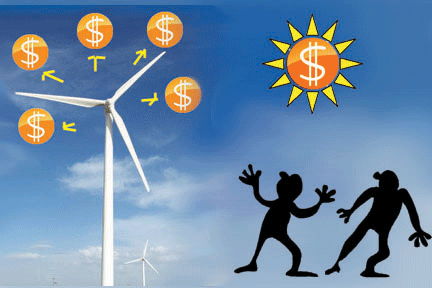
In many Texas cities the electricity market is deregulated, meaning that customers choose from a dizzying variety of providers and plans. In Houston, for example, there are more than 70 plans that offer energy from entirely renewable sources.
That makes it easy to switch, so in a dynamic marketplace, providers tend to focus on the immediate future. This discourages the creation of renewable energy facilities, which require long-term investment to be viable. But in Georgetown, the city utility company has a monopoly.
When its staff examined their options last year, they discovered something that seemed remarkable, especially in Texas: renewable energy was cheaper than non-renewable. And so last month city officials finalised a deal with SunEdison, a giant multinational solar energy company. It means that by January 2017, all electricity within the city’s service area will come from wind and solar power.
while west Texas is an oil driller’s paradise, it is also sunny and gusty, making it a perfect corridor for renewable energy.
The region bordering New Mexico is one of the prime solar resource sites in the USand the wind whistles across the plains to such an extent that, as Scientific American pointed out last year, the state is America’s largest wind power producer – as well as leading the nation in the production of crude oil and the emission of greenhouse gases.
Renewable energy also uses much less water than traditional power generation – a bonus in a state where half the land and more than nine million people are affected by drought conditions, though Briggs said that for Georgetown, water conservation was only a “side benefit”………
Outside, Jon Klopf, a barber, sat on a bench enjoying a splendidly sunny Thursday afternoon.
“They were just looking out for the cheapest deal. That’s just business,” the 50-year-old said. “I don’t really think we should be relying too much on oil, even though they have to right now. That don’t last forever.
“Sun will, though. Long as the sun comes up, the wind will blow.”http://www.theguardian.com/environment/2015/mar/28/georgetown-texas-renewable-green-energy
Dow Chemical’s purchase of wind energy shows the big shift to renewables
What Dow Chemical’s Huge Wind Deal Says About Our Energy Landscape, Clean Technica March 27th, 2015 By Mira Inbar Recently, The Dow Chemical Company signed an agreement to purchase 200 MW of wind output from a wind farm under development by a subsidiary of Bordas Wind Energy in South Texas. The wind power will power the company’s Freeport, Texas manufacturing site.
Everything about this announcement is huge: Freeport is the largest integrated chemical manufacturing complex in the Western Hemisphere. The wind farm will encompass nearly 35,000 acres of land, and annually supply an amount of electricity that could power more than 55,000 Texas homes.
Dow is the first chemical company in the US to power a manufacturing site with renewable energy at this scale. Their decision to do so is a clear sign that the energy landscape in the United States continues to evolve and that companies today have far more choice when it comes to accessing sustainable sources of power than they did just a few years ago.
So, what does Dow’s huge wind deal say about our energy landscape and the future of power generation? Three things:
1. Accelerating technological innovation and deployment at scale is driving down the cost of renewable energy.,……..
2. Wind energy is a perfect hedge against fossil fuel cost volatility……..
3. Deals like this represent an efficient use of electricity markets……..
Earlier this year, Texas completed a ten-year, $6.8 billion effort to build a huge network of new high-voltage power lines to connect all corners of the state to a robust electricity market that has become one of the most efficient and transparent in the world. These new transmission lines create better access to the market for all forms of electricity generation and allow for more efficient real-time operations and trading. This visionary investment has fostered competition and innovation, giving manufacturing companies more choice in their electricity supply so that they can better manage their costs.
Access to a reliable supply of cost-effective energy is a key ingredient to revitalizing manufacturing in America. Powering manufacturing with renewable energy is just one smart move to secure a future of sustainability, growth, and huge long-term competitive advantage.
Mira Inbar is an independent consultant who works with energy and clean technology companies. She can be reached @mirainbar or mira.inbar@gmail.com http://cleantechnica.com/2015/03/27/what-dow-chemical-huge-wind-deal-says-about-our-energy-landscape/
Tea Party leader joins environmentalists to form GREEN TEA COALITION
 During the first 15 years of nuclear — nuclear subsidies from the federal government accounted for one percent of the federal budget. Despite all the talks about the subsidies solar has received, solar during its first 15 years has only accounted for one tenth of one percent of federal subsidy.
to these elected officials who want the solar tax credit to expire, I say let’s expire all of the direct and indirect subsidies and tax credits that coal, nuclear, and oil are receiving as well. If they want to continue with the fossil fuel tax credits and the nuclear tax credits, then they should continue with the solar and wind tax credits. For every Solyndra they can point to, you can point to a nuclear reactor that’s over budget.
Conservatives need to do their research. Do your research and you’re going to come to the same conclusion that I have, that we’ve been manipulated by groups with interests in fossil fuel into believing that green energy is bad
Why This Tea Party Leader Is Seeing Green on Solar Energy As a founder of the Tea Party movement, Debbie Dooley may be an unlikely advocate for renewable energy. But in an e360 interview, she explains why she is breaking ranks with fellow conservatives and promoting a Florida ballot initiative that would allow homeowners to sell power produced by rooftop solar. 26 MAR 2015: INTERVIEW Environment 360 by diane toomey
Debbie Dooley’s conservative credentials are impeccable. She was one of the founding members of the Tea Party movement and continues to sit on the board of the Tea Party Patriots. She also serves as chairperson of the Atlanta Tea Party.
But on the issue of solar power, Dooley breaks the mold. To the consternation of some of her fellow conservatives, she has teamed up with the Sierra Club and other environmental organizations, first in Georgia and now in Florida, to form the Green Tea Coalition. It’s an unlikely mix of conservative, environmental and other groups whose focus includes campaigning against the maintenance fees that utility companies charge solar customers. In Florida, the group is working to get an initiative on the ballot that would allow individuals and businesses to sell power directly to consumers.
Debbie Dooley: My foray into becoming a strong advocate for decentralized energy began with a fight with a government-created monopoly in Georgia, Georgia Power. I believed that they had far too much power. Continue reading
India to get $1 Billion ExIm Bank Credit, nearly all of it for renewable energy development
 Renewables to Get Most of $1 Billion ExIm Bank Credit Reed Landberg (Bloomberg) 27 Mar 15 – Renewable energy developers will receive “the vast majority” of a $1 billion credit line the Export-Import Bank of the U.S. extended to India, the institution’s president said.
Regulatory policies in India, including terms for selling power, are conducive to financing solar- and wind-power projects, and make it easier for the bank to ensure it will be repaid, said Fred Hochberg, who is also chairman of the Washington-based lender.
The comments are an indication that the ExIm bank’s funding for renewables is poised to rise ….. The credit line sealed during President Barack Obama’s visit with Indian Prime Minister Narendra Modi in January is part of the U.S. effort to back an unprecedented expansion of clean energy in developing nations and check rising pollution blamed for global warming.
India’s Ambitions
Modi wants to install by 2022 five times as many photovoltaics as the U.S. has now, an ambition that may cost $160 billion, according to the Council on Energy, Environment & Water, a research group in New Delhi. Obama wants India to join in a global deal limiting greenhouse gases, and India’s ministers are seeking financial support from the West to cut the cost of emissions.
The U.S. developer SunEdison Inc. announced in January plans to build as much as 5 gigawatts of wind and solar power in India, and First Solar Inc., the largest U.S. solar manufacturer, is also developing power plants in the country. Regulations in India permit power purchase agreements that extend as long as 20 years. That makes it easier for banks to finance solar and wind projects…….http://www.bloomberg.com/news/articles/2015-03-26/renewables-to-get-most-of-1-billion-exim-bank-credit
1 This Month

of the week – Shut Down Drone Warfare!


Tell the Ukrainian Government to Drop Prosecution of Peace Activist Yurii Sheliazhenko

Petition to revoke the licensing of the Near Surface Nuclear Disposal Facility (NSDF) at Chalk River. https://www.ourcommons.ca/petitions/en/Petition/Details?Petition=e-7247
To see nuclear-related stories in greater depth and intensity – go to https://nuclearinformation.wordpress.com
-
Archives
- April 2026 (114)
- March 2026 (251)
- February 2026 (268)
- January 2026 (308)
- December 2025 (358)
- November 2025 (359)
- October 2025 (376)
- September 2025 (257)
- August 2025 (319)
- July 2025 (230)
- June 2025 (348)
- May 2025 (261)
-
Categories
- 1
- 1 NUCLEAR ISSUES
- business and costs
- climate change
- culture and arts
- ENERGY
- environment
- health
- history
- indigenous issues
- Legal
- marketing of nuclear
- media
- opposition to nuclear
- PERSONAL STORIES
- politics
- politics international
- Religion and ethics
- safety
- secrets,lies and civil liberties
- spinbuster
- technology
- Uranium
- wastes
- weapons and war
- Women
- 2 WORLD
- ACTION
- AFRICA
- Atrocities
- AUSTRALIA
- Christina's notes
- Christina's themes
- culture and arts
- Events
- Fuk 2022
- Fuk 2023
- Fukushima 2017
- Fukushima 2018
- fukushima 2019
- Fukushima 2020
- Fukushima 2021
- general
- global warming
- Humour (God we need it)
- Nuclear
- RARE EARTHS
- Reference
- resources – print
- Resources -audiovicual
- Weekly Newsletter
- World
- World Nuclear
- YouTube
-
RSS
Entries RSS
Comments RSS
 nuclear-news