Colorado city Aspen achieves 100% renewable energy
 Aspen Stands Tall As Third US City Achieves 100% Renewable Energy http://cleantechnica.com/2015/09/15/aspen-stands-tall-third-us-city-achieves-100-renewable-energy/ September 15th, 2015 by Glenn Meyers
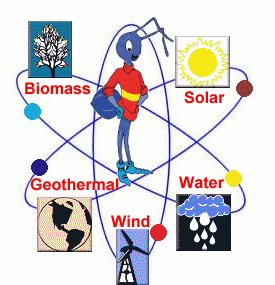
Aspen, the Colorado skiing-Mecca, now stands tall as a renewable energy visionary, having become one of three US cities to run on 100% renewable energy. This news was recently reported by The Aspen Times, citing staff members at Aspen’s environmental and project departments. The City of Aspen, a famed tourist location in the Rocky Mountains, Colorado, serves a population of just over 6,600 people, and its renewable power supply comes from a combination of wind, hydro, geothermal heat, and solar.
The plan for shifting to renewable energy and meeting the challenges of climate changedates back to 2005. According to Chris Menges and Will Dolan, from Aspen’s Sustainability and Utility departments:
“In 2005, the City created the Canary Initiative, which identifies Aspen and other mountain communities as “canaries in the coal mine” with respect to their sensitivity to the effects of climate change. Aspen relies on a stable climate and thriving natural environment for its economic viability and quality of life. In 2007, Aspen City Council adopted the Canary Action Plan, committing to the GHG reduction goals.”
The first two US cities to reach the goal were Burlington, Vermont, followed by Greensburg, Kansas.
Aspen’s transition to 100% renewable occurred September 10, after the city signed a contract with wholesale electric energy provider Municipal Energy Agency of Nebraska in order “to achieve this final leg of our goal,” city Utilities and Environmental Initiatives director David Hornbacher said.
Aspen receives wind energy from four wind farms in Nebraska and South Dakota, and the city also uses energy from Ruedi Reservoir, Maroon Creek, and Ridgway Reservoir, a hydropower facility near Montrose. Two utilities, Aspen Electric Utility and Holy Cross Energy, serve the community.
Mother Nature Network reports other cities aiming for 100% renewable energy include Copenhagen, Denmark; Bonaire, a Caribbean island; Munich and Frankfurt, Germany; San Diego, San Jose, and San Francisco, California; Sydney, Australia; and Isle of Wight, England.
In brief – solar energy and climate news
Why solar energy is poised for yet another record year.
The growth boom is being fueled by a combination of declining costs, low interest rates, and a federal solar investment tax credit, a new report suggests.
http://www.washingtonpost.com/news/energy-environment/wp/2015/09/09/why-solar-energy-is-poised-for-yet-another-record-year/ & http://www.dailyclimate.org/t/3864796633753627934
Energy boss tips solar explosion
One of the sector’s most experienced leaders has predicted a major investment in ‘utility scale’ solar power.
http://www.theaustralian.com.au/national-affairs/climate/energy-boss-grant-king-tips-solar-explosion/story-e6frg6xf-1227520102456
Sophie Lewis: Sure, winter felt chilly, but Australia is setting new heat records at 12 times the rate of cold ones
Melbourne, Canberra and much of southern Australia have shivered through a cold winter. But on a longer view, record cold snaps are disappearing, while Australian heat records continue to be broken.
https://theconversation.com/sure-winter-felt-chilly-but-australia-is-setting-new-heat-records-at-12-times-the-rate-of-cold-ones-35607
Forest fires in Alaska: A ticking climate time bomb
As US President Barack Obama visits Alaska to focus attention on climate change, scientists warn that this very bad wildfire year is part of a vicious cycle caused by – and accelerating – climate change.
http://www.dw.com/en/forest-fires-in-alaska-a-ticking-climate-time-bomb/a-18684423
In Japan’s hot summer, solar power ramped up its contribution to electricity

 Solar power supplies 10 percent of Japan peak summer power: Asahi http://news.yahoo.com/solar-power-supplies-10-percent-japan-peak-summer-030520802–finance.html?utm_content=buffer78331&utm_medium=social&utm_source=twitter.com&utm_campaign=buffer September 2, 2015 TOKYO (Reuters) – Solar power generation contributed to about 10 percent of peak summer power supplies of Japan’s nine major utilities, equivalent to more than 10 nuclear reactors, the Asahi newspaper reported on Thursday.
Though solar power accounts for about 2 percent of annual generation of all power sources, summer’s favorable sunlight conditions increased power output, generating up to about 15 gigawatts of power in total in early August, the paper said.
Japan has been pouring billions of dollars in clean-energy investment after introducing a feed-in tariff (FIT) program in 2012, aiming to help the world’s third-biggest economy shift away from its reliance on nuclear power after the March 2011 Fukushima disaster.
Asahi’s survey showed that the ratio of solar power at peak hours was as low as Hokuriku Electric Power’s <9505.T> 5.9 percent and as high as Kyushu Electric Power’s <9508.T> 24.6 percent, depending on access to ample land with favorable sunlight conditions.
The installed capacity of solar power taking advantage of FIT scheme has reached more than 24 gigawatts at the end of April, government data showed, up from about 5 GW before the scheme started.(Reporting by Osamu Tsukimori; Editing by Gopakumar Warrier)
Russia slowly turning to its former interest in developing renewable energy
|
|
 Renewable Energy Rises in Russia: The Early Steps Huffington Post By Woodrow W. Clark II and Dimitri Elkin(*) Woodrow Clark Economist for environment and renewable energy
As renewable energy becomes more widespread, its “green” transformational impact can be seen in some of the most remote corners of the world. Here are two recent examples from Russia, a country not typically associated with the green energy industrial revolution. The EU countries, Asian nations and now China are all embarked on this green revolution. While the USA just started, Russia is moving ahead with its own green renewable energy industrial transformation………..
Russia’s image as an ecologically ignorant oil superpower is so well established that it may come as a surprise that during the Soviet period, Russia had many groundbreaking achievements in the renewable energy sector. For example, in the 1930s, USSR was the first nation in the world to construct utility-scale wind turbines. In the 1960s, the Soviet Union opened an ocean tidal electric plant and took the lead in building geothermal power plants. There are currently around 100 MW of geothermal power plants operating in Russia, and about 55 MW of more geothermal planned additional capacity in the near future.
Whatever progress the Soviet Union made with renewables, it was derailed by Russia’s economic upheaval during the post-Soviet period (1991-2014), when electricity production fell by one third, creating plenty of spare capacity. During the presidency of Boris Yeltsin (1991-2000) when the USSR transformed into a new Russia, and then the first two terms of Vladimir Putin (2000-2008), the Russian government was preoccupied with delivering economic growth without considering its impact on the environment through the exploiting and exporting of coal, oil and now natural gas………
Social attitudes are also changing. Russia, just like other BRIC nations and developing countries around the world, is seeing a burgeoning middle class who now worries about their environment. And with the recent declines of the cost of renewable power, including solar panels, these renewable energy systems now seems a feasible solution for many energy consumers in Russia.
With its diverse geographic area that stretches from Arctic Circle to the subtropics, Russia sees an especially compelling opportunity for on-site power from renewable energy that is distributed through the country in cities and communities…..
While many areas of Russia will probably remain dependent on gas and coal for the foreseeable future due to central plant energy distribution, there are plenty of communities like Oktyabrsky and Batagai in Russia where renewables make economic and environmental sense. http://www.huffingtonpost.com/woodrow-clark/renewable-energy-rises-in_b_8061382.html?ir=Australia
Koch brothers undermining Renewable Energy in Kansas – emails reveal.
he Koch political network has carefully singled out renewable energy while working to preserve government support for fossil fuels. Groups founded and funded by the Koch political network regard repealing oil and gas subsidies as a “tax hike” while deriding renewable energy subsidies as “a textbook case of corporate welfare.” Moreover, Koch’s lobbying campaign to distort climate science and prevent government action on greenhouse gas emissions transfers costs from the company, a major polluter, to the public.
Emails Show Koch Industries Backed Effort to Undermine Renewable Energy in Kansas Lee Fang https://firstlook.org/theintercept/2015/08/28/emails-show-koch-industries-backed-effort-undermine-renewable-energy-kansas/
Aug. 28 2015 Emails and financial documents released by the University of Kansas on Thursday reveal earmarked funding from Koch Industries to develop research used to lobby against the state renewable energy standard.
On November 12, 2013, Art Hall, the director of the university’s Center for Applied Economics, emailed Koch Industries’ Laura Hands to discuss a grant from a Koch-controlled foundation to fund research on the Renewable Portfolio Standard.
Hall is the former chief economist for Koch Companies Public Sector, the lobbying subsidiary of Koch Industries, the largest privately owned company in America with a significant stake in oil refining, pipelines, gas production and coal. Hands is the current community affairs director at Koch Companies Public Sector.
The Koch money was part of an ongoing project Hall described as an effort to develop “intellectual products” to be used “as a tool in economic policy debates.” Hall’s center also provides special classes to teach about the virtues of capitalism. Koch-controlled foundations approved $40,000 for work that included the renewable energy standard, as well as at least $250,000 to the center in 2008 and $100,000 to the center in 2009.
Following his grant request, Hall testified before the Kansas legislature in 2014 in favor of repealing the state renewable energy portfolio, which calls for major utility companies to use an increasing ratio of renewable energy such as wind and solar.
The emails and financial documents were released in response to a Kansas Open Records Act request filed by KU student Schuyler Kraus, the president of Students for a Sustainable Future.
Hall also helped craft unprecedented tax cuts signed into law by Gov. Sam Brownback, R-Kan., and backed by Koch’s local political network. The tax cuts have been viewed roundly as a historic flop, resulting in a downgrade of the state bond rating and drastic education cuts that forced public schools to close early this year. Critics argue that the tax cut and ensuing budget chaos may have hurt employment as bordering states such as Missouri are quicklyoutpacing Kansas on job growth.
President Barack Obama recently criticized Koch Industries owners Charles and David Koch, scolding the billionaires for “pushing for new laws to roll back renewable energy standards.” In response, Charles Koch said he is opposed to “crony capitalism” in all forms.
Though the Koch Industries chief executive has said that he opposes corporate subsidies or mandates of any kind, the Koch political network has carefully singled out renewable energy while working to preserve government support for fossil fuels. Groups founded and funded by the Koch political network regard repealing oil and gas subsidies as a “tax hike” while deriding renewable energy subsidies as “a textbook case of corporate welfare.” Moreover, Koch’s lobbying campaign to distort climate science and prevent government action on greenhouse gas emissions transfers costs from the company, a major polluter, to the public. CONTACT THE AUTHOR: Lee Fang lee.fang@theintercept.comt@lhfang
New measures to promote rooftop solar, by President Obama
US President Barack Obama unveils measures to encourage solar power use,SMH, August 25, 2015 GARDINER HARRIS. The Obama administration has announced a slew of small measures designed to encourage the use of solar power in the US hours.
The measures included making an additional $US1 billion ($1.4 billion) in loan guarantee authority available in an existing federal program for the kind of residential rooftop solar projects that have become popular in places like California.
But none of the announced measures would provide the impact on the solar industry of the Clean Power Plan, which was announced this month and requires states to cut carbon emissions by an average of 32 per cent. That plan provides strong incentives for much of those reductions to come from the development of renewable energy resources – exactly what executives at the conference in Nevada are looking to sell.
“We’re going to make it even easier for individual homeowners to put solar panels on their roof with no upfront cost,” President Barack Obama told the summit. “A lot of Americans are going solar and becoming more energy-efficient not because of tree huggers — although trees are important, just want you to know — but because they’re cost-cutters.
With the nation’s new electrical needs growing only modestly, renewable power executives are depending on electric utilities finally retiring their aging coal-fired power plants and replacing them with renewable power sources. That process is happening anyway, but the administration’s power plan is expected to accelerate it……..http://www.smh.com.au/environment/us-president-barack-obama-unveils-measures-to-encourage-solar-power-use-20150825-gj71e8.html#ixzz3jsRuU7g4
Solar power races ahead as China builds huge station in Gobi desert
China builds huge solar power station which could power a million homes, http://www.independent.co.uk/environment/china-builds-huge-solar-power-station-which-could-power-a-million-homes-10446840.html The Independent, ALEXANDRA SIMS, 08 August 2015 China is set to build a giant solar power station in the Gobi desert, which could generate enough energy to supply one million homes. The proposed power station will measure 10 square miles and generate 200 megawatts of solar energy.
The plans will fall in line with the Chinese government’s ambitious initiative to reduce the country’s fossil fuel energy by 20 per cent by 2030 in addition to cutting its green house gas emissions.
Construction began six years ago on the country’s first large –scale power station, according to National Geographic.Recent photos from NASA satelites show that the solar panels making up the plant cover an area roughly three times bigger than was seen three years ago.
China is quickly becoming a world leader in solar power.
According to the International Energy Agency, the country produces two-thirds of all solar panels and it gained more solar capacity than any other country in the world last year. China invested $83.3 billion dollars last year into renewable energy, more than any other country, according to a report from the UN Environment programme.
The United States, despite being the second highest investors in renewable energies, invested less than half this amount.
Jennifer Morgan, director of the climate program at the World Resources Institute told National Geographic: “China is largely motivated by its strong national interests to tackle persistent air pollution problems, limit climate impacts and expand its renewable energy job force.”
She added that China, presently the greatest emitter of greenhouse gases, will be able to meet its pledge if it continues with its new emphasis on renewables.Chinese Premier Li Keqiang said: “China’s carbon dioxide emission will peak by around 2030 and China will work hard to achieve the target at an even earlier date,” according to Reuters.
A global boom in solar power could be on the cards, according toBloomberg New Energy Finance, as panels get cheaper and batteries become more advanced.
By 2040, they predict, in moves led partly by China, solar power could account for one-third of new electricity.
China’s massive solar farm going ahead fast in Gobi desert
 China builds huge solar power station which could power a million homes, http://www.independent.co.uk/environment/china-builds-huge-solar-power-station-which-could-power-a-million-homes-10446840.html
 The Independent, 08 August 2015 China is set to build a giant solar power station in the Gobi desert, which could generate enough energy to supply one million homes. The proposed power station will measure 10 square miles and generate 200 megawatts of solar energy.
Germany sets new record for renewable energy – 78% renewable electricity July 25
Germany Just Got 78 Percent Of Its Electricity From Renewable Sources, Think Progress BY ARI PHILLIPS JUL 29, 2015 ON SATURDAY, JULY 25, GERMANY SET A NEW NATIONAL RECORD FOR RENEWABLE ENERGY BY MEETING 78 PERCENT OF THE DAY’S ELECTRICITY DEMAND WITH RENEWABLES SOURCES, EXCEEDING THE PREVIOUS RECORD OF 74 PERCENT SET IN MAY OF 2014.

According to an analysis by German energy expert Craig Morris at the Energiewende blog, a stormy day across northern Europe combined with sunny conditions in southern Germany led to the new record, the exact figures of which are still preliminary. Morris writes that most of Germany’s wind turbines are installed in the north and most of its solar panels are in the south.
If the figures hold, it will turn out that wind and solar generated 40.65 gigawatts (GW) of power on July 25. When this is combined with other forms of renewables, including 4.85 GW from biomass and 2.4 GW from hydropower, the total reaches 47.9 GW of renewable power — occurring at a time when peak power demand was 61.1 GW on Saturday afternoon. To bolster his analysis, Morris points to early figures from Agora Energiewende, a Germany energy policy firm, that have renewables making up 79 percent of domestic power consumption that day.
Renewable sources accounted for 27.8 percent of Germany’s power consumption in 2014, up from 6.2 percent in 2000. The expansion of renewables and another weather phenomenon — a relatively mild winter — led to Germany’s greenhouse gas emissions falling for the first time in three years in 2014, a 4.3 percent year-over-year drop. Greenhouse gas emissions are now down to their lowest level since 1990, according to analysts at Agora Energiewende.
This made 2014 a big year for Germany’s renewable energy transition, known as Energiewende, which requires the phasing out of nuclear energy by 2022 and reducing greenhouse gases at least 80 percent by 2050. The government also wants the at least double the percentage of renewables in the energy mix by 2035………..
As more and more wind turbines and solar panels come online there is a major technology push to create better forecasting software and to increase the efficiency and enhance the location of these forms of power. IBM and the National Renewable Energy Laboratory (NREL) recentlyannounced that they are working on a producing solar and wind forecasting that’s at least 30 percent more accurate than conventional methods.
“There is good reason to believe that with better forecasts, it might be possible to push solar’s energy contribution up to 50 percent [by 2050],” IBM Research Manager Hendrick Hamann recently said about the United States. “As we continue to refine our system in collaboration with the DOE, we hope to double the accuracy of the system in the next year. That could have a huge impact on the energy industry — and on local businesses, the economy and the natural environment.” http://thinkprogress.org/climate/2015/07/29/3685555/germany-sets-new-renewable-energy-record/
Abandoned gold courses transformed to solar power plants – Japan
Japan has started turning abandoned golf courses into solar power plants, Business Insider, ARIEL SCHWARTZ JUL 17, 2015,…….. developers built too many golf courses over the last few decades after demand shot up in the 1980s. Now the industry is in decline, with participation in the sport down 40% from the 1990s, and abandoned golf courses are starting to pop up.
Kyocera’s solution: turn the abandoned green space into solar farms. Japan has been hungry for alternative energy ever since the 2011 Fukushima disaster made nuclear power an unattractive option in the country, and golf courses just happen to be perfectly suited for solar power — they’re large open spaces that often get lots of sunlight.
Kyocera’s first project, now under construction, is a 23 megawatt solar plant on a golf course in Kyoto prefecture. When it goes live in 2017, the plant will produce enough power for about 8,100 households.
The company is also developing a 92 megawatt solar plant — generating enough energy for over 30,000 households –……….http://www.businessinsider.com.au/japan-has-started-turning-abandoned-golf-courses-into-solar-power-plants-2015-7
Control of electricity at the local level, with batteries for renewable energy
In the end, the solution might lie on a smaller scale: giving everyone the power to store their own power. Tesla is one company of several in this game: it recently announced a device called the Powerwall, designed for homes and businesses. It uses the same batteries as electric cars to store energy, either from renewables or cheap night-time electricity, ready to be used during the day.
If such systems become commonplace, we might all become a little more aware of where our energy is coming from, and how our own behaviour affects its use and production

The battery revolution that will let us all be power brokers, New Scientist 22 July 15
Companies are racing to find better ways to store electricity – and so provide us with cheaper energy when and where we want it “……... Although they are still dwarfed in most respects by the bulky lead-acid batteries found in almost every car on the road today, in 2015, lithium-ion batteries will account for around a third of the money spent on rechargeable batteries globally (see “Turn it on”), and just under a sixth of the total energy stored, according to French research firm Avicenne.
Renewables powering more parts of the world than nuclear power is
Half the world already gets more power from renewables than from nuclear, Quartz, 17 July 15 The dream of a low-carbon future thanks to nuclear power is already looking dated. The two most populous countries in the world—China and India—plus Japan, Germany, Spain, the Netherlands, Mexico, and Brazil already generate more electricity from (non-hydro) renewable sources than they do from nuclear, according to a global nuclear industry report (pdf). That’s 45% of the world’s population that rely on wind, solar, and other green energy more than they do on radioactive atoms.
the trend toward more renewable power will likely continue for some time. First, global opinion on nuclear energy soured after the Fukushima disaster in Japan, and as a result plenty of potential nuclearpower plants aren’t getting built. Power-hungry China, for instance, isslow to approve new nuclear power plants due to both government and public safety concerns. At the same time, though, it is investing heavily in wind power.
Renewable Energy news snippets
Faced with power crisis, Africa looks to renewable energy technology PCWorld 18 July 15
PV-Tech Storage-16 Jul 2015
12 miles from Fukushima’s shattered nuclear reactors, World’s Largest Offshore Wind Turbine gives hope
World’s Largest Offshore Wind Turbine Comes Online Near Fukushima Daiichi -bureau EnviroNews World News by Emerson Urry on June 28, 2015 – http://environews.tv/world-news/worlds-largest-offshore-wind-turbine-comes-online-near-fukushima-daiichi/ Fukushima Prefecture, Japan — A mere 12 miles from the full-blown triple nuclear reactor “melt-through” at Fukushima Daiichi on the eastern coast of Japan, sits a bafflingly huge, 620-foot-tall, 1,500-ton bladed beast — floating on a 5,000 ton platform in the water. The world’s largest floating wind turbine has three 270 foot long blades, can withstand 200 mile-per-hour winds, and will be able to generate “up to 7 megawatts of electricity,” making it the biggest offshore wind turbine on earth, according to Gizmodo, a popular science and technology blog.
Additionally, the downright lies and coverup perpetrated by both TEPCO and the Japanese Government surrounding the Fukushima crisis, have left a bad taste in the mouth of the population, leaving trust in the government at an all time low. Perhaps more government-backed, non-lethal energy innovations like the one just activated in Fukushima can start to rebuild the people’s trust in the government. Time will tell. – http://environews.tv/world-news/worlds-largest-offshore-wind-turbine-comes-online-near-fukushima-daiichi
To renewable energy and energy efficiency – away from nuclear – Switzerland’s program
 Switzerland’s transition away from nuclear power, Science Daily, July 7, 2015 Source: SAGE Publications
- Summary:
- Switzerland has a long history of trying to be as self-sufficient and energy independent as possible. Although its energy supply system has served it well in the past, the country is now looking to turn away from its reliance on nuclear power and seeks to compensate for the energy lost from hydropower as a result of climate change……
In the latest issue of theBulletin of the Atomic Scientists, published by SAGE, Dominic Notter of Empa discusses how the country aims to address this transition, finding a new supply mix that combines energy conservation, greater efficiencies, alternative energy sources, the “smart grid,” and the introduction of new technologies, so that Switzerland can secure its energy independence for the future……..
-
 “The goal is to gradually phase out of nuclear power and into renewables by 2034, and to be largely independent of fossil fuels. Reaching it is based upon the idea of combining highly efficient energy production processes with substantial reductions in energy consumption.”Notter concludes: “Over the next four decades Switzerland faces a restructuring of its entire energy supply system. The new supply mix will be free from nuclear power, rather low in carbon intensity, and resting upon much higher efficiencies based on the newest and the most energy- efficient technologies- along with the developments of smart grids, decentralized power suppliers, hydropower, wind power, photovoltaics, biomass, wood, and the rigorous use of burning waste to generate energy whenever materials cannot be recycled […] A single “magic bullet” suitable for every purpose is not available. Switzerland most likely has to find its own energy supply mix, with the biggest sustainability potential.” Story Source:
The above post is reprinted from materials provided by SAGE Publications. http://www.sciencedaily.com/releases/2015/07/150707102025.htm

1 This Month

of the week – Shut Down Drone Warfare!


Tell the Ukrainian Government to Drop Prosecution of Peace Activist Yurii Sheliazhenko

Petition to revoke the licensing of the Near Surface Nuclear Disposal Facility (NSDF) at Chalk River. https://www.ourcommons.ca/petitions/en/Petition/Details?Petition=e-7247
To see nuclear-related stories in greater depth and intensity – go to https://nuclearinformation.wordpress.com
-
Archives
- April 2026 (114)
- March 2026 (251)
- February 2026 (268)
- January 2026 (308)
- December 2025 (358)
- November 2025 (359)
- October 2025 (376)
- September 2025 (257)
- August 2025 (319)
- July 2025 (230)
- June 2025 (348)
- May 2025 (261)
-
Categories
- 1
- 1 NUCLEAR ISSUES
- business and costs
- climate change
- culture and arts
- ENERGY
- environment
- health
- history
- indigenous issues
- Legal
- marketing of nuclear
- media
- opposition to nuclear
- PERSONAL STORIES
- politics
- politics international
- Religion and ethics
- safety
- secrets,lies and civil liberties
- spinbuster
- technology
- Uranium
- wastes
- weapons and war
- Women
- 2 WORLD
- ACTION
- AFRICA
- Atrocities
- AUSTRALIA
- Christina's notes
- Christina's themes
- culture and arts
- Events
- Fuk 2022
- Fuk 2023
- Fukushima 2017
- Fukushima 2018
- fukushima 2019
- Fukushima 2020
- Fukushima 2021
- general
- global warming
- Humour (God we need it)
- Nuclear
- RARE EARTHS
- Reference
- resources – print
- Resources -audiovicual
- Weekly Newsletter
- World
- World Nuclear
- YouTube
-
RSS
Entries RSS
Comments RSS
 nuclear-news