Obama backs community solar power as rooftop energy alternative
White House pushes community solar power as rooftop
alternative Gregory Korte, USA TODAY, 19 Nov 15 WASHINGTON — About half of electric customers can’t  install solar panels because they don’t own their building, don’t get enough sun or don’t have a large, south-facing roof to install solar panels, according to the U.S. Department of Energy.Those technical challenges are a particular hurdle for low- and middle-income customers — and that’s why the Obama administration is pushing a solution known as community solar.
The White House hosted a summit Tuesday to bring together major solar players to figure out ways to expand retail solar power from traditional rooftop arrays to a model in which households and businesses invest in shared solar systems. The administration announced that 68 cities, states, and businesses had signed on to a White House initiative to promote community solar, with an emphasis on low- and moderate-income households.

Those commitments are expected to bring solar power to to more than 20,000 households in 21 states, the White House said. And, just as importantly for President Obama, it will allow the United States to expand its use of clean energy as Obama prepares to travel to Paris for an international climate summit where he’ll press other companies to make similar strides to reduce carbon pollution from fossil fuels…….
Another participant, Michelle Moore of the nonprofit Groundswell, works as a community organizer to try to create markets for community solar power in places where it doesn’t yet exist. She said the White House summit was helpful in bringing for-profit utilities, cooperatives, local governments, non-profits and financiers together to make connections.
“Our role is organizing customers so that they’re able to have more of a say in what kind of energy they want and how they want to buy it,” said Moore, a former environment policymaker at Obama’s White House Council on Environmental Quality. “It’s a way to buy into a solar project without a home construction project.” http://www.usatoday.com/story/news/politics/2015/11/17/white-house-pushes-community-solar-power-rooftop-alternative/75950054/
Investment Bank Lazar finds wind and solar beat coal and nuclear on costs
 Wind and solar beating conventional fuels on costs – Lazard, REneweconomy, By Giles Parkinson on 18 November 2015 The latest study by US investment bank Lazard has highlighted the extent to which wind and solar technologies are beating conventional fuels – coal, gas and nuclear – on costs of production, and also on abatement.
The study, the “Levellised Cost of Energy Analysis 9.0 notes that utility scale solar PV has fallen 25 per cent in the last year alone, since its most recent study. Since 2009, when it began the analysis, solar and wind energy have fallen by 80 per cent and 60 per cent respectively.
Lazard says that because of this, and despite big falls in the cost of natural gas in the US, wind and solar are beating conventional fuels in most situations, as revealed in their success in competitive capacity auctions.
And so, to its graphs [on original]
………It is interesting to note that compared to Lazard’s previous reports, wind, solar and gas costs have fallen, coal has remained static, while nuclear is the only technology to show a significant increase……http://reneweconomy.com.au/2015/wind-and-solar-beating-conventional-fuels-on-costs-lazard-26273
World’ slar road first solar road performing better than expected
 World’s First Solar Road Exceeds Expectations http://www.enn.com/business/article/49158 By Candice Marcus The first aptly-titled SolaRoad made its debut last November in the Netherlands, not far from Amsterdam. The road itself is a unique foray in pollution-free solar energy. Nearly one year later, the SolaRoad’s designers say the high-tech bike path is performing better than they expected.
In the first six months since it was installed, the SolaRoad has generated over 3,000 kilowatt-hours — or roughly the equivalent required for a single-person household for one calendar year.
Experts reckon that up to 20 percent of the Netherlands’ roadways —140,000 kilometers or 87,000 miles — could accommodate the solar threading for a wider reach on a limitless solar draw.
How it works
The SolaRoad is a unique platform just 70 meters long — for now — that consists of several synthetic layers topped by 3-millimeter, glass-covered solar panels engineered to convert sunrays into energy — even on a perfectly cloudy day. Each transparent panel links into a network that optimizes absorbed solar radiation and redirects it into the local energy grid — to power street lamps, for example.
Continue reading at ENN affiliate, Triple Pundit.
Mayor of London calls on UK govt for tax help for local community solar power

 Boris Johnson: Treasury is endangering community renewables, Guardian, Adam Vaughan, 12 Nov 15
Mayor of London calls on the government to reconsider plans to remove tax relief for investors in community energy projects Boris Johnson has warned the Treasury it is endangering efforts by local communities around the UK to build their own renewable energy projects.
In a letter to the financial secretary to the Treasury, David Gauke, the mayor of London and Tory MP called on the government to reconsider its proposals to remove various forms of tax relief for investors in community energy.
More than 100 green energy groups have already said the change will “decimate” the sector, which has installed community-owned solar panels on village halls, small hydro schemes on rivers and wind turbines on farms.
Johnson is concerned that “the proposals may endanger the expansion of the sector given the investment required for the upfront capital costs” and “there is a danger of unintended consequences”, wrote the deputy mayor for environment and energy, Matthew Pencharz.
The mayor also thought that while such schemes might be small individually, in aggregate they are important to the security of London’s future energy supply, and a key part of efforts to cut the capital’s carbon emissions.
The short-term nature of the tax changes – which are due to come into effect at the end of November – could also put an end to schemes that are already in development or fundraising, he said.
One high-profile scheme for a community-owned solar array in a West Sussex village that was at the centre of anti-fracking protests, has already been shelvedas a result of the Treasury’s plans, announced in the finance bill last month. A recent report found more than £100m worth of community energy projects were at risk from the changes…….http://www.theguardian.com/environment/2015/nov/11/boris-johnson-treasury-is-endangering-community-renewables
Iran going for renewable energy
Iran signs landmark $6 billion power deal, Press TV, 4 Nov 15 The Iranian government says it has signed an agreement worth $6 billion with a European company to build 4,250 megawatts of power capacity in the country.
The agreement between Iran’s Ministry of Energy and the foreign firm envisages developing gas-powered plants for 3,250 MW and wind farms for 1,000 MW of electricity, Government spokesman Mohammad Baqer Nobakht said.
“This big investment will be made in the current year (ending on March 20, 2016) under the existing political conditions where the Joint Comprehensive Plan of Action and the lifting of sanctions has not started yet,” he said……..
Renewable projects
The government is eyeing renewables as the new alternative to fossil fuels which constitute about 90% of Iran’s energy mix.
The existing renewable capacity is focused on hydro power plants which produce about 8,500 MW. Just 150 megawatts of green power plants are currently operating in the country.
The government plans to install 5,000 MW of renewable capacity, putting Iran among the likes of the UK and France in this category. The Ministry of Energy is already implementing 500 MW wind converters and further 100 MW biomass projects.
The Middle East’s first geothermal power plant, a 50-megawatt pilot project, is being built at the foot of an inactive volcanic peak in northwest Meshguin Shahr.
However, Iran’s renewable energy potential is huge where only the wind capacity is estimated at 30,000 megawatts.
Foreign projects
German companies are reportedly about to begin next year building wind farms in Iran at a cost of $331 million. In August, they signed a document for generation of 100 MW of wind power plus 400 MW of solar in the southern Khuzestan province.
Italy’s Fata, the engineering unit of leading industrial group Finmeccanica, also signed then a 500 million euro ($543 million) contract with Ghadir Investment Company to build a power plant in Iran.
A consortium of Iranian, Indian and South Korean companies further seeks to set up an energy park in the Khuzestan province in a project worth $10 billion, including generation of 1,000 megawatts of solar power. http://www.presstv.com/Detail/2015/11/04/436250/Iran-electricity-investment-Europe-renewables
Germany’s dash for renewables has helped to create new industries
Germany’s planned nuclear switch-off drives energy innovation, Guardian, Jennifer Rankin , 3 Nov 15
While Britain visualises a nuclear future, Angela Merkel’s aim of replacing it with renewables by 2022 is well under way Hinkley Point will be the first nuclear power plant to be built in Europe since the meltdown of Japan’s Fukushima reactor in 2011. But while the British government sees nuclear energy as a safe and reliable source of power, Germany is going in a different direction.
As a result of the Fukushima, Chancellor Angela Merkel pledged to switch off all nuclear power by 2022 and fill the gap with renewables – a process known as theenergiewende (energy transition).

Germany’s push for renewables grew out of the anti-nuclear protests of the 1980s and currently more than a quarter (26%) of its electricity comes from wind, solar and other renewable sources, such as biomass, although 44% is from coal. The country’s government wants to increase the share of renewables in electricity to 40% to 45% by 2025.
No other country of Germany’s size has attempted such a radical shift in its power supply in such a short space of time. Described by Merkel as a herculean task, the transition is Germany’s most ambitious economic project since die Wende – the phrase used to describe the fall of the Berlin wall and subsequent reunification of east and west – with an estimated cost of €1tn (£742bn) over the next two decades.
However, Reinhard Bütikofer, the Green party’s spokesman for industry in the European parliament, said the really “mind-blowing” energy transition is happening in the UK, where the Hinkley Point C nuclear plant in Somerset will cost electricity customers at least £4.4bn in subsidies. “They are cutting down on solar, PV [photovoltaics], purportedly for cost reasons, while on the other hand they pledge to guarantee the nuclear industry and energy price twice the market price for the next 30 years. That’s crazy.”
The energiewende is not uncontroversial, not least due to the rising cost of subsidies paid by ordinary bill payers, which has triggered complaints that poor households are subsidising affluent dentists to put solar panels on their roofs. But the transition is not opposed by Germany’s main business lobby, the BDI, despite lingering concerns about what the transition means for the country’s manufacturing base at a time when confidence in the Made in Germany brand has been knocked by the Volkswagen scandal.
“There is broad consensus in society on the political targets – to reduce CO2 and increase energy efficiency and the share of renewables,” said Carsten Rolle, the BDI’s head of energy and climate policy………
Germany’s dash for renewables has helped to create new industries. About 370,000 Germans work in the renewable energy industry, twice the number who work in fossil fuels, according to the Heinrich Böll Foundation, a green political thinktank.
The north German port city of Bremerhaven has staged a partial revival, after decades of decline following the collapse of the shipbuilding and fishing industries in the 1970s and 1980s……..
Bütikofer said it was a myth that the push to renewables was putting German companies out of business.
“The industrial Mittelstand has always persevered, moved ahead of the curve by being more effective than others,” he said. He believed that from damaging firms, the energy law can stimulate energy efficiency. “[The energiewende] is nudging sectors of German industry towards more ambitious innovation and I think that is the name of the game for future competitiveness.” http://www.theguardian.com/environment/2015/nov/02/germanys-planned-nuclear-switch-off-drives-energy-innovation
Today’s renewable energy headlines
|
Visual Capitalist (blog) – 8 hours ago
According to the Renewable Energy Policy Network, about 22.1% of the world’s energy needs are satisfied by renewable energy. Hydro power accounts for most of this (16.4%) and the remainder (5.7%) comes from solar, wind, biomass, and other renewable …
CleanTechnica – 10 hours ago
The first era, starting in the 1990s, was characterized by deregulation, the creation of renewable energy certificates (RECs), and the development of the renewable portfolio standard (RPS). During this time period, renewable energy was purchased …
Full Fact – 7 hours ago
“We have a 20% renewables target overall across all energy, which translates into a 30% target forrenewable electricity and, I believe, there is a 12% renewable heat target, and therefore a 10%renewables target. There is no breakdown of those targets …
CleanTechnica – Nov 2, 2015
As Jordan looks to rapidly expand the renewable energy infrastructure, it is also taking measures to ensure that its transmission grid is ready for the boom in renewable energy generation. The French and Jordanian Prime Ministers recently signed an …
The Rock River Times – 1 hour ago
Our energy interests were influenced by Amory Lovins, an early advocate of energy efficiency andrenewable energy, the energy efficiency program in Osage, Iowa, visits to the solar business district in Soldiers Grove, Wisconsin, and off-grid PV powered …
Ghana Business News – 8 hours ago
Dr. Donkor said the price of solar energy in countries such as the United Arab Emirates, South Africa, Brazil and Uganda, is far below the price of electricity generated from conventional sources and government’s intent therefore, is to increase the …
Ghana Broadcasting Corporation – 4 hours ago
The three- day fair is being held at a time the country is in an energy crisis and all energy sources are being tapped to help address the situation. Opening it, the Minister of Power, Dr. Kwabena Donkor, said though renewable energy is contributing to …
|
The International Energy Agency recognises the rapid growth in renewable energy
 Even The Most Conservative Estimates For Renewables Show Huge Growth Is Coming http://www.fastcoexist.com/3052104/even-the-most-conservative-estimates-for-renewables-show-huge-growth-is-coming
The next decade will mark a massive rise in non-fossil fuel sources of energy. The International Energy Agency has a reputation for downplaying the importance of solar and wind power. So, when it says in its latest report that renewables could account for more than a quarter of generation by 2020, it’s probably good news. There’s a good chance the estimate could be under-cooked.
The IEA says the “effect of the lower oil price environment on global renewable power deployment is more perception than reality,” and that renewables will account for two-thirds of new energy generation by the end of the decade. Half of that comes from sources other than hydropower, including wind and solar, which have been falling rapidly in price. Globally, the cost of new utility-scale solar dropped two-thirds between 2010 and 2015, for example.
“The renewable share of generation rises from 22% in 2013 to over 26% in 2020 and renewable generation reaches a level more than today’s total combined demand of China, India and Brazil,” the report says. “China alone accounts for 40% of global renewable capacity growth, an amount triple the current total power capacity of the United Kingdom.” Meanwhile, some Sub-Saharan Africa countries are “poised to leapfrog to an economic development paradigm based on affordable renewables.”
Still, the IEA expects growth to slow in Europe and Japan, due to “persistent policy and market integration uncertainties.” Which is a possibility, of course—though hardly an optimistic reading of current trends. The IEA itself says that high levels of government incentives are “no longer necessary” for solar and onshore wind: that would suggest policy uncertainties, if they exist, may not be so important.
As shown by another recent study, the IEA has consistently gone low in its projections. For instance, its 2015 solar forecast was only one third of the real figure, while its 2030 wind forecast was achieved in 2010. “The [IEA World Energy Outlook] reports assume linear growth, whereas history shows an exponential growth for the new renewable energy technologies,” the paper says. In other words, the IEA draws straight-lines on a graph without considering technological advances or the compounding effect of investment and lower prices (see more here).
The projections matter because the IEA influences investment. If people see that renewables aren’t going to be the main thing, they’re more likely to put their money elsewhere.
To be fair, the IEA does allow that its projections might be off in its latest report. If governments closed the “oldest and most polluting power plants” (as the Obama Administration proposes) and developing countries work to reduce their energy financing costs, then the boom could be that much boomier. “Driven by a stronger embrace of the energy security, local pollution, and climate benefits, cumulative renewable power growth over 2014-20 could be 25% higher than in the main case forecast,” the paper says. Maybe the IEA realizes it’s been pessimistic about renewables for too long.
Germany’s slow, laborious journey from nuclear energy to renewables shows the world how to go
But here’s the thing about the Germans: They knew the energiewende was never going to be a walk in the forest, and yet they set out on it. What can we learn from them? We can’t transplant their desire to reject nuclear power. We can’t appropriate their experience of two great nation-changing projects—rebuilding their country when it seemed impossible, 70 years ago, and reunifying their country when it seemed forever divided, 25 years ago. But we can be inspired to think that the energiewende might be possible for other countries too.
In a recent essay William Nordhaus, a Yale economist who has spent decades studying the problem of addressing climate change, identified what he considers its essence: free riders. Because it’s a global problem, and doing something is costly, every country has an incentive to do nothing and hope that others will act. While most countries have been free riders, Germany has behaved differently: It has ridden out ahead. And in so doing, it has made the journey easier for the rest of us.
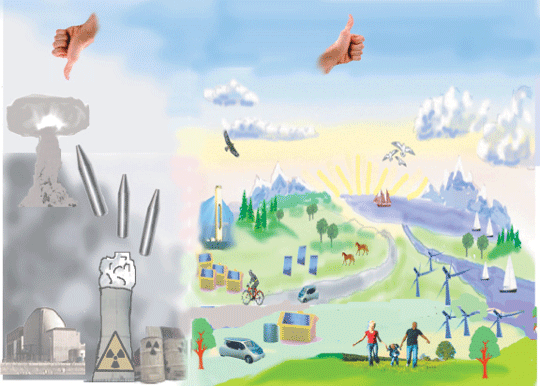
Germany Could Be a Model for How We’ll Get Power in the Future
 The European nation’s energy revolution has made it a leader in replacing nukes and fossil fuels with wind and solar technology.National Geographic, By Robert Kunzig Photographs by Luca Locatelli
OCTOBER 15, 2015 “….. Germany is pioneering an epochal transformation it calls the energiewende—an energy revolution that scientists say all nations must one day complete if a climate disaster is to be averted. Among large industrial nations, Germany is a leader. Last year about 27 percent of its electricity came from renewable sources such as wind and solar power, three times what it got a decade ago and more than twice what the United States gets today. The change accelerated after the 2011 meltdown at Japan’s Fukushima nuclear power plant, which led Chancellor Angela Merkel to declare that Germany would shut all 17 of its own reactors by 2022. Nine have been switched off so far, and renewables have more than picked up the slack.
What makes Germany so important to the world, however, is the question of whether it can lead the retreat from fossil fuels. By later this century, scientists say, planet-warming carbon emissions must fall to virtually zero. Germany, the world’s fourth largest economy, has promised some of the most aggressive emission cuts—by 2020, a 40 percent cut from 1990 levels, and by 2050, at least 80 percent…….. Continue reading
Transition from nuclear energy to renewables, in Germany
 Germany Could Be a Model for How We’ll Get Power in the Future
The European nation’s energy revolution has made it a leader in replacing nukes and fossil fuels with wind and solar technology. National Geographic, By Robert Kunzig Photographs by Luca Locatelli OCTOBER 15, 2015 “…..Germany’s Audacious Goal
Fell, who was installing PV panels on his roof in Hammelburg, realized that the new law would never lead to a countrywide boom: It paid people to produce energy, but not enough. In 1993 he got the city council to pass an ordinance obliging the municipal utility to guarantee any renewable energy producer a price that more than covered costs. Fell promptly organized an association of local investors to build a 15-kilowatt solar power plant—tiny by today’s standards, but the association was one of the first of its kind. Now there are hundreds in Germany.
In 1998 Fell rode a Green wave and his success in Hammelburg into the Bundestag. The Greens formed a governing coalition with the SPD. Fell teamed up with Hermann Scheer, a prominent SPD advocate of solar energy, to craft a law that in 2000 took the Hammelburg experiment nationwide and has since been imitated around the world. Its feed-in tariffs were guaranteed for 20 years, and they paid well.
“My basic principle,” Fell said, “was the payment had to be so high that investors could make a profit. We live in a market economy, after all. It’s logical.”…….
The biogas, the solar panels that cover many roofs, and especially the wind turbines allow Wildpoldsried to produce nearly five times as much electricity as it consumes. Einsiedler manages the turbines, and he’s had little trouble recruiting investors. Thirty people invested in the first one; 94 jumped on the next. “These are their wind turbines,” Einsiedler said. Wind turbines are a dramatic and sometimes controversial addition to the German landscape—“asparagification,” opponents call it—but when people have a financial stake in the asparagus, Einsiedler said, their attitude changes.
It wasn’t hard to persuade farmers and homeowners to put solar panels on their roofs; the feed-in tariff, which paid them 50 cents a kilowatt-hour when it started in 2000, was a good deal. At the peak of the boom, in 2012, 7.6 gigawatts of PV panels were installed in Germany in a single year—the equivalent, when the sun is shining, of seven nuclear plants. A German solar-panel industry blossomed, until it was undercut by lower-cost manufacturers in China—which took the boom worldwide.
Fell’s law, then, helped drive down the cost of solar and wind, making them competitive in many regions with fossil fuels. One sign of that: Germany’s tariff for large new solar facilities has fallen from 50 euro cents a kilowatt-hour to less than 10. “We’ve created a completely new situation in 15 years—that’s the huge success of the renewable energy law,” Fell said.
Germans paid for this success not through taxes but through a renewable-energy surcharge on their electricity bills. This year the surcharge is 6.17 euro cents per kilowatt-hour, which for the average customer amounts to about 18 euros a month—a hardship for some, Rosenkranz told me, but not for the average German worker. The German economy as a whole devotes about as much of its gross national product to electricity as it did in 1991.
In the 2013 elections Fell lost his seat in the Bundestag, a victim of internal Green Party politics. He’s back in Hammelburg now, but he doesn’t have to look at the steam plumes from Grafenrheinfeld: Last June the reactor became the latest to be switched off. No one, not even the industry, thinks nuclear is coming back in Germany…….
Germany’s big utilities have been losing money lately—because of the energiewende, they say; because of their failure to adapt to the energiewende, say their critics. E.ON, the largest utility, which owns Grafenrheinfeld and many other plants, declared a loss of more than three billion euros last year.
“The utilities in Germany had one strategy,” Flasbarth said, “and that was to defend their track—nuclear plus fossil. They didn’t have a strategy B.” Having missed the energiewende train as it left the station, they’re now chasing it. E.ON is splitting into two companies, one devoted to coal, gas, and nuclear, the other to renewables. The CEO, once a critic of the energiewende, is going with the renewables.
Vattenfall, a Swedish state-owned company that’s another one of Germany’s four big utilities, is attempting a similar evolution. “We’re a role model for the energiewende,” ……..
Vattenfall, however, plans to sell its lignite business, if it can find a buyer, so it can focus on renewables. It’s investing billions of euros in two new offshore wind parks in the North Sea—because there’s more wind offshore than on and because a large corporation needs a large project to pay its overhead. “We can’t do onshore in Germany,” Wiese said. “It’s too small.”
Vattenfall isn’t alone: The renewables boom has moved into the North and Baltic Seas and, increasingly, into the hands of the utilities. Merkel’s government has encouraged the shift, capping construction of solar and onshore wind and changing the rules in ways that shut out citizens associations. Last year the amount of new solar fell to around 1.9 gigawatts, a quarter of the 2012 peak. Critics say the government is helping big utilities at the expense of the citizens’ movement that launched the energiewende.
At the end of April, Vattenfall formally inaugurated its first German North Sea wind park, an 80-turbine project called DanTysk that lies some 50 miles offshore. The ceremony in a Hamburg ballroom was a happy occasion for the city of Munich too. Its municipal utility, Stadtwerke München, owns 49 percent of the project. As a result Munich now produces enough renewable electricity to supply its households, subway, and tram lines. By 2025 it plans to meet all of its demand with renewables……
Though Germany isn’t on track to meet its own goal for 2020, it’s ahead of the European Union’s schedule. It could have left things there—and many in Merkel’s CDU wanted her to do just that. Instead, she and Economics Minister Sigmar Gabriel, head of the SPD, reaffirmed their 40 percent commitment last fall……..http://ngm.nationalgeographic.com/2015/11/climate-change/germany-renewable-energy-revolution-text
Small scale solar power opens up big future for millions in Tanzania
“People who have small shops no longer close their shops early because they don’t have electricity. They can now operate until late at night. The availability of solar electricity has helped control immigration of people to urban areas,” says alternative energy specialist Dr Brenda Kazimili at the University of Dar es Salaam.
The government now wants all health centres and dispensaries that are not connected to the grid countrywide to be provided with solar panels.
How Tanzania plans to light up a million homes with solar power, Guardian, Erick Kab
endera, 29 Oct 15, In a country where only 40% of people have access to grid electricity, the government is looking to sunshine to power health centres and homes efore solar panels were installed at Masaki village’s only health centre, doctors, nurses and midwives had to use dim flashlights or the glow from their cellphones to deliver babies and treat night-time emergencies.
In one case in 2010, a man arrived late after a motorcycle accident and needed a wound stitching. As the nurse began the procedure by the light of her torch, she felt a cold slithering sensation against her legs.
A large black snake was moving across the dark, cement floor. The nurse fled, leaving the patient in the dark with the snake.
The work of the centre, which is five hours drive down a dirt track from the capital Dar es Salaam and serves a population of 1.5 million people in surrounding villages, is now transformed by a two kilowatt solar array installed on the roof at a cost of $15,000 (£9,700). And the government wants many more like it.
In February, it launched its One Million Solar Homes initiative to provide the sun’s power to 1m properties by 2017. Off Grid Electric, the Tanzanian company implementing the initiative, says it will provide power to 10% of the country’s homes. Currently, only 40% have access to grid power with access particularly sparse in rural areas.
The challenge across Africa is daunting. ……
Funding for the million homes initiative has come partly from the government’s Rural Energy Agency – which spends $400m a year – and international donors such as the World Bank. And in rural areas, microfinance organisations are now lending to allow householders to by solar panels. The total installation can cost up to $1,000.
“People who have small shops no longer close their shops early because they don’t have electricity. They can now operate until late at night. The availability of solar electricity has helped control immigration of people to urban areas,” says alternative energy specialist Dr Brenda Kazimili at the University of Dar es Salaam.
The government now wants all health centres and dispensaries that are not connected to the grid countrywide to be provided with solar panels.
Back at Masaki village health centre, the changes were much needed. “We’d begged for so long for solar power at this health centre. Life was unbearable here. We faced so many challenges and it was hard to work at night or do tests that required electricity,” said clinical officer Ahmed Mkamba.
“[Now] we have even installed a satellite dish to keep the health workers entertained after work. Mothers no longer have to be sent to far-away health centres to conduct simple tests and health workers don’t have to walk long distances simply to charge mobile phones.”
Health workers use the power from the solar panels (and the battery installed so that they can use the power at night) to run a computer which keeps patient records, to light the centre’s compound which covers about three or four acres of land and to operate HIV/Aids testing equipment. This means that patients no longer need to be sent to the district hospital 28km away.
And says Mkamba: “The lights keep away the snakes.” http://www.theguardian.com/environment/2015/oct/29/how-tanzania-plans-to-light-up-a-million-homes-with-solar-power
United Arab Emirates leading the way on renewable energy
UAE is the example to follow on energy, the National ae, Thamer Al Subaihi October 29, 2015 ABU DHABI // The oil-rich countries of the region should follow the UAE’s example in recycling their wealth into renewable energy, the UK’s secretary of state for foreign and commonwealth affairs said.
“The countries of this region have a choice,” said Philip Hammond at Masdar City on Thursday. “They can choose to do very little and hope climate change will not affect them, or take a lead from the UAE, investing in renewable energy and clean technology.”
Also speaking at the event was Dr Sultan Al Jaber, UAE Minister of State and chairman of Masdar, who said the UAE was committed to significantly increasing its use of renewable energy through the Intended Nationally-Determined Contribution plan it has submitted to the United Nations.
“Within the plan is the UAE’s national target to generate 24 per cent of its electricity from clean energy resources by 2021,” he said.
Mr Hammond praised the UAE’s investment in renewable energy domestically and globally as well as its ambitious plan of increasing its use of it. “Your target to achieve a quarter of your energy from clean sources within six years is bold and impressive,” said Mr Hammond.
While the UAE has the world’s seventh-largest reserves of oil and gas, Mr Hammond said it was to the nation’s credit that it was “already planning for a future beyond oil”.
The talk took place ahead of the global climate summit set to take place in Paris in December.
Mr Hammond said the time to invest in renewable energy was now, as climate change had the potential to significantly impact every country. “Climate change knows no borders and will respect no sovereignty,” he said. “While the UK would suffer from more extreme rainfall, storms and flooding, this region would be at risk from evermore extreme heat, water scarcity and drought.”
Adnan Amin, director general at the Masdar-based International Renewable Energy Agency, said that although significant strides had been made in the sector over the past decade, much more had to be done to prevent the global surface temperature increasing by 2ºC, which some experts said could be the tipping point to major climate change……..http://www.thenational.ae/uae/environment/uae-is-the-example-to-follow-on-energy
Germany’s Renewable Energy Generated Almost Double The Amount From Nuclear
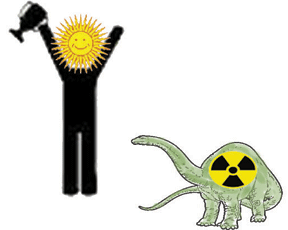 Renewable Energy In Germany Generated Almost Double The Amount From Nuclear http://cleantechnica.com/2015/10/29/renewable-energy-in-germany-generated-almost-double-the-amount-from-nuclear/ by Jake Richardson Originally published on Solar Love.
PV solar power generation in Germany is already 5% higher in the first nine months of this year than all of last year. Germany’s PV systems generated 33,193 gigawatt hours of solar electricity through the end of September, according to the German Association of Energy and Water Industries. Wind power in the first nine months of 2015 has generated 52% more than it did in all of 2014. 59,006 gigawatt hours has been produced, according to the same source.
114,723 gigawatt hours of electricity in Germany came from renewable sources in the first nine months of 2015, which was almost double the amount produced from nuclear sources. Additionally, some electricity prices have decreased from the previous year. For example, the cost of peak load power is nearly at 2002 levels.
This is all good news….the crazy thing about it is that you probably won’t hear about it anywhere but niche news sites like this one. This media oversight is a tragic deficiency, but the fact that Germany has come so far so rapidly confirms the effectiveness of renewables. This is not a small country like Costa Rica achieving 100% electricity from renewables for two months for 4.8 million people. Germany’s population is about 80 million!
Switching gradually from nuclear to renewables for such a large nation is very obviously a tremendous undertaking. How far along the path is Germany now? Some might say it won’t and can’t happen soon, but it seems to be progressing well.
Given that the price of PV solar power systems continues to drop, will there be an even greater acceleration in the rate of solar adoption? Price has been one of the major barriers, but is no longer nearly as much a factor. Another has been the lack of backup power or energy storage, but that one is being diminished too by the fact that the energy storage industry is growing quickly.
It should be pointed out that the decision to decrease reliance on nuclear power and increase investment in renewables was done before the most dramatic drop in solar power and the emergence of energy storage solutions. It will be fascinating to see how much more German renewable energy will grow in the next several years.
Renewable energy – 60% of new USA electricity capacity
 US Large-Scale Renewables Account For More Than 60% Of New Capacity http://cleantechnica.com/2015/10/28/us-renewables-account-60-new-capacity/
by Joshua S Hill
New figures reveal that US utility-scale renewable energy projects accounted for more than 60% of new energy capacity installed throughout the first three quarters of 2015. In new figures released by the US Federal Energy Regulatory Commission (FERC) in its monthly Energy Infrastructure Update (PDF), it was revealed that renewable energy sources — including biomass, geothermal, hydropower, solar, and wind — accounted for 60.20% of the total 7,276 MW of new electrical generation installed in the US during the first 9 months of 2015.
Wind alone made up 40.76% of all new capacity so far this year, with 2,966 MW of new generating capacity spread out over 26 new projects.
Second, among renewable energy technologies, was utility-scale solar, with 1,137 MW over 142 projects. Biomass was third, with 205 MW spread over 16 projects; geothermal steam fourth, with a 45 MW project; and hydropower fifth, with 27 MW across 18 projects.
“With Congress and numerous states now questioning the ability of renewable energy sources to meet targets called for in the Administration’s new Clean Power Plan (CPP), the explosive growth of wind, solar, biomass, hydropower, and geothermal in recent years confirms that it can be done,” noted Ken Bossong, Executive Director of the SUN DAY Campaign. “In fact, the latest FERC data suggest that the CPP’s goals are unduly modest and renewables will handily surpass them.”
Wind dominated even in the month of September alone, with 3 projects (or units, as FERC labels them) totalling 448 MW.
The three projects that came online during September were the 211 MW Rattlesnake Den Wind project, located in Glasscock County, in Texas; the 211 MW Logans Gap Wind project, located in Comanche County, Texas; and the smaller 25.6 MW Saddleback Ridge Wind Phase 2 Expansion Project, located in Franklin County, Maine.
Renewable energy headlines Oct 15 2015
Is Renewable Energy Starting to Bend the Carbon Curve?
Blog-Barron’s (blog)-14 hours ago
Toyota backs massive solar-wind hybrid energy park in north …
Energy Matters-6 hours ago
How Australia can become a renewable energy superpower
1 This Month

of the week – Shut Down Drone Warfare!


Tell the Ukrainian Government to Drop Prosecution of Peace Activist Yurii Sheliazhenko

Petition to revoke the licensing of the Near Surface Nuclear Disposal Facility (NSDF) at Chalk River. https://www.ourcommons.ca/petitions/en/Petition/Details?Petition=e-7247
To see nuclear-related stories in greater depth and intensity – go to https://nuclearinformation.wordpress.com
-
Archives
- April 2026 (114)
- March 2026 (251)
- February 2026 (268)
- January 2026 (308)
- December 2025 (358)
- November 2025 (359)
- October 2025 (376)
- September 2025 (257)
- August 2025 (319)
- July 2025 (230)
- June 2025 (348)
- May 2025 (261)
-
Categories
- 1
- 1 NUCLEAR ISSUES
- business and costs
- climate change
- culture and arts
- ENERGY
- environment
- health
- history
- indigenous issues
- Legal
- marketing of nuclear
- media
- opposition to nuclear
- PERSONAL STORIES
- politics
- politics international
- Religion and ethics
- safety
- secrets,lies and civil liberties
- spinbuster
- technology
- Uranium
- wastes
- weapons and war
- Women
- 2 WORLD
- ACTION
- AFRICA
- Atrocities
- AUSTRALIA
- Christina's notes
- Christina's themes
- culture and arts
- Events
- Fuk 2022
- Fuk 2023
- Fukushima 2017
- Fukushima 2018
- fukushima 2019
- Fukushima 2020
- Fukushima 2021
- general
- global warming
- Humour (God we need it)
- Nuclear
- RARE EARTHS
- Reference
- resources – print
- Resources -audiovicual
- Weekly Newsletter
- World
- World Nuclear
- YouTube
-
RSS
Entries RSS
Comments RSS
 nuclear-news