Residential solar power a money saver

 Saving Money With Solar Power http://mentalitch.com/saving-money-with-solar-power/The boundless financial benefits of solar power Having a solar energy system in your home puts you at a great advantage without being completely reliant on the electric grid and helping the environment. This is a great move to going green and living green. Another reason is that you may want to avoid paying astronomical electricity bills in the future by traditional energy companies. Hiring a solar power installation company will help you develop a solar energy, for whatever reasons that have driven you to need for such move.So why go green with having a solar power system for your home? There are a lot of good reasons to have solar energy for your property.
1) Increase in home/property value Installing a solar energy system in your home will definitely appreciate the value of your property. It will even add to the curb appeal of your home. Having a solar power system of your home will move you ahead of other property sellers in the marketplace and will be a long term benefit to the home. A licensed solar energy company will be able to help you determine how much the value of your home will be affected by the installation of a solar energy system.
2) Reduction of electricity bill costs Having a solar energy system installed in your home will help you reduce the monthly bill that you have to pay for the electric company. Before installing a solar energy system its important to get the right one that meets your needs. Professionals will first have to determine your current electricity consumption and right size the system. You may want to forgo paying the bills to the electric company completely, or at least greatly reduce electricity bills by paying the company a fraction what your previous average monthly bill. In some cases, after installing a solar energy system, your electrical bill may be completely wiped out. Some electrical companies will ‘bank’ excess power from your system so your bill even in winter or less sunny times will not increase.
Having “green energy” installed in your home comes with advantages. You may be able to get credits which will help cover the installation costs. There are many programs from the government and other organizations that reward you with incentives for having such a great source of clean, alternative energy in your home.
4) Freedom from price fluctuations by many energy companies Traditional energy companies are facing increasing demands for their power that may cause them to raise rates. With a solar power system as an alternative source of energy to your home, you can offset potential increases in your electric bill and not get caught up in the rising energy prices. Installing a solar power system in your home will give you a great advantage over those that don’t have one. Aside from contributing something good to our environment, having an alternative source of energy in your home can provide a lot of benefits. It can save you a lot of money and also increase the resale value of your property – and if you plan it right you may be able to do it with a lower cost thanks to government incentives.
Wind and solar lead in new energy generation
Wind adds the most electric generation capacity in 2015, followed by natural gas and solar
Wind, natural gas, and solar made up almost all new electric generation capacity in 2015, accounting for 41%, 30%, and 26% of total additions, respectively, according to preliminary data. The data also show a record amount of distributed solar photovoltaic (PV) capacity was added on rooftops throughout the country in 2015. The trend of wind, natural gas, and solar additions making up most new capacity is likely to continue in 2016.
http://www.eia.gov/todayinenergy/detail.cfm?id=25492
The Surprise New Boom Market for Residential Solar 03/23/2016. As the price of solar powered electricity keeps falling and rooftop panels pop up in an increasing number of neighborhoods, an interesting thing is shaping up in the market. Residential solar is no longer for just well-to-do homeowners. Indeed, the growth market in solar is median- and low-income neighborhoods in California and other locales, according to multiple recent reports.
http://www.huffingtonpost.com/greenbiz-group/residential-solars-new-bo_b_9526460.html
A revolutionary technique – recycling sunlight?
Recycling sunlight: a solar cell revolution? Christina Science Monitor Scientists have found a way to recycle sunlight and boost the amount of energy captured from the sun’s rays By Jason Thomson, Staff MARCH 24, 2016
The world of solar cells could be on the cusp of a revolution, as researchers seek to boost efficiency by harnessing the power to recycle light.
A new study, published Thursday in the journal Science, considers the properties of hybrid lead halide perovskites, a group of materials already making waves in solar cell technology, and demonstrates their ability to absorb energy from the sun, create electric charge, and then churn out some light energy of their own.
Moreover, the researchers demonstrated that such these cells can be produced cheaply, with easily synthesized materials, making the proposition much more commercially viable…….http://www.csmonitor.com/Environment/2016/0324/Recycling-sunlight-a-solar-cell-revolution
Nova Scotia’s success with wind power
Wind Power Helps Nova Scotia Set Renewable Energy Record, North American Windpower by NAW Staff January 28, 2016 Nova Scotia Power (NSP), the Canadian province’s primary electricity provider, says wind power helped it achieve a new renewable energy record in 2015, with 26.6% of the electricity used by Nova Scotians coming from renewable resources last year. “We’re becoming cleaner and greener,” says Mark Sidebottom, NSP’s vice president of power generation and delivery. “Nova Scotians depend on us to provide the electricity they need for their homes and businesses every day, and they want that electricity to come from more sustainable sources.”
NSP says its performance on renewable energy exceeded the legislated 2015 requirement of 25% renewable electricity, as well as positions the company well to meet the 40% renewable requirement that takes effect in 2020. As recently as 2007, only 9% of Nova Scotia’s electricity was renewable. Also by 2020, NSP will have reduced greenhouse-gas emissions by 25%.
“We have made remarkable progress in Nova Scotia,” states Sidebottom. “No other utility in Canada has made this rapid of a transition. In 2020, we will have a greater percentage of our electricity coming from renewables than Germany, which is often recognized as a world leader in renewable energy………Nova Scotia’s growth in renewable electricity has been largely through the development of wind power. According to NSP, there are now 294 commercial wind turbines producing electricity in Nova Scotia. Most are independently owned. At times, wind power has accounted for as much as 50% of the province’s electricity.
However, there are other times when almost no electricity is coming from wind, so the utility has to have other generation sources on hand for backup to supply customers: NSP says the Maritime Link, delivering hydroelectricity from Muskrat Falls, will provide a firm source of renewable electricity, and help push Nova Scotia Power to more than 40% renewable electricity by 2020. http://nawindpower.com/wind-power-helps-nova-scotia-set-renewable-energy-record
New battery technology developed by Chinese researchers
Chinese researchers develop new battery technology, EurekAlert, 25 Mar 16CHINESE ACADEMY OF SCIENCES HEADQUARTER A Chinese research team from the Shenzhen Institutes of Advanced Technology (SIAT) of the Chinese Academy of Sciences has developed a novel, environmentally friendly low-cost battery that overcomes many of the problems of lithium ion batteries (LIB). The new aluminum-graphite dual-ion battery (AGDIB) offers significantly reduced weight, volume, and fabrication cost, as well as higher energy density, in comparison with conventional LIBs. AGDIB’s electrode materials are composed of environmentally friendly low cost aluminum and graphite only, while its electrolyte is composed of conventional lithium salt and carbonate solvent.
The research, published in “A Novel Aluminum-Graphite Dual-Ion Battery,” recently appeared in Advanced Energy Materials (IF=16.146).
The discovery is particularly important given rising battery demand and existing LIB technology, which is reaching its limit in specific energy (by weight) and energy density (by volume).
LIBs are widely used in portable electronic devices, electric vehicles and renewable energy systems. Battery disposal creates major environmental problems, since most batteries contain toxic metals in their electrodes. According to the Freedonia Group, world battery demand is expected to rise 7.7% annually, reaching US$120 billion in 2019………http://www.eurekalert.org/pub_releases/2016-03/caos-crd032416.php
Solar power’s mighty future
We’ve Barely Begun to Tap the Sun’s Mighty Power http://www.motherjones.com/blue- marble/2016/03/solar-power-nrel-study By Tim McDonnell Mar. 24, 2016 It seems like every few weeks there’s some new measurement of how successful solar power is in the United States. In early March, industry analysts found that solar is poised for its biggest year ever, with total installations growing 119 percent by the end of 2016. This week, federal government analysts reported that in 2015, solar ranked number three (behind wind and natural gas) in megawatts of new electricity-producing capacity brought online. That rank is even more impressive when you consider that each individual solar installation is fewer megawatts than a wind turbine, and far fewer than a natural gas plant; that means solar panels are popping up like crazy across the country.
The report is the deepest dive on solar’s potential since NREL conducted a similar analysis in 2008. The new report’s estimate is much larger than the older report’s, mostly because of vast new troves of satellite imagery data of the country’s rooftops and computer models that are better able to calculate how much power each panel can produce. The analysis leaves behind policy and cost considerations. Instead, the only question is: How much power could we really get if we slathered every roof in America with solar panels? The answer: About 39 percent of the country’s electricity consumption, at current levels.
It’s important to note that the report looks only at rooftop panels, as opposed to utility-scale solar farms. Utility-scale solar provides about twice as much power as rooftop panels, so the full potential of solar is likely even higher than what NREL describes in this report. Even 39 percent, though, would be a revolutionary change from where we are now; despite solar’s rapid growth in the last several years, it still accounts for less than 1 percent of electricity consumption. Coal, which is still the nation’s number-one energy source, commands about 32 percent of the market. So the future that NREL is envisioning here would basically flip our energy makeup on its head.
The most potential exists in sunny states, obviously, but also in states that have relatively low electricity needs. [good map on original] Again, NREL stresses that the estimates here “provide an upper bound on potential deployment rather than a prediction of actual deployment.” It’s very unlikely that this exact scenario will come to pass. The most recent study by Stanford energy economist Mark Jacobson, who researches ways the US could get 100 percent of its power from renewable sources, sees rooftop solar contributing about 7 percent of total electricity by 2050. And that’s with, as Vox‘s David Roberts put it, “enormous, heroic assumptions about social and political change.”
But hey…we’re dreamers of the golden dream, right?
Shared solar – a cheaper, better way to go for electricity
Shared solar can help low-income customers get in on the solar development.
Rooftop solar can be expensive, even with incentives or leasing programs, leaving low-income ratepayers out. Shared solar can let them in on the benefits of solar. A couple of recent reports show how.

Love solar power but got no rooftop? “Shared solar” is coming for you. Vox [excellent pictures] by David Roberts on March 24, 2016 To date, solar power has mostly been available to utilities (as big power plants) or individual home and business owners (as rooftop panels).
Left out has been … well, everyone else, those of us who are not utility executives and do not have the money, wherewithal, or suitable rooftops to install solar ourselves. That’s a lot of people who love solar power but have no way to get directly involved in it.
Here’s how shared solar fits into the larger energy picture, how it works, its benefits and drawbacks, and its future potential……There are two kinds of community-scale solar. The first is utility-owned, with power sold to utility customers — a traditional arrangement between a utility and a power plant developer, just on a smaller scale. Lots of smaller utilities, municipals, and co-ops are getting into this.
The other is shared solar, in which customers a) share ownership of a community-scale PV array, b) “subscribe” to the power output of such an array, or c) both.
Existing community-scale solar is split roughly half and half between those two types.
How many shared solar projects are there? From a new report by Deloitte:
In 2010, only two shared solar projects existed [in the US]. Today 77 utilities administer 111 projects across 26 states, accounting for a combined capacity of about 106 megawatts (MW).
That’s a tiny base — less than 1 percent of installed solar PV capacity, according to GTM — but growth is accelerating.
According to RMI, if you include both types, community-scale solar could grow to 30 GW capacity by 2020.
Typically, customers “subscribe” to a shared solar project. Some subscribe to a certain amount of capacity (say, the output of one panel), measured in kW. Some subscribe to a certain amount of power, measured in kWh. The credit for the power appears on a customer’s utility bill.
Who runs these things? “Shared solar arrays,” writes NREL, “can be hosted and administered by a variety of entities, including utilities, solar developers, residential or commercial landlords, community and nonprofit organizations, or a combination thereof.”
Exactly who can build and run a shared solar project depends on whether it is located in a regulated or deregulated energy market (more on that in a second) and what type of utility service area it’s in.
Shared solar is overwhelmingly driven, at least at the moment, by customer demand. So it makes sense that the utilities most responsive to their customers — co-ops, where customers are also owners — are leading the way on shared solar projects.
Deloitte offers this information-packed breakdown of shared solar by utility type:………
Benefits of shared solar
Shared solar has many of the benefits of distributed “behind-the-meter” solar and many of the benefits of larger solar power plants, with few of the drawbacks of either.
Like utility-scale solar, it enjoys economies of scale and simple, established financing models; unlike utility-scale solar, it can squeeze into almost any surface or piece of land, near existing transmission or distribution lines.
Like distributed, behind-the-meter solar it is low risk, can be sited near existing load, increases the resilience of the distribution grid, and satisfies the powerful consumer craving for solar power; at the same time, it is cheaper, simpler (fewer contracts per kW of capacity), and more inclusive than behind-the-meter solar.
Utilities, especially investor-owned utilities, aren’t in love with it (to them it’s just a more expensive version of a solar plant), but if they get their act together, they can use small, strategically sited shared solar projects to ease grid congestion or avoid expensive new grid investments………..
Shared solar can bring solar to low-income customers
One benefit is worth calling out in particular: Shared solar can help low-income customers get in on the solar craze.
Rooftop solar can be expensive, even with incentives or leasing programs, leaving low-income ratepayers out. Shared solar can let them in on the benefits of solar. A couple of recent reports show how.
One is the “Low-Income Solar Policy Guide,” from a coalition of groups including GRID Alternatives, Vote Solar, and the Center for Social Inclusion. The other is from the Interstate Renewable Energy Council (IREC): “Shared Renewable Energy for Low- to Moderate-Income Consumers: Policy Guidelines and Model Provisions.”
Both get into the technical weeds on program design and financing……… http://www.vox.com/2016/3/24/11297054/shared-solar
Tropical countries need solar power, more than free cooling
Tropical sites need solar power, not free cooling, Data Center Dynamics 24 March 2016 By Paulo Cesar de Resende Pereira Free cooling can improve some measures of efficiency, but tropical countries may be better off looking at where their power comes from
The importance of data centers to the average citizen should not be underestimated. They are vital for even the most common daily function – from a simple internet search to a bank transaction. Their importance can even extend to, for example, the monitoring of the electricity delivered to one’s home.
But data centers are accused of being environmental villains due to their exorbitant consumption of energy, so reducing their environmental impact is vital. In this context, photovoltaic generation is an interesting alternative to free cooling, and especially suitable for tropical regions such as Brazil.
Using the wrong metricEcological footprint (ecofootprint), according to WWF Global, is connected to the impact of human activities, measured according to the production area and the amount of water needed to produce goods and assimilate the waste produced.
Data center efficiency is usually rated by PUE, a parameter conceptualized by the US, the EU and Japan to establish a single metric to assess the energy efficiency of data centers. The concept is not new, because the relationship between useful energy and invested energy is used in many other processes.
The calculation of this indicator is based on the relationship between the energy consumption by the installation as a whole (total energy) and the energy consumption exclusively by IT equipment (IT energy). Like any indicator, PUE may be called into question, but it remains a useful metric nonetheless.
It did not take long for the cooling system to be considered the greatest enemy of PUE; as a consequence, its efficiency has become closely related to its reduction. There is nothing more tempting than getting something for free; for instance, a data center that could potentially be cooled by nothing more than the forces of nature. Since this is not possible, the solution is to decrease a good percentage of energy consumed by central chilled water, taking advantage of free cooling, thus decreasing PUE………
Free energy, not free coolingThe concept of free energy emerges as an alternative to free cooling, on the grounds that it is more suitable to the Brazilian reality and to other countries with similar weather. It is related to power generation using any renewable energy source that has been obtained directly from nature through an environmentally sustainable process. This solution, as well as free cooling, aims to improve data center effectiveness and reduce the ecofootprint from data centers in general. Because of the distributed generation and the ability of interaction between the minigeneration and the energy provider, free energy has become a feasible concept.
Taking photovoltaic power as an example of free energy, when data centers are transformed into generation plants, they may apply this energy to the grid and offset it – not only from an energy standpoint but also economic. Once the concept of free energy is settled, it is inserted into another new term – EcoPUE – bringing a new idea for calculating PUE that is now even more environmentally friendly and presents a sustainable aspect, where the reduction of energy consumption in the data center is linked to the subtraction of the energy generated by the photovoltaic generation system. This renewable generated energy is called ‘free energy.’
Use what works
The increased demand for processing and storage of data, together with the environmental problems caused by high energy consumption, are forcing data centers in Brazil, and elsewhere, to seek more technological solutions and become increasingly green, using energy more efficiently and sustainably while providing a quality service to customers
. A combination of existing technology and techniques, along with new government legislation in Brazil, are now in place, so significant improvements have already been achieved. As an alternative to free cooling, the use of photovoltaics is increasingly being seen as a viable option in countries with a high solar radiation index – like Brazil – where renewable energy can be obtained for free from the natural resources available on the planet.
The concept of EcoPUE demonstrates that greater efficiency from a data center can be enforced with the use of photovoltaic generation, thus reducing their environmental footprint.
Paulo Cesar de Resende Pereira is director of Fox Engenharia e Consultoria in Brazil
This article is translated from the Portuguese-language section of the latest magazine at Datacenterdynamics.es http://www.datacenterdynamics.com/power-cooling/tropical-sites-need-solar-power-not-free-cooling/95907.fullarticle
Solar WINDOWS (not panels)
AMAZING IOT #8: SOLAR WINDOWS (NOT PANELS!) ST Smarter Together, 16 Mar 16 A handful of startups are heading toward a new window of opportunity: solar powered windows. If you think about all of the windows in the world – Manhattan alone has 10.7 million windows – creating a window that allows businesses to save on energy costs would be breaking into an almost unimaginably huge market.
Solar powered windows sound conceptually like an oxymoron: Solar panels absorb and reflect light while windows let light through. Various startups have proposed different solutions to this issue which, at its heart, is a serious one. The company Solaria, uses thin strips of photovoltaics on already existing glass, making windows appear pin-striped. Another startup called Oxford Photvoltaics uses perovskite – an oxide used for superconductors – in order to capture solar energy. ………. competitor Richard Lunt and his team at Michigan State University created solar panel windows with a new method called Transparent Luminescent Solar Concentrator (TSLC). This method has the photovoltaic strips on the edge of the glass, allowing the window to be more transparent than the other two……..http://smartertogether.telenorconnexion.com/2016/03/amazing-iot-8-solar-windows-not-panels/
Home solar energy is booming in USA
The Surprise New Boom Market for Residential Solar Huffington Post, By Barbara Grady 24 Mar 16 As the price of solar powered electricity keeps falling and rooftop panels pop up in an increasing number of neighborhoods, an interesting thing is shaping up in the market.
Residential solar is no longer for just well-to-do homeowners. Indeed, the growth market in solar is median- and low-income neighborhoods in California and other locales, according to multiple recent reports.
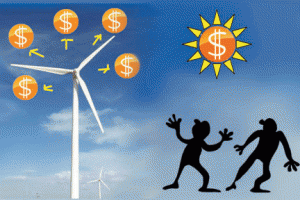
In 2015, a full 65 percent of residential solar getting installed in California was in zip codes with median household incomes of $70,000 or less, while just 6 percent of installations in the state were happening in neighborhoods with median household incomes above $100,000, according to a report from Kevala Analytics.
A surge in solar adoption — as well as a shift in where that adoption is taking place — is driven by economics that make solar the money saving option for electricity rate payers and by policies that offer flexible ways for people to benefit from solar.
In California, Massachusetts, New York, Colorado, the District of Columbia, Maryland and some other places, policies that extend the reach of solar to renters and residents without rooftops are widening the market for individual and community installations alike. Financing mechanisms prevalent in some markets but not in others have also made it possible for people to opt for solar without requiring they have money for big upfront costs.
Federal policies adopted in the last couple of years, such as Property Assessed Clean Energy loan funds, and National Community Solar programs have helped. …..http://www.huffingtonpost.com/greenbiz-group/residential-solars-new-bo_b_9526460.html
US households turning to solar panels. Impact on power industries
 Impact of solar panels keeps growing The U.S. power industry is feeling the pressure, with about 1 million households turning to the sun. PORTLAND PRESS HERALD, BY JONATHAN N. CRAWFORD BLOOMBERG.22 Mar 16 Rooftop solar is casting a $2 billion shadow over power generators across the eastern United States.
With more than a million U.S. houses set to have solar panels by the end of next month, grid managers serving the eastern U.S. plan to cut the amount of electricity they buy from conventional plants by about 1,400 megawatts, starting in 2019, according to industry consultant ICF International Inc. That’s enough juice to power about 780,000 households.
The result could be as much as $2 billion in lost revenue for generators that are already reeling from lower demand, tight environmental regulation and depressed prices. Power producers including NRG Energy Inc. warn that the growing reliance on solar may curtail investment in conventional power plants, threatening the reliability of the U.S. electricity system. That’s already happened in Germany, they say, citing plans by EON and RWE to scrap existing or planned plants……..
Under “Energiewende,” a German transition plan designed to lessen fossil fuel use, about 30 percent of the country’s power is now generated by renewables, sending power prices to their lowest levels in more than a decade. That spurred EON’s Uniper unit to seek closure of two gas-fired units in Bavaria, and Essen-based RWE to scrap plans to start up its coal-fired Westfalen-D plant, valued at $1.1 billion…….
This year, for the first time, operators of regional power grids such as PJM Interconnection, which serves more than 61 million customers ranging from Washington to Chicago, and ISO New England Inc., have included solar growth in their estimates for 2019, spurring more national debate on how the nation’s electrical system will be financed and managed moving forward. http://www.pressherald.com/2016/03/19/impact-of-solar-panels-just-keeps-growing/
LARGE-SCALE SOLAR POWER STORAGE CAN BECOME A REALITY
CAN LARGE-SCALE SOLAR POWER STORAGE BECOME A REALITY?, Stanford Engineering, An unexpected finding by a team of engineers could lead to a revolutionary change in how we produce, store and consume energy. By Glen Martin, 16 Feb 16, “……..Now a team led by William Chueh, an assistant professor of materials science and engineering, and Nicholas Melosh, an associate professor in the same department, has made a discovery that could make large-scale solar power storage a reality.
The breakthrough is based on the fact that ordinary metal oxides, such as rust, can be fashioned into solar cells capable of splitting water into hydrogen and oxygen.
So far it has been impractical to use water-splitting as a way to store the sun’s energy. One reason is cost-efficiency. Silicon-based solar cells, such as those used in rooftop solar arrays, are good at converting visible and ultraviolet light into electricity. But silicon cells waste the infrared light, which bears heat, beating down on them.”Standard cells utilize a relatively small portion of the spectrum, and the rest is lost as heat,” Chueh said.Until the recent Stanford experiments, it was believed that metal oxides also became less efficient as they became hotter. And since they were less efficient than silicon to start with, that made them less interesting as a water-splitting technology.The Stanford experiments change that misconception…………Discovering that heating up metal oxides produces more energy means that relatively simple engineering could be applied to heat these solar cells to enhance their efficiency.”You don’t have to add energy from an outside source,” said graduate student and team member Andrey Poletayev. “You can do it for free by concentrating solar radiation, either through a magnifying lens or parabolic mirrors.”Chueh believes that this discovery will refocus attention on developing metal oxides as cost-effective alternatives to silicon solar cells. Quite apart from their potential use in a day-to-night energy storage scenario, he envisions that pure hydrogen gas produced by water-splitting could be used to power vehicles or other machines directly and without pollution.”We can store these gases, we can transport them through pipelines, and when we burn them we don’t release any extra carbon,” said Chueh. “It’s a carbon-neutral energy cycle.”This research was supported by Stanford’s Global Climate and Energy Project and by the National Science Foundation. https://engineering.stanford.edu/news/can-large-scale-solar-power-storage-become-reality
Scotland’s floating wind farm will ‘store’ power
 World’s first floating wind farm to ‘store’ power http://www.cnbc.com/2016/03/21/world-first-floating-wind-farm-to-store-power.html Anmar Frangoul Monday, 21 Mar 2016 Statoil is to install a lithium battery based storage system at the world’s first floating wind farm off the coast of Scotland.
The new system, called Batwind, is to be developed in co-operation with universities and suppliers from Scotland after a deal was signed last week between Statoil, the Scottish Government, the Offshore Renewable Energy (ORE) Catapult and Scottish Enterprise, according to a statement released on Monday.
“By developing innovative battery storage solutions, we can improve the value of wind energy for both Statoil and customers,” Stephen Bull, Statoil’s senior vice president for offshore wind, said. The system is to be installed at the end of 2018, Statoil said, and will have the battery capacity of “more than 2 million iPhones.”
Because renewable sources of energy, such as the sun and wind, do not promise a constant stream of power, storage is seen as vital in the transition to a low-carbon, renewable future. A recent report from the Carbon Trust found that energy storage has the potential to save £2.4 billion ($3.46 billion) a year by 2030.
The storage system from Statoil will be piloted at Hywind Scotland, an offshore “wind park” with five floating turbines. The park is currently being built, with electricity production set to commence at the end of 2017. Statoil say that the wind farm will be able to power roughly 20,000 homes.
“This will help maximize the renewable generation of the Hywind offshore wind farm, whilst informing the case for energy storage and demonstrating the technology’s ability to support renewables in Scotland and internationally,” Fergus Ewing, Scotland’s energy minister, said.
Renewable energy beating nuclear power in India
Cheaper renewable energy has soared past nuclear power, Business Standard 18 Mar 16, Renewable energy in India has overtaken nuclear power as the country seeks carbon-free sources of energy to balance its reliance on coal. Such energy generation in India is higher than its nuclear power generation and is growing at a much faster pace because it is cheaper and quicker to install. The cost of renewable energy is now lower than the cost of nuclear power and does not come with attendant risks, such as this week’s radioactive fuel leak in Gujarat.
Renewable-energy generation in India was 61.8 billion units, versus 36.1 billion units of nuclear-power generation during the financial year (FY) 2014-15. Renewable energy accounted for 5.6 percent of electricity generated in India, against 3.2 percent for nuclear power.
Renewable energy has been growing at a faster pace than nuclear power over two years. During 2013-14 and 2014-15, renewable energy grew at 11.7 percent and 16.2 percent, respectively, while nuclear-power growth has been almost flat over the same period.
If the 2022 solar target is met, it will become India’s second largest energy source. The bulk of India’s renewable energy comes from wind, but solar energy is growing faster with installed capacity reaching 5,775 mega watts (MW) in February 2016. The national solar mission has set a target of 100,000 MW of solar power by 2022. If this target is met, renewable energy will become the second largest source of power for India after coal, and ahead of hydropower, natural gas and nuclear energy…….http://www.business-standard.com/article/news-ians/cheaper-renewable-energy-has-soared-past-nuclear-power-special-to-ians-116031800578_1.html
Hinkley nuclear- the wrong energy path for UK: five much better alternatives
“Hinkley is a deal that has nothing to do with market reality. Nothing to do with affordability, let alone with the ‘hard-working families’ that [energy secretary] Amber Rudd keeps bleating on about. And nothing to do with addressing our climate change responsibilities.
“By contrast, it’s got everything to do with political leaders in three nations – the UK, France and China – all of which ‘need’ Hinkley Point to happen for grubby geopolitical interests of their own.”
 Five ways to power the UK that are far better than Hinkley Point http://www.theguardian.com/environment/damian-carrington-blog/2016/mar/18/five-ways-to-power-the-uk-that-are-far-better-than-hinkley-point
These alternatives to the troubled planned nuclear plant will be faster to build and cheaper for energy consumers, say experts, Guardian, Damian Carrington The planned £18bn nuclear reactors at Hinkley Point in Somerset are derided by critics as “one of the worst deals ever” for Britain, but defended as crucial to the UK’s energy policy by the government.
Recent resignations and financial warnings have knocked confidence in the Hinkley C deal, raising the question of whether clean energy alternatives could plug the gap. The fast-changing economics of the energy world, with renewables and other clean technologies falling in cost, indicate they can. The alternatives also look faster to build – it would take a decade to get Hinkley into operation – and cheaper for consumers, who ultimately foot the bills.
Energy policy expert Jonathan Gaventa, from the thinktank E3G, has come up with five better ways of powering the nation:
Energy efficiency
Electricity demand is already falling. The Somerset site for Hinkley C was approved in 2010 but since then UK demand has already fallen by more than the plant will produce, about 25TWh a year or 7% of today’s demand. Due to repeated delays, Hinkley C is unlikely to produce electricity much before 2030, by which time six Hinkleys’ worth of electricity could have been cut from the national demand, according to a McKinsey report for the government.
Wind turbines
Wind power generation equivalent to one Hinkley has been connected to the national grid since 2010. Onshore wind power, having dropped 20% in cost over the last five years, is much cheaper than the heavily subsidised price Hinkley is guaranteed for over 35 years. The costs of offshore wind are also falling and likely to be below Hinkley well before 2030.

Solar power
Electricity from solar power is now also cheaper than Hinkley, having fallen by half in the last five years. From almost no solar panels in the UK, a third of a Hinkley has been added since 2010. Half of that was delivered in just 18 months, according to government statistics. [excellent graph]
Cost of silicon photovoltaic solar cells,
Interconnectors
Another third of a Hinkley has been added to the UK grid since 2010 by new cables to other European countries, where electricity is currently cheaper. New interconnectors to Norway, Denmark and France could be laid by 2025, adding another two or three Hinkleys to the grid, according to a report for the UK’s National Infrastructure Commission (NIC) in February.
Storage and flexibility
Another NIC report for the government found that four Hinkleys’ worth of electricity could be saved by 2030 by increasing the ability to store electricity, inlarge batteries for example, and making the grid smarter. This would also save bill payers £8bn a year.
“It is clear that a combination of efficiency, renewables, interconnection and flexibility would be more than enough to fill the gap if Hinkley C is withdrawn – and could do so more quickly, more reliably and more cheaply,” says Gaventa.
“It is clear that a combination of efficiency, renewables, interconnection and flexibility would be more than enough to fill the gap if Hinkley C is withdrawn – and could do so more quickly, more reliably and more cheaply,” says Gaventa.
So why isn’t Hinkley dead already? Many energy policy experts are baffled. But veteran green campaigner Jonathan Porritt, who chaired the UK’s sustainable development commission for a decade, thinks he knows: “Hinkley is a deal that has nothing to do with market reality. Nothing to do with affordability, let alone with the ‘hard-working families’ that [energy secretary] Amber Rudd keeps bleating on about. And nothing to do with addressing our climate change responsibilities.
“By contrast, it’s got everything to do with political leaders in three nations – the UK, France and China – all of which ‘need’ Hinkley Point to happen for grubby geopolitical interests of their own.”
1 This Month

of the week – Shut Down Drone Warfare!


Tell the Ukrainian Government to Drop Prosecution of Peace Activist Yurii Sheliazhenko

Petition to revoke the licensing of the Near Surface Nuclear Disposal Facility (NSDF) at Chalk River. https://www.ourcommons.ca/petitions/en/Petition/Details?Petition=e-7247
To see nuclear-related stories in greater depth and intensity – go to https://nuclearinformation.wordpress.com
-
Archives
- April 2026 (103)
- March 2026 (251)
- February 2026 (268)
- January 2026 (308)
- December 2025 (358)
- November 2025 (359)
- October 2025 (376)
- September 2025 (257)
- August 2025 (319)
- July 2025 (230)
- June 2025 (348)
- May 2025 (261)
-
Categories
- 1
- 1 NUCLEAR ISSUES
- business and costs
- climate change
- culture and arts
- ENERGY
- environment
- health
- history
- indigenous issues
- Legal
- marketing of nuclear
- media
- opposition to nuclear
- PERSONAL STORIES
- politics
- politics international
- Religion and ethics
- safety
- secrets,lies and civil liberties
- spinbuster
- technology
- Uranium
- wastes
- weapons and war
- Women
- 2 WORLD
- ACTION
- AFRICA
- Atrocities
- AUSTRALIA
- Christina's notes
- Christina's themes
- culture and arts
- Events
- Fuk 2022
- Fuk 2023
- Fukushima 2017
- Fukushima 2018
- fukushima 2019
- Fukushima 2020
- Fukushima 2021
- general
- global warming
- Humour (God we need it)
- Nuclear
- RARE EARTHS
- Reference
- resources – print
- Resources -audiovicual
- Weekly Newsletter
- World
- World Nuclear
- YouTube
-
RSS
Entries RSS
Comments RSS
 nuclear-news