Farmers turn to solar power for an economic “crop”
 Farmers Quit Corn; Grow Solar Power, Triple Pundit, by Leon Kaye on Friday, Apr 1st, 2016 One of the arguments used against solar power deployment is the amount of space needed for all of those solar panels. Although one study has shown that 0.6 percent of all land in the U.S. would be needed to completely electrify the country, the fight still goes on, even as solar and wind power technologies continue to increase in efficiency while decreasing in costs.
The fight is also occurring in counties across the U.S., as landowners and farmers seek new ways to generate revenue. Most of rural America has missed out on the economic revival that has conjoined technology and urbanization in many cities, so these counties are also seeking new ways to generate tax revenues. Farmers, of course, have also taken a hit due to the ongoing slump in global commodities.
The controversy over farmers having the right to sign contract with solar and wind power companies is now taking center stage in North Carolina.
The combination of the state’s Renewable Energy Portfolio Standard (REPS), which requires utilities operating in the state to generate some electricity from renewables, along with its booming tech culture, has turned the Tar Heel State into a solar powerhouse. In fact, the Solar Energy Industries Association (SEIA) says North Carolina ranks third in the nation amongst U.S. states in total solar capacity. Last year, the installation of over 1,100 megawatts of solar power placed North Carolina in second nationally in new solar generation.
And much of this power is generated in rural counties across the state, from the northern border with Virginia to along the South Carolina state line. According to Solar Strata, one company that is riding North Carolina’s solar boom, these new solar farms are appearing on farmland where crops such as tobacco, peanuts, cotton and corn can no longer earn enough money for farmers to keep their land. Other sites are appearing on fallow land that has not been farmed in years. Companies such as Solar Strata pay rent to these farmers, with contracts that often last as long as 20 years. As quoted by one farmer who was interviewed by Joe Ryan of Bloomberg, “It gives me a way to keep the farm . . . and pass it to my grandchildren.”…….http://www.triplepundit.com/2016/04/harvesting-solar-offers-farmers-stable-incomes/
Saving the family farm – through farming the wind
In many cases, lease payments from turbines are the difference between keeping a farm and selling off the land.
Jason Wilson of Calhan, CO, told me, “The wind farm allowed us to be able to keep our family farm. We had come to a point where it no longer made financial sense to keep the property even with its vast sentimental value. The wind farm balanced the financial viability with the sentimental value, allowing the family farm to be passed on to the next generation.”
wind farms bring other opportunities for employment. Wind turbine technician is the fastest growing occupation in the country and presents another employment avenue for people who enjoy rural lifestyles.
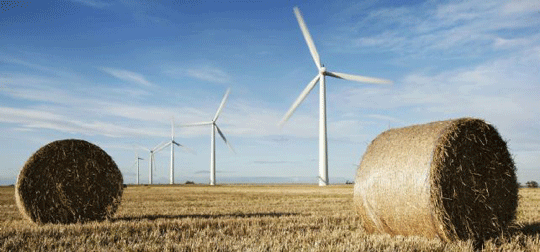
How does wind help the family farm stay in the family?, http://www.aweablog.org/how-does-wind-help-the-family-farm-stay-in-the-family/ Greg Alvarez, 22 Mar 16, During my tour through Colorado wind power last week, I often heard how wind helps keep the fabric of rural communities intact, allowing them to thrive.
Land lease payments make it possible for family famers and ranchers to keep their businesses running, expanded tax revenue provides resources to buy new emergency services equipment, and wind farms bring well-paying jobs to the community, meaning young people don’t have to leave home to find a good career.
Millions in financial resources for rural communities
New data released today allows us to quantify these sorts of anecdotes: landowners with wind turbines on their property now receive a total of $222 million in lease payments every year. Overall, landowners in six states currently receive over $10 million each year in lease payments, and 26 states have landowners that receive over $1 million.
This revenue acts as a drought resistant cash crop for family farmers and ranchers, providing a stable source of income they can count on when productivity declines because of drought or other causes. It also helps protect them from commodity price fluctuations, a frequent source of frustration in the agricultural world.
Real world impacts
In many cases, lease payments from turbines are the difference between keeping a farm and selling off the land.
Jason Wilson of Calhan, CO, told me, “The wind farm allowed us to be able to keep our family farm. We had come to a point where it no longer made financial sense to keep the property even with its vast sentimental value. The wind farm balanced the financial viability with the sentimental value, allowing the family farm to be passed on to the next generation.”
The Wilson farm sits on the plains at the base of Pike’s Peak. It’s a beautiful, serene place started by Jason’s great-grandfather in the 1940’s. Jason will be taking over the operation in the coming years, and his family explained they had no doubt this transition is only possible because of the lease payments they receive in exchange for hosting wind turbines.
Tax revenue helps communities thrive
Land lease payments aren’t the only source of revenue from wind farms; they also help expand the tax base. In many states, wind increases property tax funds by millions of dollars. For example, in Colorado increased property tax revenue from wind could near $19 million a year by 2030.
When our team visited a wind farm in the northeastern part of the state, in a town called Peetz, we heard that the local fire department had been using hand-me-down trucks in poor condition from other counties. Some locals joked that the old fire trucks couldn’t make it up a hill. However, after a wind farm was built, the resulting tax base expansion enabled the town to purchase brand new trucks.
Since around 70 percent of American wind farms are located in rural communities where median household incomes are lower than overall U.S. median incomes, lease payments and added tax revenue are doubly important. Overall, wind farm investment in such areas has exceeded $101 billion.
Wind farms mean local jobs
A final component in this economic picture concerns the jobs wind farms bring to a community.
In many rural areas, jobs are limited to agricultural professions. Young people that may want to pursue a different livelihood are often forced to move away because of a lack of options, even if they don’t want to leave their families and hometowns.
However, wind farms bring other opportunities for employment. Wind turbine technician is the fastest growing occupation in the country and presents another employment avenue for people who enjoy rural lifestyles.
Our team met with a wind farm operations and maintenance crew in Peetz, CO, and many of its members fell exactly into this category. Working as a wind turbine technician provided them with well-paying jobs while also allowing them to stay in the town they grew up in and loved, in close proximity to their extended families. The crew told us this option simply wasn’t available before the wind farm was built.
There are a multitude of different ways wind power brings resources and opportunities to local communities. Even better, the dollar amounts and job numbers will only increase as we continue to grow this American energy source, which will help rural towns thrive along the way.
British churches going for renewable energy
 Hundreds of UK churches set to go green, switch to renewable energy-charities LONDON (Thomson Reuters Foundation) – More than 400 churches in the United Kingdom plan to switch to clean energy providers for their light and heat, shifting spending of 1 million pounds ($1.4 million) to renewables from fossil fuels, two Christian charities said on Wednesday.
The move is part of the Big Church Switch, an initiative launched in February by charities Christian Aid and Tearfund, which urged UK churches and households to use clean sources of energy instead of carbon-emitting fossil fuels.
Their online platform connects those who sign up with energy experts, promising to find them the best renewable deal by negotiating with energy providers.
“As individuals and churches we have a choice in how we treat the earth, how we spend our money, how we power our homes and our buildings,” David Walker, the Anglican bishop of Manchester, said in a statement.
“By creating technology which can turn wind and sunshine into clean and renewable energy, humans continue to benefit from the gift of creation. Making the most of this bountiful harvest is a common sense way for us to roll back the ravages of climate change and ensure we are taking an active role in being part of the solution.”……..http://www.reuters.com/article/us-energy-renewables-church-idUSKCN0WW1QG
China is building a national electricity grid
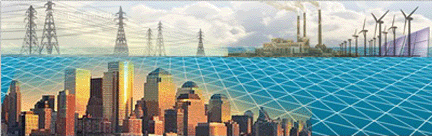
Like the US, China wants a national electricity grid. Unlike the US, China’s just building it. Vox, by David Roberts on March 30, 2016, Wind and sunlight are often concentrated in sparsely populated, remote areas. Getting wind and solar power to the population centers where it’s needed involves building long-distance power lines. Lots of them.
Earlier this week I wrote about a new long-distance power line in the US and the long, slow path it took to win approval. It was proposed in 2009; construction is expected to begin next year and finish in 2020. Like everything involving electricity in the US, it had to navigate a skein of overlapping jurisdictions, multiple state and local authorities, and federal rules. Every landowner and stakeholder had their say.
Like the US, China aspires to build a comprehensive national grid that can carry energy from where it’s generated to where it’s needed. Unlike the US, China isn’t forcing each piece of that system to go through a Byzantine series of bespoke processes and reviews. It’s just building, building, building like crazy.
China’s renewable energy is bottled up
China has the same problem the US does: Its most concentrated wind and sunlight are found in remote areas (in the north and west), distant from the populous industrial cities where the power is needed (in eastern coastal regions).
For years, the government has pushed a rapid buildout of renewable energy; the country now boasts the highest renewable energy growth rates and the most wind and solar capacity of any country in the world.
But now it has, at least temporarily, overbuilt. In those energy-dense regions, there is more wind and solar capacity than there is transmission to carry it. So a lot of that power is going unused.
China’s transmission lines will be big, and hooking up wind and solar will be mandatory
Because everything is bigger in China, the country is not building mere high-voltage transmission lines, like those being built (slowly) in the US. It’s building ultra high-voltage (UHV) lines.
By way of comparison: The US Plains & Eastern Clean Line, the high-voltage direct-current line from Oklahoma to Tennessee I wrote about the other day, will run at about 600 kilovolts, give or take. UHV lines run at 800kV, even up to 1000kV.
Building a countrywide grid is one of the government’s top priorities. According to Reuters, “China currently has 17 UHV transmission lines in operation or under construction.”…………http://www.vox.com/2016/3/30/11332900/china-long-distance-transmission
Global electricity network – China’s plan
China Unveils Proposal for $50 Trillion Global Electricity Network
BEIJING — China has unveiled a proposal for a $50 trillion global electricity network that would help fight pollution and the effects of climate change.
The plan envisions linking existing and future solar farms, wind turbines and electricity plants in Asia, Europe, Africa and the Americas, according to the head of State Grid Corporation of China.
The proposal is in its initial stages and would require huge investment from around the world. If it goes ahead, it would be the world’s largest infrastructure project. It could be operational by 2050, according to backers.http://www.nbcnews.com/business/energy/china-unveils-proposal-50-trillion-global-electricity-network-n548376
China eyes export opportunities for global super grid BEIJING, March 31. China’s biggest power transmission company has signed deals with three Asia-Pacific investors to help push its ambition to build a cross-border energy super grid that will help combat climate change, integrate renewable energy sources and boost exports.
http://in.reuters.com/article/china-power-grid-idINL3N173205
R** China’s State Grid envisions $65 trillion world power network
Could a global network be the world’s best bet for overcoming resource scarcity, pollution and climate change?
http://www.theaustralian.com.au/business/wall-street-journal/chinas-state-grid-envisions-65-trillion-world-power-network/news-story/385fc93c6fb9aa3236505a44f1be66d1
Public-private council launched to turn Fukushima into green energy hub
JIJI MAR 28, 2016 FUKUSHIMA – A public-private council tasked with devising measures to turn Fukushima Prefecture into a renewable energy hub has been set up in the city of Fukushima. …. (subscribers only) http://www.japantimes.co.jp/news/2016/03/28/national/social-issues/public-private-council-launched-make-fukushima-renewable-energy-hub/#.Vvtazpx97Gh
Solar power – on its way to taking over the world energy scene
 Is solar set to take over the world? https://www.weforum.org/agenda/2016/03/is-solar-set-to-take-over-the-world Keith Breene, Senior Writer It’s the largest power plant of its kind. Built in the Moroccan desert, the $765 million Noor-Ouarzazate complex is set to power over a million homes.
Even a few years ago, a project of this scale in the North African desert would almost certainly have been an oil or gas power station. But the Noor-Ouarzazate complex runs on the power of the sun.
It is a sign of how far solar power has come that such large infrastructure projects are now being built. That the scheme was partly funded through a loan from theWord Bank also shows how solar is becoming mainstream.
What’s behind the growth in solar?
Of course, concern over the use of fossil fuels and global warming is a large part of solar’s current success. But the reason it is doing quite so well, quite so quickly really comes down to price.
The cost of power generated by solar has plummeted to the point where, in many parts of the world, it is now close to coal or gas generated electricity.
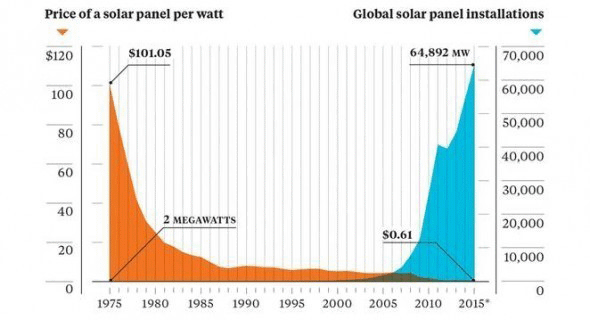
Source: Earth Policy Institute/Bloomberg
The more solar grows, the cheaper it becomes to manufacture solar panels, and the virtuous cycle continues.
But it’s not just that solar is becoming cheaper – it’s also that fossil fuel generation is becoming more expensive. That’s because once a solar or wind project is built, the marginal cost of the electricity it produces is almost nothing, whereas coal and gas plants require more fuel for every new watt produced. Power companies will choose the free power whenever they can, which means less is required from the fossil fuel power stations and the marginal cost of their power rises.
It’s a self-reinforcing cycle. As more renewables are installed, coal and natural gas plants are used less. As coal and gas are used less, the cost of using them to generate electricity goes up. As the cost of coal and gas power rises, more renewables will be installed.
BNEF reports that in every major region of the world, the lifetime cost of new coal and gas projects rose considerably in the second half of 2015, while the cost of renewables continued to fall.
How can we solve the problem of storing solar energy?
One of the problems with solar power is, of course, that it’s only there during the daytime. This has been used as an argument for keeping fossil fuel generation for the “base load” generation needed 24 hours a day.
But even this is changing. The Noor-Ouarzazate complex is not a photovoltaic power plant. Instead it uses concentrated solar power (CSP), which holds vast potential due to its ability to provide reliable power even when the sun is not shining.
Hundreds of mirrors focus the sun’s energy to heat a fluid that is used to produce steam that drives turbines to generate electricity. The fluid can also be used to heat molten salts stored in large storage tanks on site. The salt stays hot enough to generate steam even after the sun has gone down.
It is such a promising technology that the International Energy Agency estimatesthat up to 11% of the world’s electricity generation in 2050 could come from CSP.
What about batteries?
Another major change is rapidly improving battery technology. Alreadyhouseholds can buy battery packs for their solar panels, and the cost of these is expected to reduce significantly over the next few years.
Entrepreneur Elon Musk reckons that the entire world’s electricity demands could be met with around 2 billion large batteries.
What if it’s not very sunny?
It is easy to see why Morocco might look to solar to meet its energy needs. The same goes for many other hot and sunny parts of the world. But is solar really workable elsewhere?
For the answer to that, take a look at Germany. Hardly famous for its year-round sun, the northern European nation has nevertheless led the world in solar generation.
Germany has the capacity to generate over a third of its electricity from solar and in the summer of 2014 even managed to briefly generate over half of its power this way. Germany shows us that solar is not just a technology for the sun-drenched parts of the world.
Solar isn’t the only answer to the world’s energy needs, but it has much to offer. As the cost falls and the energy market is further disrupted, solar energy is set to play a huge part in meeting our global energy needs.
China’s move towards renewable energy power on the grid: new high voltage transmission lines

 China pushes for mandatory integration of renewable power, Reuters, 28 Mar 16, BEIJING China has ordered power transmission companies to provide grid connectivity for all renewable power generation sources and end a bottleneck that has left a large amount of clean power idle, the country’s energy regulator said on Monday.
The grid companies have been ordered to plug in all renewable power sources that comply with their technical standards, the National Energy Administration (NEA) said.
China’s power is primarily delivered by the State Grid Corp of China [STGRD.UL] and the China Southern Power Grid Co [CNPOW.UL], with the latter responsible for delivering electricity in five southern provinces and regions.
China has become the world’s biggest wind and solar power user, but a large amount of renewable power has not been able to reach the grid because transmission capabilities are lagging generating capacity by around three to five years.
The State Grid is banking on building new ultra-high voltage (UHV) long-distance transmission lines to fill the gap. “The construction of UHV lines are to help with cross-regional power delivery,” said Wang Yanfang, a State Grid spokeswoman, referring to the need to deliver power from remoter regions to energy-hungry eastern China…….http://www.reuters.com/article/us-china-power-renewables-idUSKCN0WU0RF
Big expansion of wind power for China
 China Plans 22% Boost for Wind Power Capacity After Record 2015 http://www.bloomberg.com/news/articles/2016-03-21/china-plans-22-boost-for-wind-power-capacity-after-record-2015 Mar 21 16
-
Government plan to develop 30.83 gigawatts of wind power
-
New developments restricted in places where turbines are idle
The nation plans to develop 30.83 gigawatts of wind power this year, the National Energy Administration said in a statement on its website on Monday. It added 33 gigawatts in 2015, triple France’s entire capacity of the clean resource, according to data from NEA.
Developers rushed to deliver projects last year before tariffs paid for clean energy were reduced, and the support levels on offer this year are generous enough to keep drawing in investment.
The central province of Henan will have the most wind power projects approved this year, with the eastern province of Shandong following, according to NEA.
Wind installations in China have almost doubled since 2012 to 139 gigawatts, according to data compiled by Bloomberg. The rapid growth of wind power has left the grid struggling to connect all the plants, forcing wind turbines to sit idle.
China is clamping down on the ability of local authorities to plan new wind projects in some of the windiest provinces because the pace of building to date has outstripped the grid’s ability to absorb new power flows. Those places include the northern provinces of Inner Mongolia, Jilin, Heilongjiang, Gansu, Ningxia and Xinjiang.
Solar towers- a more effective system for lower light conditions
 New solar towers, cubes offer 20X more power, researchers say Solar towers are ideal for lower light conditions, Computerworld, By Lucas Mearian Mar 23, 2016 5 Researchers at MIT have discovered a method of optimizing solar energy collection by arranging photovoltaic (PV) panels on a tower or in a cube shape.
The new forms of solar energy collection offer anywhere from double to 20 times as much output compared with today’s common flat-panels using the same area.
The technology would be most advantageous in northern climates — further away from the equator — where the less intensive solar exposure can be optimized.
MIT’s research, the findings for which are based on both computer modeling and outdoor testing of real modules, were published in the journal Energy and Environmental Science…….http://www.computerworld.com/article/3047660/sustainable-it/new-solar-towers-cubes-offer-20x-more-power-researchers-say.html
Community solar power now getting the backing of energy utilities
 Even Utilities Are Starting To Get Behind Community Solar http://oilprice.com/Alternative-Energy/Solar-Energy/Even-Utilities-Are-Starting-To-Get-Behind-Community-Solar.html By Nick Cunningham, 28 March 2016 Solar energy is rapidly becoming one of the top choices for new electricity capacity as costs continue to decline and generous public policies accelerate tremendous growth for the sector.
Last year was a record year for the solar industry and the momentum is set to continue. In 2016, the EIA expects the U.S. electricity market to see 26 gigawatts of new capacity installed. Utility-scale solar is expected to capture 9.5 GW of that total, or more than one-third. If that comes to pass, it would be triple the rate of installations of utility-scale solar compared to 2015, and would also equate to more than the combined total of installations from 2013 to 2015.
That could be a conservative estimate. The Solar Energy Industries Association, a trade group, expects the solar industry to add 16 GW of new solar capacity, with about three-quarters of that coming from the utility-scale segment.
A much smaller segment of the solar industry could begin to take off, however. With the bulk of solar installations made up of large-scale utility-size projects, plus some commercial and residential projects proliferating at a healthy rate, the tiny but rapidly growing “community solar” sector could begin to capture a lot more attention.
The growth of solar has been held back by the large upfront costs. That problem is already being overcome with the leasing model, which requires no upfront investment.
But another problem with solar is that not everyone can participate – some people live in apartment buildings, or do not own their own home, or do not have a suitable rooftop to host PV panels. According to Greentech Media, around 77 percent of U.S. households are ineligible for solar panel installations for one reason or another.
“Community solar” solves this problem by allowing people to buy or lease a slice of a shared solar project that is somewhere off site, maybe in a nearby town or on a tract of open land. One could live in an apartment building and still buy into a community solar project, receiving credits on their utility bill.
The community solar model is becoming more common, opening up a vast new market for the solar industry. Community solar grew five-fold last year. New customers can still access a leasing model that has no upfront costs, and with community solar they do not even need to have their own rooftop to do so.
Better yet, community solar projects are increasingly competitive, offering ratepayers a clean source of power without added cost. There is a lot of room for improvement as well. As of now, the issues and design specifications can vary from project to project, but as the sector grows, developers will find ways to standardize projects, reduce development times, and scale-up a small-scale model.
No longer able to ignore the coming explosion in the solar market, utilities have been fighting to tweak public policy to block the threat of solar. But some utilities, in a recognition of reality, are trying to get in on the community solar game so as not to be left behind.
Deloitte cites the case of a Minnesota utility that allows ratepayers to buy in to a community solar project at a discounted rate if they also purchase a new electric water heater. The idea is that the household will heat their water with the extra electricity it produces at midday, avoiding the need to use electricity in the later afternoon and early evening when demand is at a peak. The customer benefits, and the utility benefits by shaving off peak demand.
State policies have also helped. In particular, Colorado and Minnesota have passed laws that require their utilities to setup community solar programs for their ratepayers. Two dozen more have voluntary programs.
Solar is popular too. Deloitte surveyed 1,500 households to find out what they thought were the most pressing energy-related issues, and 64 percent of them said “increasing the use of solar power” was a top three issue for them. As more customers discover community solar, they will increasingly demand their utility offer community solar programs to allow them access.
To be sure, community solar is still small. There are just 111 projects across the U.S., though that is sharply up from only two in 2010, according to Deloitte. Most projects are smaller than 1 megawatt, and the largest is only 20 megawatts. Most projects serve between 40 and 600 customers, according to a report from The Rocky Mountain Institute.
Nevertheless, the solar industry is growing rapidly, and community solar could be the fastest growing segment. The Rocky Mountain Institute argues that 15 GW of community solar could come online by the end of the decade.
For years, utilities have seen solar power as a threat, but that could be changing. As Deloitte puts it, the “evolution of community solar is a classic case of business model innovation turning a challenge into an opportunity. Foreseeing the inevitable growth of distributed energy resources, utilities are deploying these programs to get ahead of the game and to capture the benefits that distributed resources provide to the grid.”
Britain now boasts world’s largest floating solar energy farm
 World’s biggest floating solar farm powers up outside London
Five years in planning and due to be finished in early March, more than 23,000 solar panels will be floated on the Queen Elizabeth II reservoir near Heathrow and used to generate power for local water treatment plants Guardian, Fiona Harvey, 29 Feb 16 On a vast manmade lake on the outskirts of London, work is nearing completion on what will soon be Europe’s largest floating solar power farm – and will briefly be the world’s biggest.
But few are likely to see the 23,000 solar panels on the Queen Elizabeth II reservoir at Walton-on-Thames, which is invisible to all but Heathrow passengers and a few flats in neighbouring estates.
“This will be the biggest floating solar farm in the world for a time – others are under construction,” said Angus Berry, energy manager for Thames Water, which owns the site. “We are leading the way, but we hope that others will follow, in the UK and abroad.”

Five years in planning and due to be finished in early March, the £6m project will generate enough electricity to power the utility’s local water treatment plants for decades. The energy will help provide clean drinking water to a populace of close to 10 million people in greater London and the south-east of England, a huge and often unrecognised drain on electricity, rather than nearby homes.
Why put solar panels on water? The answer, according to Berry, is that the water is there, and might as well be used for this purpose. Floating panels, covering only about 6% of the reservoir, will have no impact on the ecosystem, he says………
A similar floating solar farm with around half the capacity of the Thames Water project is being built by water company United Utilities on a reservoir near Manchester. Construction of an even bigger farm – at 13.7MW more than twice the QEII farm – is underway on a reservoir in land-scarce Japanand due to finish in 2018…….
Putting solar panels on the water for the QEII scheme has not required planning permission, though big arrays of similar panels on land require official sanction. The government has decided to ban farmers who put solar arrays on agricultural land from receiving EU subsidies for the land.
More than 23,000 solar panels will be floated by developer Lightsource Renewable Energy at the reservoir near Walton-on-Thames, representing 6.3MW of capacity, or enough to generate the equivalent electricity consumption of about 1,800 homes…….http://www.theguardian.com/environment/2016/feb/29/worlds-biggest-floating-solar-farm-power-up-outside-london
Renewable energy investment hits new world record
Renewable energy investments: Major milestones reached, new world record set For first
time, developing world investments in renewables (up 19 percent in 2015) topped developed nations’ (down 8%); World record total of $286 billion invested in renewables last year, makes $2.3 trillion over 12 years, Science Daily March 24, 2016
- Source:
- United Nations Environment Programme
- Summary:
- Coal and gas-fired generation attracted less than half as much capacity investment as renewables last year; Renewables added more to global energy generation capacity than all other technologies combined; For first time, developing world investments in renewables (up 19 percent in 2015) topped developed nations’ (down 8 percent); and world record total of $286 billion invested in renewables last year; makes $2.3 trillion over 12 years.
- Coal and gas-fired electricity generation last year drew less than half the record investment made in solar, wind and other renewables capacity — one of several important firsts for green energy announced today in a UN-backed report.
Global Trends in Renewable Energy Investment 2016, the 10th edition of UNEP’s annual report, launched today by the Frankfurt School-UNEP Collaborating Centre for Climate & Sustainable Energy Finance and Bloomberg New Energy Finance (BNEF), says the annual global investment in new renewables capacity, at $266 billion, was more than double the estimated $130 billion invested in coal and gas power stations in 2015.
All investments in renewables, including early-stage technology and R&D as well as spending on new capacity, totalled $286 billion in 2015, some 3% higher than the previous record in 2011. Since 2004, the world has invested $2.3 trillion in renewable energy (unadjusted for inflation).
Just as significantly, developing world investments in renewables topped those of developed nations for the first time in 2015.
Helped by further falls in generating costs per megawatt-hour, particularly in solar photovoltaics, renewables excluding large hydro made up 54% of added gigawatt capacity of all technologies last year. It marks the first time new installed renewables have topped the capacity added from all conventional technologies.
The 134 gigawatts (GW) of renewable power added worldwide in 2015 compares to 106GW in 2014 and 87GW in 2013.
Were it not for renewables excluding large hydro, annual global CO2emissions would have been an estimated 1.5 gigatonnes higher in 2015
- UNEP Executive Director Achim Steiner said, “Renewables are becoming ever more central to our low-carbon lifestyles, and the record-setting investments in 2015 are further proof of this trend. Importantly, for the first time in 2015, renewables in investments were higher in developing countries than developed.”“Access to clean, modern energy is of enormous value for all societies, but especially so in regions where reliable energy can offer profound improvements in quality of life, economic development and environmental sustainability. Continued and increased investment in renewables is not only good for people and planet, but will be a key element in achieving international targets on climate change and sustainable development. ”
“By adopting the Sustainable Development Goals last year, the world pledged to end poverty, promote sustainable development, and to ensure healthier lives and access to affordable, sustainable, clean energy for all. Continued and increased investment in renewables will be a significant part of delivering on that promise.”
Said Michael Liebreich, Chairman of the Advisory Board at BNEF: “Global investment in renewables capacity hit a new record in 2015, far outpacing that in fossil fuel generating capacity despite falling oil, gas and coal prices. It has broadened out to a wider and wider array of developing countries, helped by sharply reduced costs and by the benefits of local power production over reliance on imported commodities.”………..
- As in previous years, the report shows the 2015 renewable energy market was dominated by solar photovoltaics and wind, which together added 118GW in generating capacity, far above the previous record of 94GW set in 2014……
- Developing countries on the rise led by China and India
- In 2015, for the first time, investments in renewable energy in developing and emerging economy nations ($156 billion, up 19% compared to 2014) surpassed those in developed countries ($130 billion, down 8% from 2014).Much of these record-breaking developing world investments took place in China (up 17% to $102.9 billion, or 36% of the world total).
Other developing countries showing increased investment included India (up 22% to $10.2 billion), South Africa (up 329% to $4.5 billion), Mexico (up 105% to $4 billion) and Chile (up 151% to $3.4 billion).
Morocco, Turkey and Uruguay all joined the list of countries investing more than $1 billion……..https://www.sciencedaily.com/releases/2016/03/160324104513.htm
Renewable energy shines in American energy investment
If a Power Plant Is Built in U.S., It’s Likely to be Renewable [good graphs] http://www.
climatecentral.org/news/if-a-power-plant-is-built-in-us-chances-are-its-renewable-20175
March 25th, 2016 If a new electric power plant is built in the U.S. these days, chances are it’s renewable — either wind or solar.
That’s the gist of a report the U.S. Department of Energy released this week showing that, together, wind and solar accounted for nearly two-thirds of all new electric power plants built in 2015. It’s a trend expected to continue through 2016, even with low natural gas prices likely to keep utilities building plenty of gas-fired power plants, too.
“Right now, it’s primarily a wind and solar market,” U.S. Energy Information Administration analyst Chris Namovicz said, adding that renewables have been thriving on an extension of wind and solar tax credits, though wind is becoming competitive with fossil fuels even without the help of a tax credit.
As global investments in renewable energy far outpace investments in fossil fuels for electric power, the expansion of wind, solar and other renewable energy sources is critical for the globe to uphold the Paris climate agreement, which aims to keep global warming to 2°C (3.6°F) above pre-industrial levels.
Burning coal to produce electricity is the world’s leading driver of climate change. In the U.S., low natural gas prices and climate policies are allowing lower-carbon energy sources to eclipse coal as the leading sources of electricity.
Together, wind and solar accounted for 67 percent of all new electric power generation capacity built in the U.S. in 2015. That adds up to more than 13 gigawatts of carbon-free electric power generation capacity, enough to provide power to more than 9 million homes.
Natural gas accounted for 30 percent of new electric power generation capacity built last year.
Most renewable-powered plants built in the U.S. last year were built in two states — Texas and California — according to EIA data. Texas is the reigning champ of the wind industry, accounting for 42 percent — more than 3 gigawatts — of all the new wind power capacity built in the U.S. in 2015. Oklahoma, Kansas, Iowa, and North Dakota rounded out the top five wind farm-building states in 2015.
Wind is in the process of rebounding from the industry nearly going bust in 2013, a year when the industry bottomed out because of great uncertainty about the future of a wind power production tax credit. Last year, Congress extendedthe tax credit through 2019.
Today, more than 50,000 wind turbines twirl across the U.S. — enough to power 19 million homes.
As for solar, California built more than any other state in 2015 — more than 2 gigawatts. The state was responsible for building 42 percent of all new solar power constructed last year.
About half of all that solar energy built in California last year came from large utility-scale solar farms. The rest was built in the form of rooftop solar or small solar power systems.
North Carolina, Nevada, Arizona, and Utah rounded out the top five states building new solar plants in 2015.
India’s push for solar power to bring over a million jobs
India Solar Power Push May Produce Over 1 Million Jobs http://cleantechnica.com/2016/03/23/india-solar-power-push-may-produce-over-1-million-jobs/ March 23rd, 2016 by Smiti Mittal Originally published on Sustainnovate. India’s massive solar power capacity addition target is expected to be a revolution in the Indian jobs market as well.
According to a report by the Natural Resources and Defense Council (NRDC), India may end up creating over a million new jobs in its endeavour to have 100 GW of operational solar power capacity by March 2022.
The report suggests that a massive army of engineers, construction, and maintenance workers shall be required set up the scores of solar power capacity planned by the central and state governments.

Around 210,800 site engineers and designers would be required to set the large-scale as well as rooftop solar power systems rolling. Around 624,600 semi-skilled workers would be needed for the construction and on-field execution of the projects. To monitor ongoing operations at the power plants and their maintenance, another 182,400 semi-skilled workers would be needed. Thus, a total of 1,017,800 jobs are expected be created if India indeed manages to set up a cumulative operational capacity of 100 GW by 2022.
Jobs creation and empowering youth is one of the major policies of the current government. The ‘Skill India’ program launched by the Indian government aims to provide employment to youth by providing them industrial training in the solar power sector. Several agencies across the country have already started such training programs.
Some state governments have also announced financial support to unemployed youth to set up rooftop solar power systems to help them generate a source of income.
1 This Month

of the week – Shut Down Drone Warfare!


Tell the Ukrainian Government to Drop Prosecution of Peace Activist Yurii Sheliazhenko

Petition to revoke the licensing of the Near Surface Nuclear Disposal Facility (NSDF) at Chalk River. https://www.ourcommons.ca/petitions/en/Petition/Details?Petition=e-7247
To see nuclear-related stories in greater depth and intensity – go to https://nuclearinformation.wordpress.com
-
Archives
- April 2026 (103)
- March 2026 (251)
- February 2026 (268)
- January 2026 (308)
- December 2025 (358)
- November 2025 (359)
- October 2025 (376)
- September 2025 (257)
- August 2025 (319)
- July 2025 (230)
- June 2025 (348)
- May 2025 (261)
-
Categories
- 1
- 1 NUCLEAR ISSUES
- business and costs
- climate change
- culture and arts
- ENERGY
- environment
- health
- history
- indigenous issues
- Legal
- marketing of nuclear
- media
- opposition to nuclear
- PERSONAL STORIES
- politics
- politics international
- Religion and ethics
- safety
- secrets,lies and civil liberties
- spinbuster
- technology
- Uranium
- wastes
- weapons and war
- Women
- 2 WORLD
- ACTION
- AFRICA
- Atrocities
- AUSTRALIA
- Christina's notes
- Christina's themes
- culture and arts
- Events
- Fuk 2022
- Fuk 2023
- Fukushima 2017
- Fukushima 2018
- fukushima 2019
- Fukushima 2020
- Fukushima 2021
- general
- global warming
- Humour (God we need it)
- Nuclear
- RARE EARTHS
- Reference
- resources – print
- Resources -audiovicual
- Weekly Newsletter
- World
- World Nuclear
- YouTube
-
RSS
Entries RSS
Comments RSS
 nuclear-news