Blowing away the dishonest spin of the nuclear lobby against renewable energy

 Renewable energy versus nuclear: dispelling the myths http://www.theecologist.org/News/news_analysis/2987577/renewable_energy_versus_nuclear_dispelling_the_myths.html Mark Diesendorf 19th April 2016
Don’t believe the spurious claims of nuclear shills constantly doing down renewables, writes Mark Diesendorf. Clean, safe renewable energy technologies have the potential to supply 100% of the world’s electricity needs – but the first hurdle is to refute the deliberately misleading myths designed to promote the politically powerful but ultimately doomed nuclear industry.
Nuclear energy and renewable energy (RE) are the principal competitors for low-carbon electricity in many countries.
As RE technologies have grown in volume and investment, and become much cheaper, nuclear proponents and deniers of climate science have become deniers of RE.
The strategies and tactics of RE deniers are very similar to those of climate science deniers.
To create uncertainty about the ability of RE to power an industrial society, they bombard decision-makers and the media with negative myths about RE and positive myths about nuclear energy, attempting to turn these myths into conventional wisdom.
In responding to the climate crisis, few countries have the economic resources to expand investment substantially in both nuclear and RE. This is demonstrated in 2016 by the UK government, which is offering huge long-term subsidies to nuclear while severely cutting existing short-term subsidies to RE.
This article, a sequel to one busting the myth that we need base-load power stations such as nuclear or coal, examines critically some of the other myths about nuclear energy and RE. It offers a resource for those who wish to question these myths. The myths discussed here have been drawn from comments by nuclear proponents and RE opponents in the media, articles, blogs and on-line comments.
Myth 1: Base-load power stations are necessary to supply base-load demand. Continue reading
Clean water for 10 million people, due to London’s new floating solar farm
 World’s Largest Floating Solar Farm to Provide 10 Million People with Clean Water, Luminary Daily, By Gary Joshua Garrison / 20 March 2016 The solar farm will span 57,500 square meters (or about eight soccer stadiums) of the Queen Elizabeth II reservoir and will consist of 23,000 solar panels, covering about a tenth of the reservoir. It is slated to be completed by the end of March.

Utility company Thames Water runs the reservoir, while Lightsource Renewable Energy — a private solar energy company based in London — is responsible for the funding and operation of the revolutionary farm.
“This will be the biggest floating solar farm in the world for a time — others are under construction,” Angus Berry, energy manager for Thames Water, told The Guardian. “We are leading the way, but we hope that others will follow, in the UK and abroad.”………
Similar floating solar farms are under construction, or have already been completed, both in England and around the world. Recently, a 45,500 square meter solar farm opened in Greater Manchester, England and water company United Utilities, also in Manchester, is currently constructing a similar project that will have about half the capacity of the Thames Water project. In Japan, solar company Kyocera is in the process of building an 180,000 square meter floating solar farm (see featured image at the top) that is set to be completed in 2018.
For their dedication to providing clean, renewable energy, for their innovation, and for helping to lead the charge in the energy revolution we are happy to name the folks at Lightsource and Thames Water our Luminaries of the Week. http://luminarydaily.com/worlds-largest-floating-solar-farm-to-provide-10-million-people-with-clean-water/
Solar city makes more 4 times more electricity than it consumes
 Revolutionary: Germany Builds A Solar City That Produces Four Times More Energy Than It Consumes http://thelogicalindian.com/environment/germanys-revolutionary-solar-city-that-produces-four-times-more-energy-than-it-consumes/ – Abhishek Mittal 14 Apr 16, We have known cities to be great power-guzzlers, having a huge appetite for consuming electricity to power its homes and buildings. To generate electricity for such cities through renewable sources like solar becomes a difficult task given the vast amount of area required to place the solar panels. But a city in the heart of Germany has achieved something more incredible. It not only has made itself self-sufficient in energy, but in fact has become a net producer of energy – all thanks to a localized approach for adopting solar power.

The Solar cities of Germany:
The Sonnenschiff and Solarsiedlung cities located in Freiburg, Germany are modern, planned habitations that were worked upon with solar power in mind. Literally meaning Solar Ship and Solar Village, the Sonnenschiff and Solarsiedlung cities were specifically designed and built to be solar cities, balancing size, accessibility, green space, and solar exposure. Each of the fifty-two homes along with some commercial buildings is fitted with large rooftop solar panels that double-up as sun shades. The panels are perfectly aligned to point in the right direction of the sun, and the buildings follow the Passivhaus standards of green building technology.
The cities have been designed by architect Rolf Disch. Together with the latest photovoltaic technology for the panels that make them highly efficient, and use of phase-change materials and vacuum insulation for the walls of the buildings that provide optimum thermal performance, the cities are able to generate four times the power which they consume.
Solar Vs Nuclear:
The success of solar as an alternative to the polluting coal-fired power is not limited to these twin-cities. The entire area of Freiburg has been leading the country into a solar revolution since a long time. It was once on the crossroads of choosing between solar and nuclear as the preferred alternative source. Infact a nuclear power plant had already begun construction near Freiburg in early 1970s, amid protests from students and farmers who saw nuclear as a dangerous and polluting source of energy.
A major change in mindset of the local population came when an engineer Dieter Seifried started an institute to research into alternative forms of energy and popularized solar as a safe, reliable and efficient source. Seifried said regarding nuclear power in an interview to CBC news, “you will see first that it is not clean at all, second that it is expensive and third that we have a lot of unsolved problems like where do we deposit the waste.” Gradually more and more residents started to install rooftop solar panels on their houses and ditched the conventional power from grid. In 2000, Germany tabled a clean energy bill that forced power-companies to pay a set fee called a feed-in tariff to anybody providing power to the grid. This gave an impetus to the efforts of Seifried and others, and today, 30% of Germany’s electricity comes from renewable sources, mainly wind and solar. The nuclear plant being built in Freiburg was shut down soon after the protests, and after the unfortunate Fukushima meltdown in Japan in 2011, Germany has committed to phase out all 17 of its nuclear reactors by 2022.
The examples of Freiburg and the solar cities show how people themselves can own up the process of transitioning from conventional methods of energy generation to cleaner alternatives. The role of government in incentivizing renewable energy and providing access to technology is also very important. The Logical Indian gives a big thumbs-up to the residents of Freiburg for kickstarting the solar revolution in their country, and hopes that similar initiatives are taken up by people across the world.
Western Kenya’s solar minigrids – a rural electricity solution
A solar minigrid for 100 villages in Western Kenya, Clean Leap by DAVID KARIUKI Mar 19th 2016, Scalable solar mini grids will continue to play a major role in the rural electrification agenda in developing countries in the future. This will be fueled by the increased entry of private players into the field, and the change of regulations in respect to generation and supply of power from scalable mini grid solutions. These two are already being witnessed in Kenya. This year, Kenya is witnessing a major solar micro-grid project expected to demonstrate exactly how these power solutions can fit in rural electrification agenda now that the country is targeting 100% electricity access by 2030. The project is notable as it marks the first scalable community micro grid project since last year’s granting of the first utility concession for off-grid power supply…….

India plans 1,250 MW Solar Power Projects Over Waterways
 Indian Company Plans 1,250 MW Solar Power Projects Over Water Bodies http://cleantechies.com/2016/03/29/indian-company-plans-1250-mw-solar-power-projects-over-water-bodies/ by SAURABH on MARCH 29, 2016 Government-owned power generation company in the western state of Maharashtra has revealed expansive plans to utilise water bodies and generate solar power.

Maharashtra State Power Generation Company Limited (Mahagenco) recently floated tenders for the preparation of detailed project reports for setting up solar power projects over water bodies in the state.
Mahagenco plans to set up these projects in partnership with other government agencies that own these water bodies through a revenue-sharing model. The company plans to set up projects on a) reservoirs and canals and, b) lakes and other water bodies.
The company aims to replicate the canal-top solar power projects implemented in the neighbouring state of Gujarat. Canal-top solar power projects have dual advantage of little to no requirement of land requirement to set up the solar panels, thereby making substantial savings on project’s capital cost, and limiting the loss of water from canals/reservoirs due to evaporation.
Water bodies owned by villages and local self-governing bodies will also be roped in to set up such solar power projects. Mahagenco plans to implement these projects through net-metering scheme. Solar power projects set up at such water bodies will inject electricity during the day and the local utility will supply electricity to villages during the night. The balance in electricity units shall be settled on monthly basis. This will reduce the electricity bills for villagers and also improve electricity supply.
After the successful implementation of canal-top solar power projects in Gujarat several other states have announced plans to implement similar projects. Punjab, Damodar Valley Corporation and Kerala have publicly announced targets to set up projects over canals, reservoirs and other water bodies.
USA could be powered 40% by electricity from rooftop solar panels
Rooftop solar panels could provide nearly half US power http://www.theguardian.com/environment/2016/apr/14/rooftop-solar-panels-could-provide-nearly-half-us-power
Rooftop panels could supply 40% of country’s power with open spaces such as parking lots offering further potential, study shows. Conservation magazinereports Guardian, Prachi Patel To take advantage of the sun’s energy to satisfy our ever-increasing need for electricity, Americans will have to take a fresh look at their roofs. A report by the National Renewable Energy Laboratory (NREL) shows that if all suitable roof areas in the United States were plastered with solar panels, they would generate about 1,118 gigawatts of solar power. That is 40% of the power that Americans consume every year.

And that isn’t the half of it. The study only estimates the solar power potential of existing, suitable rooftops, and does not look at the immense potential of ground-mounted photovoltaics (PV), said NREL senior energy analyst Robert Margolis in apress release. “Actual generation from PV in urban areas could exceed these estimates by installing systems on less suitable roof space, by mounting PV on canopies over open spaces such as parking lots, or by integrating PV into building facades. Further, the results are sensitive to assumptions about module performance, which are expected to continue improving over time.”
The new study doubles the estimate from a 2008 NREL study on US rooftop solar potential, which showed an estimate of 664 GW. Margolis and his colleagues attributed the higher numbers to increases in better-performing modules, improvements in estimation of building suitability, higher estimates of the total number of buildings, and better methods to calculate photovoltaic performance.
For the new report, which is the result of three years of research, the team used light detection and ranging (Lidar) data and geographic information system (GIS) methods to map the topography of 128 cities around the country down to the square meter. This helped them determine the total amount of roof area suitable for hosting rooftop solar panels. Then they simulated the productivity of the panels on this roof area to estimate total rooftop solar potential, and finally extrapolated that data to the whole country.
The report ranked cities with the highest capability to meet energy consumption using potential solar power capacity. Mission Viejo, California topped the charts with a 88% solar potential rating, followed by Concord, New Hampshire at 72%, and Buffalo, New York at 68%.
The six states with the highest potential to offset electricity use all have significantly below-average household energy consumption, the analysts note, indicating that any state that wants to make the most of solar incentives should also prioritize energy efficiency.
Source: Pieter Gagnon, Robert Margolis, Jennifer Melius, Caleb Phillips, and Ryan Elmore, NREL. Rooftop Solar Photovoltaic Technical Potential in the United States: A Detailed Assessment.
Walt Disney Florida Resort to get Mickey Mouse shaped solar farm
 Disney launches new Micky Mouse-shaped solar farm 15 April 2016, source edie newsroom
A 22-acre solar facility arranged in the shape of Micky Mouse’s head will provide 5MW of renewable energy at the Walt Disney World Resort in Orlando, Florida. A total of 48,000 on-site solar panels will produce the power – which is equivalent of 1,000 residential solar rooftops systems – for the entertainment and recreation facility along with its partners such as the Four Seasons Resort and Hotel Plaza Boulevard hoteliers.
Walt Disney World Resort environmental integration director Angie Renner said: “As a company that cares about the environment, we continually take steps of varying sizes to benefit the environment and protect the planet. This new solar facility will help us in our efforts to conserve natural resources.”
The solar farm was designed by Duke Energy as part of an on-going renewable energy development project which will see the electric power holding company add up to 500MW of additional power to Florida by 2024……..http://www.edie.net/news/6/Disney-launch-Micky-inspired-solar-farm/
Global renewable energy boom, with Asia Pacific at the heart of it
Asia Pacific at the heart of global renewables boom Investments in clean energy reached record highs last year, spelling an optimistic outlook but new sources of competition for industry players. Eco Business, By Vaidehi Shah, 7 Apr 16, The global clean energy sector continued its breakneck development with a record US$329 billion of new investments last year, and Asia Pacific is at the heart of this boom, according to a new report by professional services firm EY.
The London-headquartered consultancy’s Renewable Energy Country Attractiveness Index 2016 report, released in late February, showed that Asia Pacific secured almost US$180 million in clean energy investments last year – more than half of the global total.
China topped the index with US$110.5 billion in investments, followed by the United States, Japan, the United Kingdom and India.
Wind and solar are the key energy sources driving the spike in global renewable energy investment, found EY. Together, the two sectors snapped up US$270 billion in clean energy investments last year, more than 80 percent of the US$329 billion total.
They also accounted for half of all new power generation capacity installed last year, contributing 120 gigawatts of new energy projects.
Asia Pacific saw more clean power going online than any other region, with 36 GW of solar and 31.5 GW of wind capacity added. This capacity was significantly higher than 8.9 GW in North America for solar energy, and 15 GW for Europe last year.
Asia Pacific’s electrifying growth
Matthew Rennie, managing partner, power and utilities, EY Australia, noted that India, Indonesia and Singapore are some of Asia’s most exciting markets.
With US$10.9 billion in clean energy investments last year, “India is the rising star of the Asia Pacific renewables market, and is starting to challenge China as the present index leader,” he said.
The rapid growth of investments in India is thanks to the government’s ambitious target to install 175 gigawatts of renewable energy capacity by 2022, announced last year. The country has also allocated US$400 million to finance this goal in its 2015 budget.
Indonesia, too, plans to scale up renewable energy………http://www.eco-business.com/news/asia-pacific-at-the-heart-of-global-renewables-boom/
EDF in America going for wind power, abandoning nuclear
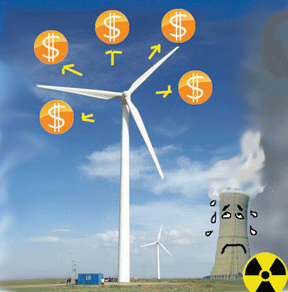 EDF shows that wind makes better sense than nuclear,Ecologist Chris Goodall April 2016 EDF in the UK may be propelled by its disastrous nuclear ambitions, writes Chris Goodall. But across the Atlantic it’s another story: the company is the US’s biggest wind developer, and selling its power, profitably, for under 40% of the price it has been promised for Hinkley C, including federal tax credits…….
Within the same company, they do things very differently on the other side of the Atlantic; there EDF focuses wholeheartedly on wind and has no nuclear under development.
It has just proudly announced that it has become the largest wind developer in North America with a portfolio in 2015 of over 1 gigawatt of newly constructed wind farms.
If it continues at the current rate, it will be generating more electricity from wind by 2025 than would be provided by Hinkley Point C. The numbers are as follows. Hinkley will generate about 25 terawatt hours a year. EDF’s 2015 annual portfolio of new wind projects will provide about 3 terawatt hours a year at average US utilisation factors.
If it continues to develop new wind projects at the rate of 1 gigawatt a year, it will be generating well over 30 terawatt hours a year from wind by the end of 2025. 2025 is when EDF says Hinkley will be finished.
What about the capital cost of wind versus nuclear? The latest US estimates suggest a figure of about $1,700 per kilowatt of capacity. That means EDF’s projects completed in 2015 cost about $1.8bn. Over ten years, that rate of installation will mean a total cost of around $18bn or about £13bn. Wind is therefore at least 30% cheaper to construct.
And it is much cheaper to operate. The most important project it completed in 2015, the 250 MW farm at Roosevelt in New Mexico, has sold its electricity for the next 20 years to a utility for $23.39 a megawatt hour, less than 20% of the price agreed for Hinkley of £92.50/MWh.
Note that the Roosevelt price is somewhat subsidised by Federal tax credits but even without this benefit the cost of wind would be less than 40% of the price of UK nuclear. Wind saves consumers money when compared to the nuclear alternative.
It’s simple really: renewables are a better and more secure investment
EDF finances many of its US wind projects on the back of power purchase agreements with major companies such as Microsoft, Procter and Gamble and Google. They commit to buy the electricity produced at a fixed price, not the inflation adjusted figure that the UK will pay for Hinkley. The EDF press release said:
“Corporate America is increasingly turning to renewable energy to power its business operations, based both on consumer preferences and because renewable energy simply makes economic sense.”
We never hear this line from EDF in the UK.
EDF cannot guarantee the wind will blow or the sun shine. Unlike in Britain, its US business is also investing heavily in energy storage. The US company has announced 100MW of battery systems in the US because “Energy storage is an attractive, cost-effective addition to intermittent energy generation projects.” However there’s no mention of batteries on EDF’s UK web site.
For sensible reasons large international companies often pursue varied market strategies in different countries. EDF in the US has decided to back wind while the UK has gone for nuclear.
But even a quick look shows that the energy and financial returns to the US strategy seem far clearer and better for the company, and its customers, than the tactics of the UK business. http://www.theecologist.org/blogs_and_comments/commentators/2987489/edf_shows_that_wind_makes_better_sense_than_nuclear.html
Wind power – the big buy-up by big companies
Why companies like Google and Walmart are buying so much wind power, WP, By Brady Dennis April 12 The U.S. wind energy industry had a memorable 2015, from installing thousands of new turbines across the country to supporting a growing number of jobs.
But perhaps one of the most noteworthy brights spots of the past year, according to an annual report released Tuesday by the American Wind Energy Association (AWEA), was the growing demand for wind energy from major corporations. High-tech firms such as Google Energy, Facebook and Amazon Web Services, as well as more traditional companies such as Procter & Gamble, General Motors, Walmart and Dow Chemical, have signed contracts to purchase increasing amounts of wind energy in coming years.
Corporations and other non-utility customers — including some municipalities and universities — accounted for more than half of the wind power capacity sold through so-called power purchase agreements in 2015, according to the AWEA. The group said that corporate and other non-utility buyers have signed contracts for more than 4,500 megawatts of wind power capacity, or enough to power the equivalent of about 1.2 million American homes.
Why does that matter?
[These states are setting wind energy records – and suing over Obama’s climate plans]
- Wind energy is seeing a global, not just a domestic boom. While the United States generated more electricity from wind than in any previous year during 2015, China outpaced every other nation in the amount of new wind energy capacity. China, the United States, Germany, Brazil and India combined to produce more than 80 percent of all new wind capacity installations in 2015, according to the AWEA………https://www.washingtonpost.com/news/energy-environment/wp/2016/04/12/why-companies-like-google-and-walmart-are-buying-so-much-wind-power/
India: Gujarat’s government increases solar energy incentives, with rooftop subsidy
 India’s Gujarat introduces rooftop solar subsidy, PV Tech By Tom Kenning Apr 11, 2016 The Indian state of Gujarat has introduced a subsidy for residential grid-connected rooftop solar systems on top of any benefits provided by India’s Central government.
The subsidy amounts to INR10,000 per kW of installed PV (US$151) with a maximum of INR20,000 per consumer. This financial support will be dispersed by the Gujarat Energy Development Agency (GEDA) after installation and commissioning of each rooftop system.
Gujarat’s government plans an initial target of 100,000 consumers, after which, based on a review, the scheme will be continued, modified or discontinued. The scheme is planned to encourage and promote setting up rooftop solar across the state.
This subsidy will be in addition to any benefit received from the Central government, which announced a return to 30% subsidy for residential rooftop systems last November
As part of India’s overall 100GW target by 2022, Gujarat was given a goal of 8,024MW solar by 2021/22, of which 3,200MW is to come from rooftop solar…….http://www.pv-tech.org/news/indias-gujarat-introduces-rooftop-solar-subsidy
Jobs boom in USA States with wind power development
 The job growth in 2015 is primarily attributable to more wind project development and construction, requiring more than 38,000 employees.
Texas leads the nation with over 24,000 wind energy employees.
US wind power jobs hit record, up 20 percent in 2016 ‘Wind rush’ fuels hiring boom, delivers more consumer savings AWEA, DENVER, April 12, 2016 — American wind power supported a record 88,000 jobs at the start of 2016—an increase of 20 percent in a year—according to the U.S. Wind Industry Annual Market Report, Year Ending 2015, released today by the American Wind Energy Association (AWEA). Strong job growth coincided with wind ranking number one as America’s leading source of new generating capacity last year, outpacing solar and natural gas.
Colorado Gov. John Hickenlooper joined in the release at a Vestas wind turbine component factory near Denver, saying “In 2015, Colorado ranked fifth in the nation for wind power capacity additions. An investment in the wind power industry and in wind projects generates new jobs, economic development in rural counties and clean air benefits to all Coloradans.”
“Wind power benefits more American families than ever before,” said Tom Kiernan, CEO of AWEA. “We’re helping young people in rural America find a job close to home. Others are getting a fresh chance to rebuild their careers by landing a job in the booming clean energy sector. With long-term, stable policy in place, and a broader range of customers now buying low-cost wind-generated electricity, our workforce can grow to 380,000 well-paying jobs by 2030.”
Each new wind turbine typically avoids over 4,200 metric tons of carbon dioxide (CO2) a year, (equal to nearly 900 cars’ worth). U.S. wind energy avoided 132 million metric tons in total CO2 emissions last year, equal to eliminating all electric power sector emissions from Kansas, Nebraska, Oklahoma, and Colorado.
Wind energy also greatly reduces a variety of health-harming air pollutants, including smog-causing sulfur dioxide (SO2) and nitrogen oxides (NOx), which helps reduce asthma attacks and other respiratory issues. That displaced an estimated 176,000 metric tons of SO2 and 106,000 metric tons of NOx in 2015, representing $7.3 billion in avoided health costs last year alone.
The AWEA U.S. Wind Industry Annual Market Report Year Ending 2015 provides a comprehensive look at the entire U.S. wind energy landscape, offering industry trends, statistics, company rankings and the market picture through 2015. A comprehensive press kit here includes more detailed releases on specific findings, videos, infographics, and up-to-date photos of wind turbines across America…….. http://www.awea.org/MediaCenter/pressrelease.aspx?ItemNumber=8736
Wind power in America in a big way, and transmission grid development

US Wind Energy Juggernaut: You Ain’t Seen Nothing Yet (CT Exclusive Interview), Clean Technica, April 4th, 2016 by Tina Casey The American Wind Energy Association will release its much anticipated annual report on April 12, and the group’s CEO Tom Kiernan provided CleanTechnica with some advance insights during a one-on-one phone chat last week. Hint: it’s gonna be big.
Kiernan also discussed two recent major milestone developments in the US wind industry, one being the construction of the nation’s first ever offshore wind farm — which will finally open the floodgates to developing the immense Atlantic Coast wind resources — and the other involving the Energy Department in what will be the biggest ever renewable energy project in the US.
The 2015 American Wind Energy Association Report
AWEA has already teased some info for its 2015 annual wind energy report to the press, underscoring the sector’s reduction in carbon dioxide, sulfur dioxide, and nitrogen emissions:
Electricity generated by wind in 2015 displaced an estimated 176,000 metric tons of SO2 and 106,000 metric tons of NOx, representing $7.3 billion in avoided health costs last year alone.
AWEA provides third-party statistics that suggest wind sector growth has contributed to a total US power sector emissions drop down to 1995 levels, while average electricity rates dropped — yes, dropped — 5.5 percent below 2009.
The group also states that “wind energy is the most cost-effective energy source to comply with the Clean Power Plan” put forth by President Obama last summer, and in the interview Kiernan emphasized that wind also provides the US with a pathway for honoring its Paris COP21 global climate pledge.
Among other tidbits, AWEA’s 2015 statistics reveal that the US is now #1 in global wind energy production.
During his conversation with CleanTechnica, Kiernan provided this additional teaser for the 2015 report:
There will be some exciting news about jobs growth…for example wind technicians [maintenance, service and repair positions] is now the fastest-growing profession in the country…
The group has also has some big news about private sector, non-utility wind investments and it has scheduled another preview announcement about the report for April 7, so stay tuned for that.
Offshore Wind Ready For Its Closeup
CleanTechnica’s conversation with Kiernan began with a discussion of the soon-to-be-completed Block Island wind farm off the coast of Rhode Island. Offshore wind energy development faces some technological challenges compared to onshore, so getting “steel in the water” is a major development for the industry:………
Biggest Ever Clean Power Project In The US
The other big development is the Energy Department’s announcement that it will get behind the proposed 700-mile megawatt Clean Line Plains & Eastern transmission line, designed primarily to transport electricity from Oklahoma and Texas wind farms through Arkansas to Tennessee and points east.
At 4,000 megawatts, Plains & Eastern counts as the biggest renewable energy project so far in US history. By way of comparison, the Hoover Dam hydropower plant clocks in at 2,000 megawatts of capacity.
The other striking thing about the project is the Energy Department approval (check out theTennessee Valley Authority for an idea of the scale and impact of major federally sanctioned energy initiatives).
As described by Kiernan, federal involvement provides wind with the same procedural advantages that other conventional forms of energy have long enjoyed:
It’s important for building momentum for [wind] transmission projects throughout the country…conventional power has long term, proven regulatory processes that are speedier. This is the first one for clean energy…it’s a very important step for the industry. This is a transformational project.
US Wind Energy Rising………http://cleantechnica.com/2016/04/04/us-wind-energy-takes-off-with-transmission-offshore-farm/
Report: £40bn in savings, if UK scrapped Hinkley nuclear, and went for renewables instead
The report says that at £24bn, Hinkley Point C would be the “most expensive building on Earth”, and argues that the new reactors would pass not just economic costs to future generations, but the burdens of nuclear waste and climate change because nuclear is not quick enough to build at scale to stave off dangerous global warming
 Scrapping Hinkley for renewable alternatives would save ‘tens of billions’
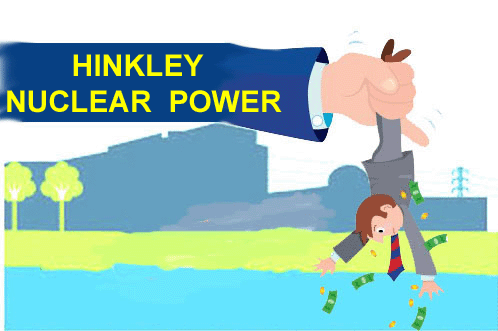
Solar and wind would generate the equivalent power to Hinkley over the plant’s planned lifetime for £40bn less, says analysis comparing future costs, Guardian, Adam Vaughan, 5 Apr 16, Scrapping plans for new nuclear reactors at Hinkley Point in Somerset and building huge amounts of renewable power instead would save the UK tens of billions of pounds, according to an analysis that compares likely future costs.
The Intergenerational Foundation thinktank calculated that Britain would pay up to £40bn less for renewable alternatives that would generate the equivalent power to Hinkley over the plant’s planned lifetime.
A final investment decision by EDF on the nuclear power plant’s expansion is expected in May. The deal involves the government committing £92.50 per megawatt hour over 35 years for its electricity output, more than twice the current wholesale price.
But a report published on Tuesday by the thinktank, which campaigns on fairness between generations, found that onshore windfarms would cost £31.2bn less than Hinkley, and solar photovoltaic power £39.9bn less over 35 years to build and run. The estimate is based on both the value of subsidies paid by the taxpayer for the electricity and the cost of building the infrastructure.
The analysis is based on the government’s ‘contracts for difference’ subsidy levels for the technologies and projections by Bloomberg for how the cost of wind and solar power will fall in the future.
Andrew Simms, one of the report’s co-authors, said: “The government’s current plans for new nuclear power will break spending records, and pass both high costs and large, unknown economic risks onto every UK child for generations to come.
But, readily available, cheaper, safer and quicker renewable energy options would help Britain live both within its economic and environmental means, while also protecting and providing for future generations.”
The report says that at £24bn, Hinkley Point C would be the “most expensive building on Earth”, and argues that the new reactors would pass not just economic costs to future generations, but the burdens of nuclear waste and climate change because nuclear is not quick enough to build at scale to stave off dangerous global warming………
Renewable power has grown in the UK to the point where more electricity was generated from biomass, wind, hydro and solar power in 2015 than nuclear power stations. But it is unlikely the Intergenerational Foundation’s report will shift minds in government, which has cut subsidies for both solar and wind power while pressing ahead with the Hinkley project.
The analysis assumes the level of subsidy for solar and wind under the contracts for difference subsidy regime would remain constant, though in reality this would likely decrease as more capacity was built……. http://www.theguardian.com/environment/2016/apr/05/scrapping-hinkley-for-renewable-alternatives-will-save-tens-of-billions
In a fully accountable marketplace, wind power is the leader
The best renewal would be the creation of a level playing field where all energy sources bear their own costs and all subsidies are removed.
In a fully accountable marketplace, challenger fuels like wind will do very well because they cost less when all costs are counted. The incumbent fuels fear that accountability—for good reason.
Market forces choose wind power http://thehill.com/blogs/congress-blog/energy-environment/274890-market-forces-choose-wind-power By Former Rep. Bob Inglis (R-S.C) 1 April 16 As a staunch believer in free markets, I don’t pick winners and losers- I let the market do that for me. And right now, the free market is telling me wind power is a big part of America’s energy future.
 There will always be people who hold on to old technology even while the evidence mounts around them that the new is better. Time and time again, history proves that those who refuse to be forward-looking get left behind. Whether it’s buggy whip manufacturers scoffing at the Model T Ford or someone hunting for a pay phone, some people just can’t adapt to the times.Here’s what happened for wind power in 2015. It was the year’s largest source of newly installed electric capacity, beating solar and natural gas by significant margins. Wind made up 35 percent of all new electricity that came online last year.
We see this progress in state after state: Iowa generated 31 percent of electricity with wind in 2015, while 12 states created at least 10 percent.
Or how about this: America continues to be the best in the world for wind energy production. We should be proud that the United States is number one on the list, beating China, Germany and every other country. Continue reading
1 This Month

of the week – Shut Down Drone Warfare!


Tell the Ukrainian Government to Drop Prosecution of Peace Activist Yurii Sheliazhenko

Petition to revoke the licensing of the Near Surface Nuclear Disposal Facility (NSDF) at Chalk River. https://www.ourcommons.ca/petitions/en/Petition/Details?Petition=e-7247
To see nuclear-related stories in greater depth and intensity – go to https://nuclearinformation.wordpress.com
-
Archives
- April 2026 (103)
- March 2026 (251)
- February 2026 (268)
- January 2026 (308)
- December 2025 (358)
- November 2025 (359)
- October 2025 (376)
- September 2025 (257)
- August 2025 (319)
- July 2025 (230)
- June 2025 (348)
- May 2025 (261)
-
Categories
- 1
- 1 NUCLEAR ISSUES
- business and costs
- climate change
- culture and arts
- ENERGY
- environment
- health
- history
- indigenous issues
- Legal
- marketing of nuclear
- media
- opposition to nuclear
- PERSONAL STORIES
- politics
- politics international
- Religion and ethics
- safety
- secrets,lies and civil liberties
- spinbuster
- technology
- Uranium
- wastes
- weapons and war
- Women
- 2 WORLD
- ACTION
- AFRICA
- Atrocities
- AUSTRALIA
- Christina's notes
- Christina's themes
- culture and arts
- Events
- Fuk 2022
- Fuk 2023
- Fukushima 2017
- Fukushima 2018
- fukushima 2019
- Fukushima 2020
- Fukushima 2021
- general
- global warming
- Humour (God we need it)
- Nuclear
- RARE EARTHS
- Reference
- resources – print
- Resources -audiovicual
- Weekly Newsletter
- World
- World Nuclear
- YouTube
-
RSS
Entries RSS
Comments RSS
 nuclear-news