The role of renewable energy in slowing climate change
Surge in renewable energy stalls world greenhouse gas emissions Falling coal use in China and the US and a shift towards renewable energy globally saw energy emissions level for the second year running, says IEA, Guardian, John Vidal, 17 March 16, Falling coal use in China and the US and a worldwide shift towards renewable energy have kept greenhouse gas emissions level for a second year running, one of the world’s leading energy analysts has said.
Preliminary data for 2015 from the International Energy Agency (IEA) showed that carbon dioxide emissions from the energy sector have levelled off at 32.1bn tonnes even as the global economy grew over 3% .
Electricity generated by renewable sources played a critical role, having accounted for around 90% of new electricity generation in 2015. Wind power produced more than half of all new electricity generation, said the IEA.
The figures are significant because they prove to traditionally sceptical treasuries that it is possible to grow economies without increasing climate emissions.
“The new figures confirm last year’s surprising but welcome news: we now have seen two straight years of greenhouse gas emissions decoupling from economic growth. Coming just a few months after the landmark COP21 agreement in Paris, this is yet another boost to the global fight against climate changem” said IEA director, Fatih Birol…….
A seperate report by the European Environment agency (EEA) shows that the EU-wide share of renewable energy has increased from 14.3% in 2012 to 15% in 2013. This allowed the EU to cut its demand for fossil fuels by 110m tonnes of oil equivalent in 2013. This, said the EEA, is the equivalent of a gross reduction of CO2 emissions of 362m tonnes in 2013. http://www.theguardian.com/environment/2016/mar/16/surge-in-renewable-energy-stalls-world-greenhouse-gas-emissions?CMP=share_btn_tw
From soldier to climate change fighter – Solar Ready Vets
Solar Ready Vets Transforms US Military Into Climate Change Fighters, Clean Technica, May 18th, 2016 by Tina Casey
At least 190,000 veterans are expected to transition out of the US military each year over the next several years, and the federal program Solar Ready Vets is gearing up to match them with solar jobs. The Energy Department has just announced that it is adding five more military bases to the program’s roster of solar training locations. The agency will also pour $10 million into 10 new training projects that will help rev up the solar industry’s ability to absorb new workers.
Solar Jobs And A Smooth Transition
Solar Ready Vets was launched in 2014 as a pilot program to help the rapidly growing US solar industry recruit enough skilled workers to meet the demand. The idea is to establish the training programs on bases and begin the training process before veterans end their military service, so they can enter the civilian workforce as seamlessly as possible.
Each base is paired with a local community college or other solar training provider, leveraging the existing framework of the GI Bill.
The training is available to active duty personnel who are within six months of leaving the service. To sweeten the pot, there is no charge to for the training program.
The program aims at all aspects of the solar industry, including sales and management as well as installation and other technical positions.
Apparently Solar Ready Vets was a success. It has already graduated 250 trainees and, from an initial five bases, this week it doubled in size to include 10 bases. The new ones are:
Camp Pendleton in California – U.S. Marine Corps
Fort Carson in Colorado – U.S. Army
Naval Station Norfolk in Virginia – U.S. Navy
Hill Air Force Base in Utah – U.S. Air Force
Fort Drum in New York – U.S. Army
These are the existing ones:
Joint Base McGuire-Dix-Lakehurst in New Jersey – U.S. Air Force, Army, and Navy
Eglin Air Force Base in Florida – U.S. Air Force
Marine Corps Base Hawaii – U.S. Marine Corps
Joint Base San Antonio in Texas – U.S. Air Force and Army
Fort Bragg in North Carolina – U.S. Army…….http://cleantechnica.com/2016/05/18/solar-ready-vets-transforms-us-military-climate-change-fighters/
Global solar power industry expanding at fast rate
Experts at industry summit say solar power expanding faster than ever CCTV America, May 11, 2016 [Good Graphs] Last week, the U.S. marked its one millionth solar panel installation, 40 years after solar energy was first developed. Analysts say it’ll only take two years to install another one million.
“By 2020, we’ll be generating enough electricity to power 20 million homes. So we are at the place where solar takes off,” Rhone Resch, president and chief executive of the Solar Energy Industry Association said……..
Renewable energy, energy efficiency cheaper options for South West England than Hinkley nuclear power
 Alternatives to Hinkley nuClear News No 85 May 2016 If there is anywhere between 4 and 18 months before a final investment decision on Hinkley is made what alternative proposals can be promoted over that time?
 West England, published a study which showed how the South-west’s energy needs could be met with renewable energy. The report focussed on dealing with the baseload question and the economic impact of a renewable energy transition. It concluded that the South West has the renewable energy resources to meet more than 100% of its total energy needs, including replacement of liquid fuels and electrifying railways.
Koch brothers and power utilities connive to stop solar power
 The Koch Brothers’ Dirty War on Solar Power All over the country, the Kochs and utilities have been blocking solar initiatives — but nowhere more so than in Florida, Rolling Stone, By Tim Dickinson February 11, 2016 After decades of false starts, solar power in America is finally poised for its breakthrough moment. The price of solar panels has dropped by more than 80 percent since President Obama took office, and the industry is beginning to compete with coal and natural gas on economics alone.
South Africa: renewable energy growth, promise that nuclear development will be “corruption-free”
South Africa targets more renewable power, nuclear expansion to go ahead
*Renewable energy seen contributing 17,800 MW by 2030
* Nuclear expansion process to be affordable, above board
Africa’s most industrialised country has turned to solar and wind power to diversify its energy mix and help plug electricity shortages. The first 47 renewable energy independent power producers are due to be fully operational by July.
It also hopes to install 9,600 megawatts of nuclear power in the next 15 years to address chronic electricity shortages but the cost of the project estimated at about $100 billion has raised budgetary concerns.
Tina Joemat-Pettersson reaffirmed in parliament that the planned nuclear expansion would be “corruption free”, following concerns by opposition parties over the tender process and about the affordability of the project in a country whose economic growth has stagnated.
The department of energy would issue a request for proposal to confirm market appetite for the fleet of nuclear plants and help secure commercial and financial information for the government to make a final decision, she said.
“We will only implement what our country can afford,” Joemat-Pettersson said.
Forecasts for growth in South Africa have fallen to below 1 percent for 2016 as a global commodity slump drags on and rising inflation rates curb domestic spending.
50% fall in solar power price, over 16 months

 The price of solar power just fell 50% in 16 months – Dubai at $.0299/kWh!, Electrec, John Fitzgerald Weaver 2 May 16, Dubai received bid of $.0299/kWh for 800MW of solar power. This price represents the lowest yet recorded for solar power (and might not represent the end of the price drops…).
Dubai Electricity and Water Authority (DEWA) has received 5 bids from international organisations for the third phase of the Mohammed bin Rashid Al Maktoum Solar Park, said HE Saeed Mohammed AlTayer, MD & CEO of DEWA. The lowest recorded bid at the opening of the envelopes was US 2.99 cents per kilowatt hour. The next step in the bidding process will review the technical and commercial aspects of the bids to select the best one.
In the USA, in 2014 and with incentives, utility scale solar projects averaged $.05/kWh. On this bid alone, five companies bid below $.045/kW – without subsidies!
In 2015, we saw Dubai sign a deal at a fixed rate of $0.0584 cents over 25 years with no incentives. In the summer of 2015 Autin, TX received almost 1,300MW`of bids at under $.04/kWh. Shortly afterwards, we saw Berkshire Hathaway Inc.’s NV Energy agreed to pay $.0387/kWh for power from a 100-megawatt project that First Solar Inc. is developing. Lastly, just this month Enel Green powersigned contracts for $.036/kWh in in Mexico and $.03/kWh in Morroco.
The price per kWh just fell 50% – and it did it in less than sixteen months…….http://electrek.co/2016/05/02/price-solar-power-fell-50-16-months-dubai-0299kwh/
China trebling its wind power capacity
 China’s wind-power installed capacity will escalate to 495 GW by 2030, says Global Data Wind Power Engineering, May 5, 2016 Michelle Froese Wind power installed capacity in China will more than treble from approximately 149 Gigawatts (GW) in 2015 to over 495 GW by 2030, representing a Compound Annual Growth Rate (CAGR) of 9%, according to research and consulting firm GlobalData.
The company’s latest report* states that China has the highest wind power globally by far, accounting for a third of cumulative wind power capacity worldwide in 2015, followed by the U.S. with 17% of the global share…….
Srivatsava comments: “China’s quick adoption of wind power can be attributed to a wider global trend driven by depleting fossil fuel reserves, the declining cost of wind power generation and a growing sensitivity towards environmental issues.
“China’s 13th Five Year Plan raised the 2020 wind target to 250 GW, and aims to shift focus from scale expansion towards quality and efficiency. In order to tackle rising pollution levels and reduce its dependence on imported oil, the country is promoting renewable energy sources such as wind. The government has a number of financial incentives such as feed-in tariffs in place to continue the development of wind power.”…….http://www.windpowerengineering.com/policy/reports/chinas-wind-power-installed-capacity-will-escalate-495-gw-2030-says-globaldata/
USA’s Energy Det program ‘Orange Button’ will bring down costs of solar power
Department of Energy Program Aims to Bump Solar Costs Even Lower A clean energy initiative goes beyond declining hardware costs to address the remaining barriers to embracing solar over fossil fuels. Inside Climate News BY DAVID J. UNGER MAY 2, 2016 While the solar industry trumpets the rapidly declining costs of solar panels—which have paved the way for solar energy capacity in the U.S. to GROW NEARLY TWENTY-FOLD SINCE 2008—those numbers don’t account for all the costs involved in the transition to clean energy. That is why a new government initiative aims to slash the overall price tag by better managing the reams of data associated with financing, building and operating solar installations.
The U.S. Department of Energy’s (DOE) Orange Button, a $4 million program launched earlier this month, seeks to streamline what experts say can be a costly, complicated and time-consuming path to bringing more solar panels online. By developing an easily downloadable, standardized set of data about individual solar installations, the DOE hopes to lower the bureaucratic barriers—as well as the excessive costs—that discourage investors, utilities and consumers from embracing solar.
Orange Button is part of the DOE’s SunShot Initiative, which launched in 2011 with the goal of making solar energy cost competitive with coal, natural gas and other traditional sources of electricity such as nuclear and hydroelectric power. If SunShot reaches its goal of reducing utility solar costs to $1 per watt by 2020, it will enable solar-generated power to expand from less than 2 percent of the nation’s electricity generation portfolio to roughly 14 percent by 2030 and 27 percent by 2050, according to the program’s vision study.
Similar programs have already been launched in other industries. The DOE’sGreen Button was launched in 2012, allowing utility customers to download standardized, consumer-friendly data about their energy usage. The Department of Health and Human Services’ Blue Button program offers people help accessing and transferring their health records.
Part of the challenge for solar is a lack of information. Compared to housing and other well-established markets, solar is relatively new, so banks, utilities, solar companies and other constituencies do not have a standardized set of metrics to share. The U.S. energy market has 18,000 jurisdictions and 3,000 utilities in regulated and unregulated markets, so navigating its idiosyncrasies costs time and money, said Elaine Ulrich, program manager at the DOE.
“When you look at the cost of financing for these solar projects, it’s artificially high,” Ulrich told InsideClimate News. “Solar is a long-term asset that has pretty well-known characteristics, but it’s treated as a higher-risk asset because there isn’t sufficient data available to help folks in the financial industry to know how to assess the risk of [a] portfolio of assets.”…….http://insideclimatenews.org/news/02052016/department-energy-program-aims-bump-solar-costs-even-lower
City of San Diego’s bi-partisan plan for 100% renewable energy
San Diego is not waiting for Washington to get its act together on climate change. The southern California city is moving forward with an ambitious plan to run on 100% renewable energy and cut greenhouse gas emissions in half by 2035 – and it’s doing so in a bipartisan manner. Republican Mayor Kevin Faulconer endorsed the Climate Action Plan that was unanimously approved by the Democrat-dominated city council in December.
Renewables, including solar and wind, would be increased to achieve the target. San Diego alreadyplaces second in the nation for solar power with solar installations growing 76.6 percent in two years to 189 megawatts of installed photovoltaic capacity at the end of 2015.
Related: Vancouver will be powered by 100 percent renewable energy
The plan also includes an initiative to increase the urban tree canopy to 35 percent by 2035 – perhaps even more important than the clean energy and greenhouse gas emissions targets because trees sequester carbon. More climate scientists are recognizing the importance of restoring ecosystems to draw down atmospheric carbon in order to reverse global warming and protect biodiversity. Restoring water cycles, soil, grasslands, wetlands and forests could remove gigatons of carbon from the atmosphere, returning the atmosphere to pre-industrial levels of safety and stability, according to Biodiversity for a Livable Climate………
In going 100 percent renewable, San Diego joins a growing list of cities around the world committing to powering their economies completely with clean energy. They include Vancouver, San Francisco, Sydney and Copenhagen.
+ San Diego Climate Action Plan http://inhabitat.com/san-diego-to-become-largest-u-s-city-to-run-on-100-renewable-energy/
A solar-powered flight across the Pacific – the Solar Impulse 2 arrives in California
Solar-powered plane reaches California after journey across Pacific Mashable Australia, BY THE ASSOCIATED PRESS , 24 Apr 16, MOUNTAIN VIEW, Calif. — A solar-powered airplane landed in California on Saturday, completing a risky, three-day flight across the Pacific Ocean as part of its journey around the world.

Pilot Bertrand Piccard landed the Solar Impulse 2 in Mountain View, south of San Francisco, at 11:45 p.m. local time following a 62-hour, nonstop solo flight without fuel. The plane taxied into a huge tent erected on Moffett Airfield where Piccard was greeted by project’s team……..
The trans-Pacific leg was the riskiest part of the plane’s global travels because of the lack of emergency landing sites…….http://mashable.com/2016/04/24/solar-impulse-2-california/#gwzcbJ_OIkq3
World record for wind power goes to Denmark, yet again
 Denmark just broke its own wind power record for the second year in a row http://inhabitat.com/denmark-breaks-its-own-wind-power-production-record-two-years-in-a-row/ by Cat DiStasio, 18 Apr 16, VIEW SLIDESHOW
This time last year, Denmark celebrated the world record achievement of generating 39.1 percent of the nation’s electricity from wind power in 2014. This means that, for two years running, Denmark has generated more electricity from wind power than any other country on Earth. Wind power also makes up a larger share of electricity sources there than in other nations. Essentially, Denmark is blazing the trail for other European countries to push forward with renewable energy projects.
Related: All Netherlands Railways trains will be 100% wind powered by 2018
“It’s not unusual that we have hours where the wind production is greater than the actual consumption. But in the western part of the country, it has sometimes been 16 percent more, and that illustrates that with a volatile electricity production, we are able to import and export across our borders,” Energinet’s Carsten Vittrup said in a statement. Indeed, wind power generation has been known to peak as high as140 percent of the country’s electricity needs on particularly windy days.
Danish parliament aims to get at least half of the country’s electricity from wind by 2020, and that seems easily achievable given the current upward trend. A corresponding goal is to rely on renewable energy for 90 percent of the electricity and heating throughout the nation, which also seems likely. Currently, Denmark is exporting some of its wind power to Norway, Sweden, and Germany, while buying hydropower from Norway and solar power from Germany. Mixing energy sources is important to ensure a consistent supply to the power grid, regardless of weather conditions, so coal and biomass power plants are still being used as a safety net. However, it’s logical to expect a decline in those sources as renewable methods continue to take over.
Impressive solar panel array on Port Alberni hospital, Vancouver Island, Canada

 Port Alberni hospital has Vancouver Island’s largest array of solar power Solar power could help with high hydro rates during peak hours on hot days By Liam Britten, CBC News Apr 23, 2016
Who loves the sun? — turns out West Coast General Hospital in Port Alberni does. That building is home to 400 solar panels — the largest power-generating array on Vancouver Island, in fact.
The panels will be doing their work in the weeks and months ahead to see how much money Island Health Authority can save by using the power of the sun.
- Thompson Rivers University puts energy into solar powered walkway
- Vancouver roofing company starts offering solar panel installation
- Nelson’s ‘community solar garden’ starts leasing panels
“When it’s really hot and sunny and we’re using a lot of power to keep the hospital cool, the rates get very high with BC Hydro,” Deanna Fourt, director of energy efficiency and conservation with Island Health Authority told All Points West host Robyn Burns.
“So it’s going to work very nicely with the solar. This is what we’re thinking, because it’s going to be offsetting those really high-rate days or high-rate times.”……..http://www.cbc.ca/news/canada/british-columbia/vancouver-island-solar-power-1.3550022
USA wind energy investment – over $128 Billion
 By staying on track to supply 20 percent of U.S. electricity by 2030, wind energy could support 380,000 well-paying jobs, according to the U.S. Department of Energy. That number could grow to 600,000 by supplying 35 percent by 2050
More Than $128 Billion Dollars Invested in U.S. Economy by New Wind Power Projects,Wind Systems, 25 Apr 16 Building new wind farms in the U.S. added $13 billion per year on average to the American economy over the past five years, according to information recently released by the American Wind Energy Association (AWEA).
“By building new wind farms across the country throughout the past decade, wind companies have invested $128 billion into the U.S. economy,” said Tom Kiernan, CEO of AWEA. “Over this time, wind has rapidly scaled-up. Now, there is enough wind power installed to reliably produce electricity for more than 19 million American homes. Continuing to invest in world-class wind resources here at home will help keep our lights on, grow state economies, and keep more money in the pockets of homeowners and businesses.”
Wind energy was the number-one source for new electric capacity additions in 2015 with 8,598 MW installed. That number translates to $14.7 billion dollars in wind project investments in one year — a 73-percent increase over the $8.5 billion invested in new projects in 2014 and a more than seven-fold increase over investments by wind in 2013……..
The new investment figures made by wind come shortly after a new accord that was announced by a bipartisan group of 17 governors who made the pledge to accelerate clean energy growth, including wind power, as a way to build “a new energy future.” The accord said that creating this new energy path will result in a “more durable and resilient infrastructure and [will] enable economic growth while protecting the health of our communities and natural resources.”
Wind power costs two-thirds less than it did six years ago because of American innovation and improved domestic manufacturing, with more than 500 factories across 43 states building wind turbine parts and materials, and those savings are being passed on to U.S. consumers. Wind power saved consumers $1 billion over just two days across the Great Lakes and Mid-Atlantic states during the 2014 Polar Vortex event.
Wind energy in the U.S. produces enough electricity for more than 19 million American homes, and American wind power supports 73,000 well-paying jobs across every state, including nearly 20,000 manufacturing jobs.
By staying on track to supply 20 percent of U.S. electricity by 2030, wind energy could support 380,000 well-paying jobs, according to the U.S. Department of Energy. That number could grow to 600,000 by supplying 35 percent by 2050. http://www.windsystemsmag.com/article/detail/1167/more-than-128-billion-dollars-invested-in-us-economy-by-new-wind-power-projects
Indian govt announces highly ambitious solar energy target
 India Sets Target Of 48 GW Solar Power Capacity By March 2019, Clean Technica April 23rd, 2016 by Saurabh Mahapatra Originally published on PlanetSave.
Highly ambitious annual solar power capacity addition targets have been announced by the Indian Ministry of New & Renewable Energy.
With a target to have an operational solar power capacity of 100 GW by March 2022, the Indian government has announced annual capacity addition targets for the next few years. The Ministry of New & Renewable Energy (MNRE) plans to add 15 GW and 16 GW solar power capacity in the financial years 2017-18 and 2018-19, respectively.
In the current financial year, the government targets an addition of 12 GW solar power capacity. If this target is achieved, India’s installed solar power capacity will cross 17 GW by the end of March 2017. By early March this year more than 5.7 GW of solar power capacity was operational in India…….
India is also in talks with development banks like the Asian Development Bank, International Finance Corporation, KfW, the Japan International Cooperation Agency, and the New Development Bank to access cheap debt finance for setting up solar power projects. https://cleantechnica.com/2016/04/23/101231/
1 This Month
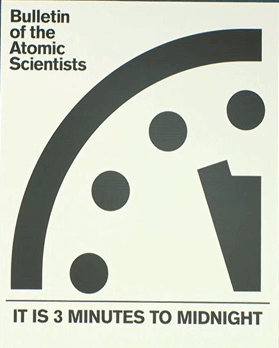
Watch the 2026 Doomsday Clock unveiling live here on January 27 at 10 a.m. EST
To see nuclear-related stories in greater depth and intensity – go to https://nuclearinformation.wordpress.com/

29 Jan. Thursday 7-8 p.m. Webinar – World’s Largest Nuclear Station in Port Hope, ON?


31st January – Challenging the War Machine – a DECLASSIFIED UK SUMMIT


Website of the Week
Now until to February 10, 2026 Radioactive waste storage in France: the debate is finally open! How to participate?
-
Archives
- January 2026 (277)
- December 2025 (358)
- November 2025 (359)
- October 2025 (376)
- September 2025 (258)
- August 2025 (319)
- July 2025 (230)
- June 2025 (348)
- May 2025 (261)
- April 2025 (305)
- March 2025 (319)
- February 2025 (234)
-
Categories
- 1
- 1 NUCLEAR ISSUES
- business and costs
- climate change
- culture and arts
- ENERGY
- environment
- health
- history
- indigenous issues
- Legal
- marketing of nuclear
- media
- opposition to nuclear
- PERSONAL STORIES
- politics
- politics international
- Religion and ethics
- safety
- secrets,lies and civil liberties
- spinbuster
- technology
- Uranium
- wastes
- weapons and war
- Women
- 2 WORLD
- ACTION
- AFRICA
- Atrocities
- AUSTRALIA
- Christina's notes
- Christina's themes
- culture and arts
- Events
- Fuk 2022
- Fuk 2023
- Fukushima 2017
- Fukushima 2018
- fukushima 2019
- Fukushima 2020
- Fukushima 2021
- general
- global warming
- Humour (God we need it)
- Nuclear
- RARE EARTHS
- Reference
- resources – print
- Resources -audiovicual
- Weekly Newsletter
- World
- World Nuclear
- YouTube
-
RSS
Entries RSS
Comments RSS
 nuclear-news