Offshore wind is cheaper and safer than Hinkley Point
 Winds of spare change, Breaking Views, 8 August 2016 By Olaf Storbeck Theresa May should look to Denmark instead of France to secure Britain’s future energy needs. ……As things stand, the UK is proposing to guarantee French state-controlled utility EDF a minimum price of 92.50 pounds for each megawatt-hour of electricity produced at the 18-billion-pound Hinkley Point project. Back in 2013, when the deal was struck, offshore wind was almost 50 percent more pricey.
Wind technology’s costs have plummeted since then. The latest generation of wind farms on the ocean is producing electricity for less than 85 pounds per megawatt hour rather than 130 pounds, new data from state-controlled Danish utility DONG Energy shows. Bigger and more efficient turbines contribute, as well as improvements in construction and grid connection.
This progress, which is faster than even DONG expected, is undermining the economic case for Hinkley Point. Offshore wind is already 8 percent cheaper. And the gap is likely to widen, as the industry continues to be on a steep learning curve, while construction costs for nuclear plants have a notorious tendency to creep upwards.
Renewable energy’s usual issue is intermittency. But offshore wind out at sea is strong and steady, so turbines generate power 98 percent of the time. Replacing Hinkley Point’s planned capacity of 3.2 gigawatts with offshore wind would admittedly require building wind parks of twice that size – offshore turbines on average deliver only around half of their nominal capacity. But as there is no shortage in potential locations for offshore wind farms, such a large scale ramp-up is technologically possible.
Offshore wind is not just cheaper, but also less risky than Hinkley Point. Wind parks usually go on the grid within four years, compared to at least a decade for planned nuclear plants. Similar reactors in Finland and France are dogged by a tripling of costs and years of delay. And the UK taxpayer would have to pay the nuclear subsidies over 35 years, while those for wind farms usually run less than half that long.
That’s before the wind turbines’ other obvious benefit: they don’t leave toxic radioactive waste behind. If May wants to pull the plug on Hinkley Point, she has a ready-made case. https://www.breakingviews.com/considered-view/cheap-wind-energy-can-deal-final-blow-to-hinkley/
Implementing storage technologies – necessary in transition from nuclear power
 As nuclear power plants close, states need to bet big on energy storage Skeptical Science 9 August 2016 by dana1981 Eric Daniel Fournier, Post Doctoral Researcher, Spatial Informatics, University of California, Los Angeles and Alex Ricklefs, Research Analyst in Sustainable Communities, University of California, Los Angeles This article was originally published on The Conversation . Read the original article.
“……due to negative opinion and costly renovations, we are now observing a trend whereby long-running nuclear power plants are shutting down and very few new plants are being scheduled for construction in the United States.
Utilities are moving toward renewable electricity generation, such as solar and wind, partially in response to market forces and partially in response to new regulations that require utilities to reduce greenhouse gas emissions. In California, in particular, the shift toward renewable energy for market and environmental reasons, along with the public’s negative perception of nuclear energy, has caused utilities to abandon nuclear power.
While opponents can view the shutdown of nuclear power plants as a health and environmental success, closing nuclear plants intensifies the challenges faced by utilities to meet electricity consumption demand while simultaneously reducing their carbon footprint. PG&E, for example, has pledged to increase renewable energy sources and energy efficiency efforts, but this alone will not help them supply their customers with electricity around the clock. What can be used to fill the sizable gap left by Diablo Canyon’s closing?
Solar and wind energy sources are desirable as they produce carbon-free electricity without producing toxic and dangerous waste byproducts. However, they also suffer from the drawback of being able to produce electricity only intermittently throughout the day. Solar energy can be utilized only when the sun is out, and wind speeds vary unpredictably.
In order to meet customer electricity demand at all hours, energy storage technologies, alongside more renewable sources and increased energy efficiency, will be needed.
Enter energy storage
Energy storage has long been touted as the panacea for integrating renewable energy into the grid at large scale. Replacing the power generation left by Diablo Canyon’s closing will require expansive additions to wind and solar. However, more renewable energy generation will require more storage.
There are many different energy storage technologies currently available or in the process of commercialization, but each falls into one of four basic categories: chemical storage as in batteries, kinetic storage such as flywheels, thermal storage and magnetic storage.
The different technologies within each of these category can be characterized and compared in terms of their:
- power rating: how much electrical current produced
- energy capacity: how much energy can be stored or discharged, and
- response time: the minimum amount of time needed to deliver energy. [excellent graphs provided here on original]
The key challenge that utilities are now faced with is how to integrate energy storage technologies for specific power delivery applications at specific locations.
This challenge is further complicated by the electric power transmission system and consumer behaviors that have evolved based on a energy supply system dominated by fossil fuels. Additionally, storage technologies are expensive and still developing, which makes fossil fuel generators look more economically beneficial in the short term.
Implementing storage technologies
Currently in California, energy storage is effectively provided by fossil fuel power plants. These natural gas and coal-powered plants provide steady “baseload” power and can ramp up generation to meet peaks in demand, which generally happen in the afternoon and early evening.
A single energy storage device cannot directly replace the capacity potential of these fossil fuel sources, which can generate high rates of power as long as needed.
The inability to perform a like-for-like replacement means that a more diversified portfolio strategy toward energy storage must be adopted in order to make a smooth transition to a lower carbon energy future. Such balanced energy storage portfolio would necessarily consist of some combination of:
- short-duration energy storage systems that are capable of maintaining power quality by meeting localized spikes in peak demand and buffering short term supply fluctuations. These could include supercapacitors, batteries and flywheels that can supply bursts of power quickly.
- Lower speed energy storage that can supply a lot of power and store a lot of energy. These systems, such as pumped hydro and thermal storage with concentrated solar power, are capable of shifting the seasonality of solar production and servicing the unique power requirements for large scale or sensitive power users in the commercial and industrial sectors.
This set of storage technologies would have to be linked up in a kind of chain, nested and tiered by end use, location and integration into the grid. Additionally, management systems will be needed to control how the storage technologies interact with the grid.
Currently without sufficient energy storage in place, utilities now use natural gas to fill in the gaps in electricity supply from renewable sources. Utilities use “peaker” plants, which are natural gas-fueled plants that can turn generation up or down to meet electricity demand, such as when solar output dips in the late afternoon and evening, while producing air pollution and greenhouse gas emissions in the process.
With natural gas consumption for electricity generation on the rise, would it be better to keep nuclear power while energy storage technologies mature? Although less polluting than coal, natural gas produces greenhouse gas emissions and has the potential to causeenvironmentally dangerous leaks, as seen in Aliso Canyon.
With nuclear, it is still not clear what to do with nuclear waste, and the disaster at Japan’s Fukushima nuclear power plant in 2011 highlights how catastrophically dangerous nuclear power plants can be.
Regardless of which situation you believe is best, it is clear that energy storage is the major limitation to achieving a carbon-free electricity grid.
California’s commitment to renewable energy sources has helped shift the state to using less fossil fuels and emitting less greenhouse gases. However, careful planning is needed to ensure that energy storage systems are installed to take over the baseline load duties currently held by natural gas and nuclear power, as renewables and energy efficiency may not be able to carry the burden.
Clever payment systems, such as Oxfam’s plan, could revolutionise Zimbabwe with decentralised solar energy
Affordable solar schemes light way to energy for all in Zimbabwe BY TONDERAYI MUKEREDZI HARARE (Thomson Reuters Foundation) Aug 8, 2016 – Innovative ways to pay for solar power systems could make clean energy affordable for many of Zimbabwe’s 1.5 million households that lack electricity, campaigners say. Zimbabwe produces only around 60 percent of the electricity it needs when demand is highest, and relies on costly imports to make up some of the shortage, particularly when drought hits hydropower facilities, as happened this year.
That means solar panels and other clean energy sources not connected to the southern African nation’s power grid are likely the cheapest and fastest way to bring electricity to those without it, say sustainable energy experts. “Only focusing on grid extension and increasing generation capacity will not allow us to attain energy access for all by 2030,” said Chiedza Maizaiwana, manager of the Power for All Zimbabwe Campaign.
To meet the internationally agreed goal, so-called “decentralised” renewable energy is “a critically needed solution”, she told the Thomson Reuters Foundation. “It is imperative that we create the opportunity for families and businesses to access (these) services rapidly and affordably,” she said.
Getting connected to the grid in a rural area can cost thousands of dollars, a huge obstacle when many people earn between $20 and $100 a month, said Ngaatendwe Murimba, a program officer for Ruzivo Trust, a non-governmental organization (NGO) working to improve rural energy access.
But families without electricity do pay for energy, buying firewood or charcoal – which drive deforestation – batteries, or polluting fuels such as paraffin……..
 Jonathan Njerere, head of programs in Zimbabwe for charity Oxfam, said that in Gutu district, 230 km east of Harare, his organization and others had helped set up a community-owned, self-financing solar energy scheme.
It has enabled more than 270 farmers to irrigate about 16 hectares (39.5 acres) of crops.
Oxfam gave the community solar equipment for irrigation and an initial batch of solar lanterns, which were sold to members. The proceeds were pooled in a savings and lending scheme, allowing others to join and buy solar products for home and business use.
Community funds are used to purchase solar equipment for sale to the public through energy kiosks, and the revenue is kept for repairs and relief in natural disasters.
Njerere said the program, assisted by 2 million euros ($2.22 million) from the European Union, had helped chicken farms, fisheries, tailors and shopkeepers acquire hire-purchase solar panels, so they can work in the evening as well as during the day.
Other entrepreneurs use the solar panels to sell mobile phone charging services for $0.20 a time………
Providing subsidized solar equipment would hugely improve uptake, Ruzivo Trust’s Murimba said. Communities are asking for free installation of solar systems, zero taxes on solar equipment, and government-accredited dealers who can provide them with quality solar equipment and technical support, he added.
One local company had to discontinue a popular package including a mobile phone and a $45 solar lamp. It sold some 400,000 lights to around a third of the country’s households, but they were poor quality, and many developed problems with no mechanism for repair or return.
In Harare, vegetable vendor Regina Meki, 40, uses a solar lamp she bought on credit to hawk her wares well into the night. Under a payment plan offered by a local solar company, she pays $1 a day for the $50 rented lamp, which has helped boost her monthly earnings from $70 to $120. “Solar energy has brought nothing but happiness to me, increasing my income. Besides payment for the equipment was easy on the pocket,” she said. http://www.reuters.com/article/us-zimbabwe-energy-solar-financing-idUSKCN10J0L3
France’ solar roads project underway
France gets a step closer to solar roads http://reneweconomy.com.au/2016/france-gets-step-closer-solar-roads-56433 By Ilias Tsagas on 5 August 2016 French energy minister Ségolène Royal has inaugurated a manufacturing plant that will produce the so-called “Wattway” paving, made of solar PV. One of its pilot projects will be a 1 kilometer solar road, built in the same region as where the plant is located.
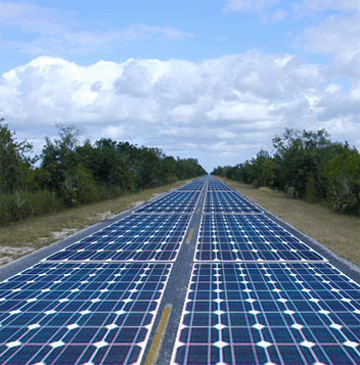
On 26 July French energy minister Ségolène Royal inaugurated a manufacturing unit for the Wattway photovoltaic panels in Tourouvre, Orne. Wattway is a French innovation and is the result of 5 years of research undertaken by Colas, a transport infrastructure company, and the French National Institute for Solar Energy (INES).
The joint patent for the product is based on crystalline silicon, and although it is very thin, Colas argues it is also “very sturdy, skid-resistant and designed to last,” with the durability to bear all types of vehicles, including trucks. Wattway panels can be applied directly to existing pavements, with the aim of generating green electricity while also allowing traffic to flow.
Colas is already taking orders for panels ranging from 10 m2 to 50 m2, however, as of 2017, Wattway panels will be included in the Colas product line and the panel surface will increase.
One of the first applications of the Wattway panels will be a 1 kilometer road in the Onre region, the local council has announced.
France’s energy minister took the opportunity at the event to also announce the mobilization of €5 million in state funding to support the development of the Wattway photovoltaic panel. Royal herself is a great support of the innovative patent and has often spoken publicly of the variety of projects the Wattway can be applied to.
A Wattway panel, said Colas, can last “at least 10 years depending on the traffic, which speeds up wear. If the section is not covered by heavy traffic – a stadium parking lot for example – then Wattway panels can last roughly 20 years.”
Source: PV Magazine.
Decentralised solar power a winner for desert area of Rajasthan, India
An entire district in Rajasthan to be powered by solar energy, will end all water woes in the desert state! Rajasthan Electronics and Instrumentation Ltd, the firm currently handling the project has been given the green signal to spend Rs 11.91 crore for the entire project. India.com By Rutu Ladage on August 2, 2016“……..For Rajasthan government, coming up with newer techniques to ensure that the water issues never crop up, Barmer district in Jaiselmer is coming up with a unique solution. While we do have villages and homes in India that boast of solar power and using solar energy to meet their electricity needs, there are hardly any complete districts that boast of running solely on solar power. If the project works out, it will definitely be one of the major firsts in India and set the benchmark for other regions too. The Mukhyamantri Solar Adharit Nalkoop Yojana (MSANY). will provide 70 solar tubewells in Barmer district to help people become reliant on solar energy and use solar power even for agriculture.
Strong support for renewables in UK public

 What does the public really think of renewables? http://www.goodenergy.co.uk/blog/articles/2016/07/29/what-does-the-public-really-think-of-renewables Did you know that 76% of the UK public support renewables, while just 21% support fracking?
This week the newly named Department for Business, Energy and Industrial Strategy (DBEIS) released its latest public attitudes tracker, asking UK residents their opinion on various energy topics ranging from bills to fracking.
The surveys, which first began in March 2012, time and again reveal overwhelming public support for renewable energy.
Strong support for renewables
In the past 18 surveys, support for renewables has never dropped below 75%, and the proportion backing solar has always been 80% or higher.
Seven in 10 of us agree that renewable energy provides economic benefits to the country, something we’re dedicated to delivering through our Renewables Development Charter.
In comparison, support for nuclear and fracking is consistently overshadowed by renewables, with the latest stats revealing that 36% and 21% of the UK public support these technologies respectively.
Good Energy founder and CEO Juliet Davenport was thrilled with the news. She said: “Clean energy has always had the public’s support because it offers good value – it’s local, it’s sustainable and it offers a solution to climate change.”
“The gulf between what the public wants for our energy future and what our Government is imposing is growing.
“The newly formed BEIS department needs to listen to public support, take the lead in seizing new opportunities and keep us on the path to decarbonisation.”
Record breaking clean power These figures are a huge boost to renewables, and come at a time when clean sources of generation are breaking records.
25% of our power needs now comes from green energy, and it was recently announced that one million UK homes are generating electricity and heat using the power of British sunshine.
With 2016 a year of political change and uncertainty for the renewable energy industry, it is good news like this which demonstrates the progress we are making towards a truly low carbon future.
Join the clean energy revolution by switching to our 100% renewable electricity and Green Gas
Nuclear enthusiast Bill Gates again trashing renewable energy
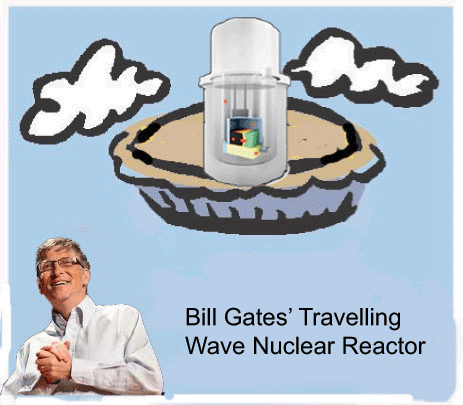 Bill Gates Again Dismisses Solar’s Value In Africa, Clean Technica July 22nd, 2016 by Joshua S Hill Bill Gates, delivering the 14th Nelson Mandela Annual Lecture on the eve of Mandela Day, has again dismissed the potential global role of solar, and in particular the value it could have in solving energy crises in Africa.
In the long run, what Africa needs is what the whole world needs: a breakthrough energy miracle that provides cheap, clean energy for everyone,” Gates said on the 17th. However, Gates doesn’t believe that that breakthrough has been made in the form of solar.
In an interview with Tech Insider earlier this year in February, which saw the billionaire philanthropist discuss the need to bring electricity to the millions who do not yet have access to reliable grid-provided energy, Bill Gates dismissed the role of solar. Gates discussed the need for an “energy miracle” then as well. “You might say, well, aren’t people saying that about wind and solar today? Not really. Only in the super-narrow sense that the capital costs per output, when the wind is blowing, is slightly lower.”
Gates continued, saying that the reason solar and wind “still needs subsidies, and it can’t go above a certain percentage, is this intermittency — it changes the economics, particularly the requirement that the power company at all times be able to require power.”
Speaking last Sunday as he delivered the 14th Nelson Mandela Annual Lecture, Gates again dismissed the role of solar in bringing electricity to the millions throughout Africa who are without reliable access to electricity……
What’s disappointing is that, at every step along Bill Gates’ arguments, we find reason to disagree with his increasingly-outdated points of view. Integrating energy storage with wind and solar generation mitigates much of the intermittency concerns, while reliance upon fossil fuels such as coal in Africa rely on massive levels of infrastructure — infrastructure which simply doesn’t exist, and would cost billions to develop, in excess of the cost of developing large-scale renewable energy deployment. Already the levelized cost of electricity (LCoE) has seen to be decreasing for both solar and onshore wind, and in some parts of the world are already cost competitive with existing fossil fuel energy sources.
Bill Gates isn’t unable to access this information, so what’s driving his seeming intentional ignorance towards the potential benefits of renewable energy, and solar energy in particular, for providing widespread electricity throughout Africa? http://cleantechnica.com/2016/07/22/bill-gates-dismisses-solars-value-africa/
Garmany’s solar PIMBY town – ‘Please In My Backyard’
 From swords to solar, a German town takes control of its energy, National Observer, By Audrea Lim in News, Energy | July 28th 2016 The German town of Saerbeck is a swords to solar panels story. Above this former German military ammunition camp, perched atop a metal stem like an oversized stalk of wheat, giant blades rotate in the sky, given life by an invisible breeze.
In 2009, Saerbeck decided to shift its electricity entirely to renewable sources by 2030. Within just five years, they were generating 3.5 times more renewable electricity than the town consumed, not only with the installation of solar panels on private roofs, but through a 90-hectare, 70-million-euro Bioenergy Park that now houses seven wind turbines, a biogas plant, and a sprawling array of solar panels on the roofs of former military bunkers.
These camouflaged bunkers look like charming rows of grass-hatted hobbit holes, but were built to house tank ammunition and grenades. Today they provide the physical foundation for achieving local energy security and self-sufficiency—since 2012, Saerbeck’s entire electric grid has been owned by the community—as well as a canvas for the psychedelic shadowplay cast by the rotating turbine blades.
The key to Saerbeck’s success, explained Mayor Wilfried Roos, is the grassroots nature of these projects, which were conceptualized at weekly community meetings, and have brought in revenue for the town and local investors, as excess energy is sold back into the grid……..
A bunch of PIMBYs (Please, in my backyard)
At the center of the town’s transformation is the local energy cooperative Energy for Saerbeck, co-founded by Roos, which owns the solar plant and a turbine in the Bioenergy Park. By investing in the cooperative (the minimum amount is 1,000 EUR), local townspeople become voting members and earn profits. Since its founding in 2009, the cooperative’s membership has expanded from an original nine members to 384 today. More residents are eager to join—if only the coop could keep pace with enough new projects.
Wallraven credits the opportunity to invest and participate for the townspeople’s embrace of the transition, which some scholars describe with the cringe-worthy acronym “PIMBY”—“Please, In My Backyard”—or, in corporate jargon, as the achievement of “social acceptance.” “The cooperative has been a very important strategic instrument to get the people on board,” said Wallraven………
In Germany, the energiewende has largely been fueled by small and mid-sized investors. Citizen participation accounted for 46 per cent of the nation’s renewable energy capacity in 2012, and there were 973 electricity cooperatives running by 2015.
Solar plane completes flight around the world
The Solar Impulse Plane Just Finished Flying Around The World With Zero Fuel,Fast Coexist 27 July 16
Now we know a solar plane works. What comes next for the future of clean aviation? Fifteen months after it took off, the world’s first solar-powered airplane finished a 22,000-mile trip around the world. In theory, the Solar Impulse 2—covered in more than 17,000 solar cells—could have made the trip without stopping. Because it doesn’t need fuel, the plane is capable of flying indefinitely………
Through the project, they wanted to help kickstart change—not just in airplanes, but in transportation in general, in housing, and in all energy-consuming products.
In aviation, some of the ideas used in Solar Impulse are already being used in other projects. Airbus recently announced that it plans to build a 19-seat electric plane. NASA is working on another small electric plane. “If you think about the future of aviation, it’s quite clear we will move in the direction of electric propulsion because of its efficiency,” Borschberg says.
The motor in the Solar Impulse is 97% efficient, compared with about 30% efficiency in a typical car. “Seventy percent of the gasoline that you put in your tank is lost as heat,” he says. “Electric propulsion is what made it possible to fly day and night.”…….
They’re also hoping that the success of their round-the-world flight inspires more people to use renewable energy in general. “If we can do it on a plane, we can certainly do it everywhere on the ground,” he says. http://www.fastcoexist.com/3062222/the-solar-impulse-plane-just-finished-flying-around-the-world-with-zero-fuel
Chernobyl’s nuclear wasteland may host world’s largest solar power plant
 World’s largest solar power plant planned for Chernobyl nuclear wasteland, Electrek, 30 July 16 John Fitzgerald Weaver @SolarInMASS

Poland’s restrictive new law hampers wind energy development
Restrictive new law will harm Poland’s wind industry, advocates say, Midwest Energy News, Kathiann M. Kowalski , 28 July 16, A new law that took effect in Poland earlier this month could kill growing competition from land-based wind farms by expanding setback requirementstenfold and increasing tax burdens, clean energy advocates say.
The law took effect July 15 and comes after Poland’s conservative Law and Justice Party won control of the government in last fall’s elections. That party’s leadership has embraced coal as the future of the country’s energy landscape.
“Investors are going to go bankrupt,” said Wojciech Cetnarski of the Polish Wind Energy Association.
Ohio passed its own law tripling property line setbacks for wind turbines in 2014. Since then, the state has seen little development of new wind farms, except forprojects grandfathered in under previous setback requirements.
Among other things, the Polish law raises the minimum setback for a new turbine to at least ten times its height from buildings and forests. In addition, the law allows extended shutdowns for turbine inspections and could lead to a fourfold increase intaxes for all land-based wind farm operations.
In Cetnarski’s view, curtailing wind energy will give an advantage to coal-fired power, which dominates Poland’s energy landscape.
“The market share of the state-owned companies will increase,” he said. “Electricity prices in Poland will go up.”
Other new provisions in Polish law could make it more difficult for renewable energy facilities to sell electricity to the grid, delaying recovery of investment costs and profits.
Poland’s actions came soon after the International Renewable Energy Association (IRENA) announced earlier this year that the levelized cost of electricity from wind energy is now essentially on par with that of coal. More recently, IRENA reported that global average costs for electricity from wind and solar energy could drop up to59 percent by 2025.
Before the law, Poland’s wind industry had been expanding, with installed capacity growing more than five times from 2010 to 2015. Projections showed that the country could add up to another 10 gigawatts of onshore wind energy by 2030.
The new setback law is especially frustrating to Poland’s wind industry because the prior government had finally agreed to a plan that would have shifted more subsidies for the country’s renewable investments into wind energy.
The new government suspended that law in December…….http://midwestenergynews.com/2016/07/26/restrictive-new-law-will-harm-polands-wind-industry-advocates-say/
Growth spurt for green bonds in the financial market
Green bonds the new black in the market as environmental financing surges, ABC News, 26 July 16 By business reporter Stephen Letts The environmentally sensitive shoots developing in the global bonds market appear to be heading for a serious growth spurt with another record quarter of “green bonds” issuance.
In a research note on the sector, the credit ratings agency Moody’s found environmentally focused green bond issuance in the June quarter hit a record $US20.3 billion ($27 billion), well above the $US16.9 billion ($22.5 billion) recorded in the first quarter of the year.
Added together, the two quarters raised almost 90 per cent more capital than in the first half of 2015.
“The global green bond market is now poised to reach $US75 billion ($100 billion) in total volume for 2016 and so set a new record for the fifth consecutive year, given the strong issuance already observable in the first two weeks of Q3,” Moody’s senior vice president Henry Shilling said.
That fresh flow in the third quarter includes $300 million worth of bonds from Victoria put out to tender earlier this month, the first green issuance from an Australian state or federal government……
Clean energy projects dominate the market
The increasing demand has been supported by many big pension funds now carrying mandates that stipulate portfolios must hold required levels of environmentally friendly investments.
Around two-thirds of green bond proceeds in the quarter were directed to renewable energy and energy efficient projects, with clean transport accounting for a further 17 per cent of the money raised.
The US dominated issuance, with 23 per cent of the market, followed by the big development agencies such as the World Bank, with 17 per cent, although China is expected to bounce back to its dominant position in the market with $US3 billion worth of bonds in the pipeline for sale in coming months……. http://www.abc.net.au/news/2016-07-27/green-is-new-black-in-the-bonds-market-environmental-finance/7664414
A disruptive technology: Elon Musk’s energy master plan
Sophie Vorrath: Musk’s energy master plan: Is this the beginning of the end of the utility? July 27, 2016. When Elon Musk published part 2 of his Tesla Masterplan last week, it was his vision of a future where cars from a huge shared fleet of driverless electric vehicles could be summoned by the touch of a mobile phone app that dominated headlines.
But Musk’s vision for a world of energy self-sufficient households with solar and battery storage was equally ambitious – and threatens to be as disruptive to the world’s electricity industry as his autonomous shared vehicle plan could be to the automotive industry, not to mention Uber. http://onestepoffthegrid.com.au/musks-energy-master-plan-is-this-the-beginning-of-the-end-of-the-utility/
Costs of European wind energy dropped.: wind in Europe now cheaper than nuclear power
European wind energy is now cheaper than nuclear power http://inhabitat.com/european-wind-energy-is-now-cheaper-than-nuclear-power/ by Julie M. Rodriguez
Wind energy has officially overtaken nuclear power as the most affordable energy option – at least in countries surrounding the North Sea. In nearby European nations, the cost of wind is now 30 percent lower than nuclear, a promising development in the push for renewable energy around the world. At the rate of present installations, industry group WindEurope predicts these wind farms will generate a full 7 percent of all energy within Europe by 2030.
The reason for the drop in price is largely due to the fact that offshore wind farms are becoming cheaper and easier to build. In the past, constructing these farms has been expensive and impractical – and given the relatively low cost of fossil fuels, it simply hasn’t made sense for many companies to invest in the projects. However, the closure of many drilling projects in the North Sea has left offshore installation vehicles without enough work, causing the cost of transporting turbines out to sea to plummet. Other factors which have helped lower the price include low oil and steel prices, reduced maintenance requirements, and the ability to mass produce turbines.
While these falling wind power costs only represent a small part of the global energy market, there’s no reason other regions can’t build up a similar capacity. China, for instance, has built so many solar and wind facilities that it’s already on track to exceed its own emissions targets by 2020. And while wind power is currently developing at a slower pace in the US, that may not be true for long – new turbine designs could potentially upend the entire industry and fuel exponential growth on the American side of the Atlantic.
Via ENN
Photos via Andreas Klinke Johannsen and m.prinke
Despite Brexit, Swedish energy company Vattenfall commits to £300m UK offshore windfarm
Vattenfall commits to £300m UK offshore windfarm despite Brexit
Aberdeen Bay windfarm near Donald Trump golf course will be key testing ground for reducing cost of offshore turbines, Guardian, Adam Vaughan, 21 Jul 16, The Swedish energy company Vattenfall is pushing ahead with a £300m windfarm off the coast of Aberdeen despite last month’s EU referendum vote.
The offshore windfarm has been dogged by years of legal battles between Donald Trump and the Scottish government over its impact on his golf course, which the tycoon ultimately lost in the courts last year.
But on Thursday Vattenfall announced its final investment decision on the European Offshore Wind Deployment Centre, which sees it buying out AberdeenRenewable Energy Group’s 25% share for an undisclosed sum.
The 11 turbines in the development will send clean energy back to the grid, but will also be a key testing ground for bringing down the cost of the technology, which is around twice as expensive as turbines on land. Ministers made clear last year that offshore was “still too expensive” and further subsidies would be conditional on the industry cutting cost.
Donald Trump’s defeat over windfarm welcomed by green campaigners
The 92.4MW project in Aberdeen Bay is all about trying experimental technologies to drive down the costs, Vattenfall said. “It’s all geared to a cost reduction,” said Gunnar Groebler, the senior vice president at Vattenfall. “We expect a lot of findings, a lot of options to further reduce the cost. If you look in Europe, the cost is clearly going south. This windfarm will help us get to the next level.”
Among the cost-cutting measures is a means of attaching the turbines to the seabed using technology that uses less material and higher voltage cabling that loses less of the electricity generated.
But the investment decision is also a vote of confidence in the industry, after the vote to leave the EU. Siemens said Brexit could freeze its offshore wind plans in the UK, though it later rowed back on the remarks.
Groebler said Vattenfall was in the UK to stay. “We’ve repeatedly said the UK is a fundamentally interesting market for us, especially in wind, both onshore and offshore, and we have no reason to change that opinion. The best proof is the decision we are making, this is not something we do lightly.”
He added that it was too early to say what the new UK government’s approach would be towards the industry, but he had seen no signs it would differ from government strategy under David Cameron……
Paul Wheelhouse, the Scottish energy minister, welcomed the investment decision. “This project will keep our nation at the forefront of innovation by allowing energy companies to identify new ways to reduce operating costs,” he said.
WWF Scotland’s climate and energy policy officer, Fabrice Leveque, said: “This is very positive news and provides a welcome boost to Scotland’s offshore wind sector. Scotland has 25% of Europe’s offshore wind resource and this new development provides a great opportunity to progress on capturing the benefits at lowest cost and least impact to the environment.”
Vattenfall said the windfarm will be operational by 2018. https://www.theguardian.com/environment/2016/jul/21/swedens-vattenfall-commits-uk-offshore-windfarm-despite-brexit-aberdeen-donald-trump-golf-course
1 This Month

of the week – Shut Down Drone Warfare!


Tell the Ukrainian Government to Drop Prosecution of Peace Activist Yurii Sheliazhenko

Petition to revoke the licensing of the Near Surface Nuclear Disposal Facility (NSDF) at Chalk River. https://www.ourcommons.ca/petitions/en/Petition/Details?Petition=e-7247
To see nuclear-related stories in greater depth and intensity – go to https://nuclearinformation.wordpress.com
-
Archives
- April 2026 (103)
- March 2026 (251)
- February 2026 (268)
- January 2026 (308)
- December 2025 (358)
- November 2025 (359)
- October 2025 (376)
- September 2025 (257)
- August 2025 (319)
- July 2025 (230)
- June 2025 (348)
- May 2025 (261)
-
Categories
- 1
- 1 NUCLEAR ISSUES
- business and costs
- climate change
- culture and arts
- ENERGY
- environment
- health
- history
- indigenous issues
- Legal
- marketing of nuclear
- media
- opposition to nuclear
- PERSONAL STORIES
- politics
- politics international
- Religion and ethics
- safety
- secrets,lies and civil liberties
- spinbuster
- technology
- Uranium
- wastes
- weapons and war
- Women
- 2 WORLD
- ACTION
- AFRICA
- Atrocities
- AUSTRALIA
- Christina's notes
- Christina's themes
- culture and arts
- Events
- Fuk 2022
- Fuk 2023
- Fukushima 2017
- Fukushima 2018
- fukushima 2019
- Fukushima 2020
- Fukushima 2021
- general
- global warming
- Humour (God we need it)
- Nuclear
- RARE EARTHS
- Reference
- resources – print
- Resources -audiovicual
- Weekly Newsletter
- World
- World Nuclear
- YouTube
-
RSS
Entries RSS
Comments RSS
 nuclear-news