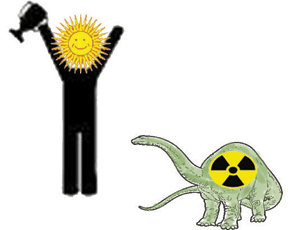
 Nuclear Power Rapidly Losing Race With Renewable Energy, http://www.ecowatch.com/nuclear-power-renewable-energy-2031607650.html, by Sun Day Campaign, Oct. 05, 2016 Two new reports from the Federal Energy Regulatory Commission (FERC) and the U.S. Energy Information Administration (EIA) confirm that nuclear power is rapidly losing the race with renewable energy sources.
In USA Over 10 GW of utility-scale solar is under construction
Over 10 GW of utility-scale solar is under construction in the United States http://www.pv-magazine.com/news/details/beitrag/over-10-gw-of-utility-scale-solar-is-under-construction-in-the-united-states_100026373/#axzz4MoKxV81R05. OCTOBER 2016 | TOP NEWS, MARKETS & TRENDS | BY: CHRISTIAN ROSELUND
Eight states have more than 400 MW-DC of projects under construction each, showing increasing market diversification. The U.S. utility-scale market has long been set for a breakout year in 2016, due to the formerly pending expiration of the U.S. Investment Tax Credit (ITC). But figures on exactly how much solar will get installed have been hard to pin down.
GTM Research has documented a boom in project starts, and according to the company’s Utility PV Market Tracker service there is currently 10.1 GW-DC of utility-scale solar PV under construction nationwide. This includes 8.6 GW of solar projects being built in the top 10 state markets – more PV than was put online in the entire year 2015 across all market segments.
Among this, the company also lists eight states where more than 400 MW-DC of solar is currently under construction. These include not only California and Texas – which each have over 1 GW under construction – but also states that a few years ago had small to non-existent markets, such as Georgia, Florida and Utah.
GTM Research notes that this has been building for some time. “States don’t go from zero to 1 GW, so a lot of the places where we’re seeing diversification, there is only a small amount being developed, but it is indicative of more to come,” GTM Research Solar Analyst Colin Smith told pv magazine.
In at least two of the top eight states – North Carolina and Utah – projects are being driven by PURPA, a 1978 law which mandates that utilities must buy electricity from independent power producers if they can match the price that the utility would otherwise pay for generation.
Rounding out the eight states with more than 400 MW under construction are Nevada and Arizona. Both of these states have seen regulatory set-backs for distributed solar in recent years, and in both utilities are instead pursuing large-scale solar.
Solar costs rocketing DOWN world-wide
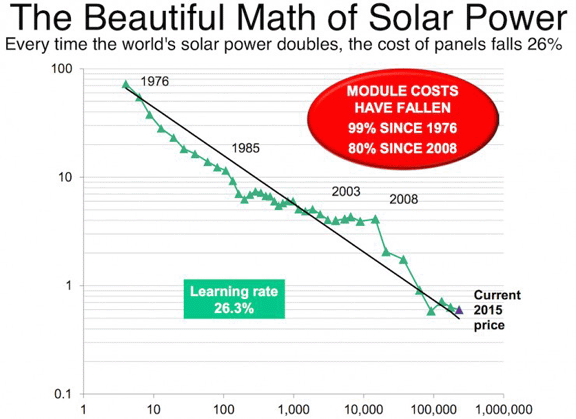
You’ll never believe how cheap new solar power is , Think Progress, Joe Romm , 8 July 16, Solar energy has grown 100-fold in this country in the past decade. Globally, solar has doubled seven times since 2000, and Dubai received a bid recently for 800 megawatts of solar at a stunning “US 2.99 cents per kilowatt hour” — unsubsidized! For context, the average residential price for electricity in the United States is 12 cents per kilowatt-hour.
Solar energy has been advancing considerably faster than anyone expected just a few years ago thanks to aggressive market-based deployment efforts around the globe. Since it’s hard to keep up with the speed-of-light changes, and this is the fuel that will power more and more of the global economy in the near future, here are all the latest charts and facts to understand it.
If you are looking for one chart to sum up the whole solar energy miracle, Bloomberg New Energy Finance (BNEF) Chairman Michael Liebreich has one from his keynote address at BNEF’s annual conference in April titled “In Search of the Miraculous”: [chart on original]
Thanks to sustained long-term deployment programs, Liebreich explained, “We’ve seen the costs come down by a factor of 150 since 1975. We’ve seen volume up by 115,000.”
“How much more miracle-y do you need your miracles to be,” Liebreich added.
What that chart doesn’t reveal is that the price drop and the sales volume increase are directly linked. There is a learning curve: Over the past four decades, for every doubling in scale of the solar industry, the price of solar modules has dropped roughly 26 percent.
BNEF has the learning curve chart in its “annual long-term view of how the world’s power markets will evolve in the future,” their New Energy Outlook(NEO) from June. In a section headlined, “Solar and Wind Prices Plummet,” BNEF says “The chart below is arguably the most important chart in energy markets. It describes a pattern so consistent, and so powerful, that industries set their clocks by it”:
BNEF projects that by 2040, the world will invest an astonishing $3.4 trillion in solar. That’s more than the projected cumulative investment of $2.1 trillion for all fossil fuels — and $1.1 trillion in new nuclear — combined. [ chart]
The result of these investments and the continued learning by solar (and wind) makes “these two technologies the cheapest ways of producing electricity in many countries during the 2020s and in most of the world in the 2030s.”……..
From 2005 through 2015, annual PV sales in this country went up 100-fold! And projections suggest that solar sales may double this year, driven by Congress’s five-year renewal (with phase-out) of the solar Investment Tax Credit (ITC).
And here is what the recent solar boom looks like world-wide — cumulative installed PV capacity and annual additions — from the recent “Renewables 2016 Global Status Report” by REN21, the Renewable Energy Policy Network for the 21st Century: [chart]……….
The ‘Other’ Form Of Solar Energy, Which Can Run At Night
Earlier this month, I wrote about the “other” form of solar, concentrating solar thermal power, which uses sunlight to heat water and uses the steam to drive a turbine and generator. That heat can be stored over 20 times more cheaply than electricity — and much more efficiently — so CSP can provide power long after the sun has gone down……… https://thinkprogress.org/youll-never-believe-how-cheap-new-solar-power-is-7c17051c1152#.ptq1vfrsm
Renewable energy racing ahead, nuclear energy falling behind
Nuclear Power Rapidly Losing Race With Renewable Energy, http://www.ecowatch.com/nuclear-power-renewable-energy-2031607650.html, by Sun Day Campaign, Oct. 05, 2016 Two new reports from the Federal Energy Regulatory Commission (FERC) and the U.S. Energy Information Administration (EIA) confirm that nuclear power is rapidly losing the race with renewable energy sources.EIA’s latest “Monthly Energy Review” notes that during the first six months of this year, renewable sources—i.e., biofuels, biomass, geothermal, hydropower, solar and wind—accounted for 5.242 quadrillion Btus (quads) of domestic energy production. This includes thermal, liquid and electrical forms of energy. By comparison, nuclear power provided only 4.188 quads. That is, renewablesoutpaced nuclear by more than 25 percent.
Meanwhile, FERC’s latest “Energy Infrastructure Update” states that the total available installed generating capacity in the U.S. from the combination of utility-scale (i.e., greater than 1-MW) hydropower, wind, solar, biomass, and geothermal has grown to 215.82 gigawatts (GW) or 18.39 percent of total generating capacity. Nuclear power’s installed capacity is only107.06 GW or 9.12 percent of the total. Thus, renewable energy generating capacity is now more than double that of nuclear.
However, actual electrical generation by nuclear plants for the first seven months of 2016 is 19.9 percent of total generation. That is still higher than that provided by renewable sources whichcontributed 15.8 percent—a figure which does not include electricity produced by distributed renewables such as rooftop solar.
But while nuclear power’s share of net electrical generation has remained essentially flat over the past decade—e.g., it was 19.4 percent in 2006, renewable energy’s share is growing rapidly, increasing from 9.5 percent 10 years ago to 15.8 percent today with EIA forecasting continuedstrong growth in the years ahead.
“If renewable sources maintain their current growth rates, they could fully eclipse nuclear in the trifecta of not only energy supply and generating capacity but also electricity production within the next five or six years … or less,” Ken Bossong, executive director of the SUN DAY Campaign, concluded.
US Dept of Energy spells out good news on wind and solar power’s phenomenal rise
DOE charts show why climate doom and gloom isn’t needed Clean tech costs have fallen 41–94% over the past 7 years. Wind and solar accounted for two-thirds of new energy installations in the US in 2015, [Excellent graphs] Guardian, Dana Nuccitelli, 3 Oct 16 , A new report from the US Department of Energy paints a bright picture for our prospects to cut carbon pollution and prevent the most dangerous levels of climate change. The report looked at recent changes in costs and deployment of five key clean energy technologies: wind, residential solar, utility-scale solar, batteries, and LED bulbs. For each technology, costs fell between 41% and 94% from 2008 to 2015
Good news for doom and gloom environmentalists Many who understand the realities and dangers of human-caused global warming are afraid that we’ll fail to avoid catastrophic climate change. Among this group, even positive climate stories are often viewed through a lens of pessimism, and we often see stories about the likelihood that we’ll miss climate targets.
However, it’s important to acknowledge the progress that’s being made, and retain a sense of hope and optimism that we can still avoid the worst climate consequences. This new DOE report highlights the fact that clean energy technology is quickly moving in the right direction, toward lower costs and higher deployment.
Wind energy is blowing away expectations
The report finds that due to its low cost, US wind energy capacity has nearly tripled since 2008. Wind now supplies nearly 5% of total US electricity generation.
As a result, there are now nearly 90,000 U.S. manufacturing, construction, and wind operations jobs. Research has resulted in bigger turbines that can generate more electricity:
a wind turbine installed today on average has 108% longer blades and is 48%taller than one installed in 1999. The longer blades allow each turbine to capture more energy, and taller towers allow access to the stronger and more consistent wind speeds that occur at higher altitudes in many parts of thecountry. Combined, these innovations allow each turbine to produce more electricity, reducing both the number of turbines needed to produce a given amount of electricity and the land area needed for their installation.
Offshore wind also presents tremendous untapped potential, with the first such project set to begin generating power off the cost of Rhode Island this month. The DOE envisions wind generating 20% of the nation’s electricity by 2030 and 35% by 2050, with costs falling a further 35% by 2050.
Solar energy’s bright future
Utility-scale solar farm costs have fallen 64% since 2008, and distributed (mostly residential) solar costs by 54%. While solar still accounts for a relatively small percentage of overall US electricity generation, its deployment has been increasing rapidly as costs have dropped. Even the military is getting on board:
For example in 2015 the Department of the Navy procured 210 MW of a utility-scale PV project to support fourteen Navy installations in California.
In 2015, the solar sector employed about 220,000 Americans. The DOE envisions that solar power could supply 27% of US electricity generation by 2050. Solar deployment is surging in 2016, with around 10 gigawatts (GW) set to be installed this year – equal to all the solar capacity installed in the US through 2014.
Solar panel leasing from companies like Solar City and Sungevity has revolutionized the distributed solar market, accounting for the majority of domestic residential system installed in leading state markets in 2015. This approach makes solar panels obtainable for households that can’t afford to purchase them. Distributed solar costs are expected to fall a further 16–33% by 2020.
Stunning drop in LED costs
The best available LED bulbs use 85% less energy than incandescent bulbs. ………
Electric cars are the future of transportation
Electric vehicle (EV) sales in the US reached 115,000 in 2015, more than double the number sold in 2012. Overall US EV sales will surpass a half-million by the end of this year. As shown by a new paper and app from MIT, EVs reduce greenhouse gas emissions 58% compared to gasoline-powered cars, and often cost less on a per-mile basis. As low-carbon energy deployment increases, EVs will only become cleaner………. https://www.theguardian.com/environment/climate-consensus-97-per-cent/2016/oct/03/doe-charts-show-why-climate-doom-and-gloom-isnt-needed
So far, in 2016, solar energy is outstripping coal power in UK
A spokeswoman for the Solar Trade Association (STA) said: “This is a valuable milestone on the road to renewables overtaking fossil fuels. It is a testament to just how effective the British solar industry has been at installing clean and reliable power and at bringing down costs.”
Solar outstrips coal in past six months of UK electricity generation
More power came from solar panels than from Britain’s ageing coal stations from April to September this year, report shows, Guardian, Adam Vaughan, 4 Oct 16, Electricity generated by solar panels on fields and homes outstripped Britain’s ageing coal power stations over the past six months in a historic first.
Climate change analysts Carbon Brief found more electricity came from the sun than coal from April to the end of September, in a report that highlighted the two technologies’ changing fortunes.
Solar had already eclipsed coal for a day in April and then for the whole month of May, with coal providing zero power for the first time in more than 100 years forseveral days in May. The latest milestone saw an estimated 6,964 gigawatt hours (GWh) generated by solar over the half-year, or 5.4% of the UK’s electricity demand. Coal produced 6,342GWh, or 4.7%.
The trend will not continue into winter because of solar’s seasonal nature, but the symbolic records reveal the dramatic impacts solar subsidies and environmental penalties for coal have wrought.
Increases in the carbon floor price last year have driven three major coal power plants – Longannet, Ferrybridge C and Rugeley – to close earlier this year. That came on top of a similar amount of coal power being closed between 2012 and 2014 because upgrading the stations to meet higher air pollution standards was deemed uneconomic……….
Solar has grown rapidly in the last six years, though figures published last week by the Office for National Statistics showed installations had crashed after the government came to power and cut the industry’s subsidies.
A spokeswoman for the Solar Trade Association (STA) said: “This is a valuable milestone on the road to renewables overtaking fossil fuels. It is a testament to just how effective the British solar industry has been at installing clean and reliable power and at bringing down costs.”
The government said last week that solar power could produce electricity more cheaply than the price agreed for a new nuclear power station at Hinkley Point, but officials suggested solar would have additional costs for the National Grid.
But a new report for the STA, published on Tuesday, concluded that integrating many more solar panels into the grid would not add excessive costs to accommodate the fact the sun doesn’t always shine and backup power is required to cover solar.
“With intermittency costs today of around £1.3/MWh for solar [with around 10-12GW of solar installed], increasing to £6.8/MWh with a substantial 40GW of solar on the system by 2030, we would suggest these costs do not provide a strong argument against the further build out of renewable generation,” said the report, by the consultancy Aurora. https://www.theguardian.com/environment/2016/oct/04/solar-outstrips-coal-in-past-six-months-of-uk-electricity-generation
South Africa’s renewable energy success: why are they even considering nuclear power build?
 Renewables Make Up 30% Of All South African Foreign Direct Investment. Why Is Nuclear Still On The Table? http://afkinsider.com/133425/renewables-make-up-30-of-all-south-african-foreign-direct-investment-nuclear-still-on-the-table/ By Dana Sanchez September 30, 2016 South Africa is delaying the procurement process for a controversial fleet of proposed nuclear power plants but the government remains committed to nuclear expansion, an official said Thursday.
This has drawn attention to South Africa’s status as a global model for renewable energy, and raises new question about why the country is pursuing nuclear when renewables look so promising.
South Africa has the fastest growing green economy in the world, according to credit rating agency Moody’s.
“South Africa was the continent’s largest renewables market in 2015 in terms of asset finance for utility-scale projects and it saw the highest year-on-year growth globally,” said Christopher Bredholt, a Moody’s vice president, in a Sept. 16 report. Asset finance is usually used by businesses to lease equipment without having to buy it outright, according to Finance & Leasing Association.
South Africa had the highest growth globally for asset finance in 2015 at 300 percent, representing $4.5 billion, according to Moody’s.
From nuclear to solar power in Sacramento County
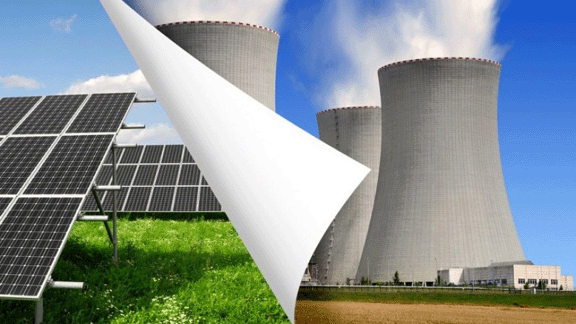 From nuclear to solar power http://www.abc10.com/news/local/from-nuclear-to-solar-power/327657069 The two cooling towers of the decommissioned Rancho Seco Nuclear Power Plant continue to stand tall across the eastern Sacramento County skyline.
A symbol of the past, the two towers got some new neighbors yesterday, that look to energize the future, and power some of Sacramento’s most iconic buildings.
With the flip of a switch, the Rancho Seco Solar plant is officially on line.
“This project will serve the two most iconic buildings in Sacramento, the new Golden One Center and the state Capitol, and it’s being done here out at Rancho Seco, one of the most iconic sites in Sacramento, so you’ve got a great juxtaposition of the old and the new here,” SMUD CEO and GM Arlen Orchard said.
The United States Nuclear Regulatory Commission decommissioned Rancho Seco in 2009. The process to remove and contain all the radiation from the site took 20 years at a cost of $500 million. In all that time, thankfully no one was injured and that the infrastructure to produce and deliver energy remained intact.
“We have all the infrastructure in place to distribute the energy down into Sacramento, so it really made sense from a space, sun, and infrastructure level,” Orchard said. Over 50 percent of the energy SMUD will create this year is carbon free. The sun shining down on this facility here will generate 11 megawatts, enough electricity to power every state building in Sacramento.
“Having a state capitol that is fully powered by clean renewable energy really fits with Governor Brown’s vision,” Brian Ferguson, California general services, said.
“The Rancho Seco project created more than 200 jobs at peak construction and will provide power not just to the Golden One Center but to all of California’s department of General Services,” Michael Argentine, Lead Project Developer, said.
The solar site around Rancho Seco is currently 62 acres with over 100,000 solar cells. SMUD hopes to double the site in the next couple years as it hopes to reach its energy production goal of 75 percent carbon free sources within the next decade.
Ukraine joining the renewable energy revolution
Solar on the steppe: Ukraine embraces renewables revolution Former Soviet nation bids for independence from Russian fossil fuels. Nature Quirin Schiermeier 28 September 2016 Wind and solar power are wallflowers in oil- and gas-rich Russia. Not so in neighbouring Ukraine. With fears about Russian hegemony at a peak, the former Soviet republic is ready to join the renewables revolution.
“Energy independence has become a matter of national security for Ukraine,” says Sergiy Savchuk, head of the state agency on energy efficiency and energy saving in Kiev. “That’s why renewable-energy development is now a priority issue for the Ukrainian government.”
In July, Ukrainian environment minister Ostap Semerak unveiled plans to build a large solar power plant and a biogas facility in the wasteland around the former Chernobyl reactor.
The announcement came just two weeks after parliament reopened the state-owned exclusion zone around the shuttered nuclear site to development for business and science.
The Chernobyl energy project will cost around US$1.1 billion, a sum that means substantial foreign investment is required. It is part of Ukraine’s broader ambition to step up renewable-energy capacity. According to the National Renewable Energy Action Plan adopted in 2014, the government aims to almost triple capacity for electricity production, transport and heating by 2020 — from its current level of around 9.3 gigawatts to more than 26 gigawatts. Renewables would then supply about 11% of all energy consumed in Ukraine……..
Ukraine has significant untapped renewable-energy potential, finds a 2015 report by the International Renewable Energy Agency (IRENA) in Abu Dhabi, United Arab Emirates — enough to support the 2014 plan. The largest country to lie entirely within Europe (Turkey and Russia are mostly in Asia), it gets more sunshine than Germany, where photo-voltaic solar power now exceeds 40 gigawatts.
Ukraine also has good grid infrastructure, including high-voltage transmission lines between Chernobyl and Kiev, says Dolf Gielen, director of IRENA’s Innovation and Technology Center in Bonn, Germany…… http://www.nature.com/news/solar-on-the-steppe-ukraine-embraces-renewables-revolution-1.20690
Nuclear power a drastically wrong answer to climate change. Solar power holds the key
 a nuclear power plant gives off twice as much energy by way of waste heat than it generates. The environment — whether the atmosphere, oceans, or rivers — would be unable to absorb that much extra heat without drastic climatic consequences
Small Sliver Of Sahara Desert Could Power Entire World With Solar Energy NYT September 24th, 2016 by Steve Hanley How big of a solar farm would you need to power the entire world with renewable energy? That’s a question addressed recently on Quora, the website that specializes in providing in depth, well researched answers to important questions. Actually, the original question was quite different. The discussion started  this way. “Could the world feasibly switch to all-nuclear power generation? If so, would that be a good counter to global warming?” For an answer, Quora turned to Mehran Moalem, PhD, a professor at UC Berkeley and expert on nuclear materials and the nuclear fuel cycle.
Professor Moalem began with this brief biographical information. “I have taught courses in nuclear engineering and a few seminar courses in alternative energies. I also worked for two years starting up six solar factories around the globe. In spite of my personal like for nuclear engineering, I have to admit it is hard to argue for it. Here is the simplified math behind it.”
Moalem then calculated that the world uses approximately 17.3 terawatts of continuous power each year. Sounds like a lot, doesn’t it? Actually it is. But, he says, a solar farm just 43,000 miles square would produce just about that amount of power. Moalem says the Sahara Desert covers 3.6 million square miles. If you’re into math, that means covering just 1.2% of the Sahara with solar power could provide the entire world with all its electrical needs.
It turns out the Sahara is also an ideal site for solar power. Because it is on the Equator, it receives 12 hours of sunlight virtually every day of the year. Also because of its location, that sunlight tends to shine directly down, meaning solar panels located there can be two to three times more efficient than those located in higher latitudes, like Europe and North America.
Moalem puts the price of such a system at $5 trillion dollars. Wow! That’s a lot of money, right? Actually, no it’s not, the professors says. Its less than the US spent to bail out banks 8 years ago. It’s about 10% of world GDP. The cost of building a nuclear power plant with a similar capacity would be more than 10 times as much.
He points out that this is a one time cost. Once such a facility gets built, the energy it produces is free. There are no ongoing costs for fuel, no generators to spin, to boilers to make steam. Moalen thinks that’s a pretty cheap price for something that could replace every other power source on earth, especially those that spew deadly pollution into the air.
Even though he is nuclear power engineer, Moalem says nuclear is not the way to meet world energy needs. One important reason is that a nuclear power plant gives off twice as much energy by way of waste heat than it generates. The environment — whether the atmosphere, oceans, or rivers — would be unable to absorb that much extra heat without drastic climatic consequences…….http://solarlove.org/sahara-desert-power-world-solar-energy/
In last 10 years wind energy growth 23 percent, solar 50 percent – World Energy Council
 Wind and solar power enjoy a decade of massive growth: World Energy Council http://www.cnbc.com/2016/09/20/wind-and-solar-power-enjoy-a-decade-of-massive-growth-world-energy-council.html Anmar Frangoul CNBC.com, 20 Sep 2016 Renewable sources of power including hydroelectric and solar represent around 30 percent of the world’s total capacity and 23 percent of total global electricity production, according to a new report from the World Energy Council (WEC).
In a news release, WEC said that in the last 10 years wind and solar power had seen “explosive average annual growth” of 23 percent and 50 percent.
The report also said that $286 billion was invested in 154 gigawatts of “new renewables capacity” in 2015, with China’s spending on renewable sources representing 36 percent of global investments.
“The success of both the development of intermittent renewables and their efficient integration in electricity systems fundamentally depends on the right market design and regulatory framework and solid regional planning to avoid bottlenecks,” Christoph Frei, secretary general of the WEC, said in a statement.
The report comes in the wake of last year’s historic COP21 agreement in Paris. There, global leaders agreed to make sure global warming stayed below 2 degrees Celsius and to also pursue efforts to limit the temperature rise to 1.5 degrees Celsius.
“We are beyond the tipping point of grand energy transition,” Frei added. “Implementing technically and economically sound, stable policies supported by clear carbon price signals will enable this transition and take us a step closer to meeting the climate aspirations agreed at COP21.”
The report, Variable Renewables Integration in Electricity Systems 2016 – How to get it right, was launched on September 20 and published by the WEC in partnership with CESI S.p.A.
The WEC said that it drew upon 32 country case studies, representing roughly 90 percent of global installed solar and wind capacity.
Amazing growth in wind and solar power in USA, and even more to come
 Wind and solar get cheaper and better, Energy Transition, 14 Sep 2016 by Ben Paulos Wind and solar power have reached a tipping point in the US, as their prices become competitive with conventional electricity sources. Ben Paulos looks at the leaps and bounds in solar and wind, and what this means for the US energy transition.
In the cornfields of Iowa, thousands of wind turbines are spinning, supplying over 30 percent of the state’s power—the highest percentage of any US state. On especially windy days in the spring, there may be enough wind power to run the whole state.
The state’s largest utility, MidAmerican Energy—partly owned by billionaire investor Warren Buffett—aims to provide 100 per cent renewable energy. And with their plan to add another 2000 MW recently approved, they’ll be getting 85 percent of their power from renewables, mostly wind.
While that number is impressive, even more impressive is the fact that MidAmerican won’t have to raise rates to do it. Thanks to the steady decline in prices and improvement in performance, wind energy is now the cheapest source of new electricity in some parts of the US.
Solar prices, too, are falling rapidly. California is the national leader by far, in both distributed and utility-scale systems. The state is now home to 14,000 MW of solar, including over 4000 MW installed on over 400,000 rooftops. Utilities are signing contracts for solar power for as low as 3 cents per kWh.
Reports released in August by the Lawrence Berkeley Lab, as well as other industry data, are showing that wind and solar prices and performance have reached a tipping point, putting renewable energy squarely in the mainstream.
Wind
What has changed? What is driving the growth of wind and solar power? While the price of wind turbines is certainly important to the cost of wind energy, the biggest price reductions in recent years have come from improved performance……..
Solar
Solar power has its own cost drivers, but it is similar to wind in one respect: the cost of the solar panels themselves is no longer the most important aspect.
Because panel prices have fallen so low—only 80 cents per watt—they now make up only one-fifth of the total cost of a residential rooftop system. Some of the costs are in the other hardware, like racks and electronics. But especially expensive are the “soft costs”—all of the other things needed to get those panels on your roof, like marketing, acquiring customers, and getting permits………
Utility-scale solar plants are increasingly using tracking systems that follow the sun across the sky, thus increasing output. Power contracts signed for new systems in 2015 were at or below $ 50 per MWh, with some as low as about $ 30 per MWh.
Overall, the US has 29.3 GW of solar installed, according to GTM Research. Utility-scale solar has been the fastest growing segment for the past few years, accounting for over half of the 7.5 GW installed in 2015.
California continues to dominate the market, with about half of all solar as of the end of 2015. But that share has been falling as other states grow.
Some US neighborhoods are seeing very high levels of saturation. In San Diego County, one in eight single family homes has solar, with some zip codes boasting double that rate. Hawaii, with very high electricity prices and excellent sunshine, has more solar power per capita than any state. In 2014, 6 percent of the state’s power came from the sun, and 17 percent of homes sported solar panels.
While this growth has been impressive, all signs point to even greater growth in coming years. At the end of 2015, there were at least 56.8 GW of utility-scale solar plants waiting to be interconnected across the nation, enough to triple current levels. And wind is expected to see at least 8 GW of growth per year: in the Midwest alone, there are 29 GW of wind projects waiting to be connected. We can expect to see even better, cheaper wind and solar soon.
Bentham Paulos is an energy consultant and writer based in California. http://energytransition.de/2016/09/wind-and-solar-get-cheaper-and-better/
Ambitious solar power plan for 12,000 homes in Saskatchewan
 SaskPower says solar plan to power up to 12,000 homes by 2021
Crown says between 10,000-12,000 Sask. homes will run on solar power within 5 years CBC News 22, 2016 SaskPower says between 10,000-12,000 homes in Saskatchewan will be run on solar power by 2021, from a project aiming to deliver 60 megawatts. Some of that electricity should be reaching the grid by 2018.
The government’s target is to have 50 per cent of its power delivered by renewable sources by 2030.
- Saskatchewan aims to get half its power from renewable energy by 2030
- SaskPower to use wind, solar, geothermal to hit 50% renewable mark by 2030
“So if we think about it, 2000 megawatts would be about fifty per cent of our mix today,” said Guy Bruce, SaskPower’s Vice President of Planning, Environment and Sustainable development. “So it’s a relatively small percentage, but it’s a move in the right direction.”
Three types of solar power providers
The 60-megawatt plan is divided into three types of providers. Twenty megawatts are expected to be provided by community projects, and another 20 from a competitive bidding process with vendors due to begin in September. SaskPower says it’s currently in negotiations with the First Nations Power Authority to provide two more 10-megawatt solar projects. ………http://www.cbc.ca/news/canada/saskatchewan/saskpower-solar-plan-2021-1.3774119
Cheap, Portable Solar Panel could transform the solar power industry
 This Cheap, Portable Solar Panel Will Be the iPad of Renewables by Good News Network – Sep 24, 2016 A California-based startup unveiled a product this week that aims to disrupt solar power production, much like the iPhone changed communications.
SunCulture Solar Inc. is calling its wire-free SolPad, which resembles a large iPad, the “world’s first integrated solar energy solution.”
It combines batteries, software, inverters and solar panels into one device. Typically, a solar system involves installation of separate parts, increasing costs. SolPad can be used off grid or tied to the grid, and uses batteries that the company says are safer than traditional lithium-ion ones.
”If the grid goes down, SolPad can keep delivering electricity,” the company said in a video unveiling the device in California this week.
“We’ve transformed solar — much like the smartphone revolutionized the personal computer sector, combining numerous components into a single device that’s significantly less expensive, more powerful and easier to use than conventional systems,” said CEO Christopher Estes.
The company plans to bring the product to market in the second half of next year……..http://www.goodnewsnetwork.org/cheap-portable-solar-device-will-ipad-renewables/
Wind energy getting popular with USA Republicans
Why Republicans support wind energy Tom Kiernan, Roberta Combs, Michele Combs, Desmoines Register September 20, 2016 Did you know that American wind turbines can now produce as much electricity as 17 typical nuclear power plants or 65 coal plants? That’s how much wind power has grown across the U.S.
A cleaner energy economy built by growing wind energy benefits both our economy and our health.
Wind energy greatly reduces a variety of health-harming air pollutants, including smog-causing sulfur dioxide and nitrogen oxides. Cutting these helps reduce asthma rates and other respiratory illnesses, creating $7.3 billion in avoided health costs last year alone.
Conventional wisdom says Democrats are typically consistent supporters of clean energy, while Republicans aren’t. That notion actually doesn’t match up with reality.
Sen. Chuck Grassley has shown visionary leadership in creating and advocating for the Production Tax Credit, a fundamental part of why we have a modern U.S. wind industry today. This performance-based tax incentive is a big reason why Iowa already generates nearly a third of its electricity using wind, with the 40 percent milestone looming in the near-future. It’s also why wind power’s technology has advanced enough to drop costs by two-thirds over just six years, saving American consumers billions of dollars.
It’s also not widely known that wind power supports well-paying jobs and invests in 75 percent of all Republican districts in the U.S.
Republican-represented districts host 86 percent of the total wind farm fleet in America. That means the majority of wind’s economic benefits — including jobs, billions of dollars in private investment, and added tax revenue for improving local infrastructure — go to rural communities with a strong presence of typically Republican voters……..http://www.desmoinesregister.com/story/opinion/columnists/iowa-view/2016/09/20/why-republicans-support-wind-energy/90743862/
Why renewable energy is a better deal for Britain than Hinkley nuclear power
Nuclear power is risky and expensive; here’s a better idea https://www.theguardian.com/uk-news/2016/sep/15/nuclear-power-is-risky-and-expensive-heres-a-better-idea
It makes more sense to invest in renewables, efficiency and storage than spending billions on Hinkley Point C, Guardian, Damian Carrington, 15 Sept 16, In the 21st century, the UK will have to supply itself with power that is affordable, reliable and clean. But in almost every way, the proposed Hinkley Point C nuclear power station offers only expensive and risky solutions from the 20th century.
A nuclear power station is about as useful in solving the dilemma as a 20th-century nuclear weapon is in ending a 21st-century guerilla insurgency, because a ground-level energy revolution is taking place. The old regime of large, centralised power plants is being replaced a smart, efficient and widely distributed network, powered by increasing amounts of renewable energy.
If that sounds radical, it’s not – it’s just how the internet works to provide fast and reliable communications. If it sounds like a hippy dream, it’s not – New York State’s energy plan has embraced it in order to deliver 50% renewable electricity by 2030 and a 23% cut in energy use by buildings. In the UK, this government aims to improve the energy efficiency of just half the homes retrofitted by the last one.
If you think New York State is alone in its thinking – it’s not. Bodies including the government’s own National Infrastructure Commission(NIC), the National Grid and industry group Energy UK all point to a smart system that is more secure, cheaper and faster to build and they all use the same word: “revolution”, while the International Energy Agency talks of a rapid “transition”.
The momentum behind the revolution is straightforward: cost. While renewable energy and other energy technologies are plummeting in price, nuclear power continues its historical trend of getting ever more expensive. Even if the UK negotiates a sharp cut in the subsidies for Hinkley, it still could not be built before 2026 at the earliest. By then, a capacity crunch will have hit the UK as old power stations close.
Hinkley puts a lot of generation capacity in one plan , which is very risky given the financial, legal and technical obstacles it faces. EDF, the French company leading the project, is taking on considerable financial risk, with Martin Young, an energy analyst at investment bank RBC Capital Markets, saying the project “verges on insanity”.
Court challenges – including from EDF’s own trade unions – abound and the fiendishly complex project has been described by one nuclear engineer as unconstructable. Two attempts to build the same reactor in France and Finland are miles over budget and behind schedule.
In contrast, energy efficiency could deliver six Hinkleys’ worth of electricity by 2030, according to the government’s own research. Four Hinkleys’ worth could be saved by increasing the ability to store electricity and making the grid smarter, with the latter alone likely to save billpayers £8bn a year.
Capturing and storing carbon from fossil fuel plants is also vital, but has received scant attention from the government compared with Hinkley. It would halve the cost of beating global warming, according to government’s own official advisers, but in November ministers abruptly canned its plan. The government will not be able to get out of the Hinkley deal, however. Once signed, the deal with EDF contains a “poison pill” which could leave taxpayers with a £22bn bill if a future UK government shuts down the plant.
The government has remained adamant that Hinkley, which could provide 7% of the UK’s electricity, is a vital part of a secure low-carbon future. But it is not just the idea of EDF’s partner, a Chinese state company, being involved that creates security fears. Nuclear power plants are prone to shutdowns, over safety concerns or even invasions of jellyfish into cooling waters as happened at Torness, in Scotland in 2011.
Closing down such a giant plant at short notice immediately puts the security of the nation’s electricity supply at risk. One back-up option recently favoured by the government is to deploy farms of diesel generators, which emit large volumes of carbon dioxide, ready to start up when needed.
Yet in a smart, distributed system, knocking out one wind turbine or solar panel is barely noticed by the grid.
The risk with Hinkley is that will it bring about the mutually assured destruction of both EDF and UK energy policy, with an expensive, hard-to-build reactor, in which the taxpayer will end up footing the bill.
1 This Month

of the week – Shut Down Drone Warfare!


Tell the Ukrainian Government to Drop Prosecution of Peace Activist Yurii Sheliazhenko

Petition to revoke the licensing of the Near Surface Nuclear Disposal Facility (NSDF) at Chalk River. https://www.ourcommons.ca/petitions/en/Petition/Details?Petition=e-7247
To see nuclear-related stories in greater depth and intensity – go to https://nuclearinformation.wordpress.com
-
Archives
- April 2026 (79)
- March 2026 (251)
- February 2026 (268)
- January 2026 (308)
- December 2025 (358)
- November 2025 (359)
- October 2025 (376)
- September 2025 (257)
- August 2025 (319)
- July 2025 (230)
- June 2025 (348)
- May 2025 (261)
-
Categories
- 1
- 1 NUCLEAR ISSUES
- business and costs
- climate change
- culture and arts
- ENERGY
- environment
- health
- history
- indigenous issues
- Legal
- marketing of nuclear
- media
- opposition to nuclear
- PERSONAL STORIES
- politics
- politics international
- Religion and ethics
- safety
- secrets,lies and civil liberties
- spinbuster
- technology
- Uranium
- wastes
- weapons and war
- Women
- 2 WORLD
- ACTION
- AFRICA
- Atrocities
- AUSTRALIA
- Christina's notes
- Christina's themes
- culture and arts
- Events
- Fuk 2022
- Fuk 2023
- Fukushima 2017
- Fukushima 2018
- fukushima 2019
- Fukushima 2020
- Fukushima 2021
- general
- global warming
- Humour (God we need it)
- Nuclear
- RARE EARTHS
- Reference
- resources – print
- Resources -audiovicual
- Weekly Newsletter
- World
- World Nuclear
- YouTube
-
RSS
Entries RSS
Comments RSS
 nuclear-news