Florida’s Amendment 1 would have undermined rooftop solar, but voters were not fooled
 Florida’s Amendment 1 defeat shows why solar won’t be stopped, Trump or no Trump, http://www.utilitydive.com/news/floridas-amendment-1-defeat-shows-why-solar-wont-be-stopped-trump-or-no/430373/14 Nov 16, David Pomerantz, executive director of the Energy and Policy Institute, wants utilities to ‘co-thrive’ with DERs.
Americans who are concerned about climate change are shell-shocked over the election of Donald Trump, who has claimed climate change was a hoax created by China and promised to end federal support for clean energy, neuter the EPA, and kill the Paris agreement.
If Trump follows through on these threats, it will cause irreversible damage. But an election result buried by the chaos of Tuesday night offers a thin silver lining to the dark clouds gathering on the climate horizon: the surprise defeat of a deceptive ballot initiative in Florida called “Amendment 1.”
Amendment 1’s defeat offers a road map for how to keep the clean energy economy growing under a Trump presidency: turn to the states. During the George W. Bush years, wind and solar power grew rapidly, despite federal hostility, thanks to supportive policies in both red and blue states. That’s not surprising, as Americans across the political spectrum, then and now, overwhelmingly support clean energy. A President Trump can’t block that progress, but another obstacle can: electric utilities.
Utilities profit when they build more power plants and transmission lines, which they can only do if people buy more electricity. Distributed solar threatens that outdated business model by offering people the choice of making their own power, so utilities have waged war on rooftop solar, and Amendment 1 revealed their battle plan:
Instead, they advocate for “smart solar” and “solar done right” – code for large solar farms that utilities own, not customers. But it’s a ruse; Duke Energy told Florida regulators that it planned to generate a mere 2.2% of its power from solar energy in 2025, and FPL reports that it will be 1% solar in that year. Duke and FPL are instead investing heavily in gas, as are many other utilities.
Florida voters proved that they wouldn’t be fooled. The utilities’ “pro-solar” message crumbled after the Energy and Policy Institute and the Center for Media and Democracy released an audio recordingconfirming Amendment 1 was a “political jiu-jitsu” campaign designed to trick pro-solar voters. Once the truth was out, support cratered.
Second, utilities try to divide environmentalists from low-income advocates and communities of color, using front groups to argue that rooftop solar is only for the rich, who “shift the costs” to poor people. It’s more deception: a host of studies have shown that the benefits that rooftop solar customers provide to the wider grid outweigh the costs.
Low-income communities and communities of color are refusing to be pawns in the utilities’ game. Black and Latino leaders spoke out against Amendment 1, noting that they want policies that result in more solar for their communities, not less. The NAACP nationally has been a forceful advocate for rooftop solar power, and polls show that communities of color support clean energy at the highest rates of all Americans.
Last, utilities use their financial might to buy political power. In addition to the $20 million that Florida’s utilities spent backing Amendment 1, they spent another $9.3 million on campaign contributions to legislators this cycle. Utilities’ influence peddling will never go away, but the pro-solar movement is learning to counter it via grassroots organizing, as it did effectively in Florida.
If other utilities follow their Florida brethren’s game plan, they too will unite their opponents into broad movements against them, and politically sensitive regulators will take notice. FPL’s war on solar power is already having this effect. Regulators in Hawaii, rightfully skeptical of FPL’s record of blocking solar in Florida, rejected its parent company NextEra’s bid to buy Hawaii’s electric utility. In Texas, where NextEra wants to buy Oncor, regulators are expressing their own concerns.
Nevadans – many still outraged at NV Energy’s hostility toward rooftop solar in the net metering battle there – voted Tuesday to strip the utility of its monopoly status.
These results should send a loud alarm to utilities and their investors that every attack they launch at rooftop solar will boomerang to erode their customers’ trust and weaken their standing with regulators.
There is only one way out of the jam for utilities: they have to adapt their business models and find ways to co-thrive with distributed resources. Some are trying to do that, albeit at the behest of regulators, but most seem intent on wasting time fighting a war they are destined to lose. Customers are demanding solar, the market forces behind solar cannot be stopped, and a Trump presidency will not change those facts.
Decentralized renewable energy – this is the future
 “……….Let me develop the real reasons why conventional renewables are likely to emerge as the dominant primary energy sources in the first half of the
21st century. The fundamental advantages of renewables, as revealed by practical experience in China as well as in industrialised countries like Germany where an energy transformation is well under way, are these.As they scale renewable energies do not present greater and greater hazards. Instead they are relatively benign technologies, without serious riskThey are clean (low to zero-carbon); they are non-polluting (important in China and India with their high levels of particulate pollution derived from coal); they tap into inexhaustibleenergy sources; and they have close-to-zero running costs since they do not need fuel. They are also diffuse, which should be viewed as an advantage, since this means that renewable sources are decentralised, and can be harvested by both large and by small operations. So they are eminently practicable.
Some advantages of renewables are not at all obvious and need to be made explicit. Fundamentally, they are scalable. They can be built in modular fashion – one solar panel, 100 solar panels, 1000 solar panels. As they are replicated in this fashion so their power ratings continue to rise, without complexity cutting back on efficiency. This cannot be said of nuclear reactors, which have an optimal operational size – below which or above which the plant under-performs.
Moreover as they scale they do not present greater and greater hazards. Instead they are relatively benign technologies, without serious risks.

When they use hazardous materials, such as the cadmium in Cd-Te solar, the solution would be to recycle materials in order to minimise the use and waste of virgin materials.
Most importantly, the superiority of conventional renewables lies in their cost reduction trends which are linked to the fact that they are always the products of manufacturing – and mass production manufacturing, where economies of scale really play a role. This means that they offer genuine energy security in so far as manufacturing can in principle be conducted anywhere. There are no geopolitical pressures stemming from accidents of chance where one country has deposits of a fossil fuel but another does not. Manufactured devices promise an end to the era in which energy security remains closely tied to geopolitics and the projection of armed force. As Hao Tan and I put it in our article published in Nature, manufacturing renewables provides the key to energy security.
Manufacturing is characterised by improving efficiencies as experience is accumulated – with consequent cost reductions captured in the learning or experience curve. Manufacturing generates increasing returns; it can be a source of rising incomes and wealth without imposing further stresses on the earth. Add to these advantages that renewables promise economic advantages of the first importance: they offer rural employment as well as urban employment in manufacturing industry; they offer an innovative and competitive energy sector; and they offer export platforms for the future.
The real driver of the renewable energy revolution is not government policy, or business risk-taking, or consumer demand. It is, quite simply, the reduction of costs
This is to list the advantages of renewables without even mentioning their low and diminishing carbon emissions. Indeed they offer the only real long-term solution to the problem of cleaning up energy systems.
With all these advantages, it is little wonder that China and now India are throwing so much effort into building renewable energy systems at scale. These are not exercises undertaken for ethical or aesthetic purposes, but as national development strategies of the highest priority.
So the real driver of the renewable energy revolution is not government policy, or business risk-taking, or consumer demand. It is, quite simply, the reduction of costs – to the point where renewables are bringing down costs of generating power to be comparable with the use of traditional fossil fuels, and with the promise of reducing these costs further still. Supergrids are also being promoted for renewables, but these are very different conceptions, based on integrating numerous fluctuating sources in IT-empowered grids, offering the same practicable, scalable and replicable energy future.
Against these advantages, the obstacles regularly cited are small indeed. There is the fluctuating nature of renewables, which can be addressed by various forms of systems integration (smart grids, demand response) and of course through energy storage, which is moving into the same kind of cost reduction learning curve that has characterised solar and wind power, promising rapid diffusion of both commercial and domestic energy storage units. With rapidly falling costs of storage providing the buffer that can even out fluctuating levels of generation, there is no further serious argument against renewables……..
by John Mathews
This article is based on a scientific paper by John A. Mathews, Competing principles driving energy futures: Fossil fuel decarbonization vs. manufacturing learning curves, which was published in Futures in November 2016 (.http://www.sciencedirect.com/science/article/pii/S0016328715300227)
John Mathews is author of the Greening of Capitalism: How Asia is Driving the Next Great Transformation”, published by Stanford University Press: http://www.sup.org/books/title/?id=24288. His latest book, “China’s Renewable Energy Revolution” (co-authored with Hao Tan) was published by Palgrave Pivot in September 2015: http://www.palgrave.com/page/detail/chinas-energy-revolution-john-a-mathews/?isb=9781137546241.
See his author’s archive on Energy Post.
South Africa’s renewable energy is making nuclear power look obsolete
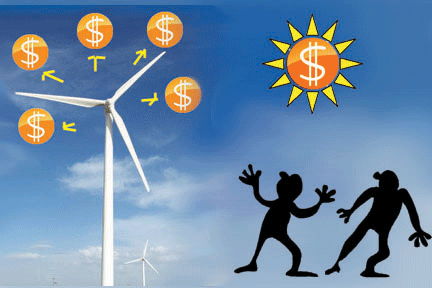
 Solar And Wind Versus Nuclear: Is Baseload Power Obsolete? Planet Save November 20th, 2016 by Stephen Hanley. The future of electrical energy is playing out in South Africa, where 80% of all electricity is generated by burning coal. The government is anxious to shutter all those coal fired plants but is caught in a crossfire between advocates for nuclear power and those who favor renewable solutions like solar and wind energy.
Renewable Strategy Successful
“The program has been very successful, clear of any corruption and very well run,” said Wikus van Niekerk, the director of the Center for Renewable and Sustainable Energy Studies at Stellenbosch University. “It’s been seen by many people in the rest of the world as one of the most successful procurement programs for renewable energy. It’s something that the South African government and public should be proud about.”
Several of those projects are concentrated solar facilities located near Upington in the central part of the country. That area has some of the most abundant daily sunshine of any place on earth. But those facilities use technology that is now almost obsolete. They use mirrors to concentrate sunlight to boil water to make steam.
After the sun goes down, they can continue to make electricity from the steam on hand for a few hours. After that, they have to wait for the sun to reappear the next day. Newer concentrated solar plants use the sun’s rays to heat molten salt, which can be kept in storage for up to 10 hours after the sun sets and used to keep the steam turbines spinning. Researchers in Spain say using molten silicon can store up to ten times as much energy as molten salt……….
Is Baseload Power An Outmoded Concept?
“The concept of baseload is actually an outdated concept,” said Harald Winkler, the director of the Energy Research Center at the University of Cape Town. “Eskom was built around big coal and to a lesser extent big nuclear — big chunks of base load power. It’s really myopic in terms of where the future of the grid is going to go. We’re going to see in South Africa and the rest of the world much more decentralized grids.”
Distributed Vs. Centralized Power
Ahhh, there is in a nutshell. The same fears that drive established utility companies in the United States. Europe, and Australia apply in South Africa. Utility companies think in terms of centralized grids. Renewables coupled with efficient, cost effective energy storage make grids virtually obsolete. Utility companies are petrified they may become irrelevant and the trillions of dollars invested in building grids throughout the world will stop producing income.
Businesses in South African cities are increasingly installing solar panels and going off the grid. Elsewhere in Africa, it is now common to see villagers connecting cellphones to single solar panels outside mud brick homes.
Opposition to South Africa’s nuclear plans is also coming from the government’s main research agency, the Council for Scientific and Industrial Research. It says an expansion of solar and wind energy, in addition to natural gas, could meet South Africa’s future energy needs for less money. “No new coal, no new nuclear,” said Tobias BischofNiemz, who leads the
council’s research on energy. “South Africa is in a very fortunate situation where we can decarbonize our energy system at negative cost.”……..
Nuclear power relies completely on a centralized grid. Building grid infrastructure — transmission lines and substations — costs as much or more as a building generating facilities themselves. That’s why localized renewable power provides the most amount of electricity per dollar invested. http://planetsave.com/2016/11/20/solar-wind-versus-nuclear-baseload-obsolete/
Texas city Georgetown joins Vermont city Burlington in going for 100% renewable energy
 Texas City Moves To 100 Percent Renewable Energy Spurred By Federal Plan That New Administration Is Expected To Spurn, Fronteras, By Lorne Matalon November 17, 2016 GEORGETOWN, Texas — Donald Trump’s victory and the impending Republican majority in Congress means the Obama administration’s initiative to cut greenhouse gas emissions, the Clean Power Plan, is almost certainly in jeopardy.
The plan is currently before a federal appeals court, under challenge by 24 states. But the new administration is expected to spike the plan before the court rules.
One conservative Texas city has decided to do what the plan was meant to help promote. It’s going 100 percent renewable, wind and solar, in a state largely defined by oil and gas.
There are environmental benefits to the switch, but the decision is all about the money.
In the central Texas city of Georgetown, the droning sound of natural gas powered industrial air conditioning represents unpredictability. Natural gas prices are low now, but historically that market fluctuates.
This city of 55,000 is on the cusp of joining Burlington, Vermont, population 42,000, as the country’s only sizable cities buying 100 percent power from renewable energy. Liberal Burlington is a far cry ideologically from fiercely conservative Georgetown. But they’re fellow travelers in energy.
“So we begin the conversations of what the future might look like,” said Georgetown’s utility chief Jim Briggs.
The city had been buying power from a utility that was expanding its coal-fired power plants. But when the Obama administration began pushing back against new coal plants, Briggs decided to go all green. And it had nothing to do with the environment.
“It was regulation and legislation coming out of Washington,” he said. Then there was the money. “We wanted the least risk, most cost effective option we could get for the community.”
In Texas, the country’s leading wind generation state, wind is now competitive with fossil fuels. But unlike oil and gas, costs don’t fluctuate.
Fred Beach, assistant director for energy and technology policy at University of Texas at Austin’s Energy Institute, explained the economics of renewables.
“You’re locking in that rate and ten years from now, wind and solar many be even less yet,” Beach said. “But if you’re happy with locking in today’s rate for the next 20 years with certainty, that’s an unbelievably powerful hedging opportunity.”
Now Briggs can tell customers, both businesses and residential, about that hedge, about a price that’s fixed……..
Wind is economical here because the state has invested in transmission lines to bring wind power from sparsely populated west Texas to cities like Georgetown in the center of the state.
History’s full of examples of sending resources across large distances, from Roman Empire aqueducts to the Hoover Dam. The dam sends power from Lake Mead on the Arizona-Nevada border to Los Angeles.
Texas has taken a page from that playbook, deploying $7 billion of taxpayer money on those transmission lines.
“We’ve done this kind off stuff in the past but now it’s like, oh well, you’re doing that for environmental reasons, you’re doing it for tree-hugger reasons,” Beach said. But now there’s a strong economic rationale. “It’s not going to cost more tomorrow, or five years or 10 years from now, we’ll lock it for 20 years.”
The city will be powered exclusively by wind and/or solar in 2017 said Chris Foster, Georgetown’s Manager of Resource Planning and Integration.
“As you add more renewables to the grid, eventually those renewable plants get paid off. And once they’re done being paid off, they have an operating margin of almost zero,” Foster said. “So if you can own these assets super longterm, you see the cost of power should be continuing to decline.” http://www.fronterasdesk.org/content/10488/texas-city-moves-100-percent-renewable-energy-spurred-federal-plan-new-administration
Just like any other house – but it’s got a SOLAR ROOF
No One Saw Tesla’s Solar Roof Coming Elon Musk just showed us the grand unification of Tesla: Fast cars, big batteries, and a stunning solar rooftop. Bloomberg, Tom Randall October 31, 2016 “…….. This is the future of solar, Musk proclaimed. “You’ll want to call your neighbors over and say ‘check out the sweet roof.’ It’s not a phrase you hear often.”
The roof tiles are actually made of textured glass. From most viewing angles, they look just like ordinary shingles, but they allow light to pass through from above onto a standard flat solar cell. The plan is for Panasonic to produce the solar cells and for Tesla to put together the glass tiles and everything that goes along with them. That’s all predicated on shareholders approving the $2.2 billion acquisition of SolarCity, the biggest U.S. rooftop installer, on Nov. 17.

Tesla says the tempered glass is “tough as steel,” and can weather a lifetime of abuse from the elements. It can also be fitted with heating elements to melt snow in colder climates. “It’s never going to wear out,” Musk said, “It’s made of quartz. It has a quasi-infinite lifetime.”
In a Q&A with reporters after the presentation, Musk said the tiles are comparable to competing high-efficiency solar panels. The current prototypes that Tesla engineers are working with reduce the efficiency of the underlying solar cell by just 2 percent. With further refinement, Musk said he hopes the microscopic louvers responsible for making the tiles appear opaque can be used to actually boost the efficiency of standard photovoltaic cells.
Putting the pieces together
The vision presented at Universal Studios in Los Angeles is the grand unification of Musk’s clean-energy ambitions. The audience was able to step into a future powered entirely by Tesla: a house topped with sculpted Tuscan solar tiles, where night-time electricity is stored in two sleek wall-hung Powerwall batteries, and where a Model 3 prototype electric car sits parked out front within reach of the home’s car charger.
Attracting less attention on Wisteria Lane was Tesla’s Powerwall 2, a major upgrade of its home battery for electricity storage. …Version 2 is a much different product. It packs more than twice the capacity—14 kilowatt hours versus 6.4 kilowatt hours—for a cheaper price after installation. 1 It includes a built-in Tesla-brand inverter and comes with a ten year, infinite-cycle warranty. ……https://www.bloomberg.com/news/articles/2016-10-31/no-one-saw-tesla-s-solar-roof-coming?cmpid=google
Strong case for solar power in Taiwan
20GW by 2025: Behind Taiwan’s big solar numbers, PV Tech Nov 02, 2016 By Tom Kenning Nuclear reactors approaching end-of-life, a sound PV manufacturing industry and a robust legal system all make a strong case for solar PV to muscle into Taiwan’s energy mix. A new government set the tone for renewables integration by setting a target of 20GW solar by 2025 last year, but this is one of the most densely populated countries on earth, with two thirds of the island covered in steep mountainous forest and national parks; where the city ends the mountains begin. Moreover, a list of unique geographical and cultural challenges to PV development is topped off by the looming threat of some of the most gruelling typhoons in all Asia.
The capital city Taipei, to the north of the island, where population is most concentrated, also happens to have the poorest irradiation. Meanwhile, if solar deployment is concentrated in the more favourable conditions of the south, transmission infrastructure is limited. An island population of more than 23 million needs a solid agricultural industry, so the government has had to focus on releasing uncultivable land for solar, which is again in short supply. Even floating solar is being promoted in an attempt to alleviate these land constrictions. However, with many more hurdles for solar developers ahead, the proximity of Japan and the fallout over Fukushima means the appetite for nuclear has been quashed. New forms of energy are the priority.
As the Taiwan government prepares to finalise details of how its target will be met, PV Tech examines some of the huge numbers being proposed and what it will take to realise them. The government has shown clear support for its clean energy transition with Chen Chien-Jen, vice president of the Republic of China (Taiwan), speaking at the opening ceremony of the PV Tawain exhibition in Taipei this year. He cited the need for more energy independence while reiterating plans to phase out nuclear by 2025 through focusing on solar and off-shore wind.
He said: “Taiwan has great resources and is in a good positon to develop PV and green energy.”
According to the green energy policy released in 2015 by the Bureau of Energy, Ministry of Economic Affairs, the plan is to have 20% of Taiwan’s energy mix coming from renewables by 2025. With all the island’s constraints, it would make sense to concentrate on the highest efficiency solar modules to make the most of every hectare of land used. As it happens, Taiwanese cell manufacturers have tended to produce some of the highest efficiency cells across the globe. It has roughly 2GW annual capacity of the higher efficiency cells, which would translate into the 2GW per year necessary over ten years to reach the domestic 20GW target.
It is no wonder then that Taiwan’s new feed-in tariff (FiT) is bias towards higher efficiency solar modules by offering a higher reward.
It may also be the reason that several Taiwanese cell manufacturers including Neo Solar Power (NSP) and AU Optronics have started to focus on vertical integration, as discussed by Solar Intelligence’s Finlay Colville in his two-part blog on upstream trends from PV Taiwan. For example, Alex Wen, senior vice president, NSP, tells PV Tech that with cell prices dropping as much as 33% in a period of just three months, the firm is increasing its module manufacturing as well as investing in solar PV projects to raise cash. Proximity to the sea and floating solar opportunities are also driving innovation in modules, with NSP due to release a double-glass module that benefits from water reflection.
PV Tech has already detailed how the landscape for solar in Taiwan is changing, but having canvassed industry members at PV Taiwan, here we go into more detail:
The numbers……… http://www.pv-tech.org/features/20gw-by-2025-behind-taiwans-big-solar-numbers?utm_source=twitterfeed&utm_medium=twitter
India turning away from fossil fuels, to replace coal with Cheaper Solar Power by 2022
Renewable Energy: India to Replace Coal with Cheaper Solar Power by 2022 http://www.natureworldnews.com/articles/30601/20161024/renewable-thinking-india-replace-coal-cheaper-solar-power-2022.htm by Monica Antonio Oct 24, 2016 India is taking the lead in creating a country powered by renewable energy by replacing expensive imported coal with affordable solar power in just six years’ time. But how will they do it? According to a report from Eco Business, India is aiming to alleviate poverty by providing the entire population with cheap electricity while, at the same time, not contributing to global warming by turning its back on fossil fuels and fully embracing solar energy.
The report says the key drivers in the rising demand for energy in the future are population growth and the doubling of GDP.
Turning Its Back on Fossil Fuels As a solution to the ballooning of energy consumption, India’s government has recently updated its National Solar Mission Target. By the year 2022, the country aims to achieve 175 GW of renewable power, including 100 GW of solar power. This means that India’s capacity for renewable energy needs to be seven times bigger, from 3 GW to 20 GW per year.
However, a big feat as it may seem, this new focus on renewable energy will benefit 600 million people with electricity by 2040. Ajay Goel, president of solar and chief of new businesses at ReNew Power said,”Especially for the 400 million Indians who have no access to electricity, solar power would mean access to clean and affordable energy.”
Is a Solar-Powered India Possible?
According to Bloomberg New Energy Finance, if India manages to create photovoltaic ground-mounted systems, the country will have an energy source that’s more affordable than imported coal. By using the levelised cost of energy (LCOE), the outlet notes that in the future, solar energy will be more economic than using coal.
Apart from giving access to cheap electricity, solar energy will also provide livelihood and “generate more than 675,000 jobs in the Indian solar industry,” Goel notes.
Wind and solar power set to take over as Fort Calhoun nuclear plant closes
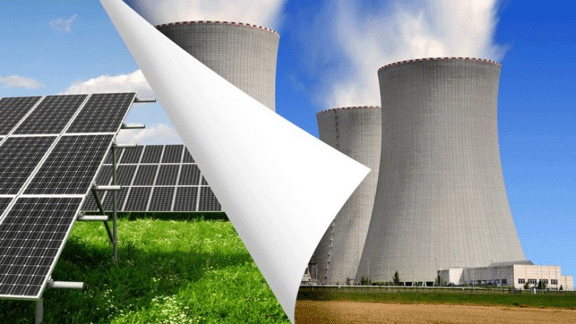 As Fort Calhoun nuclear plant closes, OPPD weighs its future in renewable energy http://www.omaha.com/money/as-fort-calhoun-nuclear-plant-closes-oppd-weighs-its-future/article_1475d290-c89c-5924-8be4-17cb76ba06a4.html By Cole Epley / World-Herald staff writer, 25 Oct 16 The winds of change are howling in the Nebraska energy industry.
Spain – the cradle of renewable energy
Costs falling fast, as wind energy booms in Europe
Europe’s offshore wind industry booming as costs fall The European Union’s push away from fossil fuels toward renewables, along with falling costs, has seen offshore wind thrive with turbines being installed from the Irish to the Baltic Seas, reports Environment 360, Guardian, Christian Schwägerl, 2q1 Oct 16 “……In Europe, offshore wind farms like the one at Burbo Bank are undergoing a boom. While still significantly outnumbered by windfarms on land, the importance of windfarms at sea has grown dramatically in the past several years. Until 2011, between 5 and 10% of newly installed wind energy capacity in Europe was offshore. Last year, almost every third new wind turbine went up offshore. That growth has helped boost the share of wind energy in the European Union’s electricity supply from 2% in the year 2000 to 12% today, according toWindEurope, a business advocacy group.
New investments for offshore projects totaled $15.5bn in the first half of 2016 alone, according to WindEurope, and newly installed offshore wind energy capacity will double to 3.7 gigawatts this year compared to 2015. More than 3,300 grid-connected turbines now exist in the North Sea, the Baltic Sea, and the Irish Sea, and 114 new wind turbines were linked to the grid in European waters in the first half of this year alone. This is in stark contrast to the US and Asia, where offshore wind use is only just getting started.
The offshore wind boom is part of a wider move from fossil fuels to renewable energy across the European Union. The overall share of renewable electricity sources in the EU – hydropower, wind, solar, biomass, and geothermal – has gone up from about 15% in 2004 to roughly 33% in 2014, according to data from Eurostat and Entso-E, the association of grid operators. Along with solar photovoltaic power, wind energy is driving this expansion. Newly installed wind energy capacity amounted to 13 gigawatts in 2015, twice as much as newly installed fossil fuel and nuclear capacity combined. WindEurope claims that all European wind turbines taken together can now generate enough electricity for87m households.
This is not only a result of government subsidies and incentives, but also of dramatically reduced production costs for wind energy. The price for a megawatt hour is now between €50 and €96 for onshore wind and €73 to €140 for offshore wind, compared to around €65 to €70 for gas and coal. Electricity generated from onshore windfarms is now the cheapest among newly installed power sources in the UK and many other countries. If environmental costs are considered, the picture looks even more favorable for wind power.
Germany now meets one-third of its electricity demand with renewable energy, Denmark 42%, and Scotland as much as 58%. On some sunny or very windy days, renewables can now fully supply the electricity demand in these countries.
The picture isn’t entirely rosy, though. The European wind industry says that grid and storage infrastructure hasn’t expanded fast enough to soak up surplus wind energy, and that the fossil fuel and nuclear industries are trying to sabotage what is called Energiewende, Germany’s transition from coal andnuclear power to renewable energy. The wind energy boom, with its recurrent surges of surplus energy, has led to a dramatic decline in electricity prices in spot market trading at the European Electricity Exchange, with the price per kilowatt hour falling by as much as 50% in the last five years. With preferential treatment from EU governments, wind energy is now outcompeting coal-fired power plants, posing major challenges for utilities heavily invested in fossil fuels.
Out in the Irish Sea, however, Dong Energy’s Sykes shows no mercy for the fossil fuel industry. “Wind power on land is becoming the cheapest form of newly installed electricity capacity,” he says. “And even out here at sea, we can’t say anymore that there are technical hurdles.”………
To long-term players in the field such as Henrik Stiesdal, a Danish wind power pioneer and former chief technology officer of Siemens Wind power, the situation is ironic: “While there were warnings in the past that wind energy would never be able to meet demands, politicians are now confronted with its abundance,” he said. Stiesdal sees storage technologies and better grid integration as opportunities, rather than problems – wind energy’s “golden bullets”.
“Once these problems are solved, wind will be able to cover the greatest part of the world’s electricity needs,” he says. The WindEurope business group says it could easily double the amount of wind electricity for EU consumption to almost 30% by the year 2030. The group argues that the recent ratification of the Paris agreement on climate change means the EU will have to pursue a more ambitious energy transition.
A visit to Dong Energy’s Burbo Bank project demonstrates the rapid progress the industry has made from its modest beginnings in the 1990s. It will take engineers and workers just a few months to assemble a facility that will provide electricity for a quarter-million households.
Like Stiesdal, Dong’s Sykes sees a bright future for offshore wind. He expects no impact from the UK’s Brexit and notes that the Burbo Bank extension is co-owned by an unlikely player in power production: the parent company of Lego, the toymaker. “Offshore is a reliable and increasingly cheap source of energy, with no lasting harm to the environment,” Sykes says. “It will soon be simply unbeatable.” https://www.theguardian.com/environment/2016/oct/20/europes-offshore-wind-industry-booming-as-costs-fall
American governments’ huge new clean energy purchase
The U.S. government just made its biggest clean energy purchase ever , WP, On Friday in Maricopa County, Ariz., the U.S. government will hit a clean energy milestone: What officials are calling the largest procurement ever of renewable energy by the federal government, in this case from a desert solar array.
The new 150-megawatt, or million-watt, Mesquite 3 solar array is located in Arizona, but the electricity it generates will be sent to California’s electric grid and will power roughly one-third of the electricity needs of 14 naval installations in the state, including San Diego’s naval base and the Marines’ Twentynine Palms and Camp Pendleton………
The move is being celebrated not only by the Navy, but also the Energy Department, which contends that the dramatic growth of large-scale solar plants in the Southwest is a direct result of major investments made by its Loan Programs Office as part of the stimulus legislation passed in the wake of the financial collapse in 2008-2009……..
The over 10 gigawatts of installed utility scale solar photovoltaic capacity in the United States today is just one part of the tremendous solar boom the country has seen. None of this takes into account more medium-sized arrays or individual rooftop solar installations. The Energy Department has also given loans for a different type of large-scale solar array, called concentrated solar power, many of which also have been built.
According to the Solar Energy Industries Association, there are 31.6 total gigawatts of solar photovoltaic capacity installed in the United States, capable of providing enough electricity for 6.2 million homes……. https://www.washingtonpost.com/news/energy-environment/wp/2016/10/14/the-u-s-government-just-made-its-biggest-clean-energy-purchase-ever-it-was-for-the-navy/?utm_term=.f407e98b78ca
Solar power in Australian desert farm – producing tons of tomatoes
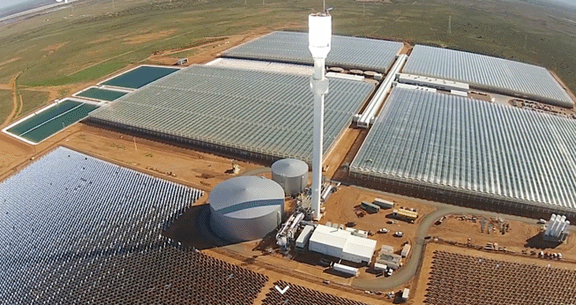
Desert farm grows 180,000 tomato plants using only sun and seawater http://www.mnn.com/your-home/organic-farming-gardening/stories/desert-farm-grows-180000-tomato-plants-using-only-sun-and-seawater
Farms that grow food in arid deserts, without groundwater or fossil fuels, could be the future of agriculture. BRYAN NELSON October 10, 2016, No soil, no pesticides, no fossil fuels, and no groundwater. And yet, a thriving farm in the heart of the arid Australian desert. How is this possible?
An international team of scientists has spent the last six years fine-tuning a system that pipes seawater in from the ocean and desalinates it using a state-of-the-art concentrated solar energy plant. The water is then used to irrigate 180,000 tomato plants grown in coconut husks instead of soil, kept in a network of greenhouses.
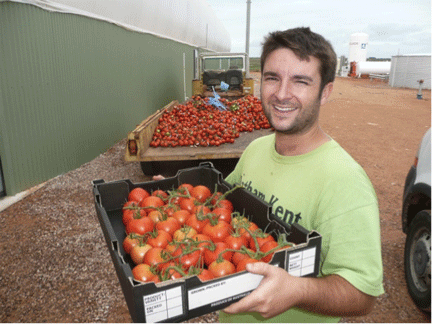 The result is Sundrop Farms, a commercial-scale facility located just off the Spencer Gulf in South Australia that began construction in 2014. Today it’s producing an estimated 17,000 tons of tomatoes per year to be sold in Australian supermarkets.
Given the increasing demand for fresh water around the world — a problem that’s particularly apparent in the sunburned landscape of South Australia — this might just represent future of large-scale farming, especially in coastal desert regions that have previously been non-arable.
The heart of the farm is the 23,000 mirrors that reflect sunlight towards a 115-meter high receiver tower. All of that concentrated sunlight produces an immense amount of power, up to 39 megawatts. That’s more than enough to cover the desalination needs of the farm and supply all the electricity needs of the greenhouses.
The seawater, too, has other purposes besides just irrigation. During scorching hot summers, seawater-soaked cardboard lines the greenhouses to help keep the plants at optimal temperature. Seawater also has the remarkable effect of sterilizing the air, meaning that chemical pesticides are unnecessary.
All in all, the facility cost around 200 million dollars to get up and running. That might sound excessive, but in the long run the facility should save money compared to the costs of conventional greenhouses that require fossil fuels for power. It’s a self-sustaining, cost-efficient design so long as the initial investment can be provided. Facilities similar to the Australian one are already being planned for Portugal and the U.S., as well as another in Australia. Desert areas like those seen in Oman, Qatar and the United Arab Emirates could be next in line.
“These closed production systems are very clever,” said Robert Park of the University of Sydney, Australia, to New Scientist. “I believe that systems using renewable energy sources will become better and better and increase in the future, contributing even more of some of our foods.”
With progressive policies, Scotland could be 50% fuelled by solar and wind, within 15 years
Half of Scotland’s energy could be produced by wind and sunlight in less than 15 years, report says http://www.independent.co.uk/environment/scotland-energy-renewables-half-by-2030-report-wind-solar-a7353831.html Analysis paints a picture of Scotland where fuel poverty is ‘eradicated’, air pollution is slashed and green electricity is a major export Ian Johnston Environment Correspondent, Monday 10 October 2016 Half of all the energy used in Scotland could be produced by renewable technology in less than 15 years, according to a new report.
It painted a picture of a country that exports vast amounts of electricity to the rest of the UK by producing 40 per cent more than it needs, where half of the buses and a third of cars are electric – improving air quality and public health – and where fuel poverty is “eradicated”.
However the report, called The Energy of Scotland, warned that while a low-carbon future was “achievable and desirable”, Scotland was currently on track to miss its climate targets, getting less than 30 per cent of energy from renewables by 2030. title=”10 October 2016 11:03 London”>Writing in the report, commissioned by the Scottish branches of WWF, Friends of the Earth and the RSPB, Lang Banks, WWF-Scotland’s director, said: “Scotland is in the enviable position of having fantastic renewable energy potential.
“Successfully unlocking this potential will not only secure our climate goals but provide the means to deliver economic opportunities across Scotland, bring social benefits and improve public health.”
However he said bringing about this future would require “significant changes to the way we heat our homes and organise our transport” and “new, bold policies”.The report, by consultants Ricardo Energy and Environment, found emissions from electricity power stations could drop to near zero with an “almost entirely renewable” supply, creating 14,000 new jobs.
“A 40 per cent drop in the use of petrol and diesel improves air quality in cities, resulting in better public health,” the report said.
“People are also fitter and healthier thanks to more walking and cycling in renewed cityscapes that are less dominated by cars.
“There is less congestion, with fewer and quieter vehicles on the road.”
Google keenly promoting wind energy in Africa
Why Google Cares about Wind Power in Africa Millions of people are coming online, and that requires (renewable) energy, Scientific American By Daniel Cusick, ClimateWire on October 12, 2016
The California internet giant has shown a growing interest in sub-Saharan Africa since it made its first cash outlay three years ago—a $12 million investment in the Jasper Solar Power Project in South Africa’s Northern Cape Province.
The 96-megawatt photovoltaic project, completed in 2014, was built by U.S.-based SolarReserve LLC and is capable of powering roughly 80,000 South African homes.
The Lake Turkana deal, whose financial terms were not disclosed, calls for Google to acquire 12.5 percent of the nearly $700 million project from Vestas Wind Systems A/S of Denmark after the wind farm is completed next year.
“We are investing in clean energy projects like Lake Turkana because they make business sense and can help accelerate the deployment of renewable energy,” a Google spokesperson said in an email to E&E News.
She added that the company sees “a large opportunity in fast-growing markets with rich renewable energy resources, where both the need and the potential are great.”
The ownership group includes lead developers Aldwych International Ltd. of Great Britain and KP&P Africa BV of the Netherlands, with additional financial support from international development funds in Norway, Finland and Denmark.
As with Jasper in South Africa, Google said its wind power investment “will help bring much needed capacity and stability to Kenya’s energy supply, reducing reliance on fossil fuels and emergency diesel generation while providing some of the most cost effective power in the country.”
In total, Google has committed more than $2.5 billion to 22 renewable energy projects around the world, mostly through power purchase agreements and direct ownership of wind and solar farms, officials said. Much of its purchased power goes to support massive Google data centers in the United States and Europe.
But the company sees a future in the developing world, where millions of new internet users are coming online annually……..https://www.scientificamerican.com/article/why-google-cares-about-wind-power-in-africa/
Solar microgrids are changing lives
 Changing lives with solar microgrids, Green Biz, Laurie Guevara-Stone Monday, October 10, 2016 Haiti is the poorest country in the western hemisphere. Only 25 percent of the 10.3 million people in the country have access to electricity. One nonprofit organization is testing a solution that could not only change the lives of the unelectrified in Haiti, but could be a model of how to bring electricity to the 1.2 billion people in the world still living in the dark.
EarthSpark International has built a 93-kilowatt solar-powered microgrid in the small town of Les Anglais (pop. 3,000 in the “downtown” area), which currently supplies clean reliable power to about 2,000 people.
Why a microgrid?
Haiti has more than 30 existing municipal microgrids, but most don’t work. Even when they do function, they run on diesel and operate just a few hours a day, a few days a week. So EarthSpark’s goal was to provide people with 24-hour clean, affordable electricity.
EarthSpark began working in Haiti providing people with small solar home systems and solar lanterns, products that are life-changing tools for people without access to grid electricity. But the organization soon realized that those aren’t the solutions to which everyone aspires. “To truly unlock economic opportunity, people need access to higher levels of electricity than what a solar home system can provide,” Allison Archambault, president of EarthSpark International, told RMI.
“With the right conditions, minigrids can provide energy services in a low-cost sweet spot between small levels of energy consumption that can be effectively served by small stand-alone solar systems and traditional grid extension,” said Eric Wanless, a principal in RMI’s international practice leading the Sustainable Energy for Economic Development initiative.
EarthSpark isn’t the only group focusing on microgrids. Husk Power has brought electricity to 200,000 people in the highly unelectrified state of Bihar in India, using rice husks to fuel microgrids; Powerhive, Devergy and PowerGen are bringing power to East Africa with solar microgrids; and Gham Power is building solar microgrids in rural Nepal.
A microgrid can give residences and businesses enough power to run motors, process agricultural products and power freezers. Plus, much of the electricity used by rural industry is seasonal, such as an agricultural mill, which is used during harvest season and on market days.
“Building an energy system just for that mill would mean an asset that is underutilized much of the time,” said Archambault. “But with a microgrid, you can use that capacity for other uses, and everyone buys down the cost for everyone else. We like to say our system is powerful enough to energize industry, and progressive enough to serve every single customer.”
Tackling technical challenges………
Overcoming logistical challenges
Working in developing countries such as Haiti brings a lot of logistical challenges as well. There is often not a clear process for implementing innovative projects…….
Confronting legal and regulatory challenges
One of the biggest challenges comes in the legal and regulatory framework in Haiti, or lack thereof. ………
Promoting economic development
Residents of Les Anglais not only have access to reliable power 24 hours a day, but are also saving money on their energy expenses. Before the microgrid, they were spending about $10 to $12 each month for kerosene and spending $3 to $4 each month to charge phones (at nearly $0.25 per charge). Now residential microgrid customers are saving 80 percent of their household energy budget, paying about $2 to $3 per month for much better quality power. And EarthSpark’s larger business customers are saving 50 percent over what they were spending on diesel.
EarthSpark’s goal is to build 80 microgrids in the next five years, bringing power to over 200,000 people, a small dent in the 7 million Haitians still living without access to electricity. But for those 200,000 people, it’s a game changer.
“We have small enterprises using electricity for the first time, people starting new businesses. The carpenter now has power tools. The hotel and the mill have been able to drastically reduce their power bills, by switching off their big diesel generators. And people come up to me and tell me their children no longer have the smoke of kerosene burn their eyes when they’re studying,” said Archambault. EarthSpark’s project in Haiti and RMI’s work in sub-Saharan Africa are delivering clean reliable electricity to people and unlocking huge opportunities for rural communities around the world. https://www.greenbiz.com/article/changing-lives-solar-microgrids
1 This Month

of the week – Shut Down Drone Warfare!


Tell the Ukrainian Government to Drop Prosecution of Peace Activist Yurii Sheliazhenko

Petition to revoke the licensing of the Near Surface Nuclear Disposal Facility (NSDF) at Chalk River. https://www.ourcommons.ca/petitions/en/Petition/Details?Petition=e-7247
To see nuclear-related stories in greater depth and intensity – go to https://nuclearinformation.wordpress.com
-
Archives
- April 2026 (77)
- March 2026 (251)
- February 2026 (268)
- January 2026 (308)
- December 2025 (358)
- November 2025 (359)
- October 2025 (376)
- September 2025 (257)
- August 2025 (319)
- July 2025 (230)
- June 2025 (348)
- May 2025 (261)
-
Categories
- 1
- 1 NUCLEAR ISSUES
- business and costs
- climate change
- culture and arts
- ENERGY
- environment
- health
- history
- indigenous issues
- Legal
- marketing of nuclear
- media
- opposition to nuclear
- PERSONAL STORIES
- politics
- politics international
- Religion and ethics
- safety
- secrets,lies and civil liberties
- spinbuster
- technology
- Uranium
- wastes
- weapons and war
- Women
- 2 WORLD
- ACTION
- AFRICA
- Atrocities
- AUSTRALIA
- Christina's notes
- Christina's themes
- culture and arts
- Events
- Fuk 2022
- Fuk 2023
- Fukushima 2017
- Fukushima 2018
- fukushima 2019
- Fukushima 2020
- Fukushima 2021
- general
- global warming
- Humour (God we need it)
- Nuclear
- RARE EARTHS
- Reference
- resources – print
- Resources -audiovicual
- Weekly Newsletter
- World
- World Nuclear
- YouTube
-
RSS
Entries RSS
Comments RSS
 nuclear-news