Tesla Flips the Switch on the Gigafactory Musk meets a deadline: Battery-cell production begins at what will soon be the world’s biggest factory—with thousands of additional jobs. Bloomberg, by Tom Randall January 5, 2017 The Gigafactory has been activated.
Tesla’s solar roofs could revolutionize the industry
Hidden in the scrubland east of Reno, Nev., where cowboys gamble and wild horses still roam—a diamond-shaped factory of outlandish proportions is emerging from the sweat and promises of Tesla CEO Elon Musk. It’s known as the Gigafactory, and today its first battery cells are rolling off production lines to power the company’s energy storage products and, before long, the Model 3 electric car. 1
The start of mass production 2 is a huge milestone in Tesla’s quest to electrify transportation, and it brings to America a manufacturing industry—battery cells—that’s long been dominated by China, Japan, and South Korea. More than 2,900 people are already working at the 4.9 million square-foot facility, 3 and more than 4,000 jobs (including temporary construction work) will be added this year through the partnership between Tesla and Panasonic. 4
By 2018, the Gigafactory, which is less than a third complete, will double the world’s production capacity for lithium-ion batteries and employ 6,500 full-time Reno-based workers, according to a new hiring forecast from Tesla. The company’s shares, having touched their highest point since August, closed up $10 at $226.99 in New York trading.
The full activation of the Gigafactory carries existential significance for Tesla, representing a new sense of urgency at a company known for its unreachable deadlines. After missing almost every aggressive product milestone it set for itself over the last decade, Tesla must prove to investors and customers that it can stay on schedule for its first mass-produced car.
There are promising signs. ………
The storage products fit into Musk’s long-term vision of transforming Tesla from an an electric car company to a clean-energy company. That’s the same motivation behind his recently concluded deal to acquire SolarCity Corp., the largest U.S. rooftop solar installer. Last week, Tesla reached a deal with Panasonic to expand its relationship to produce solar cells in Buffalo, N.Y., bringing some 1,400 jobs to the region.
At a time when President-elect Donald Trump has taken to Twitter to skewer manufacturers for moving jobs to Mexico or China, Tesla stands apart as an all-American carmaker, battery maker, and solar producer. About 95 percent of the Model 3’s components will be made in the U.S., and 25,000 of the company’s 30,000 employees are based there. Musk, who visited Trump recently in New York City, was named to a strategy group to advise the new Republican president. ……. https://www.bloomberg.com/news/articles/2017-01-04/tesla-flips-the-switch-on-the-gigafactory
China is also seeking market dominance in clean energy technology.
The nation’s ambient air pollution and its greenhouse gas emissions would both decline if China could produce more electricity using clean renewables rather than relying on coal. It has been the largest producer of solar photovoltaic cells in the world since 2007, and overtook Germany as the nation with the largest installed photovoltaic capacity in 2015.
As the price of renewable power equipment declines, the law of demand predicts that more U.S. companies will go green.
In mid-November, while Americans were preoccupied with election returns, China sent some of its clearest signals yet that it will continue to pursue an international leadership role on issues including climate.At an international climate change summit in Marrakech, the Chinese government reasserted its commitment to reduce its greenhouse gas emissions. The government announced that its aggregate emissions will peak by 2030 or earlier, and that its emissions per dollar of economic output will decline sharply.
For 25 years I have taught my economics students that climate change represents the ultimate “free rider problem.” To slow global climate change, we need to reduce aggregate global emissions.
Yet each individual nation’s efforts are too small to “solve” the problem, so it has only weak incentives to take costly mitigation actions, and strong incentives to “free ride” on the benefits of emission reductions by other countries.
Why, then, is China is pressing ahead with low-carbon initiatives?
My research suggests several motives. Chinese leaders want to improve the quality of life in their nation’s cities by reducing air pollution; win large shares of promising export markets for green technologies; and increase China’s “soft power” in international relations.
Taking aggressive action to cut carbon emissions helps China in all three areas.
Reducing Coal’s Cruel Impacts
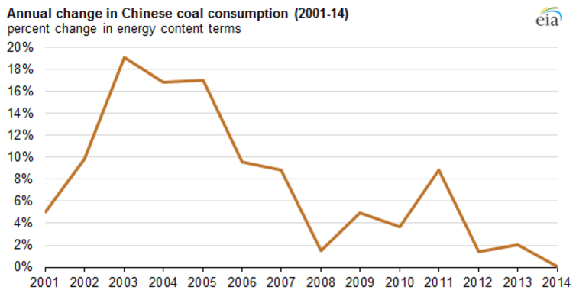
Much of the staggering rise in China’s carbon dioxide emissions in recent decades came from burning coal to produce electricity for the nation’s industrial sector. While this growth has created millions of jobs and wealth for the nation, coal-fired power plants are major sources of greenhouse gases and conventional air pollutants that affect millions of people.
Using data from around the world, economists have found that when countries develop economically they move up an “energy ladder.”
The richer a country grows, the more likely it is to swap out cheap polluting fuels in favor of cleaner, more expensive fuels. A natural experiment that occurred in Turkey as natural gas pipelines were built throughout the nation between 2001 and 2014 showed as people gained access to natural gas, air quality improved and mortality rates declined.
China has more coal than natural gas resources, but as its citizens grow wealthier, their willingness to pay to avoid pollution increases. This trend will encourage substitution toward cleaner fuels. As such, China’s political leaders will likely prioritize policies that substitute natural gas for coal, which should reduce air pollutants and greenhouse gas emissions……….
China is also seeking market dominance in clean energy technology.
The nation’s ambient air pollution and its greenhouse gas emissions would both decline if China could produce more electricity using clean renewables rather than relying on coal. It has been the largest producer of solar photovoltaic cells in the world since 2007, and overtook Germany as the nation with the largest installed photovoltaic capacity in 2015.
U.S industrial regulators have accused China of engaging in predation and dumping low-cost solar panels that compete with U.S products.
But environmentalists should cheer that potential buyers in importing nations now face lower prices — especially global companies like Wal-Mart which are pledging to shrink their carbon footprints. As the price of renewable power equipment declines, the law of demand predicts that more U.S. companies will go green.
There is a key synergy between electric vehicles and green power generation.
For decades, the world’s media have portrayed China as a bully and trade cheat abroad and a repressive power at home. In cutting carbon emissions, the Communist Party seeks to boost its own political legitimacy in the international arena as well as with the Chinese people.
By committing to pursue ambitious environmental goals, Chinese leaders hope to signal to both domestic constituents and international actors that China is an international leader and cares about its own people. A “leading nation” plays an active role in international relations, helps to keep the peace and promotes global public goods.
New Arizona Policy Would Mandate Solar After Dark, Clean Technica December 30th, 2016 by Susan KraemerA way to incentivize the use of clean energy like solar after dark — instead of gas peakers — to cover peak loads has been proposed in a white paper commissioned by Arizona’s Residential Utility Consumer Office, through a revision of state Renewable Energy Standards (RES).
Co-author Lon Huber, a Director with Strategen Consulting, was tasked with inventing a solution to the duck curve.
Huber told Utility Dive this week that his proposed Clean Peak Standard (CPS) should push developers to cover the need for generation at specific — peak — times.
“It adds more renewables, but it adds renewables when the system most needs capacity so it uses renewables to deal with system cost drivers and saves ratepayers money when electricity prices are highest.”
Under a Clean Peak Standard, during an identified peak demand period, a solar contract would have to deliver a percentage of its generation between certain — peak — hours.
A 25% CPS for example would mean that 25% of MWh generated during the identified peak demand period would have to be from “qualifying clean peak resources.” Currently, coal or gas peaker plants provide that peak generation.
So How Would Solar After Dark Work?
While so-called “spilled solar” at midday is already a concern, there are slim pickings so far in covering the evening peak with solar generation: battery storage or thermal solar.
It is in Arizona, where the largest US dispatchable solar after dark project is sited, that this proposal is being considered. Solana is a thermal solar plant with the most energy storage in the US after pumped hydro — 1,680 MWh daily.
Arizona, along with Nevada, has been at the forefront of the battles over net-metering between utilities and rooftop solar, that hinges on too much solar by day, increasing the duck curve after dark.
Just this week the Arizona Corporation Commission (ACC) approved a drastic drop in net metering rates to shadow average utility-scale solar rates. Since utility-scale solar wholesale prices are much lower than rooftop prices, due to efficiencies of scale, that is a huge blow to rooftop in the state.
The decision “balances the economic benefits of grid-scale solar — which provides clean power to all of our customers at far less cost — with the desire of some customers to install solar on their rooftops,” said Arizona Public Service (APS) in a written statement.
Peak Loads are After Dark Now
Arizona is far from the only state trying to work out an arrangement that is fair to both utilities and those who invest in their own rooftop solar. …….
A thermal solar project like Crescent Dunes in Nevada can generate solar at any time of day or night, from stored solar energy in tanks of molten salts.
This Clean Solar Peak policy valuing stored clean energy is one foreseen by Nancy LaPlaca, who was Policy Advisor to former Commissioner Paul Newman at the ACC when it approved the solar storage contract between APS and Solana in 2013.
“We are underestimating the value of storage, as well as grid security,” she said to me at the time. “If the grid goes down in Phoenix on a very hot day, we will see the value of local storage that doesn’t depend on a long transmission line.”https://cleantechnica.com/2016/12/30/new-arizona-policy-mandate-solar-dark/
US Doubles Down On Wave Energy, $40 Mil For New Test Bed, Clean Technica December 31st, 2016 by Tina CaseyIt looks like the US is about to get much, much more serious about developing its vast wave energy potential. Researchers have been working at several relatively modest sites in Hawaii and the Pacific Northwest, and now the Energy Department has announced funding for a new, $40 million utility scale test site in the waters of the continental US, off the coast of Oregon.
Why Wave Energy?
The new wave energy test site will be built and operated under the auspices of Oregon State University’s Northwest National Marine Renewable Energy Center.
In a press release announcing the plan to invest up to $40 million in the nation’s first utility scale wave energy test site, the Energy Department noted that more than half of the population of the US lives within 50 miles of a coastline.
All things being equal, coastal populations are expected to grow, but getting zero emission energy to coastal regions is becoming more complex and difficult. Aging coastal nuclear power plants will most likely not be replaced, and population density limits the potential for utility scale wind farms and solar arrays on land.
Another limitation for land-based renewable energy in coastal areas is the need for new long distance transmission lines. Plans have been in place for years to bring wind power from the wind rich midwest to points east, but the new lines have had to battle against fossil fuel interests as well as local stakeholders.
One solution is to tap the waters of the US coastlines.
That’s beginning to happen in the wind energy sector on the east coast, where the relatively shallow waters of the Continental Shelf are amenable to offshore wind turbine technology.
The nation’s first offshore wind farm just went online off the coast of Rhode Island, and the Obama Administration has mapped out an ambitious plan to harvest wind energy all along the eastern seaboard. It looks like New York State’s Long Island is next in line for development.
The west coast is a different kettle of fish. The Continental Shelf drops off quickly, and the waters are too deep for conventional offshore wind turbines to be set on the ocean floor.
As a solution, the Energy Department has been pumping some significant dollars into R&D to commercialize floating wind turbines.
With the new investment of $40 million the agency appears to be broadening its focus to accelerate wave energy development, too.
The payoff could be huge, so to speak: Recent studies estimate that America’s technically recoverable wave energy resource ranges between approximately 900–1,230 terawatt hours (TWh) per year…For context, approximately 90,000 homes can be powered by 1 TWh per year. This means that even if only a few percent of the potential is recovered, millions of homes could be powered by wave energy as the technology progresses.
The New Wave Energy Test Facility
The new facility will be called the Pacific Marine Energy Center South Energy Test Site. Along with federal dollars, unspecified non-federal funding will go into the construction………
We’ve seen a lot of commentary on the fact that utility-scale solar power has become the least expensive source of electricity in many places. There is more than that to be found in the data inLazard’s Levelized Cost of Energy Analysis, Version 10.0, however, and what it tells us is that solar and wind power have benefits apart from the simple facts that their costs are low.
We have always needed a variety of power sources. Conventional baseload power provided by coal-burning and nuclear plants lacks flexibility and is, in fact, a really bad match for grid demand. Baseload generation cannot be ramped up or down as demand changes, and this is one reason why such power plants never provided all of our electricity. There always had to be other, more flexible generating facilities available.
The greatest need for power is often on warm, sunny afternoons, when air conditioners are running in work spaces, stores, and homes, in addition to normal human activities. These have been the times when peaking plants could make their money. With high demand, come the high prices they need to be profitable.
As solar photovoltaics (PV) have come on the market in quantity, however, sunny afternoons suddenly bring the sun as a competing power source. The early evening, after the sun has gone down, is still potentially a time of high demand, when solar power does not cut into the use of fossil-fuel peaking plants. This situation, however, is clearly coming to an end.
According to Lazard, the levelized cost of utility-scale solar power with storage is $92 per megawatt-hour (MWh). This means that solar-plus-storage can be highly competitive, even after dark, with natural gas peaking plants, which have levelized costs ranging from $165 to $217 per MWh. It is even competitive to a degree with gas-powered reciprocating engines, whose costs are from $68 to $101 per MWh.
There is more to this story, however. It happens that wind power is usually strongest when the sun is not shining brightly, and solar power output is often highest when the wind does not blow much. A storage system that is charged by the sun could be charged by the wind when the sun does not shine. This means that a solar-plus-storage system can be made more valuable by storing excess power from wind as needed.
The fact that power from solar-plus-storage is becoming relatively inexpensive makes it likely that the combination will increasingly be used instead of peaking plants using fossil fuels. This will increase production of batteries, and it will increase research and development into storage technologies. And these changes imply further reductions in costs.
The declines in costs of energy storage have already been impressive. Tesla lithium-ion batteries are delivering about double the amount of electricity that they had been providing when they were first introduced, and their cost has not increased appreciably. This implies that the cost of the electricity from them has been roughly halved. Other battery technologies have alsoseenexciting developments. For example the ViZn flow battery shows a number of improvements over earlier designs at considerably lower costs. Salt water batteries, such as those from Aquion Energy, alsocome to mind. As fast as the price of electricity from solar PVs has been dropping, we should not be surprised if the costs of solar-plus-storage or wind-plus-storage drop considerably faster.
There are other advantages implicit in adding storage to the power supply. One is that the power can be ramped up or down much faster than it can be with conventional approaches to equipment. Power demands on batteries and some other storage solutions can be ramped up or down in fractions of a second.
Indeed, the storage component moves us into a situation where solar and wind, with support from other types of renewable energy, can take on larger baseload power systems. Clearly, if utility-scale solar + storage = $92/MWh, it will always be less expensive than the $97 to $136 per MWh cost of nuclear power. It is competitive with power from coal. The only fossil fuel remaining in Lazard’s analysis that is clearly less expensive than solar-plus-storage is combined cycle natural gas, with a costrange of$48 to $78 MWh, and we have no guarantees those prices will last. And remember, this is not solar power alone, but solar with energy storage.
We seem to be moving into a new age, and it is not merely an age when the sun and wind provide the least expensive power we have. It is an age when the sun and the wind may replace baseload power altogether, not only as the least expensive solution, but as the best general solution. And we might come to that faster than we dreamed possible.
Trump: “I have a problem with wind” https://blog.bulb.co.uk/trump-wind-problem/by haydenNovember 2016 In a recent interview with the New York Times, President-elect Trump claimed there are three reasons to oppose wind power. Perhaps unsurprisingly, we disagree with each of them. We thought we’d break them down and add some facts to a discussion that threatens to undermine one of the most important global efforts of our time.
Here are Trump’s three main points:
Wind turbines kill birds (even the golden eagle)
Wind turbines are bad for the atmosphere due to their steel construction
Energy from wind isn’t commercially viable
You can read the full transcript of the NYT interview here but here’s an excerpt:
TRUMP: The wind is a very deceiving thing. First of all, we don’t make the windmills in the United States. They’re made in Germany and Japan. They’re made out of massive amounts of steel, which goes into the atmosphere, whether it’s in our country or not, it goes into the atmosphere.
The windmills kill birds and the windmills need massive subsidies. In other words, we’re subsidizing wind mills all over this country. I mean, for the most part they don’t work. I don’t think they work at all without subsidy, and that bothers me, and they kill all the birds. You go to a windmill, you know in California they have the, what is it? The golden eagle? And they’re like, if you shoot a golden eagle, they go to jail for five years and yet they kill them by, they actually have to get permits that they’re only allowed to kill 30 or something in one year. The windmills are devastating to the bird population, OK.
With that being said, there’s a place for them. But they do need subsidy. So, if I talk negatively. I’ve been saying the same thing for years about you know, the wind industry. I wouldn’t want to subsidize it. Some environmentalists agree with me very much because of all of the things I just said, including the birds, and some don’t. But it’s hard to explain. I don’t care about anything having to do with anything having to do with anything other than the country.
We wouldn’t normally include such a long quote, but we thought you’d enjoy President-elect Trump’s turn of phrase in its full, unfiltered glory.
Bird protection groups are in favour of wind
To quote the Royal Society for the Protection of Birds; “the RSPB supports a significant growth in offshore and onshore wind power generation in the UK”. It couldn’t be put more succinctly than that.
Climate change is set to have a devastating impact on the environment, which is a far greater threat to birds than wind farms. Of course, governments and wind farm investors should do all they can to minimise the danger to birds. However, this is not a significant hurdle. The RSBP scrutinises hundreds of UK wind farm applications each year, and 94% of those are safe enough for the RSPB to give their blessing.
Steel, of course, takes energy to produce. However, the carbon cost of this energy is dwarfed when other factors are taken into consideration. We can do this by considering the lifecycle carbon emissions associated with each type of electricity generation. This is a common method used to compare technologies on an environmental basis and is recommended by bodies such as Defra because it considers the full impact of each technology by calculating the emissions associated with it from cradle to grave, not just the period where it’s generating electricity.
Over the course of its lifetime, a wind turbine will produce 400 times less carbon per kWh than coal. A study conducted by the Intergovernmental Panel on Climate Change (IPCC) in 2014 put the median carbon cost of onshore wind at an equivalent of 11 grammes of CO2 per kWh over its lifetime. Which is similar to nuclear, hydro, solar and a lot lower than the 820 grammes per kWh of Mr Trump’s beloved coal power.
You can read the full IPCC report here. The key figures are on the right-hand side of page seven.
Wind is commercially viable
The cost of wind per unit of electricity is already on par with the likes of new-build coal and nuclear. According to Lazard Investment Bank, coal costs $65-150 per MWh, compared to $32-77 for wind. This cost advantage already gives wind the edge over coal, before the carbon cost is even considered. It’s easy to criticise wind, claiming the supply is unreliable and dependent on the weather, but this is solved through energy storage. When Denmark was generating 140% of its energy needs through wind power, it simply exported it to be stored as potential energy in Germany and Sweden’s hydro dams.
Plus, the efficiency of wind power is improving at a rate of knots. Bloomberg New Energy Finance estimates the cost of wind will decrease by 19% for every doubling of installed capacity. By comparison, the cost reduction for existing technologies, like coal, is a fraction of a percent.
How much can Trump actually change?
Experts aren’t yet in agreement about the extent to which Trump will be able to reverse recent climate change policy. He could repeal President Obama’s executive orders, which he seems set to do. This would likely move US climate policy decisions from national decision makers to individual states. When Reagan starved the EPA of funding in the 1980s, most policies were made at the state level, rather than federal.
Perhaps the biggest concern, though, is Trump’s inconsistency. He has shown a willingness to reverse direction, which makes it difficult to know quite what’s going to happen. He has previously stated he would pull out of the Paris agreement. But in the New York Times interview above he said he would just “take a look at it.” Everyone is closely watching this space. As Trump tells us, he’s a businessman, so it’s possible he may end up seeing the benefits of new and competitive technology.
Over the past three days wind power accounted for 26 percent of total electricity consumption, almost as much as six nuclear power plants, says Anders Enqvist, Director of Risk Management at Bixia.
Sweden currently has three nuclear plants with ten nuclear reactors in commercial operation, making it the only country in the world that has more than one reactor per million inhabitants, says the Swedish Institute.
In 2015 Sweden added 200 more wind turbines. More wind blows in Sweden during the winter.
Solar leading the charge in Mexico’s clean energy push BN Americas By Adam Critchley – Tuesday, December 27, 2016 Mexico’s installed solar capacity is expected to increase 20-fold by 2019 to 5.4GW, the energy ministry (Sener) said.
Key growth drivers are two supply auctions held in March and September, which will result in 1,691MW and 1,853MW being added, respectively.
Solar dominated the September auction, accounting for 54% of electric power sold and 53% of clean energy certificates (CEC) issued. It was followed by wind with 43% of power and 41% of CECs. Hydroelectric and geothermal accounted for 3% of power and 2% of CECs, respectively.
Mexico’s solar PV capacity is expected to grow 275% this year, or by 390MW, US consultancy GTM Research has said.
Mexico’s installed clean energy capacity grew 6.3% year-on-year in June to 20.2GW, and these types of sources now account for 28.4% of the country’s energy generation mix, Sener said.
Growth has so far been led by wind and co-generation. Wind power capacity is expected to triple over the coming years, largely due to the development of the projects awarded contracts in this year’s auctions. Wind power capacity is expected to total 2,456MW by the end of 2018 and 3,857MW by the end of 2019.
No wonder that the nuclear lobby is in a panic to spread its spin all over the world. Their lies, about curing climate change with Small Nuclear and Big Nuclear, remain lies, no matter how fervently the nuclear industry and its media acolytes repeat them.
The nuclear panic is on, because genuinely clean energy, (and energy conservation), are developing so fast, ever cheaper and more efficient, that it’s becoming evident that New Nuclear doesn’t stand a chance.
Renewable energy is inexorably becoming cheaper, even without subsidies. Wind energy is the cheapest form of new electricity generation available today. Solar power is on the way to beating even wind. Compared to nuclear, both forms are fast to set up, and provide many more and cleaner, jobs.
The media usually ignore decentralised renewable energy. Yet small solar and wind systems are already becoming the dominant form of new energy production. (It’s quite laughable to see the Small Modular Nuclear Reactor (SMR) lobby pushing their propaganda all over, while literally millions of solar rooftop panels go up every day. )
This month, this website will bring a focus onto the fast-growing renewable energy movement.
In 2017 the nuclear lobby lies should not prevail.
In a world where a jury acquitted O J Simpson of a double murder, and a nation elected Donald Trump for President, it is more important than ever, for lies and dishonest spin top be exposed.
Dec 10th 2016 THAT solar panels do not emit greenhouse gases such as carbon dioxide when they are generating electricity is without question. This is why they are beloved of many who worry about the climate-altering potential of such gases. Sceptics, though, observe that a lot of energy is needed to make a solar panel in the first place. In particular, melting and purifying the silicon that these panels employ to capture and transduce sunlight needs a lot of heat. Silicon’s melting point, 1,414°C, is only 124°C less than that of iron.
Silicon is melted in electric furnaces and, at the moment, most electricity is produced by burning fossil fuels. That does emit carbon dioxide. So, when a new solar panel is put to work it starts with a “carbon debt” that, from a greenhouse-gas-saving point of view, has to be paid back before that panel becomes part of the solution, rather than part of the problem. Observing this, some sceptics have gone so far as to suggest that if the motive for installing solar panels is environmental (which is often, though not always, the case), they are pretty-much useless.
Wilfried van Sark, of Utrecht University in the Netherlands, and his colleagues have therefore tried to put some numbers into the argument. As they report in Nature Communications, they have calculated the energy required to make all of the solar panels installed around the world between 1975 and 2015, and the carbon-dioxide emissions associated with producing that energy. They also looked at the energy these panels have produced since their installation and the corresponding amount of carbon dioxide they have prevented from being spewed into the atmosphere. Others have done life-cycle assessments for solar power in the past. None, though, has accounted for the fact that the process of making the panels has become more efficient over the course of time. Dr Van Sark’s study factors this in.
Panel games To estimate the number of solar panels installed around the world, Dr Van Sark and his team used data from the International Energy Agency, an autonomous intergovernmental body. They gleaned information on the amount of energy required to make panels from dozens of published studies. Exactly how much carbon dioxide was emitted during the manufacture of a panel will depend on where it was made, as well as when. How much emitted gas it has saved will depend on where it is installed. A panel made in China, for example, costs nearly double the greenhouse-gas emissions of one made in Europe. That is because China relies more on fossil fuels for generating power. Conversely, the environmental benefits of installing solar panels will be greater in China than in Europe, as the clean power they produce replaces electricity that would otherwise be generated largely by burning coal or gas.
Once the team accounted for all this, they found that solar panels made today are responsible, on average, for around 20 grams of carbon dioxide per kilowatt-hour of energy they produce over their lifetime (estimated as 30 years, regardless of when a panel was manufactured). That is down from 400-500 grams in 1975. Likewise, the amount of time needed for a solar panel to produce as much energy as was involved in its creation has fallen from about 20 years to two years or less. As more panels are made, the manufacturing process becomes more efficient. The team found that for every doubling of the world’s solar capacity, the energy required to make a panel fell by around 12% and associated carbon-dioxide emissions by 17-24%.
The consequence of all this number-crunching is not as clear-cut as environmentalists might hope. Depending on the numbers fed into the model, global break-even could have come as early as 1997, or might still not have arrived. But if it has not, then under even the most pessimistic assumptions possible it will do so in 2018. After that, solar energy’s environmental credentials really will be spotless.
World Energy Hits a Turning Point: Solar That’s Cheaper Than Wind Emerging markets are leapfrogging the developed world thanks to cheap panels. by Tom Randall December 15, 2016,
A transformation is happening in global energy markets that’s worth noting as 2016 comes to an end: Solar power, for the first time, is becoming the cheapest form of new electricity.
This has happened in isolated projects in the past: an especially competitive auction in the Middle East, for example, resulting in record-cheap solar costs. But now unsubsidized solar is beginning to outcompete coal and natural gas on a larger scale, and notably, new solar projects in emerging markets are costing less to build than wind projects, according to fresh data from Bloomberg New Energy Finance.
The chart below [on original] shows the average cost of new wind and solar from 58 emerging-market economies, including China, India, and Brazil. While solar was bound to fall below wind eventually, given its steeper price declines, few predicted it would happen this soon.
“Solar investment has gone from nothing—literally nothing—like five years ago to quite a lot,” said Ethan Zindler, head of U.S. policy analysis at BNEF. “A huge part of this story is China, which has been rapidly deploying solar” and helping other countries finance their own projects.
Half the Price of Coal
This year has seen a remarkable run for solar power. Auctions, where private companies compete for massive contracts to provide electricity, established record after record for cheap solar power. It started with a contract in January to produce electricity for $64 per megawatt-hour in India; then a deal in August pegging $29.10 per megawatt hour in Chile. That’s record-cheap electricity—roughly half the price of competing coal power.
“Renewables are robustly entering the era of undercutting” fossil fuel prices, BNEF chairman Michael Liebreich said in a note to clients this week.
Storage – the missing link NuClear News No 91, Jan 2017 Bloomberg New Energy Finance (BNEF) predicts a six-fold increase in investment in energy storage to $8.2bn (£6.7bn) by 2024, and to $250bn (£197bn) by 2040. This massive growth in energy storage will create a “fundamentally different” global power system. This energy storage ‘megashift’ is already beginning to gather pace. The battery market has seen breath-taking levels of growth from utilities over the past 12 months, while non-utilities are increasingly realising that lithium-ion or flow storage systems can act as the perfect accompaniment to onsite renewable energy installation. (11)
Paul Massara, former CEO of RWE nPower, is now CEO of North Star Solar, a new solar PV + battery home energy system start-up. He says that lithium ion batteries for electrical storage are getting cheaper and cheaper, and PV + battery packages are now cost effective in the UK with the right financing package. Cheap, ubiquitous electrical energy storage will lead to a very different world and may change the focus of many of today’s energy policy debates. It is likely to help reduce peak demand, and allow renewables to provide a much higher percentage of electricity demand, especially if they are cheaper than alternative forms of low carbon electricity such as nuclear or fossil fuel with carbon capture and storage. (12)
North Star Solar has set up a joint scheme with the former colliery town of Stanley in Co Durham to offer in-home batteries and solar panels for free to all the town’s 35,000 households. Paul Massara says the combination of rooftop panels, a lithium battery and energy-efficient LED light bulbs will immediately cut power bills by 20%. (13)
The £19m ‘Big Battery’ installed at a sub-station in Leighton Buzzard, Bedfordshire has completed a two-year trial and successfully shown that power storage has the potential to be both technically and commercially viable. (14)
Camden Council has teamed up with Islington and Waltham Forest Councils to deliver a pilot programme to test the potential benefits of solar panels and energy storage systems for residents at risk of fuel poverty. The ’24/7 Solar’ initiative is being part-funded by national fuel poverty charity National Energy Action. The aim of the trial is to see if there is evidence that integrated solar and storage technologies can effectively reduce the energy bills of fuel poor households. (15) Meanwhile in Edinburgh and surrounding towns several housing associations have been working with Sunamp to install solar PV and heat storage ‘batteries’. Surplus solar generated electricity can be diverted to the heat battery and used for hot water or central heating when required later. (16) And in Orkney where renewable energy generators are often curtailed due to the constraints on the distribution of electricity around the Orkney grid, yet fuel poverty levels are at 63%, a new project, launched by Heat Smart Orkney Ltd, is aiming to divert unused renewable energy into affordable heat. (17) The Scottish Government has given a new 400-MW pumped-storage hydro power plant in Dumfriesshire permission to go ahead. (18)
Solar power is expected to be the cheapest form of energy (not just electricity) everywhere in the world by around 2030. Cheap solar panels and advances in storage technology are transforming the world. By 2030 or 2040 solar will be the cheapest way to generate electricity, indeed any form of energy EVERYWHERE. The proportion of global electricity provided by solar is likely to grow from 2% now to at least 50% by 2030. We can see the cost of batteries coming down in price dramatically, but turning surplus solar electricity generating during the summer into something we can put into natural gas networks will probably come soon. Generating hydrogen from water and, using microbes, combining it with carbon dioxide to form methane is the simplest way to do this. (19)
Even offshore wind costs are falling. Swedish utility Vattenfall has agreed to build a giant offshore wind farm in Denmark that would sell power for €49.50 per MWh. Vattenfall has broken its own previous record of €60 per MWh. Once the cost of transmission is included this works out at around £75.50/MWh compared with £100.50/MWh for Hinkley Point C (once inflation has been added to the £92.50 at 2012 prices). (20) http://www.no2nuclearpower.org.uk/nuclearnews/NuClearNewsNo91.pdf
Wind farms play key role in cutting carbon emissions, study finds https://www.eurekalert.org/pub_releases/2016-12/uoe-wf120916.phpUNIVERSITY OF EDINBURGH: WIND FARMS HAVE MADE A SIGNIFICANT IMPACT IN LIMITING CARBON EMISSIONS FROM OTHER SOURCES OF POWER GENERATION IN GREAT BRITAIN, A STUDY SHOWS.
Power from wind farms prevented the creation of almost 36 million tonnes of greenhouse gas emissions from sources such as coal and gas, in a six-year period – the equivalent of taking 2.3 million cars off the road, analysis of nationwide output shows.
The figures from 2008-2014, analysed in the most accurate study of its kind to date, suggest that a greater investment in wind energy could help meet Scottish and UK government targets for carbon emissions reduction.
Engineers from the University of Edinburgh analysed National Grid figures for the power generated by various sources including wind, coal and gas. Their data detailed generator energy output figures for every half hour, creating a comprehensive picture of how demand over time was met by power from the various sources.
Their study improves on previous estimates because it uses real, rather than estimated, energy output figures and takes into account the inefficiency of individual conventional generators, researchers say. The calculations are complex because energy demand is met from a mix of sources at any one time, and when output from wind turbines increases, a number of different conventional sources may need to decrease their outputs.
The study demonstrates that government estimates for carbon savings underestimated the benefits from wind farms. Over the six year period, 3.4 million more tonnes of greenhouse gases were saved than thought – the equivalent of taking an extra 220,000 cars off the road.
Engineers say their methodology could be applied to give accurate estimates of possible future emissions savings for energy developers, planners and policymakers. They suggest wind power generation could play an increasingly important role in the future energy mix, which could also include carbon capture and storage, marine and nuclear power.
The study, published in Energy Policy, was supported by the Engineering and Physical Sciences Research Council.
Dr Camilla Thomson, from the University of Edinburgh’s School of Engineering, who led the study, said: “Until now, the impact of clean energy from wind farms was unclear. Our findings show that wind plays an effective role in curbing emissions that would otherwise be generated from conventional sources, and it has a key role to play in helping to meet Britain’s need for power in future.”
State power utility Eskom is dragging its feet on honoring government-brokered deals with private renewables companies. Its refusal to purchase 250 megawatts of power from wind and solar projects has left its Irish and Saudi Arabian suppliers fuming and in limbo. More than scuppering the deals, Eskom’s actions, critically, threaten to undermine the gains made by the country’s green energy program, which many have come to hail as the shining beacon of a renewables-based future . On the Fieldstone Africa Renewable Index or FARI, South Africa’s ranking has plummeted off the charts entirely, prompting concerns amongst investors over green energy’s future in the country. Its decline is ironic given the rainbow nation had topped the continent-wide list just four months ago.
India has just built the world’s largest solar plant in record time The nation’s push for solar power is gaining steam. Scroll In Ananya Bhattacharya, qz.com At the end of November, the country turned on the world’s largest solar power plant spanning 10 km sq in Kamuthi in the state of Tamil Nadu. It packs 648 megawatts of power – nearly 100 more than California’s Topaz Solar Farm, which was previously the largest solar plant at a single location. At full capacity, the Kamuthi plant can provide enough electricity to power around 150,000 homes.









 nuclear-news