Trump’s war on wind power: Plans to stop windmill construction nationwide

In a recent conference held at his Florida resort, US President-elect
Donald Trump announced his intention to halt the construction of wind
turbines across the country. “We are going to have a policy where no
windmills will be built,” Trump declared, reiterating his long-standing
opposition to this form of renewable energy.
Review Energy 8th Jan 2025
https://www.review-energy.com/otras-fuentes/trump-s-war-on-wind-power-plans-to-stop-windmill-construction-nationwide
Is the Haverigg wind project once more under a nuclear threat?
NFLA 8th Jan 2025
Standing alongside the perimeter of the old RAF Millom are eight wind turbines generating clean energy for the nation, and the UK/Ireland Nuclear Free Local Authorities fear they may be threatened by the latest plans to bring a nuclear waste dump to Haverigg and Millom.
A private company with fifty shareholders, Windcluster, owns and operates four of the turbines, whilst the remainder are run by Thrive Renewables, which has over seven thousand investors.
Windcluster was established in 1988 as a private company. The company first installed five 225 Kw Vestas V27 turbines near the abandoned airfield. This Haverigg I project was a groundbreaker being only the second commercial wind project in the UK. Commissioned on 5 August 1992, it was formally opened that December by Environment Minister, David Maclean MP, at a ceremony hosted by the Haverigg Primary School. Windcluster has continued its relationship with the school, having established a community fund to sponsor its activities.
The V27 turbines were dismantled in 2004 and replaced in 2005 by four larger V52 turbines, with a total rating of 3.4 MW, as the Haverigg III project. This had an expected generating lifespan of 20 years; however, after 15 years, the company secured permission from the landlord, the Craghill family, and from the planning authority, Copeland Council, to continue operations until 2040.
8th January 2025
Is the Haverigg wind project once more under a nuclear threat?
Standing alongside the perimeter of the old RAF Millom are eight wind turbines generating clean energy for the nation, and the UK/Ireland Nuclear Free Local Authorities fear they may be threatened by the latest plans to bring a nuclear waste dump to Haverigg and Millom.
A private company with fifty shareholders, Windcluster, owns and operates four of the turbines, whilst the remainder are run by Thrive Renewables, which has over seven thousand investors.
Windcluster was established in 1988 as a private company. The company first installed five 225 Kw Vestas V27 turbines near the abandoned airfield. This Haverigg I project was a groundbreaker being only the second commercial wind project in the UK. Commissioned on 5 August 1992, it was formally opened that December by Environment Minister, David Maclean MP, at a ceremony hosted by the Haverigg Primary School. Windcluster has continued its relationship with the school, having established a community fund to sponsor its activities.
The V27 turbines were dismantled in 2004 and replaced in 2005 by four larger V52 turbines, with a total rating of 3.4 MW, as the Haverigg III project. This had an expected generating lifespan of 20 years; however, after 15 years, the company secured permission from the landlord, the Craghill family, and from the planning authority, Copeland Council, to continue operations until 2040.
Alongside Haverigg I, Windcluster secured consents to install four more wind turbines on the airfield. Initially financed and developed by The Wind Company UK Ltd and The Wind Fund, this Haverigg II project was brought online by the end of July 1998. This is now owned outright by Thrive Renewables. Haverigg II is equipped with four Wind World W4200 turbines, with a generating capacity of 2.4 GW. Thrive has also developed a Community Benefit Programme which has awarded energy-efficiency grants to the Millom Baptist Church and Kirksanton Village Hall. Like the Windcluster project, Thrive has secured permissions to extend its operations to 2032.
Together the two wind projects generate enough renewable electricity, approximately 16 GW annually, to power around 4,100 homes. Windcluster has published an estimate that Haverigg II saves 4,430 tons of CO2 per year, equivalent to the carbon footprint of 443 people in the UK. The smaller Thrive project will save an additional two-thirds of that.
Nuclear Waste Services are now looking to identify ‘Areas of Focus’ in each of the three Search Areas where investigations are ongoing to find a prospective site for a surface facility for the Geological Disposal Facility that would receive regular shipments of high-level radioactive waste from Sellafield.
In each ‘Area of Focus’ NWS will conduct ‘further investigative and technical studies’. The NFLAs have been advised by Simon Hughes, NWS Siting and Communities Director, that ‘NWS will publish an update on Areas of Focus early next year, and the community engagement teams will be out in the community to explain our findings, listen to their feedback, and consider next steps’.
The NFLAs have already written to NWS to request that the major local employer, HMP Haverigg, and tourist and heritage sites be excluded from consideration in the South Copeland Search Area.
As supporters of renewable energy generation, we are also worried that the future of these wind turbines might also be jeopardised if the site is selected as an ‘Area of Focus’, and becomes subject to intrusive borehole investigations in the future.
This is not the first time the turbines have been threatened by a nuclear project………………………………………….. https://www.nuclearpolicy.info/news/is-the-haverigg-wind-project-once-more-under-a-nuclear-threat/
A 12-year-old schoolgirl has designed a solar-powered blanket for the homeless
A 12-year-old schoolgirl has designed a solar-powered blanket for the
homeless, winning a prize in a UK engineering competition. Rebecca Young,
from Kelvinside Academy in Glasgow, said she thought of the invention after
seeing people sleeping on the city streets. Tasked with producing a design
to address a social issue, she began researching sleeping bags and
backpacks to see if there was a way to help protect those living rough from
the cold.
Times 1st Jan 2024 https://www.thetimes.com/uk/scotland/article/girl-12-designs-solar-powered-blanket-for-homeless-xxwwg2rrx
A nuclear-free energy future for Hydro-Québec, says Michael Sabia

Marie-Anne Audet, Thursday, December 12, 2024, Le Journal de Montreal,
Hydro-Québec has definitively closed the door to nuclear power, according to its CEO, Michael Sabia, who assured Thursday that energy production will reach new heights with the agreement in principle announced between Quebec and Newfoundland and Labrador around the Churchill Falls dam.
If approved, the deal would add 2,400 MW to Hydro-Québec’s production. The Crown corporation also plans to invest $25 billion to launch three new power plants in Labrador
“We are going to increase production between 8,000 and 9,000 megawatts [by 2035]. With the 2,400 megawatts coming from Newfoundland, we arrive at more than 11,000 megawatts of additional power,” he illustrated during an interview with LCN………………………………………………… https://www.journaldemontreal.com/2024/12/12/un-futur-energetique-sans-nucleaire-pour-hydro-quebec-affirme-michael-sabia
Murder, mayhem, and minerals: The price of the renewable energy revolution
It’s not as if the human and environmental toll of mining is a
particularly well-kept secret. But the full extent of the damage from
mining for the rare earth elements and other metals that go into electronic
devices, electric vehicles, solar panels, and countless additional
components of modern life can be hard to wrap one’s mind around—unless
the mountain of evidence is laid out end-to-end, as in Vince Beiser’s new
book Power Metal: The Race for the Resources That Will Shape the Future.
The book begins with an overview of what Beiser calls “critical
metals,” where they come from, and the history of their discovery and
extraction, before moving on to the current state of mining and processing
critical metals today.
Bulletin of Atomic Scientists 11th Dec 2024 https://thebulletin.org/2024/12/murder-mayhem-and-minerals-the-price-of-the-renewable-energy-revolution/
Hunterston ‘industrial revolution’ on our doorstep

Drew Cochrane, Largs & Millport Weekly News 29th Nov 2024
When politicians of every hue have been popping up in promotional photos in recent weeks to pronounce the pathway to thousands of jobs for Hunterston in the next five years you know it’s for real.
The bad news for those in Fairlie who are of a protesting disposition (God forbid) is that the projects, spearheading Scotland’s mission towards Net Zero, will not be stopped.
First Minister John Swinney risked a nose bleed by travelling way down south to London to welcome the Highview Power plans to create the world’s largest liquid air energy facility at Hunterston which will store as much as five times Scotland’s current operational battery capacity for locally produced renewable energy.
One thousand jobs in the construction phase and 650 jobs in the local supply chain by its completion in 2030 are the headlines.
Labour’s UK Energy Minister and Scottish MP Michael Shanks visited Hunterston this month to see the ‘Converter’ station at the site of the forthcoming XLCC sub-sea cable production factory which promises 900 permanent well-paid jobs, including, crucially, 200 apprentices. Again, contractors and suppliers will also number hundreds in support work.
Electricity is being supplied from the local site to Wales by sub-sea cable as a precursor to the XLCC plan to bring renewable energy from the Sahara, via Morocco, once the production factory bursts into action by 2029, work scheduled to start in March. We also carried the story and picture of the first apprentices being trained.
Local SNP MSP Kenneth Gibson visited Clydeport which has released 350 acres of the land, designated as National Development Status by the Scottish Government. He, like myself, does not buy the argument from some quarters, that the value of properties in Fairlie will fall; quite the reverse when staff move into the area.
It won’t entirely be a smooth transition, particularly, with heavy traffic on the A78 but as I’ve said before on this page this is our biggest industrial revolution since the decades of IBM and nuclear power on our proverbial doorstep……https://www.largsandmillportnews.com/news/fairlie/24745296.drew-cochrane-hunterston-industrial-revolution-doorstep/
Germany’s national, federal highways could host 54 GW of PV

Germany’s national, federal highways could host 54 GW of PV. A new study
by Germany’s Federal Highway Research Institute (BASt) points to strong
potential for solar deployment across the nation’s roadways and highways.
PV Magazine 20th Nov 2024, https://www.pv-magazine.com/2024/11/20/germanys-national-federal-highways-could-host-54-gw-of-pv/
Donald Trump’s election victory deals blow to US clean energy industry.
Developers of solar and battery recycling projects put plans on hold amid concern
about policy and federal funding support.
Donald Trump’s US election victory has dealt a blow to the renewable energy industry, prompting at least half a dozen developers to put projects on hold and investors to dump
shares.
Canadian solar manufacturer Heliene is pausing progress on its
$150mn plan to manufacture solar cells in the US until it gets more policy
clarity from the incoming Trump administration. Battery recycling start-up
Princeton NuEnergy is reconsidering its timeline to build a $300mn factory
in 2028, the companies told the Financial Times. Clean energy fears Trump’s
re-election spells doom for the industry.
The president-elect has vowed to
turbo-charge the country’s oil and gas production and do away with
President Joe Biden’s climate policies on the campaign trail, including
repealing the Inflation Reduction Act, the strongest action the US has
taken to boost renewable energy.
FT 11th Nov 2024 https://www.ft.com/content/8bcb24f3-4deb-4500-8880-cf46a4670463
At COP29, IRENA Outlook calls for ambitious NDC update a ‘Make or Break’ for Global Goal to Triple Renewables by 2030

Even if all COP announcements to date were to be fully implemented, a
significant CO2 emission gap would still need to be closed by 2050,
according to IRENA’s World Energy Transitions Outlook 2024.
Released at the opening of the UN Climate Conference COP29 in Baku, Azerbaijan, the
Agency’s 1.5°C Scenario outlines a net-zero path by mid-century, offering
a framework for governments to develop energy transition strategies that
better align energy planning with climate policies to channel investment.
The Outlook shows that current country pledges could cut global
energy-related CO2 emissions by 3% by 2030 and 51% by 2050. Achieving the
global goals of tripling renewable power capacity and doubling energy
efficiency by 2030, as agreed at COP28, would keep the energy transition on
track for net-zero emissions by 2050. These 2030 targets are crucial to
limiting global temperature rise to below 1.5°C, as underscored by the UAE
Consensus.
IRENA 11th Nov 2024, https://mailchi.mp/73121b5cd521/press-release-ndcs-30-a-make-or-break-for-global-goal-to-triple-renewables-by-2030
Compelling Economics of Renewables Unmask Fossil Fuels and Nuclear
Posted to Energy November 07, 2024, by Francesco La Camera, Paul Dorfman,
https://dcjournal.com/compelling-economics-of-renewables-unmask-fossil-fuels-and-nuclear/
The renewable energy revolution is happening, but it is running too slow.
Renewables set a record in 2023 with 473 gigawatts added. Yet, we need to triple capacity by 2030 to stay aligned with the Paris Agreement.
While renewables are overtaking fossil fuels and nuclear as the primary choice for new power, the transition isn’t fast enough to limit global warming. In fact, renewable power capacity must triple by 2030, as recommended by International Renewable Energy Agency and agreed on by world leaders in the UAE Consensus at the last U.N. Climate Conference in Dubai.
Peaking fossil fuels is not enough; we need deep and rapid carbon dioxide cuts in the limited time we have to keep within our vanishingly small carbon budget.
The choices we make about the use of technologies will largely determine the success of our climate actions. We need low-carbon, or even no-carbon technologies. The concept of technology neutrality, understood as the capacity to cut carbon dioxide emissions, should also include the dimensions of costs and the time needed to reach the desired outcome.
Recently, nuclear energy has attracted attention as a technology to cut emissions and diversify energy supplies.
We are not challenging the choice of technology as a matter of national sovereignty. Instead, energy technologies (nuclear, renewables, fossil fuels) are compared in the context of the fight against climate change, where time is the most relevant variable.
According to the Intergovernmental Panel on Climate Change, accelerating renewables coupled with energy efficiency measures are the most realistic means to reduce global emissions by 43 percent by 2030 and at least 60 percent by 2035.
Due to lower cost and higher efficiency, the IPCC has stated that renewables, particularly solar and wind, are ten times more effective at cutting carbon dioxide emissions than nuclear.
Nuclear’s share of global electricity production has almost halved from 1996 to 2023, largely due to the high costs of, and delays to, building and operating nuclear reactors. Far from improving, the latest nuclear reactor designs offer the worst-ever record of delays and cost escalation.
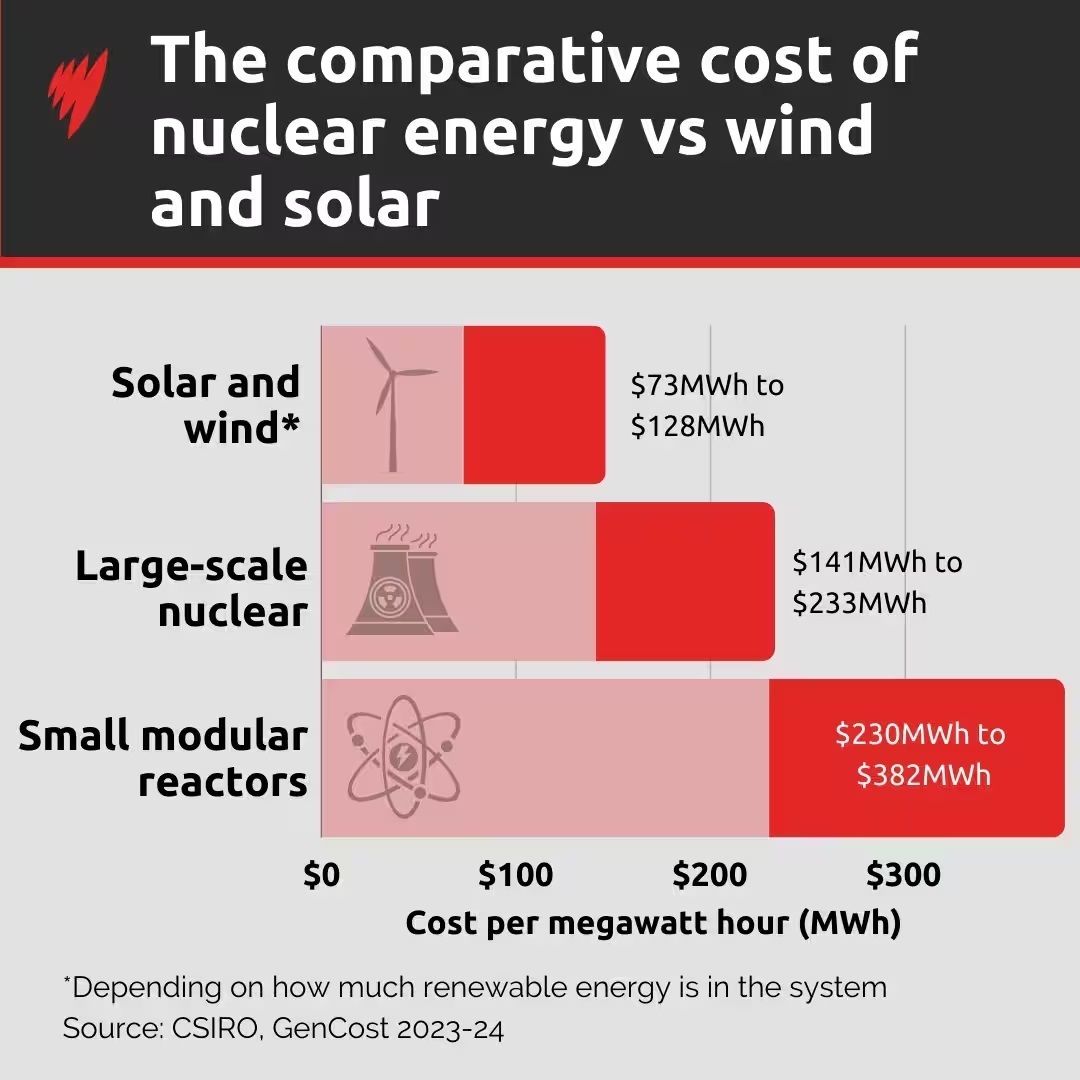
According to studies from Stanford University, new nuclear power plants cost 2.3 to 7.4 times those of onshore wind or solar per kilowatt-hour of electricity, take five to 17 years to deploy, and produce nine to 37 times the emissions per kilowatt-hour as wind.
New nuclear adds only as much electricity in a year as renewables add every few days. For example, China is now installing wind and solar capacity equivalent to five new nuclear reactors weekly.
Nuclear delivers far less power per dollar.
Because of significant costs and delays, the emphasis has moved to small modular reactors (SMRs). Their economics are costly and share the same significant security and waste problems. To date, several key SMR projects have fallen by the wayside.
Instead of wasting money on expensive non-renewable technologies, limited financial resources should be channeled into realistic solutions to climate change, including electrification; the expansion of renewables across all sectors; expansion and modernization of grids; storage, efficiency solutions and smart demand-side management.
The last decade represents a seismic shift in the balance of competitiveness between renewable technologies and incumbent fossil options.
The notion that renewables are expensive is outdated. According to IRENA data, 81 percent of the record renewable additions in 2023 were cheaper than fossil fuel and nuclear alternatives.
The total renewable power capacity deployed globally since 2000 has saved $409 billion in fuel costs in the power sector.
Factoring in the wider economic and environmental benefits of renewable power in reducing fossil fuel imports, improving a country’s balance of payments and enhancing security of affordable energy supply by reducing exposure to volatile fossil fuel prices in global markets makes it even more compelling.
The world is increasingly rallying behind renewables to do the heavy lifting for the net-zero energy transition. We have the knowledge, the technology and the means. We are fully equipped to adjust the trajectory of the transition and reduce the carbon footprint of the global energy system.
We must move faster.
Why Nimbys are wrong about solar farms
Opponents of solar farms often say that solar panels should be put on roofs and that fields should be left for agriculture so i asked the experts on whether they agreed
By Tom Bawden, Science & Environment , November 3, 2024 ,
https://inews.co.uk/news/environment/why-nimbys-are-wrong-about-solar-farms-3355702
Tory leadership loser Robert Jenrick said that solar panels are “for roofs not fields” when asked byi last month if he supported a proposed giant solar farm in his Nottinghamshire constituency.
He is by no means alone in that view, which is a common argument given by opponents of solar farms.
Those who protest against solar farm developments argue fields would be better used for growing food, while solar panels could and should be concentrated on roofs, of which there are quite literally millions in the UK.
“I’ve said that we must ban solar farms from prime agricultural land and I mean it. These facilities are despoiling our beautiful countryside and jeopardising our food security. We must end it,” Mr Jenrick added.
But since Labour came to power Energy Secretary Ed Miliband has approved four of the five biggest solar farms to be given planning permission in the UK.
Mr Miliband has vowed to take on “the blockers, the delayers, the obstructionists” who oppose large solar and onshore wind development to help the UK meet its ambitious targets to make the country’s energy supply virtually carbon neutral in just six years.
As the Government steps up its campaign to drive through new solar and wind projects, it is likely we will be seeing more projects of a similar scale too that opposed by Mr Jenrick in the coming years.
i asked experts whether it was feasible for the UK to do without new solar farms and instead confine new solar panel installations to the rooftops of households, offices and other business properties, and what effect this could have on food security.
The sale of the solar challenge
Experts were clear that there needs to be a huge and rapid increase in renewable energy generation if the UK is to have any chance of meeting its highly ambitious climate targets.
And, as the cheapest source of renewable energy – now costing less than onshore and offshore wind, according to government figures – solar will inevitably play a key role in the transformation of the UK’s energy supply.
The Conservative’s British Energy Strategy in April 2022 outlines the need for 70 gigawatts (GW) of solar power to be installed by 2035 – enough to power 20 million homes, according to National Grid.
As of June 2024, the UK only had about 17GW installed capacity (powering around 4.5million homes), meaning the country needs to quadruple its solar power generation in the next 11 years.
Two thirds of the current solar power is generated by solar farms with panels on the ground – known as “ground mount” – with the remaining third coming from the rooftops of businesses and over 1.5 million homes.
Meanwhile, government advisor the Climate Change Committee estimates that we will need 90GW of solar by 2050 (5.3 times current capacity) if we are to hit our legally binding target of becoming Net Zero.
Dr Simon Harrison, a member of the Government’s new advisory commission to help make the UK’s power generation virtually carbon neutral by 2030, told i the task is so great that it’s “going to require vastly more renewable energy generation” – meaning that “in practice both solar farms and roof top solar will be needed at scale to meet our needs”.
“There’s a significant role for both,” added Professor Rob Gross, who also sits on the commission.
What are the advantages of solar farms?
The first major advantage of solar farms is the sheer amount of energy they produce.
The 600 MW Cottam Solar farm that was granted planning permission in September would be the UK’s largest – supplying 180,000 homes, or 1,500 homes for every 5MW of energy generated.
By contrast, large solar rooftop installs, say over an airport or large of space, typically generate hundreds of kilowatts (kW) potentially up to a few megawatts (MW).
While the average solar rooftop installation size on someone’s home for their own use is typically 4kW.
So the Cottam Solar project would generate at least 200 times the electricity of the very largest commercial roof top installations and around 150,000 times as much as a typical household solar panel setup.
Tony Slade, technical director of Beaverbrook Energy, which designs, finances and builds low-carbon energy generators, told i: “Ground mounted solar farms also suffer from less ‘shading’ (blocking of direct sunlight through obstacles and obstructions) and ‘directional losses’ by being angled in the wrong direction.
“About 50 per cent of roofs face the wrong way and of those that face the right way about 25 per cent suffer from shading issues,” he said.
Are solar farms cheaper than roof panels?
Yes, in part because they benefit from economies of scale. In other words, the bigger the solar farm, the cheaper each unit of electricity will be, as more panels can benefit from the infrastructure.
Professor Gross, who is also director of the UK Energy Research Centre coalition of researchers, told i “the principal advantages are economic”.
“It is far cheaper to install each solar panel in a large array of thousands of panels than it is to install a handful of panels on a roof.
“Ground mounted is cheapest, followed by larger arrays on commercial units, followed by new build, followed by residential retrofit. All categories are getting cheaper but it is impossible to get away from the fundamentals – the cheapest solar will always be the simplest to install, in the largest arrays,” he said.
“And ground mounted developers building large schemes may also be able to negotiate the best deals for panels and equipment,” he added.
Mr Slade explains that greenfield ground mount solar panels on fields typically cost two thirds as much, per unit of energy, as large scale solar panel arrays on commercial buildings such as warehouses, shopping centres and factories – as well as new build domestic and commercial buildings, where the solar panels are fitted as part of the original construction.
Meanwhile, installing solar panels above car parks is typically twice as expensive as wind farms and retrofitting homes is about three times as expensive, he said.
What about food security?
Opponents of large solar farms often argue that the land would be better used for agriculture and that too many of them could impact food security.
But the Department for Energy Security and Net Zero firmly rebuts those suggestions, arguing the amount of agricultural land involved would make very little difference to the UK’s food production.
“Our plans to boost solar power do not risk the UK’s food security. The total area of agricultural land used for solar is very small and is often the lowest grade quality for food production.
“Even in the most ambitious scenarios, solar would still occupy less than 1 per cent of the UK’s agricultural land, while bringing huge benefits for the British public and our energy security,” the spokesperson added.
Meanwhile, in July, National Farmers’ Union boss Tom Bradshaw warned MPs against making “sensationalist” claims about food security.
“It’s a small amount of land which is being taken out of production,” he told the Politico Europe website.
The role of rooftop solar panels
“They can potentially play a very important role, accounting for perhaps 40 per cent of new installation of solar. But it’s important to be clear that rooftop and ground based are additive not competitive,” Professor Gross said.
Dr Harrison says “there are serious considerations to make on where solar is placed”, meaning that sometimes roof top solar power can be far more suitable than those in fields.
“In the simplest terms, there is more space in rural areas for solar panel installations and it is often easier to optimise their positioning for greater energy capture. But they are generally further from existing grid connections and with sometimes competing requirements for land use,” he said.
“On the other hand, rooftop solar, most commonly in urban settings, often avoids use of congested electricity networks, especially when combined with local batteries, and when used in homes tends to drive greater awareness and action by residents in other areas such as energy efficiency improvements, as well as reducing bills. In practice both will be needed at scale to meet our needs.”
The Government estimates there are 250,000 hectares of south-facing, industrial roof space across the country. That’s an area bigger than London and Manchester combined, with the potential for a vast amount of solar panels.
Even a very conservative estimate suggests that this commercial roof space could provide an area big enough to generate approximately 25GW of energy.
This amounts to nearly half the total amount recommended by the Climate Change Committee (CCC), according research by University College London for the Campaign to Protect Rural England (CPRE).
Mr Ramandani agrees that fields and rooftops can play different, complementary, roles in UK energy generation.
“We need about 18GW more of rooftop solar to hit 70GW by 2035 to keep us on the right path to Net Zero. So it will play a massive role,” he said.
“Rooftop solar can power people’s homes and business onsite without needing to pull from the grid, and excess generation can be stored or exported back to the grid, which supports the flexibility and security of the grid. And they operate at a smaller scale with some export to the overall grid system.
“Solar farms, meanwhile, are not onsite generation – they operate at a much bigger scale and power the grid with greater quantities of energy, which is used by the whole system and not specific to a home or business (before they export the excess generation that they don’t use or store).”
Is there a big role for household solar panels?
UK households are already waking up to solar panels, receiving record sums last year for the amount of excess energy they generated that they sold back to the grid, Ofgem said last week.
Homeowners received more than £30m for the energy they didn’t need in the year to March 2024, four times the £7.2m they made the previous year.
Although this amounted to a relatively small amount of energy – enough to power 88,000 homes – experts say there is considerable scope to increase this and they expect this to happen in the coming years.
“There is definite major role for rooftop solar in the UKs future energy mix,” said Mr Slade. “As installations become cheaper and the market for excess generation becomes fairer to the home owner rooftop domestic solar will continue to grow,” he said.
Mr Ramandani says: “Onsite solar rooftop generation takes money off consumer’s bills as they purchase less from the grid, and excess generation can be exported to the grid for income. This in turn creates a stable grid system with less demand side pressure, as well as supplementary energy generation from homes and businesses.
For a typical house, installing a PV system could lower bills by the equivalent of nearly 330 every year over the 30-year lifespan of the system, according to a study by Cambridge University and the Think Three property development company for Solar Energy UK.
Grazing sheep among solar panels could produce higher quality wool, study finds
Sophie Vorrath, Nov 1, 2024,
https://reneweconomy.com.au/grazing-sheep-among-solar-panels-could-produce-higher-quality-wool-study-finds/
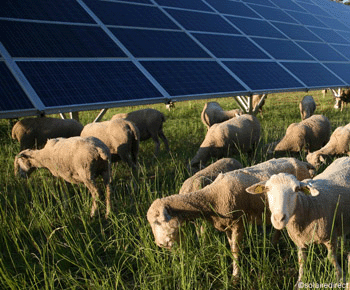
The co-location of solar farming with sheep grazing does not have a negative affect on wool production and could even improve the quality of the wool produced, a new study has found.
The study is based on the results of a second round of wool testing at the Wellington solar farm, south east of Dubbo in New South Wales, which has shared its site with 1,700 merino sheep for the past three years.
Legend has it that the decision to graze sheep at the solar farm came about when an employee of Lightsource bp, the owner of the Wellington project, complained to a local, sixth-generation wool farmer about the hassle and cost of mowing the solar farm six times a year.
According to Tony Inder, who heads up the Allendale Merino Stud, the effect on his sheep has been a lot better than he thought it would be – he says the wool quality they are producing has “increased significantly.”
But Lightsource bp – which is now wholly owned by the oil and gas giant BP, after completing the acquisition of the remaining 50.03% interest – has used the opportunity to gather some formal data.
The study, conducted by EMM Consulting with support from Elders Rural Services, compares two groups of merino sheep – one group grazed in a regular paddock and the other at the Wellington solar farm.
The latest findings show grazing sheep among solar panels does no harm to wool production, even in the case of pre-existing high-quality standards. And it says that some parameters even indicate an improvement in wool quality, although conclusive benefits require further long-term measurement.
Lightsource bp says that while the study at the Wellington solar farm is ongoing, it is another indication that solar farms can exist side-by-side with sheep farming, for the benefit of both enterprises.
“These results are very encouraging and highlight the potential for solar farms to complement agricultural practices,” says Emilien Simonot, Lightsource bp’s head of agrivoltaics.
“By integrating sheep farming with solar energy production, we can achieve dual benefits of sustainable energy together with agricultural output.” . By co-locating grazing with renewable energy, land can remain in agricultural use, offering farmers additional revenue while contributing to cleaner energy for the planet.
“Finding ways for agriculture and clean energy to work together is crucial for a more sustainable future,” says Brendan Clarke, interim head o environmental planning Australia and NZ at Lightsource bp.
“The promising results from this study indicate that we are on the right path, and working closely with farmers to grow our knowledge in this area is paramount.”
As for the sheep, Inder says they “just do really well” when grazing among the Wellington solar farm panels.
“I like to say that panel sheep are happy sheep.”
Sophie is editor of One Step Off The Grid and deputy editor of its sister site, Renew Economy. She is the co-host of the Solar Insiders Podcast. Sophie has been writing about clean energy for more than a decade.
IEA: Global clean tech market set to be worth $2tr a year by 2035.
Business Green 30th Oct 2024
The global market for clean technologies such as solar panels, wind
turbines, and electric vehicles (EVs) is set to triple to more than $2tr a
year over the next decade, eclipsing the value of the oil and gas markets
in the process, according to the International Energy Agency (IEA).
In a “first of its kind” analysis today, the IEA estimates the global market for
six leading mass-manufactured clean technologies – solar PV, wind turbines,
EVs, batteries, heat pumps, and green hydrogen electrolysers – is set to
surge in the coming years.
The report estimates that based on today’s
policy settings the global market for these technologies is set to rise
from $700bn in 2023 to more than $2tr by 2035, which would put it on a
similar level to the value of the global crude oil market in recent years.
https://www.businessgreen.com/news/4374453/iea-global-clean-tech-market-set-worth-usd2tr-2035
Green jobs and green skills – the state of play

October 26, 2024, https://renewextraweekly.blogspot.com/2024/10/green-jobs-and-green-skills-state-of.html
In 2023, the global renewable energy sector witnessed a record increase in jobs, rising from 13.7 million in 2022 to 16.2 million. China led with an estimated 7.4 million renewable energy jobs, representing 46% of the global total. The EU followed with 1.8 million jobs, while Brazil had 1.56 million. The US and India each contributed nearly one million jobs. The strongest growth was seen in the solar photovoltaics sector, which accounted for 7.2 million jobs globally, with 4.6 million jobs located in China.
However, as I have reported in earlier posts, green skill shortages may slow progress and, exploring this issue in the UK context, an Imperial College Futures Lab briefing paper has investigated the Net-Zero job skills and training requirements in the UK’s energy system. It notes that the governments advisory Committee on Climate Change (CCC) estimates that between 135,000 and 725,000 net new jobs could be created in the UK by 2030 directly in low-carbon sectors, this wide range highlighting uncertainties in estimates about the number of workers required to support the transition to Net-Zero. The Futures Lab study identifies ongoing barriers and opportunities for expanding low-carbon job competencies, culminating in a set of policy recommendations to create clear, inclusive training pathways into low-carbon energy jobs.
Using three sectoral case studies, the paper investigates challenges and opportunities for improving skills and training. Firstly it shows how the building energy retrofit sector faces a significant shortage of skilled workers, particularly in heat pump installation, energy efficiency measures, retrofit coordination, and digital roles. Despite the potential to create 120,000–230,000 new jobs by 2030, it says ‘inconsistent policies and funding have hindered private investment in training’. Secondly, the offshore wind sector is forecast to employ over 100,000 workers in 2030, compared to 32,000 in 2022. But it says ‘offshore wind struggles with skills gaps in electrical, digital, consenting, and marine roles, relying on experienced workers and those from other industries to fill these gaps’. Thirdly, the paper claims the electric vehicles sector ‘could generate at least 80,000 new jobs over the next 10-15 years’ but says that this ‘is contingent on gigafactory development, with key skills needed in charging point installation, vehicle recycling, battery manufacturing, and electrification engineering.’
Most of these cases involve expanding training for specific green energy technologies and electrification, but the report says that ‘not all industrial decarbonisation can be achieved through direct electrification, and particularly across hard-to-abate industries, decarbonisation will depend on the development of hydrogen and CCUS sectors’. It notes that ‘growth of these sectors is considered highly conditional, subject to the competitiveness of international markets, the availability of skilled labour, and levels of investment,’ but reports that the CCC estimates that ‘these industries could create between 1,500 and 97,000 new jobs by 2030’. It adds that ‘the current offshore oil and gas workforce is expected to provide a large number of skills required in these sectors’.
That’s good news (arguably blue hydrogen/CCUS apart) but making it happen won’t be easy. It is interesting in this context that there has recently been a call for £1.9bn a year to help oil and gas workers move into clean energy, with the Green Jobs Taskforce also estimating that ‘the low-carbon transport sector could create 78,000 new jobs by 2040, including 24,500 in battery manufacturing, 43,500 in the battery supply chain, and 10,000 in EV manufacturing’.
Looking to the way ahead, the Future Lab identify a series of barriers facing this type of job transition. First come straight forward ‘skills transferability’ barriers. For example it notes that it has been estimated that 100,000 jobs in the UK’s offshore energy sector will be filled by workers transferring from oil and gas into offshore renewable roles, and by new entrants from outside the sector. But it says ‘there is debate about how transferable skills across high- and low-carbon sectors actually are, and whether a ‘topping up’ of skills or more rigorous retraining will be required for those transitioning’.
Then there are mobility barriers. ‘Whether or not workers are able to take low-carbon jobs will depend on where and when existing jobs are being lost and new jobs become available. It will also depend on the supply of and demand for relevant training, which is likely to be unevenly distributed in terms of quantity and quality. If green jobs or re-skilling opportunities do not appear in areas where jobs have been phased out, workers will either have to lose out on opportunities, seek employment in other high-carbon sectors, or relocate, which risks reinforcing existing regional inequalities.’
That links up to regional barriers. It says ‘UK regions with a higher concentration of energy-intensive industries, such as the North East, Yorkshire and the Humber, and the West Midlands, stand a higher chance of being negatively affected by the transition. These regions are often also those whose economies have seen the least growth in recent decades. They are also likely to have less capacity and resources to be able to provide adequate re-skilling support’.
And finally there are diversity barriers. The report notes that ‘the current energy sector is predominantly represented by white male workers. Available statistics suggest that only 5% of the workforce comes from BAME backgrounds. Unless active measures are taken to support underrepresented groups joining the Net-Zero energy workforce, occupational gender & ethnicity gaps are likely to persist’.
Some of the reports recommended actions are obvious enough from the foregoing analysis. For example green sectors should be ‘inclusive and respectful places to work, where underrepresented groups not liable to be discriminated against’, and we should build ‘closer links between high- and low-carbon energy sectors to create direct routes into new jobs.’
More specifically ‘current public financing mechanisms for skills, including the Apprenticeship Levy, the National Skills Fund, and the Adult Education Budget, should be reviewed to see how funding can be better directed towards the development of training for green jobs. Additional public funding should also be leveraged to support long-term development of skills for Net-Zero, specifically for FE colleges and training providers to be able to develop new, high-quality green courses and overcome low participation rates. There is also a case for targeted funding for SMEs who cannot afford to send staff to be trained or take on apprentices’. And more generally, ‘introduce a national Net-Zero Skills Commission to take on monitoring, research and advisory roles to support development of skills for the Net-Zero transition in England.’
Plenty of good ideas. Let’s hope some are implemented soon, and meantime, the UK government is pushing ahead with its ‘skills passport’ initiative. In parallel, we hope helpfully, OU Visiting Research Fellow Terry Cook and I are putting together a journal paper on this whole area, looking in particular at what governments can do at the strategic level, by making new energy technology funding/subsidies conditional on the provision of green skill training programmes.
Will AI’s huge energy demands spur a nuclear renaissance?
Contracts with Google and Amazon could help, but bringing new types of reactor online will take larger investments — and time.
Davide Castelvecchi, Nature , 25vOct 24
Last week, technology giants Google and Amazon both unveiled deals supporting ‘advanced’ nuclear energy, as part of their efforts to become carbon-neutral.
Google announced that it will buy electricity made with reactors developed by Kairos Power, based in Alameda, California. Meanwhile, Amazon is investing approximately US$500 million in the X-Energy Reactor Company, based in Rockville, Maryland, and has agreed to buy power produced by X-energy-designed reactors due to be built in Washington State.
Both moves are part of a larger [??] green trend that has arisen as tech companies deal with the escalating energy requirements of the data centres and number-crunching farms that support artificial intelligence (AI). Last month, Microsoft said it would buy power from a utility company that is planning to restart a decommissioned 835-megawatt reactor in Pennsylvania.
The partnerships agreed by Google and Amazon involve start-up companies that are pioneering the design of ‘small modular reactors’, which are intended to be assembled from prefabricated pieces………….they still have a way to go before they become a reality.
Nature talked to nuclear-energy researchers to explore the significance and possible implications of these big-tech investments.
Could these deals spur innovation in the nuclear industry?
Building nuclear power stations — a process often plagued by complex permit procedures, construction delays and cost overruns — is financially risky, and betting on unproven technologies is riskier still…………..
the details of the deals are murky, and the level of support provided by Amazon and Google is likely to be “a drop in the bucket” compared with the billions these start-ups will ultimately need, says physicist Edwin Lyman, director of nuclear power safety at the Union of Concerned Scientists in Washington DC. “The PR machine is just going into overdrive,” says Lyman, but “private capital just doesn’t seem ready yet to take that risk”.
Allison Macfarlane, director of the School of Public Policy and Global Affairs at the University of British Columbia in Vancouver, Canada, and former chair of the US Nuclear Regulatory Commission (NRC), says that the speed of progress in computer science raises another question. “If we’re talking 15 years from now, will AI need that much power?”
Are there safety advantages to the small modular designs?
“The smallest reactors, in theory, could have a high degree of passive safety,” says Lyman. When shut down, the core of a small reactor would contain less residual heat and radioactivity than does a core of the type that melted down in the Fukushima Daiichi disaster that followed the cataclysmic 2011 tsunami in Japan.
The companies also say that the proposed pebble-bed reactors are inherently safer because they are not pressurized, and because they are designed to circulate cooling fluids without the help of pumps (it was the loss of power to water pumps that caused three of the Fukushima plant’s reactors to fail).
But Lyman thinks it is risky to rely on potentially unpredictable passive cooling without the backup of an active cooling option. And as reactors become get smaller, they become less efficient. Another start-up company, NuScale Power, based in Portland, Oregon, originally designed its small modular reactor — which was certified by the NRC — to produce 50 MW of electricity, but later switched to a larger, 77-MW design. The need to make the economics work “makes passive safety less credible”, Lyman says.
Do small modular reactors carry extra risks?
In some cases, small modular reactors “could actually push nuclear power in a more dangerous direction”, says Lyman. “Advanced isn’t always better.”
In particular, Lyman points out that the pebble-bed designs drawn up by X-energy and Kairos would rely on high-assay low-enriched uranium (HALEU), which comprises 10–20% uranium-235 — compared with the 5% enrichment level required by most existing reactors (and by NuScale’s reactor). HALEU is still classified as low-enrichment fuel (as opposed to the highly enriched uranium used to make nuclear bombs), but that distinction is misleading, Lyman says. In June, he and his collaborators — including physicist Richard Garwin, who led the design of the first hydrogen bomb — warned in a Science article that a bomb could be built with a few hundred kilograms of HALEU, with no need for further enrichment1.
Smaller reactors are also likely to produce more nuclear waste and to use fuel less efficiently, according to work reported in 2022 by Macfarlane and her collaborators2. In a full-size reactor, most of the neutrons produced by the splitting of uranium travel through a large volume of fuel, meaning that they have a high probability of hitting another nucleus, rather than colliding with the walls of the reactor vessel or escaping into the surrounding building. “When you shrink the reactor, there’s less material in there, so you will have more neutron leakage,” Macfarlane says. These rogue neutrons can be absorbed by other atomic nuclei — which would then themselves become radioactive.
Will small reactors be cheaper to build?
The capacity to build components in an assembly line could drastically cut reactors’ construction costs. But there are also intrinsic economies of scale in building larger reactors, says Buongiorno. “Don’t believe people blindly” when they say smaller reactors will produce cheaper energy, he says: nuclear energy has a lot going for it, but “it ain’t cheap” — and that is unlikely to change significantly.
Will all of these efforts help to combat climate change?
…………….. whether building new reactors is the best way to rapidly cut emissions is debated. Macfarlane points out that solar panels and wind turbines can be deployed at a much faster rate.
https://www.nature.com/articles/d41586-024-03490-3
1 This Month

of the week – Shut Down Drone Warfare!


Tell the Ukrainian Government to Drop Prosecution of Peace Activist Yurii Sheliazhenko

Petition to revoke the licensing of the Near Surface Nuclear Disposal Facility (NSDF) at Chalk River. https://www.ourcommons.ca/petitions/en/Petition/Details?Petition=e-7247
To see nuclear-related stories in greater depth and intensity – go to https://nuclearinformation.wordpress.com
-
Archives
- March 2026 (237)
- February 2026 (268)
- January 2026 (308)
- December 2025 (358)
- November 2025 (359)
- October 2025 (376)
- September 2025 (257)
- August 2025 (319)
- July 2025 (230)
- June 2025 (348)
- May 2025 (261)
- April 2025 (305)
-
Categories
- 1
- 1 NUCLEAR ISSUES
- business and costs
- climate change
- culture and arts
- ENERGY
- environment
- health
- history
- indigenous issues
- Legal
- marketing of nuclear
- media
- opposition to nuclear
- PERSONAL STORIES
- politics
- politics international
- Religion and ethics
- safety
- secrets,lies and civil liberties
- spinbuster
- technology
- Uranium
- wastes
- weapons and war
- Women
- 2 WORLD
- ACTION
- AFRICA
- Atrocities
- AUSTRALIA
- Christina's notes
- Christina's themes
- culture and arts
- Events
- Fuk 2022
- Fuk 2023
- Fukushima 2017
- Fukushima 2018
- fukushima 2019
- Fukushima 2020
- Fukushima 2021
- general
- global warming
- Humour (God we need it)
- Nuclear
- RARE EARTHS
- Reference
- resources – print
- Resources -audiovicual
- Weekly Newsletter
- World
- World Nuclear
- YouTube
-
RSS
Entries RSS
Comments RSS
 nuclear-news