BBC 7th July 2017 An Australian state will install the world’s largest lithium ion battery in a “historic” deal with electric car firm Tesla and energy company Neoen. The battery will protect South Australia from the kind of energy crisis
which famously blacked out the state, Premier Jay Weatherill said.
Tesla boss Elon Musk confirmed a much-publicised promise to build it within 100 days, or do it for free. The 100-megawatt (129 megawatt hour) battery should be ready this year.

July 8, 2017
Posted by Christina Macpherson |
AUSTRALIA, energy storage |
Leave a comment
 FT 7th July 2017, Tesla Motors and now Volvo may have big plans to end the addiction of drivers to fossil fuels via electric vehicles, however the environmental footprint of mining raw materials used in car batteries and their eventual disposal are emerging as a flash point.
As the mining sector presents a green face and extracts raw materials from lithium to cobalt and nickel
that constitute electric batteries, so the focus on their environmental standards and energy efficient production methods will intensify.
At the tail-end of the electric vehicle boom is the matter of improving the recycling of lithium-ion batteries and making sure the environmental impact is also contained.
To offset the environmental impact of mining there will have to be a large build out in recycling facilities to meet the first wave of electric vehicles, analysts say. Currently over 90 per cent of lead-acid
batteries used in conventional gasoline cars are recycled, versus less than 5 per cent of lithium-ion batteries. An estimated 11m tonnes of spent lithium-ion battery packs will be discarded between now and 2030, according to Canada-based Li-Cycle, a recycler of batteries.
https://www.ft.com/content/8342ec6c-5fde-11e7-91a7-502f7ee26895?mhq5j=e3
July 8, 2017
Posted by Christina Macpherson |
2 WORLD, energy storage |
Leave a comment
Renewable energy surges past nuclear for 1st time in decades, Star Tribune
By MICHAEL BIESECKER Associated Press, JULY 6, 2017, WASHINGTON — For the first time in decades, the United States got more electricity from renewable sources than nuclear power in March and April.
The U.S. Energy Information Administration said Thursday that electricity production from utility-scale renewable sources exceeded nuclear generation in both March and April, the most recent months for which data is available. That’s the first time renewable sources have outpaced nuclear since 1984.
The growth in renewables was fueled by scores of new wind turbines and solar farms, as well as recent increases in hydroelectric power as a result of heavy snow and rain in Western states last winter. More than 60 percent of all utility-scale electricity generating capacity that came online last year was from wind and solar.
In contrast, the pace of construction of new nuclear reactors has slowed in recent decades amid soaring costs and growing public opposition. Nearly all nuclear plants now in use began operation between 1970 and 1990, with utilities starting to retire some of their older reactors……..http://www.startribune.com/renewable-energy-surges-past-nuclear-for-1st-time-in-decades/432955983/
July 7, 2017
Posted by Christina Macpherson |
renewable |
Leave a comment
Solar Power Portal 4th July 2017, Aldi UK has marked the fourth Solar Independence Day with the announcement
that it will install a further 11,000 solar panels across more than 50 of
its stores by the end of the year.
The supermarket has already installed
more than 85,000 solar panels on all nine of its regional distribution
centres and more than 275 stores across the UK, generating over 17,500 MWh
of electricity a year.
This deployment will now be extended by the end of
the year, bringing its total store investment in solar to almost £17
million and saving more than 8,100 tonnes of CO2 in the process. https://www.solarpowerportal.co.uk/news/aldi_uk_marks_solar_independence_day_with_new_solar_rollout_pledge
July 7, 2017
Posted by Christina Macpherson |
renewable, UK |
Leave a comment
Study: Renewables will be cheapest power source by 2030, By Sam Morgan | EURACTIV.com, Jul 6, 2017, Renewable energy sources like wind and solar are set to be the cheapest form of power generation in the G20 countries by 2030, according to a new study. The EU also announced that the Paris Agreement “cannot be renegotiated”.
Ahead of this week’s G20 summit in Hamburg, the study also found that in half the G20 countries renewables have already been cheaper or the same price as electricity derived from coal or nuclear plants for the last two years.
The study, carried out by Finland’s Lappeenranta University and published by Greenpeace Germany, calculated the costs of electricity generation in all G20 countries for the years between 2015 and 2030.
It found that wind farms generated the cheapest electricity in 2015 across large parts of Europe, in South America, the United States, China and Australia. The study also predicted that technological progress will mean that solar power will be even cheaper than wind by 2030 in many G20 nations
Greenpeace Germany’s energy expert, Tobias Austrup, said “climate protection increasingly makes economic sense across the G20 as renewable energy becomes cheaper than dirty coal and nuclear”.
He added that “any G20 country that is still investing in coal and nuclear power plants is wasting their money on technology that will not be competitive in coming years”.
At an event organised by the French Institute of International Relations on Tuesday (4 July), the French energy ministry’s executive director, Mario Pain, acknowledged that “renewables are a major part of the answer” when asked about the future of France’s electricity system……..https://www.euractiv.com/section/energy/news/study-renewables-will-be-cheapest-power-source-by-2030/
July 7, 2017
Posted by Christina Macpherson |
2 WORLD, renewable |
Leave a comment
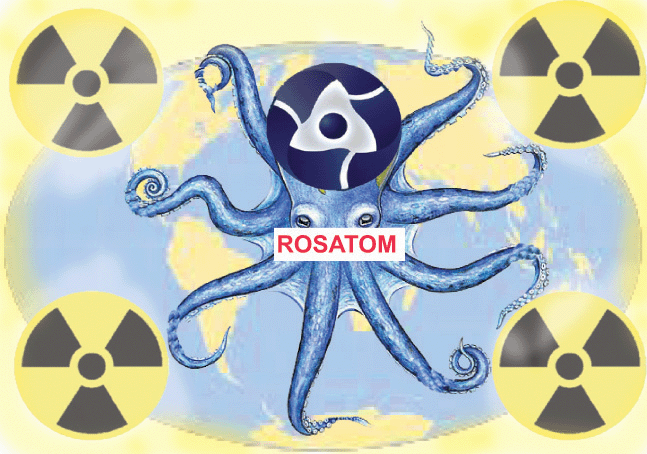
 Rosatom loses hope in its international nuclear builds, eyes renewables http://bellona.org/news/nuclear-issues/2017-07-rosatom-loses-hope-in-its-international-nuclear-builds-eyes-renewables
Amid decreasing world demand for nuclear energy, Russia’s state nuclear corporation 
 last week warned it would likely be receiving fewer requests to build nuclear power plants abroad. July 3, 2017 by Charles Digges, The announcement marks a sharp departure for the corporation, which until recently has posed its contracts with other countries as the bread and butter of its bottom line – as well as a potent tool for broadening Moscow’s sphere of political influence.
But there’s a silver lining to the nuclear monolith’s recent disillusionment with its traditional lifeblood: A possible, albeit modest, shift in the direction of renewable energy and battery technologies.
Speaking at last month’s Tekhnoprom-2017 conference, a technical conference in the Siberian city of Novosibirsk, Rosatom’s deputy director Vyacheslav Pershukov called the market for nuclear power stations abroad “exhausted.” “We see that the market is contracting, and for the sustainable growth of the corporation…we must make our money on something other than nuclear technology,” he said, according to the RBK news agency.
His remarks dovetail with a worldwide nuclear sag.
In the United States, renewable energy output eclipsed nuclear for the first time during March and April. Meanwhile, huge nuclear corporations are trying to stave off going broke. Exelon, the country’s biggest nuclear operator, has seen its share prices plummet by 60 percent since 2008.
Westinghouse, meanwhile filed for bankruptcy in March, and Toshiba, its parent company, is trying to sell of its computer divisions to cover the debt. France’s Areva was saved from financial peril by a huge taxpayer infusion into its owner EDF, but that bailout will only stop the bleed the company is experiencing thanks to huge cost overruns on an ambitious but delayed reactor build in Finland.
Pershukov told the Tekhnoprom conference that Rosatom would shift some of its efforts to providing nuclear power plant services abroad, primarily to those it’s in the process of building.
For the past several years, Rosatom has touted its VVER-1200 reactor packages to international capitols and has worked vigorously to sign up customers even – if not especially – those who can barely afford it. On paper, the company has $130 billion in outstanding “memoranda of understanding” and other handshake type deals with foreign countries.
But many of the counties Rosatom counts among its potential contracts – like Jordan, Algeria, Nigeria and Bolivia, and most recently Uganda and Ethiopia – won’t have infrastructure to support nuclear power for decades.
In other cases, like Hungary, the Rosatom-built Paks-2 plant has been approved, but will leave Budapest’s right wing-government heavily indebted to Moscow for the $10 billion plant.
Another similar deal would have indentured South Africa to Rosatom for $76 billion, but that country’s high court torpedoed the deal before it got off the ground.
Other countries where Rosatom builds are already underway – like India’s Kudankulam, Iran’s Bushehr, China’s Tianwan and Belarus’s Ostrovets – are already familiar with Rosatom’s typical cost overruns and delays.
The company can pay for these huge loans because of the generous state subsidies it receives, but taxpayer injections are slated to dry up by 2020.
Oskar Njaa, a nuclear adviser with Bellona said curtailing Rosatom’s international nuclear ambitions represents a humbling moment for the company, and a dampening of its political influence abroad. “This is an economic blow,” he said. “For Russia, reducing an ability to make other countries dependent on Moscow’s nuclear fuel and expertise for energy needs is a blow to its geopolitical interests as well.”
As such, Rosatom is casting a wide net for other avenues of influence and revenue. In May, the company appeared in Chile’s Lithium Call Roadshow, and is reportedly pursuing inroads with Santiago to become a player in cell phone and electric car batteries. Other reports say the company is making a foray into fiber-optics.
More optimistically, Njaa noted, the company also seems to have discovered a bent for the renewable energy sector. He noted Rosatom’s recent interest in small hydroelectric plants and wind energy.
July 5, 2017
Posted by Christina Macpherson |
marketing, politics international, renewable, Russia |
Leave a comment
Energy Post 27th June 2017,The introduction of renewables auctions in Germany, replacing administratively set feed-in premiums, has led to considerably lower prices and very high realization rates. However, community participation was very low in the first solar PV auctions.
Now a new rule favouring community projects in onshore wind auctions turned out to be so attractive that most
bidders created community projects to profit from them. This is turning the
market upside down. Corinna Klessmann and Silvana Tiedemann of consultancy Ecofys, a Navigant company, look at the effects of auctions on the German renewables markets and make recommendations. http://energypost.eu/germanys-first-renewables-auctions-are-a-success-but-new-rules-are-upsetting-the-market/
July 3, 2017
Posted by Christina Macpherson |
business and costs, decentralised, Germany |
Leave a comment
 Solar Portal 29th June 2017, What is expected to be Europe’s largest community battery is set to be
installed at an innovative regeneration scheme in Nottingham, with a 2MWh
Tesla battery to be deployed in September as part of a housing scheme
alongside community solar.
The £100 million Trent Basin project is a new housing development built at the site of an inland dock previously derelict
for around two decades. It is expected to deliver 500 homes over five
phases with 375kW of rooftop and ground mounted solar and the Tesla battery
to be installed by EvoEnergy.
In an innovative use of the solar farm, planning permission has been granted on the basis that the site shall be
cleared by 28 February 2020. By this time, the panels from the ground
mounted installation will be removed and installed on new homes built as
part of the development. https://www.solarpowerportal.co.uk/news/tesla_install_to_bring_europes_largest_community_battery_to_nottingham
July 3, 2017
Posted by Christina Macpherson |
decentralised, UK |
Leave a comment
Times 1st July 2017, Turbines for the world’s first floating wind farm are set to arrive in
Scottish waters within weeks after taking to the seas off Norway. Five
turbines for the £200 million Hywind project, being built by Statoil, the
Norwegian energy group, were floated near Stord island on the country’s
southwest coast. They will be towed on a four-day journey to a location 16
miles off Peterhead.
The five turbines, standing 175m above sea level, are
kept afloat by ballasted steel cylinders that extend 78m beneath the waves.
Each will be attached to the seabed by chains. Together they should
generate up to 30 megawatts of power, enough to supply 20,000 homes.
https://www.thetimes.co.uk/edition/business/turbines-sail-closer-to-the-wind-8bfzgdxnl
July 3, 2017
Posted by Christina Macpherson |
decentralised, UK |
Leave a comment
Renew Economy 30th June 2017, Global research institute McKinsey & Company has analyzed current energy
storage prices and concluded that commercial customers are already feeling
the economic benefits of cheaper batteries and recent price falls in
lithium-ion technology.
With battery-pack costs now down to less than
$230/kWh – compared to around $1,000/kWh as recently as 2010 – storage
uptake is on the rise across Europe, Asia and the U.S. This growth is being
facilitated by a greater uptick in electric vehicle (EV) adoption, with
major players now scaling-up their lithium-ion manufacturing capacity in
order to meet demand.
http://reneweconomy.com.au/energy-storage-already-cost-competitive-commercial-sector-finds-study-20246/
July 3, 2017
Posted by Christina Macpherson |
2 WORLD, energy storage |
Leave a comment
Climate News Network 1st July 2017, Trucks, trains and ships using hydrogen fuel cells for propulsion are no longer just theoretically possible: they have reached the trial stage. Decades of work on refining the technology have coincided with the need to store surplus energy from solar and wind farms when supply exceeds demand.
And making and storing hydrogen from surplus renewable energy that can then be used as fuel for vehicles is good economic sense, according to the Norwegian research group SINTEF. Fuel cells are much lighter than batteries
and with hydrogen fuel they provide a better method of propulsion for all sorts of freight and passenger transport. The only residue of burning hydrogen is water, so there is no pollution.
Top-secret research and development has been going on since 1980 at SINTEF in an attempt to make
fuel cells competitive with the internal combustion engine for transport. The technology is already used in some niche markets, but it is now expected to become mainstream, according to Steffen Møller-Holst, vice-president for marketing at SINTEF. He says: “In Japan, 150,000 fuel cells have been installed in households to generate power and heat, and in
the United States more than 10,000 hydrogen-powered forklifts are operatingin warehouses and distribution centres.”
In Norway SINTEF has been working on advancing that technology. Engineers there also want to power
forklifts, but they’re planning more: they want as well to power heavyduty trucks and passenger ferries with fuel cells. Norway is also working on a plan to make its railways greener, running long-distance trains on hydrogen as an alternative to electrifying lines currently operated by diesel locomotives.
“In Germany, the first fuel cell train is alreadyundergoing trials, and Norway is one of many European countries now
considering hydrogen-powered trains based on the conclusions of a studycarried out by SINTEF for the Norwegian Railway Directorate,” saysMøller-Holst. He is convinced Norway should follow the German example.
Surprisingly, the report concluded that between €36 and 45 billion could be saved annually on one section of the line if battery- or hydrogen-powered trains were used instead of the more conventional electric trains drawing power from overhead wires. http://climatenewsnetwork.net/hydrogen-fuel-reaches-lift-off/
July 3, 2017
Posted by Christina Macpherson |
energy storage, EUROPE |
Leave a comment
The tumbling cost of offshore wind power could mean that it turns out to be
25 per cent cheaper than energy from Hinkley Point nuclear plant when
subsidies are awarded to new projects this year, the industry regulator has
suggested.
Developers behind a series of proposed offshore wind farms are
vying to secure government contracts that will guarantee a price for the
electricity they generate for 15 years. Dermot Nolan, chief executive of
Ofgem, said he hoped the winning projects would emerge at a price of “£70
or less” per megawatt-hour (MWh).
That would compare with £92.50/MWh that
was last year awarded to Hinkley Point for a 35-year contract, fuelling
debate about the merits of the project and future nuclear plants. The
difference between the guaranteed price and wholesale price, currently
£43/MWh, will be subsidised by consumers through energy bills, with
payouts for Hinkley forecast to hit £30 billion.
Just a few years agooffshore wind was one of the most expensive technologies in the market. In
2014 the government awarded some projects a price of £150/MWh.
Technological advances, including bigger, more efficient turbines,
economies of scale in manufacturing and the introduction of a competitive
“reverse auction” process to award subsidies to the cheapest projects have
helped to bring costs down rapidly.
Times 30th June 2017
https://www.thetimes.co.uk/edition/business/offshore-wind-power-could-be-25-cheaper-than-hinkley-s-nuclear-qk77fqhd9
July 1, 2017
Posted by Christina Macpherson |
renewable, UK |
Leave a comment
The National 30th June 2017, RENEWABLE electricity generation in Scotland has reached a record high. A
new UK government report shows that generation was up by 13 per cent in the
first quarter of this year compared to the same period last year. There was
also a 16 per cent increase in capacity with more than half of all gross
electricity consumption in Scotland coming from renewables.
Scotland’s total installed renewable capacity – the amount of renewable electricity
the country is capable of producing – now stands at 9.3GW, which is four
times what it was just a decade ago.
The renewable electricity sector also supports 26,000 jobs and has a turnover of £5 billion which is set to grow
further as new capacity comes on stream. Acting director of WWF Scotland Dr
Sam Gardner said: “It’s fantastic news that Scotland’s renewable
electricity generation is at an all-time high and re-affirms the vital role
it plays in powering the country. The renewable electricity sector
continues to play a vital role at the heart of Scotland’s economy,
delivering jobs and attracting investment.” However, he added: “If we are
to replicate these benefits in the wider economy the Energy Strategy from
the Scottish Government should make clear the steps it plans to take to
remove fossil fuels from the heat and transport sectors. “The Scottish
Government now needs to set out clear policies for how it will replicate
its amazing progress on renewable electricity in the heat and transport
sectors to ensure we hit the 50 per cent target by 2030.”
http://www.thenational.scot/business/15381373.Record_renewable_levels_in_Scotland_as_minister_describes__vindication__of_policies/
July 1, 2017
Posted by Christina Macpherson |
renewable, UK |
Leave a comment
 Sempra VP Surprises, Says 100 Percent Renewable Grid Is Possible Now http://www.kpbs.org/news/2017/may/26/sempra-vp-surprises-says-100-percent-renewable-gri/ By Ingrid Lobet / inewsource A vice president with Sempra Energy, one of the nation’s largest utilities, made a stunning admission to a roomful of gas and oil executives this week: there is no technical impediment to California getting all of its energy from renewables — now.
In simple terms, this means all power could come from sources like wind, solar and hydro without reliance on fossil fuels. This has been the position of environmental groups and renewable energy companies. But not utilities, which typically argue that the grid still requires fossil electricity for stability, because renewables come and go.
“I am speaking with confidence now. We have a solution now to adjust the intermittency of solar and wind energy that is no longer a technology challenge. Now it is an economic decision,” said Patrick Lee, Sempra Energy vice president for major project controls. “So installing a base load power plant is no longer your only option. You can now look at solar, wind and storage as alternatives, and still be able to manage the reliability of the grid. So that is the takeaway I would like you to have.”
He addressed the annual La Jolla energy conference sponsored by the UC San Diego Institute of the Americas at the Hilton La Jolla Torrey Pines.
Lee said that as a trained engineer, even three years ago he would not have believed this was possible.
“But today my answer is: The technology has been resolved. How fast do you want to get to 100 percent? That can be done today,” he said.
In those three years, not only have wind, solar and battery prices plunged. The software to control storage and the grid has also advanced.
Suddenly, there is software that can make grid adjustments and bring battery power online much, much faster. “We now have the ability to control the grid twenty times faster than you can blink your eye,” Lee said.
To commercialize the new control software, Sempra has spun off a company called Pxise Energy Solutions, LLC. It has licensed several patents developed with the company OSIsoft. Pxise has three more patents in the works. Lee is president of Pxise.
New abilities like this help point the way to future profit for utilities like Sempra facing financial challenges from many energy trends. But they also raise questions about the necessity of controversial new fossil fuel plants that these companies still want to build, such as the one near the beach in Carlsbad. Until recently, Sempra and that plant’s builder, NRG Energy, had countered, saying batteries were just not there yet.
June 30, 2017
Posted by Christina Macpherson |
renewable |
Leave a comment
Co-op News 27th June 2017, Energy co-ops are in a bullish mood and are focused on sector-wide growth.
Last week, I attended the General Assembly of REScoop – the European
federation of renewable energy co-operatives – on behalf of Co-op Energy
and also as an elected director of Community Energy England.
One of the discussion points was that around half of the European Union population
will be producing their own energy in the next 40 years, according to the
European Renewable Energies Federation. The figures predict that over 264
million European citizens could produce their own energy in 2050, meeting
45% of Europe’s electricity demand.
The discussion was all very upbeat and heartening, although all gains made to date are still in play, with
legislative proposals subject to amendments from the European Parliament in
the near future. The European Commission is now even on record as saying:
“Our vision is of an Energy Union with citizens at its core, where
citizens take ownership of the energy transition, benefit from new
technologies to reduce their bills, participate actively in the market, and
where vulnerable consumers are protected.” https://www.thenews.coop/119543/sector/energy-coops-come-together-to-innovate/
June 30, 2017
Posted by Christina Macpherson |
decentralised, EUROPE |
Leave a comment









 nuclear-news