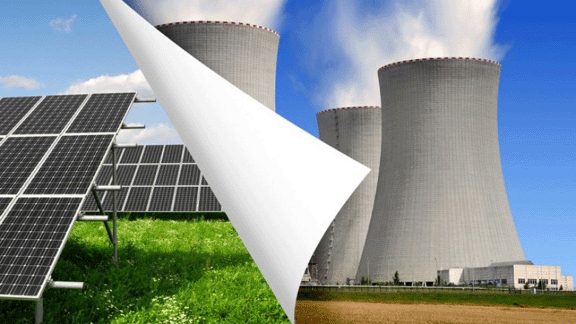
Reuters Staff, PARIS (Reuters) 27 Sept 17, – The French government plans to invest 20 billion euros in an energy transition plan, including 9 billion euros towards improved energy efficiency, 7 billion for renewables and 4 billion to precipitate the switch to cleaner vehicles.
The environment-related investments, drafted by economist Jean Pisani-Ferry and presented by Prime Minister Edouard Philippe on Monday, are part of a 57 billion-euro investment plan to run from 2018 to 2022.
Buildings are responsible for 20 percent of greenhouse gas emissions, so the government plans a 9 billion-euro thermal insulation programme that will focus on low-income housing and government buildings, the government said in a statement.
“The number of badly insulated low-income housing and social housing will be divided by two, and a quarter of government buildings will be renovated in line with environmental norms,” it said.
The programme aims at financing the renovation of 75,000 dwellings per year, or 375,000 over the government’s five-year term.
The government will also invest 7 billion euros ($8.31 billion) to boost the growth of French renewable energies by 70 percent over the next five years.
Investments will include research and innovation to combat climate change, and will speed up France’s transition to low carbon and greater energy efficiency…… https://www.reuters.com/article/us-france-renewables-investments/france-to-invest-20-billion-euros-in-energy-transition-idUSKCN1C027P
September 30, 2017
Posted by Christina Macpherson |
France, politics, renewable |
Leave a comment

Times 26th Sept 2017,In rural Bedfordshire today, Claire Perry, the climate change minister,
will open the first solar farm in Britain to sell power to the grid without
a direct subsidy.
It will perform this trick thanks partly to banks of
batteries that enable it to transmit electricity even when the sun is not
shining, and partly to the plummeting price of both batteries and solar
panels in recent years. Clayhill Farm is a landmark achievement. It will
provide power for 2,500 homes without pumping out any pollution, making any
noise or killing any birds. It will come onstream less than a month after
an auction for wholesale energy contracts in which wind power operators
underbid even gas-fired energy producers for the first time.
And it was built in 12 weeks flat. A renewable energy revolution is gathering steam,
so to speak, but Clayhill Farm poses a troubling question for government
and the rest of the British solar industry.
Why is it, so far, alone? There are three reasons.
First, one of the biggest obstacles to setting up a new
solar farm is securing a connection to the grid, and Clayhill has been able
to piggyback on a neighbouring facility whose connection is already in
place.
Second, few sites in Britain are so lucky, because solar power
installation slumped when subsidies were withdrawn two years ago while
still being available for wind.
Thirdly, Britain is not very sunny. The
Clayhill project shows that solar power has a future here despite
everything. Moreover, battery and solar panel prices are expected to keep
falling thanks to a global glut created by China. This oversupply is a
result of mass Chinese production initially to meet subsidised German
demand in the 1990s, and later to meet domestic Chinese demand. Beijing now
dreams of building and controlling a global solar-powered grid. If Britain
wants its own, the time to build is now.
https://www.thetimes.co.uk/edition/comment/sun-trap-hppsxdcsp
September 30, 2017
Posted by Christina Macpherson |
renewable, UK |
Leave a comment
– the energy revolution is happening, Guardian, John Sauven, 27 Sept 17 Far-sighted government policy means the cost of offshore wind energy has halved. The benefits in terms of climate change and UK jobs will be enormous “…….. the price of offshore wind energy has dropped by half in less than two years. By the 2020s, it will be as cheap or cheaper than any other form of power generation. It’s just become much cheaper than nuclear, even taking into account the additional costs associated with the wind’s intermittency. And in any case, this is less of an issue at sea where the winds are more constant……on the cusp of a quiet revolution. From being the most expensive form of renewable energy, offshore wind was fast becoming the cheapest form of large-scale, low-carbon generation bar none. ……..
This month’s contracts for the next round of offshore wind farms to be built in the North Sea should have the champagne corks popping in No 10. They mean billions more in foreign investment coming into the UK. They will be playing a major role in regenerating regions in the north-east of the country. And they will create a thriving export market in contracts for offshore wind developments. But we at Greenpeace are not sure the government has noticed the full potential that their policies have created.
To bring it to their attention, some of the world’s biggest players, including Vattenfall and General Electric, have come together alongside environmental organisations including WWF and the Marine Conservation Society. A campaign is being launched today at Westminster with the help of creative agency Mother, which is working pro bono. They explained to us that when you’re selling the future of energy generation at 50% off, all you really need to do is get this fact in front of your customers. MPs using Westminster tube station will find it hard to miss.
The UK needs affordable and secure energy. We have to replace our obsolete power stations and meet growing demand from the electric vehicle revolution. Offshore wind, alongside a smart energy system including storage and interconnectors, should be the backbone of how the UK generates its power in future. Short term, as part of the transition, gas back up might be required (but only when needed, unless it’s green like biogas). Such a system could help us meet our climate change commitments and speed up the move to a low-carbon economy. It could provide jobs and regional regeneration as well as provide export markets. It could be the cheapest form of large-scale power available. It’s shown to be wildly popular in all opinion surveys. We urge the government to come clean on this issue and publicly admit that they got this right! https://www.theguardian.com/commentisfree/2017/sep/26/offshore-wind-power-energy-price-climate-change
September 29, 2017
Posted by Christina Macpherson |
renewable, UK |
Leave a comment
Quiet energy revolution underway in Japan as dozens of towns go off the grid, Japan Times BY AARON SHELDRICK AND OSAMU TSUKIMORI REUTERS, 24 Sept 17, HIGASHIMATSUSHIMA, MIYAGI PREF. – A Miyagi city’s efforts to rebuild its electrical power system after 3/11 mark a quiet shift away from Japan’s old utility model and toward self-reliant, local generation and transmission.
After losing three-quarters of its homes and 1,100 people in the March 2011 Great East Japan Earthquake and tsunami, the city of Higashimatsushima in Miyagi Prefecture turned to the government’s “national resilience program,” with ¥3.72 trillion in funding for this fiscal year, to rebuild.
The city of 40,000 chose to construct microgrids and decentralized renewable power generation to create a self-sustaining system in Tohoku capable of producing an average of 25 percent of its electricity without the need of the region’s power utility.
The city’s steps illustrate a massive yet little known effort to take dozens of the nation’s towns and communities off the power grid and make them partly self-sufficient in generating electricity…….https://www.japantimes.co.jp/news/2017/09/24/national/quiet-energy-revolution-underway-japan-dozens-towns-go-off-grid/#.Wcg4L_MjHGh
September 25, 2017
Posted by Christina Macpherson |
decentralised, Japan |
Leave a comment
Nuclear plans ‘should be rethought after fall in offshore windfarm costs’
Lib Dems and green groups say reduced price of state support should sound death knell for plants such as Hinkley Point C, Guardian, Adam Vaughan, 12 Sept 17 The government is under pressure to reconsider its commitment to a new generation of nuclear power stations after the cost of offshore wind power reached a record low.
Experts said green energy had reached a tipping point in the UK after two windfarms secured a state-backed price for their output that was nearly half the level awarded last year to Britain’s first new nuclear power site in a generation, Hinkley Point C.
Vince Cable, the leader of the Liberal Democrats, said the breakthrough should prompt a rethink of the government’s energy plans, which have pencilled in atomic plants at Wylffa in Wales, Sizewell in Suffolk and Bradwell in Essex.
“The spectacular drop in the cost of offshore wind is extremely encouraging and shows the need for a radical reappraisal by government of the UK’s energy provision,” he said.
The government spending watchdog this year described Hinkley as a “risky and expensive” project that generations of British consumers will have to pay for through electricity bills. Experts hailed Monday’s auction results, for a group of windfarms that will open early in the next decade, as evidence that large scale renewable projects had come of age in Britain.
“The epoch of renewables as the most cost competitive technology has arrived,” said energy analysts Cornwall Insight, while the Economist Intelligence Unit said they showed “the trajectory of cheaper renewable technologies is irreversible”.
Ministers said the multimillion-pound pot of subsidies would generate clean power for 3.6m homes. Two windfarms – the Hornsea 2 project off the Yorkshire coast and the Moray offshore windfarm in Scotland – secured a guaranteed price for their power of £57.50 per megawatt hour (MWh) from the government. This is far below the £92.50 awarded to Hinkley last year.
Richard Harrington, the energy minister, said: “The offshore wind sector alone will invest £17.5bn in the UK up to 2021 and thousands of new jobs in British businesses will be created by the projects announced today.”………https://www.theguardian.com/environment/2017/sep/11/huge-boost-renewable-power-offshore-windfarm-costs-fall-record-low?CMP=share_btn_tw
September 16, 2017
Posted by Christina Macpherson |
renewable, UK |
Leave a comment
German nuclear damage shows atomic and renewable power are unhappy bedfellows https://www.euractiv.com/section/electricity/news/german-nuclear-damage-shows-atomic-and-renewable-power-are-unhappy-bedfellows/,By Dagmar Dehmer | Der Tagesspiegel | translated by Sam MorganJul 26, 2017, A Germany nuclear plant was damaged because its operators increased and decreased its output to respond to energy grid fluctuations. The incident supports the theory that nuclear and renewable energy generation are incompatible. EURACTIV’s partner Der Tagesspiegel reports.
The Brokdorf nuclear power station, located in northern Germany, was taken offline in February after maintenance showed its reactor’s fuel rods had begun to unexpectedly oxidise.
A regional nuclear supervisory body has now ruled that the plant can be booted back up but only in “safe mode”, according to Schleswig-Holstein’s energy transition minister.
State Minister for Energy Robert Habeck (Greens) added that the power plant’s output should not be increased or decreased at short notice to adapt to the supply of renewable energies on the electricity grid. The minister warned that “atomic energy is not a bridging technology”.
A 2011 study by Greenpeace also concluded that renewables and nuclear are not compatible and that fuel rod damage is a possible consequence.
Kiel’s nuclear supervisory authority explained that the corrosion of Brokdorf’s fuel rods was a result of the reactor’s capacity being increased from 1,440 MW to 1,480 MW in 2006.
The investigation also concluded that the decision to run the plant as a load-following power station, where output was tailored to grid fluctuations, contributed to the damage.
“According to our findings, this stress has contributed to the unexpected oxidisation of the upper parts of some of the fuel rods,” Habeck explained.
The practice of quickly increasing or decreasing electricity generation to compensate for excessive or reduced renewable output has been particularly prevalent since 2015.
In 2015, the cost of switching off wind turbines in the northern German region, when electricity networks had reached their capacity, was particularly high.
The damage at Brokdorf was discovered in February when the plant was shut down for an inspection. Oxidisation that exceeded safety levels was recorded on ten fuel rods across three fuel elements. However, evidence of increased corrosion has been present since 2011, according to Habeck’s ministry.
Brokdorf’s period of inactivity has cost plant owner EON more than €100 million, according to reports by Bloomberg.
The shutdown came at a delicate time for the company, which at the beginning of this month transferred €24 billion to the German government, as part of an agreed contribution to decommissioning costs for the country’s nuclear plants.
Operating company PreussenElektra has a soft spot for Brokdorf, which was brought online in 1986, and its website boasts that up to 90% of Schleswig-Holstein’s electricity demands can be met by the nuclear plant. Brokdorf is due to be decommissioned in 2021 as part of Germany’s divorce from atom smashing.
The operator’s own investigation suggested that the material sheathing the fuel rods could have contributed to the oxidisation problem. But the supervisory body’s report dismissed these findings. The German Greens’ nuclear policy spokesperson, Sylvia Kotting-Uhl, warned that Berlin’s environment ministry should share the findings from Brokdorf with the Swiss nuclear authority.
Switzerland’s Leibstadt facility is located on the German border and reportedly has the same problems as its northern German cousin. Kotting-Uhl accused Bern of “closing its eyes and leaving Leibstadt on, even though the problems are not solved”.
The German lawmaker insisted that the Swiss power plant is temporarily switched off “until complete clarity prevails”.
The 2011 Fukushima nuclear disaster prompted Germany to announce it will phase out nuclear power by 2022. Berlin has so far shut down eight of its 17 reactors.
As a result, Germany has moved to secure its energy security by prioritising capacity mechanisms, in order to take advantage of its large-scale renewable generation capabilities.
However, in April 2017, the European Commission started an investigation into whether Berlin’s plans to set up an electricity capacity reserve comply with EU state aid rules.

September 14, 2017
Posted by Christina Macpherson |
business and costs, Germany, renewable |
Leave a comment
Solar grid keeps harvests high, hospitals lit in parched rural Zimbabwe, by Tonderayi Mukeredzi | Thomson Reuters Foundation, 11 September 2017, With worsening droughts drying fields and hydropower, solar energy is providing a way forward in rural areas MASHABA, – Until recently, farmers in this town in southern Zimbabwe struggled to water their crops, frustrated by poor rainfall and the regular breakdown of the diesel engines that powered their irrigation systems.
As in most areas of rural Zimbabwe, rain-fed agriculture provides most of the jobs in this part of Gwanda district, some 130km (80 miles) southeast of Bulawayo.
But sparse rains over the last decade, a worsening problem associated with climate change, have caused many harvests to fail, and cut into the country’s generation of hydropower, which provides much of its electricity.
In Mashaba, however, the community’s luck is turning. In 2015, the town installed a solar mini-grid power station that has helped green the hot, arid area transform into a hive of entrepreneurial activity. The off-grid power system, with 400 solar panels that provide nearly 100 kilowatts of reliable power, has made it possible to effectively irrigate crops, boosting farming yields and fuelling economic growth. Local leaders say schools have become more productive and medical facilities safer.
The $3.2 million mini-grid was funded by the European Union, the OPEC Fund for International Development and the Global Environment Facility as part of a drive to promote universal access to modern energy in rural areas. Its construction was overseen by Practical Action Southern Africa, a development charity.
The plant powers the Mankonkoni and Rustlers Gorge irrigation schemes, which cover 32 hectares (79 acres) and 42 hectares (104 acres) respectively; the Mashaba Primary School; a business centre with three shops; the Mashaba Clinic; and the Masendani Business Centre, which has four shops and an energy kiosk.
A board of trustees selected by the community is responsible for the day-to-day operation of the mini-grid, and community members have been trained to maintain and operate it.
The mini-grid will be co-owned by an independent power producer and the community through the trust…….http://news.trust.org/item/20170911111952-ei8xq/
September 14, 2017
Posted by Christina Macpherson |
AFRICA, renewable |
Leave a comment

Hinkley nuclear power is being priced out by renewables https://www.theguardian.com/environment/nils-pratley-on-finance/2017/sep/11/hinkley-nuclear-power-no-match-for-renewables, Nils Pratley
The UK should concentrate on wind- and gas-fired stations, and involve nuclear only if it can vaguely compete on price Reuters 12 September 2017
Hinkley Point C nuclear power station was conceived in the days when offshore wind cost £150 per megawatt hour and a few misguided souls, some of them government ministers, thought a barrel of oil was heading towards $200.
Successive governments swallowed the line that Hinkley represented a plausible answer to the UK’s threefold energy conundrum – keeping the lights on, reducing carbon emissions and producing the juice at affordable prices for consumers and business.
Hinkley still scores on reliability and low carbon (if one ignores the effect of spoiling the Somerset countryside with so much concrete), but the extent to which its costs are obscene is now plainer than ever. In Monday’s capacity auction, two big offshore wind farms came in at £57.50 per megawatt hour and a third at £74.75. These “strike prices” – a guaranteed price for the electricity generated – are expressed in 2012 figures, as is Hinkley’s £92.50 so the comparison is fair.
The dramatic improvement in offshore wind’s competitiveness is easy to explain because it was predicted. The turbines have become bigger and more efficient, installation costs have fallen and operators are able to use existing infrastructure. Even the post-Brexit fall in sterling has not altered the script because more of the equipment is produced in the UK these days.
By contrast, nuclear – a technology that has been around for half a century – seems to only become more expensive in a world of tighter safety regulation. Hinkley Point’s construction tripled between conception and contract, remember.
As for the argument that we must pay up for reliable baseload supplies, there ought to be limits to how far it can be pushed. A nuclear premium of some level might be justified, but Hinkley lives in a financial world of its own, even before battery technology (possibly) shifts the economics further in favour of renewables. A credible energy strategy would concentrate on wind- and gas-fired stations, and invite nuclear to the game only if it can vaguely compete on price.
The government should draw the obvious conclusion from Monday’s successful auction. One Hinkley is bad enough; a series of follow-on white elephants would be a disgrace.
September 13, 2017
Posted by Christina Macpherson |
renewable, UK |
Leave a comment
Solar Energy Capacity Could Outpace Nuclear by the End of Year https://www.globalcitizen.org/en/content/solar-power-more-energy-than-nuclear-power/ Solar is still marginal in terms of how much it actually powers. By Joe McCarthy , 10 Sept 17, From giant floating farms to solo rooftop installations, solar power is growing in both scale and potential each year.
September 11, 2017
Posted by Christina Macpherson |
2 WORLD, renewable |
Leave a comment

UK offshore wind power subsidy set to undercut nuclear, Ft.com , Campaigners for renewable energy say this is a key moment for the industry by: Nathalie Thomas and Andrew Ward , Sept 8 17 The results of an energy subsidy auction held by the government will prove offshore wind farms are a much cheaper way to meet the UK’s future electricity needs than contentious nuclear projects such as Hinkley Point, supporters of renewable technology have claimed.
The latest auction results, to be published on Monday, are expected to show a dramatic fall of as much as nearly 50 per cent in the minimum electricity price that is guaranteed by the government to offshore wind farm developers compared with the last similar subsidy round in 2015. They are also expected to show a substantial discount on the £92.50 per megawatt hour “strike price” guaranteed by the government to the French and Chinese companies behind the Hinkley Point nuclear plant in Somerset during its first 35 years of operation. The Hinkley price, which was set in 2012, rises with inflation and is now worth closer to £100/MWh. The latest subsidy auction was aimed by the government at “less established technologies” including offshore wind and energy derived from tidal currents.
Successful offshore wind projects are expected to be guaranteed electricity prices in a range of £60 to £75/MWh for 15 years linked to inflation, according to Cornwall Insight, a consultancy. This compares with the average £117.14/MWh awarded to offshore projects in the last auction in 2015. Offshore wind farm developers are seeking much lower subsidies after their costs tumbled, reflecting how the industry has matured and learnt how to construct projects more cheaply.
“This expected reduction in the price of power from offshore wind will mark a huge moment for the UK energy sector,” said Hannah Martin, head of energy at Greenpeace UK. Jonathan Cole, managing director for offshore wind at ScottishPower Renewables, said: “These ongoing cost reductions show that offshore wind is in pole position to be the foremost low carbon power source.” The low auction prices for offshore wind will be seized on by critics of nuclear power, who argue it is too expensive to compete in a world of cheap renewable energy…….
https://www.ft.com/content/77563334-9484-11e7-a9e6-11d2f0ebb7f0
September 9, 2017
Posted by Christina Macpherson |
renewable, UK |
Leave a comment
Solar farm may spell end for China’s plan to build nuclear plant on North Korea’s border
Renewable development on site earmarked for reactors raises speculation the authorities have gone cold on the idea, SCMP, Stephen Chen Thursday, 31 August, 2017 China has set up a solar farm near the North Korean border on a site previously earmarked for a nuclear power plant, in an apparent sign that the authorities have abandoned plans to build a reactor.
The Baishan solar farm in Jingyu county, Jilin province was recently connected to the local power grid after a three-month construction period plagued with problems.
A farmer living near Baishan reservoir said solar panels had been put up over the past few months and now covered half of a large swathe of elevated land by the lake’s west bank.
The solar plant can generate up to 10 megawatts of power, provincial newspaper Jilin Daily reported in July…….
Authorities had earlier acquired the area south of Gangding village, which was once used for cultivating corn and beans, to build the Jingyu nuclear power station, according to the county government website.
The planned power plant was one of two Chinese nuclear projects proposed near the North Korean border.
Ground-clearing work on the site, meant to house four AP1000 nuclear reactors, was completed in 2013.
The reactors, if built, would have been situated less than 100km north of Chunggang, a North Korean county bordering China across the Yalu river.
Chunggang is home to an intermediate-range ballistic missile base targeting the US military base on the Japanese island of Okinawa, according to globalsecurity.org.
In the border city of Dandong in Liaoning province, construction of the Donggang nuclear power plant has also been put on hold, according to Chinese media reports……..http://www.scmp.com/news/china/society/article/2109018/solar-farm-may-spell-end-chinas-plan-build-nuclear-plant-north
September 2, 2017
Posted by Christina Macpherson |
China, renewable |
Leave a comment
China’s amazing green shift to solar, wind and water power, REneweconomy, [good graphs] By John Mathews on 1 September 2017 Global Green Shift
China’s energy-related agencies, the National Energy Administration (NEA) and the China Electricity Council (CEC), have released data on the operation of China’s electric power system in the first half of 2017 (1H 2017), noting that renewable sources (water, wind and sun) accounted for just on 69.8% of new capacity added, with thermal sources (mainly coal) accounting for 28%, and nuclear for just on 2% (Fig. 1).
These results reveal a marked shift towards green sources of electric power, when compared with the 2016 data which show that renewable sources (WWS) added 51.9% of new capacity, while thermal accounted for 42.9% and nuclear for 5.2%.
The first half results for 2017 thus reveal that the electric power system is continuing its green shift, edging closer to placing more reliance on WWS sources at the margin, with WWS sources increasing their influence and thermal sources declining in proportion.
The trends therefore continue those analyzed previously by Dr Hao Tan and myself (http://apjjf.org/2017/10/Mathews.html)……..
When we turn to examine new capacity additions and investments in WWS sources in 2017 (1H) we see that the green shift continues to operate at a level that far exceeds what is found elsewhere in the world.
Solar
The 23.6 GW new solar PV capacity added in 2017 (1H) is another world record for China, taking the cumulative installed capacity to 101 GW by end of June 2017 (and to 112.3 GW by July 2017– which is already above the (conservative) target of 105 GW set for 2020 by the ND&RC in its 13th FYP for energy).
Some observers like the AECEA see China’s solar PV installations as likely to top 40 GW in 2017 for the full year (https://www.pv-magazine.com/2017/08/22/aecea-china-installations-to-surpass-40-gw-in-2017).
The AECEA sees the 2020 cumulative total for China as likely to reach 230 GW, which would dominate the global picture.
Now the NEA in China in August has acted to raise the target for solar PV in China by 2020, setting a new target of 213 GW – or a doubling of the previous target total, which is already five times the current installed capacity in the US (https://www.ecowatch.com/china-solar-target-2476947208.html)……
Wind
The 6.0 GW new capacity added for wind in China for 2017 (1H) – or 1 GW per month (equivalent to 400 new turbines built and erected, rated at 2.5 MW each).
This is a 4.7% increase on the pro rata figure for 2016, which saw wind capacity additions reaching 17.3 GW, and the cumulative total reaching 154.6 GW, easily the largest in the world.
According to Greenpeace, China is on track to install 110 GW onshore wind capacity by 2020 – raising cumulative wind capacity to 259 GW, well in excess of the 210 GW target set for the end of the 13th FYP period in 2020……..http://reneweconomy.com.au/chinas-amazing-green-shift-solar-wind-water-power-57490/
September 2, 2017
Posted by Christina Macpherson |
China, renewable |
1 Comment

Power company kills nuclear plant, plans $6 billion in solar, battery investment
Duke Energy Florida is just the latest utility to walk away from nuclear. Ars Technica MEGAN GEUSS – 8/31/2017, On Tuesday, power provider Duke Energy Florida announced a settlement with the state’s public service commission (PSC) to cease plans to build a nuclear plant in western Florida. The utility
INSTEAD INTENDS TO INVEST $6 BILLION
in solar panels, grid-tied batteries, grid modernization projects, and electric vehicle charging areas. The new plan involves the installation of 700MW of solar capacity over four years in the western Florida area.There’s excitement from the solar industry, but the announcement is more bad news for the nuclear industry. Earlier this year, nuclear reactor company Westinghouse declared bankruptcyas construction of its new AP1000 reactors suffered from contractor issues and a stringent regulatory environment. Two plants whose construction was already underway—the Summer plant in South Carolina and the Vogtle plant in Georgia—found their futures in question immediately.
At the moment, Summer’s owners are considering abandoning the plant, and Vogtle’s owners are weighing whether they will do the same or attempt to salvage the project.
Duke Energy Florida hadn’t started building the Levy nuclear plant, but it did have plans to order two AP1000 reactors from Westinghouse. Now that Westinghouse company is in dire financial straits, the Florida utility decided that its money is better spent elsewhere.
Just last week, Duke told its PSC that it would have to increase rates by more than eight percentdue to increased fuel costs. But with the new settlement that directs the utility toward solar and storage, customers will see that rate hike cut to 4.6 percent…….
overall, the changes will save residential customers future nuclear-related rate increases. Those customers will see a cost reduction of $2.50 per megawatt-hour (MWh) “through the removal of unrecovered Levy Nuclear Project costs,” the utility said.
The 700MW of solar won’t exactly cover the nameplate capacity of the Levy plant, which was supposed to deliver 2.2 gigawatts to the region. But the Tampa Bay Times wrote that Duke “is effectively giving up its long-held belief that nuclear power is a key component to its Florida future and, instead, making a dramatic shift toward more solar power.”……https://arstechnica.com/science/2017/08/florida-power-company-exchanging-nuclear-plans-for-solar-plans-cutting-rates/
 |
Click here to Reply or Forward
|
3.9 GB (26%) of 15 GB used
Last account activity: 30 minutes ago
Details
September 1, 2017
Posted by Christina Macpherson |
business and costs, renewable, USA |
Leave a comment

Russia’s Rosatom State Atomic Energy Corp. is exploring an investment in Inox Group’s wind turbine manufacturing business, said two people aware of the development. The Russian government company’s interest in
India’s second largest wind-turbine maker by market share stems from its strategy to gain control over the supply chain, which in turn will help towards reining in costs and offer competitive tariffs in the country’s wind power space.
“Rosatom is exploring this investment given its interest in the Indian wind energy space. It is trying to build a
manufacturing presence. Through its unit JSC OTEK, it already has a partnership with the Netherlands’ wind turbine maker Lagerwey Wind BV,” said a person aware of the development, requesting anonymity.
http://www.livemint.com/Companies/3oXjwYjcSSF7WWiGh0MScN/Russias-Rosatom-eyes-Inoxs-wind-turbine-manufacturing-busi.html
August 26, 2017
Posted by Christina Macpherson |
renewable, Russia |
Leave a comment
http://reneweconomy.com.au/small-scale-solar-will-displace-2-billion-us-power-2025/ By Bloomberg New Energy Finance on 23 August 2017 By 2025, over $2 billion worth of U.S. electricity production will change hands from traditional generators to small-scale generation assets.
Worldwide, the small-scale solar photovoltaic capacity operated by homes and businesses is predicted to grow consistently as depicted by Bloomberg New Energy Finance in the New Energy Outlook 2017.
In countries like the U.S. which face stagnant electricity demand growth, the growth in distributed electricity production will take sales from generators in the wholesale markets and regulated power regions.
Australia leads the way in distributed energy, with around 45 per cent of total demand to be delivered by locally sourced distributed power solar, wind and storage, by 2040.
Clients can access the full report here.
August 25, 2017
Posted by Christina Macpherson |
2 WORLD, decentralised |
Leave a comment


