How we can manage the intermittency of renewables and attain 100% renewables
|
Yes. In fact, many ways are possible, including
Interestingly, in June 2020, several large power companies, including Centrica and E.ON, sent an open letter calling on National Grid to accelerate the deployment of smart electric vehicle (EV) charging infrastructure, energy storage and other flexibility services in order to manage the Grid more rationally. The utilities’ letter stated that a number of options existed to reduce its current reliance on curtailing renewables, from long-duration storage to industrial-scale demand response. They stated that EVs, smart electric heaters and home solar batteries “could all be providing services at this time if the right signals and instructions were being administered”. They added “flexible technologies and storage assets will be needed to integrate a higher level of renewable generation into the system to produce carbon savings. Harnessing the potential of these technologies is critical to ensuring green energy supply isn’t unnecessarily wasted”. https://www.greentechmedia.com/articles/read/smart-flexibility-could-slash-uk-coronavirus-curtailment-costs Indeed, throughout the UK,local authorities and local companies are in fact steaming ahead with their own initiatives. See box below. In addition, the recent UK pressure group, 100percentrenewableuk, was also set up to press for these developments. www.100percentrenewableuk.org Some examples of innovative flexible RE technologies Continue reading |


New Mexico utility to exit nuclear power, go for renewable energy instead
|
June 15, 2020 A New Mexico utility will exit current leases for nuclear power and will instead develop renewable power by 2040, Kallanish Energy reports. PNM said it will allow leases for 114 megawatts of electricity power from the Palo Verde Nuclear Generating Station in Arizona to expire. Replacing that reduced capacity will allow PNM “to integrate more renewable resources that provide the best value to customers and support the path to emissions-free energy,” said the company that is a subsidiary of PNM Resources. “The increase in renewables combined with ongoing nuclear ownership will maximize cost savings to customers and is essential to achieving our plans of emissions-free energy by 2040,” said Pat Vincent-Collawn, PNM Resources chairman, president, and CEO, in a statement……… The company provides power to 790,000 customers in New Mexico and Texas. https://www.kallanishenergy.com/2020/06/15/new-mexico-utlity-to-allow-nuclear-leases-to-expire/ |
|
Renewable energy for South Africa – cost-efficient and quick – forget coal and nuclear
 Global advances in renewable energy sector should halt SA’s rush to nuclear, Let’s avoid any major financial and technological disasters such as Medupi and Kusile happening again Business Live 17 JUNE 2020 , SA is once again on the cusp of another major electricity production decision. We had better get this one right. Mineral resources & energy minister Gwede Mantashe recently announced that the government is pressing ahead with a nuclear build programme for SA as early as 2024. This despite ample reported evidence that renewables, particularly solar, can be built both rapidly and cost effectively in incremental amounts up to the scale envisaged (2,500MW) to closely match any supply/demand curve.
It is therefore of some concern that those major companies in SA that have been interfacing with the renewables fraternity for their internal electricity production will respond to the one month deadline to raise reservations in a responsible manner with sound factual numbers. We certainly need to avoid any major financial and technological disasters such as Medupi and Kusile happening again.
The coming decade looks set to become a golden one for renewables globally and could well cement their position irreversibly as the way forward for a threefold purpose: global electricity needs, containing the global temperature rise, and avoiding the drastic climate change…….
The good news is that the driver for electricity production through renewables is no longer climate change but economics. A recent announcement of the lowest competitive tariff globally for a large-scale solar PV (photovoltaic) project in Abu Dhabi certainly illustrates this. It particularly signals the resetting of economies after the Covid-19 lockdown, especially in terms of any incremental increase in the supply/demand curve going forward.
Most significantly, the rapid construction capability of small- to large-scale renewable technologies avoids the long lead times of the large-scale fossil fuel and nuclear projects, with their difficult financial funding constraints. In addition, it shows that matching the supply/demand curve is relatively straightforward.
With favourable economics as the driver, this raises the issue of stranded assets. Increased reporting on the abandonment of coal plants has become relevant. The stranded asset value of fossil fuel electricity production, explained in a recent Cambridge Econometrics paper in Nature Climate Change, is said to be in the range $1-trillion to $4-trillion. Big numbers. …….
For SA, renewables would surely help overcome load-shedding and the planned closure of our ageing coal fleet. However, the political opposition to significant introduction of renewables capacity (by trade unions) could well be a limitation for this route………. https://www.businesslive.co.za/bd/opinion/2020-06-17-global-advances-in-renewable-energy-sector-should-halt-sas-rush-to-nuclear/
COVID-19 recovery plans – excellent opportunity for global renewable energy develoment
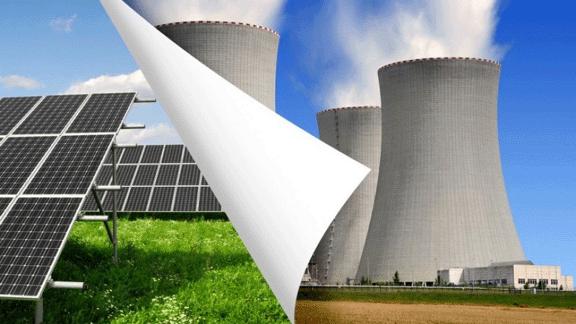 Current 12th June 2020, With renewable energy more cost-efficient than ever before, there is a clear opportunity to forward decarbonisation in COVID-19 recovery plans. A new report entitled Global Trends in Renewable Energy Investment 2020, put together by the UN Environment Programme (UNEP), the Frankfurt School-UNEP Collaborating Centre and BloombergNEF (BNEF), outlines that globally 2019 saw the highest investment in offshore wind in one year and highest solar power capacity additions in one year, while looking into investment trends for 2020.
As Germany transitions to renewables, massive nuclear cooling towers are demolished
WATCH GERMANY BLOW UP TWO NUCLEAR COOLING TOWERS AS MINISTER SAYS ‘THE FUTURE LIES IN RENEWABLE ENERGIES‘ NEWSWEEK, BY JASON MURDOCK ON 5/15/20 Drone footage shows the moment when two massive cooling towers at a former nuclear power plant in Germany were demolished in a controlled explosion.
Operator EnBW confirmed a demolition at the Philippsburg site, in southwest Germany, was initiated by targeted blasts in lower area of the towers and took place shortly after 6 a.m. yesterday, a scene which lacked spectators due to COVID-19 restrictions.
Officials described the change as being an “important milestone” in the nation’s energy transition, moving it one step closer to a greater reliance on renewables. Germany aims to see all nuclear plant reactors taken offline by the end of 2022.
The Philippsburg power plants’ reactors were previously shuttered in 2011 and 2019 as part of those plans, the Associated Press reported.
According to EnBW, the land will soon be used by TransnetBW, a subsidiary managing the state’s electricity grid, to house a converter that will bring power generated from renewable energies from the north to the south.
“Two relics of the nuclear power era are gone: a visible sign that the nuclear phase-out is progressing in Germany,” tweeted environment minister Svenja Schulze. “The last nuclear power plant will also be switched off by 2022. The future lies in renewable energies that are safer, cheaper and more sustainable.”……..
The Baden-Württemberg ministry explains on its website the move posed challenges for its industrial region, as its energy supply was once 50 percent from nuclear. Officials are now investing in renewable sources, including wind, solar and hydro. ……. https://www.newsweek.com/europe-germany-philippsburg-nuclear-power-cooling-towers-demolition-explosion-video-1504280
World’s Sixth Largest Economy, Going Nuclear-Free
Diablo Canyon nuclear plant to be shut down, power replaced by renewables, efficiency, storage https://foe.org/news/2016-06-diablo-canyon-nuclear-plant-to-be-shut-down/ California, World’s Sixth Largest Economy, Going Nuclear-Free, BERKELEY, CALIF. – An historic agreement has been reached between Pacific Gas and Electric, Friends of the Earth, and other environmental and labor organizations to replace the Diablo Canyon nuclear reactors with greenhouse-gas-free renewable energy, efficiency and energy storage resources. Friends of the Earth says the agreement provides a clear blueprint for fighting climate change by replacing nuclear and fossil fuel energy with safe, clean, cost-competitive renewable energy. Continue reading
South Korea, Germany to bolster ties in transition towards renewable energy
S. Korea, Germany to bolster ties in transition towards renewable energy
The cooperation came as a follow-up to an agreement reached by Industry Minister Sung Yun-mo and German counterpart Peter Altmaier in Berlin last year, in which they vowed to bolster cooperation in the energy segment.
Seoul and Berlin will especially focus efforts on cooperating deeper on their shift towards renewable energy, while phasing out nuclear energy…….
The two countries are both making efforts to reduce their coal-based power generation as well, with Germany planning to break away from the resource by 2038. South Korea also vowed to “significantly reduce” its consumption of coal. https://en.yna.co.kr/view/AEN20200512003700320?fbclid=IwAR1RpCGPA8_id6MKRdp3q4xHlK6-BjaQOf5lbJL5TIhbKP6kHqekyrZmMagcolin@yna.co.kr
Wind and solar power thriving in pandemic, but nuclear power going down the drain
 Nuclear is Getting Hammered by Green Power and the Pandemic, Plant operators are forced to switch uneconomic units off because of low prices and slumping demand. Bloomberg Green, May 4, 2020, “………Nations around the world have set tough targets to reduce greenhouse gases with the help of clean energy to meet commitments set out in the 2015 Paris Agreement.
In China, the coronavirus caused reduced output at CGN Power Co.’s atomic plants after the Lunar New Year holiday. Without taking into account the two reactors that came into operation in 2019, output at the remaining 22 units fell 4.7% in the first quarter from a year earlier, the company said.
After correcting for weather effects, full lockdowns reduced daily electricity demand by at least 15% in France, India, Italy, Spain, the U.K. and northwest U.S., the International Energy Agency said in a report on April 30. Global power consumption will decline as much as 5% this year, or the most since the Great Depression, according to the group advising the richest nations.
That will hurt all power sources, although use of renewables will still post a 1% gain this year, IEA said. Nuclear could drop by 3% from 2019 due to lower demand and delays to planned maintenance and construction of several projects, IEA said.
For example, EDF’s U.K. unit is undertaking more work than usual at its reactors, with five out of 15 units halted for long-term repairs. Output is below normal for the time of year. The company declined to comment on whether it was altering production due to rising renewables.
……. At Vattenfall, workers will permanently shut another old reactor at Ringhals by the end of the year, just after one unit was closed down in December. It would have been too costly to make the investments needed to keep them running any longer, the company has said.
And Hall, the boss, has a clear vision. While 5 billion kronor ($510 million) will be invested to secure safe operations at its nuclear and hydro plants this year and next, as much as 25 billion kronor will go to wind.
“We want to build more fossil-free generation and that is predominantly wind.” https://www.bloomberg.com/news/articles/2020-05-04/nuclear-is-getting-hammered-by-green-power-and-the-pandemic
Michael Moore’s sham attack on renewable energy has had rigorous debunking
Rolling Stone 1st May 2020, Bill McKibben: ‘A Bomb in the Center of the Climate Movement’: Michael Moore Damages Our Most Important Goal. Basically, Moore and his colleagues
have made a film attacking renewable energy as a sham and arguing that the environmental movement is just a tool of corporations trying to make money off green energy.
“One of the most dangerous things right now is the illusion that alternative technologies, like wind and solar, are somehow different from fossil fuels,” Ozzie Zehner, one of the film’s producers, tells the camera. When visiting a solar facility, he insists: “You use more fossil fuels to do this than you’re getting benefit from it. You would have been better off just burning the fossil fuels.”
That’s not true, not in the least — the time it takes for a solar panel to pay back the energy used to build it is well under four years. Since it lasts three decades, it means 90 percent of the power it produces is pollution-free, compared with zero percent of the power from burning fossil fuels.
It turns out that pretty much everything else about the movie was wrong — there have been at least 24 debunkings, many of them painfully rigorous; as one scientist wrote in a particularly scathing takedown, “Planet of the Humans is deeply useless. Watch anything else.”
Moore’s fellow filmmaker Josh Fox, in an epic unraveling of the film’s endless lies, got in one of the best shots: “Releasing this on the eve of Earth Day’s 50th anniversary is like Bernie Sanders endorsing Donald Trump while chugging hydroxychloroquine.”
Here’s long-time solar activist (and, oh yeah, the guy who wrote “Heart of Gold“) Neil Young:
“The amount of damage this film tries to create (succeeding in the VERY short term) will ultimately bring light to the real facts, which are turning up everywhere in response to Michael Moore’s new erroneous and headline grabbing TV publicity tour of misinformation. A very damaging film to the human struggle for a better way of living, Moore’s film completely destroys whatever reputation he has earned so far.”
Inside Climate News 30th April 2020, 6 Things Michael Moore’s ‘Planet of the Humans’ Gets Wrong. The documentary’s “facts” are deceptive and misleading, not to mention way out
of date. Filmmaker Michael Moore’s new documentary purports to expose hypocrisy at the heart of the renewable energy movement. But the video, released on YouTube last week, is a mess of deceptive and outdated anecdotes, and a succession of ridiculous arguments. It will almost
certainly do far more harm than good in the struggle to reduce carbon emissions.
Observer 3rd May 2020, Planet of the Humans is an environmental documentary that has enraged
renewable energy experts and environmentalists, with some calling for its high-profile executive producer, Michael Moore, to apologise. It was released for free less than two weeks ago, and at the time of writing had had close to 5m views on YouTube. Across its 102 minutes, the film’s
producer and narrator, Jeff Gibbs, weaves a disjointed narrative that renewable energy is just as bad  as fossil fuels, high-profile environmentalists are corrupted by capitalism and population growth is the great unspoken enemy. “It is truly demoralising how much damage this film has done at a moment when many are ready for deep change,” said the Canadian activist and journalist Naomi Klein.
Solar heating
well as solar electricity. It is clear than solar photovoltaic power generation is booming around the world, with over 580 GW of PV solar installed by the end of 2019, and much more expected, but it’s worth noting that there is also a large amount of direct solar heating system capacity in use (470 GW thermal), and that too is also growing.
large inter-seasonal heat stores, allowing summer heat to be used for winter warming via local district heating networks.
augments heat supplied by other means, including from biomass combustion, but new approaches are being adopted which enhance the solar and bioenergy input using large heat pumps. Although (fossil) gas fired heating still often has the edge, solar heating with heat stores can be competitive with other heating sources if district heating networks already exists, as they do in Denmark. And of course the carbon emissions associated with using
fossil gas are then avoided.https://renewextraweekly.blogspot.com/2020/05/solar-heats-up.html
Offshore wind is General Electric’s great opportunity, not dodgy Small Nuclear Reactors
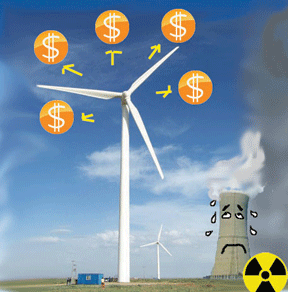 GE Power Plays: Wind Might Blow Coal, Gas And Nuclear Away, Seeking Alpha, Apr. 29, 2020 Keith Williams
GE offshore wind: massive offshore turbine Haliade-X 12MW looks like a winner.
GE-Hitachi Nuclear Energy may be a receding opportunity.
GE might sell its steam power business and rationalise its fossil fuel interests.
The power and renewables businesses are important in considering investment in GE.
………. Nuclear Small Modular Reactors : GE-Hitachi BWRX-300
There is a lot of talk in the nuclear industry and also in political circles from groups who are opposed to solar PV and wind developments, yet who acknowledge the need for low emissions technologies. The World Nuclear Association (WNA) has an excellent summary of many proposed developments in the area of Small Modular Nuclear Reactors (SMRs). The list of projects is long but many (most) seem to be struggling. A key point from the WNA report is the following : “Licensing is potentially a challenge for SMRs, as design certification, construction and operation licence costs are not necessarily less than for large reactors.” This is a huge red flag for any SMR project.
A second objection is cost of nuclear power versus solar PV/wind plus storage. There is a lot of information about these relative costs, including well into the future. I am not aware of any studies that suggest that any nuclear technology will be able to compete with renewables and storage on price. A recent study (December 2019) by the Australian Energy Market Operator (AEMO) and CSIRO concluded that SMR nuclear reactors will generate power costing ~8x that of rooftop or solar PV and wind, with solar and wind costs of power generation being similar.
……. With Small Modular Reactors the poster child of nuclear power supporters, it is clear that there is a lot riding on this potential saviour for the nuclear industry after Fukushima and recent delays and cost blowouts in the European (especially UK, French and Finnish) nuclear industries.
With current focus on emissions reductions and the climate emergency, this is an excellent time for low emissions technologies. However, the need is now and renewables (solar PV and wind) plus storage (pumped hydro and batteries) are making a lot of progress in addressing the needs. My question is whether the cost structure and long lead times mean that nuclear technology is too expensive and late to play a part.
A recent summary of the current state of the nuclear industry as a whole is depressing reading for someone who is enthusiastic about the nuclear industry’s prospects. A lot has to happen in the next decade and SMR technology isn’t ready yet. Is GE investing a lot in a technology that can’t compete with the dramatic advances in solar PV, wind and battery storage?……
GE’s adventures in nuclear developments seem like the kind of speculative play GE could happily fund when it was one of the world’s biggest and most powerful engineering companies. It doesn’t have that status anymore and my take is that it needs to cut its cloth and focus on projects that will have more immediate commercial outcomes. Of course, that is asking for a big rethink about how GE sees itself, but does it really have a choice if it wants to survive?
Offshore wind business
While there is some apprehension in the wind industry, especially in the US and China, as changes in regulations come into force next year, and 2020 has been messed up by COVID-19, there is a long-term future for wind power; offshore wind prospects look huge………
GE Renewable Energy is a major wind turbine supplier, with more than 42,000 of its turbines (mostly onshore) installed. Its role in the wind industry is extensive, from manufacture, digital optimization, operations and maintenance. Its onshore turbines range in size from 1MW to 5MW. GE installed ~50% of onshore turbines in the US last year, a 40% increase compared with the number of onshore turbines it installed in the US in 2018.
The offshore market is still emerging, with turbines substantially bigger than those used onshore. ….. The area that looks to me as if it could become a big winner is in offshore wind turbine developments, ….
A lot of investors have GE in their portfolios and a lot more are probably reflecting on whether GE might once again become a secure safe-haven investment. My biggest issue with GE is that it seems to me it is yet to understand that it is no longer the huge and dominant business that can afford to make big bets that burn a lot of cash. The current SMR nuclear programs in GE seem to be in this category. They have a very low chance of success but require major resources. I’d prefer not to have these distractions in a company I invest in….. https://seekingalpha.com/article/4340805-ge-power-plays-wind-might-blow-coal-gas-and-nuclear-away
Solar and Wind Cheapest Sources of Power in Most of the World
 Solar and Wind Cheapest Sources of Power in Most of the World https://www.bloomberg.com/news/articles/2020-04-28/solar-and-wind-cheapest-sources-of-power-in-most-of-the-world By Brian Eckhouse, April 28, 2020,
- Batteries also gaining against traditional energy sources
- Most competitive new power is wind in U.S., solar in China
Solar and onshore wind power are now the cheapest new sources of electricity in at least two-thirds of the world’s population, further threatening the two fossil-fuel stalwarts — coal and natural gas.
The levelized cost of electricity for onshore wind projects has fallen 9% to $44 a megawatt-hour since the second half of last year. Solar declined 4% to $50 a megawatt-hour, according to a report Tuesday by BloombergNEF.
The prices are even lower in countries including the U.S., China and Brazil. Equipment costs have come down, technologies have improved and governments across the world have boosted clean-power targets as they seek to combat climate change. That could squeeze out coal and natural gas when utilities develop new power plants.
“Best-in-class solar and wind projects will be pushing below $20 per megawatt-hour this side of 2030,” Tifenn Brandily, an analyst at BNEF, said in a statement. “There are plenty of innovations in the pipeline that will drive down costs further.”
Yet it remains unclear whether the coronavirus’ impact on coal and gas prices will erode the competitiveness of wind and solar. “If sustained, this could help shield fossil fuel generation for a while from the cost onslaught from renewables,” Seb Henbest, chief economist at BNEF, said in the statement.
A decade ago, solar was more than $300 a megawatt-hour and onshore wind exceeded $100 per megawatt-hour. Today, onshore wind is $37 in the U.S. and $30 in Brazil, while solar is $38 in China, the cheapest sources of new electricity in those countries.
Battery storage is also getting more competitive. The levelized cost of electricity for batteries has fallen to $150 a megawatt-hour, about half of what it was two years ago. That’s made it the cheapest new peaking-power technology in places that import gas, including Europe, China and Japan.
BNEF’s levelized cost for electricity measures the entire cost of producing power, accounting for development, construction and equipment, financing, feedstock, operation and maintenance.
European Solar Generation Breaks Records, As Coronavirus Shutdowns Reduce Air Pollution
|
As Coronavirus Shutdowns Reduce Air Pollution, European Solar Generation Breaks Records, 360 Yale, 23 Apr 20, Three of Europe’s biggest economies — Germany, Spain, and the United Kingdom — have recently achieved new records in solar generation, due in part to a drop in air pollution from coronavirus-related shutdowns, which has cleared skies and boosted production of photovoltaic cells, Greentech Media reported.
Germany generated a record-high 32.2 gigawatts (GW) of solar power earlier this week, accounting for 40 percent of the country’s electricity needs, according to Bloomberg News. And UK solar production peaked at 9.68 GW this week, up from a previous record of 9.55 GW set in May 2019, according to Sheffield Solar, a project of the University of Sheffield. In total, the UK has gone without coal power on its grid for nearly two weeks….. Spain’s record-high solar production is the result of last year’s boost in installations, which expanded new capacity by 4.7 gigawatts. On March 26, Spain generated 6.3 GW of solar power, accounting for about a quarter of the country’s electricity needs. https://e360.yale.edu/digest/as-coronavirus-shutdowns-reduce-air-pollution-european-solar-generation-breaks-records |
|
|
EDF nuclear power company looks to a profitable future in small-scale, distributed RENEWABLE energy
Can EDF Make Big Money in Small-Scale Renewables?, Greentech Media
The world’s leading nuclear power generator is betting big on a future of small-scale, distributed energy.
Électricité de France operates 58 nuclear reactors in its home country and owns stakes in several U.S. nuclear plants that it’s now moving to sell. But EDF’s biggest stamp on the American power market has come in large-scale renewables: Its San Diego-based EDF Renewables North America subsidiary has developed and now operates gigawatts of wind and solar farms across the country.
Now, EDF Renewables is trying to replicate that success on a much smaller scale. How it fares in the distributed space will be of great interest to other 20th-century energy giants feeling their way toward a transformed, low-carbon future.
Over the past few years, and largely through acquisitions, EDF Renewables has amassed one of the most comprehensive U.S. distributed energy businesses, covering solar, energy storage, microgrids and electric vehicle chargers.
The coronavirus crisis may open the door to more dealmaking, said Raphael Declercq, who runs the Distributed Solutions unit at EDF Renewables North America. “There will be some casualties in our sector: Assets seemed overpriced up to a month ago; that may change and we may be able to grow through acquisitions,” Declercq told GTM.
Several European energy giants have been on a recent shopping spree for distributed energy companies in the startup-rich U.S. — notably Shell, EDF and Enel. Without their own U.S.-based utilities to worry about taking business from, they can roll up fleets of behind-the-meter energy assets and deliver power to customers in new ways, while learning lessons that can be applied in other markets.
“It’s a grab game right now, getting as much of that value chain as possible,” said Elta Kolo, content lead for grid edge research at Wood Mackenzie. “In a way, you’re almost seeing a new type of utility emerging in the market,” she said.
It’s a hazardous moment for the energy industry, oil companies and utilities alike. State-controlled EDF last week pulled its financial guidance for 2020 and 2021, saying it expects a sharp drop in its French nuclear output this year as the coronavirus outbreak depresses power demand…….
The rising importance of corporate renewables…….
Investment in green energy could drive Covid-19 recovery – International Renewable Energy Agency report
|
The agency’s director general, Francesco La Camera, said the global crisis ignited by the coronavirus outbreak exposed “the deep vulnerabilities of the current system” and urged governments to invest in renewable energy to kickstart economic growth and help meet climate targets. The agency’s landmark report found that accelerating investment in renewable energy would help tackle the climate crisis and would in effect pay for itself. Investing in renewable energy would deliver global GDP gains of $98tn above a business-as-usual scenario by 2050 by returning between $3 and $8 on every dollar invested. It would also quadruple the number of jobs in the sector to 42m over the next 30 years, and measurably improve global health and welfare scores, according to the report. “Governments are facing a difficult task of bringing the health emergency under control while introducing major stimulus and recovery measures,” La Camera said. “By accelerating renewables and making the energy transition an integral part of the wider recovery, governments can achieve multiple economic and social objectives in the pursuit of a resilient future that leaves nobody behind.” The report also found that renewable energy could curb the rise in global temperatures by helping to reduce the energy industry’s carbon dioxide emissions by 70% by 2050 by replacing fossil fuels. Renewables could play a greater role in cutting carbon emissions from heavy industry and transport to reach virtually zero emissions by 2050, particularly by investing in green hydrogen…… The call for a green economic recovery from the coronavirus crisis comes after a warning from Dr Fatih Birol, head of the International Energy Agency, that government policies must be put in place to avoid an investment hiatus in the energy transition. “We should not allow today’s crisis to compromise the clean energy transition,” he said. “We have an important window of opportunity.”….. https://www.theguardian.com/environment/2020/apr/20/green-energy-could-drive-covid-19-recovery-international-renewable-energy-agency |
|

1 This Month
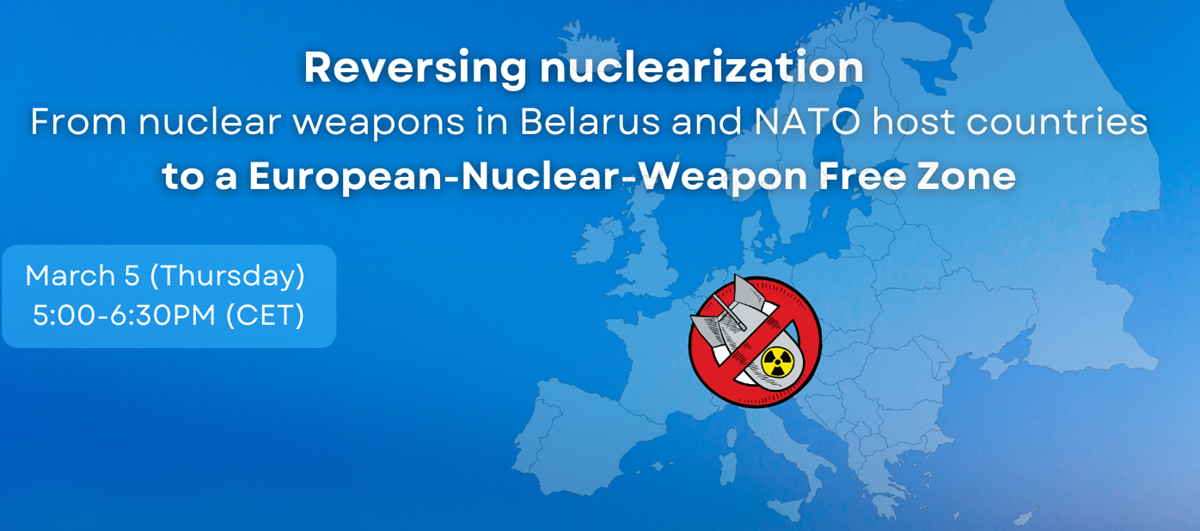
5 March -Online – Reversing nuclearization:
From nuclear weapons in Belarus and NATO host countries to a European-Nuclear-Weapon Free Zone
11am-12:30pm Eastern Time USA / 5pm-6:30pm CET

of the week – Advocating for a
nuclear free beach – https://www.samuellawrencefoundation.org/
The Samuel Lawrence Foundation advocates for a Nuclear Waste Free Beach at San Onofre, join us and take action!

10 March A LIVE WEBINAR THE REAL EFFECTS OF NUCLEAR POWER
What the Industry Isn’t Telling Us
1:00 PM Mountain, 2 pm Central, 3 pm Eastern. Live on the Keepers of the Water Facebook page

18 March Webinar @ 1 PM EST: An Assessment of SMR Projects: The Case of Canada
register for the zoom:
https://us02web.zoom.us/webinar/register/WN_o8BIIOUvQ2ONJR1nta65DQ#/registration

of the week – STOP SMALL MODULAR REACTORS IN CANADA
To see nuclear-related stories in greater depth and intensity – go to https://nuclearinformation.wordpress.com
-
Archives
- March 2026 (51)
- February 2026 (268)
- January 2026 (308)
- December 2025 (358)
- November 2025 (359)
- October 2025 (376)
- September 2025 (258)
- August 2025 (319)
- July 2025 (230)
- June 2025 (348)
- May 2025 (261)
- April 2025 (305)
-
Categories
- 1
- 1 NUCLEAR ISSUES
- business and costs
- climate change
- culture and arts
- ENERGY
- environment
- health
- history
- indigenous issues
- Legal
- marketing of nuclear
- media
- opposition to nuclear
- PERSONAL STORIES
- politics
- politics international
- Religion and ethics
- safety
- secrets,lies and civil liberties
- spinbuster
- technology
- Uranium
- wastes
- weapons and war
- Women
- 2 WORLD
- ACTION
- AFRICA
- Atrocities
- AUSTRALIA
- Christina's notes
- Christina's themes
- culture and arts
- Events
- Fuk 2022
- Fuk 2023
- Fukushima 2017
- Fukushima 2018
- fukushima 2019
- Fukushima 2020
- Fukushima 2021
- general
- global warming
- Humour (God we need it)
- Nuclear
- RARE EARTHS
- Reference
- resources – print
- Resources -audiovicual
- Weekly Newsletter
- World
- World Nuclear
- YouTube
-
RSS
Entries RSS
Comments RSS
 nuclear-news