Renewables are beating nuclear
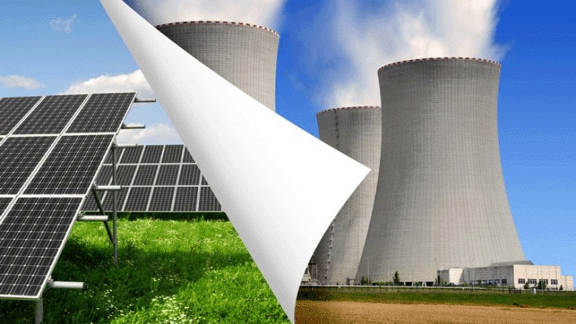
It’s Not a Competition, But Renewables Are Beating Nuclear Anyway, Bloomberg Green By Nathaniel Bullard19 August 2021, Energy giant BP Plc has been publishing its annual review of global energy statistics for seven decades. (I’ve been reading it — and digesting its data — for about a fifth of that time.)
The latest edition published in July is, understandably, quite focused on the largest year-on-year decline in primary energy consumption since 1945. But there’s another finding worth noting: 2020 was the first year in which renewable power generation (excluding hydro) surpassed nuclear power generation.
……..with nuclear generation basically flat since the turn of the century and renewables continuing to grow, the latter caught the former in 2020.
[on original – graph showing dramatic rise in renewable energy, uneven output of nuclear] Compare the shape of the renewables curve to nuclear’s. The perfectly smooth renewables curve is an aggregate of hundreds of geothermal plants, thousands of biomass turbines, a-third-of-a-million wind turbines, and more than a billion photovoltaic modules, installed across numerous global markets. It shows not a single annual decline in more than 50 years.
Nuclear is basically the opposite: a single technology with a small number of plants in an even smaller number of markets. Many discrete decisions — whether to embark on a massive expansion in one market, say, or to shut down generation for years in the wake of disaster — are visible in this chart. There, in 2011, is the Japanese nuclear fleet response to the Tōhoku earthquake and ensuing tsunami. And we don’t need to squint to see the shutdown of six plants last year in the U.S, Sweden, Russia, and France.
This is what the nuclear fleet’s growth trajectory looks like, according to the International Atomic Energy Agency: basically flat in the 21st century, with only four more plants operational now than in 2001.
Nuclear plants are also pretty old. Most were designed for a 40-year useful life, and a lot of them are approaching that age now—a full 45% are between the ages of 31 and 40. There are more nuclear plants older than 46 than there are those under 6.
………. It takes years, sometimes a decade or more, to bring a nuclear plant into full operation, which means that there’s a significant lag between when construction starts and when the finished facility is connected to the grid. New nuclear construction in the U.S. is also running over schedule and over budget, for many reasons………. https://www.bloomberg.com/news/articles/2021-08-19/it-s-not-a-competition-but-renewables-are-beating-nuclear-anyway
An expert explains that the Philippines’ nuclear power plant would be OK, but solar power would be faster and better.
Instead of nuclear power, why not solar power? https://opinion.inquirer.net/143165/instead-of-nuclear-power-why-not-solar-power Philippine Daily Inquirer August 17, 2021, Last July 8, Peter Wallace wrote in his column about nuclear power plants being safe and that there are many countries operating their nuclear power plants safely over the last 50 years: the United States, Germany, Taiwan, Japan. etc.
I agree about recommissioning the Bataan nuclear plant. As a chemical engineer, I can say that we have enough controls to operate it safely.
However, reviving the Bataan plant will take at least five years. Why not recommend the use of solar panels instead, per Republic Act No. 11285 or the Energy Efficiency and Conservation Act, which requires building owners to use renewable sources like solar? The Philippines is the only country in the world with 2,000 hours of sun per year.
Germany went on to use solar panel systems on roofs and, in a short period of time, four million houses have been generating power, resulting in the shutdown of many coal plants. In the United States, New York appointed an energy czar to speed up the use of renewable energy.
Australia gives incentives to households that use solar batteries. lberdrola Spain has made tremendous progress on the use of renewable energy, becoming one of the top five electric utility companies in the world. Portugal and Spain have invested in photovoltaic battery storage systems.
Comparing the costs of nuclear and solar power
Solar challenging nuclear as potential climate change solution https://www.pv-magazine.com/2021/08/09/solar-challenging-nuclear-as-potential-climate-change-solution/
Research suggests that we can power 80% of the United States with wind, solar, and 12 hours of energy storage, but the replacement of nuclear power plants hasn’t been financially viable. Is that about to change?AUGUST 9, 2021 JOHN FITZGERALD WEAVER Nuclear power delivers almost 20% of all electricity in the United States, and about 50% [ if you don’t count the uranium-nuclear fuel chain] of all low-emission electricity. Moreover, the United States has almost 100 nuclear power units operating more than 90% of the time, providing a steady base of power generation.
But moving forward, it seems nuclear has lost its swagger. Price increases, project delays, and cancellations have caused what may prove to be generational damage to nuclear power’s reputation. pv magazine USA has previously reported on industry pricing models, showing nuclear’s lagging pricing.
Now, Georgia Power’s Vogtle Unit 3 and Unit 4 – the nation’s only nuclear generating units currently under construction – have announced further delays and price increases. Conservative cost estimates suggest the two 1.117 GW facilities will require at least $30 billion to complete, including $3 billion in finance costs and $27 billion in construction costs.
Solar+storage costs
As solar and energy storage professionals, we must be conscious of the limitations of the sun, and the cost of energy storage. As we all know, the sun also sets. And while research suggests we can power 80% of the U.S. with wind, solar, and 12 hours of energy storage, being able to replace a nuclear power plant that runs 24/7/365 in wind, rain, snow, and sleet simply hasn’t been financially viable.
But is it today?
The chart above [ on original] shows the price of solar panels from 1976 through the end of 2019. Here, we see prices fall by more than 99.8% from over $100 per watt down to nearly $0.20 per watt. Below, we see the price of battery packs starting in 2010 and ending in 2020, based on data from Bloomberg New Energy Finance. Here, we see costs fall from $1,191/kWh to $137/kWh – a price decrease of greater than 88%.
In both cases, we can expect prices to continue trending downward in both the middle and long term. And so, what can we expect to pay when we replace a nuclear power plant with solar power plus batteries?
Cash to spend
The chart above [ on original] shows the price of solar panels from 1976 through the end of 2019. Here, we see prices fall by more than 99.8% from over $100 per watt down to nearly $0.20 per watt. Below, we see the price of battery packs starting in 2010 and ending in 2020, based on data from Bloomberg New Energy Finance. Here, we see costs fall from $1,191/kWh to $137/kWh – a price decrease of greater than 88%.
In both cases, we can expect prices to continue trending downward in both the middle and long term. And so, what can we expect to pay when we replace a nuclear power plant with solar power plus batteries?
Cash to spend
In order to replace the two nuclear plants while the sun is down, the batteries would need to replicate two 1.117 GW power sources for 16 hours. The total energy storage capacity would be 39.3 GWh, after we add an extra 10% for safe measure.
Roughly speaking, the total cost of these solar+storage facilities would be:
- $8.4 billion for 10.55 GWdc of solar power, fully installed at $0.80/watt
- $527 million for hypothetical power grid upgrades at $0.05/watt
- $7.8 billion for 39.3 GWh of energy storage fully installed at $200/kWh
- Around $16.8 billion grand total, no incentives
So, Georgia, pv magazine USA just saved you more than $13 billion (as of today, anyway).
Some caveats
It’s almost certain that a solar facility of this magnitude – roughly 27,000 acres, or around 0.07% of Georgia’s land – would be split among many landowners in the state. If land lease rates in Georgia are comparable to what might be earned in Pennsylvania, the project could provide as much as $27 million per year in income to Georgia landowners for decades to come.
Furthermore, the solar power plants would start generating electricity and revenue within about three years of the first signature, and two years after groundbreaking. The new Vogtle reactors began construction in 2013 (planning began much earlier), and are projected to complete in 2022-23.
With these considerations in mind, the repowering costs to get a solar+storage facility to a 40 to 80-year lifetime would likely be offset by the fact that the solar facility will enter service at least eight years earlier than the equivalent nuclear site. Additionally, during the solar plant’s operating lifetime, it saves massive amounts of regular operations and maintenance costs,
as well as specialist engineer labor costs. The nuclear facility will easily last 40 years, and potentially as long as 80. However, the ongoing operations and maintenance costs are significant, as well as upgrades and equipment replacements that start to become necessary after 40 years. And sometimes, those $1 billion dollar upgrades go wrong, and a nuclear power plant gets trashed.
When we do repower the batteries and solar panels, they almost certainly will be cheaper, and operate at a higher efficiency, likely stretching the life of the solar facility to 50+ years. Again, this solar+storage facility would generate 20% more juice in the summer (when the power is needed most in Georgia) because we oversized it for the winter.
In the end, it would be best if we had a healthy ecosystem of clean energy generation systems that include nuclear [but nuclear is not clean]. However, if we’re going to debate the costs of nukes vs. solar, then it is no longer a discussion.
US Renewables Generated More Power Than Coal Or Nuclear In 2020 For First Time
US Renewables Generated More Power Than Coal Or Nuclear In 2020 For First Time, IFL SCience, Jack Dunhill, 3 Aug 21, Renewables produced more power than coal or nuclear power in the USA last year for the first time in history, according to a new report by the Energy Information Administration. With surges in wind, solar and hydroelectric power, the renewable industry produced 21 percent of all electricity generation in the US last year, a massive increase over the previous decade.
Over the past year, the US has seen record growth in renewable power generation, adding 26 gigawatts of production capability in 2020 alone, 80 percent more than 2019. Combined with previous infrastructure, it brought the total renewable power production up to 170 gigawatts, which edged out both nuclear and coal by just a few percent (20 percent and 19 percent of total energy production, respectively). ….. https://www.iflscience.com/environment/us-renewables-generated-more-power-than-coal-or-nuclear-in-2020-for-first-time
Australia’s carbon emissions down 20% due to wide take-up of renewable energy

Telegraph UK, 29th July 2021, For Australia’s part, our experience with technology-orientated pathways
gives us confidence that with the right investments and partnerships, a prosperous net-zero world is well within our reach.
On the ground, our real-world rollout of renewables has made clear to Australian firms and families the immense benefits of investing in clean technology. Because of their embrace of our new energy future, Australia’s emissions are down over 20 per cent on 2005 levels and green technology continues to be taken
up at record levels right across our nation.
https://www.telegraph.co.uk/news/2021/07/29/technology-key-free-prosperous-net-zero-world/
Renewables overtook coal and nuclear power generation in the U.S last year .
RENEWABLES OVERTOOK COAL AND NUCLEAR POWER GENERATION IN THE US LAST YEAR by,VICTOR TANGERMANN, 30 July 21,
CLEARER SKIES AHEAD. For the first time in US history, renewables became the second-most prevalent electricity source in 2020 after natural gas, according to the US Energy Information Administration (EIA).
In 2020, renewable energy sources —including wind, solar, hydroelectric, and geothermal — accounted for 21 percent of all the electricity generated in the country. Coal represented just 19 percent, while nuclear power accounted for 20 percent.,,,,,,,,, https://futurism.com/the-byte/renewables-overtook-coal-and-nuclear-power-generation-us
Japanese govt’s new Basic Energy Plan will prioritise renewable energy
The industry ministry July 21 laid out its vision for a cleaner energy future in its draft new Basic Energy Plan. The blueprint gives a breakdown of energy sources to power the nation in fiscal 2030 to achieve the
government’s goal of carbon neutrality, or net-zero carbon dioxide emissions, in 2050. It states that promoting renewable energy sources should be the policy priority and set a target of raising the share of
renewables in the nation’s overall power output by 14 points to 36-38 percent in fiscal 2030.
The ministry deserves to be lauded for declaring that renewables should a primary energy source. But its decision to maintain the share of nuclear power at the current level of 20-22 percent is baffling.
Asahi Shimbun 24th July 2021
Greenpeace Rainbow Warrier aims to help workers to transition to renewable energy work
The Greenpeace Rainbow Warrior III ship is in Aberdeen Harbour as part of its Just Transition Tour. The campaign calls on government to train oil and gas workers for a smooth transition to renewable energy schemes. The 190-ft vessel will moor overnight in Aberdeen before heading for Wick with sights set on the 84-turbine Beatrice offshore windfarm sitting lying nine miles off the Caithness coast. The intrepid crew are keen to assess “the challenges and opportunities” facing the platforms’ workers.
Greenpeace UK’s oil campaign leader Mel Evans, head said offshore workers had their full support. He added: They have powered our economy through difficult times and they have plenty of transferable skills which will be vital to our transition to renewable energy. “Politicians must sit down with offshore workers and take urgent action to make the funds, retraining opportunities and jobs available to make Scotland’s clean energy transition a success.”
Evening Express 18th July 2021
UK government’s pointless pursuit ofnuclear power, as renewable energy proving to be cheaper and faster.
Renewable energy, mainly wind and solar, is rising on the back of rapidly falling costs. So much so that the International Energy Agency, which has in the past been rather guarded about their potential, has switched over to seeing them as the main way ahead, supplying 90% of global electric power by 2050.
| Dave Elliott: No room for nuclear. As noted in an article in Regional Life, a local conservation e-magazine linked to a local anti nuclear group, the flat landscape of the Dengie peninsula in Essex is punctuated by a line of tall wind turbines, slowly turning and the massive grey-blue hulk of the former Bradwell ‘A’ nuclear power station. These two features it says graphically express the contrast between rise of renewable energy and the demise of nuclear power, the past and the future of electricity generation. Renewable energy, mainly wind and solar, is rising on the back of rapidly falling costs. So much so that the International Energy Agency, which has in the past been rather guarded about their potential, has switched over to seeing them as the main way ahead, supplying 90% of global electric power by 2050. That is actually quite conservative compared to some projections for the UK: renewables are supplying over 43% of UK power at present and the Renewable Energy Association says that reaching 100% is possible by 2032 – indeed Scotland is already almost there. All of which raises thequestion of why we are still pursuing nuclear power- which just about everyone agrees is very much more expensive than wind and solar. The recent BBC TV documentary series on construction work at Hinkley Point C in Somerset made stunningly clear the massive scale and environmental footprint of nuclear projects like this. Especially notable was the vast amount of concrete that had to be poured- the production of which involves significant release of carbon dioxide gas. That is one reason why nuclear plants are not zero carbon options, another being the fact that mining and processing uranium fuel are energy and carbon intensive activities. By contrast, renewable energy systems like solar cells and wind turbines need no fuel to run, and, although energy is needed to make the materials used in their construction, the net carbon/energy lifetime debt is less than for nuclear- one study suggested nuclear produces on average 23 times more emissions than onshore wind per unit electricity generated. The Government’s stated aim is to generate ‘enough electricity from offshore wind to power every home by 2030’. That means many more offshore wind farms, off the East coast and also elsewhere around the UK. With the other renewables also added in and more of them planned (we have 14 GW of solar capacity so far) it is hard to see what the nuclear plants are for – the 9 GW or so of old plants and the new 3.2 GW Hinkley Point C plant, much less any other proposed new ones. The nuclear lobby sometimes argues we need more nuclear to replace nuclear plants that are being closed and also to back up renewables. It is hard to see how that could work, unless the new plants were flexible, and able to compensate for the variable output of the 30GW or so of wind and solar capacity we have at present. As yet there are no plans to run the Hinkley Point C plant that way, or for that matter, the proposed 3.2 GW Sizewell C. In which case, adding more nuclear will mean that, at times of low demand, some cheap renewable output, or some low cost flexible gas plant output, would have to be curtailed. What a waste! All of this to keep the £22bn Hinkley Point, and any that follow, financially viable. Renew Extra 17th July 2021 https://renewextraweekly.blogspot.com/2021/07/no-room-for-nuclear.html |

Japan’s government acknowledges that solar power will be cheaper than nuclear
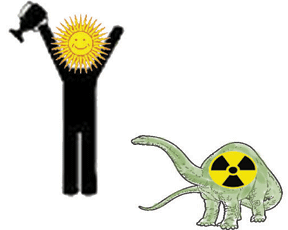
Solar power eclipses nuclear energy in terms of costs, Asahi Shimbun, By SATOSHI SHINDEN/ Staff Writer, July 13, 2021 For businesses looking ahead to reduce costs, solar power would definitely seem to be the way to go. Households could possibly benefit as well.
A new estimate by the industry ministry on future costs of power generation found that solar power will eclipse nuclear energy in terms of costs as of 2030.
The finding, released July 12, is expected to have significant implications for the nation’s energy policy.
This is the first time for the Ministry of Economy, Trade and Industry to acknowledge that the cost to generate solar power will be lower than that for nuclear power.
The estimates were presented at a meeting of a working group of the Advisory Committee for Natural Resources and Energy the same day.
Estimated costs for nuclear power came to close to the 12 yen level or more per kilowatt-hour as of 2030, about 1 yen higher than the previous estimate in 2015.
Costs for solar power ranged from the lower 8 yen level to close to 12 yen for businesses. The rate for homes was estimated at between the last half of the 9 yen level to the first half of the 14 yen level.
The government and electric utilities have continued to champion nuclear power generation even after the 2011 triple meltdown at the Fukushima No. 1 nuclear plant, citing cost efficiency over other energy sources.
However, the latest estimates would seem to call the legitimacy of that argument into question and will likely have an impact on the government’s Basic Energy Plan, for which officials are working to revise.
The Basic Energy Plan is updated almost every three years.
“The industry ministry has finally acknowledged it can no longer maintain the position that nuclear power is the most economical source of energy,” noted Kenichi Oshima, a professor of environmental economics at Ryukoku University who studies the nation’s nuclear policy, referring to the latest findings about costs.
The estimated costs for generating electricity with nuclear energy have risen each time calculations were made.
The ministry was forced to include ballooning costs for decommissioning of nuclear reactors and decontaminating crippled facilities in the aftermath of the Fukushima nuclear disaster…..
solar energy is getting cheaper.
The latest estimate for solar power was down from the previous calculation in 2015 because the costs of installing solar panels are dropping.
Charges for generating electricity are calculated as follows: the total cost of building a new power facility, operating it for decades and finally dismantling it divided by the overall amount of power produced during the period…… https://www.asahi.com/ajw/articles/14394069
Rapid growth of renewable energy: it’s the major energy source in Europe
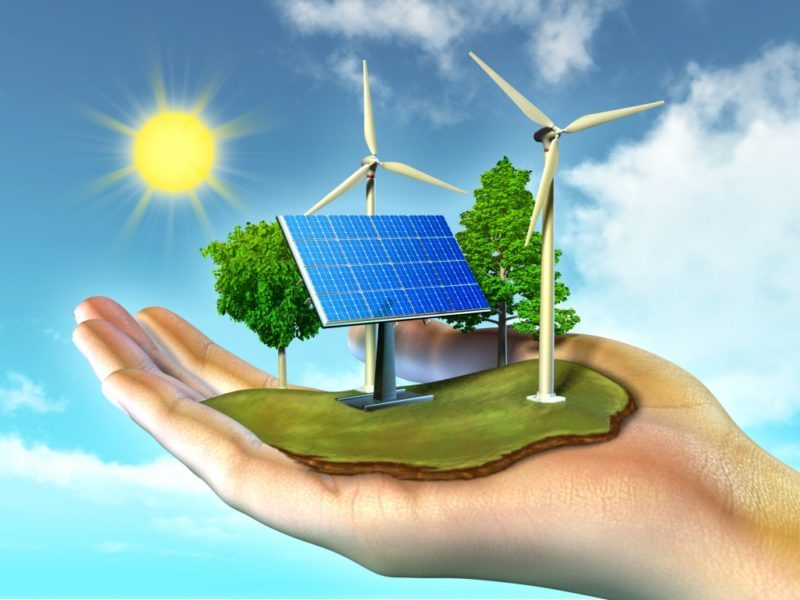
Renewable energy capacity around the world grew by a record amount during 2020, even as China continued to build new fossil-fuel burning coal plants. Capacity of wind and solar power grew by 238GW globally – about 50pc larger
than any previous expansion, according to the latest annual review of world energy by oil and gas giant BP.
The jump in renewable output amounts to about seven times the total installed capacity in the UK, and came in a
year marked by a slump in energy use as the pandemic triggered a slowdown in global travel. The share of renewable power, including wind and solar, in the global power mix also rose from 10.3pc to 11.7pc. In Europe, that share reached 23.8pc, making it the first region where renewables are the main source of fuel, BP said.
Telegraph 8th July 2021
https://www.telegraph.co.uk/business/2021/07/08/wind-solar-power-surges-record-year/
Even this conservative journal recognises renewables as the only meaningful future energy source – nuclear is irrelevant

Regardless of what the nuclear industry itself wants, the signs are that renewables may be defining themselves not only as the cheapest, but also as the only meaningful energy proposal for the future.
Let’s Leave Nuclear Power In The Past https://www.forbes.com/sites/enriquedans/2021/06/30/lets-leave-nuclear-power-in-thepast/?sh=4beadbb23864 Enrique Dans, Senior Contributor

It makes a lot of sense to start this article by linking to the old smiling sun badge that symbolizes the opposition to nuclear energy, to talk about the increasingly negative perceptions of nuclear power around the world, to the point where, with the exception of a few unconditional enthusiasts, it is beginning to be seen as a technology with less and less of a role in the world’s energy future.

During the 1950s, the term atomic age was widely used to describe a future where all energy would be based on nuclear fission, one in which energy would be so cheap and inexhaustible that it wouldn’t be worth metering it, to the point that it would be used not only to make weapons or provide energy, but even to power cars like the Ford Nucleon, to heat water in swimming pools, to keep artificial hearts beating and even for the mechanism of a ballpoint pen.
What happened? First, the obvious problem of safety: in a world with an increasingly unstable climate and more extreme weather phenomena, nuclear power plants are, as the tenth anniversary of the Fukushima accident on March 11 reminded us, a reckless option. Germany became the first major economy to commit to retiring its nuclear power plants by 2022, but China also seems to be losing interest in the technology due to cost and safety concerns, while nuclear power is relegated to a token role in the US energy map.

Large reactors cannot compete with low renewable energy prices. Many of them have already closed, and furthermore, due to their high cost, complexity and difficulties, it seems very unlikely that any new large plants will be built in the coming decades. Nuclear power has turned out to be a promise that never materializes, and looks increasingly remote as an answer to the climate emergency.

Some point to small modular reactors (SMRs) as the only option that could be implemented on a significant scale in the climate-critical period of the next few decades, but quite a few analyses suggest this is extremely unlikely to happen.
The option that seemed the most obvious can easily be sidelined as new technologies develop and undergo their own economies of scale. Nuclear power, which still generates around 10% of the world’s total energy, is now seen as too slow, too expensive and too dangerous, something no one wants to see being built near their home or town. Regardless of what the nuclear industry itself wants, the signs are that renewables may be defining themselves not only as the cheapest, but also as the only meaningful energy proposal for the future.
Germany’s success in phasing out nuclear energy, and remarkable uptake of solar.

Germany’s nuclear phase out expected to be complete by 2022 as country
cuts capacity by over 60% last decade, says GlobalData. Between 2010 and
2020, installed nuclear capacity in Germany declined from 20.5GW to 8.1GW,
according to GlobalData, which estimates the country will reach 4.1GW by
the end of this year.
The leading data and analytics company notes that
this progression sets Germany on track to completely phase out nuclear by
2022. Rohit Ravetkar, Power Analyst at GlobalData says: “The German
Government has made steady progress towards the elimination of nuclear
power following the Fukushima nuclear disaster in Japan.
Under the Energiewende policy, the country’s aim to fill its power generation void
with renewable power includes a planned increase of solar PV capacity to
100GW by 2030.
The expansion of solar PV systems has been the most
successful in Germany, increasing at an impressive compound annual growth
rate (CAGR) of 11.6% between 2010 and 2020.” Germany has been at the
forefront in the adoption of solar PV technology since 2000. The country
launched the 100,000 rooftop PV program way back in 1999, providing a
significant push to the solar PV technology.
Global Data 29th June 2021
New UK energy report – need for investment in wind and solar, no need for new nuclear.
The UK should grow its solar capacity to 210GW by 2050, unlocking a low
cost transition to net zero, a new report has found. Wind and solar will
need increased investment to grow to generate 98% of the electricity mix,
up from 27% in 2020, according to the report, published by energy provider
Good Energy with modelling from the Energy Systems Catapult (ESC).
Solar Power Portal 22nd June 2021
This will require over 200GW of solar, as well as 150GW of wind and 100GW of
lithium-ion battery energy storage, the Renewable Nation: Pathways to a
Zero Carbon Britain report has said. A substantial amount of that growth is
possible by the end of this decade, with 100GW of solar and 70GW of wind
needed to produce 84% of the country’s electricity by 2030.
The report – which is the first to use the ESC’s Storage and Flexibility model,
which itself combines long-term investment planning with hour-by-hour grid
balancing – found that no new nuclear beyond that under construction
currently was needed for net zero.
Renewable energy consumption grew in 2020 as fossil fuels and nuclear shrank.
Sunrise brief: Renewable energy consumption grew in 2020 as fossil fuels and nuclear shrank, PV Magazine , 17 June 21,
Also on the rise: Black & Veatch unit sets financing for 137 MW Texas project, Rockefeller Foundation partners to fund distributed renewable projects in Africa, and DroneBase closes a funding round as it expands its solar presence.JUNE 16, 2021 DAVID WAGMAN Consumption of renewable energy grew for the fifth year in a row in 2020, reaching a record high of 11.6 quadrillion British thermal units (Btu), or 12% of total U.S. energy consumption.
The Energy Information Administration (EIA) reported the data and said that renewable energy was the only source that increased in 2020 from 2019; fossil fuel and nuclear consumption declined.
Hydroelectric power accounted for about 22% of U.S. renewable energy consumption. Consumption has remained relatively flat since the 1970s, but fluctuates with seasonal rainfall and drought conditions.
Financing set for Texas solar project
Black & Veatch unit Diode Ventures said it reached financial close on the Grizzly Ridge Solar Project, a 137.7 MW solar project located in Hamilton County, Texas, southwest of Fort Worth. The project was co-developed with RKB Energy. Details of the financing were not disclosed.
Once complete, Grizzly Ridge will provide energy to the ERCOT North Zone, a growing economy and power market where there is high demand for all forms of electricity.
The project has an executed interconnection agreement with Brazos Electric Cooperative, the transmission service provider. The area will undergo an upgrade from 69 kV to 138 kV. Diode also is in discussions to add an on-site battery energy storage system to the project.
Rockefeller Foundation partners to bolster renewables
The International Finance Corp., the private sector arm of the World Bank Group, and The Rockefeller Foundation announced a partnership to deploy $150 million of capital in blended finance to leverage up to $2 billion of private sector investment in distributed renewable energy.
The two will prioritize countries in Sub-Saharan Africa and other regions, where both organizations have identified immediate opportunities.
By blending philanthropic and private investment funding, the Rockefeller Foundation and IFC hope to de-risk capital investment in distributed renewable projects in emerging markets and help to address global energy access needs.
An initial “rapid deployment” phase will distribute $30 million in blended concessional finance and grant capital to leverage an active pipeline of distributed renewable energy projects developed by IFC. The funding will go toward IFC’s prototype scaling mini-grid program in addition to distributed renewable energy generation, battery energy storage, and other clean energy technologies to facilitate access………. https://pv-magazine-usa.com/2021/06/16/sunrise-brief-renewable-energy-consumption-grew-in-2020-as-fossil-fuels-and-nuclear-shrank/
1 This Month

of the week – Shut Down Drone Warfare!


Tell the Ukrainian Government to Drop Prosecution of Peace Activist Yurii Sheliazhenko

Petition to revoke the licensing of the Near Surface Nuclear Disposal Facility (NSDF) at Chalk River. https://www.ourcommons.ca/petitions/en/Petition/Details?Petition=e-7247
To see nuclear-related stories in greater depth and intensity – go to https://nuclearinformation.wordpress.com
-
Archives
- April 2026 (19)
- March 2026 (251)
- February 2026 (268)
- January 2026 (308)
- December 2025 (358)
- November 2025 (359)
- October 2025 (376)
- September 2025 (257)
- August 2025 (319)
- July 2025 (230)
- June 2025 (348)
- May 2025 (261)
-
Categories
- 1
- 1 NUCLEAR ISSUES
- business and costs
- climate change
- culture and arts
- ENERGY
- environment
- health
- history
- indigenous issues
- Legal
- marketing of nuclear
- media
- opposition to nuclear
- PERSONAL STORIES
- politics
- politics international
- Religion and ethics
- safety
- secrets,lies and civil liberties
- spinbuster
- technology
- Uranium
- wastes
- weapons and war
- Women
- 2 WORLD
- ACTION
- AFRICA
- Atrocities
- AUSTRALIA
- Christina's notes
- Christina's themes
- culture and arts
- Events
- Fuk 2022
- Fuk 2023
- Fukushima 2017
- Fukushima 2018
- fukushima 2019
- Fukushima 2020
- Fukushima 2021
- general
- global warming
- Humour (God we need it)
- Nuclear
- RARE EARTHS
- Reference
- resources – print
- Resources -audiovicual
- Weekly Newsletter
- World
- World Nuclear
- YouTube
-
RSS
Entries RSS
Comments RSS
 nuclear-news