Local MP has vision for a non-nuclear future for Hunterston
LOCAL MP Patricia Gibson has spoken of her vision for a non-nuclear future
for Hunterston. The Westminster politician has thrown her weight behind a
call to develop a green energy plan for the site. She said: “The closure of
Hunterston B is the end of an era for North Ayrshire, regardless of
anyone’s views on nuclear power. “Jobs have been lost, with many more to
follow over the next eight years as the plant defuels and is then
decommissioned. “A plan to transition to new green energy generation at
this prime location must now be taken forward with a renewed sense of
urgency.
Largs & Millport News 24th Jan 2022
Transistion to genuinely clean energy has succeeded in many cases, including economically
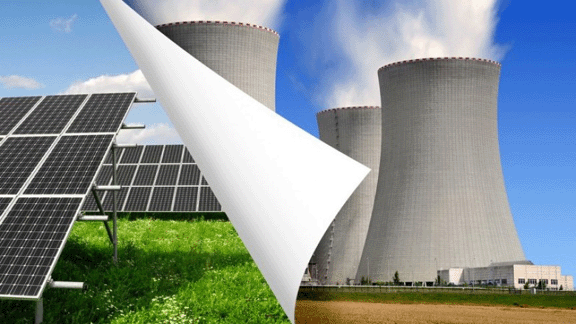
Michael Grubb: Limiting climate change will require an unprecedented
global movement to make low-carbon technologies the norm. COP26 – the UN
climate conference held last November in Glasgow – showed that
unfortunately, the world is far from ready for such a movement.
Many leaders still assume that reducing emissions and growing their countries’
economies aren’t compatible goals. Yet in many places, transitions to
clean energy technologies have succeeded far beyond expectations.
Since 2010, wind power has grown from providing under 1% to providing 10% of
electricity in Brazil, and provided 15% of the EU’s electricity demand in
2019. Solar power – described as “the most expensive way to reduce
carbon emissions” as recently as 2014 – now costs 85% less than it did
a decade ago, increasingly making it the cheapest electricity in history.
And in India, affordable energy access programmes drove sales of
high-efficiency LED bulbs from just 3 million in 2012 to 670 million in
2018, with prices also falling by 85%.
These three technologies now offer
some of the cheapest ways to produce electricity or light across much of
the world. What’s crucial is that these transitions all involved
significant government action. Plus, most went ahead despite the fact that
in many cases, early economic calculations suggested that developing
renewables would be an especially expensive way to cut emissions.
Rather than relying on research and development to bring down costs through coming
up with new inventions – or leaving the market to do so on its own
through competition – governments used subsidies and public procurement
programmes (government commitments to buy a certain volume of a new
product) to keep costs down and boost uptake.
Historically, it’s been widely assumed that reducing emissions would mean damaging countries’
economies. And low-carbon transitions do, of course, involve social and
economic challenges. But well-designed policies – such as those used to
drive the revolutions in wind, solar and LEDs – have the potential to
create huge benefits for participating countries, not just for our climate.
If we want to solve climate change, we first need to transform our economic
thinking.
Renew Economy 20th Jan 2022
Australia continues to lead the world for solar installations.

Rooftop solar took a hit in 2021 with the industry growing a third less than expected thanks to lockdowns and supply chain disruptions, despite still showing strong growth overall. More than 3m households and small businesses across the country now have solar panel systems installed, with the milestone reached in November. According to registration data provided by solar consultancy company SunWiz, 3.24GW of new solar capacity was added across the country last year, representing 10% growth on the previous year.
These figures include small rooftop systems of less than 100MW registered by homeowners and small businesses, and do not include large, industrial-scale solar installations. Queensland now has the most installed capacity, with 4,483MW, closely followed by New South Wales (4,256MW) and Victoria (3,839MW). Australia continues to lead the world for solar installations with a total installed capacity of just under 17GW.
nationwide.
Guardian 19th Jan 2022
Germany’s admirable record in promoting renewable energy, as it leaves nuclear behind.

The nuclear shenanigans aren’t enough to take away Germany’s crown as a climate-forward country. The politics that sped up the nuclear phaseout also created room for a renewables boom. Starting with the Renewable Energy Sources Act in 2000, Germany’s energy policy, known as energiewende, created some of the most generous subsidies for solar power. ………..
Germany moved ahead with a plan to shut off nearly 50 per cent of its nuclear power plants, with the rest scheduled to close by the end of 2022. Some asked how a climate-forward country could lay waste to a source of zero-carbon power, [zero carbon? not so] especially when there’s a shortage of it. Others
pointed out that Germany’s renewables investments are for naught if it has to fill up the nuclear quota using dirty coal. Outrageous, right?
Not so fast, says Nikos Tsafos, an energy and climate analyst at the Center for Strategic and International Studies. “It’s very easy to solve climate change if I’m not politically constrained.” Any sensible climate plan
requires that clean energy replaces dirty sources quickly, while at the same time efficiency measures cut the demand for energy overall.
That, in theory, would result in a smooth decline in emissions as laid out in scientific models. Reality, however, is anything but smooth. The transition will inevitably be shaped by human particularities.
The nuclear shenanigans aren’t enough to take away Germany’s crown as a climate-forward country. The politics that sped up the nuclear phaseout also created room for a renewables boom. Starting with the Renewable Energy Sources Act in 2000, Germany’s energy policy, known as energiewende, created some of the most generous subsidies for solar power. These came in the form of guaranteed prices (or feed-in tariffs) for generating solar power. German taxpayers paid billions of euros to support a new technology. The demand created giant solar companies, including many in China, that progressively made the technology cheaper (with additional support in the form of Chinese subsidies) and thus more accessible to the rest of the world.
Financial Post 11th Jan 2022
The European Association for Renewable Energie Eurosolar rejects inclusion of nuclear and natural in the EU taxonomy
The European Association for Renewable Energie Eurosolar rejects »any
elements of nuclear and natural gas supply in the EU taxonomy for
environmentally sustainable activities«. The taxonomy is a classification
system for sustainable economic activities which are due to receive
advantageous financing conditions under EU regulations.
The European
Commision has proposed to include nuclear and natural gas into the
taxonomy. Member states like Germany strongly protested or, like Luxembourg
and Austria, even announced to bring action against the Commission, while
others are decisively supporting the proposal.
Photon 10th Jan 2022
Hunterston nuclear power workers need a just transition to sustainable work. No more subsidies to the nuclear industry.
Workers are key to a just transition at the Hunterston nuclear plant,
which retires today, according to the Scottish Greens.
The nuclear sectorbhas used the occasion to call for more subsidies, despite the UK Government
already subsidising the sector and proposing to charge bill payers upfront
to pay for nuclear power stations that haven’t even been built yet, like
at Hinkley Point.
Commenting, Scottish Greens energy spokesperson Mark
Ruskell said: “Respect and thanks must go to the workers at Hunterston
who have kept our lights on over the decades and those who will continue
the important work of de-commissioning. “These communities deserve a just
transition away from an energy source that is expensive and neither clean
nor sustainable. The vast subsidies involved would be better spent
investing in modern renewable energy solutions that provide a long-term
future for workers and our planet.”
Scottish Greens 7th Jan 2021
https://greens.scot/news/greens-workers-key-to-hunterston-transition
Scotland very nearly reached goal of 100% renewable energy over 2020
Final figures released by the Scottish government show that the country
just missed out on reaching its goal of 100% of its energy consumption
being from renewables by 2020. In the year, the equivalent of 98.6% of
gross electricity consumption in Scotland was from renewable sources in
2020, up on the provisional figure of 97.4% released in May 2021.
Current 6th Jan 2022
Pro nuclear shills use UK’s energy crisis to promote nuclear, but with government action, renewable energy would solve the problem
Government failure behind energy crisis, Chartist, By Dave Toke -31/12/2021 The only thing wrong with renewables is that we’ve not built nearly enough of them, says Dave Toke. Amidst a global shortfall of gas supplies in relation to demand (and a global increase in gas prices), the anti-renewables lobbies are busy blaming a lack of wind and solar (wot, solar too?) for the soaring energy prices. It’s nonsense of course to pin the blame on renewables for a combination of a global oil and gas crisis and the UK’s unique market vulnerability to natural gas supply squeezes, but that’s precisely what is happening. The truth is we’d be much more secure and greener with a much higher proportion of energy coming from renewables backed up with a revived storage network that successive UK governments have allowed to run down.
Of course we’ve had fossil fuel energy price surges and crises for decades, but now, suddenly, to read some papers and a lot of tweets, I’m told mainly from fossil fuel lobbyists, it’s the fault of renewables! Remarkable!
Some are even using the crisis to boost the case for nuclear power. Now that’s ironic, given that five out of 14 of EDF’s nuclear units are offline as I write! With nuclear, of course, it’s always going to be better in the future (and never is). Certainly, the idea that the UK relying on 3.2GW units (like Hinkley C and the planned Sizewell C) for its security at times of pressure is a guarantee of system security needs rather clearer analysis than is being done at the moment. (By the way, did you know that the first Hinkley C – like EPR in China – got shut down this summer because of radioactive leaks? Somebody please tell me when it gets back online.)………………..
We need much, much more renewables. Currently, the UK generates about 100TWh a year of wind and solar, compared to around 900TWh of natural gas consumption. How on earth can you blame wind and solar for a failure to meet gas demand when the Government has so far incentivised only a small fraction of the renewable energy generation required to phase out reliance on natural gas? It’s gaslighting on a grand scale (pun intended).
And, yes, there’s easily enough renewables to do the job. All of UK energy could be supplied from offshore wind occupying less than less than 8 per cent of the UK’s offshore waters, not counting all the solar and other renewable energy resources in the UK. https://www.chartist.org.uk/government-failure-behind-energy-crisis/
Why nuclear power is a bad way to balance renewable energy
Why nuclear power is a bad way to balance renewable energy https://100percentrenewableuk.org/why-nuclear-power-is-a-bad-way-to-balance-renewable-energy
David Toke, Ian Fairlie and Herbert Eppel from 100percentrenewableuk discuss how nuclear power effectively switches off wind and solar power and how a 100percent renewable energy system is much better for the UK than one involving nuclear power.
The Government, backed by a lot of public policy reports paid for by pro-nuclear interests, constantly pushes out the view that nuclear power is ‘essential’ to balancing wind and solar power. But what they never mention is the massive waste of renewables that occurs in such a scenario. Under the scenarios planned by the Government nuclear power is paid very high prices to generate power even when there is excess electricity, which pushes renewables to close down. The Government also refuses to undertake serious investigations of how a system that uses excess renewables to create short and long term storage is a much better way of organising our energy needs rather than wasting more money on building nuclear power stations.
Look at our video which, drawing upon research on the role of nuclear and renewables, discusses these issues.
If you agree the aims of 100percentrenewableuk please join the discussion via our email group.
UK’s fossil fuel use at an all-time low , as renewables generate 67% of Britain’s electricity

Fossil fuel use on the UK’s power grid dropped to an all-time low this week, in a sign analysts say is further evidence of the “renewables revolution” under way on the British electricity generation.
Just before midnight on Wednesday evening coal and gas were providing just six per cent
of electricity, according to Drax Electric Insights. “Renewables generated 24.19 GW – 65 per cent of the country’s entire electricity needs – while fossil fuels were at a new record low,” the analysts said
in statement on Thursday.
iNews 30th Dec 2021
https://inews.co.uk/news/fossil-fuels-power-wind-renewable-1375827
Germany steadfast in rejecting nuclear power, aims for 100% renewables
The Germans persist and sign against nuclear power and for renewables. Across the Rhine, the debate pushed by France on nuclear power, presented as “green” energy, is clearly not taking hold. The consensus remains around the bet made by the new government that a direct switch to “all renewable” is possible and will ultimately pay off much more, even if it involves painful decisions. Mediapart 25th Dec 2021 https://www.mediapart.fr/journal/international/251221/les-allemands-persistent-et-signent-contre-le-nucleaire-et-pour-le-renouvelable |
Australia is racing towards 100 per cent renewables. What does that look like? —

When too much wind and solar is not nearly enough! What does a grid look like when it is nearly 100 per cent powered by renewables? The post Australia is racing towards 100 per cent renewables. What does that look like? appeared first on RenewEconomy.
Australia is racing towards 100 per cent renewables. What does that look like? — RenewEconomy
| The share of wind and solar has nearly quadrupled, and AEMO, whose main responsibility is to keep the lights on, is modelling a 79 per cent share of renewables (that’s an average over the year) by 2030 as its most likely and now central scenario. Even the mainstream political parties are keeping up, even if some don’t like to admit it: Labor’s emissions target (a 43 per cent cut by 2030) proudly assumes an 82 per cent share of renewables by 2030. The federal Coalition, which demonised Labor’s 50 per cent renewables target from the 2019 election campaign as “economy wrecking”, quietly assumes a 69 per cent share in renewables by 2030 in its emissions modelling. i.e. when too much wind and solar is not nearly enough. The biggest reasons for the extraordinary pace of this renewables transition, and the dramatic change in expectations, are many. Mostly they fall around the rapid falls in technology costs, and the subsequent embrace of wind, solar and storage by state governments of both sides of the political divide, and by corporate demand, keen to have cheaper and greener power. The Liberal government in South Australia is heading towards 100 per cent renewables in the next few years, on its way to 500 per cent renewables via renewable hydrogen exports, and the Tasmania Liberal government aims for 200 per cent renewables for the same reason. Renew Economy 23rd Dec 2021 https://reneweconomy.com.au/australia-is-racing-towards-100-per-cent-renewables-what-does-that-look-like/ |
U.S. can get to 100% clean energy with wind, water, solar and zero nuclear, Stanford professor says
U.S. can get to 100% clean energy with wind, water, solar and zero nuclear, Stanford professor says, CNBC DEC 21 2021 Catherine Clifford, @IN/CATCLIFFORD
- Stanford professor Mark Jacobson sees a way for the U.S. to meet its energy demands by 2050 with 100% wind, water and solar.
- His models use no fossil fuels, carbon capture, direct air capture, bioenergy, blue hydrogen or nuclear power.
- Jacobson’s roadmap is different from many clean-energy proposals, which advocate using all technologies possible.
A prominent Stanford University professor has outlined a roadmap for the United States to meet its total energy needs using 100% wind, water and solar by 2050.
Mark Jacobson, a Stanford professor of civil and environmental engineering and the director of its Atmosphere/Energy Program, has been promoting the idea of all renewable energy as the best way forward for more than a decade. His latest calculations toward this ambitious goal were recently published in the scientific journal Renewable Energy.
Transitioning to a clean-energy grid should happen by 2035, the study advises, with at least 80% of that adjustment completed by 2030. For the purposes of Jacobson’s study, his team factored in presumed population growth and efficiency improvements in energy to envision what that would look like in 2050.
Jacobson first published a roadmap of renewable energy for all 50 states in 2015.This recent update of that 2015 work has a couple of notable improvements.First, Jacobson and his colleagues had access to more granular data for how much heat will be needed in buildings in every state for the coming two years in 30-second increments. “Before we didn’t have that type of data available,” Jacobson told
Also, the updated data makes use of battery storage while the first set of calculations he did relied on adding turbines to hydropower plants to meet peak demand, an assumption that turned out to be impractical and without political support for that technology, Jacobson said.
Reliability of four-hour batteries
In the analysis, Jacobson and his team used battery-storage technology to compensate for the inherent intermittency of solar and wind power generation — those times when the sun doesn’t shine and the wind doesn’t blow.
The Achilles’ heel of a completely renewable grid, many argue, is that it is not stable enough to be reliable. Blackouts have become a particular concern, notably in Texas this year and during the summer of 2020 in California.That’s where four-hour batteries come in as a way to generate grid stability. “I discovered this all just because I have batteries in my own home,” Jacobson told CNBC. “And I figured, oh, my God, this is so basic. So obvious. I can’t believe nobody has figured this out.”
Jacobson said that he observed his batteries stayed charged if they weren’t plugged in when they are off.
o get more than four hours of charge, multiple four-hour batteries can be stacked to discharge sequentially. If a battery needs more charge output at one time than the battery can provide, then the batteries need to be used simultaneously, Jacobson told CNBC.
With this observation, Jacobson and his colleagues at Stanford produced scenarios showing it is possible to transition to a fully renewable system without any blackouts or batteries with ultra-long-duration battery technology.
That’s key because technology for ultra-long-duration batteries that would hold energy for several days have yet to be commercialized. Start-ups like Form Energy are working to bring such batteries to market.
Planning, of course, is also key to keeping the grid stable. “Wind is variable, solar is variable,” Jacobson said. “But it turns out, first of all, when you interconnect wind and solar over large areas, which is currently done, you smooth out the supply quite a bit. So it’s because, you know, when the wind is not blowing in one place, it’s usually blowing somewhere else. So over a large region, you have a smoother supply of energy.”
Similarly, wind and solar power are complimentary. And hydropower “is perfect backup, because you can turn it on and off instantaneously,” he said.
Also, there needs to be changes in pricing structures to motivate customers to do high energy demand activities at off-peak times.“Demand response is a very big component of keeping the grid stable,” Jacobson said. “It’s used some today. But a lot of places a lot of states in the US right now, the electricity price is constant all day … and that’s a problem.”
Calculating the breakdowns………………..
The resulting models use no fossil fuels, carbon capture, direct air capture, bioenergy, blue hydrogen or nuclear power.And in that, Jacobson’s roadmaps are different from many clean-energy proposals, which advocate for using all technologies possible.
“So we’re trying to eliminate air pollution and global warming, and provide energy security. So those are the three purposes of our studies,” Jacobson told CNBC. And that “is a little different than a lot of studies that only focus on greenhouse gases. So we’re trying to eliminate air pollution as well, and also provides energy security.”………..
Combating fears of blackoutsJacobson knows that his viewpoint is not the loudest. The promise of next-generation nuclear power plants, for example, has gotten government and private funding of late.Nuclear innovation is “pushed mostly by the industry people, people like Bill Gates, who has a huge investment in small modular reactors,” Jacobson said. “He has a financial interest. And he wants to be known as somebody who tries to help solve the problem.”
Gates addressed the criticism that he’s a “technocrat” looking to solve climate change with new innovations, instead of with political legislation supporting technology like wind and solar which already exists, in an interview with Anderson Cooper on CBS’ “60 Minutes” earlier in the year. “I wish all this funding of these companies wasn’t necessary at all. Without innovation, we will not solve climate change. We won’t even come close,” Gates said.Also, the timeline for getting some of these technologies to commercialization is too long to be useful. Gates’ advanced reactor company, TerraPower, announced in November that it has chosen the frontier-era coal town Kemmerer, Wyoming, as the preferred location for its first demonstration reactor, which it aims to build by 2028.
“Even if it’s seven years, that’s just a demonstration plant,” Jacobson said. “That’s not even close to a commercial plant and on the scale we need.”……………
Education is a key hurdle, as Jacobson sees it. “I am optimistic. But the thing I find that’s the biggest difficulty is the fact that it is an information issue, because most people are not aware, most people are not aware of what’s possible,” he said. https://www.cnbc.com/2021/12/21/us-can-get-to-100percent-clean-energy-without-nuclear-power-stanford-professor-says.html?utm_term=Autofeed&utm_medium=Social&utm_content=Main&utm_source=Twitter#Echobox=1640127800
China to lead in global wind power
China is forecast to account nearly 70% of new wind power capacity
additions globally within a decade boosted by the country’s robust
electricity demand. Consulting firm Wood Mackenzie in its fourth quarter
forecast expects a 69 gigawatts (GW) increase in new wind power capacity
additions globally for the period of 2021 to 2030 with 48GW coming from
China.
Capital.com 15th Dec 2021
https://capital.com/china-to-lift-global-new-wind-power-capacity-additions
100% renewables possible for USA – study demonstrates
A study led by Stanford University professor Mark Jacobson has
demonstrated that the US energy system running on wind, water and solar,
coupled with storage, not only avoids blackouts but lowers energy
requirements and consumer costs while creating millions of jobs, improving
health, and freeing up land. The Jacobson-led study conducted with
colleagues from Stanford University analysed grid stability under multiple
scenarios in which wind, water, and solar energy resources powered 100% of
all energy needs in the United States. The study, published in the journal
Renewable Energy, demonstrates a blackout-free energy system under ideal
circumstances, and a much reduced risk of blackouts in extreme weather
events compared to the current fossil fuel-led energy systems.
Renew Economy 10th Dec 2021
1 This Month

of the week – Shut Down Drone Warfare!


Tell the Ukrainian Government to Drop Prosecution of Peace Activist Yurii Sheliazhenko

Petition to revoke the licensing of the Near Surface Nuclear Disposal Facility (NSDF) at Chalk River. https://www.ourcommons.ca/petitions/en/Petition/Details?Petition=e-7247
To see nuclear-related stories in greater depth and intensity – go to https://nuclearinformation.wordpress.com
-
Archives
- April 2026 (7)
- March 2026 (251)
- February 2026 (268)
- January 2026 (308)
- December 2025 (358)
- November 2025 (359)
- October 2025 (376)
- September 2025 (257)
- August 2025 (319)
- July 2025 (230)
- June 2025 (348)
- May 2025 (261)
-
Categories
- 1
- 1 NUCLEAR ISSUES
- business and costs
- climate change
- culture and arts
- ENERGY
- environment
- health
- history
- indigenous issues
- Legal
- marketing of nuclear
- media
- opposition to nuclear
- PERSONAL STORIES
- politics
- politics international
- Religion and ethics
- safety
- secrets,lies and civil liberties
- spinbuster
- technology
- Uranium
- wastes
- weapons and war
- Women
- 2 WORLD
- ACTION
- AFRICA
- Atrocities
- AUSTRALIA
- Christina's notes
- Christina's themes
- culture and arts
- Events
- Fuk 2022
- Fuk 2023
- Fukushima 2017
- Fukushima 2018
- fukushima 2019
- Fukushima 2020
- Fukushima 2021
- general
- global warming
- Humour (God we need it)
- Nuclear
- RARE EARTHS
- Reference
- resources – print
- Resources -audiovicual
- Weekly Newsletter
- World
- World Nuclear
- YouTube
-
RSS
Entries RSS
Comments RSS
 nuclear-news