General Electric finds nuclear, fossil fuels, soon costlier than solar
 new technology breakthroughs are making it possible for solar generated electricity to be the most economical choice within the next three to five years.
 Report: GE says fossil fuels, nuclear soon costlier than solar power, SmartPlanet, By David Worthington | May 27, 2011 General Electric is forecasting that solar power could soon be a more affordable than fossil fuels and nuclear power, the company’s global research director told Bloomberg. Continue reading
Small scale renewable energy is challenging big utilities
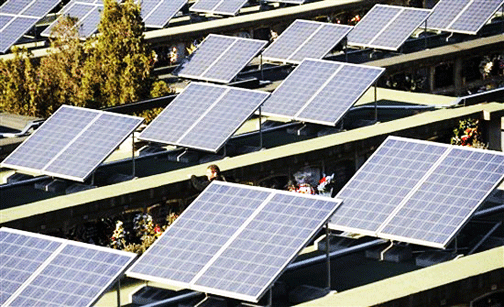 Small-scale renewable energy is more accessible to new entrants compared with the forward purchase of huge amounts of baseload generation from burning fossil fuels, which is the routine business of big utilities.
Change so far is happening slowly and from a tiny base but the cost of small-scale renewable technologies is falling.
Micro-Power Presents Slow-Burn Threat to Utilities Planet Ark: 27-May-11 SPAIN AND U.K. : Martin Roberts and Gerard Wynn A wide rollout of small-scale renewable energy poses a long-term challenge to utilities as households switch to home generation and the supply market opens, executives at green specialists and independents say. Continue reading
Offshore renewable energy innovation centre for UK
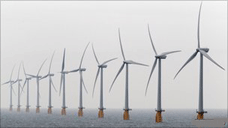 UK Government invests in offshore renewables innovation centre | Energy Efficiency News, 28 May 11, The UK Government yesterday announced plans to invest in an offshore renewable energy technology and innovation centre to help businesses commercialise wind, wave and tidal power. Continue reading
Around the world in solar-powered boat
World’s largest solar boat to arrive in Brisbane cnet AustraliaBy Irene Mickaiel May 27, 2011 The MS Tûranor PlanetSolar, the world’s largest solar boat, is circumnavigating the globe and will arrive in Australia this weekend.
According to PlanetSolar, it is attempting to break the world record by travelling around the world (approx 27,000 nautical miles) to show that renewable energy technologies are effective and can be relied upon, as well as to demonstrate the potential of environmentally friendly modes of transport…..World’s largest solar boat to arrive in Brisbane – Travel Tech
Renewable energy makes good economic sense forAustralia
Renewable energy will only get cheaper: study, Australian Broadcasting Corporation, By Michael Edwards May 26, 2011 A new study has found the future prices of wind, thermal and solar power will only keep falling as more alternative power sources are switched into the energy grid. Researchers say it proves the widespread adoption of renewable energy sources makes good economic sense. Continue reading
Solar panels plan for all new buildings in Japan
 Japan ‘plans solar panels for all new buildings’, Google News, (AFP) – 23 May 11TOKYO — Japan is considering a plan that would make it compulsory for all new buildings and houses to come fitted with solar panels by 2030, a business daily said Sunday.The plan, expected to be unveiled at the upcoming G8 Summit in France, aims to show Japan’s resolve to encourage technological innovation and promote the wider use of renewable energy, the Nikkei daily said……
AFP: Japan ‘plans solar panels for all new buildings’
Decentralised solar energy a boon for local companies
“We’re recommending it to everyone,” ….. “We’ve certainly got our money’s worth.”
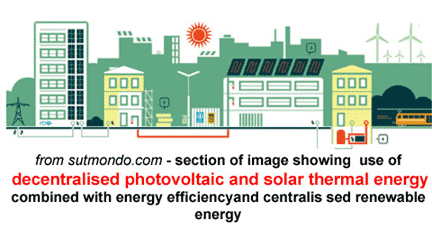
 Many local companies laud effects of renewable energy efforts By Marc Munroe DionHerald News Staff Reporter 22 May 11, FALL RIVER — It’s been 15 months since linen manufacturer Matouk, 925 Airport Road, installed about 200 solar panels atop its building, which houses the company’s offices, manufacturing space and factory store.
Matouk Controller Peter Brust said it’s been a good deal for the company. Continue reading
A good business move for Japan – from nuclear to solar?
new solutions for solar power installation in Japan’s relatively small geographic areas. “The [irradiated] agricultural land near the Fukushima power plant is no longer usable, so why don’t we convert that into solar plants?” …alculation from Japan’s National Institute of Advanced Industrial Science and Technology: “Rice produced on one hectare of land yields a yearly revenue of 1.58 million yen, while a solar plant on the same surface would generate a revenue of 7.5 million yen.”
Why Japan’s Shift Away from Nuclear Is Good for Business, TIME, By Lucy Birmingham / Tokyo Wednesday, May 18, 2011 “…….New legislation is expected to help diversify the nation’s energy portfolio. A new feed-in tariff (FIT) will oblige utility companies to buy all the power generated through renewable sources connected to a grid, at fixed, premium rates. Continue reading
Success with small scale solar energy and feed-in tariffs
“It might not seem like a lot if you look at one unit, but it’s like looking at ants,” ….. “If you look at one at a time, they seem tiny, but they build up into a large population.”
Green energy from city skylines, nwi.com, 15 May 11, While large wind and solar farms catch grief from nearby residents, engineers and designers have created ways to incorporate renewable energy systems into city skylines, including Chicago’s.
Across the United States, renewable energy developers are supplementing energy grids more discreetly, more affordably and on an urban-friendly scale. Continue reading
Japan could, and should, move from nuclear power to renewables
Iida and ISEP researchers estimate that Chubu Electric can provide 30.59 million kilowatts without nuclear power, enough to cover this summer’s projected demand of 26.37 million kilowatts.
This can be done by operating all of its thermal power plants and buying surplus electricity from large manufacturers in the Chubu region, who run their own power stations, they say.
Renewable energy making good business sense for Germany
Merkel’s big bet is that environmental technology will be one of Germany’s most important sources of income. Already, the country’s share in the green-tech world market is 16 percent, which means billions of Euros in business. Renewable energy has generated 300,000 ‘green collar’ new jobs in the past decade, Röttgen says. Big companies like Siemens and Bosch are determined to become “green multinationals.” Thousands of small- and medium-sized technology companies see green technology as an important part of their business and investment strategy.
How Angela Merkel became Germany’s unlikely green energy champion Christian Schwägerl for Yale Environment 360, guardian uk 9 May 2011 Germany is in a good starting position,…. Since the 1990s, the Renewable Energy Sources Act has paved the way for billions of Euros flowing to consumers and investors for green power projects. The law guarantees that each kilowatt hour of green electricity is fed into the grid and bought at a favorable statutory rate by operators. The rate varies between green energy sources, but is considerably higher than normal electricity prices. Continue reading
IPCC to discuss big world report on Renewable Energy
 By far the most comprehensive UN assessment of the status and potential for the clean energy sector, the report weighs 164 separate development scenarios……
The report says there is virtually unlimited technical potential for renewables, with much of it coming from solar energy.
Renewables major part of 2050 world energy, Sydney Morning Herald, Marlowe Hood, May 7, 2011 Renewable power from the Sun, wind, water and biomass can and should generate a major portion of the planet’s energy supply by 2050, a leaked draft of a United Nations report says. Continue reading
Potential of renewable energy to outstrip global need – UN report
“Scenarios are largely consistent in indicating widespread growth in renewable energy deployment around the globe,”
UN Renewables ‘Bible’ Says Clean Energy Can Outstrip Demand, Bloomberg, By Alex Morales – May 4, 2011 Wind and solar power are among six renewable energy options that have the potential to outstrip total world energy needs and may grow as much as 20-fold over the next four decades, a draft United Nations report said. Continue reading
New Zealand joins International Renewable Energy Agency
NZ becomes member of energy agency, NewsTalk ZB, 2/05/2011 , New Zealand has become a full member of the International Renewable Energy Agency, which is dedicated to the rapid development of renewable energy worldwide.
Acting energy minister Hekia Parata says we’re one of the leading countries in the area, with 74% of our electricity last year coming from renewable sources.
By joining this organisation, Ms Parata says, we have the opportunity to contribute to international efforts to increase the deployment of renewable energy technologies and drive down their costs… http://www.newstalkzb.co.nz/newsdetail1.asp?storyID=195799
USA’s leading 10 solar energy States
The Top 10 Solar States, New York Times, By MIREYA NAVARRO April 29, 2011, New Jersey is the nation’s second largest solar market behind California thanks to the state government’s commitment to increase the amount of electricity derived from renewable energy sources over the next decade.
But where are the other leaders in solar energy?
Here, courtesy of the Solar Energy Industries Association, is a Top 10 list for cumulative installed solar capacity in the United States.
1. California: 47 percent with 971 megawatts
2. New Jersey: 14 percent with 293 MW
3. Colorado: 5 percent with 108 MW
4. Arizona: 5 percent with 101 MW
5. Nevada: 5 percent with 97 MW
6. Florida: 4 percent with 73 MW
7. New York: 3 percent with 54 MW
8. Pennsylvania: 3 percent with 54 MW
9. New Mexico: 2 percent with 45 MW
10. North Carolina: 2 percent with 42 MW
http://green.blogs.nytimes.com/2011/04/29/the-top-10-solar-states/?partner=rss&emc=rss
1 This Month
26 September – International Day for the Total Elimination of Nuclear Weapons





PLEASE OPPOSE HR 8255 AND S.3639 – bills would accelerate satellite deployment, with no environmental review or safeguards – https://ncstd5li.quorum.us/campaign/169331/
To see nuclear-related stories in greater depth and intensity – go to https://nuclearinformation.wordpress.com
-
Archives
- September 2026 (313)
- August 2026 (330)
- July 2026 (355)
- June 2026 (287)
- May 2026 (306)
- April 2026 (356)
- March 2026 (251)
- February 2026 (267)
- January 2026 (308)
- December 2025 (358)
- November 2025 (359)
- October 2025 (375)
-
Categories
- 1
- 1 NUCLEAR ISSUES
- business and costs
- climate change
- culture and arts
- ENERGY
- environment
- health
- history
- indigenous issues
- Legal
- marketing of nuclear
- media
- opposition to nuclear
- PERSONAL STORIES
- politics
- politics international
- Religion and ethics
- safety
- secrets,lies and civil liberties
- spinbuster
- technology
- Uranium
- wastes
- weapons and war
- Women
- 2 WORLD
- ACTION
- AFRICA
- Atrocities
- AUSTRALIA
- Christina's notes
- Christina's themes
- culture and arts
- Events
- Fuk 2022
- Fuk 2023
- Fukushima 2017
- Fukushima 2018
- fukushima 2019
- Fukushima 2020
- Fukushima 2021
- general
- global warming
- Humour (God we need it)
- Nuclear
- RARE EARTHS
- Reference
- resources – print
- Resources -audiovicual
- Weekly Newsletter
- World
- World Nuclear
- YouTube
-
RSS
Entries RSS
Comments RSS

