Arnold Schwarzenegger calls for renewable energy to get fair treatment from federal government
An unfair fight for renewable energies Washington Post, By Arnold Schwarzenegger, December 4 More energy from the sun hits Earth in one hour than all the energy consumed on our planet in an entire year.
In those terms, it is absurd that our federal renewable energy to get government spends tens of billions of dollars annually subsidizing the oil industry, which pulls diminishing resources from underground, while the industry focused above ground on wind, solar and other renewable energies is
derided in Washington. Federal support for development of new energy sources is lower today than at any other point in U.S. history, and our government is forcing the clean-energy sector into a competitive disadvantage. To bring true competition to the energy market, ensure
our national security and create jobs here rather than in China or elsewhere, we must level the playing field for renewable energies. In this presidential primary, Americans need to hear where the candidates stand on this critical issue. Continue reading
Wind power growing in importance in South Korea
South Korea’s drive for renewable energy By Lucy Williamson, BBC News,1 Dec 11 South Korea “…..Wind power is becoming increasingly important to South Korea – not just as a way to help meet ambitious targets on greenhouse gas emissions, but also as a way to boost the economy.
“Green Growth” has been a key national strategy since President Lee Myung-bak took office four years ago……..South Korea is relatively late to the green technology market. Europe is the established leader in wind turbines – and even China is judged to be steaming ahead.
Korea completed its first wind farm five years ago. Spread across a beautiful series of hills in Gangwon Province, near the country’s eastern coast, the wind farm produces an impressive 240MW per year….. http://www.bbc.co.uk/news/business-15984399
Fukushima residents learn at first hand the success of renewable energy projects
 “It is important for the Japanese to realize that renewable energy can work on a large scale, and that people can make money from it,” said Yamamoto,
 Fukushima residents tour German renewable
  village; learn about non-nuclear energy sources Washington Post, By Associated Press, November 30 FELDHEIM, Germany — A group of residents from the radiation-stricken area around Japan’s tsunami-hit nuclear reactors and a Tokyo actor are visiting Germany to learn how renewable energy could work in their
homeland…..
The group, organized and led by representatives of Greenpeace Japan, arrived Wednesday in the northeastern German village of Feldheim to learn how its 145 residents have taken advantage of the energy generated by a nearby windfarm and a biofuel plant that burns the
waste from a local pig farm to become an entirely self-sustaining, energy-positive village….. Continue reading
Renewable energy investment in South Africa
South Africa Becoming a Renewable Energy Hub Afribiz, Dec 1 South Africa is fast becoming a preferred renewable energy investment destination for both private and public sector investors – good news for the country’s growing electricity demands, emerging clean energy sector and the economy.
The World Bank recently approved a $250-million (R1.5- billion) loan to South African power utility Eskom to develop a wind and solar plant, which will help the country reduce its reliance on coal-based power generation.
The World Bank, which granted the funding through its Clean Technology Fund, will finance a 100-megawatt solar power plant in Upington in the Northern Cape province and a 100-megawatt wind power project north of Cape Town in the Western Cape…. http://www.afribiz.info/content/south-africa-becoming-a-renewable-energy-hub
Renewables, energy efficiency better options for India than nuclear power
Koodankulam struggle: Western nations are learning from their mistakes, India is not The Weekend Leader, By Nityanand Jayaraman & Sundar Rajan, 30 Nov Chennai “…….Nuclear power is not the only option for generating electricity. There are a number of conventional and non-conventional sources of energy that can be explored for generating electricity.
It is a fact that in more than 60 years of post-independence industrialisation and modernisation, the contribution of nuclear energy to the total electricity generation is less than 3%.
Renewable energy sources already contribute more than 10% of India’s electricity and large hydro projects deliver about 22%. Large dams, though, have exacted a devastating toll on the environment and lives of adivasi communities. Continue reading
Masdar home if International Renewable Energy Agency (IRENA)
 Renewable energy to power growth Masdar symbolises the UAE leadership’s vision of sustainable economic progress and development of human capital By Sultan Ahmad Al Jaber, Gulf News November 30, 2011 “…….Masdar is a growing global hub for clean technology companies and works across the renewable energy value chain; covering education, research and development, investment in clean technology, implementation of renewable energy projects, and reducing carbonemissions.
In just five years, Masdar has achieved a great deal and hosts the permanent headquarters of the International Renewable Energy Agency (Irena) at Masdar City. Irena is the first international organisation to be headquartered in the Middle East. … Continue reading
Renewable energy set to boom
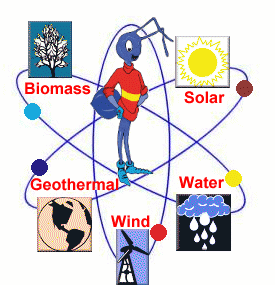 “These results indicate that last year’s record renewable energy investment was no one-off despite the recent economic gloom. Big winners over the next 20 years will be the emerging renewable energy hubs in Latin America, Asia, the Middle East and Africa
Bloomberg Predicts $7 Trillion Renewable Energy Spend By 2030, by Energy Matters, 29 Nov 11 New figures from Bloomberg New Energy Finance (BNEF) predict that by 2030, global spending on renewable energy installations will have hit $7 trillion.
BNEF predicts doubling from 2010’s record-breaking $195 billion, to $395 billion in 2020, before reaching $460 billion in 2030. By 2030, the report states, 15.7 percent of the world’s energy (including hydropower) will come from renewable sources. Continue reading
French company AREVA finding wind energy a better bet than nuclear?
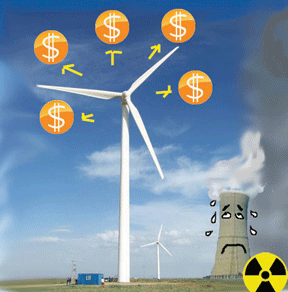 Areva has looked to diversify away from
  nuclear energy and build up solar, wind and biomassbusinesses. …..Areva has teamed up with energy group GDF Suez SA and concessions company Vinci SA to bid for a part of the French government’s wind turbine project…The French government aims for a total of 1,200 wind turbines to be eventually built, costing a total of €10 billion.
In mid-December Areva is set to detail the financial impact of the nuclear disaster at Fukushima this March.
Areva Diversifies Further Into Wind, WSJ, 28 Nov, By MAX COLCHESTER And NOÉMIE BISSERBE, PARIS—Areva SA said Monday it is in advanced talks to build about 120 wind turbines at two offshore wind farms in Germany, as theengineering group continues to diversify away from nuclear energy…. Continue reading
Feed-in Tariffs – the renewable energy way to go
 Feed-in Tariffs the Way Forward for Renewable Energy, Peter Lynch with an introduction by Andrew DeWit, 28 Nov 11 Peter Lynch, an expert on the renewable energy sector, offers a concise introduction to the central role of feed-in tariffs (FITs) in fostering the ongoing transition from conventional, carbon-laden sources of generating electricity to renewables such as solar, wind and geothermal. As the author points out, FITs guarantee markets and prices for renewable power, and drive down their cost through deployment and the encouragement of yet more technical advance. FITs thus offer much hope to a world that seems unable to reach any sort of global agreement on cutting emissions which have continued to spiral since the 1997 Kyoto Protocol.
Last year, according to figures from Bloomberg New Energy Finance (link), investment in new generation capacity from renewable energy sources (excluding hydro) totaled USD 187 billion, outpacing the USD 157 billion new investment in natural gas, oil, and coal-fired generating capacity. This rapid ramping up of deployment of existing technologies is key for renewables, as Bloomberg notes. For example, since the mid-1980s each doubling of wind generation capacity has led to a 14% reduction in cost through technical improvements in production, better materials, learning by doing, and the like. Advances have come so rapidly that the Bloomberg New Energy Finance researchers “expect wind to become fully competitive with energy produced from combined-cycle gas turbines by 2016 in most regions offering fair wind conditions.”
The article highlights the role of the German FIT in driving this energy revolution. It notes that a decade ago Germany targeted a 12.5% share of electricity from renewables for 2010, but blew through the target in 2007 to achieve a 15.1% share……..
Feed-in Tariffs: The Proven Road NOT Taken…Why?
Peter Lynch……. http://japanfocus.org/-Peter-Lynch/3654
Economic, environmental, resources crises to be solved in Denmark through 100% renewable energy
Denmark faced three global crises which will hit it “with a force that is so far absolutely unheard of” — an economic and financial crisis, a climate crisis and a resources crisis. “This proposal will address all three crises.”
 Denmark aims for 100 pct renewable energy in 2050
* Proposes to get 52 pct of power from renewables in 2020
* Aims for entire energy supply from renewables in 2050
* Minister says investment in green energy can pay off
By Mette Fraende COPENHAGEN, Nov 25 (Reuters) – Danish government proposals on Friday called for sourcing just over half of its electricity from wind turbines by 2020 and all of its energy from renewable sources in 2050. Continue reading
Renewable energy now winning the race against fossil fuels
Renewable power trumps fossil fuels for first time L.A. Times, 25 Nov 11 Renewable energy is surpassing fossil fuels for the first time in new power-plant investments, shaking off setbacks from the financial crisis and an impasse at the United Nations global warming talks.
Thanksgiving for the free fuel of wind and sun
 Thankful for Alternatives to Coal and Nuclear November 24th, 2011 › Clean Energy › Simon Mahan › Last week, SACE participated in a media flurry over two released reports. The first report documents how America’s traditional power plants (like coal and nuclear) consume vast amounts of freshwater – an invaluable, and increasingly stressed resource here in the Southeast. The second report gives us a path forward – away from dirty, thirsty coal plants and equally thirsty nuclear plants.
The other report (“Toward a Sustainable Future for the US Power Sector: Beyond Business as Usual 2011“) was published by Synapse Energy Economics and commissioned by the Civil Society Institute to figure out how the U.S. could power our country without coal.
Hardly a pie-in-the-sky, academic endeavor, Beyond Business as Usual looks at a 40 year timeframe to phase out coal and cut nuclear without heavy reliance on any one single source of electricity generation. By ramping up energy efficiency, solar, wind energy, biomass and other renewable energies, the report lays out a roadmap for eliminating coal by 2050 – all while reducing consumer costs by $18 Billion. This is possible, in part, due to renewable energy’s fuel costs being stable in perpetuity – in other words, the wind and sun are free whereas coal and natural gas prices are expected to continue to fluctuate wildly. Anadditional $450 billion in health-related costs would be avoided (such as asthma and premature deaths caused by coal) and are not included in the analysis’ initial $18 Billion savings figure. Water consumption would be expected to drop 90% over a business-as-usual scenario – nearly a 54 trillion gallon per year reduction.
This Thanksgiving, in addition to family and friends, I’m also thankful for energy alternatives to “business as usual.” http://blog.cleanenergy.org/2011/11/24/thankful-for-alternatives-to-coal-and-nuclear/
Small is economic, as well as beautiful – renewable energy developments
And will the rest of Europe follow? The poll-leading Socialists in France, after all, are talking of halving the country’s nuclear capacity. “Most of the world will follow this way, but it will be slow,” Dudenhauser says. “Everyone expected blackouts after the nuclear shutdown, but it didn’t happen. But it would not be manageable if everyone goes Germany’s way in the next two years.”
 Size not a factor in German power play , Climate Spectator, GilesParkinson, 24 Nov 11 It seems strange that the world’s most cautious and best performing economy should be acting as some sort of crash test dummy for the world’s clean energy future. But this is exactly the position that Germany finds itself in following its commitment earlier this year to abandon nuclear energy and to push towards its vision of a fully renewable power supply by 2050.
And if this is the future, then companies that have based their models around the principal of centralised power stations may find little cause for comfort. But it is presenting enormous opportunities for those focused on the concept of distributed generation, particularly fuel cells – at least that’s the take of Roman Dudenhausen, the CEO and co-founder of German energy consultants ConEnergy, and a recently appointed director to the board of Australia’s Ceramic Fuels Cells.
Dudenhausen says the accelerated phase-out of Germany’s nuclear capacity is presenting companies such as Ceramic with a unique opportunity…… Continue reading
Increasingly cost competitive – renewable energy report by IEA
 Renewable energy becoming cost competitive, IEA says, By Henning Gloystein, LONDON Nov 23, (Reuters)–Renewable energy technology is becoming increasingly cost competitive and growth rates are in line to meet levels required of a sustainable energy future, the International Energy Agency (IEA) said in a report on Wednesday.
The report also said subsidies in green energy technologies that were not yet competitive are justified in order to give an incentive to investing into technologies with clear environmental and energy security benefits.
The renewable electricity sector has grown rapidly in the past five years and now provides nearly 20 percent of the world’s power generation, the IEA said during the presentation of the report titled Deploying Renewables 2011.
The IEA’s report disagreed with claims that renewable energy technologies are only viable through costly subsidies and not able to produce energy reliably to meet demand. ”A portfolio of renewable energy (RE) technologies is becoming cost-competitive in an increasingly broad range of circumstances, in some cases providing investment opportunities without the need for specific economic support,” the IEA said, and added that “cost reductions in critical technologies, such as wind and solar, are set to continue.”
“The portfolio of RE technologies, which includes established hydro power, geothermal and bioenergy technologies is now, therefore, cost-competitive in an increasingly broad range of circumstances, providing investment opportunities without the need for specific economic support.”
But the IEA also defended subsidies in renewable energy technology as a necessary means to create a clean and independent energy supply system. In the past, the IEA has been criticized by environmental groups for underplaying the role of renewable energy technologies in favor of nuclear and fossil-fuels….. http://www.reuters.com/article/2011/11/23/us-energy-iea-renewables-idUSTRE7AM0OV20111123
A silver lining to USA militarisation of northern Australia – renewable energy marines?
When the case for renewables is made on the grounds of national security, the arguments of climate denialists and delay merchants are bombed back to the Stone Age. ….
as the U.S. Marine Corps demonstrates, energy conservation and renewable energy are now critical national security concerns.

 Will President Obama Send Green Marines to Darwin?, Renewable Energy World, By Dan Cass ,November 18, 2011 President Barack Obama was in Australia this week and upset China and Indonesia with the annoucement of an increased military presence in this country, including 2500 US Marines to train and provision equipment in Darwin.
When the U.S. Marine Corp establish themselves a new home in Darwin, they will bring some seriously green equipment and ideas to our shores. This is because in the three years of his Presidency, Barack Obama has actively led the U.S. Department of Defense to embrace renewable energy and a strategic awareness of climate change…. Continue reading
1 This Month
To see nuclear-related stories in greater depth and intensity – go to https://nuclearinformation.wordpress.com/
Now until to February 10, 2026 Radioactive waste storage in France: the debate is finally open! How to participate?

-
Archives
- February 2026 (11)
- January 2026 (307)
- December 2025 (358)
- November 2025 (359)
- October 2025 (376)
- September 2025 (258)
- August 2025 (319)
- July 2025 (230)
- June 2025 (348)
- May 2025 (261)
- April 2025 (305)
- March 2025 (319)
-
Categories
- 1
- 1 NUCLEAR ISSUES
- business and costs
- climate change
- culture and arts
- ENERGY
- environment
- health
- history
- indigenous issues
- Legal
- marketing of nuclear
- media
- opposition to nuclear
- PERSONAL STORIES
- politics
- politics international
- Religion and ethics
- safety
- secrets,lies and civil liberties
- spinbuster
- technology
- Uranium
- wastes
- weapons and war
- Women
- 2 WORLD
- ACTION
- AFRICA
- Atrocities
- AUSTRALIA
- Christina's notes
- Christina's themes
- culture and arts
- Events
- Fuk 2022
- Fuk 2023
- Fukushima 2017
- Fukushima 2018
- fukushima 2019
- Fukushima 2020
- Fukushima 2021
- general
- global warming
- Humour (God we need it)
- Nuclear
- RARE EARTHS
- Reference
- resources – print
- Resources -audiovicual
- Weekly Newsletter
- World
- World Nuclear
- YouTube
-
RSS
Entries RSS
Comments RSS
 nuclear-news