USA city Ithaca goes 100% renewable energy

 Ithaca Moves to 100% Renewable Energy (VIDEO)
  http://www.weny.com/News-Local.asp?ARTICLE3864=9163128 Joe Melillo December 29, 2011 Ithaca (WENY) – The city of Ithaca will now be powered completely by renewable energy and moving the community one step closer to its goal of reducing the carbon footprint 20 percent by 2016. Nothing will change for people living in the city. From now on all the electricity used by the city will be from a renewable energy source. Continue reading
Clean energy highlights of 2011
Top 10 clean energy stories of 2011, Grist, BY STEPHEN LACEY 29 Dec 11 What an odd year. While businesses around the world were making record-level investments in renewables and efficiency, a growing number of conservative politicians and members of the American media punditry — lead by the outrageously ignorant “reporting” by Fox News — have been foolishly projecting (even cheering on) the demise of the sector.
However, in order to cut through some of the recent political attacks, here are stories on the positive trends in clean energy. These are some of our favorites from the last year (with some of our best clean energy charts of the year):
1. Clean energy stunner: Renewable power tops fossil fuels for the first time.
Even with a severe financial crisis in Europe and the continued malaise in the U.S., renewable energy surpassed fossil fuels for the first time in new power-plant investments in 2011.
2. Solar is ready now: “Ferocious cost reductions” make solar PV competitive.
This great series of charts shows just how cost-competitive solar photovoltaics have become with new coal and nuclear plants in the U.S…..
10. Polling reveals that being anti-clean energy is bad politics.
Anyone watching the presidential primaries has seen an astonishing reversal from candidates on climate science and support of clean energy. It turns out that negative rhetoric can actually havenegative consequences for candidates. http://www.grist.org/renewable-energy/2011-12-28-top-10-clean-energy-stories-of-2011
Scottish renewable energy’s record successes
‘Scottish renewable electricity on track for ‘record year Figures reveal country is likely to produce its highest ever levels of electricity from renewable sources, Guardian UK, 23 Dec 11 Scotland is set to generate a third of its electricity from renewable sources in 2011. Scotland looks set for its highest ever renewables output, and could produce almost a third of its electricity from renewable sources by the end of 2011.The latest Energy Statistics (PDF) from the Department of Energy and Climate Change (DECC) show that, over the first three quarters of 2011, Scotland delivered 94 per cent of last year’s totals and 83 per cent of the previous record year.
The Scottish government said that, if the trend continues over the fourth quarter, 2011 will be a record year for renewable electricity in Scotland.
It added that the country’s goal of 100 per cent green energy by 2020 is also on track, as the statistics reveal sufficient capacity in Scotland to meet its interim target of 31 per cent of electricity demand from renewables in 2011. Installed capacity reached a record high of 4.3GW over the year, while Scotland continued to be a net exporter of electricity in 2010, exporting 21 per cent of electricity generated.
Scottish energy minister Fergus Ewing said that £750m worth of renewables projects were switched on in 2011, while another £46bn worth are in the pipeline.
“2011 has been an exceptional year for renewable energy in Scotland,”
he said in a statement. “These figures show that it is on course to be truly the best year yet.”….
Farmers can provide renewable energy along with agriculture
 Farmers, fishermen and food processing businesses have opportunities to install technologies to generate wind power, solar power, micro-hydropower.
in remote rural areas without access to the electricity grid, autonomous renewable energy systems are competitive because they allow users to avoid the high expenses in connecting to the grid.
Clean and green farming is feasible, Malaya Business Insights, 23 Dec 11 REDUCING the dependence of food systems on fossil fuels by using renewable energy is feasible. Renewable energy can also be used for transporting raw food feedstocks, processing food, distributing finished products and cooking.
In poor countries, renewable energy presents opportunities to provide much needed basic energy services such as in post-harvest stages that are important for reducing food losses. In Sri Lanka, for example, wood biomass is being used to dry spices. Continue reading
Africa: investment in renewable energy $3.6 billion and growing
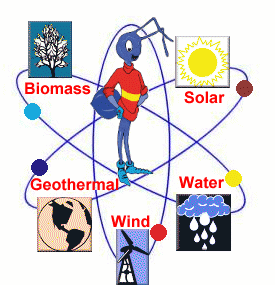 Investment in Africa’s renewable energy hits $3.6b The Nation, By Franca Ochigbo, Abuja 22 Dec 11 Over $3.6 billion has been invested in renewable energy in Africa, including Nigeria, with Egypt and Kenya taking centre stage. The Bank of Industry (BoI) in partnership with the United Nations Development Programme (UNDP) has unveiled plans to boost Nigeria’s investment portfolio in renewable energy through private sector participation.
The Managing Director, Bank of Industry, Ms Evelyn Oputu who was represented by Mr Austin Jo-Madugu, General Manager, Operations, disclosed this during the First Renewable Energy Investment Forum in Abuja. She said renewable energy has a large potential for growth given the large gap between energy demand and supply and the enormous renewable energy options available to the country……
http://www.thenationonlineng.net/2011/index.php/business/30662-investment-in-africa%E2%80%99s-renewable-energy-hits-$3.6b.html
Obama government boosts wind and solar energy on both coasts
 Obama Admin Pushes Renewable Energy on 2 Coasts ABC News, By MATTHEW DALY Associated Press WASHINGTON December 20, 2011 (AP) The Obama administration moved Tuesday to boost renewable energy on both coasts, approving onshore solar and wind farms in the West and pushing for offshore wind power in the Atlantic Ocean.
Interior Secretary Ken Salazar said his department has approved a 300-megawatt solar farm on public land in Arizona and a 200-megawatt wind farm in Southern California. The wind farm includes 186 megawatts that would be produced on federal lands.
The projects, southwest of Phoenix and east of San Diego, respectively, are the 24th and 25th renewable energy projects approved on public lands in the past two years, Salazar said, and demonstrate that the administration’s commitment to renewable energy is paying dividends. “Together, these projects will produce the clean energy equivalent of nearly 18 coal-fired power plants, so what’s happening here is nothing short of a renewable energy revolution,” Salazar said.
The Sonoran Solar Energy Project in Arizona, being developed by Florida-based NextEra Energy Resources, will generate enough electricity to power about 90,000 homes. The Tule Wind Project in California, developed by Iberdrola Renewables, the U.S. division of a Spanish energy company, will be able to power about 65,000 homes….
Salazar has urged Congress to extend the wind credit, which expires next year, calling it a lifeline for domestic producers that could save tens of thousands of jobs and bring financial certainty to the renewable industry… http://abcnews.go.com/US/wireStory/interior-backs-solar-wind-farms-calif-ariz-15199048#.TvKi7zXZ7_M
Direct current (DC) the way of the future, with renewable energy
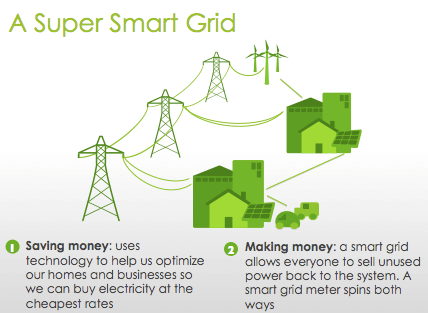 The main factor driving demand is the need to conserve energy and produce more of it from renewable sources. Alternating current is generated by rotating engines, but renewable sources such as wind and solar produce DC power.
DC can now be transmitted at high voltage over very long distances, longer than AC. It can be easily used in cables, over ground or under the sea.
“I’d put my money on the sun and solar energy,” – [Edison said]
 Insight: How renewable energy may be Edison’s revenge, Reuters, By Sara Ledwith LONDON | Tue Dec 20, 2011 “……The American inventor, who made the incandescent light bulb viable for the mass market, also built the world’s first electrical distribution system, in New York, using “direct current” electricity. DC’s disadvantage was that it couldn’t carry power beyond a few blocks. His Serbian-born rival Tesla, who at one stage worked with Edison, figured out how to send “alternating current” through transformers to enable it to step up the voltage for transmission over longer distances……
from the late 1800s, AC became the accepted form to carry electricity in mains systems. For most of the last century, the power that has reached the sockets in our homes and businesses is alternating current.
Now DC is making a comeback, becoming a promising money-spinner in renewable or high-security energy projects. From data centers to long-distance power lines and backup power supplies, direct current is proving useful in thousands of projects worldwide… Continue reading
Renewable energy gaining strength, saving money for customers and State budgets
A Response To Attacks On Renewable Energy Environmental defense Funds, By COLIN MEEHAN DECEMBER 19, 2011 “……renewable energy saves money for customers and adds much needed revenue to state budgets.
Obscuring the Facts
A recent analysis found that the five states with the highest amount of renewable energy (states that are encouraged by the policies Norquist asks us to rethink) have lower rates than the states with the least amounts of renewable energy. In 2009 the Texas PUC declaredthat the state’s national leadership in wind energy, driven by their RPS, “has had the impact of lowering wholesale and retail prices of electricity.” The Texas State Comptroller said, “After the RPS was implemented, Texas wind corporations and utilities invested $1 billion in wind power, creating jobs, adding to the Texas Permanent School Fund and increasing the rural tax base.” Continue reading
Small scale Wind- Solar hybrid system powering a whole village
Nepal’s Dhaubadi turns Asia’s first ‘renewable energy village’, Times of India Dec 17, 2011, |KATHMANDU: Dhaubadi, in remote Nepal has become Asia’s first ‘renewable energy village’ with the installation of mini wind-solar hybrid power system with the financial and technical support from ADB.
The two sets of 5 kw wind turbines complimented by 2 kwp of solar PV panels can generate 43.6 kwh per day electricity which can light 46 households of the village, according the Asian Development Bank country office in Nepal. The installation of this ultra-modern facility will allow women to cook and clean, and children to study or play after dark, ADB says in a press release issued at a function today.
The villagers are now able to see television, charge their cell phone sets, operate computers and read at night with the help of the wind-solar power system. Erecting greenhouses to absorb solar energy and manage water uses for high-value cash crop and vegetable production is also being planned which will augment income generation activities in the village community.
Energy fuels economic growth and poverty reduction. Reliable and efficient energy services underpin the expansion of economic and employment opportunities, the continuing progress in social development, and the sustained improvement in standard of living, observed S Hafeez Rahman, ADB’s director general for South Asia Development.
The Wind-Solar hybrid system was installed under ADB’s regional technical assistance (RETA) for Effective Development of Distributed Small Wind Power System in Asian Rural Areas of with the Alternative Energy Promotion Centre of the Ministry of Environment is the implementing agency in Nepal. The USD 3.8 million RETA will contribute to ADB’s Energy for All initiative by increasing access to energy in remote rural areas.
In view of the Nepal’s chronic energy shortage and its abundant wind and solar resources, as well as the government’s strong commitment towards a low-carbon economy, ADB has selected Nepal as the first pilot country for its small wind power initiative.
The lessons learnt from Nepal on the deployment of small wind power system in rural areas will be very useful in scaling up the systems in Nepal and replicating in other ADB member countries, said Kangbin Zheng, ADB’s senior investment specialist. Articles.timesofindia.indiatimes.com/2011-12-17/developmental-issues/30528393_1_s-hafeez-rahman-solar-energy-small-wind-power
Vermont’s comprehensive plan for renewable energy and energy efficiency
Vt. to seek 90 percent renewable energy by 2050 Bloomberg, By DAVE GRAM, 18 Dec 11 MONTPELIER, VT. Gov. Peter Shumlin wants the state to satisfy 90 percent of its energy needs from renewable sources by 2050, largely eliminating its reliance on fossil fuels.
Shumlin joined Public Service Commissioner Elizabeth Miller and other officials on Thursday to unveil a comprehensive energy plan that lifts what had been a moratorium on construction of renewable energy projects on state land; calls for more use of electric vehicles coupled with energy efficiency in the electric sector; says large-scale hydroelectric power like that imported from Canada should be considered renewable; and calls for expansion of piped natural gas
in the state. Continue reading
High renewable energy start up costs, later fall, because sun and wind are free
converting to a lower-carbon economy would increase electricity prices until around 2030, because renewable energy technology requires high start-up costs. They would fall after that, because fuel sources such as sun and wind are free.
Renewables need not cost more: EU energy chief By Barbara Lewis, BRUSSELS Dec 15, 2011 (Reuters) – A shift to renewable energy would ultimately cost around the same as business as usual and the EU needs to make progress on setting a 2030 target for greener fuel soon, the bloc’s energy commissioner said.
Guenther Oettinger was laying out the European Union’s latest road map for mostly eliminating carbon from the fuel mix by 2050 and guiding investors beyond the Commission’s existing set of energy goals. Continue reading
Despite media coverage against renewable energy, British public supports it
Over at BusinessGreen, James Murray describes the survey results as “explosive”, especially given that they “follow months during which the right-wing press has waged an increasingly virulent campaign against climate change, wind farms, renewable energy, and the greenlevies that pay for it”.
 British public strongly support renewable energy, survey says, The Guardian, 14 Dec 11 56% of UK population wants to see more investment in wind power, finds a YouGov survey
Does the UK have a “silent majority” in support of further investment in renewables? You wouldn’t necessarily think so if you listen to the very vocal, media-driven opposition against, say, wind power, but a recent YouGov survey commissioned by the Sunday Times suggests the true picture might be a little different.
The Sunday Times itself chose not to report the YouGov findings related to renewables (you can draw your own conclusions as to why), but if you look beyond the headline polling about the 1,696 respondents’ political leanings you start to reach some rather intriguing environmentally themed results ….
But the real point of interest can be found on page nine, which asks: “Thinking about the country’s future energy provision, do you think the government should be looking to use more or less of the following?”
Solar power
More than at present – 74%
Less than at present – 6%
Maintain current levels – 12%
Not sure – 9%
Wind farms
More than at present – 56%
Less than at present – 19%
Maintain current levels – 15%
Not sure – 9%… Continue reading
How Japan’s nuclear lobby sabotaged renewable energy
Secret Weapons Program Inside Fukushima Nuclear Plant? Global Research, 12/4/11 by Yoichi Shimatsu“….Sabotaging Alternative Energy The cynical attitude of the nuclear lobby extends far into the future, strangling at birth the Japanese archipelago’s only viable source of alternative energy—offshore wind power.Mitsubishi Heavy Industries, a nuclear-power partner of Westinghouse, manufactures wind turbines but only for the export market.
The Siberian high-pressure zone ensures a strong and steady wind flow over northern Japan, but the region’s utility companies have not taken advantage of this natural energy resource. The reason is that TEPCO, based in Tokyo and controlling the largest energy market, acts much as a shogun over the nine regional power companies and the national grid. Its deep pockets influence high bureaucrats, publishers and politicians like Tokyo Governor Shintaro Ishihara, while nuclear ambitions keep the defense contractors and generals on its side. Yet TEPCO is not quite the top dog. Its senior partner in this mega-enterprise is Kishi’s brainchild, METI.
The national test site for offshore wind is unfortunately not located in windswept Hokkaido or Niigata, but farther to the southeast, in Chiba Prefecture. Findings from these tests to decide the fate of wind energy won’t be released until 2015. The sponsor of that slow-moving trial project is TEPCO….. http://www.globalresearch.ca/index.php?context=va&aid=24275
Tiny Pacific island Tokelau to go %100 renewable energy – Durban report
 Tokelau to be first renewable energy nation Tokelau plans to use only renewable energy from next year. [ABC], Australia Network News, 9 Dec 2011 The tiny Pacific nation of Tokelau has told a UN conference it plans to use only renewable energy within a year. It would be the first country in the world to do so.
The head of the Tokelau Government, Foua Toloa, toldPacific Beat although his country is small, it has a powerful message.
“By September, 2012 – Tokelau will be the first nation 100 per cent renewable energy efficient, fulfilling our global obligation,” he said.
“We are making sure our voice is being heard here – especially the smallest of the small here in Durban”. Attending the UN conference in South Africa the Tokelau representatives have called for a legally-binding agreement of emission pledges from all countries. http://australianetworknews.com/stories/201112/3387536.htm?desktop
American Indians enthusiastic about potential for renewable energy industris
Indian Country welcomes renewable energy by Martin LaMonica December 4, 2011 JEMEZ PUEBLO, N.M.–American Indian tribes see renewable energy as a way to capitalize on their natural resources.
The Department of Energy last week proposed a rule that would speed up decisions regarding land used for renewable energy projects, many of which have been derailed by bureaucracy. The rule would require decisions within a 60-day limit for business-related leases, such as developing solar and wind projects on Indian land.
“It will require the government to act,” said Interior Secretary Ken Salazar last Monday, according to reports. “The government cannot sit on its hands, as it has often done.” Indian lands have significant resources, including solar and wind, but little has been developed, according to the National Congress of American Indians. “We’re ready to strengthen our economies now and jumpstart the clean energy economy in Indian Country. This is something the entire country can get behind,” said NCAI president Jefferson Keel in a statement….
For tribes with the resources, renewable energy holds the prospect of bringing in much-needed tax revenue, jobs, and potentially lower electricity costs, said Carolyn Stewart, managing partner at Red Mountain Energy Partners, which advises tribes on renewable energy.
“[Tribes] are very interested in controlling the pace of the development on the reservation, which they have not been able to do in the past for the most part with oil and gas, coal, or uranium mining [which] had significant environmental impacts,” she said….. http://news.cnet.com/8301-11128_3-57335065-54/indian-country-welcomes-renewable-energy/
1 This Month
To see nuclear-related stories in greater depth and intensity – go to https://nuclearinformation.wordpress.com/
Now until to February 10, 2026 Radioactive waste storage in France: the debate is finally open! How to participate?

-
Archives
- February 2026 (11)
- January 2026 (307)
- December 2025 (358)
- November 2025 (359)
- October 2025 (376)
- September 2025 (258)
- August 2025 (319)
- July 2025 (230)
- June 2025 (348)
- May 2025 (261)
- April 2025 (305)
- March 2025 (319)
-
Categories
- 1
- 1 NUCLEAR ISSUES
- business and costs
- climate change
- culture and arts
- ENERGY
- environment
- health
- history
- indigenous issues
- Legal
- marketing of nuclear
- media
- opposition to nuclear
- PERSONAL STORIES
- politics
- politics international
- Religion and ethics
- safety
- secrets,lies and civil liberties
- spinbuster
- technology
- Uranium
- wastes
- weapons and war
- Women
- 2 WORLD
- ACTION
- AFRICA
- Atrocities
- AUSTRALIA
- Christina's notes
- Christina's themes
- culture and arts
- Events
- Fuk 2022
- Fuk 2023
- Fukushima 2017
- Fukushima 2018
- fukushima 2019
- Fukushima 2020
- Fukushima 2021
- general
- global warming
- Humour (God we need it)
- Nuclear
- RARE EARTHS
- Reference
- resources – print
- Resources -audiovicual
- Weekly Newsletter
- World
- World Nuclear
- YouTube
-
RSS
Entries RSS
Comments RSS
 nuclear-news