Solar power the leader in rising renewable energy investment
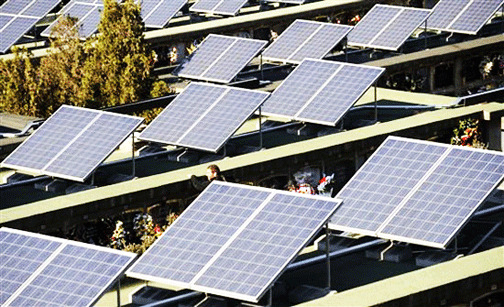
 the performance of solar owed most to “booming” rooftop PV installations in Germany and Italy, as property owners took advantage of falling panel prices.
Global investment in solar power jumped 52% in 2011: Report Startup Smart, By Michelle Hammond, 13 June 2012 Global investment in the renewable energy sector surged by 17% to a record $257 billion in 2011, a new report reveals, while total investment in solar power jumped by a whopping 52%. Continue reading
Solar panels for IKEA’s buildings in China
 IKEA To Use Solar Power on Buildings in China, Market Watch, June 12, 2012, IKEA Group partners with Hanergy to install solar panels on IKEA buildings BEIJING, Jun 12, 2012 (BUSINESS WIRE) — IKEA Group today announced that, as part of its goal to only use renewable energy to power its buildings, it will partner with Hanergy, one of China’s leading clean energy companies, to install solar photovoltaic panels on IKEA owned buildings in China. Continue reading
Solar energy investment soaring in world wide renewable energy growth
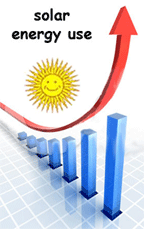 $257 billion invested in renewable energy in 2011 SMH, FRANK JORDANS, June 12, 2012 Global investment in renewable energy reached a record of $257 billion last year, with solar attracting more than half the total spending, according to a U.N. report released Monday.
Investment in solar energy surged to $147 billion in 2011, a year-on-year increase of 52 percent thanks to strong demand for rooftop photovoltaic installations in Germany, Italy, China and Britain.
Large-scale solar thermal installations in Spain and the United States also contributed to growth during a fiercely competitive year for the solar industry. Continue reading
Private enterprise is the major funder for new renewable energy
Who’s funding the green energy revolution? By Eoghan Macguire, June 12, 2012 – (CNN) — Money invested in renewable energy reached new heights last year, topping $257 billion.
So is the world finally going green?
The figures come from The Global Trends in Renewable Energy Investment 2012 report, a UN Environment Program backed study that has tracked the finance flowing into green energy across the world since 2004.
It found that renewables accounted for 44% of all new energy generation capacity added last year, up from 34% in 2010 and just 10.3% back in 2004.
The source for most of this finance came from the private sector, according to the report. Investment from the private domain in research and development of new technologies was almost double that of governments and public bodies.
While Europe attracts most of the investment, the renewable energy sectors of emerging economies such as India and China have been given the biggest boost.
China overtook the U.S. in terms of total annual investment in renewable energy in 2009 and attracted more money than any other country ($52.2 bn) in 2011.
India meanwhile saw the fastest expansion rate for any large renewables market last year, with a 62% increase in capital funding…… http://edition.cnn.com/2012/06/12/world/renewables-finance-unep/
Solar energy brings clean drinking water to 10,000 Indian villages
A solar energy based drinking water supply system has already changed lives of villagers in naxal affected Gadchiroli district of Maharashtra where solar energy based dual pump piped water supply system has been installed.

 10,000 Naxal villages to get 24 into 7 water supply, courtesy solar http://www.hindustantimes.com/India-news/NewDelhi/10-000-Naxal-villages-to-get-24-into-7-water-supply-courtesy-solar/Article1-868921.aspx Chetan Chauhan, Hindustan Times New Delhi, June 10, 2012 You in India’s top cities may envy around one-fifth of total villages in 78 naxal affected districts set to get around the clock tap water supply, courtsey solar energy. Three Central government ministries — New and Renewable Energy, Drinking
Water and Sanitation and Finance — have come together to provide 24 into 7 clean drinking water to 10,000 villages in the Naxal affected districts under the Integrated Action Plan of the Central government. Continue reading
Decentralised solar energy is transforming the economics of providing electricity
One of the reasons why the German government has reversed its decision in the energy changeover. It wants to give the companies more time to get out of their old investments and enter new ones.
The conventional energy industry will have to adapt to a more decentralized energy supply system very soon.

 Photovoltaic solar energy may get even cheaper, Reve, June 11, 2012 What does the trend towards cheaper solar electricity mean for the energy industry? Interview: Gero Rueter / nh. Editor: Sean Sinico. www.dw.de
For the conventional energy industry it means a change of paradigm, that’s for sure. It’s something you can see very clearly when you look at the statements made by Germany’s big energy suppliers lately. When he retired, Jürgen Großmann, former CEO of Essen-based RWE, said photovoltaics essentially ruin the business for the conventional energy industry, because they’re pushing the prices down on the energy stock markets.
A member of E.ON’s executive board said a couple of days ago that building power plants in Germany is no longer financially viable because of the economic framework conditions, with renewable energies advancing fast and forcing down prices. Continue reading
African and Islander nations going for small scale, off-grid, renewable technology
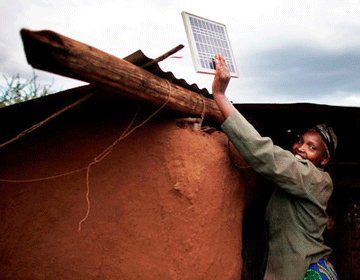 Africa: First African Renewable Energy Confab in Accra All Africa, BY AYUUREYISIYA KAPINI ATAFORI, 8 JUNE 2012 “….Off-grid technology is extremely important throughout Africa with many of the continent?s inhabitants without access to the grid.
…….A pioneering role in renewable energy development in Africa has been taken by Cape Verde. The West African islands have set a goal of 50 per cent renewable energy by 2020. Abrao Andrade Lopez, Director General of the Ministry of Industry and Energy, announced that the country was currently running a study to explore how to achieve 100 per cent renewable energy.
In a related development, decreasing dependency on oil imports encouraged 39 of the small island developing states (SIDS) in Africa, the Caribbean, the Indian Ocean and the Pacific to meet in Barbados to work out energy efficiency plans.
Islands like Tonga and Tokelau plan to become fully energy independent by 2013, and others are following suit. The small island developing states are writing the stories of their future, said Veerle Vandeweerd, Director of Environment and Energy at the United Nations Development Programme (UNDP). Continue reading
India’s solar-powered buses
Apoorva Renewable Energy to make solar-electric buses for transport body Business Line, BANGALORE, JUNE 8: Buses in Bangalore may soon be powered by solar energy. The Bangalore Metropolitan Transport Corporation (BMTC) has placed orders with Apoorva Renewable Energy Products to design solar-electric hybrid buses, the company CEO, Mr Suresh Babu, said on the sidelines of the Global Investors Meet 2012.
“The BMTC has asked us to provide a sample hybrid vehicle and we have accepted the order and will start working on it,” Mr Babu said. Several other government bodies such as the Bruhat Bengaluru Mahanagara Palike (BBMP) are in talks with the company too, he said.
The company makes three-wheeled vehicles powered by electric and solar power, and customises products for Indian conditions. “Using a common technology, we design products as per customer requirements and outsource the manufacturing,” Mr Babu said.
EXPORTS Currently, the company’s vehicles are used in Delhi and parts of Karnataka and it will start exporting in two months from now….. http://www.thehindubusinessline.com/companies/article3505672.ece
All Africa Renewable Energy Conference for October
Africa: First African Renewable Energy Confab in Accra All Africa, BY AYUUREYISIYA KAPINI ATAFORI, 8 JUNE 2012 The first conference in Africa solely focused on off-grid renewable energy technologies will be held in Accra in October this year with a special look at applications in rural communities of developing countries….. Continue reading
Ambitious solar energy plans in Middle East and North Africa
Solar Power Rises in the Mideast, North Africa, CNBC, 7 June 12, ”….A number of recent developments highlight the push for renewable energy in the MENA region, from Saudi Arabia’s ambitious solar plans to Qatar’s first-ever polysilicon plant and massive concentrated solar power plants across North Africa. Continue reading
Falling costs of renewable energy – International Renewable Energy Agency
 Renewable energy costs falling: Agency http://finance.ninemsn.com.au/newsbusiness/aap/8479949/renewable-energy-costs-falling-agency 7 June 12, Power from renewable energy sources is getting cheaper every year, according to a newly-released study, challenging long-standing myths that clean energy technology is too expensive to adopt.According to the study by the Abu Dhabi-based International Renewable Energy Agency and released on Wednesday, the costs associated with extracting power from solar panels has fallen as much as 60 per cent in just the past few years.
The price of generating power from other renewables, including wind, hydro power, concentrating solar power and biomass, was also falling.
“One of the (myths) out there perpetuated by industry lobby groups is that renewable energy is too expensive,” said Adnan Amin, IRENA’s director general. The numbers tell a different story, however, as “costs are falling
exponentially … and will continue (to do so) in the future,” said Amin arguing that electricity generation “is now cost-competitive with many traditional fossil fuel technologies”.
According to Dolf Gielen, director of IRENA’s innovation and technology centre, investment in renewables is no longer a niche but rather represents the “bulk of investments in global power generation,” accounting for half of the total annual capacity additions worldwide. ”The markets are growing very fast… and further cost reductions are
very likely,” he said adding that in 2011, investments in the supply side of renewable energy sources reached about $US260 billion ($A267.70 billion).
A second IRENA study released on Wednesday estimates renewables will create a minimum of four million jobs just in the electricity sector in rural areas of the developing world. Today, there are five million jobs world-wide in the renewable energy sector and more than 1.3 billion people, mainly in Africa and Asia, who do not have access to electricity, according to IRENA. ”There is considerable employment potential,” said Amin.
Founded in 2009, IRENA is an intergovernmental organisation established to promote the widespread use of renewable energy sources. It has more than 155 member states and is headquartered in Abu Dhabi.
Enthusiasm for solar power in Japan
The recent rush by home owners to cover their roofs with panels and companies to build “mega solar” farms have made solar cells a hot commodity.
“We are almost at grid parity here. Think of what would happen if Japan allows things to run their natural course and solar reaches grid parity
That all of Japan’s 50 nuclear reactors lie dormant amid public concern in the wake of Fukushima is an added boost for solar power
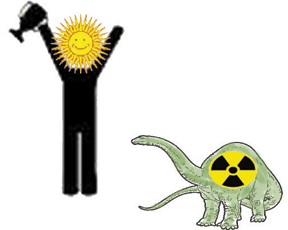
 Solar makers bet on Japan nuclear crisis being a game-changer
* Solar power firms to get boost from feed-in tariff
* Foreign players looking to grab slice of Japan’s solar market
* Companies say FIT will encourage economies of scale
* Public faith in nuclear power still in tatters after Fukushima
By Shinichi Saoshiro TOKYO, June 5 (Reuters) – Solar power firms are betting that the nuclear crisis in Japan will become a game-changer for renewable energy in the world’s third largest economy, with new foreign entrants such as Canadian Solar looking to go toe-to-toe there with some of the biggest utilities in Asia.
They will be given a big helping hand next month when the government introduces a generous subsidy for renewable energy via a so-called feed-in tariff (FIT), in a bid to encourage alternative energy sources, which currently only generate about 1 percent of power in Japan.
The FIT, which excludes large hydro-electric schemes, will require utilities to buy electricity generated by renewable sources such as solar, wind and geothermal heat at a premium for 20 years. Continue reading
Distributed solar energy plan launched in the Philippines
 Such facilities in the Philippines should be installed mostly on rooftops because there is a lot of arable and productive land which should be used for food production rather than for solar power generation,
Rooftop solar power project launched to prove viability, Business World, 5 June 12, THE ASIAN Development Bank (ADB) said yesterday it expects solar power capacity in the Philippines to reach up to 115 megawatts (MW) by next year, as it launched yesterday its solar rooftop facility to prove the viability of this renewable energy thrust.
The multilateral lender said it estimates most of solar projects in the country will consist of small clusters that generate lower capacities of electricity rather than large facilities. ADB installed 2,040 solar panels on its rooftop which can generate around 500 kilowatts of energy or around 613 MW a year. Continue reading
First solar powered transcontinental flight
Pilot completes first solar-powered transcontinental flight from Madrid to Rabat THE AUSTRALIAN, AP June 06, 2012 AN experimental solar-powered plane has landed in Morocco’s capital after a 20-hour trip from Madrid in the first transcontinental journey by a craft of its type.
With the wing span of a Boeing 777, the plane appeared out of the pitch darkness over the runway, suddenly turning on its lights and gliding to a landing in Rabat, its four propellers already still. “It was perhaps the most beautiful flight of my life,” said pilot
Bertrand Piccard, who has already circumnavigated the world by balloon.
“I have dreamed since I was a child of flying without using fuel.”
The single-seat aircraft is fitted with 12,000 solar cells across its immense wings and but only weighs just as much as the average family car, according to organisers. The plane is the first of its kind to fly both during the night and day as the solar panels charge the batteries for night flying….. http://www.theaustralian.com.au/news/world/pilot-completes-first-solar-powered-transcontinental-flight-from-madrid-to-rabat/story-e6frg6so-1226386003212
Summer days doubling solar electricity output in Britain
 Weatherwatch: long days of sunshine double electricity output http://www.guardian.co.uk/news/2012/jun/03/weatherwatch-sunshine-solar-power?newsfeed=true Paul Brown 3 June 2012 The last nine days of May saw a record production of solar power in Britain. The clear dry air meant sunlight was strong, more than doubling the daily average electricity output. Long hours of daylight are currently giving the thousands of households that invested in solar power under the original high level of subsidy considerable income. Continue reading
1 This Month
26 September – International Day for the Total Elimination of Nuclear Weapons





PLEASE OPPOSE HR 8255 AND S.3639 – bills would accelerate satellite deployment, with no environmental review or safeguards – https://ncstd5li.quorum.us/campaign/169331/
To see nuclear-related stories in greater depth and intensity – go to https://nuclearinformation.wordpress.com
-
Archives
- September 2026 (313)
- August 2026 (330)
- July 2026 (355)
- June 2026 (287)
- May 2026 (306)
- April 2026 (356)
- March 2026 (251)
- February 2026 (267)
- January 2026 (308)
- December 2025 (358)
- November 2025 (359)
- October 2025 (375)
-
Categories
- 1
- 1 NUCLEAR ISSUES
- business and costs
- climate change
- culture and arts
- ENERGY
- environment
- health
- history
- indigenous issues
- Legal
- marketing of nuclear
- media
- opposition to nuclear
- PERSONAL STORIES
- politics
- politics international
- Religion and ethics
- safety
- secrets,lies and civil liberties
- spinbuster
- technology
- Uranium
- wastes
- weapons and war
- Women
- 2 WORLD
- ACTION
- AFRICA
- Atrocities
- AUSTRALIA
- Christina's notes
- Christina's themes
- culture and arts
- Events
- Fuk 2022
- Fuk 2023
- Fukushima 2017
- Fukushima 2018
- fukushima 2019
- Fukushima 2020
- Fukushima 2021
- general
- global warming
- Humour (God we need it)
- Nuclear
- RARE EARTHS
- Reference
- resources – print
- Resources -audiovicual
- Weekly Newsletter
- World
- World Nuclear
- YouTube
-
RSS
Entries RSS
Comments RSS

