First solar powered transcontinental flight
Pilot completes first solar-powered transcontinental flight from Madrid to Rabat THE AUSTRALIAN, AP June 06, 2012 AN experimental solar-powered plane has landed in Morocco’s capital after a 20-hour trip from Madrid in the first transcontinental journey by a craft of its type.
With the wing span of a Boeing 777, the plane appeared out of the pitch darkness over the runway, suddenly turning on its lights and gliding to a landing in Rabat, its four propellers already still. “It was perhaps the most beautiful flight of my life,” said pilot
Bertrand Piccard, who has already circumnavigated the world by balloon.
“I have dreamed since I was a child of flying without using fuel.”
The single-seat aircraft is fitted with 12,000 solar cells across its immense wings and but only weighs just as much as the average family car, according to organisers. The plane is the first of its kind to fly both during the night and day as the solar panels charge the batteries for night flying….. http://www.theaustralian.com.au/news/world/pilot-completes-first-solar-powered-transcontinental-flight-from-madrid-to-rabat/story-e6frg6so-1226386003212
Summer days doubling solar electricity output in Britain
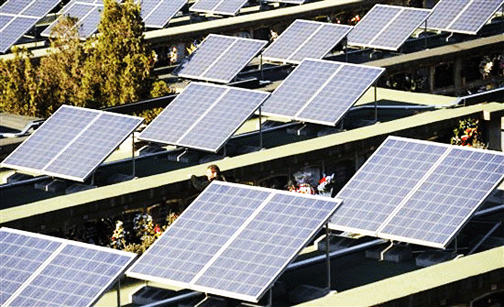
 Weatherwatch: long days of sunshine double electricity output http://www.guardian.co.uk/news/2012/jun/03/weatherwatch-sunshine-solar-power?newsfeed=true Paul Brown 3 June 2012 The last nine days of May saw a record production of solar power in Britain. The clear dry air meant sunlight was strong, more than doubling the daily average electricity output. Long hours of daylight are currently giving the thousands of households that invested in solar power under the original high level of subsidy considerable income. Continue reading
Solar energy projects for India’s rural areas

 Solar energy to be promoted in Varanasi http://timesofindia.indiatimes.com/city/varanasi/Solar-energy-to-be-promoted-in-Varanasi/articleshow/13767724.cms Binay Singh, TNN | Jun 3, 2012, VARANASI: With the announcement of a budgetary provision of Rs 100 crore for promoting solar energy projects particularly in the rural areas of the state the authorities of New and renewable Energy Development Agency (NEDA) are optimistic about further promotion and use of solar energy in the region. Continue reading
Solar panel that follows the sun
 includes video Heliowatcher allows solar panels to track the sun http://www.earthtechling.com/2012/06/heliowatcher-allows-solar-panels-to-track-the-sun/ 4 June 12, They’re called solar panels for a reason: they need the sun in order to generate electricity. Whether we’re talking about pocket-sized, portable solar chargers or massive rooftop arrays, direct sunlight is the must-have ingredient on which all other elements of solar-energy production depends.
You might think that simply placing solar panels on a rooftop or balcony free from shade would be enough. Except there’s that small matter of Earth rotating on its axis. So throughout the day, the sun moves across the sky, cutting into the efficiency of fixed panels. But what if the panels could automatically change their position to follow the sun and enjoy an uninterrupted flow of direct sunlight? Two electrical engineering students at Cornell are currently testing just such a technology, and it looks promising.
 Solar panel that follows the sun
As this review points out , HelioWatcher’s design is simple and effective: “The base is mounted like a Lazy Susan, able to pivot on the horizontal plane. The bottom edge of the solar panel is mounted with two door hinges, with a motorized screw jack used to raise and lower it.” Using a GPS module and magnetometer, the HelioWatcher allows the user to place the system anywhere in the world without any calibration. The HelioWatcher then calculates what the sun’s current location is and orients the panel to the appropriate angle. It also utilizes a quadrature of light-detecting diodes to correct for short-term light obstruction, such as clouds or shade.
This system is a vast improvement over other solar tracking systems that adjust position based on either a predetermined algorithm or light detection. Instead HelioWatcher combines elements of both technologies to leverage the guaranteed accuracy of a geospatial algorithm while also correcting for local or short-term changes, such as cloud cover or shade. Here’s a video, prepared by the two students, that explains the system:
Rapid growth in renewable energy jobs
 Renewable Energy Sector Employs Over 5 Million http://www.energymatters.com.au/index.php?main_page=news_article&article_id=3234 4 June 12, by Energy Matters According to a recent UN report, the number of renewable energy jobs doubled globally between 2007 and 2011 and millions more will be employed in the sector over the next 20 years.
The shift to a greener global economy could see an additional 15 to 60 million additional job over the next two decades according to a study led by the Green Jobs Initiative; a UN International Labour Organization (ILO) project. Continue reading
Sun providing heaps of electricity for Massachusetts
 Solar power hot all over Cape, state Jun 3 – McClatchy-Tribune Regional News – Patrick Cassidy Cape Cod Times, Hyannis, Mass. Solar in Massachusetts is on fire. Over the past two years, capacity from photovoltaic panels across the state has more than quadrupled from 25 to 115 megawatts, enough to power about 115,000 homes, according to figures provided by state energy officials and energy information websites. Continue reading
Ways to make renewable energy competitive in USA
 Two financial mechanisms that have driven investment in traditional energy projects — real estate investment trusts and master limited partnerships — could, with some help from Washington, be extended to renewable energy projects to lower their cost and make America’s energy future cleaner, cheaper — and more democratic
How to Make Renewable Energy Competitive, NYT By FELIX MORMANN and DAN REICHER June 1, 2012 STANFORD, Calif.Renewable energy needs help. Technological innovation has significantly reduced the cost of solar panels, wind turbines and other equipment, but renewable energy still needs serious subsidies to compete with conventional energy. Today, help comes mostly in the form of federal tax breaks.
These tax incentives, and the Congressional battle over extending them for wind projects beyond the end of this year, mean that other, more powerful policies to promote renewables are not getting the attention they deserve. If renewable energy is going to become fully competitive and a significant source of energy in the United States, then further technological innovation must be accompanied by financial innovation so that clean energy sources gain access to the same low-cost capital that traditional energy sources like coal and natural gas enjoy. Continue reading
Mainstream media waking up to Fukushima danger, and Germany’s renewables leadership
The second energy event of this past weekend was uplifting and extraordinary, due to an extremely sunny weekend, half of Germany’s electricity was generated by solar power two days. The decision to close down and eventually shut all of Germany’s nuclear reactors now appears to have been justified
 Germany’s Solar Success and Fukushima’s Crisis: Intelligent Energy Priorities, HUFFINGTONPOST, Vivian Norris 06/01/2012
  Last weekend, events took place which should make us think about the future of energy on this planet. Firstly, radioactive bluefish tuna was caught off the coast of California. The radioactivity, though in fairly small amounts, could be directly traced to the releases from the disasters at the reactors at Fukushima Daichi, following the devastating earthquake and tsunami.
And more importantly, the public finally received some answers from those supposedly in charge in Japan during the accident. Former Prime Minister Kan testified that the ties between regulators and TEPCO was so intertwined, and the accident so profound, that he called for Japan to stop all use of nuclear energy. For once, it appeared that mainstream media paid attention and published both Kan’s words, as well as articles on serious concerns about the status of fuel pools at Fukushima. Experts and more fringe elements on the internet had been publishing good information for over a year. It is to the New York Times’ credit that they acknowledged the role that the pressure from these groups played in forcing TEPCO and the Japanese government to admit they had not been forthcoming. Continue reading
Solar smart grid a Middle East first for Bahrain
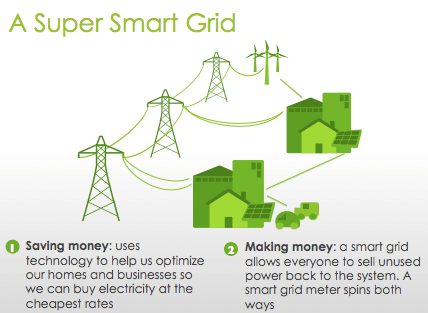 Bahrain Commits to Green Energy, Sacramento Bee, By Kingdom of Bahrain, Jun. 1, 2012 – MANAMA, Bahrain, — /PRNewswire-USNewswire/ –– In one of the first major solar energy projects in the Middle East, Bahrain yesterday announced plans to implement a solar smart grid in Awali, paving the way for future smart cities in Gulf.
“The Middle East has for some time evaluated the integration of solar energy for reduction
of reliance on non-renewable energy sources. However, Bahrain is among the first in the region to implement a project of this kind, demonstrating a serious commitment to long term solutions,” Marty Youssefiani, CEO of Caspian Energy Holdings, said.
Bahrain’s National Oil and Gas Authority (NOGA) is implementing five megawatt solar
capacity into a wireless smart grid network in cooperation with Petra Solar, Bahrain Petroleum Company (BAPCO) and Caspian Energy Holdings.
The grid circumvents common interconnection issues and costs of traditional solar systems because of its ability to install into the current transmission and distribution infrastructure. Bahrain intends to spread similar sustainable technology across the country in the future…… http://www.sacbee.com/2012/06/01/4531560/bahrain-commits-to-green-energy.html#storylink=cpy
Distributed solar power for millions of the world’s poor
Barefoot Power’s products are brightening up the lives of those with limited or no access to grid power. Products range from single desk lamps to complete kits for use by homes, clinics and schools. With good links to microfinance organisations and exceptional customer care, Barefoot has sold more than 400,000 lanterns and lighting kits to two million rural poor in Africa,Asia Pacific, India and the Americas.
 Solar power pioneer wins global green energy award, PR Wire 1 June 12, A company specialising in providing affordable solar power products to remote rural communities has won a coveted Ashden Award for its work in Africa.
Barefoot Power was awarded some £20,000 in prize money at a prestigious ceremony in London this evening after joining other Award winners at a meeting with His Royal Highness the Prince of Wales at Clarence House in the morning.
The Ashden judges said: “With its astonishing sales figures, Barefoot is a fantastic example of a market-led solution to bringing renewable electricity to Africa’s rural poor. Through its network of micro-entrepreneurs it is overcoming the barriers of how to access remote communities and how to make solar power affordable.” Continue reading
Germany’s dazzling success with small scale solar energy
the really meaningful story starts with a different number: 189.24 GWh. That’s the amount of electrical energy generated from more than a million PV solar systems spread all over the country on that record day. Not only was this almost 14% of Friday’s total electricity consumption in Germany, it was also, actually, not that unusual.
For the last couple of weeks, the output of PV solar peaked within an inch of the 20 GW line several times, and it never peaked very low throughout the month. The lowest peak load was 8 GW, while the average peak load of PV solar was 16 GW. So, it seems that solar is not as unreliable as conventional wisdom and media outlets often lead people to believe. Because I can tell you that we didn’t have 4 weeks straight of sunshine here in Germany, that’s for sure.
In-Depth: Germany’s 22 GW Solar Energy Record Clean Technica, MAY 31, 2012 BY THOMAS Last Friday, on the 25th of May 2012, Germany set a new world solar energy record in photovoltaic solar energy: 22.4 GW of photovoltaic energy on the grid covering over 30% of all energy demand! That’s the equivalent of 20 huge conventional fossil or nuclear power plants. This is clearly amazing news that made headlines around the world and was accompanied by either praise or the typical anti-solar bickering that is rather dominant in big media outlets even today (or especially today).
The latter didn’t mind even using this incredible clean energy accomplishment to repeat the usual ignorant talking points, disinformation, or flat out lies. Unfortunately, those news pieces and early articles praising the event didn’t fully exploit the opportunity to explain the true significance of having so much solar energy in the energy mix, especially when looking at the technological developments and opportunities of the coming years. Continue reading
Distributed solar energy, and distributed energy storage
In-Depth: Germany’s 22 GW Solar Energy Record Clean Technica, MAY 31, 2012 BY THOMAS“…….Millions of Batteries in Buildings — Utopian? …… it is very easy to show that it’s just a matter of time until the combination of energy storage for homes with rooftop solar energy and/or small-wind becomes viable and even profitable.
Today, there are still about 6.4 million oil tanks in homes and buildings all over Germany storing energy in the form heating oil. Installing such a tank costs several thousand Euros today. So, why shouldn’t independent power producers start putting up new forms of energy storage in the same numbers as soon as it makes economic sense?
How would 6 million home storage systems change the energy system? Well, 6 million 10 kW / 25 kWh would mean a distributed storage system with 60 GW maximum output/input and 150 GWh of capacity. That’s already enough storage for 10% of the current daily consumption, more than enough to power all German households through the night. It’s also coming a long way to fill the gap between renewable baseload power (hydro and biomass) and variable sources like wind and solar.
That 10-kW/25-kWh battery is not fiction by the way. It’s quite similar to the battery pack that powers the Nissan Leaf right now, Just one battery that will soon reach production volumes in the hundreds of thousands as factories in Japan, Europe, and the US crank up production by 2013.
It’s true that the $15,000 price tag for the battery is too high right now. But, since all kinds of competitors are investing in this market, economics of scale, innovation and optimization will certainly reduce the cost of such batteries in the coming years. In the case of multi-kWh batteries, this development is a lot more obvious than what happened with the price for solar cells just 7 years ago. The fall of prices surprised many analysts back then. Today, prices for solar cells are 70%-80% cheaper than what they were in 2007, putting the cost of solar systems well below $2 per Watt in Germany…. .. https://mail.google.com/mail/u/0/?shva=1#inbox/137a6ed1432cd545
Germany doing well with nuclear phaseout – despite the nuclear lobby’s lies about this
Busting the carbon and cost myths of Germany’s nuclear exit, Guardian UK Damian Carrington, 23 May 12 Critics of the atomic phase-out said energy emissions, costs and imports would all rise. They were wrong. it’s worth taking a look at what actually happens when you phase out nuclear power in a large, industrial nation.
That is what Germany chose to do after the Fukushima nuclear disaster, closing eight plants immediately – 7GW – and another nine by 2022. The shrillest critics predicted blackouts, which was always daft and did not happen.
But more serious critics worried that the three things at the heart of th eenergy and climate change debate – carbon, cost and security of supply – would all head in the wrong direction. Here in Berlin, I have found they were wrong on every count. Continue reading
The transition to renewable s – American’s energy revolution under way
America’s renewables revolution, Climate Spectator , 24 May 2012 John Kemp “……Speaking in his state of the union address to Congress in January, the president claimed, “We’ve subsidised oil companies for a century. That’s long enough. It’s time to end the taxpayer giveaways to an industry that rarely has been more profitable and double-down on a clean energy industry that never has been more promising.”
But the rhetoric obscures an unprecedented push to cut energy consumption and increase the share of renewable energy generation underway at all levels of government as well as in the private sector.
Federal, state and local governments, coupled with local power and gas utilities, are pouring billions of dollars a year into a vast range of initiatives to boost efficiency and renewables.
Support for efficiency and renewables is split across thousands of
different programs, which has tended to hide the scale of the overall effort. As a result, many energy analysts fail to appreciate the scale of the shift underway. However, the sheer amount of support being given to clean technology and energy efficiency programs suggests a revolutionary transformation of the energy system will likely occur in the next two decades. Continue reading
Small scale renewable energy for millions in Sub-Saharan Africa
Solar energy enterprise to provide 10 million with access to renewable energy, PR Wire 24 May 12 The BCtA is a global initiative that encourages private sector efforts to fight poverty, supported by several international organizations including the UN Development Programme (UNDP).
Ten million low-income people living in rural communities in Sub-Saharan Africa, Asia and the Pacific, Latin America and the Caribbean, will gain access to low-cost solar energy by 2015, in part due to a commitment made by solar energy provider Barefoot Power to the Business Call to Action (BCtA).
The BCtA is a global initiative that encourages private sector efforts to fight poverty, supported by several international organizations including the UN Development Programme (UNDP). Continue reading
1 This Month
To see nuclear-related stories in greater depth and intensity – go to https://nuclearinformation.wordpress.com/
31st January – Challenging the War Machine – a DECLASSIFIED UK SUMMIT



Website of the Week
Now until to February 10, 2026 Radioactive waste storage in France: the debate is finally open! How to participate?
-
Archives
- January 2026 (306)
- December 2025 (358)
- November 2025 (359)
- October 2025 (376)
- September 2025 (258)
- August 2025 (319)
- July 2025 (230)
- June 2025 (348)
- May 2025 (261)
- April 2025 (305)
- March 2025 (319)
- February 2025 (234)
-
Categories
- 1
- 1 NUCLEAR ISSUES
- business and costs
- climate change
- culture and arts
- ENERGY
- environment
- health
- history
- indigenous issues
- Legal
- marketing of nuclear
- media
- opposition to nuclear
- PERSONAL STORIES
- politics
- politics international
- Religion and ethics
- safety
- secrets,lies and civil liberties
- spinbuster
- technology
- Uranium
- wastes
- weapons and war
- Women
- 2 WORLD
- ACTION
- AFRICA
- Atrocities
- AUSTRALIA
- Christina's notes
- Christina's themes
- culture and arts
- Events
- Fuk 2022
- Fuk 2023
- Fukushima 2017
- Fukushima 2018
- fukushima 2019
- Fukushima 2020
- Fukushima 2021
- general
- global warming
- Humour (God we need it)
- Nuclear
- RARE EARTHS
- Reference
- resources – print
- Resources -audiovicual
- Weekly Newsletter
- World
- World Nuclear
- YouTube
-
RSS
Entries RSS
Comments RSS
 nuclear-news