Renewable energy the choice of most Americans – of all political views
 Americans of all political persuasions really like renewable energy and will almost always choose it as a priority over fossil fuels.
Poll: Independent Voters Favor Renewable Energy Over Keystone XL Pipeline By 4-1 Margin Think Progress, By  Stephen Lacey Nov 15, 2012 Environmental groups celebrated last fall when President Obama delayed the northern portion of the Keystone XL pipeline, a project that would pipe carbon-intensive tar sands crude from Canadian strip mines to refineries in Texas.
Now that Obama is back in the White House for a second term, those same forces are banding together to encourage the president to kill the pipeline altogether. A new poll suggests that these groups have public opinion on their side. Continue reading
UK’s Conservative Party driven by climate denialism, and anti wind power fervour
Anti-wind zeal already runs through the party…… the objections of many Tories suggest a deeper animus, fuelled by Euroscepticism, climate-change denial
Mr Cameron made a windpower sceptic, John Hayes, energy minister, and appointed yet another, Owen Paterson, as environment secretary.
as turbines get bigger and more efficient, the costs for operating and maintaining them are falling
Wind farms and renewable energy A lot of hot air The government’s energy policy gets mired in politics
http://www.economist.com/news/britain/21566680-governments-energy-policy-gets-mired-politics-lot-hot-air Nov 17th 2012 THE hatred some Conservative MPs feel for windmills is amazing.On November 14th Chris Heaton-Harris, a Tory MP charged with running his party’s campaign for a by-election in Corby, was secretly taped bragging that he had supported a rival, James Delingpole. A climate-change sceptic, Mr Delingpole had briefly stood as an independent on an anti-wind platform. Mr Heaton-Harris suggested this was a put-up job, designed to implant the issue into the “DNA of the Tory party”. Continue reading
Google’s Investment in Renewable Energy Approaches $1 Billion http://mashable.com/2012/11/15/googles-renewable-energy-1-billion/
November 15, 2012 by Todd Wasserman Google announced a $75 million equity stake in an Iowa wind farm on Thursday, bringing the company’s total investment in renewable energy to “more than $990 million.” Continue reading
Qatar moving ahead on renewable energy
Qatar puts focus on renewable energy initiatives, AMEinfo.com Qatar: November 14 – 2012“………as part of its commitment to reducing carbon emissions and increasing sustainable energy production, Qatar has overseen a range of internal initiatives
as part of its Vision 2030.
In this, Qatar is one of the region’s leading proponents of energy diversification. The International Energy Agency’s World Energy Outlook report shows that this is in line with a
global shift in attitudes towards energy generation and consumption. Continue reading
International Energy Agency says Energy Efficiency and renewables can fight global warming
 The IEA says energy demand out to 2035 could be halved through energy efficiency measures – in the building sector, including appliances, the transport sector and the industry sector. This would require an estimated $US11.8 trillion investment, but this would be more than offset by an $18 trillion reduction in fuel costs.
 How energy efficiency and renewables can save the planet http://reneweconomy.com.au/2012/how-energy-efficiency-and-renewables-can-save-the-planet-44897 By Giles Parkinson , 13 November 2012 The International Energy Agency has raised hopes that time can be bought for the world to finally get its act together on climate change – as long as it implements a rapid uptake of energy efficiency measures.
In its latest World Energy Outlook, the IEA says energy efficiency could buy the world an extra five years to reach conclusive and effective climate change policies. Without such measures,it says, the world by 2017 will have exhausted its carbon budget to try and keep keep the world to an average rise in global temperatures of 2C. It says 81 per cent of that budget has already been used. Continue reading
Mongolia could meet all its energy need through renewable sources
Mongolia to Increase Renewable Energy Development, Xinhua Says http://www.bloomberg.com/news/2012-11-12/mongolia-to-increase-renewable-energy-development-xinhua-says.html By Ehren Goossens – Nov 12, Mongolia plans to increase the amount of energy produced from renewable sources, the country’s President Tsakhia Elbegdorj said Monday, according to China ’s official Xinhua News Agency.
The country expects to produce 20 percent to 25 percent of its electricity from wind, solar and other renewable resources by 2020, Elbegdorj said at the Northeast Asia Renewable Energy Resources Cooperation Forum. He didn’t say how much renewable energy is produced now.
Mongolia has the potential to meet its entire domestic energy demand with renewable power, Elbegdorj said.
New ways to store solar energy
Using rust and water to store solar energy as hydrogen e! science News, November 11, 2012 How can solar energy be stored so that it can be available any time, day or night, when the sun shining or not? EPFL scientists are developing a technology that can transform light energy into a clean fuel that has a neutral carbon footprint: hydrogen. The basic ingredients of the recipe are water and metal oxides, such as iron oxide, better known as rust. Kevin Sivula and his colleagues purposefully limited themselves to inexpensive materials and easily scalable production processes in order to enable an economically viable method for solar hydrogen production. The device, still in the experimental stages, is described in an article published in the journal Nature Photonics……
The results presented in the Nature Photonics paper represent a breakthrough in performance that has been enabled by recent advances in the study of both the iron oxide and dye-sensitized titanium dioxide, and both of these technologies are rapidly advancing. Sivula predicts that the tandem cell technology will eventually be able to attain an efficiency of 16% with iron oxide, while still remaining low cost, which is, after all, the attractiveness of the approach. By making it possible to store solar energy inexpensively, the system developed at EPFL could considerably increase the potential of solar energy to serve as a viable renewable energy source for the future.
Source: Ecole Polytechnique Fédérale de Lausanne
http://esciencenews.com/articles/2012/11/11/using.rust.and.water.store.solar.energy.hydrogen
Sun and wind saving money, and the environment, in USA sports stadiums
Stadiums increase renewable energy use Pro sports facilities are using green energy sources to help the environment and their own bottom lines. Nov. 9, 2012 ALISON BURDO, MEDILL NEWS SERVICE WASHINGTON, Nov. 9 (UPI) — Green is more than a team color for the Philadelphia Eagles. By the end of the year the team’s stadium, Lincoln Financial Field, will generate enough energy from 14 wind turbines and 11,000 solar panels to power every home game.
“One of the uses of such a high-profile enterprise is you can sometimes help show the way and lead by example,” said Eagles Vice President of Communications Rob Zeiger.
Construction of the wind turbines was to be completed this week. The 15-feet-tall structures were installed atop the north and south ends of the stadium, in direct view of the nearly 70,000 fans entering the “Linc” and the countless drivers passing the complex on I-95. Continue reading
Solar truck helping to provide electricity in New York
 Rolling Sunlight Helping New York Storm Victims http://www.energymatters.com.au/index.php?main_page=news_article&article_id=3454 by Energy Matters, 7 Nov 12, Greenpeace’s solar truck is in New York, generating electricity for some of those affected by Sandy.
Hundreds of thousands of people in states hit by Sandy are still without power and it may be quite some time before electricity supply is back to normal. Adding to the misery is the cold weather and a lack of fuel.
Greenpeace has sent in Rolling Sunlight to lend a bit of a helping hand.
Built in 2001, Rolling Sunlight is a mobile power station fitted with 2.4kW of solar panels and a 50kWh deep cycle battery storage system. The truck itself is powered with biodiesel. After reaching a site, Rolling Sunlight can start cranking clean electricity within 15 minutes.
The truck has been generating power in a variety of locations, including acommunity store in Rockaway. Residents have also been able to drop by to get a much-needed charge for their mobile phones.
“We are happy to work with the community relief effort to bring solar power to New York. Today, solar power can help bring a small degree of comfort and a cell phone charge to the people left without electricity in Sandy’s wake,” said Greenpeace climate campaigner Robert Gardner.
“Tomorrow, the same solar power can help us slow down the global warming that is supercharging storms like Sandy, and prevent us from further loading the dice toward even worse extreme weather.”
In a nation where the term “climate change” is such a thorny issue that the topic was never raised during the recent series of presidential debates, attitudes are rapidly changing as a result of the storm.
While in a blackout scenario grid connected home solar power systems are also crippled as a safety measure, the Next Big Thing for solar is energy storage for residential applications; which will allow households to still generate power in such circumstances and enable people to further reduce their dependence on the mains grid.
Westmill Solar Co-operative – the whopper community owned energy project
 World’s Largest Community Owned Solar Project http://www.energymatters.com.au/index.php main_page=news_article&article_id=3455 by Energy Matters, 7 Nov 12 Last week, Westmill Solar Co-operative in the UK completed the acquisition of Westmill Solar Park, making the project the largest community-owned solar power station in the world.
The £16.5million facility is a 5MW solar farm covering 30 acres and consisting of over 20,000 solar panels. The power station is located near Watchfield, on the Wiltshire/Oxfordshire border.
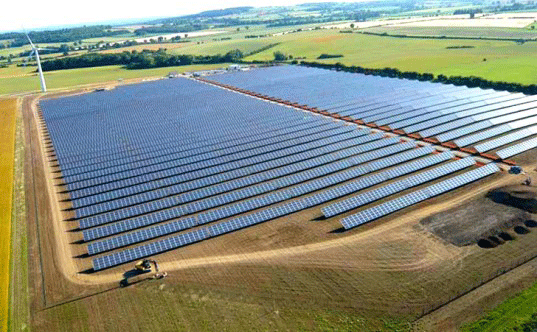
Westmill Wind Farm is adjacent to the site, which was also started as a 100% community owned renewable energy project.
In the last year, the solar farm has generated 4,900 MWh of clean electricity, enough to power 1,500 households and avoiding over 2,000 tonnes of carbon dioxide emissions.
“Westmill represents the best of what low carbon investment and renewable energy can offer and hopefully will inspire others to realise that when we get together we can make change happen and can engage positively with the threat of climate change,” said founder director Adam Twine.
The Westmill Solar Co-operative share offer attracted around 1650 investors in just 6 weeks- 50% more than was required. More than half of the Westmill members live within 40km of the project. Members will be entitled to a share in the profits generated by the electricity sold. Predicted internal rate of return to members is 9 – 11% over the 24 years of the project.
Aside from the environmental benefits and in addition to offering local residents a substantial return on their investment, the solar farm will boost the local economy by making sure the profits stay in the area, encourage tourism and raise the local area’s profile.
“Solar power will become the world’s greatest energy source in our lifetime; heralding a new era of sustainable and ‘democratic’ energy supply,” said Cooperative chairman Philip Wolfe.
“As the success of Westmill shows, solar energy enables ordinary people to produce clean power, not only on their roof tops, but also at utility scale.”
Community owned windfarms could be good for UK
 Windfarms: is community ownership the way ahead? http://www.guardian.co.uk/environment/2012/nov/05/windfarms-community-ownership
On the Danish island of Samsø many of the wind turbines are owned by the residents. Is that the way around nimbyism? Patrick Kingsley guardian.co.uk, 5 November 2012 “I can’t single-handedly build a new Jerusalem,” said John Hayes, the Tory energy minister, last week, “but I can protect our green and pleasant land.” What was he on about? Windfarms. He wants them stopped because he says locals don’t like them.
But that isn’t always the case. Take Samsø, a pretty island off the coast of Denmark. In the late 90s, Samsø’s 4,000 elderly farmers were famous for their early crop of new potatoes. Smothering their isolated Eden with windmills was far from a priority.
Yet 15 years later, that is exactly what’s happened. These conservative islanders have installed 11 onshore windmills, while another 10 lie just off the coast. Astonishingly, Samsø is now one of the world’s largest carbon-neutral settlements. To find how it happened, I visited the island this spring while researching my new book, How to be Danish. The answer? Community ownership. Sixteen of the 21 new turbines are owned either by local co-operatives, or by individual farmers. This means that the turbines haven’t been sprung on the locals. Instead, the latter are invested in the former, both emotionally and financially. The excess energy created by the turbines is sold back to the national grid – and the profit creates a handy annual dividend for each local. “There’s money in it,” smiles 66-year-old Erik Andersen, who owns a herd of rare Red Danish cows. “It’s a good investment.”
So wind power doesn’t always alienate locals. Denmark has over 6,000 turbines – 2,000 more than Britain, despite being a sixth of the size. This is partly down to its topography: it’s flat, so there’s a lot of wind. But it’s also to do with how the Danes involve local communities. Around 70-80% of those turbines are co-owned by local groups – little wonder there’s more of them.
Could it happen in Britain? An ICM poll suggests so: while only one in two Britons would back a windmill within two miles of their home, 68% would support one that was community-owned. John Hayes, take note.
Renewable energy trumping nuclear in Britain
 Renewable UK said that last year there were at least 137,000 people involved in the sector, with a further 654,500 jobs in ancillary industries.
Renewable energy will overtake nuclear power by 2018, research says Renewables will provide enough power for one in 10 British homes by 2015 if current growth rates continue Fiona Harvey, environment correspondent The Guardian, 30 October 2012 Renewable energy capacity will overtake nuclear power in the UK by 2018, if current rates of growth continue, and will provide enough power for one in 10 British homes by 2015, according to new research.
The amount of electricity supplied by wind energy alone is up by a quarter since 2010, in a surprisingly good year for the renewables industry. While the government has notably cooled on wind power – more than 100 Tory MPs signed a statement this year opposing new windfarms, and the chancellor of the exchequer, George Osborne, has queried the future of subsidies – the industry has continued to grow, with investment in offshore wind up by about 60% to £1.5bn in the past year. Planning approvals for onshore windfarms also rose, up by about half, to reach a record level, according to the trade association Renewable UK.
Despite the outspoken opposition from many Tory MPs against wind power, there was a rise in the amount of onshore wind capacity approved last year for the first time since 2008. Continue reading
Germany’s nuclear phaseout – financial benefits to farmers, investors, and small business
the nuclear shutdown and an accompanying move toward renewable energy are already
yielding measurable economic and environmental benefits, with one top expert calling the German phase-out a probable game-changer for the nuclear industry worldwide.
the nuclear phase-out and accompanying shift to renewable energy have brought financial benefits to farmers, investors, and small business;
 Bulletin: German nuclear exit delivers economic, environmental
benefits http://www.ecnmag.com/news/2012/11/bulletin-german-nuclear-exit-delivers-economic-environmental-benefits, 11/01/2012 Following the accident at the Fukushima Daiichi Nuclear Power Station in 2011, the German government took the nation’s eight oldest reactors offline immediately and passed legislation that will close the last nuclear power plant by 2022.
This nuclear phase-out had overwhelming political support in Germany. Continue reading
A solar energy solution for India’s power needs
 The solar-powered success of the Malankara Tea Plantation has national implications.
India’s most recent power outages demonstrate how important it is for the country and its peers to pursue the sustainable, onsite generation of renewable energy and move away from the fossil fuels and fragile power grids that left millions in the sweltering dark this summer.
Solar Energy Could Solve Developing Nations’ Infrastructure Problems Aol Energy , By Mark Cerasuolo November 1, 2012 The challenges with India’s public electricity grids last summer showed the world what happens when a country’s growth rapidly outpaces its energy delivery infrastructure and diversity of sources. When three of India’s electricity grids failed and more than half a billion people suffered two days of blackouts at the height of summer, the global media reminded us that even on the country’s best day, there is still an enormous portion of the population with no access to power. Solar energy is one way to solve this problem….
Today, India gets only one gigawatt of power from solar energy, a mere 0.5 percent of its total power consumption according to BusinessWeek . But the country’s solar capacity is growing, and the government is encouraging state utilities to tap into that capacity by offering companies the chance to trade renewable energy credits……
The Malankara Tea Plantation took advantage of the Indian government’s incentives on solar photovoltaic installations; it used capital subsidies of 90 rupees per watt up to a maximum of 30 percent of the project cost. It installed solar arrays and charge controllers that gave the company independence from the unreliable grid and made it one of India’s first net-zero energy buildings. The organization has also reduced its annual carbon emissions by 47 tons. Continue reading
Pacific Island Tokelau leads the world in renewable energy: small really is beautuful
PEC-funded projects have brought power to the lives of more than 10,000 people in the Solomon Islands; will reduce Samoa’s fuel usage by 135,000 litres per annum; and, in the Federated States of Micronesia, reduce carbon emissions by 500 tonnes and induce fuel cost savings of 486,000 dollars per year.
 Pacific Island Sets Renewable Energy Record, Alert Net, 26 Oct 2012 By Catherine Wilson BRISBANE, (IPS) – Tokelau, a small Polynesian territory in the central Pacific, has surpassed the rest of the world in replacing fossil fuels and raised the benchmark of achievement on sustainable development. Continue reading
1 This Month

Protect Sazan Island from the Trump family! https://secure.avaaz.org/campaign/en/protect_sazan_island_from_the_trump_family_loc/?bqFCVab&v=174511&cl=22707147157&_checksum=5e9dde668860e8231c33699735e16a1fbf22ab2cb01da50c999fe8732b9775ef&utm_source=email&utm_medium=blast_email&utm_campaign=174511


Cuba Is Not a Failed State – It Is a Besieged State
PETITION: “Global Appeal to Endorse Palestinian Right of Return of Refugees”
To see nuclear-related stories in greater depth and intensity – go to https://nuclearinformation.wordpress.com
-
Archives
- June 2026 (129)
- May 2026 (306)
- April 2026 (356)
- March 2026 (251)
- February 2026 (268)
- January 2026 (308)
- December 2025 (358)
- November 2025 (359)
- October 2025 (376)
- September 2025 (257)
- August 2025 (319)
- July 2025 (230)
-
Categories
- 1
- 1 NUCLEAR ISSUES
- business and costs
- climate change
- culture and arts
- ENERGY
- environment
- health
- history
- indigenous issues
- Legal
- marketing of nuclear
- media
- opposition to nuclear
- PERSONAL STORIES
- politics
- politics international
- Religion and ethics
- safety
- secrets,lies and civil liberties
- spinbuster
- technology
- Uranium
- wastes
- weapons and war
- Women
- 2 WORLD
- ACTION
- AFRICA
- Atrocities
- AUSTRALIA
- Christina's notes
- Christina's themes
- culture and arts
- Events
- Fuk 2022
- Fuk 2023
- Fukushima 2017
- Fukushima 2018
- fukushima 2019
- Fukushima 2020
- Fukushima 2021
- general
- global warming
- Humour (God we need it)
- Nuclear
- RARE EARTHS
- Reference
- resources – print
- Resources -audiovicual
- Weekly Newsletter
- World
- World Nuclear
- YouTube
-
RSS
Entries RSS
Comments RSS
 nuclear-news