Saudi Arabia to spend $109 billion on renewable energy projects
Saudi Arabia To Add 50GW Of Renewables By 2030 http://www.energymatters.com.au/index.php?main_page=news_article&article_id=3693 17 April 13 Saudi Arabia plans to spend $109 billion on renewable energy projects over the next 20 years, installing more solar and wind power capacity than the rest of the world to date. Continue reading
Germany moving ahead on renewable energy storage
Germany’s Energy Storage Incentives Start May 1 http://www.energymatters.com.au/index.php?main_page=news_article&article_id=3694 17 April 13, New renewable energy subsidies in Germany may do for battery storage globally what the nation did for solar power.

In February we reported Germany would apparently soon formally confirm a start date for an initiative to support the purchase of battery based energy storage systems integrated with solar panel arrays. It took a little longer than rumoured, but that moment seems to have arrived. Continue reading
Go for renewable energy, scrap subsidies for fossil fuels – Obama
Obama Budget – Spend Big On Renewables, Slash Fossil Fuel Support http://www.energymatters.com.au/index.php?main_page=news_article&article_id=3682 11 April 13, US President Barack Obama has proposed billions more be ploughed into renewable energy and to eliminate $4 billion in fossil fuels subsidies in his 2014 budget proposal.
Among the highlights:
– $615 million to increase the use and reduce the costs of solar power, wind, geothermal, and hydro energy.
– $4 billion in loans to rural electric cooperatives and utilities to support a transition to clean-energy generation.
– $238 million in loan guarantees and grants to assist farmers and rural small businesses in developing renewable energy systems and energy efficiency improvements.
– $100 million to maintain capacity to review and permit new renewable energy projects on Federal lands and waters.
– $23 billion of incentives for renewable energy production and energy efficiency over the next 10 years.
– $153 million in smart grid research and development and other activities plus $80 million to advance clean energy integration into the grid.
– $2.5 billion in tax credits for investments in advanced energy manufacturing projects.
The fossil fuel subsidy gravy train will lose more than just a few carriages.
“As we continue to pursue clean energy technologies that will support future economic growth, we should not devote scarce resources to subsidizing the use of fossil fuels produced by some of the largest, most profitable companies in the world.”
“The Budget proposes to eliminate inefficient fossil fuel subsidies that impede investment in clean energy sources and undermine efforts to address the threat of climate change. The Budget would repeal over $4 billion per year in tax subsidies to oil, gas, and other fossil fuel producers.”
The United States has nearly doubled its energy generation from renewable energy sources since 2008 and President Obama has set a goal of doubling it again by 2020.
Further details of the 2014 budget proposal section, “Clean Energy Economy, Improving Energy Security, and Addressing Climate Change” can be viewed here.
GDF’s wind energy provides over 50% of the company’s electricity: France
Renewable energy accounts for 50% of GDF Suez production capacity in 2012 http://www.utilityproducts.com/news/2013/04/10/renewable-energy-accounts-for-50-of-gdf-suez-production-capacity-in-2012.html
 Apr 10, 2013 – French utility GDF Suez’s (EPA:GSZ) production capacity from renewable energies stood at 5.1 GW at the end of 2012, or over 50% of the total production capacity of the group in France, the company said.
GDF Suez is the first producer of wind energy in the country and the second major producer of electricity from hydraulic energy, accounting for 25% of France’s capacity.
The group invests in all types of renewable sources, including solar and tidal power, offshore wind energy, biomass and biofuels, such as biomethane.
New York’s progress towards 100% renewable energy
“Exclusive of hydropower, the state has developed more renewable energy than any other state in the Northeast,” “Including hydropower, New York’s renewable energy capacity is comparable to the entire renewable energy capacity of the other eight states in the Northeast.”
NY Renewable Energy Study Finds New York Could Soon Be Powered By Wind, Water And Sunlight HUFFINGTON POST, AP By MICHAEL HILL, 5 April 13— A new study says New York could get the power it needs from wind, water and sunlight by 2030 with a concerted push, though the state’s decade-long effort to significantly boost green energy shows how challenging that could be.
The study, led by researchers from Stanford and Cornell universities, provides a theoretical road map to how New Yorkers could rely on renewable energy within 17 years. It would require massive investments in wind turbines, solar panels and more from the windy shores off Long Island to sun-exposed rooftops upstate.
“It’s doable,” said co-author Robert Howarth, a Cornell professor of ecology and environmental biology. “It’s way outside of the realm of what most people are talking about … But I think people have been too pessimistic about what can be done.”
In fact, New York has been committed to significantly increasing green energy production for the past nine years under its renewable portfolio standard, which is funded by a surcharge of less than a dollar on monthly electricity bills. Then-Gov. George Pataki began the program in 2004 with the goal of New York relying on renewable resources for a quarter of its electricity by 2013. Continue reading
Crescent Dunes Solar Energy Plant solves problem of “intermittent power”
Crescent Dunes Molten Salt Solar Receiver Completed http://www.energymatters.com.au/index.php?main_page=news_article&article_id=3673 5 April 13, SolarReserve has announced one of its flagship projects is reaching final stages of completion in the Nevada desert, with the installation of molten salt receiver panels on the peak of the 540-foot tall tower of the Crescent Dunes Solar Energy Plant. By utilising molten salt storage technology, the Crescent Dunes solar plant, located near Tonopah, Nevada, can operate like a conventional power plant, providing “on demand” and emissions-free electricity for up to 10 hours in adverse conditions.
“The energy storage capability of this technology solves the problem of intermittency typical of other renewable energy sources,” said Kevin Smith, CEO of SolarReserve. Continue reading
Bill Gates now promoting renewables (? not nuclear)
Bill Gates Provides Boost To Renewable Energy Storage Company Aquion Energy April 3, 2013 Clean Technica Nicholas Brown
Bill Gates, the well known co-founder of Microsoft, has decided to provide a financial boost to renewable energy storage research and development (R&D). He is one member of a group of high-profile investors who are investing $35 million into Aquion energy.
The company is creating a water-based battery system intended to be cheap and environmentally friendly. Aquion’s energy storage technology is reportedly being developed for large- and small-scale energy storage projects, and the company is delivering pre-production energy storage units throughout this year, with the intention to ramp up production at a high-volume manufacturing plant in Pennsylvania by the end of 2013. http://cleantechnica.com/2013/04/03/bill-gates-provides-boost-to-renewable-energy-storage/#XErorPJRkTq1fT8b.99
Gallup poll shows Americans want solar and wind power
 Survey Says: Americans Want More Solar And Wind
  Power, by Energy Matters 3 April 13 As the USA seeks to consolidate its domestic energy industry, a nation-wide poll has revealed two-thirds of Americans support solar and wind power over oil and nuclear energy.
Production of coal proved least popular, with just one in three people surveyed supporting it as the primary solution to future energy independence.
The Gallup poll asked respondents to categorise the emphasis they believe should be placed on a range of domestic energy production sources.
The poll found an overwhelming 76 percent of all Americans wanted more emphasis placed on producing domestic energy using solar power, followed closely by wind energy (71 percent), then natural gas (65 percent), oil (46 percent), nuclear (37 percent), and coal (31 percent)…. http://www.energymatters.com.au/index.php?main_page=news_article&article_id=3669
Birthpangs of a new capitalist industry – China’s solar technology
 What’s going on with Chinese solar? The Conversation, John Mathews, 27 March 2013 ”….. The birth pangs of a capitalist industry What we’re seeing is the birth pangs of a new, capitalist industry. We should be rejoicing that some companies are going bankrupt – it shows that the
  industry really is competitive, and not subject to arbitrary state control.
There have been comparable episodes at the birth of every major industry. Detroit boasted hundreds of auto companies in the 1910s and 1920s before bankruptcies and consolidation led to the creation of the Big Three – Ford, General Motors and Chrysler. Likewise in electronics and computers. Now it is the turn of solar photovoltaics.
China has created an astonishingly successful solar photovoltaic industry, far beyond the imaginings of commentators even ten years ago. A decision was taken at the highest levels that China needed to promote renewable energy industries to complement and offset its rapid escalation of coal-burning and fossil fuel driven industrialisation. Continue reading
Tokyo has the storage capacity for a solar powered city
A Solar Powered Tokyo? http://www.energymatters.com.au/index.php?main_page=news_article&article_id=3661 28 March 13 Much of Tokyo’s power needs once supplied by nuclear power could be met by rooftop solar along with energy storage systems already in place.
 Nuclear is still a dirty word to many in Japan following the Fukushima crisis, a disaster that will continue to negatively affect a large area for many years to come.
While solar power offers an attractive alternative; the issue remains of continual supply – particularly at night and during heavily overcast days.
A recent study examining the potential for rooftop photovoltaics in Tokyo to replace nuclear capacity reveals some of the answer is already in place – pumped hydroelectric storage. Continue reading
Solar energy systems for all new homes, rules Californian City Council
CALIFORNIA CITY TO REQUIRE SOLAR ENERGY SYSTEMS ON ALL NEW HOMES HTTP://E360.YALE.EDU/DIGEST/LANCASTER_CALIFORNIA_TO_REQUIRE_SOLAR_ENERGY_SYSTEMS_ON_NEW_HOMES/3804/ 28 MAR 2013: A city in southern California this week passed a zoning regulation that requires developers to install solar power systems on every new house they build. Beginning next year, all new homes built on lots at at least 7,000 square feet in size in Lancaster, Calif. will be required to produce at least one kilowatt of solar electricity. Developers also have the option of purchasing solar energy credits from other developments within the city limits. The new zoning rules are the latest initiative in Mayor Rex Parris’s quest to make Lancaster, which has a population of 150,000 and abundant sunshine, the “solar capital of the universe.” Since 2008, the city has also introduced an initiative to attract utility-scale solar developers to the city, proposed a transmission project to deliver solar-generated power to other communities, and created an affordable solar financing program for homeowners, businesses, and nonprofits. “To truly establish ourselves as the alternative energy capital of the world, we must continue to take a progressive approach,” Parris, a Republican, said in a statement.
Small scale renewable energy storage
Small-scale energy storage project wins Australian Government backing PACE – Process and Control Engineering 22 March, 2013 Kevin Gomez Australian energy storage company Ecoulthas been awarded Australian Government funding through the Australian Renewable Energy Agency (ARENA).
The funds will be used to conduct small/ mid-sized storage project development using Deka UltraBattery technology to deliver cost effective storage solutions for homes and businesses in Australia and around the world.
This pilot will develop a battery storage system prototype for three types of deficit charge/distributed energy applications:
- Off-grid renewable power solutions (Remote Area Power Supply);
- Distributed grid connected storage to support voltage and power fluctuations that arise where there is dense concentration of small roof-top solar installations in residential areas; and
- Hybrid generation (such as diesel plus renewables) to improve fuel efficiencies.
Ecoult CEO John Wood said the ARENA grant was a strong vote of confidence in the Australian-invented technology……
The pilot project will extend the collaboration between Ecoult, its US-based parent company East Penn Manufacturing and the Commonwealth Scientific and Industrial Research Organisation (CSIRO).
Research partner CSIRO, which originally invented the Deka UltraBattery technology, will also play an important role in this pilot project, developing intelligent algorithms that improve the integration of Deka Ultrabattery units with the Solar PV panels and increase the value derived from each kWh of energy storage…… http://www.pacetoday.com.au/news/small-scale-energy-storage-project-wins-australian
Koch brothers and fossil fuel front groups are not winning in Kansas
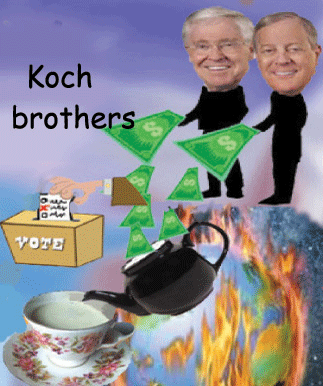 Kansas Ignores Koch Brothers, Keeps Renewable Energy Standard Clean Technica, March 2, 2013 The Topeka Capital-Journal reports that twin votes in Kansas State House and Senate on Thursday put the kibosh on legislative efforts to roll back and delay Kansas’ renewable energy standard (RES).
Passed in 2009, Kansas’ RES requires investor-owned utilities to generate 20 percent of peak demand electrical capacity from renewable sources by 2020. The American Wind Energy Association has actually highlighted the RES as a driving factor in the states burgeoning wind power sector — half of Kansas’ wind farms began operating between 2010 and 2012, after the RES went into effect.
Unfortunately, Kansas has also been targeted by conservative anti-renewable efforts. Republican Rep. Dennis Hedke, the chairman of Kansas’ House Energy and Environment Committee, recently acknowledged he had private talks with a lobbyist for Koch Companies Public Sector LLC concerning the House bill to dilute the RES. (HB 2241) Even anti-tax activist Graver Norquist got in on the action, telling the state’s legislature it ought to abandon the “costly renewable energy mandate so as to mitigate its negative impact on the economy.”
But to Kansas’ credit, it looks like neither effort bore fruit: Continue reading
Ontario shutting down coal fired power, going for renewables
Ontario to add renewable energy, shut coal-fired power plants Mar 1,
2013 (Reuters) – Ontario’s power grid operator expects more than
3,200 megawatts (MW) of renewable capacity to be connected to the
transmission system, while the province’s remaining coal-fired plants
will shut over the next 18 months.
In a report published on Thursday, the Independent Electricity
System Operator (IESO) said the renewable capacity
includes the Canadian province’s first two transmission grid-connected
solar projects.
By August 2014, the IESO said total wind and solar generation
connected to the transmission and distribution systems is expected to
reach about 6,800 MW.
“Integrating renewable resources into Ontario’s changing supply
mix has been a learning process for both us and the renewable
generators,” Bruce Campbell, IESO Vice-President of Resource
Integration, said in the release.
“Everything we’ve learned will be applied in the coming months as
wind and solar gain even more prominence on the grid,” he
said……..http://www.reuters.com/article/2013/03/01/utilities-ontario-ieso-idUSL1N0BT5TX2013030
Elderly Australians ill due to extreme heat – solar air-conditioning is the answer
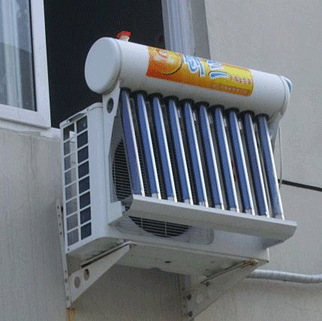 Grandparents Carking It In The Heat? Install Renewable Energy!, Clean Technica March 1, 2013 Ronald Brakels
World temperatures are rising, resulting in increasing mortality from heat stress. Or to put it another way, more people are dropping dead because it’s too damn hot. Unfortunately this is nothing new in Australia. Dropping dead from damn hotness has always been popular in these parts. Here in South Australia about 75 people currently die from it each year.
Other people building wind turbines or installing solar on their roofs can push down electricity prices for everyone and help prevent old people from dying when it’s too damn hot, but an excellent way to keep down electricity prices for the elderly is to put solar panels on the roofs of any old people whom you’d like to see continue to shuffle around on this mortal coil.
Rooftop solar is especially good for powering air conditioners as it produces the most electricity on hot, cloudless, summer days. It is particularly good for air conditioning when it faces west, or partially west, as then it can produce plenty of power all through the afternoon. It will produce less electricity when it’s cloudy, but it’s not so hot when it’s cloudy, so that’s not a real problem. And sure, it can still be hot after the sun goes down, but that’s not such a big deal if the house is already cool. No one is likely to die from it being too damn hot if they turn off their air conditioner at sunset.
For most Australians the feed-in tariff for new solar is now about 8 cents a kilowatt-hour. This means it will cost a person with a couple of kilowatts or more of rooftop solar perhaps 18 cents an hour to run a room air conditioner in a heat wave. Considering that ice-cream cones can cost $7.50 here, that’s a pretty good deal and only the most price sensitive of Australians would be too cheap to turn on the air conditioner at that cost.
1 This Month
26 September – International Day for the Total Elimination of Nuclear Weapons





PLEASE OPPOSE HR 8255 AND S.3639 – bills would accelerate satellite deployment, with no environmental review or safeguards – https://ncstd5li.quorum.us/campaign/169331/
To see nuclear-related stories in greater depth and intensity – go to https://nuclearinformation.wordpress.com
-
Archives
- September 2026 (305)
- August 2026 (330)
- July 2026 (355)
- June 2026 (287)
- May 2026 (306)
- April 2026 (356)
- March 2026 (251)
- February 2026 (267)
- January 2026 (308)
- December 2025 (358)
- November 2025 (359)
- October 2025 (375)
-
Categories
- 1
- 1 NUCLEAR ISSUES
- business and costs
- climate change
- culture and arts
- ENERGY
- environment
- health
- history
- indigenous issues
- Legal
- marketing of nuclear
- media
- opposition to nuclear
- PERSONAL STORIES
- politics
- politics international
- Religion and ethics
- safety
- secrets,lies and civil liberties
- spinbuster
- technology
- Uranium
- wastes
- weapons and war
- Women
- 2 WORLD
- ACTION
- AFRICA
- Atrocities
- AUSTRALIA
- Christina's notes
- Christina's themes
- culture and arts
- Events
- Fuk 2022
- Fuk 2023
- Fukushima 2017
- Fukushima 2018
- fukushima 2019
- Fukushima 2020
- Fukushima 2021
- general
- global warming
- Humour (God we need it)
- Nuclear
- RARE EARTHS
- Reference
- resources – print
- Resources -audiovicual
- Weekly Newsletter
- World
- World Nuclear
- YouTube
-
RSS
Entries RSS
Comments RSS

