Ontario shutting down coal fired power, going for renewables
Ontario to add renewable energy, shut coal-fired power plants Mar 1,
2013 (Reuters) – Ontario’s power grid operator expects more than
3,200 megawatts (MW) of renewable capacity to be connected to the
transmission system, while the province’s remaining coal-fired plants
will shut over the next 18 months.
In a report published on Thursday, the Independent Electricity
System Operator (IESO) said the renewable capacity
includes the Canadian province’s first two transmission grid-connected
solar projects.
By August 2014, the IESO said total wind and solar generation
connected to the transmission and distribution systems is expected to
reach about 6,800 MW.
“Integrating renewable resources into Ontario’s changing supply
mix has been a learning process for both us and the renewable
generators,” Bruce Campbell, IESO Vice-President of Resource
Integration, said in the release.
“Everything we’ve learned will be applied in the coming months as
wind and solar gain even more prominence on the grid,” he
said……..http://www.reuters.com/article/2013/03/01/utilities-ontario-ieso-idUSL1N0BT5TX2013030
Elderly Australians ill due to extreme heat – solar air-conditioning is the answer
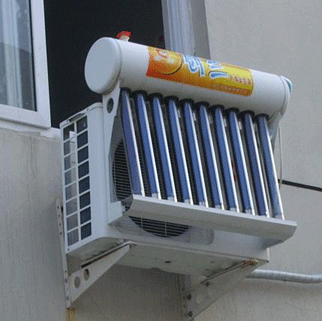 Grandparents Carking It In The Heat? Install Renewable Energy!, Clean Technica March 1, 2013 Ronald Brakels
World temperatures are rising, resulting in increasing mortality from heat stress. Or to put it another way, more people are dropping dead because it’s too damn hot. Unfortunately this is nothing new in Australia. Dropping dead from damn hotness has always been popular in these parts. Here in South Australia about 75 people currently die from it each year.
Other people building wind turbines or installing solar on their roofs can push down electricity prices for everyone and help prevent old people from dying when it’s too damn hot, but an excellent way to keep down electricity prices for the elderly is to put solar panels on the roofs of any old people whom you’d like to see continue to shuffle around on this mortal coil.
Rooftop solar is especially good for powering air conditioners as it produces the most electricity on hot, cloudless, summer days. It is particularly good for air conditioning when it faces west, or partially west, as then it can produce plenty of power all through the afternoon. It will produce less electricity when it’s cloudy, but it’s not so hot when it’s cloudy, so that’s not a real problem. And sure, it can still be hot after the sun goes down, but that’s not such a big deal if the house is already cool. No one is likely to die from it being too damn hot if they turn off their air conditioner at sunset.
For most Australians the feed-in tariff for new solar is now about 8 cents a kilowatt-hour. This means it will cost a person with a couple of kilowatts or more of rooftop solar perhaps 18 cents an hour to run a room air conditioner in a heat wave. Considering that ice-cream cones can cost $7.50 here, that’s a pretty good deal and only the most price sensitive of Australians would be too cheap to turn on the air conditioner at that cost.
100% renewable energy – it’s happenng
These are just a handful of examples in what amounts to the beginnings of a global movement. Go100Percent.org, a project launched to track 100% renewable energy projects around the world, has mapped more than 8 Countries, 41 Cities, 48 Regions, 8 Utilities, and 21 NonProfit/Educational/Public Institutions that have shifted or are committed to shifting within the next few decades to 100% renewable energy in at least one sector.
Basic logic says that non-renewable energy, by definition, is finite and will run out.
100% Renewable Energy: Becoming the New Normal? http://cleantechnica.com/2013/02/22/100-renewable-energy-becoming-the-new-normal/#tdSoYvM5qMkJWZmy.99 February 22, 2013
By Diane Moss, Founding Director of Renewables 100 Policy Institute A decade ago, cities, regions, and businesses aiming for 20% renewable energy were on the cutting edge. Few believed that a higher target in a few decades was an achievable goal. Anyone even suggesting a target of 100% renewable energy was a radical. Fast forward to today and in much of Europe, and increasingly in the U.S. and the developing world, 100% renewable energy goals are becoming the new normal.
Entire countries like Denmark have passed laws requiring that the whole energy supply — electricity, heating/cooling, and transportation — be met by renewable resources. The Pacific island of Tokelau, which risks disappearing as climate change raises sea levels, is one nation that has already met the goal of 100% renewable energy supply, throwing down the gauntlet to far larger polluters around the world who are truly causing the problem.
Iceland is almost there, with 100% renewable electricity and 81% renewable energy overall.
Scotland has a mandate to achieve 100% renewable power supply by 2020.
Upper Austria, inspired by the town of Guessing, which is already there, has a target to achieve 100% renewable heat and power by 2030.
Whole regions in Germany are already meeting, if not surpassing, their power demand with renewables. Several have done the same for their heating requirements, and are busy working toward targets for integrating the transportation sector.
In the U.S, cities like San Francisco, Lancaster, and San José have set official goals to reach 100% renewable power within the next decade, and the state of Vermont has an energy plan in place to reach 90% renewable energy in all sectors by mid century. The heartland town of Greensburg, KS has already reached a 100% renewable power goal set after being destroyed by a tornado in 2007, and aims to achieve renewable energy for all sectors.
Additionally, businesses including IKEA, Whole Foods, and Google are aiming to power, or already are powering, their companies with 100% renewable energy technologies. Continue reading
Britain’s schools to use crowdfunding to go for solar energy
Crowdfunding Solar Schools In Britain http://www.energymatters.com.au/index.php?main_page=news_article&article_id=3606, 22 Feb 13, Schools in the UK wanting to go solar but that are strapped for cash are able to participate in a new crowdfunding service. Continue reading
Secret funding supplied to USA anti-wind power front groups
 Media campaign against windfarms funded by anonymous conservatives http://www.guardian.co.uk/environment/2013/feb/15/media-campaign-windfarms-conservatives/print Suzanne Goldenberg, US environment correspondent guardian.co.uk, 15 February 2013
Secretive funding network channelled millions to stop state governments moving towards renewable energy Conservatives used a pair of secretive trusts to fund a media campaign against windfarms and solar projects, and to block state agencies from planning for future sea-level rise, the Guardian has learned.
The trusts, Donors Trust and Donors Capital Fund, served as the bankers of the conservative movement over the past decade. Promising anonymity to their conservative billionaire patrons, the trusts between them channelled nearly $120m to contrarian thinktanks and activists, wrecking the chances of getting Congress to act on climate change.
Now the Guardian can reveal the latest project of the secretive funding network: a campaign to stop state governments moving towards renewable energy.
The campaign against wind and solar power was led by a relatively new entity, theFranklin Centre for Government and Public Integrity. The Franklin Centre did not exist before 2009, but it has quickly become a protege of Donors Trust. Continue reading
See this: low cost boadband Internet – solar powered – for rural Africa
 Video: Microsoft Providing Low-Cost, Solar-Powered Broadband Access In Africa http://www.energymatters.com.au/index.php?main_page=news_article&article_id=3595 15 Feb 13, Early this month, Microsoft Corp announced the launch of a pilot project delivering low-cost wireless broadband access in parts of Kenya via solar-powered base stations.
A project carried out in collaboration with the government of Kenya’s Ministry of Information and Communications and Indigo Telecom Ltd., the network utilizes TV white spaces to carry broadband signals to previously unserved locations near Nanyuki and Kalema. The project is the first deployment of TV white space technology in Africa.
TV white spaces are well-suited for delivering low-cost broadband access as radio signals in the TV bands can be transmitted over longer distances and penetrate more obstacles than other types of radio signals. As a result, fewer base stations are required.
Microsoft says that as television has begun to switch from analog to digital around the world, even more of this spectrum can be used to relay broadband.
More than 6,000 people will benefit from the project; which is part of theMicrosoft 4Afrika Initiative. In addition, solar power systems with deep cycle battery energy storage will be installed at local schools to supply electricity to their Information & Communication Technology (ICT) labs. Each system will generate 4.5 kilowatt hours (kWh) of energy per day, which should provide a small surplus of power above what is required for each lab.
While 4.5 kilowatt hours doesn’t sound like a great deal, it will be sufficient for students to use tablets and eReaders in the labs.
“Solar power addresses the issue of reliability in developing economies and carries low operating costs since panels last a long time and batteries can function for up to three years,” says a statement from Microsoft.
“That makes solar an increasingly affordable way to deliver power, especially in areas that lack infrastructure for both electricity transmission and broadband access.”
Small scale solar energy will revolutionise Ghana’s rural communities
Solar energy to power rural electricity launched, Ghana Business News, February 10, 2013 A new life changing solar energy system aimed at augmenting rural electricity power generation using the sun’s direct energy has been launched in Accra.
Dubbed Solar2Africa400, the system consists of a portable folding solar panel, a cable, a connector and a 400-watt power inverter.
It is aimed at responding to the growing demand for off-grid electrification solutions and support government’s efforts at cutting down the cost of extending the national grid to island and lakeside communities.
The innovation was born out of collaboration between Power for Africa, a United Kingdom based company, which designed the system for developing countries such as Ghana and Gem Technologies, a Ghanaian company. Continue reading
Germany moving ahead with solar energy storage
Germany To Announce Energy Storage Subsidy? http://www.energymatters.com.au/index.php?main_page=news_article&article_id=3584 Germany blazed the trail for solar PV uptake and it appears the nation may be about to do the same for energy storage.
Rumour has it that early this week Germany’s government will announce an initiative to support the purchase of battery based energy storage systems integrated with solar panel arrays.
Owners of solar power systems up to 30kW capacity will be entitled to low-interest loans from state-owned bank KfW and a repayment allowance from the Ministry of Environment that will cover 30% of the cost of an energy storage system. Continue reading
Exelon nuclear company blaming wind energy for decline in electricity prices
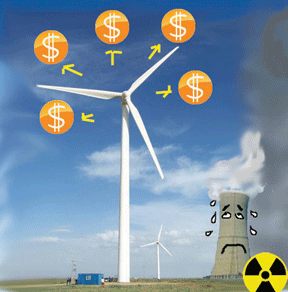 Exelon is merely “looking for a scapegoat” after power prices plummeted following the utility’s “bet on the electricity spot market” with nuclear.
Exelon chief: Wind subsidies could shut down nuclear plants,THE HILL By Zack Colman – 02/08/13
A major utility that was ousted from a wind energy trade group last fall said continued government support of wind power could shutter nuclear plants.
Exelon Corp. CEO Christopher Crane told the Chicago Tribune in comments published Friday that his company might eventually have to close nuclear facilities “if we continue to build an excessive amount of wind and subsidize wind.”
Exelon vocally opposed the extension of the wind production tax credit last year. That led the American Wind Energy Association (AWEA) to kick the Chicago-based utility out of the organization.
Exelon will likely try to quash AWEA’s push this year for a phase-out of the 2.2 cent per kilowatt-hour credit for wind power production. Exelon has ties to the White House, as one of its directors is a top fundraiser for and friend of President Obama. Former strategist David Axelrod also consulted for the utility, and Chicago Mayor Rahm Emanuel, who served as Obama’s first chief of staff, helped create the firm through a merger in 2000 while working as an investment banker. Continue reading
Local solar energy making a huge difference in rural Argentina
In Renewable Energy in Rural Markets Project (PERMER)’s proposed scheme, photovoltaic or wind system are installed
for the user, who then pays for its operation and maintenance
dependent on their means.
”People have adapted well to technology and began to ask for solar panels instead of electricity lines,”
there [ the province of Entre Riosall] the rural schools and nearly 2,000 homes have solar panels.The impact is rewarding.

Renewable energy brings power to the rural corners of Argentina
http://www.renewableenergymagazine.com/article/renewable-energy-brings-power-to-the-rural-20130208
Cooking, heating water, or the house during
winter, reading, listening to the radio, charging your phone, using
the computer, watching TV — most people take these activities for
granted in the 21st century, but for thousands of inhabitants in
Argentina’s remote rural communities without electricity it is a
challenge. Nearly 150,000 homes still do not have this basic service,
most of them in the northern part of the country.
Since 1999, the Renewable Energy in Rural Markets Project (PERMER) has
aimed to put an end to this situation. Supported by the World Bank and
the Global Environment Facility (GEF), the initiative connects homes
and schools to clean energy sources such as solar panels and
windmills.
So far, around 25,000 residential customers and nearly 2,000 schools
have been reached, and 300 solar thermal stoves, furnaces and water
heaters have been installed. Also 2,000 users in small, isolated
communities have benefited from small power systems (generation and
distribution networks). The project has also included almost 400
public buildings, such as health centers, community centers, as well
as Gendarmerie (Police force) and National Parks Administration’s
stations. Continue reading
Wind energy to be stored in USA’s largest power storage system
Duke Energy completes North America’s largest energy storage system,
Renewable Energy Magazine Robin WhitlockThursday, 07 February 2013
The 36MW energy storage system will store power generated by the
nearby Notrees wind farm and became fully operational in December
The company announced plans to install large-scale energy storage
systems to service its wind farm at Notrees in late 2009, matching a
$22 million grant from the US Department of Energy (DOE).
As well as helping to meet power demand the system will also help to stabilize the frequency of electricity travelling through the power grid. DukeEnergy is currently working closely with the Energy Reliability Council of Texas (ERCOT) which will indicate whether the system shoulddispatch stored energy to increase frequency or absorb energy to decrease it. Performance data will be collected from the battery storage system by the Electric Power Research Institute (EPRI) to help assess the broader potential for deployment of storage solutions throughout the sector. Continue reading
Not In My Backyard – attacks on renewable energy prevent jobs and economic growth
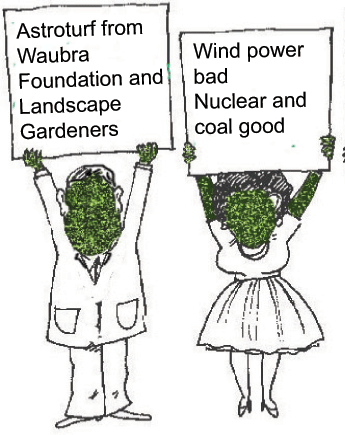 The US Chamber of Commerce put into action an initiative called
Project No Project, which looks at energy projects being delayed or
stopped entirely due to NIMBYism. Project No Project has projected
that in the short term the 351 projects the group looked at could
produce $1.1 trillion for the economy and create 1.9 million jobs a
year. Also once these projects are created and established, they are
estimated to produce $145 billion and create 791,000 jobs…..
The Real Cost of NIMBYism, Reneweable Energy Magazine Al Maiorino , 07
February 2013 All over the world renewable energy projects are being
delayed or stopped entirely due to the NIMBY or “not in my backyard”
phenomenon, this is a case that often involves people in communities
who stall developments in their areas due to a variety of reasons.
NIMBYism is not limited to the United States, it is global.
The amountof revenue and jobs that have been lost or delayed due to public opposition and protest to renewable energy projects is astounding. Continue reading
NOT using renewable energy will cost the world $billions
Cost Of Not Using Renewable Energy at $9 Billion Per Day, http://designbuildsource.com.au/cost-of-not-using-renewable-energy-at-9-billion-per-day-study-claims By Justin McGar, 7 Feb 13, Study Claims In an unprecedented study, the World Future Council conservatively estimates that the future usage loss resulting from current oil, gas and coal consumption is between $US 3.2 and 3.4 trillion per year.
Opponents of renewable energy claim conventional energy sources are cheaper on the whole, but the World Future Council report asks what costs are incurred when renewable energiesare not used. Continue reading
Worldwide surge in renewable energy, with costs falling
 Renewable Energy Revolution: Declining Costs, Surging Capacity Clean Technica January 24, 2013 The renewable energy revolution is under way. Renewable power generation now accounts for around 50% of all new power generation capacity installed worldwide.
The combination of rapid deployment and high learning rates for technology “has produced a virtuous circle that is leading to significant cost declines and is helping fuel a renewable revolution,” according to a new global study of renewable power generation costs in 2012 produced by IRENA, the International Renewable Energy Agency, which announced it is establishing its global headquarters in the United Arab Emirates during last week’s Abu Dhabi Sustainability Week.
Additions to global wind power generation capacity totalled 41 gigawatts (GW) in 2011, according to IRENA’s “Renewable Power Generation Costs in 2012: An Overview.” That’s in addition to 30 GW of new solar photovoltaic (PV) electricity generation capacity, 25 GW of hydro power, 6 GW of biomass, 0.5 GW of concentrated solar power (CSP), and 0.1 GW of new geothermal power capacity.
“Renewable technologies are now the most economic solution for new capacity in an increasing number of countries and regions,” IRENA concluded upon analyzing the levelized cost of electricity (LCOE) among the some 8,000 renewable power projects in its database and related literature…….. http://cleantechnica.com/2013/01/24/renewable-energy-revolution-declining-costs-surging-capacity/
USA: In 2012 49% of new energy capacity was renewable
 Nearly half of new U.S. power capacity in 2012 was renewable — mostly wind Grist, By Philip Bump, 18 Jan 13 As predicted, almost half of the new power-generating capacity installed in the United States last year was renewable.
 The Federal Energy Regulatory Commission recently released its December update on the nation’s energy infrastructure [PDF]. When we last checked on the data, it suggested that some 46 percent of new capacity — January through October — was renewable. Well, that ratio improved over the last two months of the year. Ultimately, 49.1 percent of new capacity was renewable….. http://grist.org/news/nearly-half-of-new-u-s-power-capacity-in-2012-was-renewable-mostly-wind/#.UPoHA3lLia4.twitter
1 This Month
29 Jan. Thursday 7-8 p.m. Webinar – World’s Largest Nuclear Station in Port Hope, ON?
To see nuclear-related stories in greater depth and intensity – go to https://nuclearinformation.wordpress.com/



31st January – Challenging the War Machine – a DECLASSIFIED UK SUMMIT


Website of the Week
Now until to February 10, 2026 Radioactive waste storage in France: the debate is finally open! How to participate?
-
Archives
- January 2026 (296)
- December 2025 (358)
- November 2025 (359)
- October 2025 (376)
- September 2025 (258)
- August 2025 (319)
- July 2025 (230)
- June 2025 (348)
- May 2025 (261)
- April 2025 (305)
- March 2025 (319)
- February 2025 (234)
-
Categories
- 1
- 1 NUCLEAR ISSUES
- business and costs
- climate change
- culture and arts
- ENERGY
- environment
- health
- history
- indigenous issues
- Legal
- marketing of nuclear
- media
- opposition to nuclear
- PERSONAL STORIES
- politics
- politics international
- Religion and ethics
- safety
- secrets,lies and civil liberties
- spinbuster
- technology
- Uranium
- wastes
- weapons and war
- Women
- 2 WORLD
- ACTION
- AFRICA
- Atrocities
- AUSTRALIA
- Christina's notes
- Christina's themes
- culture and arts
- Events
- Fuk 2022
- Fuk 2023
- Fukushima 2017
- Fukushima 2018
- fukushima 2019
- Fukushima 2020
- Fukushima 2021
- general
- global warming
- Humour (God we need it)
- Nuclear
- RARE EARTHS
- Reference
- resources – print
- Resources -audiovicual
- Weekly Newsletter
- World
- World Nuclear
- YouTube
-
RSS
Entries RSS
Comments RSS
 nuclear-news