Tokyo has the storage capacity for a solar powered city
 A Solar Powered Tokyo? http://www.energymatters.com.au/index.php?main_page=news_article&article_id=3661 28 March 13 Much of Tokyo’s power needs once supplied by nuclear power could be met by rooftop solar along with energy storage systems already in place.
 Nuclear is still a dirty word to many in Japan following the Fukushima crisis, a disaster that will continue to negatively affect a large area for many years to come.
While solar power offers an attractive alternative; the issue remains of continual supply – particularly at night and during heavily overcast days.
A recent study examining the potential for rooftop photovoltaics in Tokyo to replace nuclear capacity reveals some of the answer is already in place – pumped hydroelectric storage. Continue reading
Small scale renewable energy storage
Small-scale energy storage project wins Australian Government backing PACE – Process and Control Engineering 22 March, 2013 Kevin Gomez Australian energy storage company Ecoulthas been awarded Australian Government funding through the Australian Renewable Energy Agency (ARENA).
The funds will be used to conduct small/ mid-sized storage project development using Deka UltraBattery technology to deliver cost effective storage solutions for homes and businesses in Australia and around the world.
This pilot will develop a battery storage system prototype for three types of deficit charge/distributed energy applications:
- Off-grid renewable power solutions (Remote Area Power Supply);
- Distributed grid connected storage to support voltage and power fluctuations that arise where there is dense concentration of small roof-top solar installations in residential areas; and
- Hybrid generation (such as diesel plus renewables) to improve fuel efficiencies.
Ecoult CEO John Wood said the ARENA grant was a strong vote of confidence in the Australian-invented technology……
The pilot project will extend the collaboration between Ecoult, its US-based parent company East Penn Manufacturing and the Commonwealth Scientific and Industrial Research Organisation (CSIRO).
Research partner CSIRO, which originally invented the Deka UltraBattery technology, will also play an important role in this pilot project, developing intelligent algorithms that improve the integration of Deka Ultrabattery units with the Solar PV panels and increase the value derived from each kWh of energy storage…… http://www.pacetoday.com.au/news/small-scale-energy-storage-project-wins-australian
Germany moving ahead with solar energy storage
Germany To Announce Energy Storage Subsidy? http://www.energymatters.com.au/index.php?main_page=news_article&article_id=3584 Germany blazed the trail for solar PV uptake and it appears the nation may be about to do the same for energy storage.
Rumour has it that early this week Germany’s government will announce an initiative to support the purchase of battery based energy storage systems integrated with solar panel arrays.
Owners of solar power systems up to 30kW capacity will be entitled to low-interest loans from state-owned bank KfW and a repayment allowance from the Ministry of Environment that will cover 30% of the cost of an energy storage system. Continue reading
Wind energy to be stored in USA’s largest power storage system
Duke Energy completes North America’s largest energy storage system,
Renewable Energy Magazine Robin WhitlockThursday, 07 February 2013
The 36MW energy storage system will store power generated by the
nearby Notrees wind farm and became fully operational in December
The company announced plans to install large-scale energy storage
systems to service its wind farm at Notrees in late 2009, matching a
$22 million grant from the US Department of Energy (DOE).
As well as helping to meet power demand the system will also help to stabilize the frequency of electricity travelling through the power grid. DukeEnergy is currently working closely with the Energy Reliability Council of Texas (ERCOT) which will indicate whether the system shoulddispatch stored energy to increase frequency or absorb energy to decrease it. Performance data will be collected from the battery storage system by the Electric Power Research Institute (EPRI) to help assess the broader potential for deployment of storage solutions throughout the sector. Continue reading
New ways to store solar energy
Using rust and water to store solar energy as hydrogen e! science News, November 11, 2012 How can solar energy be stored so that it can be available any time, day or night, when the sun shining or not? EPFL scientists are developing a technology that can transform light energy into a clean fuel that has a neutral carbon footprint: hydrogen. The basic ingredients of the recipe are water and metal oxides, such as iron oxide, better known as rust. Kevin Sivula and his colleagues purposefully limited themselves to inexpensive materials and easily scalable production processes in order to enable an economically viable method for solar hydrogen production. The device, still in the experimental stages, is described in an article published in the journal Nature Photonics……
The results presented in the Nature Photonics paper represent a breakthrough in performance that has been enabled by recent advances in the study of both the iron oxide and dye-sensitized titanium dioxide, and both of these technologies are rapidly advancing. Sivula predicts that the tandem cell technology will eventually be able to attain an efficiency of 16% with iron oxide, while still remaining low cost, which is, after all, the attractiveness of the approach. By making it possible to store solar energy inexpensively, the system developed at EPFL could considerably increase the potential of solar energy to serve as a viable renewable energy source for the future.
Source: Ecole Polytechnique Fédérale de Lausanne
http://esciencenews.com/articles/2012/11/11/using.rust.and.water.store.solar.energy.hydrogen
New fast Lithium Ion Battery for electric cars
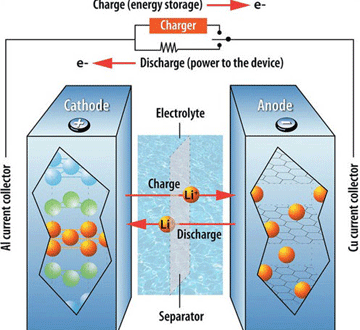 New Korean Lithium Ion Battery for EVs Charges in Under 1 Minute http://www.greenoptimistic.com/2012/08/21/korean-lithium-ion-carbonized-battery/?utm_source=feedburner&utm_medium=email&utm_campaign=Feed%3A+TheGreenOptimistic+%28The+Green+Optimistic%29#.UDbvH8FlT4Y By Ovidiu Sandru August 21, 2012 A new lithium ion battery developed in Korea could make those long waiting times for an electric car to charge become history. A team of researchers at the Ulsan National Institute of Science and Technology (UNIST) claim they can build a battery that can charge in less than a minute, 30 to 120 times faster than a classic Li-Ion battery. Continue reading
Developing storage systems for renewable energy
 Storage systems for renewable energy, Energy Harvesting Journal , 13 Aug 12, Energy storage systems are one of the key technologies for the energy turnaround. With their help, the fluctuating supply of electricity based on photovoltaics and wind power can be stored until the time of consumption.
At Karlsruhe Institute of Technology (KIT), several pilot plants of solar cells, small wind power plants, lithium-ion batteries, and power electronics are under construction to demonstrate how load peaks in the grid can be balanced and what regenerative power supply
by an isolated network may look like in the future.
“High-performance batteries on the basis of lithium ions can already be applied reasonably in the grid today,” says Dr. Andreas Gutsch, coordinator of the Competence E project. As stationary storage systems, they can store solar or wind power until it is retrieved by the grid. “When applied correctly, batteries can also balance higher load and production peaks and, hence, make sense from an economic point of view.”
The Competence E project is presently developing several pilot systems consisting of photovoltaics and wind power plants coupled to a lithium-ion battery. Over a development phase of two years, a worldwide battery screening was made. “Now, we know which lithium-ion cells are suited best for stationary storage systems,” says Gutsch.
The first stage of the modular systems will be constructed on KIT Campus North by the end of 2012. It will have a capacity of 50 kW…..
http://www.energyharvestingjournal.com/articles/storage-systems-for-renewable-energy-00004648.asp?sessionid=1
Storage of solar energy at home
In a test building, they were able to increase “own consumption” – solar power used directly within the household without being exported to the grid
Home Solar Power Storage — Another Option Clean Technica, JUNE 15, 2012 BY ZACHARY SHAHAN In addition to the home storage option recently announced by Panasonic, below is another story about a some storage option that could greatly benefit those with cheap solar power on their rooftops in Germany (and some other locations). This is a full repost from the awesome site Renewables Continue reading
Distributed solar energy, and distributed energy storage
In-Depth: Germany’s 22 GW Solar Energy Record Clean Technica, MAY 31, 2012 BY THOMAS“…….Millions of Batteries in Buildings — Utopian? …… it is very easy to show that it’s just a matter of time until the combination of energy storage for homes with rooftop solar energy and/or small-wind becomes viable and even profitable.
Today, there are still about 6.4 million oil tanks in homes and buildings all over Germany storing energy in the form heating oil. Installing such a tank costs several thousand Euros today. So, why shouldn’t independent power producers start putting up new forms of energy storage in the same numbers as soon as it makes economic sense?
How would 6 million home storage systems change the energy system? Well, 6 million 10 kW / 25 kWh would mean a distributed storage system with 60 GW maximum output/input and 150 GWh of capacity. That’s already enough storage for 10% of the current daily consumption, more than enough to power all German households through the night. It’s also coming a long way to fill the gap between renewable baseload power (hydro and biomass) and variable sources like wind and solar.
That 10-kW/25-kWh battery is not fiction by the way. It’s quite similar to the battery pack that powers the Nissan Leaf right now, Just one battery that will soon reach production volumes in the hundreds of thousands as factories in Japan, Europe, and the US crank up production by 2013.
It’s true that the $15,000 price tag for the battery is too high right now. But, since all kinds of competitors are investing in this market, economics of scale, innovation and optimization will certainly reduce the cost of such batteries in the coming years. In the case of multi-kWh batteries, this development is a lot more obvious than what happened with the price for solar cells just 7 years ago. The fall of prices surprised many analysts back then. Today, prices for solar cells are 70%-80% cheaper than what they were in 2007, putting the cost of solar systems well below $2 per Watt in Germany…. .. https://mail.google.com/mail/u/0/?shva=1#inbox/137a6ed1432cd545
Supergrid or networks of grids for renewable energy in Europe
European Supergrid to Revolutionise Renewable Energy?, Oil Price.com, By James Burgess | , 25 January 2012 Europe is the world leader in renewable energy generation, but as with all renewable energy sources they face the problem of reliability. One way of overcoming this limitation and ensuring that power supply will be constant is to have expensive, traditional, fossil-fuelled power stations to generate electricity whilst conditions are unfavourable for the renewable source; but this almost makes the whole investment in renewable power sources irrelevant. A better way of ensuring consistent power is to link several diverse sources of renewable energy on one electrical grid. So when a wind farm can’t produce much power on a windless day, a solar farm might compensate. Continue reading
China’s revolutionary new storage battery for renewable energy
China’s State Grid and BYD Launch World’s Largest Battery Energy Storage Station, Market Watch . ZHANGBEI, China, Dec 30, 2011 (BUSINESS WIRE) — BYD and the State Grid Corporation of China (SGCC) have finished construction on what may be the world’s largest battery energy storage station.
This large utility-scale project, located in Zhangbei, Hebei Province, combines 140 Mega-Watts of renewable energy generation (both wind & solar), 36 Mega-Watt-Hours (MWh) of energy storage and a smart power transmission system. While there are renewable generation systems of this scale in service today, there are no battery systems of this size.
The State Grid system is demonstrating a stable solution for transferring vast amounts of
renewable electricity safely to the grid on an unprecedented scale. Although BYD manufactures 1GW of solar panels annually, their role in this project was primarily providing energy storage batteries in arrays larger than a football field…. This new project with the
State Grid has outpaced other grid projects in China and, though independently designed by SGCC, is part of the national “Golden Sun” program. The first phase investment with 100MW of Wind, 40MW of Solar and 36MWh of Battery is worth over $500M USD (~3.3 Billion RMB). Continue reading
Breakthroughs in electric car design
 Charge a car in time it takes for a coffee, SMH, Stephen Ottley, October 22, 2011 ELECTRIC cars are a big step closer to mainstream acceptance thanks to two breakthroughs. Long battery recharging has been the biggest hurdle for the car industry to overcome. But a technology being developed by Nissan and Japan’s Kansai University could solve the problem.
It has reportedly created a charger that can replenish a car’s batteries in 10 minutes, without any adverse affect on the batteries. Currently it can take up to eight hours to recharge an electric car…..
At present so-called fast chargers require 30 minutes to restore batteries to just 80 per cent capacity and cost more than $30,000.
The industry has been struggling to come up with a solution to long charging times as electric cars fight to become a viable alternative to petrol cars….Another hurdle cleared by the industry is an agreed standard of recharging plugs.
The move is seen as crucial to the implementation of public charging infrastructure. Volkswagen, General Motors, Ford, Audi, BMW, Mercedes-Benz and Porsche have all agreed to work together on the universal system for plug outlets, voltage and cables….http://smh.drive.com.au/charge-a-car-in-time-it-takes-for-a-coffee-20111021-1mcaf.html
Energy storage solutions for renewable energy
These forms of electricity storage are all likely to be needed, and they should be considered in conjunction with the much higher levels of renewable energy that will be required to “decarbonise” the electricity supply, which experts say will be necessary if global targets to reduce emissions by 50 per cent by 2050, compared with 1990 levels, are to be met.

Electricity storage: holy grail of the renewables industry, FT.com, By Fiona Harvey, Environment CorrespondentPublished: January 14 2011 Storing electricity reliably, safely and cheaply has long been the holy grail of the alternative energy industry. Continue reading

Renewable energy storage going ahead in 2011
Perhaps the biggest news (not in terms of scale but in terms of significance) is that the first utility-scale battery storage system in the U.S. is now in commercial operation….2011’s shaping up for a strong year for energy storage.
1 This Month

of the week – Shut Down Drone Warfare!


Tell the Ukrainian Government to Drop Prosecution of Peace Activist Yurii Sheliazhenko

Petition to revoke the licensing of the Near Surface Nuclear Disposal Facility (NSDF) at Chalk River. https://www.ourcommons.ca/petitions/en/Petition/Details?Petition=e-7247
To see nuclear-related stories in greater depth and intensity – go to https://nuclearinformation.wordpress.com
-
Archives
- March 2026 (237)
- February 2026 (268)
- January 2026 (308)
- December 2025 (358)
- November 2025 (359)
- October 2025 (376)
- September 2025 (257)
- August 2025 (319)
- July 2025 (230)
- June 2025 (348)
- May 2025 (261)
- April 2025 (305)
-
Categories
- 1
- 1 NUCLEAR ISSUES
- business and costs
- climate change
- culture and arts
- ENERGY
- environment
- health
- history
- indigenous issues
- Legal
- marketing of nuclear
- media
- opposition to nuclear
- PERSONAL STORIES
- politics
- politics international
- Religion and ethics
- safety
- secrets,lies and civil liberties
- spinbuster
- technology
- Uranium
- wastes
- weapons and war
- Women
- 2 WORLD
- ACTION
- AFRICA
- Atrocities
- AUSTRALIA
- Christina's notes
- Christina's themes
- culture and arts
- Events
- Fuk 2022
- Fuk 2023
- Fukushima 2017
- Fukushima 2018
- fukushima 2019
- Fukushima 2020
- Fukushima 2021
- general
- global warming
- Humour (God we need it)
- Nuclear
- RARE EARTHS
- Reference
- resources – print
- Resources -audiovicual
- Weekly Newsletter
- World
- World Nuclear
- YouTube
-
RSS
Entries RSS
Comments RSS
 nuclear-news