Shared solar – a cheaper, better way to go for electricity
Shared solar can help low-income customers get in on the solar development.
Rooftop solar can be expensive, even with incentives or leasing programs, leaving low-income ratepayers out. Shared solar can let them in on the benefits of solar. A couple of recent reports show how.

 Love solar power but got no rooftop? “Shared solar” is coming for you. Vox [excellent pictures] by David Roberts on March 24, 2016 To date, solar power has mostly been available to utilities (as big power plants) or individual home and business owners (as rooftop panels).
Left out has been … well, everyone else, those of us who are not utility executives and do not have the money, wherewithal, or suitable rooftops to install solar ourselves. That’s a lot of people who love solar power but have no way to get directly involved in it.
Here’s how shared solar fits into the larger energy picture, how it works, its benefits and drawbacks, and its future potential……There are two kinds of community-scale solar. The first is utility-owned, with power sold to utility customers — a traditional arrangement between a utility and a power plant developer, just on a smaller scale. Lots of smaller utilities, municipals, and co-ops are getting into this.
The other is shared solar, in which customers a) share ownership of a community-scale PV array, b) “subscribe” to the power output of such an array, or c) both.
Existing community-scale solar is split roughly half and half between those two types.
How many shared solar projects are there? From a new report by Deloitte:
In 2010, only two shared solar projects existed [in the US]. Today 77 utilities administer 111 projects across 26 states, accounting for a combined capacity of about 106 megawatts (MW).
That’s a tiny base — less than 1 percent of installed solar PV capacity, according to GTM — but growth is accelerating.
According to RMI, if you include both types, community-scale solar could grow to 30 GW capacity by 2020.
Typically, customers “subscribe” to a shared solar project. Some subscribe to a certain amount of capacity (say, the output of one panel), measured in kW. Some subscribe to a certain amount of power, measured in kWh. The credit for the power appears on a customer’s utility bill.
Who runs these things? “Shared solar arrays,” writes NREL, “can be hosted and administered by a variety of entities, including utilities, solar developers, residential or commercial landlords, community and nonprofit organizations, or a combination thereof.”
Exactly who can build and run a shared solar project depends on whether it is located in a regulated or deregulated energy market (more on that in a second) and what type of utility service area it’s in.
Shared solar is overwhelmingly driven, at least at the moment, by customer demand. So it makes sense that the utilities most responsive to their customers — co-ops, where customers are also owners — are leading the way on shared solar projects.
Deloitte offers this information-packed breakdown of shared solar by utility type:………
Benefits of shared solar
Shared solar has many of the benefits of distributed “behind-the-meter” solar and many of the benefits of larger solar power plants, with few of the drawbacks of either.
Like utility-scale solar, it enjoys economies of scale and simple, established financing models; unlike utility-scale solar, it can squeeze into almost any surface or piece of land, near existing transmission or distribution lines.
Like distributed, behind-the-meter solar it is low risk, can be sited near existing load, increases the resilience of the distribution grid, and satisfies the powerful consumer craving for solar power; at the same time, it is cheaper, simpler (fewer contracts per kW of capacity), and more inclusive than behind-the-meter solar.
Utilities, especially investor-owned utilities, aren’t in love with it (to them it’s just a more expensive version of a solar plant), but if they get their act together, they can use small, strategically sited shared solar projects to ease grid congestion or avoid expensive new grid investments………..
Shared solar can bring solar to low-income customers
One benefit is worth calling out in particular: Shared solar can help low-income customers get in on the solar craze.
Rooftop solar can be expensive, even with incentives or leasing programs, leaving low-income ratepayers out. Shared solar can let them in on the benefits of solar. A couple of recent reports show how.
One is the “Low-Income Solar Policy Guide,” from a coalition of groups including GRID Alternatives, Vote Solar, and the Center for Social Inclusion. The other is from the Interstate Renewable Energy Council (IREC): “Shared Renewable Energy for Low- to Moderate-Income Consumers: Policy Guidelines and Model Provisions.”
Both get into the technical weeds on program design and financing……… http://www.vox.com/2016/3/24/11297054/shared-solar
Solar WINDOWS (not panels)
AMAZING IOT #8: SOLAR WINDOWS (NOT PANELS!) ST Smarter Together, 16 Mar 16 A handful of startups are heading toward a new window of opportunity: solar powered windows. If you think about all of the windows in the world – Manhattan alone has 10.7 million windows – creating a window that allows businesses to save on energy costs would be breaking into an almost unimaginably huge market.
Solar powered windows sound conceptually like an oxymoron: Solar panels absorb and reflect light while windows let light through. Various startups have proposed different solutions to this issue which, at its heart, is a serious one. The company Solaria, uses thin strips of photovoltaics on already existing glass, making windows appear pin-striped. Another startup called Oxford Photvoltaics uses perovskite – an oxide used for superconductors – in order to capture solar energy. ………. competitor Richard Lunt and his team at Michigan State University created solar panel windows with a new method called Transparent Luminescent Solar Concentrator (TSLC). This method has the photovoltaic strips on the edge of the glass, allowing the window to be more transparent than the other two……..http://smartertogether.telenorconnexion.com/2016/03/amazing-iot-8-solar-windows-not-panels/
Home solar energy is booming in USA
The Surprise New Boom Market for Residential Solar Huffington Post, By Barbara Grady 24 Mar 16 As the price of solar powered electricity keeps falling and rooftop panels pop up in an increasing number of neighborhoods, an interesting thing is shaping up in the market.
Residential solar is no longer for just well-to-do homeowners. Indeed, the growth market in solar is median- and low-income neighborhoods in California and other locales, according to multiple recent reports.
In 2015, a full 65 percent of residential solar getting installed in California was in zip codes with median household incomes of $70,000 or less, while just 6 percent of installations in the state were happening in neighborhoods with median household incomes above $100,000, according to a report from Kevala Analytics.
A surge in solar adoption — as well as a shift in where that adoption is taking place — is driven by economics that make solar the money saving option for electricity rate payers and by policies that offer flexible ways for people to benefit from solar.
In California, Massachusetts, New York, Colorado, the District of Columbia, Maryland and some other places, policies that extend the reach of solar to renters and residents without rooftops are widening the market for individual and community installations alike. Financing mechanisms prevalent in some markets but not in others have also made it possible for people to opt for solar without requiring they have money for big upfront costs.
Federal policies adopted in the last couple of years, such as Property Assessed Clean Energy loan funds, and National Community Solar programs have helped. …..http://www.huffingtonpost.com/greenbiz-group/residential-solars-new-bo_b_9526460.html
US households turning to solar panels. Impact on power industries
 Impact of solar panels keeps growing The U.S. power industry is feeling the pressure, with about 1 million households turning to the sun. PORTLAND PRESS HERALD, BY JONATHAN N. CRAWFORD BLOOMBERG.22 Mar 16 Rooftop solar is casting a $2 billion shadow over power generators across the eastern United States.
With more than a million U.S. houses set to have solar panels by the end of next month, grid managers serving the eastern U.S. plan to cut the amount of electricity they buy from conventional plants by about 1,400 megawatts, starting in 2019, according to industry consultant ICF International Inc. That’s enough juice to power about 780,000 households.
The result could be as much as $2 billion in lost revenue for generators that are already reeling from lower demand, tight environmental regulation and depressed prices. Power producers including NRG Energy Inc. warn that the growing reliance on solar may curtail investment in conventional power plants, threatening the reliability of the U.S. electricity system. That’s already happened in Germany, they say, citing plans by EON and RWE to scrap existing or planned plants……..
Under “Energiewende,” a German transition plan designed to lessen fossil fuel use, about 30 percent of the country’s power is now generated by renewables, sending power prices to their lowest levels in more than a decade. That spurred EON’s Uniper unit to seek closure of two gas-fired units in Bavaria, and Essen-based RWE to scrap plans to start up its coal-fired Westfalen-D plant, valued at $1.1 billion…….
This year, for the first time, operators of regional power grids such as PJM Interconnection, which serves more than 61 million customers ranging from Washington to Chicago, and ISO New England Inc., have included solar growth in their estimates for 2019, spurring more national debate on how the nation’s electrical system will be financed and managed moving forward. http://www.pressherald.com/2016/03/19/impact-of-solar-panels-just-keeps-growing/
Solar powered airport for South Africa
Africa gets its first solar-powered airport By Milena Veselinovic, for CNN March 4, 2016 (CNN) South Africa has ramped up its green credentials by unveiling the continent’s first solar-powered airport.
Located halfway between Cape Town and Port Elizabeth, George Airport will meet 41% of its energy demand from a brand new 200 square meter solar power plant built on its grounds.
The facility, which was officially launched last week, has 3,000 photovoltaic modules, and will gradually increase capacity to deliver 750Kw power when it reaches full production…….
The airport serves the Western Cape town of George which lies in the heart of the scenic Garden Route, famous for its lush vegetation and lagoons which are dotted along the landscape.
It handles over 600,000 passengers a year, many of them tourists, but it’s also a national distribution hub for cargo such as flowers, fish, oysters, herbs and ferns.
The clean energy initiative follows in the footsteps of India’s Cochin International airport — the world’s first entirely solar powered airport, and Galapagos Ecological Airport, built in 2012 to run solely on Sun and wind power.
Around 635 million people, or 57% of the population, are estimated to live without power on the continent, with that number climbing to 68% in Sub-Saharan Africa.
Last year, a UK start-up collaborated with Shell to build a solar-powered soccer pitch in the Nigerian city of Lagos, but governments are also increasingly harnessing the Sun’s energy for major infrastructure projects.
Last month, Morocco switched on what will be the world’s largest concentrated solar plant when it’s completed. It is predicted to power one million homes by 2018. In Rwanda, a $23.7 million solar plant has increased the country’s generation capacity by 6% and lighting up 15,000 homes. http://edition.cnn.com/2016/03/04/africa/george-airport-solar-south-africa/index.html?utm_source=twitter&utm_medium=post&utm_term=africa,airport,solar,renewables&utm_campaign=greenpeace&__surl__=IgNX8&__ots__=1457298969501&__step__=
How solar energy can turn lives around in nuclear-devastatedFukushima
Adorable Japanese couple devastated by Fukushima turn lives around with solar http://www.greenpeace.org/international/en/news/Blogs/makingwaves/this-adorable-japanese-farming-couple-lost-th/blog/55657/

Eventually though, they decided to return.
“We have cattle and chickens and we had to come back to feed them. We couldn’t leave them and go elsewhere,” they told us in 2012.
But apart from dealing with the aftermath of such a tragic accident they also had to deal with the future of their farming business – their customer base fell due to fears of contaminated produce, and they even thought about giving up on farming.
But instead of letting the nuclear accident shape them, they knew they had to move forward – for themselves, for their community and for their children’s future.
In 2013 they opened up an organic shop, “Esperi” in the agricultural town of Miharu, Fukushima Prefecture. Their intention was to help revitalise the area and create a community space where people could gather and help each other in 2013. After all, the name “Esperi” means “hope” in Esperanto.
But this wasn’t enough. So in October 2015, the couple launched the Solarise Fukushima crowdfunding project to install solar panels on the rooftop of their shop. Their aim? “Hope to spread life with solar energy from Miharu town, Fukushima”.
Before they knew it people around Japan and the rest of the world began contributing to their crowd funding project, and about a month later they achieved their target of around 1.5 mil JPY (about 13,500 US). Messages from crowd funding supporters gave them the encouragement they needed, especially as they felt “forgotten”.
Greenpeace Japan helped launch the project, and in January 2016 solar panels were installed on the Esperi rooftop.
When the Greenpeace International radiation investigation team first met the couple in April 2011, Mrs Okawara said:
“Fukushima people are a bit naive. For a long time, we did not have money, and just accepted the plan of nuclear power plants. But for the future of our children it would be a shame if we didn’t continue organic farming and take drastic action.”
In 2012 Fukushima Prefecture pledged to switch to 100% renewable energy by 2040. But the policies that the Japanese government are currently promoting is heading in the opposite direction.
In order to achieve a sustainable, reliable and affordable electricity system, the Japanese government urgently needs to change course and streamline its actions. It needs to put the interests of people before those of the utilities and stop wasting efforts on restarting nuclear plants, stop investments in coal power plants that lock in climate destruction, and an set ambitious renewable energy target.
For many people in Fukushima, their biggest wish is for a life without nuclear energy and a future powered by clean, safe renewable energy. Esperi is a tangible testament to the community’s future – it’s our hope. Ai Kashiwagi is an energy campaigner at Greenpeace Japan.
Solar is the solution for economic growth in rural locations
 Solar: The Catalyst for Economic Growth and Improved Health in the World’s Most Rural Locations http://www.huffingtonpost.com/cathy-zoi/solar-the-catalyst-for-economic-growth_b_8919532.html?utm_hp_ref=green&ir=Green&utm_content=buffer9ceee&utm_medium=social&utm_source=twitter.com&utm_campaign=buffer, Cathy Zoi , 15 Jan 16
Late last year my colleagues and I visited a remote village in rural Rajasthan, India. We were greeted by village leaders offering fresh flower garland necklaces while a joyous collection of enthusiastic, young boys beat drums and tins of all sizes in the background. Following a few moments of warm “Namastes,” we were escorted up the path to a terrace adjacent to the village’s central building where we participated in a town hall meeting. To discuss what? Bringing electricity for the first time to this community of 400 families.
Solar is the solution. Solar panels are the fastest-to-deploy, most cost-effective and cleanest electricity option available to bring electricity to villages like this one and provide essential, basic services, including clean water, pumps, light, refrigeration, and connectivity. To many of us in developed countries, the simple concept of light is taken for granted. Flip a switch, right? In many parts of the developing world there are no “switches” – to get light, you must burn diesel or kerosene, both of which produce harmful emissions. In fact, kerosene lamps lead to 1.5 million deaths per year– more than five times the annual malaria deaths. Simply replacing those kerosene lamps with solar-powered lamps would save more lives than eliminating malaria.
My company, SunEdison Frontier Power, is in the business of building solar-powered mini-grids in villages like this one. We design, construct and operate rural utilities that offer communities light, water pumping, phone charging, refrigeration, connectivity and other modern amenities. Children can study at night. Water can be purified. Medicines and food can be kept cold. Businesses can expand their operating hours. While this has terrific community benefits, both in terms of human health and the economy, it isn’t charity. The villagers and local businesses – in this case a flour mill and several shops – pay us for the power they consume. And at the town hall meeting in Rajasthan that day, there was overwhelming support for doing just that: the town agreed that the solar-powered mini-grid should be built. We will be starting construction early next year.
Access to non-polluting electricity in the developing world is mission-critical for enabling health and preventing disease, as well as in facilitating commerce. Over 1.3 billion people are completely without power; another billion have electricity for just a few hours a day. The economic upshot is clear: a recent International Monetary Fund report names “severe” electricity shortages as a significant contributor to Sub-Saharan Africa’s reduced economic growth. The sooner the developing world gains greater access to cost-effective clean energy, the quicker these issues will be alleviated. And it all starts with solar power.
In many remote areas, solar power is now more cost effective than diesel or kerosene. With solar now cheaper than kerosene, we can eradicate kerosene lamp deaths and remove the health impacts of burning fuel inside and around homes. By offering cost-effective electricity we can deliver other essential services and catalyze the growth of local economies – without waiting for power plants and transmission lines to be built. It takes only a few months to power a village with a solar mini-grid, whereas extending the electrical grid frequently takes several years.
Just as remote areas leapfrogged wire phone lines for mobile phones, solar can leapfrog the old way of providing electricity by skipping the capital-intensive, centralized power plants and long-distance transmission infrastructure. Solar has been used for decades, often paired with batteries, for a range of remote applications, from telephone stations on mountain tops to villagers requiring water pumping. Today a local solar mini-grid can help provide reliable internet services as well, supporting businesses, clinics, schools and families.
As a global society it is in our collective best interest for the developing world to “develop” in a way that is economically and environmentally sustainable. We want to improve health, build economies and save lives. We want to do this as fast, effectively and cheaply as possible. Looking at the numbers, these objectives add up to solar as an answer. As countries continue to work through the best ways to address climate change, we are hopeful that they realize that reducing greenhouse gas emissions needn’t mean stifling growth or compromising health in developing economies. The opposite is true. Reducing carbon, improving health, enabling commerce and securing access to clean energy are not mutually exclusive; they are in fact, inextricably intertwined.
Australian Aboriginal company to launch portable solar system, and storage
The products are being launched at Tandanya Aboriginal Cultural centre in Adelaide on Wednesday 2 September. Ms Oberon said Adelaide was chosen for the launch because of the council’s Sustainable City Incentive Scheme, which provides up to $5000 towards the cost in installing solar PV storage across the residential, business, education and community sectors. Funding for the program also has financial support from the South Australian government.
“We felt it was important to acknowledge the South Australian government and the City of Adelaide for such a forward-looking and innovative scheme,” Ms Oberon said.
The company is also hoping other state governments and councils will be encouraged to take up the idea of supporting the uptake of renewable energy storage.
The company’s core mission is based on the fundamental Aboriginal approach of stewardship of the earth and its resources. This means needing to shift out of high-emissions fossil-fuel derived energy.
 Aboriginal-owned energy company one-upping Tesla By Willow Aliento, The Fifth Estate Friday 8 January 2016 The renewable energy storage game is about to be disrupted, with Australian Aboriginal-owned company AllGrid Energy announcing the launch of WattGrid, a new 10kWh solar energy storage system it says is around 30 per cent cheaper than the Tesla Powerwall.
Customers also don’t have to wait until 2016. Spokeswoman for AllGrid, Deborah Oberon, said the company expected to be making its first deliveries in the next two to three months.
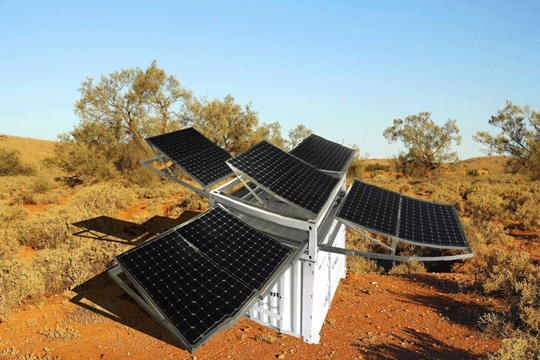
The $11,999 WattGrid unit comprises an aluminium cabinet containing tubular lead acid gel batteries, and a hybrid 5kW solar inverter with battery management system that has load share capability with the grid and uninterrupted power supply capability.
The unit is also accompanied by a software app, WattsHappening, that allows users to view real-time information and interface with the system.
Beta testing has shown the unit can help solar owners maintain an energy supply profile that can be matched to the demand profile, potentially rendering drawing grid power unnecessary.
The Queensland-based company is also releasing another product it has developed, the PortaGrid. This is an independent unit comprising solar panels, storage, UPS, inverter and outlets that is suitable for remote and off-grid locations, as well as emergency situations.
The units can be supplied with an inbuilt weather station that will automatically close up the panels in the event of a severe weather hazard such as a cyclone.
The AllGrid company is an alliance between two established firms, Consolidated Industrial Holdings, which operates across the energy efficiency, engineering design and technology sectors, and DICE Australia, an Aboriginal-owned and Aboriginal-operated company in the electrical contracting and general construction services sector………
The products are being launched at Tandanya Aboriginal Cultural centre in Adelaide on Wednesday 2 September. Ms Oberon said Adelaide was chosen for the launch because of the council’s Sustainable City Incentive Scheme, which provides up to $5000 towards the cost in installing solar PV storage across the residential, business, education and community sectors. Funding for the program also has financial support from the South Australian government.
“We felt it was important to acknowledge the South Australian government and the City of Adelaide for such a forward-looking and innovative scheme,” Ms Oberon said.
The company is also hoping other state governments and councils will be encouraged to take up the idea of supporting the uptake of renewable energy storage.
The company’s core mission is based on the fundamental Aboriginal approach of stewardship of the earth and its resources. This means needing to shift out of high-emissions fossil-fuel derived energy.
“It is so important for everyone to shift to renewable energy,” Ms Oberon said.
All the intellectual property involved in the products is owned by the AllGrid business.
Currently the company has one manufacturing facility established in Brisbane where the various parts, some of them manufactured offshore to AllGrid’s specifications, will be assembled by a predominantly Indigenous workforce.
Ms Oberon said if demand in South Australia was great enough, the company would also look to establish a plant in Adelaide.
The PortaGrid product is already attracting interest, she said, with the company in discussions with National Parks about supplying the units for remote sites that currently rely on diesel generators.
“The applicability worldwide of the technology is just enormous,” Ms Oberon said, “particularly in developing countries.”
Talks are underway with a number of groups that are currently running leadership programs with Indigenous people in other nations and setting up training programs in renewable energy for the local peoples.
The company is also investing heavily in research and development………
AllGrid has committed to directing a percentage of all company profits into creating and supporting training and employment programs for Indigenous Australian young people. http://www.eco-business.com/news/aboriginal-owned-energy-company-one-upping-tesla/
Obama backs community solar power as rooftop energy alternative
White House pushes community solar power as rooftop
alternative Gregory Korte, USA TODAY, 19 Nov 15 WASHINGTON — About half of electric customers can’t  install solar panels because they don’t own their building, don’t get enough sun or don’t have a large, south-facing roof to install solar panels, according to the U.S. Department of Energy.Those technical challenges are a particular hurdle for low- and middle-income customers — and that’s why the Obama administration is pushing a solution known as community solar.
The White House hosted a summit Tuesday to bring together major solar players to figure out ways to expand retail solar power from traditional rooftop arrays to a model in which households and businesses invest in shared solar systems. The administration announced that 68 cities, states, and businesses had signed on to a White House initiative to promote community solar, with an emphasis on low- and moderate-income households.

Those commitments are expected to bring solar power to to more than 20,000 households in 21 states, the White House said. And, just as importantly for President Obama, it will allow the United States to expand its use of clean energy as Obama prepares to travel to Paris for an international climate summit where he’ll press other companies to make similar strides to reduce carbon pollution from fossil fuels…….
Another participant, Michelle Moore of the nonprofit Groundswell, works as a community organizer to try to create markets for community solar power in places where it doesn’t yet exist. She said the White House summit was helpful in bringing for-profit utilities, cooperatives, local governments, non-profits and financiers together to make connections.
“Our role is organizing customers so that they’re able to have more of a say in what kind of energy they want and how they want to buy it,” said Moore, a former environment policymaker at Obama’s White House Council on Environmental Quality. “It’s a way to buy into a solar project without a home construction project.” http://www.usatoday.com/story/news/politics/2015/11/17/white-house-pushes-community-solar-power-rooftop-alternative/75950054/
Mayor of London calls on UK govt for tax help for local community solar power

 Boris Johnson: Treasury is endangering community renewables, Guardian, Adam Vaughan, 12 Nov 15
Mayor of London calls on the government to reconsider plans to remove tax relief for investors in community energy projects Boris Johnson has warned the Treasury it is endangering efforts by local communities around the UK to build their own renewable energy projects.
In a letter to the financial secretary to the Treasury, David Gauke, the mayor of London and Tory MP called on the government to reconsider its proposals to remove various forms of tax relief for investors in community energy.
More than 100 green energy groups have already said the change will “decimate” the sector, which has installed community-owned solar panels on village halls, small hydro schemes on rivers and wind turbines on farms.
Johnson is concerned that “the proposals may endanger the expansion of the sector given the investment required for the upfront capital costs” and “there is a danger of unintended consequences”, wrote the deputy mayor for environment and energy, Matthew Pencharz.
The mayor also thought that while such schemes might be small individually, in aggregate they are important to the security of London’s future energy supply, and a key part of efforts to cut the capital’s carbon emissions.
The short-term nature of the tax changes – which are due to come into effect at the end of November – could also put an end to schemes that are already in development or fundraising, he said.
One high-profile scheme for a community-owned solar array in a West Sussex village that was at the centre of anti-fracking protests, has already been shelvedas a result of the Treasury’s plans, announced in the finance bill last month. A recent report found more than £100m worth of community energy projects were at risk from the changes…….http://www.theguardian.com/environment/2015/nov/11/boris-johnson-treasury-is-endangering-community-renewables
Small scale solar power opens up big future for millions in Tanzania
“People who have small shops no longer close their shops early because they don’t have electricity. They can now operate until late at night. The availability of solar electricity has helped control immigration of people to urban areas,” says alternative energy specialist Dr Brenda Kazimili at the University of Dar es Salaam.
The government now wants all health centres and dispensaries that are not connected to the grid countrywide to be provided with solar panels.
How Tanzania plans to light up a million homes with solar power, Guardian, Erick Kab
endera, 29 Oct 15, In a country where only 40% of people have access to grid electricity, the government is looking to sunshine to power health centres and homes efore solar panels were installed at Masaki village’s only health centre, doctors, nurses and midwives had to use dim flashlights or the glow from their cellphones to deliver babies and treat night-time emergencies.
In one case in 2010, a man arrived late after a motorcycle accident and needed a wound stitching. As the nurse began the procedure by the light of her torch, she felt a cold slithering sensation against her legs.
A large black snake was moving across the dark, cement floor. The nurse fled, leaving the patient in the dark with the snake.
The work of the centre, which is five hours drive down a dirt track from the capital Dar es Salaam and serves a population of 1.5 million people in surrounding villages, is now transformed by a two kilowatt solar array installed on the roof at a cost of $15,000 (£9,700). And the government wants many more like it.
In February, it launched its One Million Solar Homes initiative to provide the sun’s power to 1m properties by 2017. Off Grid Electric, the Tanzanian company implementing the initiative, says it will provide power to 10% of the country’s homes. Currently, only 40% have access to grid power with access particularly sparse in rural areas.
The challenge across Africa is daunting. ……
Funding for the million homes initiative has come partly from the government’s Rural Energy Agency – which spends $400m a year – and international donors such as the World Bank. And in rural areas, microfinance organisations are now lending to allow householders to by solar panels. The total installation can cost up to $1,000.
“People who have small shops no longer close their shops early because they don’t have electricity. They can now operate until late at night. The availability of solar electricity has helped control immigration of people to urban areas,” says alternative energy specialist Dr Brenda Kazimili at the University of Dar es Salaam.
The government now wants all health centres and dispensaries that are not connected to the grid countrywide to be provided with solar panels.
Back at Masaki village health centre, the changes were much needed. “We’d begged for so long for solar power at this health centre. Life was unbearable here. We faced so many challenges and it was hard to work at night or do tests that required electricity,” said clinical officer Ahmed Mkamba.
“[Now] we have even installed a satellite dish to keep the health workers entertained after work. Mothers no longer have to be sent to far-away health centres to conduct simple tests and health workers don’t have to walk long distances simply to charge mobile phones.”
Health workers use the power from the solar panels (and the battery installed so that they can use the power at night) to run a computer which keeps patient records, to light the centre’s compound which covers about three or four acres of land and to operate HIV/Aids testing equipment. This means that patients no longer need to be sent to the district hospital 28km away.
And says Mkamba: “The lights keep away the snakes.” http://www.theguardian.com/environment/2015/oct/29/how-tanzania-plans-to-light-up-a-million-homes-with-solar-power
New batteries coming for solar powered homes
 Want a Solar-Powered Home? Here’s a New Battery That Won’t Ignite
As solar panels and wind turbines spread worldwide, they’ll need batteries to store power for times when they don’t produce it. Harvard debuts a promising prototype. By Wendy Koch, National Geographic SEPTEMBER 24, 2015 If you dream of an off-grid house powered by the sun, plan on a battery to store energy for cloudy days—ideally, one that won’t catch fire. Harvard researchers might have just the fix.
“It is a huge step forward. It opens this up for anyone to use,” says Michael Aziz, Harvard University engineering professor and co-author of a study published Thursday in the journal Science. Because the battery is safe and non-corrosive, he says, it’s well suited for both businesses and homes, adding: “This is chemistry I’d be happy to put in my basement.”………http://news.nationalgeographic.com/energy/2015/09/150924-nonflammable-battery-could-charge-solar-homes/
New measures to promote rooftop solar, by President Obama
US President Barack Obama unveils measures to encourage solar power use,SMH, August 25, 2015 GARDINER HARRIS. The Obama administration has announced a slew of small measures designed to encourage the use of solar power in the US hours.
The measures included making an additional $US1 billion ($1.4 billion) in loan guarantee authority available in an existing federal program for the kind of residential rooftop solar projects that have become popular in places like California.
But none of the announced measures would provide the impact on the solar industry of the Clean Power Plan, which was announced this month and requires states to cut carbon emissions by an average of 32 per cent. That plan provides strong incentives for much of those reductions to come from the development of renewable energy resources – exactly what executives at the conference in Nevada are looking to sell.
“We’re going to make it even easier for individual homeowners to put solar panels on their roof with no upfront cost,” President Barack Obama told the summit. “A lot of Americans are going solar and becoming more energy-efficient not because of tree huggers — although trees are important, just want you to know — but because they’re cost-cutters.
With the nation’s new electrical needs growing only modestly, renewable power executives are depending on electric utilities finally retiring their aging coal-fired power plants and replacing them with renewable power sources. That process is happening anyway, but the administration’s power plan is expected to accelerate it……..http://www.smh.com.au/environment/us-president-barack-obama-unveils-measures-to-encourage-solar-power-use-20150825-gj71e8.html#ixzz3jsRuU7g4
Control of electricity at the local level, with batteries for renewable energy
In the end, the solution might lie on a smaller scale: giving everyone the power to store their own power. Tesla is one company of several in this game: it recently announced a device called the Powerwall, designed for homes and businesses. It uses the same batteries as electric cars to store energy, either from renewables or cheap night-time electricity, ready to be used during the day.
If such systems become commonplace, we might all become a little more aware of where our energy is coming from, and how our own behaviour affects its use and production

The battery revolution that will let us all be power brokers, New Scientist 22 July 15
Companies are racing to find better ways to store electricity – and so provide us with cheaper energy when and where we want it “……... Although they are still dwarfed in most respects by the bulky lead-acid batteries found in almost every car on the road today, in 2015, lithium-ion batteries will account for around a third of the money spent on rechargeable batteries globally (see “Turn it on”), and just under a sixth of the total energy stored, according to French research firm Avicenne.
Small scale energy revolution in India’s slums – from Australia solar company
Australian solar company Pollinate Energy brings light to slums of India ABC Foreign Correspondent By South Asia correspondent Stephanie March 26 May 15 With indoor air pollution from kerosene lamps and stoves the second largest cause of death in India, one company, founded by Australians, has come up with a solution to the problem.
Every night in the sprawling shanty towns of the country of 1.2 billion people, the air fills with dense, black smoke.
“We used to get oil from the market and pour it into the lamp and light it; the house used to get full of soot and dirt,” said Abdul, a slum-dweller in Bangalore who lives in a hut made of wooden board and tarpaulin.
That was until Abdul bought a portable solar light from a company called Pollinate Energy, founded by five young Australians.
“After we got this solar lamp a lot of things improved,” Abdul said. “Now we don’t worry that there will be a fire.”
There are 400 million people in India who do not have access to electricity. Many of them live in the thousands of slums found in the country’s cities.
“They’re people who’ve come from rural places to the city to find work, usually in construction sites or as rag pickers, and to make a life for themselves,” Pollinate Energy co-founder Kat Kimmorley said.
“They are sort of like the modern day pharaoh slaves building this next new empire that we all … take for granted that is just coming up before our eyes and yet [is] completely ignored and sort of invisible to the state here.”
Pollinate Energy employs locals to go tent to tent to sell the solar lights.
The lights cost about $30 each — a lot of money for people who earn a few dollars a day. The company allows customers to pay in instalments.
“For most of the people we work with in these urban slums, when we provide a solar light, every time I sell it I think this is the same type of investment as for a plasma screen TV in Australia,” Ms Kimmorley said.
More mobile phones than toilets in India
The lights are popular — the company has sold more than 7,000, and is expanding to two more Indian cities. And that is partly because they double as a phone charger.
“We discovered that the customers would pay double what they would pay for a solar light for a solar-powered phone charger,” Ms Kimmorley said.
“So it is just testament to the fact that it is not just what we think would improve peoples’ lives but also what keeping up with the Joneses means in an urban slum. It’s having a mobile phone and being able to charge that mobile phone,” she said.
The uptake of mobile phones in India has been huge — there are more mobile phones than there are toilets.
The team at Pollinate believes solar lights can follow the same path………http://www.abc.net.au/news/2015-05-26/solar-energy-brings-light-to-slums-of-india/6495912
1 This Month


31st January – Challenging the War Machine – a DECLASSIFIED UK SUMMIT



Website of the Week
Now until to February 10, 2026 Radioactive waste storage in France: the debate is finally open! How to participate?
-
Archives
- January 2026 (227)
- December 2025 (358)
- November 2025 (359)
- October 2025 (377)
- September 2025 (258)
- August 2025 (319)
- July 2025 (230)
- June 2025 (348)
- May 2025 (261)
- April 2025 (305)
- March 2025 (319)
- February 2025 (234)
-
Categories
- 1
- 1 NUCLEAR ISSUES
- business and costs
- climate change
- culture and arts
- ENERGY
- environment
- health
- history
- indigenous issues
- Legal
- marketing of nuclear
- media
- opposition to nuclear
- PERSONAL STORIES
- politics
- politics international
- Religion and ethics
- safety
- secrets,lies and civil liberties
- spinbuster
- technology
- Uranium
- wastes
- weapons and war
- Women
- 2 WORLD
- ACTION
- AFRICA
- Atrocities
- AUSTRALIA
- Christina's notes
- Christina's themes
- culture and arts
- Events
- Fuk 2022
- Fuk 2023
- Fukushima 2017
- Fukushima 2018
- fukushima 2019
- Fukushima 2020
- Fukushima 2021
- general
- global warming
- Humour (God we need it)
- Nuclear
- RARE EARTHS
- Reference
- resources – print
- Resources -audiovicual
- Weekly Newsletter
- World
- World Nuclear
- YouTube
-
RSS
Entries RSS
Comments RSS
 nuclear-news