Solar power brings free irrigation to a Gujarat Village

 With Solar Power, A Gujarat Village Is Irrigating Its Fields For Free NDTV, All India |Written by Rohit Bhan | Updated: May 22, 2016 DHUNDI:
HIGHLIGHTS
- Farmers formed cooperative to install solar panels in their fields
- Solar panels power irrigation, surplus power sold to electricity board
- Project funded by farmers and non-profit group IWMI
Around seven months ago, about a dozen farmers in Ramabhai’s village about 90 km from Ahmedabad came together to form a solar cooperative and set up solar panels in the fields to generate electricity.
“We used to spend 500 rupees on diesel for pumping sets for drawing water for irrigation. But now we do it with solar energy,” Rambhai said.
“We also make money by selling solar power when we not irrigating our fields. We can sell excess electricity to the power board for Rs. 4.63 per unit,” he added…….http://www.ndtv.com/india-news/with-solar-power-a-gujarat-village-is-irrigating-its-fields-for-free-1408800
Wind power and solar replacing diesel on Galapagos
Wind turbines on Galapagos replace millions of liters of diesel since 2007, meet 30 percent of energy needs World’s top utilities hand over project keys, chart path for Ecuador’s famously biodiverse archipelago to meet 70 percent of fast-rising energy needs with renewables, Eureka Alert, 29 May 16.
GLOBAL SUSTAINABLE ELECTRICITY PARTNERSHIP A global renewable energy project on the Galapagos Islands — one of Earth’s most fragile and important ecological treasures — has helped avoid many tanker loads worth of risky diesel fuel imports since 2007, reduced the archipelago’s greenhouse gas emissions and preserved critically endangered species.
Now, after eight successful years, the project’s new operators are pursuing an ambitious expansion that would multiply the benefits of renewable energy for this remote, precious archipelago with a growing appetite for electricity.
A performance summary and recommendations for the expansion are contained in a new report by the Global Sustainable Electricity Partnership (GSEP), a not-for-profit association of 11 of the world’s foremost electricity firms, which led and financed the $10 million project.
The project’s three 51-metre-tall wind turbines and two sets of solar panels have supplied, on average, 30% of the electricity consumed on San Cristóbal, the archipelago’s second-largest island in size and population, since it went into operation in October 2007.
During that time, it has displaced 8.7 million litres (2.3 million gallons) of diesel fuel and avoided 21,000 tonnes of carbon dioxide emissions, the GSEP report states. The achievements have led to awards from Power Engineering Magazine, World Energy Forum, and Energy Globe.
The proposed expansion could boost the renewable energy share to 70 per cent, en route to a hoped-for elimination of fossil fuels, the report states. It could also be a template for energy development elsewhere in the Galapagos chain — where renewable sources now account for 20% of electricity production — and elsewhere around the world……..http://www.eurekalert.org/pub_releases/2016-05/tca-wto052016.php
Revolutionary solar power: London Borough’s solar panels over marketplace
 London borough installs 6,000 solar panels over marketplace http://www.theguardian.com/environment/2016/may/19/london-borough-installs-6000-solar-panels-on-market £2m scheme by Hounslow council on Western International Market will be biggest solar scheme by any local authority, and use batteries to store energy. A London council is unveiling a vast installation of 6,000 solar panels on a wholesale market rooftop, which it says is the largest such array put up by a local authority.
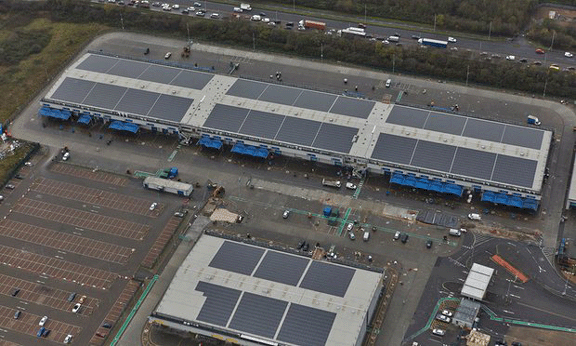
The London Borough of Hounslow says its £2m investment in solar, which has been installed on the roof of Western International Market, is also the first by a council to adopt battery storage to maximise the power from the panels.
The 1.73 megawatt (MW) array of 6,069 panels and four 60kW lithium batteries system now generates half the site’s required electricity.
The site is west London’s largest wholesale market for fresh produce and flowers, and uses around 3.5 megawatt hours (MWh) of electricity to provide climate controlled facilities to around 80 wholesalers and buyers – the equivalent of 1,750 homes a year.
Hounslow council, which owns the market near Heathrow Airport, says the solar system will contribute 2% of its carbon reduction target, cutting emissions by more than 780 tonnes a year.
It will also save £148,000 in energy costs which, along with £100,000 in generation tariff payments and £7,000 in export tariffs, means that the council expects to be £255,000 better off in the first year of operation.
Charles Pipe, energy manager at Hounslow, said: “From the very beginning, this project has been about reducing our carbon footprint and making an investment for the future. “But we have achieved so much more than that. Not only can we expect to see immediate savings on our electricity bills, but we are expecting to see a return on this investment in about five years.”
LG Electronics, one of Hounslow’s partners in the scheme, said it was the company’s largest solar panel installation in Europe and would deliver significant costs savings to the borough.
LG Solar’s UK senior solar sales manager Bob Mills said: “What’s more, the project has set the wheels in motion for further investment and research into the potential of battery storage, which is set to revolutionise the solar industry.
A solar-powered flight across the Pacific – the Solar Impulse 2 arrives in California
Solar-powered plane reaches California after journey across Pacific Mashable Australia, BY THE ASSOCIATED PRESS , 24 Apr 16, MOUNTAIN VIEW, Calif. — A solar-powered airplane landed in California on Saturday, completing a risky, three-day flight across the Pacific Ocean as part of its journey around the world.

Pilot Bertrand Piccard landed the Solar Impulse 2 in Mountain View, south of San Francisco, at 11:45 p.m. local time following a 62-hour, nonstop solo flight without fuel. The plane taxied into a huge tent erected on Moffett Airfield where Piccard was greeted by project’s team……..
The trans-Pacific leg was the riskiest part of the plane’s global travels because of the lack of emergency landing sites…….http://mashable.com/2016/04/24/solar-impulse-2-california/#gwzcbJ_OIkq3
Impressive solar panel array on Port Alberni hospital, Vancouver Island, Canada
 Port Alberni hospital has Vancouver Island’s largest array of solar power Solar power could help with high hydro rates during peak hours on hot days By Liam Britten, CBC News Apr 23, 2016
Who loves the sun? — turns out West Coast General Hospital in Port Alberni does. That building is home to 400 solar panels — the largest power-generating array on Vancouver Island, in fact.
The panels will be doing their work in the weeks and months ahead to see how much money Island Health Authority can save by using the power of the sun.
- Thompson Rivers University puts energy into solar powered walkway
- Vancouver roofing company starts offering solar panel installation
- Nelson’s ‘community solar garden’ starts leasing panels
“When it’s really hot and sunny and we’re using a lot of power to keep the hospital cool, the rates get very high with BC Hydro,” Deanna Fourt, director of energy efficiency and conservation with Island Health Authority told All Points West host Robyn Burns.
“So it’s going to work very nicely with the solar. This is what we’re thinking, because it’s going to be offsetting those really high-rate days or high-rate times.”……..http://www.cbc.ca/news/canada/british-columbia/vancouver-island-solar-power-1.3550022
In Tanzania, distributed solar power not only for home lighting, now for business, too
Solar panels power business surge – not just lights – in Tanzania BY KIZITO MAKOY UKARA, Tanzania (Thomson Reuters Foundation) 19 Apr 16 –
“………SOLAR STEPS UP
Around the world, as the costs of solar energy plunge, it is increasingly being used to power industry and businesses, a huge step forward from simply supplying lighting and basic electrical power in places like Tanzania, experts say.
Nyakalege, for instance, now uses solar power to operate his three milling machines simultaneously. He has employed three people to help him and has seen his customer base rise to 600 a day…….
The solar system at Bwisya is part of a project to provide reliable and affordable electricity to the nearly 2,000 households and more than 200 businesses on Ukara, in order to boost opportunities to earn an income.
It is the first of 30 such systems JUMEME plans to install over the next two years. They are expected to supply power to around 100,000 people, company officials said.
The company has even bigger plans for the longer-term, they said.
“Our goal is to set up 300 systems and serve up to 1 million people in rural areas across Tanzania by 2022, making JUMEME the largest mini-grid operator in the country,” said Thadeus Mkamwa, one of the company’s directors.
The project, jointly funded by the European Union and private investors with political support from the Tanzanian government , has a total budget of 38.4 billion shillings ($17.6 million), Mkwama said.
PRE-PAID SOLAR POWER
In Bwisya, the largest village on Ukara, 250 customers are due to be connected to a hybrid power station consisting of a 60-kilowatt (KW) solar photovoltaic system and a 240 KW-hour battery bank. A diesel generator provides back-up.
The system will be extended in the second half of this year to connect the other villages on the island, Mkamwa said.
The installation charges for individual homes and business are repaid by customers in installments. Consumers pre-pay for their power, with costs per unit depending on the amount of electrical equipment they use…….http://www.reuters.com/article/us-tanzania-solar-energy-idUSKCN0XG1VX
Solar city makes more 4 times more electricity than it consumes
 Revolutionary: Germany Builds A Solar City That Produces Four Times More Energy Than It Consumes http://thelogicalindian.com/environment/germanys-revolutionary-solar-city-that-produces-four-times-more-energy-than-it-consumes/ – Abhishek Mittal 14 Apr 16, We have known cities to be great power-guzzlers, having a huge appetite for consuming electricity to power its homes and buildings. To generate electricity for such cities through renewable sources like solar becomes a difficult task given the vast amount of area required to place the solar panels. But a city in the heart of Germany has achieved something more incredible. It not only has made itself self-sufficient in energy, but in fact has become a net producer of energy – all thanks to a localized approach for adopting solar power.

The Solar cities of Germany:
The Sonnenschiff and Solarsiedlung cities located in Freiburg, Germany are modern, planned habitations that were worked upon with solar power in mind. Literally meaning Solar Ship and Solar Village, the Sonnenschiff and Solarsiedlung cities were specifically designed and built to be solar cities, balancing size, accessibility, green space, and solar exposure. Each of the fifty-two homes along with some commercial buildings is fitted with large rooftop solar panels that double-up as sun shades. The panels are perfectly aligned to point in the right direction of the sun, and the buildings follow the Passivhaus standards of green building technology.
The cities have been designed by architect Rolf Disch. Together with the latest photovoltaic technology for the panels that make them highly efficient, and use of phase-change materials and vacuum insulation for the walls of the buildings that provide optimum thermal performance, the cities are able to generate four times the power which they consume.
Solar Vs Nuclear:
The success of solar as an alternative to the polluting coal-fired power is not limited to these twin-cities. The entire area of Freiburg has been leading the country into a solar revolution since a long time. It was once on the crossroads of choosing between solar and nuclear as the preferred alternative source. Infact a nuclear power plant had already begun construction near Freiburg in early 1970s, amid protests from students and farmers who saw nuclear as a dangerous and polluting source of energy.
A major change in mindset of the local population came when an engineer Dieter Seifried started an institute to research into alternative forms of energy and popularized solar as a safe, reliable and efficient source. Seifried said regarding nuclear power in an interview to CBC news, “you will see first that it is not clean at all, second that it is expensive and third that we have a lot of unsolved problems like where do we deposit the waste.” Gradually more and more residents started to install rooftop solar panels on their houses and ditched the conventional power from grid. In 2000, Germany tabled a clean energy bill that forced power-companies to pay a set fee called a feed-in tariff to anybody providing power to the grid. This gave an impetus to the efforts of Seifried and others, and today, 30% of Germany’s electricity comes from renewable sources, mainly wind and solar. The nuclear plant being built in Freiburg was shut down soon after the protests, and after the unfortunate Fukushima meltdown in Japan in 2011, Germany has committed to phase out all 17 of its nuclear reactors by 2022.
The examples of Freiburg and the solar cities show how people themselves can own up the process of transitioning from conventional methods of energy generation to cleaner alternatives. The role of government in incentivizing renewable energy and providing access to technology is also very important. The Logical Indian gives a big thumbs-up to the residents of Freiburg for kickstarting the solar revolution in their country, and hopes that similar initiatives are taken up by people across the world.
Western Kenya’s solar minigrids – a rural electricity solution
A solar minigrid for 100 villages in Western Kenya, Clean Leap by DAVID KARIUKI Mar 19th 2016, Scalable solar mini grids will continue to play a major role in the rural electrification agenda in developing countries in the future. This will be fueled by the increased entry of private players into the field, and the change of regulations in respect to generation and supply of power from scalable mini grid solutions. These two are already being witnessed in Kenya. This year, Kenya is witnessing a major solar micro-grid project expected to demonstrate exactly how these power solutions can fit in rural electrification agenda now that the country is targeting 100% electricity access by 2030. The project is notable as it marks the first scalable community micro grid project since last year’s granting of the first utility concession for off-grid power supply…….

India plans 1,250 MW Solar Power Projects Over Waterways
Indian Company Plans 1,250 MW Solar Power Projects Over Water Bodies http://cleantechies.com/2016/03/29/indian-company-plans-1250-mw-solar-power-projects-over-water-bodies/ by SAURABH on MARCH 29, 2016 Government-owned power generation company in the western state of Maharashtra has revealed expansive plans to utilise water bodies and generate solar power.

Maharashtra State Power Generation Company Limited (Mahagenco) recently floated tenders for the preparation of detailed project reports for setting up solar power projects over water bodies in the state.
Mahagenco plans to set up these projects in partnership with other government agencies that own these water bodies through a revenue-sharing model. The company plans to set up projects on a) reservoirs and canals and, b) lakes and other water bodies.
The company aims to replicate the canal-top solar power projects implemented in the neighbouring state of Gujarat. Canal-top solar power projects have dual advantage of little to no requirement of land requirement to set up the solar panels, thereby making substantial savings on project’s capital cost, and limiting the loss of water from canals/reservoirs due to evaporation.
Water bodies owned by villages and local self-governing bodies will also be roped in to set up such solar power projects. Mahagenco plans to implement these projects through net-metering scheme. Solar power projects set up at such water bodies will inject electricity during the day and the local utility will supply electricity to villages during the night. The balance in electricity units shall be settled on monthly basis. This will reduce the electricity bills for villagers and also improve electricity supply.
After the successful implementation of canal-top solar power projects in Gujarat several other states have announced plans to implement similar projects. Punjab, Damodar Valley Corporation and Kerala have publicly announced targets to set up projects over canals, reservoirs and other water bodies.
USA could be powered 40% by electricity from rooftop solar panels
Rooftop solar panels could provide nearly half US power http://www.theguardian.com/environment/2016/apr/14/rooftop-solar-panels-could-provide-nearly-half-us-power
Rooftop panels could supply 40% of country’s power with open spaces such as parking lots offering further potential, study shows. Conservation magazinereports Guardian, Prachi Patel To take advantage of the sun’s energy to satisfy our ever-increasing need for electricity, Americans will have to take a fresh look at their roofs. A report by the National Renewable Energy Laboratory (NREL) shows that if all suitable roof areas in the United States were plastered with solar panels, they would generate about 1,118 gigawatts of solar power. That is 40% of the power that Americans consume every year.

And that isn’t the half of it. The study only estimates the solar power potential of existing, suitable rooftops, and does not look at the immense potential of ground-mounted photovoltaics (PV), said NREL senior energy analyst Robert Margolis in apress release. “Actual generation from PV in urban areas could exceed these estimates by installing systems on less suitable roof space, by mounting PV on canopies over open spaces such as parking lots, or by integrating PV into building facades. Further, the results are sensitive to assumptions about module performance, which are expected to continue improving over time.”
The new study doubles the estimate from a 2008 NREL study on US rooftop solar potential, which showed an estimate of 664 GW. Margolis and his colleagues attributed the higher numbers to increases in better-performing modules, improvements in estimation of building suitability, higher estimates of the total number of buildings, and better methods to calculate photovoltaic performance.
For the new report, which is the result of three years of research, the team used light detection and ranging (Lidar) data and geographic information system (GIS) methods to map the topography of 128 cities around the country down to the square meter. This helped them determine the total amount of roof area suitable for hosting rooftop solar panels. Then they simulated the productivity of the panels on this roof area to estimate total rooftop solar potential, and finally extrapolated that data to the whole country.
The report ranked cities with the highest capability to meet energy consumption using potential solar power capacity. Mission Viejo, California topped the charts with a 88% solar potential rating, followed by Concord, New Hampshire at 72%, and Buffalo, New York at 68%.
The six states with the highest potential to offset electricity use all have significantly below-average household energy consumption, the analysts note, indicating that any state that wants to make the most of solar incentives should also prioritize energy efficiency.
Source: Pieter Gagnon, Robert Margolis, Jennifer Melius, Caleb Phillips, and Ryan Elmore, NREL. Rooftop Solar Photovoltaic Technical Potential in the United States: A Detailed Assessment.
India: Gujarat’s government increases solar energy incentives, with rooftop subsidy
 India’s Gujarat introduces rooftop solar subsidy, PV Tech By Tom Kenning Apr 11, 2016 The Indian state of Gujarat has introduced a subsidy for residential grid-connected rooftop solar systems on top of any benefits provided by India’s Central government.
The subsidy amounts to INR10,000 per kW of installed PV (US$151) with a maximum of INR20,000 per consumer. This financial support will be dispersed by the Gujarat Energy Development Agency (GEDA) after installation and commissioning of each rooftop system.
Gujarat’s government plans an initial target of 100,000 consumers, after which, based on a review, the scheme will be continued, modified or discontinued. The scheme is planned to encourage and promote setting up rooftop solar across the state.
This subsidy will be in addition to any benefit received from the Central government, which announced a return to 30% subsidy for residential rooftop systems last November
As part of India’s overall 100GW target by 2022, Gujarat was given a goal of 8,024MW solar by 2021/22, of which 3,200MW is to come from rooftop solar…….http://www.pv-tech.org/news/indias-gujarat-introduces-rooftop-solar-subsidy
Farmers turn to solar power for an economic “crop”
 Farmers Quit Corn; Grow Solar Power, Triple Pundit, by Leon Kaye on Friday, Apr 1st, 2016 One of the arguments used against solar power deployment is the amount of space needed for all of those solar panels. Although one study has shown that 0.6 percent of all land in the U.S. would be needed to completely electrify the country, the fight still goes on, even as solar and wind power technologies continue to increase in efficiency while decreasing in costs.
The fight is also occurring in counties across the U.S., as landowners and farmers seek new ways to generate revenue. Most of rural America has missed out on the economic revival that has conjoined technology and urbanization in many cities, so these counties are also seeking new ways to generate tax revenues. Farmers, of course, have also taken a hit due to the ongoing slump in global commodities.
The controversy over farmers having the right to sign contract with solar and wind power companies is now taking center stage in North Carolina.
The combination of the state’s Renewable Energy Portfolio Standard (REPS), which requires utilities operating in the state to generate some electricity from renewables, along with its booming tech culture, has turned the Tar Heel State into a solar powerhouse. In fact, the Solar Energy Industries Association (SEIA) says North Carolina ranks third in the nation amongst U.S. states in total solar capacity. Last year, the installation of over 1,100 megawatts of solar power placed North Carolina in second nationally in new solar generation.
And much of this power is generated in rural counties across the state, from the northern border with Virginia to along the South Carolina state line. According to Solar Strata, one company that is riding North Carolina’s solar boom, these new solar farms are appearing on farmland where crops such as tobacco, peanuts, cotton and corn can no longer earn enough money for farmers to keep their land. Other sites are appearing on fallow land that has not been farmed in years. Companies such as Solar Strata pay rent to these farmers, with contracts that often last as long as 20 years. As quoted by one farmer who was interviewed by Joe Ryan of Bloomberg, “It gives me a way to keep the farm . . . and pass it to my grandchildren.”…….http://www.triplepundit.com/2016/04/harvesting-solar-offers-farmers-stable-incomes/
Saving the family farm – through farming the wind
In many cases, lease payments from turbines are the difference between keeping a farm and selling off the land.
Jason Wilson of Calhan, CO, told me, “The wind farm allowed us to be able to keep our family farm. We had come to a point where it no longer made financial sense to keep the property even with its vast sentimental value. The wind farm balanced the financial viability with the sentimental value, allowing the family farm to be passed on to the next generation.”
wind farms bring other opportunities for employment. Wind turbine technician is the fastest growing occupation in the country and presents another employment avenue for people who enjoy rural lifestyles.
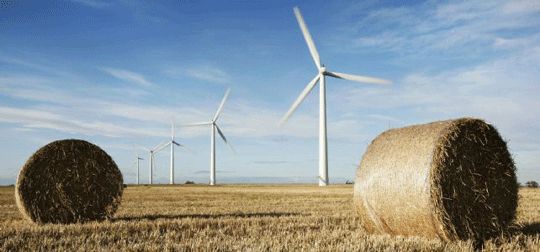
How does wind help the family farm stay in the family?, http://www.aweablog.org/how-does-wind-help-the-family-farm-stay-in-the-family/ Greg Alvarez, 22 Mar 16, During my tour through Colorado wind power last week, I often heard how wind helps keep the fabric of rural communities intact, allowing them to thrive.
Land lease payments make it possible for family famers and ranchers to keep their businesses running, expanded tax revenue provides resources to buy new emergency services equipment, and wind farms bring well-paying jobs to the community, meaning young people don’t have to leave home to find a good career.
Millions in financial resources for rural communities
New data released today allows us to quantify these sorts of anecdotes: landowners with wind turbines on their property now receive a total of $222 million in lease payments every year. Overall, landowners in six states currently receive over $10 million each year in lease payments, and 26 states have landowners that receive over $1 million.
This revenue acts as a drought resistant cash crop for family farmers and ranchers, providing a stable source of income they can count on when productivity declines because of drought or other causes. It also helps protect them from commodity price fluctuations, a frequent source of frustration in the agricultural world.
Real world impacts
In many cases, lease payments from turbines are the difference between keeping a farm and selling off the land.
Jason Wilson of Calhan, CO, told me, “The wind farm allowed us to be able to keep our family farm. We had come to a point where it no longer made financial sense to keep the property even with its vast sentimental value. The wind farm balanced the financial viability with the sentimental value, allowing the family farm to be passed on to the next generation.”
The Wilson farm sits on the plains at the base of Pike’s Peak. It’s a beautiful, serene place started by Jason’s great-grandfather in the 1940’s. Jason will be taking over the operation in the coming years, and his family explained they had no doubt this transition is only possible because of the lease payments they receive in exchange for hosting wind turbines.
Tax revenue helps communities thrive
Land lease payments aren’t the only source of revenue from wind farms; they also help expand the tax base. In many states, wind increases property tax funds by millions of dollars. For example, in Colorado increased property tax revenue from wind could near $19 million a year by 2030.
When our team visited a wind farm in the northeastern part of the state, in a town called Peetz, we heard that the local fire department had been using hand-me-down trucks in poor condition from other counties. Some locals joked that the old fire trucks couldn’t make it up a hill. However, after a wind farm was built, the resulting tax base expansion enabled the town to purchase brand new trucks.
Since around 70 percent of American wind farms are located in rural communities where median household incomes are lower than overall U.S. median incomes, lease payments and added tax revenue are doubly important. Overall, wind farm investment in such areas has exceeded $101 billion.
Wind farms mean local jobs
A final component in this economic picture concerns the jobs wind farms bring to a community.
In many rural areas, jobs are limited to agricultural professions. Young people that may want to pursue a different livelihood are often forced to move away because of a lack of options, even if they don’t want to leave their families and hometowns.
However, wind farms bring other opportunities for employment. Wind turbine technician is the fastest growing occupation in the country and presents another employment avenue for people who enjoy rural lifestyles.
Our team met with a wind farm operations and maintenance crew in Peetz, CO, and many of its members fell exactly into this category. Working as a wind turbine technician provided them with well-paying jobs while also allowing them to stay in the town they grew up in and loved, in close proximity to their extended families. The crew told us this option simply wasn’t available before the wind farm was built.
There are a multitude of different ways wind power brings resources and opportunities to local communities. Even better, the dollar amounts and job numbers will only increase as we continue to grow this American energy source, which will help rural towns thrive along the way.
Community solar power now getting the backing of energy utilities

 Even Utilities Are Starting To Get Behind Community Solar http://oilprice.com/Alternative-Energy/Solar-Energy/Even-Utilities-Are-Starting-To-Get-Behind-Community-Solar.html By Nick Cunningham, 28 March 2016 Solar energy is rapidly becoming one of the top choices for new electricity capacity as costs continue to decline and generous public policies accelerate tremendous growth for the sector.
Last year was a record year for the solar industry and the momentum is set to continue. In 2016, the EIA expects the U.S. electricity market to see 26 gigawatts of new capacity installed. Utility-scale solar is expected to capture 9.5 GW of that total, or more than one-third. If that comes to pass, it would be triple the rate of installations of utility-scale solar compared to 2015, and would also equate to more than the combined total of installations from 2013 to 2015.
That could be a conservative estimate. The Solar Energy Industries Association, a trade group, expects the solar industry to add 16 GW of new solar capacity, with about three-quarters of that coming from the utility-scale segment.
A much smaller segment of the solar industry could begin to take off, however. With the bulk of solar installations made up of large-scale utility-size projects, plus some commercial and residential projects proliferating at a healthy rate, the tiny but rapidly growing “community solar” sector could begin to capture a lot more attention.
The growth of solar has been held back by the large upfront costs. That problem is already being overcome with the leasing model, which requires no upfront investment.
But another problem with solar is that not everyone can participate – some people live in apartment buildings, or do not own their own home, or do not have a suitable rooftop to host PV panels. According to Greentech Media, around 77 percent of U.S. households are ineligible for solar panel installations for one reason or another.
“Community solar” solves this problem by allowing people to buy or lease a slice of a shared solar project that is somewhere off site, maybe in a nearby town or on a tract of open land. One could live in an apartment building and still buy into a community solar project, receiving credits on their utility bill.
The community solar model is becoming more common, opening up a vast new market for the solar industry. Community solar grew five-fold last year. New customers can still access a leasing model that has no upfront costs, and with community solar they do not even need to have their own rooftop to do so.
Better yet, community solar projects are increasingly competitive, offering ratepayers a clean source of power without added cost. There is a lot of room for improvement as well. As of now, the issues and design specifications can vary from project to project, but as the sector grows, developers will find ways to standardize projects, reduce development times, and scale-up a small-scale model.
No longer able to ignore the coming explosion in the solar market, utilities have been fighting to tweak public policy to block the threat of solar. But some utilities, in a recognition of reality, are trying to get in on the community solar game so as not to be left behind.
Deloitte cites the case of a Minnesota utility that allows ratepayers to buy in to a community solar project at a discounted rate if they also purchase a new electric water heater. The idea is that the household will heat their water with the extra electricity it produces at midday, avoiding the need to use electricity in the later afternoon and early evening when demand is at a peak. The customer benefits, and the utility benefits by shaving off peak demand.
State policies have also helped. In particular, Colorado and Minnesota have passed laws that require their utilities to setup community solar programs for their ratepayers. Two dozen more have voluntary programs.
Solar is popular too. Deloitte surveyed 1,500 households to find out what they thought were the most pressing energy-related issues, and 64 percent of them said “increasing the use of solar power” was a top three issue for them. As more customers discover community solar, they will increasingly demand their utility offer community solar programs to allow them access.
To be sure, community solar is still small. There are just 111 projects across the U.S., though that is sharply up from only two in 2010, according to Deloitte. Most projects are smaller than 1 megawatt, and the largest is only 20 megawatts. Most projects serve between 40 and 600 customers, according to a report from The Rocky Mountain Institute.
Nevertheless, the solar industry is growing rapidly, and community solar could be the fastest growing segment. The Rocky Mountain Institute argues that 15 GW of community solar could come online by the end of the decade.
For years, utilities have seen solar power as a threat, but that could be changing. As Deloitte puts it, the “evolution of community solar is a classic case of business model innovation turning a challenge into an opportunity. Foreseeing the inevitable growth of distributed energy resources, utilities are deploying these programs to get ahead of the game and to capture the benefits that distributed resources provide to the grid.”
Residential solar power a money saver
 Saving Money With Solar Power http://mentalitch.com/saving-money-with-solar-power/The boundless financial benefits of solar power Having a solar energy system in your home puts you at a great advantage without being completely reliant on the electric grid and helping the environment. This is a great move to going green and living green. Another reason is that you may want to avoid paying astronomical electricity bills in the future by traditional energy companies. Hiring a solar power installation company will help you develop a solar energy, for whatever reasons that have driven you to need for such move.So why go green with having a solar power system for your home? There are a lot of good reasons to have solar energy for your property.
1) Increase in home/property value Installing a solar energy system in your home will definitely appreciate the value of your property. It will even add to the curb appeal of your home. Having a solar power system of your home will move you ahead of other property sellers in the marketplace and will be a long term benefit to the home. A licensed solar energy company will be able to help you determine how much the value of your home will be affected by the installation of a solar energy system.
2) Reduction of electricity bill costs Having a solar energy system installed in your home will help you reduce the monthly bill that you have to pay for the electric company. Before installing a solar energy system its important to get the right one that meets your needs. Professionals will first have to determine your current electricity consumption and right size the system. You may want to forgo paying the bills to the electric company completely, or at least greatly reduce electricity bills by paying the company a fraction what your previous average monthly bill. In some cases, after installing a solar energy system, your electrical bill may be completely wiped out. Some electrical companies will ‘bank’ excess power from your system so your bill even in winter or less sunny times will not increase.
Having “green energy” installed in your home comes with advantages. You may be able to get credits which will help cover the installation costs. There are many programs from the government and other organizations that reward you with incentives for having such a great source of clean, alternative energy in your home.
4) Freedom from price fluctuations by many energy companies Traditional energy companies are facing increasing demands for their power that may cause them to raise rates. With a solar power system as an alternative source of energy to your home, you can offset potential increases in your electric bill and not get caught up in the rising energy prices. Installing a solar power system in your home will give you a great advantage over those that don’t have one. Aside from contributing something good to our environment, having an alternative source of energy in your home can provide a lot of benefits. It can save you a lot of money and also increase the resale value of your property – and if you plan it right you may be able to do it with a lower cost thanks to government incentives.
1 This Month

of the week – Shut Down Drone Warfare!


Tell the Ukrainian Government to Drop Prosecution of Peace Activist Yurii Sheliazhenko

Petition to revoke the licensing of the Near Surface Nuclear Disposal Facility (NSDF) at Chalk River. https://www.ourcommons.ca/petitions/en/Petition/Details?Petition=e-7247
To see nuclear-related stories in greater depth and intensity – go to https://nuclearinformation.wordpress.com
-
Archives
- March 2026 (237)
- February 2026 (268)
- January 2026 (308)
- December 2025 (358)
- November 2025 (359)
- October 2025 (376)
- September 2025 (257)
- August 2025 (319)
- July 2025 (230)
- June 2025 (348)
- May 2025 (261)
- April 2025 (305)
-
Categories
- 1
- 1 NUCLEAR ISSUES
- business and costs
- climate change
- culture and arts
- ENERGY
- environment
- health
- history
- indigenous issues
- Legal
- marketing of nuclear
- media
- opposition to nuclear
- PERSONAL STORIES
- politics
- politics international
- Religion and ethics
- safety
- secrets,lies and civil liberties
- spinbuster
- technology
- Uranium
- wastes
- weapons and war
- Women
- 2 WORLD
- ACTION
- AFRICA
- Atrocities
- AUSTRALIA
- Christina's notes
- Christina's themes
- culture and arts
- Events
- Fuk 2022
- Fuk 2023
- Fukushima 2017
- Fukushima 2018
- fukushima 2019
- Fukushima 2020
- Fukushima 2021
- general
- global warming
- Humour (God we need it)
- Nuclear
- RARE EARTHS
- Reference
- resources – print
- Resources -audiovicual
- Weekly Newsletter
- World
- World Nuclear
- YouTube
-
RSS
Entries RSS
Comments RSS
 nuclear-news