Renewable energy systems set to go ahead with new technology enhancing flexibility
 Chatham House 22nd Aug 2018 Electricity Markets** As renewables become a large share of the global energy mix, greater electricity system flexibility will be critical and will originate from the
small scale, write Daniel Quiggin and Antony Froggatt.
represent 75 per cent of global renewable electricity capacity growth over
the medium-term’. Bloomberg New Energy Finance also estimates that by
2040, nearly three-quarters of the $10.2 trillion invested in new
power-generating capacity will be in renewables.
costs associated with managing the system start to escalate once renewables
exceed a 30 per cent share of generated electricity. Unless properly
planned for, the growth in electric vehicle use and electric heating could
further amplify these ‘system integration costs’. They include the cost
of holding fossil fuel power plants in reserve for periods of low renewable
supply, grid upgrades and the dumping of power from renewables when system
constraints are reached.
and as a growing number of cars and domestic-heating systems begin to add
to power usage, how can governments ensure electricity is affordable? The
answer is ‘flexibility’. A raft of technologies already entering the
market, promise to radically enhance the flexibility of electricity
systems, helping contain system integration costs while accelerating the
low-carbon transition.
https://hoffmanncentre.chathamhouse.org/article/decentralised-flexibility/
Flexible localised renewable energy networks in UK
Centrica (accessed) 24th Aug 2018 , By 2040 Bloomberg New Energy Finance predicts that more than half of global
energy capacity will come from renewables and flexible sources, such as
battery storage and demand side response. At 7% of global capacity,
flexible sources such as batteries and demand side response – where homes
and businesses automatically cut energy usage a peak times – will account
for the same level of global energy capacity as oil-fired power plants
today.
And more than half of this energy storage capacity will come from
small-scale batteries installed by households and businesses alongside
rooftop solar panels.
This trend away from larger power plants and towards
smaller, decentralised energy systems is happening in both developed and
developing nations. The decarbonisation trend is being accelerated by the
falling price of renewable energy technology, and the availability of
technology such as batteries that makes it easier to store electricity.
This in turn accelerates decentralisation, as renewables are by their
nature smaller and more spread out than the equivalent capacity provided by
a traditional power plant.
The rate of decarbonisation and decentralisation
is being accelerated by digital technology, giving people the power to
save, or even make, money by being more flexible with their energy use,
while helping electricity grid operators to balance supply and demand.
Europe’s largest demand side response aggregator, REstore, was acquired
by Centrica in 2017. Centrica CEO Iain Conn says he expects demand side
response to become one of the fastest growing elements of the energy market
over the next few years. From smart home products such as Hive that allow
home owners to control their energy use from their smartphone, through to
companies like REstore employing artificial intelligence to calculate just
how much energy capacity a factory can offer as a virtual power plant.
Energy, like every other sector, is going digital.
Greater insight through
digital technology is just the start of the shift of power away from energy
companies and towards the customer. Centrica is currently piloting a
project in the south west of England that will allow local residents and
businesses to buy and sell energy between themselves without the
intervention of their energy supplier. The £19 million Local Energy Market
in Cornwall is enabling 200 homes and businesses to do this using a digital
record known as Blockchain. It is used to create a secure electronic ledger
of transactions between participants. Iain Conn says he believes such local
networks will become the norm in a new decentralised energy market.
https://www.centrica.com/platform/three-tech-trends
U.S. army increasing its investment and use of solar power
FT 24th Aug 2018 The US Army has increased its investments in solar power and is eyeing
further opportunities to work with the private sector to develop projects,
despite the Trump administration’s scepticism about renewable energy.
Michael McGhee, who leads the US Army’s Office of Energy Initiatives, told
the Financial Times that installing solar panels at army bases could
improve resilience against attacks or natural disasters, and provide
cost-effective electricity supplies.
https://www.ft.com/content/7c23057e-a3cc-11e8-8ecf-a7ae1beff35b
Success of London’s community renewable energy projects: mayor Sadiq Khan launches second round

 Solar Power Portal 23rd Aug 2018 London’s mayor Sadiq Khan has today launched a second round of funding for community energy projects following the success of the first, which
funded the initial stages of 11 solar projects set to be installed by the end of the year.
of solar project feasibility and scoping activities.
to £15,000 per project to support the development stages of community
energy projects.
https://www.solarpowerportal.co.uk/news/sadiq_khan_launches_second_phase_of_community_energy_funding_as_solar_push
Smart householders don’t just switch energy providers, they go solar
Guardian 5th July 2018 , Emeritus Professor Sue Roaf: You should talk to people in the solar
industry about the future for domestic solar power rather than just relying
on “predictions”. As a non-executive director of AES Solar Ltd in Forres,
Scotland, I can tell you that our order books are healthy, despite the
government’s solarcoaster tariffs.
We are seeing real, steady growth
because, for instance, where better to spend a small part of a pension pot
than to put in a solar water heater, PV electrics and a battery system,
thus decoupling the household budget from soaring energy prices from the
grid.
Smart householders don’t just switch energy providers, they go solar,
not least those looking for a financially safer old age. That is the sort
of compelling reason why solar has a brilliant future in the UK, not a dark
one.
https://www.theguardian.com/environment/2018/jul/05/tidal-power-to-the-people
Community Energy could bring a revolutionary change to Europe’s clean energy package
 Unearthed 26th June 2018 ,This week national governments will meet in Brussels to vote on a deal –
part of the EU’s clean energy package – that would recognise the right
of people and communities to produce their own energy. It could represent
possibly the biggest systematic change to Europe’s electricity market in
a generation. Unearthed has got hold of the final text of the renewable
energy directive, which could boost the take-up of renewable energy from
households and small producers in the EU. The UK appears unsure as to
whether it will integrate the policies into national law after Brexit.
https://unearthed.greenpeace.org/2018/06/26/eu-makes-it-a-right-for-people-to-sell-renewable-energy-here-are-5-things-you-need-to-know/
California to make solar panels mandatory on new houses?
Independent 5th May 2018 , California is set to become the first US state to make solar panels
mandatory on most newly built homes. The state’s Energy Commission is due
to vote next week on new energy standards that would require virtually all
new homes to be constructed with solar panels from 2020. Currently around
20 per cent of single-family homes are constructed with solar capacity
built in, but if the new standards are approved as expected this proportion
will rise sharply.
https://www.independent.co.uk/news/world/americas/california-solar-power-panels-homes-renewable-green-energy-climate-change-a8337626.html
Australia claims world first: fully solar-powered train

World-first solar train now leaving the platform in Byron Bay with zero emissions, ABC North Coast , By Bruce Mackenzie, 17 Dec 17, What is claimed to be the world’s first fully solar-powered train is operating on the New South Wales North Coast.
A refurbished 70-year-old ‘red rattler’ is running on a three-kilometre stretch of disused rail line at the popular tourist destination of Byron Bay.
It made its maiden trip yesterday with almost 100 passengers on board.
Electric bus solar system
The $4-million project is the brainchild of multi-millionaire businessman Brian Flannery, who owns a resort in the area.
“Hopefully it attracts people to Byron Bay,” Mr Flannery said.
“I think international tourists will come here to have a look at this world’s first solar train.
“So let’s see, in five years’ time they’ll probably still say I’m mad, but it’s a bit of fun.”
Tim Elderton, from the Lithgow Railway Workshop, was tasked with building curved solar panels and a battery system to power the train.
“Of course the major difference is it’s got solar panels on the roof so it can recharge itself.
“For those cloudy days we’ve also got 30 kilowatts of solar panels in this [station’s] roof here so we can also plug it in.
“On a sunny day like today we can do about four or five trips before we have to plug it in.”……..
Tram infrastructure a possibility
Longer trips than this one — 10 minutes to cover three kilometres or so — would require regular recharging stations along the route, but Mr Flannery said the technology might be suited to inner-city trams.
A lot of the tram networks of course have overhead wires and they’re electric but they’re powered off the grid from overhead,” he said.
“But in a case where you want to build a tramline without that infrastructure, I think you could.
“At various stations you could top the train [or tram] up.” http://www.abc.net.au/news/2017-12-16/world-first-solar-train-the-brainchild-of-byron-bay-millionaire/9265522
Up and running in 3 weeks – solar power for Puerto Rico’s children’s hospital

 Struggling Puerto Rico children’s hospital gets solar power from Tesla, http://abcnews.go.com/US/struggling-puerto-rico-childrens-hospital-solar-power-tesla/story?id=50721869 By J.J. GALLAGHER A children’s hospital in Puerto Rico that was forced to run off generators and ration diesel fuel in the wake of Hurricane Maria now has a solar power system that will supply all of its electricity needs. Tesla and Puerto Rico’s governor touted the project yesterday, sending out multiple official tweets and Facebook posts, and officials said today that the system is already providing solar-generated electricity to the hospital.
The Hospital del Nino is located in the capital San Juan and serves about 3,000 children across the island. The hospital also houses some 30 children with serious medical needs that require round-the-clock care.
A hospital spokesperson told Primera Hora last month that they were forced to ration diesel fuel and take other measures to ensure a constant flow of electricity.
Hurricane Maria also knocked down all of the trees surrounding the hospital, resulting in heat from the withering tropical sun beating down on the building and its surroundings.
Tesla’s system works with solar panels that generate electricity during the day and batteries that store the power and distribute it when the sun isn’t shining. Earlier this month, Tesla CEO Elon Musk tweeted that his company could bring solar power to Puerto Rico. Puerto Rico Gov. Ricardo Rossello replied “let’s talk” and later said the two had a “great initial conversation.”
Less than three weeks later, officials say the hospital is up and running with a solar system that supplies all of its electricity needs.
“I’ve never seen a team arrive so fast and work so fast. They built this in a week,” Rafael Pagán, the hospital’s chairman of the board, told Telemundo.
Just 25 percent of Puerto Rico’s 3.4 million residents have electricity, according to the latest figures, and some 3,758 people are still in shelters nearly two months after Maria ravaged the island, causing widespread damages and killing 51 people.
Rossello has promised to fully restore electricity to the island by Christmas, a goal that analysts have cast doubt upon.
Repairing Puerto Rico’s badly damaged electrical grid could take months and cost billions of dollars. Musk has put forth his so-called solar microgrids, that produce energy locally through solar energy, as an alternative.
ABC News’ Joshua Hoyos contributed to this report.
Japan’s solar powered smart communities
The Sun Rises on Japan’s Solar-Powered Smart Communities, Solar Magazine, By Andrew Burger – 16 Oct 17

Futuristic solar powered car feeds energy back into the grid
Guardian 15th Oct 2017, A futuristic family car that not only uses the sun as power but supplies
energy back to the grid has been hailed as “the future” as the annual
World Solar Challenge wrapped up in Australia. The innovative bi-annual
contest, first run in 1987, began in Darwin a week ago with 41 vehicles
setting off on a 3,000km (1,860-mile) trip through the heart of Australia
to Adelaide. A Dutch car, Nuna 9, won the race for the third-straight time,
crossing the finish line on Thursday after travelling at an average speed
of 81.2kmh (55.5 mph).
https://www.theguardian.com/environment/2017/oct/15/this-is-the-future-solar-powered-family-car-hailed-by-experts
Dozens of Japanese towns choosing decentralised solar energy, with microgrids
Quiet energy revolution underway in Japan as dozens of towns go off the grid, Japan Times BY AARON SHELDRICK AND OSAMU TSUKIMORI REUTERS, 24 Sept 17, HIGASHIMATSUSHIMA, MIYAGI PREF. – A Miyagi city’s efforts to rebuild its electrical power system after 3/11 mark a quiet shift away from Japan’s old utility model and toward self-reliant, local generation and transmission.
After losing three-quarters of its homes and 1,100 people in the March 2011 Great East Japan Earthquake and tsunami, the city of Higashimatsushima in Miyagi Prefecture turned to the government’s “national resilience program,” with ¥3.72 trillion in funding for this fiscal year, to rebuild.
The city’s steps illustrate a massive yet little known effort to take dozens of the nation’s towns and communities off the power grid and make them partly self-sufficient in generating electricity…….https://www.japantimes.co.jp/news/2017/09/24/national/quiet-energy-revolution-underway-japan-dozens-towns-go-off-grid/#.Wcg4L_MjHGh
Small-scale solar will displace $2 billion of US power by 2025
http://reneweconomy.com.au/small-scale-solar-will-displace-2-billion-us-power-2025/ By Bloomberg New Energy Finance on 23 August 2017 By 2025, over $2 billion worth of U.S. electricity production will change hands from traditional generators to small-scale generation assets.
Worldwide, the small-scale solar photovoltaic capacity operated by homes and businesses is predicted to grow consistently as depicted by Bloomberg New Energy Finance in the New Energy Outlook 2017.
Australia leads the way in distributed energy, with around 45 per cent of total demand to be delivered by locally sourced distributed power solar, wind and storage, by 2040.
Clients can access the full report here.
EDF offers British homeowners a solar system – installed free, but with conditions
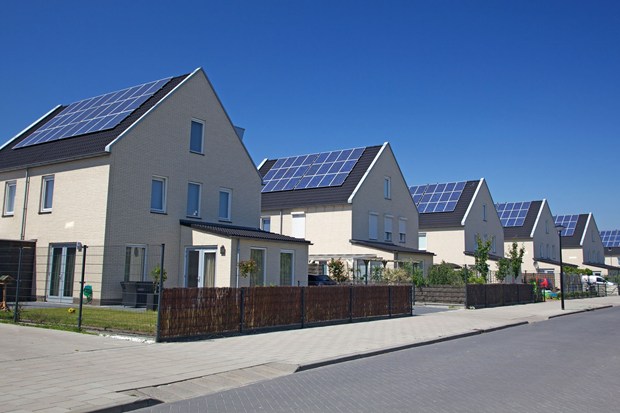 Guardian 12th Aug 2017, If you want solar photovoltaic panels on your home but don’t have the money for them, EDF Energy is offering to install a free system – complete with
storage batteries – if you agree to buy the subsidised power it generates
for 20 years.
The French-owned energy giant is looking for 100 homes to
trial its Sunplug scheme, which is being offered in conjunction with
established solar supplier Lightsource. To sign up you need to have a
large, unshaded south-facing roof at a pitch of about 45 degrees. If you
are accepted, the company will install the largest solar panel system the
roof can take – a 16-panel setup will generate 4kW – plus an LG storage
battery that lets you use the power that’s generated during the day in the
evening.
In return, EDF gets to keep the feed-in tariff paid by the
government, which is worth about £150 a year. It also keeps the export
tariff – around £50 a year. The householder is contractually bound to
pay Sunplug 9.9p per kilowatt hour for each unit of electricity they use
from the panels and battery.
This is a little cheaper than what you would pay if you bought green electricity from the grid. For example, green
supplier Good Energy charges 15.5p, with a standing charge averaging 26p a
day. The advantage could come in future years as the price demanded by
Sunplug can only rise by the retail prices index or 2.5% – whichever is
lower.
If the price of grid electricity rises substantially over the next
20 years, users will make considerable savings. However, if they don’t,
some users will be left wondering why they bothered, not least because they
have to have the system inspected each year, which will cost about £80. So
this scheme is likely to appeal to anyone who wants green electricity at
fixed prices over the next two decades.
The other significant benefit comes at the end of the 20-year term, when the householder is given ownership of
the system, which should continue to generate substantial free power. So
what’s the Money verdict? Solar PV systems are still a good investment if
you have the money upfront, the right roof and location, and if you plan to
stay in the house for a long time. The case for the free Sunplug deal is
less clear. To us, it looks too heavily weighted in favour of the company.
If it offered some free electricity each day or other incentives, that
would make the scheme more attractive.
https://www.theguardian.com/money/2017/aug/12/edf-free-solar-panels-buy-power-generated-20-years
Big savings for UK homes that install solar and storage technologies
 Solar Power Portal 10th Aug 2017, Installing solar and storage technologies into homes could save them as
much as £600 each year on their fuel bills, a new study has found.
The report, released by Swansea University’s Specific Innovation and
Knowledge Centre, claims that an integrated system comprising solar PV roof
installations, battery storage and solar heat collection technology on
south-facing walls could cut energy consumption by more than 60%.
The findings are backed up by a working demonstration project completed on a
school in Swansea. The ‘Active Classroom’, as it has been dubbed, has
generated more energy than it has consumed since receiving the complete
system six months ago. https://www.solarpowerportal.co.uk/news/solar_and_storage_could_save_homes_600_each_year_new_report_finds
1 This Month
To see nuclear-related stories in greater depth and intensity – go to https://nuclearinformation.wordpress.com

-
Archives
- February 2026 (192)
- January 2026 (308)
- December 2025 (358)
- November 2025 (359)
- October 2025 (376)
- September 2025 (258)
- August 2025 (319)
- July 2025 (230)
- June 2025 (348)
- May 2025 (261)
- April 2025 (305)
- March 2025 (319)
-
Categories
- 1
- 1 NUCLEAR ISSUES
- business and costs
- climate change
- culture and arts
- ENERGY
- environment
- health
- history
- indigenous issues
- Legal
- marketing of nuclear
- media
- opposition to nuclear
- PERSONAL STORIES
- politics
- politics international
- Religion and ethics
- safety
- secrets,lies and civil liberties
- spinbuster
- technology
- Uranium
- wastes
- weapons and war
- Women
- 2 WORLD
- ACTION
- AFRICA
- Atrocities
- AUSTRALIA
- Christina's notes
- Christina's themes
- culture and arts
- Events
- Fuk 2022
- Fuk 2023
- Fukushima 2017
- Fukushima 2018
- fukushima 2019
- Fukushima 2020
- Fukushima 2021
- general
- global warming
- Humour (God we need it)
- Nuclear
- RARE EARTHS
- Reference
- resources – print
- Resources -audiovicual
- Weekly Newsletter
- World
- World Nuclear
- YouTube
-
RSS
Entries RSS
Comments RSS
 nuclear-news