Sheffield the UK’s top renewable energy producer
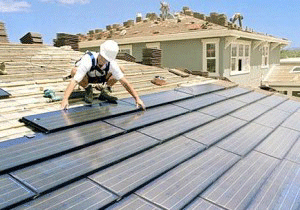 Sheffield solar power sees city top table for renewable energy installation, Steel city has added the most renewable energy production per head since introduction of feed-in tariffs last year. Sheffield shines out as the soar-away winner of the solar stakes in the UK, with more solar power generation added in the city per household than in any other British city, according to a league table published on Monday. Guardian UK, Fiona Harvey, 12 September 2011 Continue reading
160,000 US army bases to get rooftop solar panels
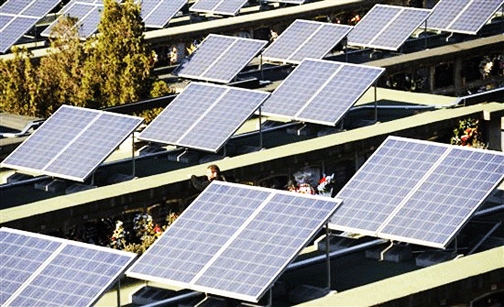 U.S. military to be largest rooftop solar customer CNet News,By: Martin LaMonica, SEPTEMBER 7, 2011d more:The Department of Energy today backed a deal to connect solar electric panels at 160,000 locations on military bases, a move which could double the number of residential solar installations in the U.S.
The DOE said it has provided a conditional commitment to guarantee a $344 million loan for the SolarStrong Project, which will help the military meet its renewable energy targets and bring solar power to a many states which now have little. SolarCity, which specializes in residential solar installation and financing, has been tapped to install, own, and operate the panels in up to 124 military bases in as many as 33 states. The five-year project will add 371 megawatts of solar capacity, bringing rooftop solar to military families’ homes as well as warehouses and administrative offices on bases.
“This is the largest domestic residential rooftop solar project in history,” Energy secretary Steven Chu said in a statement. “This groundbreaking project is expected to create hundreds of jobs for Americans and provide clean, renewable power to our military families.” SolarCity said it hopes to fill as many jobs as possible with U.S. veterans and military family members.
This deal brings a clever residential financing model to a scale never been done before. Rather than pay for rooftop solar panels, customers pay a monthly fee–either to purchase the energy produced by panels or a solar lease. The arrangement allows consumers to avoid the big upfront cost of panels and lower their monthly spending on electricity.
For the SolarStrong deal, investor U.S. Renewables Group will serve as the lead lender for the project in partnership with Bank of America Merrill Lynch. The DOE will guarantee loans provided for the residential solar installations……http://news.cnet.com/8301-11128_3-20102845-54/u.s-military-
California’s solar electricity exceeds nuclear by 6%
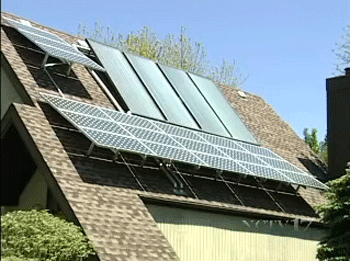 California rooftop solar installations surge; renewable energy approaches oil output, reports say, LA Times 6 July 11 Renewable sources in the U.S. are starting to produce enough energy to rival oil output, according to the federal Energy Information Administration.
Biomass and biofuels along with geothermal, solar, water and wind-power generation were responsible for nearly 12% of the country’s energy production during the first quarter of the year. That’s nearly 6% more than nuclear’s output and 77% of the amount coming from domestic crude oil, the agency said. Continue reading
Decentralised solar energy boom taking off in India
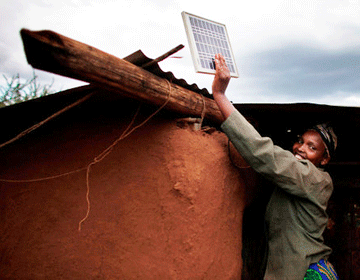 solar technology presents an elegant and immediate solution to powering everything from light bulbs and heaters to water purifiers and pumps…….most new grid capacity will be sucked up by industry, leaving little for the poor who live in off-grid desert outcrops, mountain hamlets and jungle villages like Nada. For them, the surest way to get electricity anytime soon may be to get a solar panel and make it themselves.
 Fuel for solar boom could come from rural India, where thousands give up on grid, buy panels, Washington Post, 2 July 11 “……….Across India, thousands of homes are receiving their first light through small companies and aid programs that are bypassing the central electricity grid to deliver solar panels to the rural poor. Those customers could provide the human energy that advocates of solar power have been looking for to fuel a boom in the next decade.
With 40 percent of India’s rural households lacking electricity and nearly a third of its 30 million agricultural water pumps running on subsidized diesel, “there is a huge market and a lot of potential,” said Santosh Kamath, executive director of consulting firm KPMG in India. “Decentralized solar installations are going to take off in a very big way and will probably be larger than the grid-connected segment.”…… Continue reading
Push for decentralised renewable energy to meet the needs of rural India
 “The centralised grid based approach of RGGVY has not been able to meet people’s aspirations. Rural areas have always been neglected in this energy hierarchy. Decentralised renewable energy can break this hierarchy and provide quick, reliable and sustainable power to people.
|
Decentralised solar energy racing ahead in Bangladesh
One Million Households Powered by Solar Energy – in Bangladesh ENN June 18, 2011 The number of households powered by solar energy in Bangladesh has passed the one million mark — the fastest expansion of solar power in the world, according to Bangladeshi officials. Aided by non-governmental organizations that provide low-cost loans to install solar panels, Bangladesh’s rural households — most of which are off the electricity grid — have driven a dizzying expansion of solar power in recent years. In 2002, only 7,000 households were using solar panels.
The country reached the 1 million-household milestone 18 months ahead of schedule, and by 2014 Bangladeshi officials are aiming to power 2.5 million homes with solar energy. “It’s the fastest expansion of solar energy anywhere in the world,” said Nazmul Haq, of Bangladesh’s Infrastructure Development Company.
An estimated 60 percent of Bangladesh’s 150 million people have no access to reliable electricity, and a World Bank report last month said that solar panels had “changed the face of the remote, rural areas of Bangladesh.” Bangladesh had gotten a World Bank loan in 2009 for solar energy in the country. The results are impressive! In 2002, just 2000 homes had solar systems, and now there are more than one million. Bangladesh now aims to have 2.5 million on solar by 2014…..: One Million Households Powered by Solar Energy – in Bangladesh
Small scale renewable energy is challenging big utilities
Small-scale renewable energy is more accessible to new entrants compared with the forward purchase of huge amounts of baseload generation from burning fossil fuels, which is the routine business of big utilities.
Change so far is happening slowly and from a tiny base but the cost of small-scale renewable technologies is falling.
Micro-Power Presents Slow-Burn Threat to Utilities Planet Ark: 27-May-11 SPAIN AND U.K. : Martin Roberts and Gerard Wynn A wide rollout of small-scale renewable energy poses a long-term challenge to utilities as households switch to home generation and the supply market opens, executives at green specialists and independents say. Continue reading
Solar panels plan for all new buildings in Japan
Japan ‘plans solar panels for all new buildings’, Google News, (AFP) – 23 May 11TOKYO — Japan is considering a plan that would make it compulsory for all new buildings and houses to come fitted with solar panels by 2030, a business daily said Sunday.The plan, expected to be unveiled at the upcoming G8 Summit in France, aims to show Japan’s resolve to encourage technological innovation and promote the wider use of renewable energy, the Nikkei daily said……
AFP: Japan ‘plans solar panels for all new buildings’
Decentralised solar energy a boon for local companies
“We’re recommending it to everyone,” ….. “We’ve certainly got our money’s worth.”
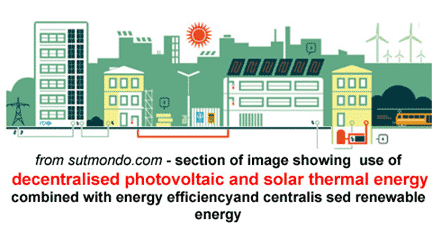
 Many local companies laud effects of renewable energy efforts By Marc Munroe DionHerald News Staff Reporter 22 May 11, FALL RIVER — It’s been 15 months since linen manufacturer Matouk, 925 Airport Road, installed about 200 solar panels atop its building, which houses the company’s offices, manufacturing space and factory store.
Matouk Controller Peter Brust said it’s been a good deal for the company. Continue reading
A good business move for Japan – from nuclear to solar?
new solutions for solar power installation in Japan’s relatively small geographic areas. “The [irradiated] agricultural land near the Fukushima power plant is no longer usable, so why don’t we convert that into solar plants?” …alculation from Japan’s National Institute of Advanced Industrial Science and Technology: “Rice produced on one hectare of land yields a yearly revenue of 1.58 million yen, while a solar plant on the same surface would generate a revenue of 7.5 million yen.”
Why Japan’s Shift Away from Nuclear Is Good for Business, TIME, By Lucy Birmingham / Tokyo Wednesday, May 18, 2011 “…….New legislation is expected to help diversify the nation’s energy portfolio. A new feed-in tariff (FIT) will oblige utility companies to buy all the power generated through renewable sources connected to a grid, at fixed, premium rates. Continue reading
Success with small scale solar energy and feed-in tariffs
“It might not seem like a lot if you look at one unit, but it’s like looking at ants,” ….. “If you look at one at a time, they seem tiny, but they build up into a large population.”
Green energy from city skylines, nwi.com, 15 May 11, While large wind and solar farms catch grief from nearby residents, engineers and designers have created ways to incorporate renewable energy systems into city skylines, including Chicago’s.
Across the United States, renewable energy developers are supplementing energy grids more discreetly, more affordably and on an urban-friendly scale. Continue reading
Decentralised renewable energy – the way of the future
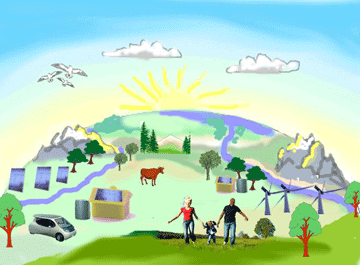 small and medium scale solar power has the potential to become the Internet of distributed electricity generation – a network resilient to a single point of failure; whether caused by natural disasters or attack by hostile parties.
Centralised Vs. Decentralised Solar Power Renewable Energy News, by Energy Matters, 28 April11, As the U.S. begins a major push to become the leading player in the global solar revolution, the topic of sprawling solar farms built away from communities vs. small and medium scale solar arrays utilising rooftops and smaller parcels of already developed or degraded land is becoming an increasingly important issue. Continue reading
The power of community decentralised renewable energy
Reach Clean Energy Goals Faster and Cheaper With Community Power, Renewable Energy World, By John Farrell , 25 April 2011 Reaching our renewable energy goals can be met cost-effectively, more quickly, and with greater economics benefits if Californians focus on decentralized renewable energy.
That’s the powerful conclusion in the recently released report, Community Power: Decentralized Renewable Energy in California, and the lessons are applicable in every state across America. These lessons are attracting attention, as large-scale desert solar projects and new transmission lines meet stiff resistance from an increasingly broad-based opposition. The cost-competitiveness of renewable energy is not news to anyone familiar with the industry, but Weinrub shows that for the most prominent decentralized renewable energy source – solar power – decentralized production from photovoltaics (PV) has better economics than centralized solar thermal power plants. His research is reinforced by data from the California Solar Initiative that shows that large majority of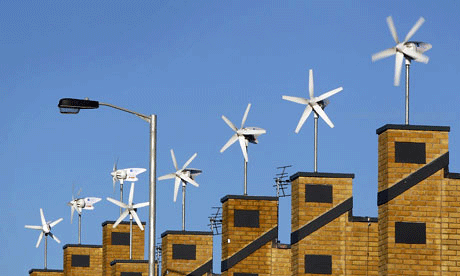 decentralized solar PV’s economies of scale are captured by projects as small as 10 kilowatts. Research from the Institute for Local Self-Reliance shows that wind economies of scale are similarly limited for larger wind projects.
Weinrub also shows that California has plenty of decentralized renewable energy potential – with rooftop solar alone – to meet its ambitious renewable energy target (33% by 2020). As he notes, the actual potential far exceeds the necessary amount required to meet the state standard:…. http://www.renewableenergyworld.com/rea/blog/post/2011/04/reach-clean-energy-goals-faster-and-cheaper-with-community-power
Distributed energy makes more sense than nuclear, or any centralised system
there are also massive losses of energy as we step it down from the plant to the grid to our homes and buildings. Instead, why not build a far more distributed energy system (or at least invest only in distributed energy going forward)?
Does nuclear power make sense?, Huffington Post, 22 march 11 Who really knows what the outcome might be from the frightening breakdown of the Fukushima Daiichi Nuclear Plant ( the radioactive releases could go on for months)? But the speculation about what this means for a much-touted nuclear “renaissance” in the U.S. began in earnest last week. As the New York Times reported, “U.S. Nuclear Industry Faces New Uncertainty.”…. Continue reading
Scotland’s farmers to benefit financially from community renewable energy
The money will go into the government’s existing Communities and Renewable Energy Scheme Loan Fund, which, from April, will be opened up to farmers and land managers for the first time.
Funding boost for Scottish renewables -Farmers Weekly, Paul Spackman 18 February 2011 Development of renewable energy schemes in rural Scotland has been boosted by £2.4m of funding from the Scottish Government. Continue reading
1 This Month
29 Jan. Thursday 7-8 p.m. Webinar – World’s Largest Nuclear Station in Port Hope, ON?


31st January – Challenging the War Machine – a DECLASSIFIED UK SUMMIT


Website of the Week
Now until to February 10, 2026 Radioactive waste storage in France: the debate is finally open! How to participate?
-
Archives
- January 2026 (246)
- December 2025 (358)
- November 2025 (359)
- October 2025 (376)
- September 2025 (258)
- August 2025 (319)
- July 2025 (230)
- June 2025 (348)
- May 2025 (261)
- April 2025 (305)
- March 2025 (319)
- February 2025 (234)
-
Categories
- 1
- 1 NUCLEAR ISSUES
- business and costs
- climate change
- culture and arts
- ENERGY
- environment
- health
- history
- indigenous issues
- Legal
- marketing of nuclear
- media
- opposition to nuclear
- PERSONAL STORIES
- politics
- politics international
- Religion and ethics
- safety
- secrets,lies and civil liberties
- spinbuster
- technology
- Uranium
- wastes
- weapons and war
- Women
- 2 WORLD
- ACTION
- AFRICA
- Atrocities
- AUSTRALIA
- Christina's notes
- Christina's themes
- culture and arts
- Events
- Fuk 2022
- Fuk 2023
- Fukushima 2017
- Fukushima 2018
- fukushima 2019
- Fukushima 2020
- Fukushima 2021
- general
- global warming
- Humour (God we need it)
- Nuclear
- RARE EARTHS
- Reference
- resources – print
- Resources -audiovicual
- Weekly Newsletter
- World
- World Nuclear
- YouTube
-
RSS
Entries RSS
Comments RSS
 nuclear-news