Asia and Pacific powering ahead with decentralised renewable eneergy
The Asian Development Bank (ADB), United Nations Economic and Social Commission for Asia and the Pacific (ESCAP) and the United Nations Environment Program (UNEP) released the report “Green Growth, Resources, and Resilience” this week.
 On the road to green economies, Malaya Business Insights, 24 Feb12, Net metering is empowering electric consumers in the Philippines. The scheme is embodied in the Philippines’ Renewable Energy Act of 2008 – considered to be the most comprehensive renewable energy law in Southeast Asia.
It allows electric consumers to sell power to the grid at an approved feed-in tariff and buy power as necessary at the normal retail tariff. The feed-in tariff will provide a guaranteed fixed price for at least 12 years for electricity produced from emerging renewable resources: wind, solar power, ocean, run-of-river hydropower, and biomass.
With net metering, the consumer generates electricity at the point of use, and is able to supply excess electricity generated into the grid, either earning revenue or reducing net payable consumption.
Net metering provides a regulatory basis for distributed and decentralized energy systems and at the same time provides a powerful incentive for end-use efficiency improvements. Net metering can be combined with feed-in-tariffs to promote renewable energy generation in decentralized applications. Continue reading
Growing number of small decentralised renewable energy projects
Smaller, renewable energy projects setting roots across west central Minnesota It’s hard to miss the development of renewable energy at the University of Minnesota campus in Morris. What can be more difficult to see, but no less significant, is the growing number and variety of smaller renewable energy projects setting roots all around the region. Morris Sun Tribune, By: Tom Cherveny, West Central Tribune WILLMAR, Minn. 21 Feb 12, – It’s hard to miss the development of renewable energy at the University of Minnesota campus in Morris.
There are now two, 1.6-megawatt wind generators towering over the prairie and cranking out enough kilowatts to provide 60 percent of the electrical needs on campus. A heating system utilizing locally harvested biomass produces 25 percent of the thermal energy required on campus, with expectations of meeting 50 percent of needs next year.
What can be more difficult to see, but no less significant, is the growing number and variety of smaller renewable energy projects setting roots all around the region. In recent years 17 different “net metering” projects have been added by customers on the Kandiyohi Power Cooperative’s distribution grid, for example. Using small wind generators or solar photovoltaic panels, customers are producing a portion of their own electricity and selling any excess back to the grid.
Renewable energy systems of all types — from small wind generators to methane digesters — are being installed on farms, homes and businesses throughout southwestern Minnesota. Participants from throughout western Minnesota gathered recently at the Prairie Woods Environmental Learning Center to identify the projects and to help chart the way for more….. http://www.morrissuntribune.com/event/article/id/27223/
Decentralised renewable energy taking off in Britain’s small businesses
 London Small and Medium Enterprises plan to generate their own renewable energy – and one in eight already do London Loves Business 20 February 2012 A number of London’s SMEs have invested in generating their own energy and even more plan to follow within the next five years, according to a survey.
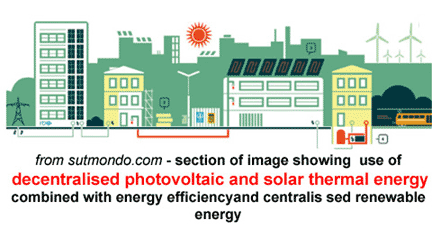
About 13 per cent of the capital’s small and medium-sized firms now generate at least some of their own energy, higher than the national average of six per cent, Opus Energy’s research found.
The amount of SMEs based in London that could be producing their own energy by 2017 is set to rise to 38 per cent, if they carry out investment plans. One in 10 of London’s firms said they hoped to start generating renewable power on their business’ premises within the next
12 months…. http://www.londonlovesbusiness.com/news/london-firms-plan-to-generate-renewable-power/1737.article
Great potential for decentralised solar and wind energy in Kenya
Kenya receives an estimated 4 to 6 kWh per square meter per day of solar insolation, equivalent to about 300 million tonnes of oil according to African Energy Policy Research Network 2004.
Kenya has one of the best wind resources in the world averaging between 3 and 10m/s with northern Kenya recording speeds of up to 11m/s.
 Innovation and Diversification Are Key for Kenya’s Renewable Energy Industry, Renewable Energy World, By Peter Kahare, February 20, 2012 KENYA — Decentralizing and diversifying renewable energy power generation technologies could be the panacea to save Kenyans from unreliable and expensive power supplied by hydro and thermal power generation, a recent study has found.
The new study by Christian Aid, an international agency that seeks solutions to chronic poverty in various nations says that empowering communities in rural areas in Kenya to produce power through renewable, cleaner sources could reduce overreliance on hydropower and fully exploit the renewable energy potential while offering opportunity to unlock economic growth. Participation of local communities in renewable energy technology projects such as
small/micro hydro, wind, solar, bagasse cogeneration and improved stoves could increase energy security and mitigate against climate change effects that badly affect the hydro power generation technology,” says Alison Doig, the report’s lead author and senior climate change advisor at Christian aid. Continue reading
Decentralised solar power saving money in USA schools
70 Percent Of Energy Needs Met Via Solar Power, Earth Techling, by Kristy Hessman, February 7th, 2012 Solar panels are popping up on school campuses across the nation as financial incentives become more readily available for schools that implement renewable energy as a way to offset their energy costs. In Arizona, Constellation Energy and Buckeye Union High School District have just completed a 4.3-megawatt solar generation project. The project will provide up to 70 percent of the electricity needs for three area high schools. Buckeye Union High School and Youngker High School in Buckeye and Estrella Foothills High School in Goodyear will be the recipients of the new renewable energy. The school district has agreed to purchase and receive all of the electricity generated by the solar panels at a fixed rate from Constellation Energy under a 25-year deal.
The solar power systems include 15,468 photovoltaic panels on 29 carport rooftops and two ground-mounted installations. The project is expected to generate more than 7 million kilowatt-hours of electricity per year. That equals a savings of more than 3,875 metric tons of carbon dioxide, or the equivalent emissions from 760 passenger vehicles annually, according to U.S. EPA data for the Arizona region.
“We’re pleased to celebrate the addition of three solar installations in our school district,” Beverly Hurley, superintendent of Buckeye Union High School District, said in a statement. “This addition will play an important role in meeting the district’s electricity needs and will serve as an educational tool for our students to learn about solar energy production.”
The installations, were developed by GV Enterprises and REgeneration Finance and built by CORE Construction. The project was coordinated with help from the Arizona Corporation Commission-approved APS Renewable Energy Incentive Program. The program offers financial incentives, covering up to 40 percent of the installation costs, to customers who add renewable energy systems to their homes or businesses. http://www.earthtechling.com/2012/02/schools-go-solar-in-arizona-of-all-places/
Solar energy for e-books, iPad, iPhone, other mobile phones and USB devices
 Solar Panel Cover For The Kindle E-reader, by Energy Matters, 9 Jan 12 Using solar energy to provide power for hand-held devices has huge potential and while solar panels embedded in mobile phones mightn’t be much chop (yet) in terms of performance; it seems a new solar cover for the Kindle e-reader delivers.
The SolarKindle, weighing just 215 grams, incorporates a flexible, lightweight triple junction amorphous solar panel and is able to provide some level of charging even in the shade. A one hour charge in direct sunlight can provide almost three days worth of reading time according to the company that created the device, SolarFocus Technology.
After fully charging the Kindle, the solar panel automatically switches to charge the SolarKindle’s 1500mA reserve battery. A fully charged reserve battery requires around eight hours of direct sunlight and provides up to 80% of backup power to the Kindle.
……. sticking your SolarKindle enshrouded e-reader out in the sun on a 40 degree day for extended periods may be unwise.
The SolarKindle also incorporates an 800 lux LED reading lamp. If the reserve battery is used for lighting alone, it can power the light for up to 50 hours. An LED indicator incorporated in the SolarKindle shows battery power level and status of charging and discharging.
The SolarKindle can be purchased online for around AUD $80, plus delivery.
SolarFocus was named an International CES Innovations 2012 Design and Engineering Awards Honoree for its SolarKindle Lighted Cover. The company says it holds several solar technology patents with their products used in extreme environments such as the Himalayas and the North Pole.
SolarFocus also manufactures a folding solar charger for the iPad, iPhone, other mobile phones and USB devices called the SolarMio Pro. While certainly not as compact as the embedded solar panel Nokia recently trialed, the 5 watt SolarMio Pro watt system can provide 6 hours of talk time on the iPhone 3Gs with just an hour of solar charging.. http://www.energymatters.com.au/index.php?main_page=news_article&article_id=1972
In UK’s slow economy, renewable energy is coming up trumps
 Renewable energy boosts UK economy by £2.5bn Renewable Energy Focus, 02 January 2012 Figures from the UK Department of Energy and Climate Change (DECC) show that companies have announced plans for almost £2.5 billion worth of renewable energy investment in the UK, with the potential to create almost 12,000 jobs, so far in the financial year 2011/12. By Kari Williamson
A separate report to the European Commission on renewable energy progress, shows that the UK:
Achieved a 27% increase in renewable energy consumption from 42.6 TWh in 2008 to 54 TWh in 2010 – representing 3.3% of total energy consumed;
Increased wind generation by 46% from 7 TWh in 2008 to 10.2 TWh in 2010, and in 2010 achieved 5 GW of offshore and onshore wind capacity; and
Saw a threefold increase in the use of biofuels in transport from 1% of total road transport fuel supply in 2007/8 to 3.33% in 2010……
Renewable energy saves £84 per person annually Continue reading
Farmers can provide renewable energy along with agriculture
 Farmers, fishermen and food processing businesses have opportunities to install technologies to generate wind power, solar power, micro-hydropower.
in remote rural areas without access to the electricity grid, autonomous renewable energy systems are competitive because they allow users to avoid the high expenses in connecting to the grid.
Clean and green farming is feasible, Malaya Business Insights, 23 Dec 11 REDUCING the dependence of food systems on fossil fuels by using renewable energy is feasible. Renewable energy can also be used for transporting raw food feedstocks, processing food, distributing finished products and cooking.
In poor countries, renewable energy presents opportunities to provide much needed basic energy services such as in post-harvest stages that are important for reducing food losses. In Sri Lanka, for example, wood biomass is being used to dry spices. Continue reading
Direct current (DC) the way of the future, with renewable energy
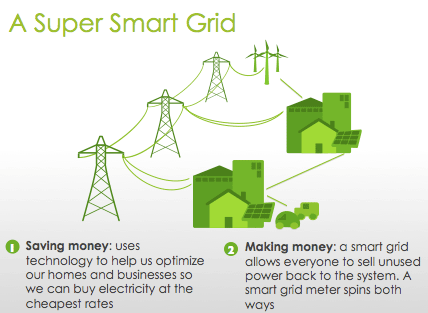 The main factor driving demand is the need to conserve energy and produce more of it from renewable sources. Alternating current is generated by rotating engines, but renewable sources such as wind and solar produce DC power.
DC can now be transmitted at high voltage over very long distances, longer than AC. It can be easily used in cables, over ground or under the sea.
“I’d put my money on the sun and solar energy,” – [Edison said]
 Insight: How renewable energy may be Edison’s revenge, Reuters, By Sara Ledwith LONDON | Tue Dec 20, 2011 “……The American inventor, who made the incandescent light bulb viable for the mass market, also built the world’s first electrical distribution system, in New York, using “direct current” electricity. DC’s disadvantage was that it couldn’t carry power beyond a few blocks. His Serbian-born rival Tesla, who at one stage worked with Edison, figured out how to send “alternating current” through transformers to enable it to step up the voltage for transmission over longer distances……
from the late 1800s, AC became the accepted form to carry electricity in mains systems. For most of the last century, the power that has reached the sockets in our homes and businesses is alternating current.
Now DC is making a comeback, becoming a promising money-spinner in renewable or high-security energy projects. From data centers to long-distance power lines and backup power supplies, direct current is proving useful in thousands of projects worldwide… Continue reading
Small scale Wind- Solar hybrid system powering a whole village
Nepal’s Dhaubadi turns Asia’s first ‘renewable energy village’, Times of India Dec 17, 2011, |KATHMANDU: Dhaubadi, in remote Nepal has become Asia’s first ‘renewable energy village’ with the installation of mini wind-solar hybrid power system with the financial and technical support from ADB.
The two sets of 5 kw wind turbines complimented by 2 kwp of solar PV panels can generate 43.6 kwh per day electricity which can light 46 households of the village, according the Asian Development Bank country office in Nepal. The installation of this ultra-modern facility will allow women to cook and clean, and children to study or play after dark, ADB says in a press release issued at a function today.
The villagers are now able to see television, charge their cell phone sets, operate computers and read at night with the help of the wind-solar power system. Erecting greenhouses to absorb solar energy and manage water uses for high-value cash crop and vegetable production is also being planned which will augment income generation activities in the village community.
Energy fuels economic growth and poverty reduction. Reliable and efficient energy services underpin the expansion of economic and employment opportunities, the continuing progress in social development, and the sustained improvement in standard of living, observed S Hafeez Rahman, ADB’s director general for South Asia Development.
The Wind-Solar hybrid system was installed under ADB’s regional technical assistance (RETA) for Effective Development of Distributed Small Wind Power System in Asian Rural Areas of with the Alternative Energy Promotion Centre of the Ministry of Environment is the implementing agency in Nepal. The USD 3.8 million RETA will contribute to ADB’s Energy for All initiative by increasing access to energy in remote rural areas.
In view of the Nepal’s chronic energy shortage and its abundant wind and solar resources, as well as the government’s strong commitment towards a low-carbon economy, ADB has selected Nepal as the first pilot country for its small wind power initiative.
The lessons learnt from Nepal on the deployment of small wind power system in rural areas will be very useful in scaling up the systems in Nepal and replicating in other ADB member countries, said Kangbin Zheng, ADB’s senior investment specialist. Articles.timesofindia.indiatimes.com/2011-12-17/developmental-issues/30528393_1_s-hafeez-rahman-solar-energy-small-wind-power
Fukushima residents learn at first hand the success of renewable energy projects
“It is important for the Japanese to realize that renewable energy can work on a large scale, and that people can make money from it,” said Yamamoto,
 Fukushima residents tour German renewable
  village; learn about non-nuclear energy sources Washington Post, By Associated Press, November 30 FELDHEIM, Germany — A group of residents from the radiation-stricken area around Japan’s tsunami-hit nuclear reactors and a Tokyo actor are visiting Germany to learn how renewable energy could work in their
homeland…..
The group, organized and led by representatives of Greenpeace Japan, arrived Wednesday in the northeastern German village of Feldheim to learn how its 145 residents have taken advantage of the energy generated by a nearby windfarm and a biofuel plant that burns the
waste from a local pig farm to become an entirely self-sustaining, energy-positive village….. Continue reading
Small is economic, as well as beautiful – renewable energy developments
And will the rest of Europe follow? The poll-leading Socialists in France, after all, are talking of halving the country’s nuclear capacity. “Most of the world will follow this way, but it will be slow,” Dudenhauser says. “Everyone expected blackouts after the nuclear shutdown, but it didn’t happen. But it would not be manageable if everyone goes Germany’s way in the next two years.”
 Size not a factor in German power play , Climate Spectator, GilesParkinson, 24 Nov 11 It seems strange that the world’s most cautious and best performing economy should be acting as some sort of crash test dummy for the world’s clean energy future. But this is exactly the position that Germany finds itself in following its commitment earlier this year to abandon nuclear energy and to push towards its vision of a fully renewable power supply by 2050.
And if this is the future, then companies that have based their models around the principal of centralised power stations may find little cause for comfort. But it is presenting enormous opportunities for those focused on the concept of distributed generation, particularly fuel cells – at least that’s the take of Roman Dudenhausen, the CEO and co-founder of German energy consultants ConEnergy, and a recently appointed director to the board of Australia’s Ceramic Fuels Cells.
Dudenhausen says the accelerated phase-out of Germany’s nuclear capacity is presenting companies such as Ceramic with a unique opportunity…… Continue reading
David Crane, CEO of NRG Energy spells it out on decentralised renewable energy
A Power Company President Ties His Future to Green Energy ENVIRONMENT 360 09 NOV 2011: INTERVIEW David Crane, the CEO of one of the nation’s largest electric companies, has become a leading proponent of renewable energy. In an interview with Yale Environment 360, he explains how, in the face of government paralysis, the private sector can help lead the shift away from fossil fuels.
Florida schools save money while kids manage mini solar power plants
The systems also will be used year-round to save schools an estimated $1,200 a year in electricity costs. Schools are already thrilled with the educational prospects.
the newest program has created several much-needed small-business and contractor jobs.
 Solar power is coming to a school near you, $10 million federal project will be educational, ease utility costs By Erica Rodriguez, Orlando Sentinel, November 3, 2011 Schoolchildren across Florida will soon be managing mini solar-energy power plants this fall designed to ease utility costs, educate kids and supply campuses with power during natural disasters. Continue reading
Solar power could solve Texas’ electricity problems
The fastest way to shore up the Texas electrical grid is with home-generated solar electricity….
The real advantage to solar power is that it can be added to the grid as it is installed — in a matter of weeks or months. Solar power would not require water for cooling and would not harm the environment.
Solar power could fill energy needs, use less water, Standard Times San Angelo, Larry Payne, October 5, 2011 An editorial in the Texas Co-op Magazine says Texas came close to electrical shutdown on two occasions this year. The first was in February when we had an abnormal cold spell. The second was during the record-setting hot spell in August when all air-conditioners were running 24/7. The article goes on to say that the drought has made the problem worse, causing some plants to be hobbled by lack of water to cool their turbines.
Current Texas energy plans call for two new nuclear plants and a coal-fired plant to be built in South Texas near Bay City. These plants cost billions, are bad for the environment and take years to get on line. They also will require massive amounts of cooling water and that would most likely need to come from the Highland Lakes via the Colorado River. Continue reading
1 This Month
29 Jan. Thursday 7-8 p.m. Webinar – World’s Largest Nuclear Station in Port Hope, ON?


31st January – Challenging the War Machine – a DECLASSIFIED UK SUMMIT


Website of the Week
Now until to February 10, 2026 Radioactive waste storage in France: the debate is finally open! How to participate?
-
Archives
- January 2026 (246)
- December 2025 (358)
- November 2025 (359)
- October 2025 (376)
- September 2025 (258)
- August 2025 (319)
- July 2025 (230)
- June 2025 (348)
- May 2025 (261)
- April 2025 (305)
- March 2025 (319)
- February 2025 (234)
-
Categories
- 1
- 1 NUCLEAR ISSUES
- business and costs
- climate change
- culture and arts
- ENERGY
- environment
- health
- history
- indigenous issues
- Legal
- marketing of nuclear
- media
- opposition to nuclear
- PERSONAL STORIES
- politics
- politics international
- Religion and ethics
- safety
- secrets,lies and civil liberties
- spinbuster
- technology
- Uranium
- wastes
- weapons and war
- Women
- 2 WORLD
- ACTION
- AFRICA
- Atrocities
- AUSTRALIA
- Christina's notes
- Christina's themes
- culture and arts
- Events
- Fuk 2022
- Fuk 2023
- Fukushima 2017
- Fukushima 2018
- fukushima 2019
- Fukushima 2020
- Fukushima 2021
- general
- global warming
- Humour (God we need it)
- Nuclear
- RARE EARTHS
- Reference
- resources – print
- Resources -audiovicual
- Weekly Newsletter
- World
- World Nuclear
- YouTube
-
RSS
Entries RSS
Comments RSS
 nuclear-news