EBay’s revolutionary new renewable energy powered data centre
eBay Commits to Renewable Energy for Next Data Center PC Magazine, By Stephanie Mlot June 21, 2012 EBay is continuing its green business initiatives by building the next phase of the company’s data center primarily using renewable energy.
In partnership with Bloom Energy, eBay will build the country’s largest non-utility fuel cell installation. Though renewable energy typically supplements an electric grid, eBay is building the energy source into its core, incorporating 30 Bloom Energy servers into the
new center’s architecture.
“We believe the future of commerce can be greener,” eBay president and CEO John Donahoe said in a statement. The six-megawatt Bloom installation is being designed and engineered
as part of eBay’s expanded data center in Utah, and will be installed a few hundred feet from the building. Expected to be fully functional by mid-2013, each of the 30 energy servers will generate 1.75 million kilowatt hours of electricity annually, a press release said….. http://www.pcmag.com/article2/0,2817,2406136,00.asp
Boost for solar power in Japan
Odawara, a city of 200,000 south of Tokyo, is setting up its own power company that will install solar panels at public facilities and sell electricity to Tokyo Electric Power Co
Residents who want to install panels on their homes will also get subsidies..
 Japan approves renewable subsidies in shift from nuclear power, Malaysian Insider, TOKYO, June 18 — Japan approved today incentives for renewable energy that
  could unleash billions of dollars in clean-energy investment and help the world’s third-biggest economy shift away from a reliance on nuclear power after the Fukushima disaster.
Industry Minister Yukio Edano approved the introduction of feed-in tariffs (FIT), which means higher rates will be paid for renewable energy. The move could expand revenue from renewable generation and related equipment to more than $30 billion (RM90 billion) by 2016, brokerage CLSA estimates. Continue reading
Solar street lights for Indian city
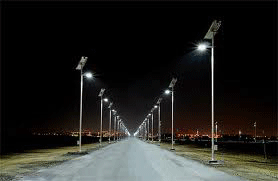
 Solar power for streets, Deccan Chromicle, June 16, 2012 By Kiran Tom Sajan | Smitha T he city’s roads will be soon dotted with solar and wind energy powered street lights. The city corporation is in talks with a private agency for installing street lights using solar and wind energy.
To begin with, plans are afoot to install energy-efficient lights on the Edappally railway overbridge (RoB) and on Chathiyath Road….. The corporation has adopted a policy in favour of energy saving and measures like installing solar street lights will be taken for energy conservation, the mayor added.
According to experts, wind could be a potential energy source that could be used to power even homes and businesses. Earlier, the civic body has decided to install energy-efficient street lights on selected stretches of the roads in the city. It has invited tenders for installing energy saving LED lights along the MG Road and Marine Drive.
The ministry of new and renewable energy has recently included the city in its ‘solar city’ programme, which aims at promoting the use of renewable energy in urban
areas.http://www.deccanchronicle.com/channels/cities/kochi/solar-power-streets-028
Storage of solar energy at home
In a test building, they were able to increase “own consumption” – solar power used directly within the household without being exported to the grid
 Home Solar Power Storage — Another Option Clean Technica, JUNE 15, 2012 BY ZACHARY SHAHAN In addition to the home storage option recently announced by Panasonic, below is another story about a some storage option that could greatly benefit those with cheap solar power on their rooftops in Germany (and some other locations). This is a full repost from the awesome site Renewables Continue reading
Renewable energy pledge of the small Pacific island nations
Pacific pledge to switch to renewable energy, June 15, 2012 http://www.abc.net.au/news/2012-06-15/pacific-ministers-commit-to-renewable-energy/4006638 Pacific Island nations have pledged to dump diesel and similar fuels they use to produce energy and replace them with renewable power sources.
Tuvalu, Tokelau and Cook Islands’ leaders outlined their renewable energy targets this week. The Deputy Prime Minister of Tuvalu, Kausa Natano has told Pacific Beat the implementation of renewable energy schemes in small island states is very important. ”I think everyone’s supported the idea of energy efficiency as it will save a lot of funds from their budgets and could be used for other social developments in respective countries,” he said.
“We had some donor partners – Denmark, Norway, the United Kingdom – that actually also made the commitment to support these small island states as they move forward to try and support the transformation of their societies.”
He says donor partners – Denmark, Norway and the United Kingdom – have committed to support the small island states in their transformation.
Solar power the leader in rising renewable energy investment
 the performance of solar owed most to “booming” rooftop PV installations in Germany and Italy, as property owners took advantage of falling panel prices.
Global investment in solar power jumped 52% in 2011: Report Startup Smart, By Michelle Hammond, 13 June 2012 Global investment in the renewable energy sector surged by 17% to a record $257 billion in 2011, a new report reveals, while total investment in solar power jumped by a whopping 52%. Continue reading
Solar panels for IKEA’s buildings in China
 IKEA To Use Solar Power on Buildings in China, Market Watch, June 12, 2012, IKEA Group partners with Hanergy to install solar panels on IKEA buildings BEIJING, Jun 12, 2012 (BUSINESS WIRE) — IKEA Group today announced that, as part of its goal to only use renewable energy to power its buildings, it will partner with Hanergy, one of China’s leading clean energy companies, to install solar photovoltaic panels on IKEA owned buildings in China. Continue reading
Solar energy brings clean drinking water to 10,000 Indian villages
A solar energy based drinking water supply system has already changed lives of villagers in naxal affected Gadchiroli district of Maharashtra where solar energy based dual pump piped water supply system has been installed.
 10,000 Naxal villages to get 24 into 7 water supply, courtesy solar http://www.hindustantimes.com/India-news/NewDelhi/10-000-Naxal-villages-to-get-24-into-7-water-supply-courtesy-solar/Article1-868921.aspx Chetan Chauhan, Hindustan Times New Delhi, June 10, 2012 You in India’s top cities may envy around one-fifth of total villages in 78 naxal affected districts set to get around the clock tap water supply, courtsey solar energy. Three Central government ministries — New and Renewable Energy, Drinking
Water and Sanitation and Finance — have come together to provide 24 into 7 clean drinking water to 10,000 villages in the Naxal affected districts under the Integrated Action Plan of the Central government. Continue reading
Decentralised solar energy is transforming the economics of providing electricity
One of the reasons why the German government has reversed its decision in the energy changeover. It wants to give the companies more time to get out of their old investments and enter new ones.
The conventional energy industry will have to adapt to a more decentralized energy supply system very soon.
 Photovoltaic solar energy may get even cheaper, Reve, June 11, 2012 What does the trend towards cheaper solar electricity mean for the energy industry? Interview: Gero Rueter / nh. Editor: Sean Sinico. www.dw.de
For the conventional energy industry it means a change of paradigm, that’s for sure. It’s something you can see very clearly when you look at the statements made by Germany’s big energy suppliers lately. When he retired, Jürgen Großmann, former CEO of Essen-based RWE, said photovoltaics essentially ruin the business for the conventional energy industry, because they’re pushing the prices down on the energy stock markets.
A member of E.ON’s executive board said a couple of days ago that building power plants in Germany is no longer financially viable because of the economic framework conditions, with renewable energies advancing fast and forcing down prices. Continue reading
African and Islander nations going for small scale, off-grid, renewable technology
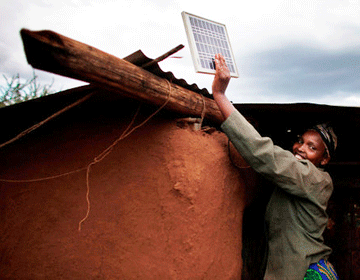 Africa: First African Renewable Energy Confab in Accra All Africa, BY AYUUREYISIYA KAPINI ATAFORI, 8 JUNE 2012 “….Off-grid technology is extremely important throughout Africa with many of the continent?s inhabitants without access to the grid.
…….A pioneering role in renewable energy development in Africa has been taken by Cape Verde. The West African islands have set a goal of 50 per cent renewable energy by 2020. Abrao Andrade Lopez, Director General of the Ministry of Industry and Energy, announced that the country was currently running a study to explore how to achieve 100 per cent renewable energy.
In a related development, decreasing dependency on oil imports encouraged 39 of the small island developing states (SIDS) in Africa, the Caribbean, the Indian Ocean and the Pacific to meet in Barbados to work out energy efficiency plans.
Islands like Tonga and Tokelau plan to become fully energy independent by 2013, and others are following suit. The small island developing states are writing the stories of their future, said Veerle Vandeweerd, Director of Environment and Energy at the United Nations Development Programme (UNDP). Continue reading
India’s solar-powered buses
Apoorva Renewable Energy to make solar-electric buses for transport body Business Line, BANGALORE, JUNE 8: Buses in Bangalore may soon be powered by solar energy. The Bangalore Metropolitan Transport Corporation (BMTC) has placed orders with Apoorva Renewable Energy Products to design solar-electric hybrid buses, the company CEO, Mr Suresh Babu, said on the sidelines of the Global Investors Meet 2012.
“The BMTC has asked us to provide a sample hybrid vehicle and we have accepted the order and will start working on it,” Mr Babu said. Several other government bodies such as the Bruhat Bengaluru Mahanagara Palike (BBMP) are in talks with the company too, he said.
The company makes three-wheeled vehicles powered by electric and solar power, and customises products for Indian conditions. “Using a common technology, we design products as per customer requirements and outsource the manufacturing,” Mr Babu said.
EXPORTS Currently, the company’s vehicles are used in Delhi and parts of Karnataka and it will start exporting in two months from now….. http://www.thehindubusinessline.com/companies/article3505672.ece
Distributed solar energy plan launched in the Philippines
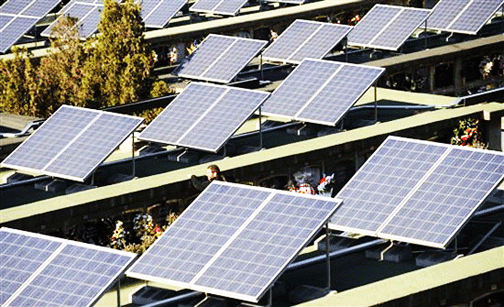 Such facilities in the Philippines should be installed mostly on rooftops because there is a lot of arable and productive land which should be used for food production rather than for solar power generation,
Rooftop solar power project launched to prove viability, Business World, 5 June 12, THE ASIAN Development Bank (ADB) said yesterday it expects solar power capacity in the Philippines to reach up to 115 megawatts (MW) by next year, as it launched yesterday its solar rooftop facility to prove the viability of this renewable energy thrust.
The multilateral lender said it estimates most of solar projects in the country will consist of small clusters that generate lower capacities of electricity rather than large facilities. ADB installed 2,040 solar panels on its rooftop which can generate around 500 kilowatts of energy or around 613 MW a year. Continue reading
Summer days doubling solar electricity output in Britain
 Weatherwatch: long days of sunshine double electricity output http://www.guardian.co.uk/news/2012/jun/03/weatherwatch-sunshine-solar-power?newsfeed=true Paul Brown 3 June 2012 The last nine days of May saw a record production of solar power in Britain. The clear dry air meant sunlight was strong, more than doubling the daily average electricity output. Long hours of daylight are currently giving the thousands of households that invested in solar power under the original high level of subsidy considerable income. Continue reading
Solar energy projects for India’s rural areas
Solar energy to be promoted in Varanasi http://timesofindia.indiatimes.com/city/varanasi/Solar-energy-to-be-promoted-in-Varanasi/articleshow/13767724.cms Binay Singh, TNN | Jun 3, 2012, VARANASI: With the announcement of a budgetary provision of Rs 100 crore for promoting solar energy projects particularly in the rural areas of the state the authorities of New and renewable Energy Development Agency (NEDA) are optimistic about further promotion and use of solar energy in the region. Continue reading
Solar panel that follows the sun
 includes video Heliowatcher allows solar panels to track the sun http://www.earthtechling.com/2012/06/heliowatcher-allows-solar-panels-to-track-the-sun/ 4 June 12, They’re called solar panels for a reason: they need the sun in order to generate electricity. Whether we’re talking about pocket-sized, portable solar chargers or massive rooftop arrays, direct sunlight is the must-have ingredient on which all other elements of solar-energy production depends.
You might think that simply placing solar panels on a rooftop or balcony free from shade would be enough. Except there’s that small matter of Earth rotating on its axis. So throughout the day, the sun moves across the sky, cutting into the efficiency of fixed panels. But what if the panels could automatically change their position to follow the sun and enjoy an uninterrupted flow of direct sunlight? Two electrical engineering students at Cornell are currently testing just such a technology, and it looks promising.
 Solar panel that follows the sun
As this review points out , HelioWatcher’s design is simple and effective: “The base is mounted like a Lazy Susan, able to pivot on the horizontal plane. The bottom edge of the solar panel is mounted with two door hinges, with a motorized screw jack used to raise and lower it.” Using a GPS module and magnetometer, the HelioWatcher allows the user to place the system anywhere in the world without any calibration. The HelioWatcher then calculates what the sun’s current location is and orients the panel to the appropriate angle. It also utilizes a quadrature of light-detecting diodes to correct for short-term light obstruction, such as clouds or shade.
This system is a vast improvement over other solar tracking systems that adjust position based on either a predetermined algorithm or light detection. Instead HelioWatcher combines elements of both technologies to leverage the guaranteed accuracy of a geospatial algorithm while also correcting for local or short-term changes, such as cloud cover or shade. Here’s a video, prepared by the two students, that explains the system:
1 This Month

of the week – Shut Down Drone Warfare!


Tell the Ukrainian Government to Drop Prosecution of Peace Activist Yurii Sheliazhenko

Petition to revoke the licensing of the Near Surface Nuclear Disposal Facility (NSDF) at Chalk River. https://www.ourcommons.ca/petitions/en/Petition/Details?Petition=e-7247
To see nuclear-related stories in greater depth and intensity – go to https://nuclearinformation.wordpress.com
-
Archives
- April 2026 (7)
- March 2026 (251)
- February 2026 (268)
- January 2026 (308)
- December 2025 (358)
- November 2025 (359)
- October 2025 (376)
- September 2025 (257)
- August 2025 (319)
- July 2025 (230)
- June 2025 (348)
- May 2025 (261)
-
Categories
- 1
- 1 NUCLEAR ISSUES
- business and costs
- climate change
- culture and arts
- ENERGY
- environment
- health
- history
- indigenous issues
- Legal
- marketing of nuclear
- media
- opposition to nuclear
- PERSONAL STORIES
- politics
- politics international
- Religion and ethics
- safety
- secrets,lies and civil liberties
- spinbuster
- technology
- Uranium
- wastes
- weapons and war
- Women
- 2 WORLD
- ACTION
- AFRICA
- Atrocities
- AUSTRALIA
- Christina's notes
- Christina's themes
- culture and arts
- Events
- Fuk 2022
- Fuk 2023
- Fukushima 2017
- Fukushima 2018
- fukushima 2019
- Fukushima 2020
- Fukushima 2021
- general
- global warming
- Humour (God we need it)
- Nuclear
- RARE EARTHS
- Reference
- resources – print
- Resources -audiovicual
- Weekly Newsletter
- World
- World Nuclear
- YouTube
-
RSS
Entries RSS
Comments RSS
 nuclear-news