Huge solar rooftop system completed in Denmark
Largest N. Europe Rooftop Solar Power System Using REC Panels by Energy Matters, 24 Aug 12, Renewable Energy Corporation (REC) has announced completion of the largest rooftop solar panel system in Northern Europe.
The system sits atop the headquarters of insurance company Topdanmark in Ballerup, near Copenhagen in Denmark. Completed last week, the system features 3,042 REC Peak Energy Series solar panels and has an annual production capacity of 752,000 kWh – enough to meet the needs of almost 200 households.
600 tonnes of electricity generation related carbon emissions will be avoided through the system each year…. http://www.energymatters.com.au/index.php?main_page=news_article&article_id=3353
Decentralised solar energy for a billion Indian villagers

 Solar energy offers a ray of hope http://www.thehindu.com/news/cities/Visakhapatnam/article3806664.ece RAVI P BENJAMIN TERI is engaged in setting up solar charging stations in rural and Agency areas
With a view to easing the power situation, The Energy and Resources Institute (TERI), a global NGO, is engaged in setting up Solar Charging Stations in the rural and Agency areas in collaboration with the Union Ministry of New and Renewable Energy.
As part of the MNRE mandate to popularise the tapping of solar power, TERI has been introducing solar appliances, including home lighting systems, individual lanterns, and task lights, etc, in the villages which are experiencing long hours of power-cut. TERI State coordinator V. Murthy told The Hindu that nearly 100 SCSs were being set up in rural areas in the State. Solar lights and other appliances were being supplied to every home so that villages can overcome total darkness at the time of power interruption.
The objective of SCSs is mainly to recharge batteries which can be used for four to six hours every day. TERI is engaged in supply of solar lights as well as in opening charging stations manned by a single person. The stations can charge up to 50 lights at a time. Every village will have a local entrepreneur who will supply and maintain the solar lamps.
Every nine villages will have a technical resource person who will ensure smooth functioning of the SCSs. As many as 11 stations are operating in the district and 46 more are in the process of being set up. Thirty stations are operating in Srikakulam district, four in East Godavari district, and 40 are being established. Nine stations are running in Guntur, 12 in Karimnagar, and two in Adilabad. The local people in every village take care of the entrepreneur’s salary by paying for battery recharge.
Also, the nine villages contribute Rs.300 each to take care of the technician’s salary. Local NGOs engaged in Maa Thota and coffee plantations are working with TERI. TERI, Nabard, Vikasa, Kovel Foundation, and a host of NGOs are engaged
in the solar mission of lighting a billion lives.
Australians lead the world in distributed solar energy on housetops
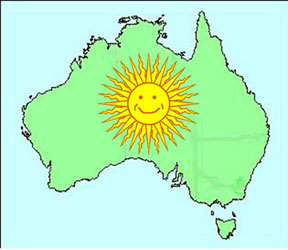 Australians lead in fitting solar panels on homes, SMH, August 18, 2012 Ben Cubby AUSTRALIANS put more household solar panel systems on their roofs than anyone else in the world last year, new data from the Clean Energy Regulator and the International Energy Agency show. The statistic astonished many in the solar industry, given Australia’s small population compared with renewable energy market leaders such as European Union countries, China, Japan and the United States. Continue reading
Pacific islands Tonga and Tokelau moving to 100% solar energy
Tonga joins Pacific solar drive to cheaper, safer, cleaner power REneweconomy By Sophie Vorrath 17 August 2012 Last week, New Zealand-based Powersmart Solar officially switched on the first of three solar power systems being installed on the South Pacific archipelago of Tokelau. As reported on RenewEconomy earlier this month, Tokelau is replacing the diesel electricity systems that have powered its three atolls with solar power systems and battery storage.
But Tokelau is not the the only South Pacific nation currently undergoing a solar transformation. The Kingdom of Tonga switched on its own maiden solar plant at the end of last month – another New Zealand-funded project that, along with the plant at Tokelau’s Fakaofo atoll, are set to be the first of many to come in the region, according to NZ Foreign Affairs Minister Murray McCully.
As is the case in Tokelau, the Tongan solar plant – Ma’ama Mai, which means “Let there be Light” – is part of a scheme to reduce the island nation’s dependence on fossil fuels and, in particular, diesel. According to reports, Tonga was consuming about 30 million litres of diesel a year; an average of about one litre every two seconds.
A collaborative effort between Tonga Power and NSW-based Meridian Energy, Ma’ama Mai’s nearly 6,000 solar panels will generate around 1MW a year, which equates to 4 per cent of electricity used on the main island of Tongatapu. For such a seemingly small amount, this will help Tonga save an estimated 470,000 litres of diesel – $NZ15 million-worth – over the 25-year-life of the plant.
According to an ABC News report, the plant was originally going to be funded by Tonga Power and the Tongan Government, but the World Bank would not loan Tonga any more funds, so New Zealand stepped in to cover the $7.9 million cost.
Already it is paying off, with the government announcing a reduction in the price Tongans pay for electricity from August 1. And this could just be the beginning – Tonga’s Minister for Public Enterprises, William Clive Edwards, says the aim is to have 50 per cent of the country’s energy to come from renewable sources by 2018; including solar, wind and biomass….. http://reneweconomy.com.au/2012/tonga-joins-pacific-solar-drive-to-cheaper-safer-cleaner-power-60042
Siddharth Malik’s success story in solar power for India
 How seven young entrepreneurs defied hurdles to develop clean renewable energy http://economictimes.indiatimes.com/news/emerging-businesses/entrepreneurs/how-seven-young-entrepreneurs-defied-hurdles-to-develop-clean-renewable-energy/ 4 AUG, 2012, SHREYA JAI,ET BUREAU articleshow/15347643.cms Renewable energy in India has always been a risky business, be it due to high input cost, unsteady market or lack of government support. But these seven young entrepreneurs defied all this and much more.
At a time when even big companies are reluctant to enter the renewable energy market due to the huge costs involved, they have come up with innovative solutions to develop clean energy, which brings down the costs and is accessible by the commons, even village folks, reports ET.
‘SWADES’ STORY IN REAL Siddharth Malik, 30 Megawatt Solutions, Delhi
AN engineering and management degree fromUniversity of Pennsylvania, a flourishing career with energy-focused companies in the US where the base package is a sinful $1,00,0000 per annum. What more can you ask for?
Well, Siddharth Malik had ideas. This passionate 30-year old left all this to come back to India and start his own renewable energy venture amalgamating high-performing solar-thermal systems with fossil fuels.
He started Megawatts Solutions in 2010, which provides concentrated solar-thermal solutions. “At least when sun is shining, fossils need not be fired,” says Malik, adding, “this simple idea creates long-term economic value for industry owners.” Its 0.5-mw pilot project in Guragon provides a hybrid solution by integrating solarthermal with fossil fuel that offers considerably higher value than stand-alone solar thermal plants.” It has resulted in up to 25% more efficient performance than competing technologies , which makes a drastic improvement in economics of solar,” adds Malik.
MS’ solutions are based on home-grown concentrated solar thermal technology and its role ranges from designing to manufacturing, installing and commissioning industrial-scale solar thermal projects. It has four projects in the pipeline including a 3 mw solar thermal heating project in Gujarat – the largest ever in India.
Decentralised solar power made poor Indian villagers the winners!
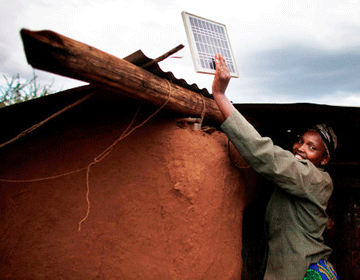 Solar Power Helped Keep the Lights On in India By David Biello | August 1, 2012 Every day, at least 400 million Indians lack access to electricity. Another nearly 700 million Indians joined their fellows inenergy poverty over the course of the last few days, or roughly 10 percent of the world’s population.
Oddly enough, some of the formerly energy poor—rural villagers throughout the subcontinent—found themselves better off than their middle-class compatriots during the recent blackouts, thanks to village homes outfitted with photovoltaic panels. In fact, solar power helped keep some electric pumps supplying water for fields parched by an erratic monsoon this year.
That monsoon is partly to blame for the blackouts as well. A lack of rain has meant a reduction in power from India’s hydroelectric dams. Pair that with problems with the supply of coal to burn and the northern half of India found itself with not enough electricity supply to meet demand. One ironic anecdote illustrates this conundrum nicely: coal miners in northern India were trapped when their electric lifts failed as a result of the blackout exacerbated by a lack of coal….. http://blogs.scientificamerican.com/observations/2012/08/01/solar-power-kept-the-lights-on-in-india/
Solar power gives energy independence to Pacific Island Tokelau
Island nation of Tokelau gets ready to go solar Gizmag, By Antonio Pasolini, July 30, 2012 Adopting renewable energy sources such as solar and wind power is a great way to reduce emissions and produce energy locally.

In places like remote Pacific islands, however, those benefits are potentially a key to independence. For that reason Tokelau, a 10 sq. km. (3.86 sq. mi) island nation that lies around 500 km (311 mi) north of Samoa and which is a territory of New Zealand, is about to ditch diesel as a source of electricity and switch to solar power. Continue reading
Solar energy panels designed specifically for Japanese roofs
Global Solar Energy Brings Powerful Building Integrated Solar to Japan’s Growing Renewable Energy Market, Clean Technica, JULY 24, 2012 BY NICHOLAS BROWN Global Solar Energy Incorporated, a manufacturer of flexible solar panels, has announced that it is entering the Japanese solar market with flexible solar panels that are designed specifically for Japanese roofs. Continue reading
It’s already happening – solar hot water, and solar energy cooling systems
According to the International Energy Agency, solar heating and cooling (SHC) could make a dramatic impact on the world’s electricity grids, providing 17 per cent of all energy required for heating in buildings, industrial processes, swimming pools, and 17 per cent of cooling needs.
 Solar cooling technologies are relatively new, and not widely deployed – only 711 systems were deployed in the world in 2011, according to the IEA …..The IEA suggests that solar cooling particularly useful in handling electricity peaks, because it produces at the time of highest demand. It says the technology is already competitive in tropical regions with high electricity costs, including a 1.47MW capacity installation installed at a college in Singapore, was reportedly fully cost competitive without subsidies.
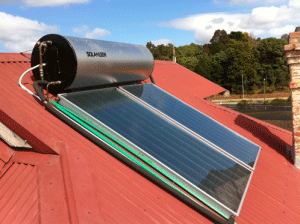 Solar Insights: Is solar hot water (and cooling) the next big thing? REneweconomy, By Giles Parkinson 19 July 2012 Amid the dramatic cost reductions and soaring demand for solar PV (photovoltaic) technologies in Australia and across the world, the long established idea of using the sun to heat water has taken a back seat. In Australia, where SHW once dominated the local rooftop industry, installations were outpointed by rooftop PV by a factor of 5 in the last year.
But now SHW it is tipped to make a return to centre stage, along with relatively new solar thermal technologies that use the sun to provide heating and cooling for office and building spaces, district heating and under-floor heating in cooler climates, as well as for industrial processes and in hybrid systems with solar PV (known at PV-T). At a larger scale, it could one day be used for water treatment and desalination. Continue reading
Decentralised renewable energy is the answer to USA electricity outages
Renewable energy sources are the answer to power outages.
http://www.baltimoresun.com/news/opinion/readersrespond/bs-ed-power-outages-20120713,0,5572931.story Brent Flickinger Much has been said about the power outages caused by recent storms, but one thing rarely mentioned is the importance of getting people off the electrical grid.
It’s a national security issue when so many people are rendered helpless in a neighborhoods because their electrical power all comes from the local utility. The government should continue to offer incentives for households to install solar panels, wind turbines or geothermal systems of whatever size. It would help if even one or two people on a block had an energy
source besides the grid.
Generators are one option, though they are noisy and still depend on fossil fuel. But renewable energy sources such as solar and wind give communities a measure of both energy independence and resilience. Our future depends on as swift a transition to renewables as possible.
An community solar energy scheme is paying off
 How a community solar scheme is turning sunshine into dollars REneweconomy, By Kelly Vaughn on 11 July 2012 Rocky Mountain Institute Years ago, a Basalt native Paul Spencer set out to build an off-grid home not far from RMI’s Snowmass office. Through the process of designing and building his house, he developed a passion for real estate, and became well versed in renewable energy technologies. He began looking into the option of a green development in the Roaring Fork Valley: super-efficient homes powered by renewable energy.
But, due to trees shading the proposed building sites, rooftop solar didn’t work. Instead, Spencer proposed to build a shared solar array that would power the neighborhood. While the development didn’t go through, the community solar concept remained.
Now, Spencer is the president and founder of Carbondale-based Clean Energy Collective (CEC) an LLC that builds, operates, and maintains community-based clean energy facilities, currently all solar PV……..
Distributed renewable energy is now a mainstream commercial factor in USA
The data submission forms the EIA uses do not catch every last TWh, and indeed, don’t include solar photovoltaic generation from systems less than 1 megawatt in size. This smaller capacity segment includes most residential and commercial distributed PV systems.
renewable energy is clearly moving beyond “niche” status. It’s a mainstream source that will increasingly challenge existing electricity generation and provision business models, particularly as distributed solutions (electric vehicles, demand response, PV, etc.) take off
 Renewable Energy Supplies 7% US Electricity, Has Anyone Noticed? SustainableBusiness.com News, by Dan Seif, Rocky Mountain Institute, 29 June 12, Between April 2011 and March 2012, the US generated 5% of its annual electricity from renewable sources, according to the Energy Information Administration (EIA).
To be exact, the US generated 204 terawatt-hours (TWh) out of 4,070 TWh from non-hydro renewables – solar, wind, geothermal, biomass and small hydro.
Putting this annual total of non-hydro renewable generation in context, this is:
More than the total electrical use of 197 nations (92% of all nations), including Indonesia, Mexico, Turkey, and Thailand.
More than the combined electrical use of the Philippines, Switzerland, and Malaysia.
Enough electrical energy to power about 16 million American homes, deducting about 10% for transmission and distribution losses. Continue reading
Affordable solar energy racing ahead in Californian homes and businesses
This list shows undeniable solar growth in a diverse range of cities, debunking the common misconception that solar is only for the wealthy,” notes Stephen Torres, founder and managing director of PV
Solar Report. “Key to this diversification is third-party-owned solar, which makes solar affordable for a wider range of homeowners.”
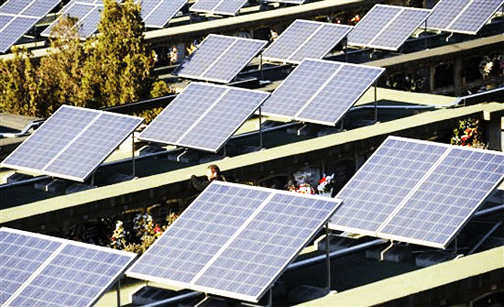
California Residential Solar Market Has Grown 80% So Far This Year http://solarindustrymag.com/e107_plugins/content/content.php?content.10611 27 June 2012 Thirteen cities helped the California residential solar market grow 80% so far this year, according to a new report from SunRun.
According to the report, the top cities reflect solar adoption in median-income communities rather than in the wealthiest areas of the state.
The high-growth cities were evaluated by percent growth through May 31 as compared to the same time frame last year. While solar adoption continues to surge in traditional solar hot beds like Fresno and Bakersfield, new solar leaders like Santa Clarita, Castaic and Palmdale are also leading the charge.
The top California cities for home solar installations were as follows: Continue reading
Bank assists Indian village communities by providing solar power
 Using solar energy to create viable livelihoods The Hindu, V. K. RAKESH REDDY , 22 June 12, Andhra Pragathi Grameena Bank uses a centrally-sponsored scheme for people in Obulapuram and surrounding villages
The sun, which is the one resource that is abundant in Anantapur district, is creating viable livelihoods for the poor of Anantapur district with visionary banking by the Andhra Pragathi Grameena Bank (APGB). Continue reading
Another long distance solar-powered flight
Solar plane makes successful flight over Moroccan desert Herald Sun, AFP June 22, 2012 A SOLAR-powered plane has completed a flight over the Moroccan desert to showcase renewable energy, as a key summit in Rio discussed “greening” the world economy. Continue reading
1 This Month

of the week – Shut Down Drone Warfare!


Tell the Ukrainian Government to Drop Prosecution of Peace Activist Yurii Sheliazhenko

Petition to revoke the licensing of the Near Surface Nuclear Disposal Facility (NSDF) at Chalk River. https://www.ourcommons.ca/petitions/en/Petition/Details?Petition=e-7247
To see nuclear-related stories in greater depth and intensity – go to https://nuclearinformation.wordpress.com
-
Archives
- April 2026 (7)
- March 2026 (251)
- February 2026 (268)
- January 2026 (308)
- December 2025 (358)
- November 2025 (359)
- October 2025 (376)
- September 2025 (257)
- August 2025 (319)
- July 2025 (230)
- June 2025 (348)
- May 2025 (261)
-
Categories
- 1
- 1 NUCLEAR ISSUES
- business and costs
- climate change
- culture and arts
- ENERGY
- environment
- health
- history
- indigenous issues
- Legal
- marketing of nuclear
- media
- opposition to nuclear
- PERSONAL STORIES
- politics
- politics international
- Religion and ethics
- safety
- secrets,lies and civil liberties
- spinbuster
- technology
- Uranium
- wastes
- weapons and war
- Women
- 2 WORLD
- ACTION
- AFRICA
- Atrocities
- AUSTRALIA
- Christina's notes
- Christina's themes
- culture and arts
- Events
- Fuk 2022
- Fuk 2023
- Fukushima 2017
- Fukushima 2018
- fukushima 2019
- Fukushima 2020
- Fukushima 2021
- general
- global warming
- Humour (God we need it)
- Nuclear
- RARE EARTHS
- Reference
- resources – print
- Resources -audiovicual
- Weekly Newsletter
- World
- World Nuclear
- YouTube
-
RSS
Entries RSS
Comments RSS
 nuclear-news