VIDEO: Award for solar wheelchair design
 VIDEO Solar Powered Wheelchair Wins Award http://www.energymatters.com.au/index.php?main_page=news_article&article_id=3758 25 May 13 A team from University of Virginia’s School of Engineering and Applied Science recently won first place in a 2012 World Cerebral Palsy Day competition for their solar powered wheelchair design.
We first reported on solar wheelchairs back in 2010, when Haidar Taleb had just begun a journey to take him across the United Arab Emirates.
Inspired by roofs on convertible cars, the lightweight solar panels on the U.Va. team’s wheelchair are retractable and don’t significantly add to its length, width, height or weight when stored. A system of hinges on both sides of the chair controls the deployment of the solar panels. The three panels have a conversion efficiency of 15% and a capacity of 160 watts. When fully deployed, the custom solar panels cover an area of over one square meter. The wheelchair can operate for more than 4.5 hours at a speed of 8 kilometres per hour on a fully charged lead acid deep cycle battery, a range increase of more than 40 percent over batteries alone. At a speed of 1.6 km/h and suitable light exposure, the wheelchair and can run “indefinitely”; without needing to utilise battery power.
Built with lightweight materials, while the system may look fragile, it has been designed to operate under conditions more extreme than would be experienced in normal use. The panels and retractable mechanisms account for less than 15% of the completed wheelchair’s unoccupied weight.
Anyone with enough physical dexterity to use a joystick can operate the chair; including retracting and deploying the solar panels. In addition to standard features common to this type of wheelchair, USB power outlets are provided that can power a wide range of small devices.
In a wonderful display of generosity, the team will use their prize money to perform some final tweaks to the chair give it the individual in Turkey who submitted the initial suggestion for a solar-powered wheelchair.
The remaining prize money will be returned to United Cerebral Palsy in support of future World CP Day competitions.
Renewable energy – Germany’s impressive export of electricity
Germany Continues to Export Power Despite Nuclear Exit http://climatecrocks.com/2013/05/21/germany-continues-to-export-power-despite-nuclear-exit/ Climate Denial Crock of the Week with Peter Sinclair May 21, 2013
They said it couldn’t happen. They keep trying to trash the EnergieWende – Germany’s planet-leading transformation to renewable energy. But the pesky Germans keep perking along. Wall Street Journal:
FRANKFURT–Germany exported more electricity than it imported for the seventh consecutive year in 2012, despite an accelerated exit from nuclear-power generation that included the immediate and permanent shut-down of nearly half of the country’s atomic reactors in 2011.
Germany exported about 22.8 terrawatt-hours of electricity more than it imported in 2012, the Federal Statistics Office, Destatis, said Tuesday in a written statement.
The main destinations for German-produced electricity were the Netherlands, Switzerland and Austria, said the statistics office, citing data supplied by Germany’s four power transmission grid operators. The main sources of power imports into Germany were France, Denmark and the Czech Republic, it said.
The statistics office didn’t provide any reasons for the continued power exports, despite the fact that Germany shut down eight of 17 nuclear reactors in the wake of the Fukushima disaster in Japan in March 2011.
The rapid expansion of solar- and wind-power installations are seen as the main reason for continued German electricity exports, as well as the erosion of wholesale power prices under which many of Europe’s utilities are presently suffering.
US Department of Defense (DOD) world’s biggest consumer of solar energy

 US Military on Track to Reach 3 GW of Solar Energy by 2025, The Energy Collective, 20 May 13 The Army, Navy and Air Force are using more than 130 megawatts of solar for everything from powering remote special operations to air conditioning and lighting for U.S. base residences. And the forces intend to keep building toward 3 gigawatts of solar capacity by 2025 as part of a much bigger Department of Defense (DOD) commitment.
While detractors were declaring solar too intermittent to be reliable at home, U.S. Marines were successfully relying on it at battlefield sites in the Khyber Pass, according to Enlisting the Sun: Powering the U.S. Military with Solar Energy, a new report from the Solar Energy Industries Association (SEIA), released just in time for Armed Forces Day on May 18.
The DOD’s annual $20 billion energy budget makes it the biggest single energy consumer in the world……http://theenergycollective.com/hermantrabish/226186/us-military-3-gw-solar-energy
Printing solar photovoltaic cells – an Australian breakthrough
“We’re using the same techniques that you would use if you were screen printing an image on to a T-Shirt,” he says.
VIDEO Printing Australia’s Largest Solar Cells http://cleantechnica.com/2013/05/19/printing-australias-largest-solar-cells/#I2hPrL1dDL6WTXwD.99 20 May 13, Scientists have produced the largest flexible, plastic solar cells in Australia – 10 times the size of what they were previously able to – thanks to a new solar cell printer that has been installed at CSIRO. The printer has allowed researchers from the Victorian Organic Solar Cell Consortium (VICOSC) – a collaboration between CSIRO, The University of Melbourne, Monash University and industry partners – to print organic photovoltaic cells the size of an A3 sheet of paper.
According to CSIRO materials scientist Dr Scott Watkins, printing cells on such a large scale opens up a huge range of possibilities for pilot applications.
“There are so many things we can do with cells this size,” he says. “We can set them into advertising signage, powering lights and other interactive elements. We can even embed them into laptop cases to provide backup power for the machine inside.”….. Continue reading
Walmart going solar in a big way, in Massachusetts.
Walmart Adds More Solar In Massachusetts http://www.energymatters.com.au/index.php?main_page=news_article&article_id=3744 17 May 13, U.S. retail giant Walmart has taken another step towards its goal of becoming 100 percent supplied by renewable energy, announcing the completion of rooftop solar power systems on eight of its stores across Massachusetts.
The solar power generated by each system will provide an estimated 10 to 15 percent of each store’s electricity needs.
The announcement was made at the launch of the company’s Walpole store, which features a 374-kilowatt rooftop system, with 1337 solar panels generating 383,551 kilowatt hours of electricity per year.
The eight Walmart stores used almost 10,000 solar panels in their PV arrays, providing a combined 2.8 million kilowatt hours of solar electricity and avoiding almost 1,500 metric tons of carbon dioxide emissions; earning Walmart the Environment Protection Agency’s top ranking as number one on-site green power generator/consumer in the U.S in 2013.
“The stores in Massachusetts demonstrate our commitment to increasing the share of renewable energy that powers our stores and improving energy efficiency,” said David Ozment, senior director of energy at Walmart.
Massachusetts Department of Energy Resources Commissioner, Mark Sylvia said, “Investments from business leaders like Walmart have helped the Commonwealth meet our 250 megawatt solar goal four years early and earn the number one national ranking in energy efficiency two years in a row.”
Walmart used Connecticut solar installer Greenskies Renewable Energy to complete the project, and a power purchase agreement will see the company buy all the electricity generated by the system.
With a stated goal to source 100 percent of its power from renewables, Walmart now has 280 renewable energy projects in operation and under development worldwide, supplying one billion kilowatt hours of electricity to its stores annually. Onsite renewable projects such as solar, wind and fuel cell technology account for around four percent, while the company’s current total of 21 percent renewable electricity as of the end of 2012 is made up from grid-connected utility-scale renewable sources.
Enormous solar rooftop system for Hyundai, South Korea
Hyundai To Install 40,000 Solar Panels On South Korean Plant http://www.energymatters.com.au/index.php?main_page=news_article&article_id=3740 15 May 13, South Korea’s largest automaker, Hyundai, announced last week it will install the nation’s largest rooftop photovoltaic power plant at its manufacturing factory in Asan, Korea.
Hyundai says it plans to install 40,000 solar photovoltaic modules on the rooftops of Asan’s press, welding, assembly and engine buildings by the end of 2013.
In total, the panels will occupy just shy of 145,000 square meters (14.5 hectares) of the building’s massive 213,000 square metre rooftop area.
The 10MW rooftop solar power facility will generate approximately 11.5 million kilowatt-hours of electricity per year; enough to supply the power needs of 3,200 households. At that generation level, 5,600 tons of carbon dioxide emissions will be avoided annually.
The shading provided by the panels, plus the arrays’ sprinkler cooling systems will also help reduce the temperature in the plant below; offering some energy savings.
Korea Electric Power Corporation (KEPCO) will purchase the electricity produced by the solar modules.
The type of panels to be used on the facility is unknown and while it wouldn’t be unreasonable to assume Hyundai solar panels will be the choice; Hyundai Solar is a totally separate company run under different ownership – it is a subsidiary of Hyundai Heavy Industries.
Hyundai joins a growing list of automakers turning to solar energy for powering operations or providing an additional revenue stream.
While Hyundai’s Asan project is utility scale, commercial and manufacturing operations large and small can benefit from installing solar panels.
According to Australian commercial solar provider Energy Matters; which specialises in systems with a capacity of 20 kilowatts to 1 megawatt, if businesses are paying more than 20c/kWh for daytime electricity rates, a system sized to daytime load will provide a payback time of between 5 and 7 years – after which time, the electricity generated is essentially free.
Small scale solar power to take off in a big way in Dubai
 Dubai looks to rooftop solar power revolution, The National, Florian Neuhof May 13, 2013 , Dubai is finalising legislation that will enable property owners to feed solar power into the grid and may even allow them to make money from it. The Government last year unveiled plans for a 1,000-megawatt solar park, but it believes that small-scale applications are important for meeting its renewable energy targets.
“In the near future we will have a legislative environment that allows for grid-connected solar power. There will be different approaches for different scales,” said Ivano Iannelli, the chief executive of the government-owned advisory company Dubai Carbon Centre of Excellence.
“In the next 12 months, we will see a constant increase of solar infrastructure. Not only standalone facilities such as solar pumps, but to actually power our villas, our parks, our residential communities.”
Industry sources say that encouraging the use of solar on rooftops is one of the pillars of Dubai’s plans to bring the technology to the emirate. Photovoltaic panels can be mounted on roofs of residential properties, office buildings or industrial facilities, providing electricity and creating a surplus that can be fed into the grid…… After decades of relying on fossil fuels, Dubai has now woken up to the potential of solar power.
The emirate seeks to generate 5 per cent of its electricity from the sun by 2030. Last year, the Dubai Supreme Council for Energy announced plans for the Mohammad bin Rashid Al Maktoum Solar Park, and Dewa awarded the contract for the first array in October.
While solar is a clean source of energy, it is also an increasingly viable alternative to scarce natural gas. http://www.thenational.ae/thenationalconversation/industry-insights/energy/dubai-looks-to-rooftop-solar-power-
Safe and clean – solar-powered mosquito traps
Solar Power Helps In The Battle Against Malaria http://www.energymatters.com.au/index.php?main_page=news_article&article_id=3711 29 April 13, The Netherland’s Wageningen University is leading a project to install 4,000 solar powered mosquito traps on the Kenyan island of Rusinga. Continue reading
Solar energy systems for all new homes, rules Californian City Council
CALIFORNIA CITY TO REQUIRE SOLAR ENERGY SYSTEMS ON ALL NEW HOMES HTTP://E360.YALE.EDU/DIGEST/LANCASTER_CALIFORNIA_TO_REQUIRE_SOLAR_ENERGY_SYSTEMS_ON_NEW_HOMES/3804/ 28 MAR 2013: A city in southern California this week passed a zoning regulation that requires developers to install solar power systems on every new house they build. Beginning next year, all new homes built on lots at at least 7,000 square feet in size in Lancaster, Calif. will be required to produce at least one kilowatt of solar electricity. Developers also have the option of purchasing solar energy credits from other developments within the city limits. The new zoning rules are the latest initiative in Mayor Rex Parris’s quest to make Lancaster, which has a population of 150,000 and abundant sunshine, the “solar capital of the universe.” Since 2008, the city has also introduced an initiative to attract utility-scale solar developers to the city, proposed a transmission project to deliver solar-generated power to other communities, and created an affordable solar financing program for homeowners, businesses, and nonprofits. “To truly establish ourselves as the alternative energy capital of the world, we must continue to take a progressive approach,” Parris, a Republican, said in a statement.
Britain’s schools to use crowdfunding to go for solar energy
Crowdfunding Solar Schools In Britain http://www.energymatters.com.au/index.php?main_page=news_article&article_id=3606, 22 Feb 13, Schools in the UK wanting to go solar but that are strapped for cash are able to participate in a new crowdfunding service. Continue reading
See this: low cost boadband Internet – solar powered – for rural Africa
Video: Microsoft Providing Low-Cost, Solar-Powered Broadband Access In Africa http://www.energymatters.com.au/index.php?main_page=news_article&article_id=3595 15 Feb 13, Early this month, Microsoft Corp announced the launch of a pilot project delivering low-cost wireless broadband access in parts of Kenya via solar-powered base stations.
A project carried out in collaboration with the government of Kenya’s Ministry of Information and Communications and Indigo Telecom Ltd., the network utilizes TV white spaces to carry broadband signals to previously unserved locations near Nanyuki and Kalema. The project is the first deployment of TV white space technology in Africa.
TV white spaces are well-suited for delivering low-cost broadband access as radio signals in the TV bands can be transmitted over longer distances and penetrate more obstacles than other types of radio signals. As a result, fewer base stations are required.
Microsoft says that as television has begun to switch from analog to digital around the world, even more of this spectrum can be used to relay broadband.
More than 6,000 people will benefit from the project; which is part of theMicrosoft 4Afrika Initiative. In addition, solar power systems with deep cycle battery energy storage will be installed at local schools to supply electricity to their Information & Communication Technology (ICT) labs. Each system will generate 4.5 kilowatt hours (kWh) of energy per day, which should provide a small surplus of power above what is required for each lab.
While 4.5 kilowatt hours doesn’t sound like a great deal, it will be sufficient for students to use tablets and eReaders in the labs.
“Solar power addresses the issue of reliability in developing economies and carries low operating costs since panels last a long time and batteries can function for up to three years,” says a statement from Microsoft.
“That makes solar an increasingly affordable way to deliver power, especially in areas that lack infrastructure for both electricity transmission and broadband access.”
Small scale solar energy will revolutionise Ghana’s rural communities
Solar energy to power rural electricity launched, Ghana Business News, February 10, 2013 A new life changing solar energy system aimed at augmenting rural electricity power generation using the sun’s direct energy has been launched in Accra.
Dubbed Solar2Africa400, the system consists of a portable folding solar panel, a cable, a connector and a 400-watt power inverter.
It is aimed at responding to the growing demand for off-grid electrification solutions and support government’s efforts at cutting down the cost of extending the national grid to island and lakeside communities.
The innovation was born out of collaboration between Power for Africa, a United Kingdom based company, which designed the system for developing countries such as Ghana and Gem Technologies, a Ghanaian company. Continue reading
Local solar energy making a huge difference in rural Argentina
In Renewable Energy in Rural Markets Project (PERMER)’s proposed scheme, photovoltaic or wind system are installed
for the user, who then pays for its operation and maintenance
dependent on their means.
”People have adapted well to technology and began to ask for solar panels instead of electricity lines,”
there [ the province of Entre Riosall] the rural schools and nearly 2,000 homes have solar panels.The impact is rewarding.

Renewable energy brings power to the rural corners of Argentina
http://www.renewableenergymagazine.com/article/renewable-energy-brings-power-to-the-rural-20130208
Cooking, heating water, or the house during
winter, reading, listening to the radio, charging your phone, using
the computer, watching TV — most people take these activities for
granted in the 21st century, but for thousands of inhabitants in
Argentina’s remote rural communities without electricity it is a
challenge. Nearly 150,000 homes still do not have this basic service,
most of them in the northern part of the country.
Since 1999, the Renewable Energy in Rural Markets Project (PERMER) has
aimed to put an end to this situation. Supported by the World Bank and
the Global Environment Facility (GEF), the initiative connects homes
and schools to clean energy sources such as solar panels and
windmills.
So far, around 25,000 residential customers and nearly 2,000 schools
have been reached, and 300 solar thermal stoves, furnaces and water
heaters have been installed. Also 2,000 users in small, isolated
communities have benefited from small power systems (generation and
distribution networks). The project has also included almost 400
public buildings, such as health centers, community centers, as well
as Gendarmerie (Police force) and National Parks Administration’s
stations. Continue reading
China looks to thousands of jobs and cheap electricity with home solar connected to the grid
 First Home Solar Array Connected To China’s State Grid
  http://www.energymatters.com.au/index.php?main_page=news_article&article_id=3531 27 Dec 12 For a nation that leads the world in solar panel production, China has been a little slow off the mark with grid connection in relation to home solar power – but that will change dramatically soon. China Daily reports the first residential solar power system has been connected to China’s State electricity grid in Qingdao, Shandong province. While grid connection is taken for granted in countries such as Australia, this first installation proved to be quite a task; taking 19 days to complete. However, we can expect grid connected residential solar to bypass Australia’s tally very soon. State Grid Corporation of China, the largest electricity utility in the world, only started allowing small-scale solar power systems to connect to the national grid in November.
The Qingdao installation will be the first of many millions as new policies mean the work needed to connect privately owned systems below 5 megawatts capacity to the grid will be carried out free of charge. State Grid will also purchase surplus electricity generated by these systems.
The scale of State Grid Corporation of China is staggering. It has over 1.5 million employees and in 2011, generated revenue to the tune of US$ 259.14 billion. Its service area represents 88% of the country and provides electricity to over one billion people.
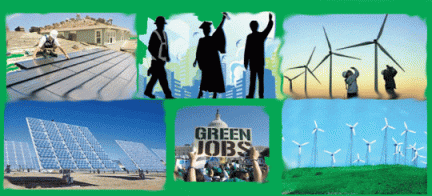
There will be no shortage of work for those employees. According to RenewEconomy’s Giles Parkinson, rumour has it that China will boost their solar target to 40GW by 2015; which is an entirely achievable goal considering more than 5GW capacity has been installed in this year alone. While China’s love affair with solar is set to continue, its rapid ascent in solar manufacturing hasn’t been without its casualties; with numerous manufacturers falling by the wayside due to competition and external forces. China’s government recently announced it would carry out reforms to the industry; including promoting mergers and acquisitions and reducing government support for manufacturers.
China is often criticised; but something we can all be thankful for is the nation brought affordable solar to the world.
New solar fabric will light up your clothes
Japan researchers invent solar-cell fabric, Herald Sun, From: AAP December 12, 2012 CLOTHES that could literally light up your life were unveiled Tuesday by Japanese researchers who said their solar-cell fabric would eventually let wearers harvest energy on the go. Continue reading
1 This Month

of the week – Shut Down Drone Warfare!


Tell the Ukrainian Government to Drop Prosecution of Peace Activist Yurii Sheliazhenko

Petition to revoke the licensing of the Near Surface Nuclear Disposal Facility (NSDF) at Chalk River. https://www.ourcommons.ca/petitions/en/Petition/Details?Petition=e-7247
To see nuclear-related stories in greater depth and intensity – go to https://nuclearinformation.wordpress.com
-
Archives
- April 2026 (7)
- March 2026 (251)
- February 2026 (268)
- January 2026 (308)
- December 2025 (358)
- November 2025 (359)
- October 2025 (376)
- September 2025 (257)
- August 2025 (319)
- July 2025 (230)
- June 2025 (348)
- May 2025 (261)
-
Categories
- 1
- 1 NUCLEAR ISSUES
- business and costs
- climate change
- culture and arts
- ENERGY
- environment
- health
- history
- indigenous issues
- Legal
- marketing of nuclear
- media
- opposition to nuclear
- PERSONAL STORIES
- politics
- politics international
- Religion and ethics
- safety
- secrets,lies and civil liberties
- spinbuster
- technology
- Uranium
- wastes
- weapons and war
- Women
- 2 WORLD
- ACTION
- AFRICA
- Atrocities
- AUSTRALIA
- Christina's notes
- Christina's themes
- culture and arts
- Events
- Fuk 2022
- Fuk 2023
- Fukushima 2017
- Fukushima 2018
- fukushima 2019
- Fukushima 2020
- Fukushima 2021
- general
- global warming
- Humour (God we need it)
- Nuclear
- RARE EARTHS
- Reference
- resources – print
- Resources -audiovicual
- Weekly Newsletter
- World
- World Nuclear
- YouTube
-
RSS
Entries RSS
Comments RSS
 nuclear-news