Solar power races ahead as China builds huge station in Gobi desert
China builds huge solar power station which could power a million homes, http://www.independent.co.uk/environment/china-builds-huge-solar-power-station-which-could-power-a-million-homes-10446840.html The Independent, ALEXANDRA SIMS, 08 August 2015 China is set to build a giant solar power station in the Gobi desert, which could generate enough energy to supply one million homes. The proposed power station will measure 10 square miles and generate 200 megawatts of solar energy.
The plans will fall in line with the Chinese government’s ambitious initiative to reduce the country’s fossil fuel energy by 20 per cent by 2030 in addition to cutting its green house gas emissions.
Construction began six years ago on the country’s first large –scale power station, according to National Geographic.Recent photos from NASA satelites show that the solar panels making up the plant cover an area roughly three times bigger than was seen three years ago.
China is quickly becoming a world leader in solar power.
According to the International Energy Agency, the country produces two-thirds of all solar panels and it gained more solar capacity than any other country in the world last year. China invested $83.3 billion dollars last year into renewable energy, more than any other country, according to a report from the UN Environment programme.
The United States, despite being the second highest investors in renewable energies, invested less than half this amount.
Jennifer Morgan, director of the climate program at the World Resources Institute told National Geographic: “China is largely motivated by its strong national interests to tackle persistent air pollution problems, limit climate impacts and expand its renewable energy job force.”
She added that China, presently the greatest emitter of greenhouse gases, will be able to meet its pledge if it continues with its new emphasis on renewables.Chinese Premier Li Keqiang said: “China’s carbon dioxide emission will peak by around 2030 and China will work hard to achieve the target at an even earlier date,” according to Reuters.
A global boom in solar power could be on the cards, according toBloomberg New Energy Finance, as panels get cheaper and batteries become more advanced.
By 2040, they predict, in moves led partly by China, solar power could account for one-third of new electricity.
China’s massive solar farm going ahead fast in Gobi desert
 China builds huge solar power station which could power a million homes, http://www.independent.co.uk/environment/china-builds-huge-solar-power-station-which-could-power-a-million-homes-10446840.html
 The Independent, 08 August 2015 China is set to build a giant solar power station in the Gobi desert, which could generate enough energy to supply one million homes. The proposed power station will measure 10 square miles and generate 200 megawatts of solar energy.
Germany sets new record for renewable energy – 78% renewable electricity July 25
Germany Just Got 78 Percent Of Its Electricity From Renewable Sources, Think Progress BY ARI PHILLIPS JUL 29, 2015 ON SATURDAY, JULY 25, GERMANY SET A NEW NATIONAL RECORD FOR RENEWABLE ENERGY BY MEETING 78 PERCENT OF THE DAY’S ELECTRICITY DEMAND WITH RENEWABLES SOURCES, EXCEEDING THE PREVIOUS RECORD OF 74 PERCENT SET IN MAY OF 2014.

According to an analysis by German energy expert Craig Morris at the Energiewende blog, a stormy day across northern Europe combined with sunny conditions in southern Germany led to the new record, the exact figures of which are still preliminary. Morris writes that most of Germany’s wind turbines are installed in the north and most of its solar panels are in the south.
If the figures hold, it will turn out that wind and solar generated 40.65 gigawatts (GW) of power on July 25. When this is combined with other forms of renewables, including 4.85 GW from biomass and 2.4 GW from hydropower, the total reaches 47.9 GW of renewable power — occurring at a time when peak power demand was 61.1 GW on Saturday afternoon. To bolster his analysis, Morris points to early figures from Agora Energiewende, a Germany energy policy firm, that have renewables making up 79 percent of domestic power consumption that day.
Renewable sources accounted for 27.8 percent of Germany’s power consumption in 2014, up from 6.2 percent in 2000. The expansion of renewables and another weather phenomenon — a relatively mild winter — led to Germany’s greenhouse gas emissions falling for the first time in three years in 2014, a 4.3 percent year-over-year drop. Greenhouse gas emissions are now down to their lowest level since 1990, according to analysts at Agora Energiewende.
This made 2014 a big year for Germany’s renewable energy transition, known as Energiewende, which requires the phasing out of nuclear energy by 2022 and reducing greenhouse gases at least 80 percent by 2050. The government also wants the at least double the percentage of renewables in the energy mix by 2035………..
As more and more wind turbines and solar panels come online there is a major technology push to create better forecasting software and to increase the efficiency and enhance the location of these forms of power. IBM and the National Renewable Energy Laboratory (NREL) recentlyannounced that they are working on a producing solar and wind forecasting that’s at least 30 percent more accurate than conventional methods.
“There is good reason to believe that with better forecasts, it might be possible to push solar’s energy contribution up to 50 percent [by 2050],” IBM Research Manager Hendrick Hamann recently said about the United States. “As we continue to refine our system in collaboration with the DOE, we hope to double the accuracy of the system in the next year. That could have a huge impact on the energy industry — and on local businesses, the economy and the natural environment.” http://thinkprogress.org/climate/2015/07/29/3685555/germany-sets-new-renewable-energy-record/
Abandoned gold courses transformed to solar power plants – Japan
Japan has started turning abandoned golf courses into solar power plants, Business Insider, ARIEL SCHWARTZ JUL 17, 2015,…….. developers built too many golf courses over the last few decades after demand shot up in the 1980s. Now the industry is in decline, with participation in the sport down 40% from the 1990s, and abandoned golf courses are starting to pop up.
Kyocera’s solution: turn the abandoned green space into solar farms. Japan has been hungry for alternative energy ever since the 2011 Fukushima disaster made nuclear power an unattractive option in the country, and golf courses just happen to be perfectly suited for solar power — they’re large open spaces that often get lots of sunlight.
Kyocera’s first project, now under construction, is a 23 megawatt solar plant on a golf course in Kyoto prefecture. When it goes live in 2017, the plant will produce enough power for about 8,100 households.
The company is also developing a 92 megawatt solar plant — generating enough energy for over 30,000 households –……….http://www.businessinsider.com.au/japan-has-started-turning-abandoned-golf-courses-into-solar-power-plants-2015-7
Control of electricity at the local level, with batteries for renewable energy
In the end, the solution might lie on a smaller scale: giving everyone the power to store their own power. Tesla is one company of several in this game: it recently announced a device called the Powerwall, designed for homes and businesses. It uses the same batteries as electric cars to store energy, either from renewables or cheap night-time electricity, ready to be used during the day.
If such systems become commonplace, we might all become a little more aware of where our energy is coming from, and how our own behaviour affects its use and production

The battery revolution that will let us all be power brokers, New Scientist 22 July 15
Companies are racing to find better ways to store electricity – and so provide us with cheaper energy when and where we want it “……... Although they are still dwarfed in most respects by the bulky lead-acid batteries found in almost every car on the road today, in 2015, lithium-ion batteries will account for around a third of the money spent on rechargeable batteries globally (see “Turn it on”), and just under a sixth of the total energy stored, according to French research firm Avicenne.
Global investment is going to renewables, much less is going to nuclear power
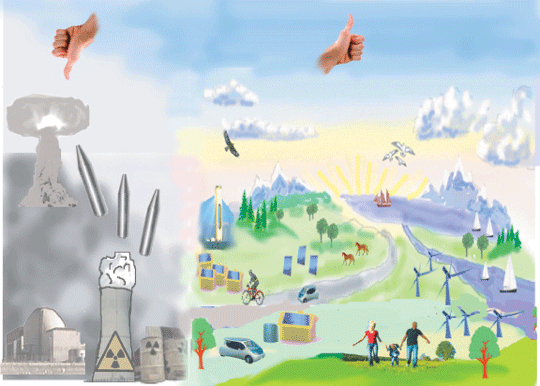 Around the World, Nuclear Can’t Compete With Growing Renewables“What is spectacular is the extent to which the nuclear industry is appearing to ignore reality.” Katherine TweedGreentech Media, July 16, 2015 [excellent diagrams & graphs]
Global investment in new nuclear is an order of magnitude less than renewable energy investment. That is just one of the findings of a new independent report on the state of the worldwide nuclear industry that was issued on Thursday. No matter which aspect of the nuclear industry is assessed, the picture isn’t pretty.
Despite talk of a nuclear renaissance in the 1990s, no single Generation III reactor has come into service in the past 20 years. Most are delayed three to nine years and are far over budget.
“The impressively resilient hopes that many people still have of a global nuclear renaissance are being trumped by a real‐time revolution in efficiency‐plus‐renewables‐plus-storage, delivering more and more solutions on the ground every year,” Jonathon Porritt, co-founder of the Forum for the Future and former Chairman of the U.K. Sustainable Development Commission, wrote in the forward to the World Nuclear Industry Status Report 2015. “[The report] remorselessly lays bare the gap between the promise of innovation in the nuclear industry and its delivered results.”
China, which leads the world in new nuclear builds, spent about $9 billion in 2014, but invested more than $83 billion on wind and solar in the same year. China’s non-hydro renewable fleet produces more energy than its nuclear capacity.
What’s more, Germany, Brazil, India, Mexico, the Netherlands, Spain and Japan all generate more electricity from non-hydro renewables than from nuclear. Those countries make up nearly half of the world’s population and three of the world’s largest economies.
For nuclear that is being built, the word “boondoggle” seems to come up frequently, especially in the West. “The project is in shambles,” the report said of the U.K.’s Hinkley Point C reactor, which was meant to be the first new nuclear in the country in decades. Now, the company building it, Areva, is bankrupt. Areva’s Olkiluoto 3 project in Finland and Flamanville 3 in France are also both way over budget and still not in operation.
“What is spectacular is the extent to which the nuclear industry is appearing to ignore reality,” the report states. In 2013, Areva’s then-CEO predicted reactors would be coming back on-line in Japan by the end of the year and that his company would be taking new orders in the next few years. In 2015, Japan has been nuclear-free for the first time in more than four decades. Areva has had no new orders.
Despite the issues with Areva reactors, there are more than 60 reactors currently under construction. Of those reactors, most have been under construction for more than seven years. Three-quarters of the building sites are delayed and, amazingly, five have been listed as “under construction” for more than 30 years. http://www.greentechmedia.com/articles/read/renewables-outpace-nuclear-in-major-economies
Renewables powering more parts of the world than nuclear power is
Half the world already gets more power from renewables than from nuclear, Quartz, 17 July 15 The dream of a low-carbon future thanks to nuclear power is already looking dated. The two most populous countries in the world—China and India—plus Japan, Germany, Spain, the Netherlands, Mexico, and Brazil already generate more electricity from (non-hydro) renewable sources than they do from nuclear, according to a global nuclear industry report (pdf). That’s 45% of the world’s population that rely on wind, solar, and other green energy more than they do on radioactive atoms.
the trend toward more renewable power will likely continue for some time. First, global opinion on nuclear energy soured after the Fukushima disaster in Japan, and as a result plenty of potential nuclearpower plants aren’t getting built. Power-hungry China, for instance, isslow to approve new nuclear power plants due to both government and public safety concerns. At the same time, though, it is investing heavily in wind power.
Fukushima delegation to Switzerland, to learn about transition plan from nuclear to renewable energy
Fukushima team studies Swiss nuclear experience By swissinfo.ch, with reporting by Fumi Kashimada , 16 July 15
A Japanese delegation from Fukushima, site of a nuclear disaster in March 2011, has visited Switzerland to discuss energy policies, technologies and the development of renewable forms of energy.
“Almost five years after the explosions in the Fukushima Daiichi nuclear power plant, 110,000 people still can’t return to live in their homes,” Masao Uchibori, mayor of the prefecture of Fukushima since November, toldswissinfo.ch in Solothurn.
“The inhabitants of zones with raised levels of radioactivity can’t lead a normal life.”
While most foreign reports on Fukushima focus on the reconstruction of the destroyed power plant, Uchibori points out that “time hasn’t stood still in Fukushima – we’ve made progress on rebuilding the infrastructure”.
Uchibori said the prefecture of Fukushima had set itself the ambitious target of getting 100% of its energy from renewable sources by 2040. To that end, the delegation is interested in Switzerland’s experiences in withdrawing from nuclear power. ……..
“The most important thing is that no nuclear power station accident happens ever again – it doesn’t matter whether it’s in Japan or another country. Countries should cooperate so that the world isn’t dependent on nuclear power.” http://www.swissinfo.ch/eng/nuclear-safety_fukushima-delegation-studies-swiss-nuclear-experience/41552346
Renewable Energy news snippets
Faced with power crisis, Africa looks to renewable energy technology PCWorld 18 July 15
PV-Tech Storage-16 Jul 2015
12 miles from Fukushima’s shattered nuclear reactors, World’s Largest Offshore Wind Turbine gives hope
World’s Largest Offshore Wind Turbine Comes Online Near Fukushima Daiichi -bureau EnviroNews World News by Emerson Urry on June 28, 2015 – http://environews.tv/world-news/worlds-largest-offshore-wind-turbine-comes-online-near-fukushima-daiichi/ Fukushima Prefecture, Japan — A mere 12 miles from the full-blown triple nuclear reactor “melt-through” at Fukushima Daiichi on the eastern coast of Japan, sits a bafflingly huge, 620-foot-tall, 1,500-ton bladed beast — floating on a 5,000 ton platform in the water. The world’s largest floating wind turbine has three 270 foot long blades, can withstand 200 mile-per-hour winds, and will be able to generate “up to 7 megawatts of electricity,” making it the biggest offshore wind turbine on earth, according to Gizmodo, a popular science and technology blog.
Additionally, the downright lies and coverup perpetrated by both TEPCO and the Japanese Government surrounding the Fukushima crisis, have left a bad taste in the mouth of the population, leaving trust in the government at an all time low. Perhaps more government-backed, non-lethal energy innovations like the one just activated in Fukushima can start to rebuild the people’s trust in the government. Time will tell. – http://environews.tv/world-news/worlds-largest-offshore-wind-turbine-comes-online-near-fukushima-daiichi
To renewable energy and energy efficiency – away from nuclear – Switzerland’s program
 Switzerland’s transition away from nuclear power, Science Daily, July 7, 2015 Source: SAGE Publications
- Summary:
- Switzerland has a long history of trying to be as self-sufficient and energy independent as possible. Although its energy supply system has served it well in the past, the country is now looking to turn away from its reliance on nuclear power and seeks to compensate for the energy lost from hydropower as a result of climate change……
In the latest issue of theBulletin of the Atomic Scientists, published by SAGE, Dominic Notter of Empa discusses how the country aims to address this transition, finding a new supply mix that combines energy conservation, greater efficiencies, alternative energy sources, the “smart grid,” and the introduction of new technologies, so that Switzerland can secure its energy independence for the future……..
-
 “The goal is to gradually phase out of nuclear power and into renewables by 2034, and to be largely independent of fossil fuels. Reaching it is based upon the idea of combining highly efficient energy production processes with substantial reductions in energy consumption.”Notter concludes: “Over the next four decades Switzerland faces a restructuring of its entire energy supply system. The new supply mix will be free from nuclear power, rather low in carbon intensity, and resting upon much higher efficiencies based on the newest and the most energy- efficient technologies- along with the developments of smart grids, decentralized power suppliers, hydropower, wind power, photovoltaics, biomass, wood, and the rigorous use of burning waste to generate energy whenever materials cannot be recycled […] A single “magic bullet” suitable for every purpose is not available. Switzerland most likely has to find its own energy supply mix, with the biggest sustainability potential.” Story Source:
The above post is reprinted from materials provided by SAGE Publications. http://www.sciencedaily.com/releases/2015/07/150707102025.htm

The Renewable Energy News that I can’t keep up with
Norway Could Be Europe’s ‘Green Battery’
Norwegian hydropower could make Norway the “green battery” of Europe — not by building new power plants, but by further developing the hydropower installations that were built out beginning at the ..
http://www.sciencedaily.com/releases/2015/07/150710081213.htm
-
Burlington, Vermont Leads the Charge in 100 Percent Renewable …
Triple Pundit (registration) (blog)-12 hours agoWhat’s the formula for building a green city? Energy experts in Burlington, Vermont, chipped away at the solution for over a decade and recently … -
EPO supports new platform on renewable energy innovation
European Patent Office-9 Jul 2015Policy makers and other energy sector players now have consolidated access to the world’s largest collection of global renewable energy .. -
-
Top Trends Defining Global Shift To Clean And Renewable Energy
CleanTechnica-8 hours agoClean Energy Canada has released a report defining the 10 top trends which drove the global shift to clean and renewable energy in 2014. -
Pension Funds Back €2 Billion Danish Renewable Energy …
CleanTechnica-15 hours agoPension funds from around the world continue to pour capital intorenewable energy assets. Denmark-based Copenhagen Infrastructure … -
Renewable energy sources should power all city government, de …
New York’s PIX11 / WPIX-TV-13 minutes agoSUNSET PARK, Brooklyn — Mayor Bill de Blasio announced Friday that he would like 100% of the energy for city government provided by … -
Obama, Sanders propose boosting solar energy for low, moderate …
Computerworld-6 hours agoThe White House announced an initiative to increase access to solar energy for all Americans, especially those in low and moderate-income …Solar Breakthrough Could Be on the Way for Renters
InsideClimate News-9 hours agoExplore in depth (9 more articles) -
Energy Voice
Renewable Energy Generation Wins Planning Consent for U.K. Wind
Bloomberg-12 hours agoRenewable Energy Generation Ltd., a British low-carbon asset developer, was granted permission to build a wind farm after the U.K. …
-
New renewable energy app from IRENA will help investors
 Irena off to a clean start with new renewable energy app, The National Business LeAnne Graves June 30, 2015 The renewable energy sector has been growing fast, and more and more people – particularly potential investors – are seeking information on little known areas to venture into.
Although some forms of renewable energy have been around for decades, there has been almost no mapping of the industry. Sure, companies have looked into their particular areas of interests, but until the International Renewable Energy Agency (Irena), an intergovernmental organisation that supports countries in their transition to a sustainable energy future, launched in 2009, there was little aggregated information available.
The organisation has now created an app to feed hungry minds on the subject – allowing users to search for renewable energy resources anywhere in the world, from sources such as wind, solar or marine, hydro, geothermal and bioenergy. And all this from their smartphone.
Launched last month, the Global Atlas pocket is a free app available for download on all platforms including BlackBerry 10, iOS, Android and Windows Phone.
At present it claims to be the only global tool of its kind, combining 1,000 maps from 67 governments and 50 data centres.
The idea is that users can overlay information listed in the catalogue to help identify areas of interest for potential projects or business ventures…….
What are the pros of this app?
It’s important to remember that this is the first of its kind. So to begin with, Irena needed to grab whatever information is currently available on different markets and regions. It’s not an easy task. But you can select any place in the world to find out how much solar irradiation is present, ask if renewable energy could power 100 per cent of a particular island or even whether wind energy is a suitable prospect for the UAE…….. http://www.thenational.ae/business/the-life/irena-off-to-a-clean-start-with-new-renewable-energy-app
Renewable Energy News In Brief
Rising number of local governments set targets to cut emissions
Twenty local governments, representing areas producing 5 percent of global climate-changing emissions, have committed to targets to cut those emissions, with the majority also setting goals for renewable energy, a platform uniting them said on Thursday.
http://planetark.org/enviro-news/item/73390
Brazil lifts renewable energy target http://kwqc.com/2015/07/03/religious-leaders-want-presidential-candidates-to-discuss-renewable-energy/ Business Spectator-1 Jul 2015 The Abbott Government recently reduced Australia’s Renewable Energy Target significantly. After excluding hydro, the target would represent …
“We haven’t had that honest of a discussion,” said Lonnie Ellis. ” When people on the left are trying to score political points, and people on the right are avoiding the topic. We’ve got to challenge both parties on the issues.”
Last week Pope Francis came out in support of preventing climate change. The document issued by Pope Francis opened up new discussions on the topic. On Wednesday, Catholic and interfaith leaders joined clean energy advocates to ask Iowans to push for a cleaner planet.
“He sees climate change itself as a consequence of other problems, and to be honest, the primary problem the Pope Identified in his encyclical, is over-consumption of the earth’s resources by the wealthy,” said Father Bud Grant.
Bill Gates and his nuclear power company – no friend to renewable energy
Gates: Renewable energy can’t do the job. Gov should switch green subsidies into R&D, The Register , 26 Jun 2015 , Lewis Page
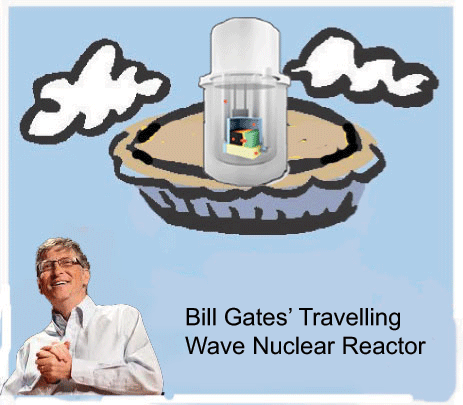
‘Only way to a positive scenario is innovation’ ……….In Bill Gates’ view, the answer is for governments to divert the massive sums of money which are currently funnelled to renewables owners to R&D instead. This would offer a chance of developing low-carbon technologies which actually can keep the lights on in the real world……
1 This Month
Chernobyl: The Lost Tapes – A good documentary on Chernobyl on SBS available On Demand for the next 3 weeks– https://www.sbs.com.au/ondemand/tv-program/chernobyl-the-lost-tapes/2352741955560

of the week–London Campaign for Nuclear Disarmament

Tell the Ukrainian Government to Drop Prosecution of Peace Activist Yurii Sheliazhenko
To see nuclear-related stories in greater depth and intensity – go to https://nuclearinformation.wordpress.com
-
Archives
- April 2026 (139)
- March 2026 (251)
- February 2026 (268)
- January 2026 (308)
- December 2025 (358)
- November 2025 (359)
- October 2025 (376)
- September 2025 (257)
- August 2025 (319)
- July 2025 (230)
- June 2025 (348)
- May 2025 (261)
-
Categories
- 1
- 1 NUCLEAR ISSUES
- business and costs
- climate change
- culture and arts
- ENERGY
- environment
- health
- history
- indigenous issues
- Legal
- marketing of nuclear
- media
- opposition to nuclear
- PERSONAL STORIES
- politics
- politics international
- Religion and ethics
- safety
- secrets,lies and civil liberties
- spinbuster
- technology
- Uranium
- wastes
- weapons and war
- Women
- 2 WORLD
- ACTION
- AFRICA
- Atrocities
- AUSTRALIA
- Christina's notes
- Christina's themes
- culture and arts
- Events
- Fuk 2022
- Fuk 2023
- Fukushima 2017
- Fukushima 2018
- fukushima 2019
- Fukushima 2020
- Fukushima 2021
- general
- global warming
- Humour (God we need it)
- Nuclear
- RARE EARTHS
- Reference
- resources – print
- Resources -audiovicual
- Weekly Newsletter
- World
- World Nuclear
- YouTube
-
RSS
Entries RSS
Comments RSS
 nuclear-news