France to launch 6 tenders for solar energy projects

 France ushers in 3 GW solar tender across six rounds, PV Magazine, 25. AUGUST 2016, BY: IAN CLOVER
Energy ministry confirms series of six tenders of 500 MW each to be launched between 2017 and 2020 as country gradually reignites efforts to boost its solar PV sector. “……the government appears to at least be coming to terms with its solar shortsightedness, and this week announced that it will launch a series of solar PV tenders next year to support an additional 3 GW of PV by 2020.
The energy ministry will oversee a series of six tenders of 500 MW each, beginning in 2017. This steady and regular roll out of available projects will, the ministry said, provide stability and visibility to the French solar industry, delivering jobs and aiding the country’s carbon reduction efforts.
The tenders will be available to ground-mounted PV systems between 500 kW and 17 MW in size, and the first round of bidding ends on February 1, 2017.
During each of the six, 500 MW rounds, 300 MW capacity will be reserved for solar farms larger than 5 MW, while 135 MW of capacity will be for plants with a capacity between 500 kW and 5 MW. The remaining 65 MW will be offered to developers looking to build PV systems on carports, provided they are sized between 500 kW and 10 MW.
France is famously largely nuclear-powered, but a new solar support mechanism introduced in May – whereby bidders receive a premium on top of the market price for the PV power they feed to the grid – will hopefully deliver the types of revenue guarantee that can help the country make the transition towards more renewables.
France’s solar installation aims target 10.2 GW of PV by the end of 2018, with anywhere between 18.2 GW to 20.2 GW by 2023. http://www.pv-magazine.com/news/details/beitrag/france-ushers-in-3-gw-solar-tender-across-six-rounds_100025903/#ixzz4IPyzWiC8
Germany’s green power going strong, with more renewable energy than it ever had nuclear
In short, Germany is paying coal to shut down, ramping up renewables far faster than nuclear shrinks, and enjoying unparalleled power reliability—while New York fails to move with solar and wind, pays nuclear to stay on, and has as much downtime a month as Germany has in a year.
 Germany already has more green power than it ever had nuclear, Energy Transition 24 Aug 2016 by Craig Morris “….. Craig Morris takes a look at the data……In Germany, however, solar and wind are reducing the wholesale prices that baseload nuclear and coal sell at—because green power is growing fast. In 2002, the country adopted a plan to phase out nuclear by around 2022 (this is still the target). Most onlookers thought it would be impossible to ever offset nuclear power with renewables in such a short time. In fact, Germany hit that target last year—seven years early.
“Unless we’re willing to go back to candles, which would be uncomfortable and inconvenient, we need energy generation,” New York’s Governer Cuomo said in explaining the nuclear bailout. In doing so, he unwittingly reiterated the long-disproven claim by German nuclear proponents that the lights would go out without nuclear. Like the rest of the US, New York State counts downtime (SAIDI) in hours (PDF), with New York coming in at around two hours of power outages annually—or just over 10 minutes a month. Germany had 12 minutes a year in 2014.
In short, Germany is paying coal to shut down, ramping up renewables far faster than nuclear shrinks, and enjoying unparalleled power reliability—while New York fails to move with solar and wind, pays nuclear to stay on, and has as much downtime a month as Germany has in a year.
Craig Morris (@PPchef) is the lead author of German Energy Transition. He directs Petite Planète and writes every workday for Renewables International. He is co-author of Energy Democracy, the first history of Germany’s Energiewende. http://energytransition.de/2016/08/germany-already-has-more-green-power-than-it-ever-had-nuclear/
Utilities, commercial purchasers benefit from wind energy’s improvements and lowered prices
 Annual wind report confirms tech advancements, improved performance, and low energy prices, Eureka Alert, DOE/LAWRENCE BERKELEY NATIONAL LABORATORY, 17 Aug 16 Wind energy pricing remains attractive to utility and commercial purchasers, according to an annual report released by the U.S. Department of Energy and prepared by the Electricity Markets & Policy Group at Lawrence Berkeley National Laboratory (Berkeley Lab). Prices offered by newly built wind projects are averaging around 2¢/kWh, driven lower by technology advancements and cost reductions.“Wind energy prices–particularly in the central United States–are at rock-bottom levels, with utilities and corporate buyers selecting wind as the low-cost option,” said Berkeley Lab Senior Scientist Ryan Wiser. “Moreover, enabled by technology advancements, wind projects are economically viable in a growing number of locations throughout the United States.”
Key findings from the U.S. Department of Energy’s reflective “Wind Technologies Market Report” include:
- Wind power represented the largest source of U.S. electric-generating capacity additions in 2015. Wind power capacity additions in the United States surged in 2015, with $14.5 billion invested in 8.6 gigawatts (GW) of new capacity. Wind power constituted 41% of all U.S. generation capacity additions in 2015, up sharply from its 24% market share the year before and close to its all-time high. Wind power currently meets about 5% of the nation’s electricity demand, and represents more than 10% of total electricity generation in twelve states, and more than 20% in three of those states.
- Bigger turbines are enhancing wind project performance……
- Low wind turbine pricing continues to push down installed project costs. Wind turbine prices have fallen 20% to 40% from their temporary highs in 2008, and these declines are pushing project-level costs down. …..
- Wind energy prices remain very low. Lower installed project costs, along with improvements in capacity factors, are enabling aggressive wind power pricing. ….
- The manufacturing supply chain continued to adjust to swings in domestic demand for wind equipment. …. http://www.eurekalert.org/pub_releases/2016-08/dbnl-awr081716.php
Climate friendly future – 6 countries giving a renewable energy lead – World Bank
Six stories show renewable energy underpins a climate-friendly future http://blogs.worldbank.org/energy/six-stories-show-renewable-energy-underpins-climate-friendly-future [INCLUDES VIDEOS] BY ANDY SHUAI LIU ON TUE, 01/05/2016 In 2015 the world saw great momentum for climate action, culminating in a historic agreement in December to cut carbon emissions and contain global warming. It was also a year of continued transformation for the energy sector. For the first time in history, a global sustainable development goal was adopted solely for energy, aiming for: ACCESS TO AFFORDABLE, RELIABLE, SUSTAINABLE AND MODERN ENERGY FOR ALL.
Renewable energy, energy efficiency would create over 145,000 jobs in Alberta, Canada
 Alberta could produce over 145,000 jobs by going green: report HTTP://EDMONTONJOURNAL.COM/BUSINESS/ENERGY/ALBERTA-COULD-PRODUCE-OVER-145000-JOBS-BY-GOING-GREEN-REPORT GORDON KENT April 22, 2016 Alberta could create more than 145,000 jobs by investing more heavily in renewable energy, energy efficiency and public transit, a report by three environmental organizations says.
The move would boost employment when oil prices have dropped, reduce carbon emissions and help shift the economy toward green industries, according to the report released Friday by Greenpeace, the Alberta Green Economy Network and Gridworks Energy Group.
“The government can start putting people back to work without having to wait for the price of oil to go back up,” co-author David Thompson said Friday, which was also Earth Day.
The report estimates 68,400 positions are available from energy efficiency upgrades on more than 183,000 older homes and other buildings, requiring spending of $1 billion over five years.
Another 30,000 to 40,000 places would come from building LRT lines at a cost of more than $3.6 billion, along with the unpriced expansion of bike lanes, sidewalks and other sustainable transportation.
As well, there could be 46,780 jobs created by 2020 by almost doubling the amount of wind power to seven per cent of the electricity grid, boosting solar and geothermal production, and improving energy efficiency and storage.
No price tag is attached to this development. The provincial budget calls for investing $6.2 billion raised by the new carbon levy in green infrastructure, renewable energy, energy efficiency and other work over five years.
Many communities are already shifting toward renewable power.
The Lubicon Lake First Nation of Little Buffalo, 465 kilometres northwest of Edmonton, put in an 80-panel, 20.8-kilowatt solar electricity system next to its health centre last summer. The Louis Bull First Nation at Maskwacis, 70 kilometres south of Edmonton, will start installing 340 solar panels on four public buildings next month, training residents to work in this field and cutting electricity bills, councillor Desmond Bull said.
The approximately $300,000 cost is being covered with money from the federal government.
The project is intended to help the environment as well as produce economic development, Bull said.
“There’s not really any template or model for how First Nations can move in this direction.”
City of Edmonton chief economist John Rose cautioned this week that governments need to be prudent about major investments in renewable energy, but Thompson said Alberta has big wind and solar resources.
“We can learn from the mistakes others have made … We can go down the tunnel and hopefully get less scratched.”
Cheapest unsubsidized power plant in the world – Chile leads in the solar age
Solar Delivers Cheapest Electricity ‘Ever, Anywhere, By Any Technology’ https://thinkprogress.org/solar-delivers-cheapest-electricity-ever-anywhere-by-any-technology-c2ef759ac33f#.mxa8earjt Dr. Joe Romm , Founding Editor of Climate Progress, “the indispensable blog,” 24 Aug 16
Half the price of coal! Chile has just contracted for the cheapest unsubsidized power plant in the world, Bloomberg New Energy Finance (BNEF) reports.
In last week’s energy auction, Chile accepted a bid from Spanish developerSolarpack Corp. Tecnologica for 120 megawatts of solar at the stunning price of $29.10 per megawatt-hour (2.91 cents per kilowatt-hour or kwh). This beats the 2.99 cents/kwh bid Dubai received recently for 800 megawatts. For context, the average residential price for electricity in the United States is 12 cents per kilowatt-hour.
“Solar power delivers cheapest unsubsidised electricity ever, anywhere, by any technology,” BNEF Chair Michael Liebreich said on Twitter after this contract was announced.
Carlos Finat, head of the Chilean Renewable Energies Association (ACERA) told Bloomberg that the auction is “a strong warning sign that the energy business continues on the transition path to renewable power and that companies should adapt quickly to this transition process.” Indeed, in the same auction, the price of coal power was nearly twice as high!
Grid-connected solar power on Chile has quadrupled since 2013. Total installed capacity exceeded 1,000 megawatts this year — the most by far in South America. Another 2,000 megawatts is under construction, and there are over 11,000 megawatts that are “RCA Approved” (i.e. have environmental permits).
Chile is aided by the fact that its Atacama desert is “the region with the highest solar radiation on the planet,” according to the Inter-American Development Bank. So much solar is being built in the high-altitude desert that Northern Chile can’t use it all, and the government is rushing to buildnew transmission lines.
Chile is part of a global trend where solar energy has doubled seven times since 2000. In the U.S. alone, it has grown 100-fold in the past decade thanks to a sharp drop in prices that has brought the cost of solar (with subsidies) to under four cents a kilowatt hour in many places, as I detailed last month.
The future for solar could not be sunnier.
Trends in Europe’s changing energy systems
Europe’s Energy Transition: Megatrends & Tipping Points (Part 3) Shifting Power-Generating Resources, Forbes, 18 Aug 16 By Mark Livingstone & Jan Vrins In our initial blog on Europe’s energy transition, we discussed seven megatrends that are fundamentally changing how we produce and use power. In this third blog in the series, we discuss the shift in power generation fuel mix and how this is transforming the European power industry.
European electricity-generating facilities that use oil, coal, and nuclear are devaluing and at risk of becoming stranded as generation sources shift to less expensive renewable generation and natural gas generation. This shift is playing out in different ways across Europe.
According to the US Energy Information Administration (EIA), net European generation capacity will increase by 7 GW in 2016. Much of Europe’s new capacity comes from renewables, with close to 75% of new capacity coming from wind (44%) and solar (29%). While new coal (16%) and gas (6%) capacity was added, far more coal assets were decommissioned. As a result, net new capacity in Europe is virtually 100% renewables. While recent subsidy cuts have tempered solar’s growth, wind is marching onward. There is still no effective utility-scale solution to the inherent intermittency in renewable generation, as storage solutions and grid interconnection/active management are still lacking penetration at scale. Natural gas is the bridging fuel during the shift to renewables, supported by the abundance of natural gas available globally, lower long-term prices, and increasing import capacity in Europe.
What Are the Drivers Behind This Shift?
We see five main drivers for the shift in generation resources described above:
- Climate Change Policy: Europe has taken definitive steps to decarbonize its power generation, including relatively generous support for renewables and economic penalties for carbon emitters via the EU Emissions Trading System (EU ETS). See our previous blog on the rising number of carbon emissions reduction policies and regulations.
- European Market Coupling: A second aspect of Europe’s power sector is the physical and economic integration of markets. Interconnection growth has been strong, and the economic incentives via use of power exchanges for dynamic price signaling has provided further support for low-carbon generation.
- Generation Economics: While policy and regulatory support for low-carbon generation has taken centre stage, the economics of various forms of generation have also been shifting. Within 7 years, solar power has gone from a heavily subsidized resource to a key component of the generation mix, even with zero or minimal subsidies. Europe continues to lead the world in development of offshore wind, particularly in the North Sea. Thermal generation economics have also changed—despite relatively low gas and coal prices, low marginal cost renewables are increasingly forcing thermal plants to shift from stable baseload operation to less efficient cycling and reliance on ancillary service contracts.
- Decentralization of Generation: The scale of distributed energy resources (DER) is not yet huge across Europe; however, this trend is already shaking the traditional utility business models. The rise of the prosumer is gathering momentum, be it an industrial customer who invests in combined heat and power, a new commercial building with a biomass boiler, or a housing development with rooftop solar panels.
- Public Sentiment: This driver cannot be underestimated given the prevalence of democratically elected governments in Europe. Public support for action to curb climate change despite the costs has been most obvious in Germany, where the changes via nuclear shutdowns and solar growth have been massive—and expensive. In the UK, it is more expensive to construct offshore wind than onshore, but the public and political preference is that location trumps economics.
How Does This Play Out Across Europe?……. http://www.forbes.com/sites/pikeresearch/2016/08/18/europes-energy-transition-megatrends-tipping-points-part-3/#6d68a5b124e8
Interactive before and after images of Louisiana floods
 Devastating images reveal why US can’t ignore Louisiana floods
Explore these interactive before and after images to see the scale of “the worst natural disaster to strike the US since Superstorm Sandy”. ABC News
By Matt Liddy and Ben Spraggon Widespread flooding in the southern US state of Louisiana has killed at least 13 people, and more than 80,000 people have registered for emergency assistance.
The American Red Cross called the flooding “the worst natural disaster to strike the US since Superstorm Sandy”.
About 30,000 people had to be rescued, as rainfall hit historic levels.
On Thursday, the Atlantic published an article accusing the national media and presidential candidates Hillary Clinton and Donald Trump of largely ignoring the disaster.
More than 40,000 homes have been flooded.
Authorities are still searching tens of thousands of homes and countless cars for victims and survivors……..http://www.abc.net.au/news/2016-08-19/before-after-louisiana-floods-satellite/7767084
UK’s Crown Estate recommends UK switching attention from nuclear power to offshore wind

 Hinkley C’s future is in doubt. Let’s turn our sights to offshore wind
Falling costs and increased reliability mean this clean power now offers a mature part of the solution for the UK’s energy mix Guardian 15 Aug 16 Huub den Rooijen Director of energy, minerals and infrastructure at Crown Estate
With the government re-examining the case for new nuclear reactors at Hinkley Point, it’s a good time to reflect on recent breakthroughs in another low carbon technology: offshore wind.
Offshore wind is already meeting about 5% of the UK’s electricity demand, more than any other country globally, and is on course to meet 10% by 2020. The sector has undergone a sea change over the last few years, driven by rapid advances in technology, cost, and industry’s ability to deliver on time and to budget.
In fact, over the last three years, construction costs have come down by more than 40% in the UK alone. And by 2025, industry and government expect UK prices to be comparable with new gas generation at about £85 per megawatt hour (MWh).
In the Netherlands, there has been an even bigger step change. Although there are differences in terms of regulation, most would agree that after a recent offshore wind tender the Dutch are now going to be paying the equivalent of about £80 per MWh for their 700MW windfarm. That is significantly lower than Hinkley Point C at £92.50per MWh.
As active managers of the UK seabed, including awarding leases for offshore wind, we take a keen interest in this result. After all, the Dutch windfarm is only about 75 miles away from UK waters, and has very similar conditions like water depth, wind speeds, and distances to ports. If costs can be slashed in the Netherlands, geography tells us they can be slashed here too……..
As the Committee on Climate Change urges government to consider alternatives if there are delays to renewing our nuclear fleet, we should remember our seabed is a powerful energy asset.
At present, we have 2,200 wind turbines in operation and under construction, taking up less than 1% of our total seabed. National Grid estimates that nearly half of all power could be generated from our seabed by 2030 through offshore wind, combined with tidal power lagoons and strong electrical connections to our neighbouring countries.
We have an inexhaustible supply of reliable and clean power right on our doorstep, and competitively priced offshore wind now offers a mature part of the solution for the UK’s energy mix. https://www.theguardian.com/environment/2016/aug/14/hinkley-cs-future-is-in-doubt-lets-turn-our-sights-to-offshore-wind
70% jump in renewable energy’s share of global electricity
Renewables jump 70% in shift away from fossil fuels, http://www.iran-daily.com/news/166891.html The share of electricity that the world’s 20 major economies are generating from the sun and the wind has jumped by more than 70 percent in the space of five years, new figures show.
In a sign of the shift away from fossil fuels that is starting to take hold in some regions, G20 countries collectively produced eight percent of their electricity from solar farms, wind parks and other green power stations in 2015, up from 4.6 percent in 2010, FT reported.
Seven G20 members now generate more than 10 percent of their electricity from these sources, compared with three in 2010. The seven were led by Germany, home of the Energiewende — a policy shift towards green power. Renewables made up 36 percent of its electricity mix, according to data compiled for the FT by the Bloomberg New Energy Finance research group.
The UK, Italy and France all generated more than 19 percent of their electricity from renewables while Australia and Brazil reached 11 percent and 13 percent respectively. For the 28 members of the EU, the number was 18 percent.
The figures do not include hydropower, one of the oldest sources of renewable electricity.
Instead, the data underline the growth of newer forms of green energy such as solar and wind farms that have been heavily subsidized in many countries as governments try to combat global warming.
This growth has been especially striking in the UK, which generated 24 percent of its electricity from such renewables last year compared with just six percent in 2010.
Still, fossil fuels continue to dominate the electricity supply in many countries, including the US and China, two of the most powerful proponents of the UN climate change accord struck in Paris in December.
China is the world’s largest clean energy market, accounting for nearly a third of the $329 billion invested in clean energy globally last year as the government continued to boost its renewables industry.
World’s biggest offshore windfarm on track in UK
Second phase of world’s biggest offshore windfarm gets go-ahead Multibillion-pound Hornsea Project Two, 55 miles off Grimsby coast, would see 300 turbines span an area five times size of Hull, Guardian, Josh Halliday, 16 Aug 16, Plans for the world’s biggest offshore windfarm off the Yorkshire coast are to be expanded to an area five times the size of Hull after being approved by ministers.
The multibillion-pound Hornsea Project Two would see 300 turbines – each taller than the Gherkin – span more than 480 sq km in the North Sea.
Fifty-five miles off the coast of Grimsby, the project by Denmark’s Dong Energy is expected to deliver 1,800MW of low-CO2 electricity to 1.8m UK homes. The development would represent a large boost to the UK’s wind energy industry, with Dong Energy pledging to invest £6bn in the UK and create more than 2,500 jobs……https://www.theguardian.com/environment/2016/aug/16/hornsea-project-two-windfarm-second-phase-grimsby
UK government’s own projections find solar and wind ‘cheaper than new nuclear’
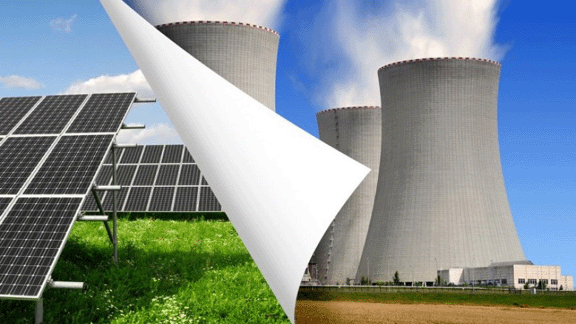 Solar and wind ‘cheaper than new nuclear’ by the time Hinkley is built https://www.theguardian.com/environment/2016/aug/11/solar-and-wind-cheaper-than-new-nuclear-by-the-time-hinkley-is-built
UK government’s own projections expect onshore wind power and large-scale solar to cost less per megawatt hour than new nuclear by 2025, Guardian, Adam Vaughan, 11 Aug 16, The government expects solar and wind power to be cheaper than new nuclear power by the time Hinkley Point C is completed, its own projections show.
Theresa May’s government last month made a surprise decision to delay a deal on Hinkley, prompting a renewed look at what alternatives could power Britain if ministers this autumn fail to back new reactors in Somerset.
An unpublished report by the energy department shows that it expects onshore wind power and large-scale solar to cost around £50-75 per megawatt hour of power generated in 2025. New nuclear is anticipated to be around £85-125/MWh, in line with the guaranteed price of £92.50/MWh that the government has offered Hinkley’s developer, EDF.
The NAO cited the forecasts as coming from the energy department in March 2016. The department said the NAO had been provided with an early draft of its report, and the full version would be published soon.
Niall Stuart, chief executive of the trade body Scottish Renewables, said: “These numbers speak for themselves: onshore wind and solar will be significantly better value than all other large scale sources of power in the UK by 2025.
“It is time to start backing the two technologies to deliver the clean power we need to hit our climate change targets and the cheap electricity required to keep bills down for consumers.”
Molly Scott Cato, a Green party MEP, said: “These latest figures confirm what many of us have been saying for years: that the Hinkley project is a dud.
“The cost of renewables is tumbling and Hinkley will become a giant white elephant as it struggles to compete with cheaper renewable options. Research has shown that solar power would be a less costly way of generating the equivalent amount of power, and now the government’s own projections show that onshore wind too will be cheaper than nuclear by the time Hinkley is built.”
Since coming to power in May 2015, the government ended onshore wind subsidies and allowed communities to veto turbines near them, as well as axing and cutting various subsidies for solar.
Government data published on Thursday showed that renewables generated 25.1% of the UK’s electricity in the first quarter of this year. Around half of that came from on and offshore wind combined.
Offshore wind is cheaper and safer than Hinkley Point
Winds of spare change, Breaking Views, 8 August 2016 By Olaf Storbeck Theresa May should look to Denmark instead of France to secure Britain’s future energy needs. ……As things stand, the UK is proposing to guarantee French state-controlled utility EDF a minimum price of 92.50 pounds for each megawatt-hour of electricity produced at the 18-billion-pound Hinkley Point project. Back in 2013, when the deal was struck, offshore wind was almost 50 percent more pricey.
Wind technology’s costs have plummeted since then. The latest generation of wind farms on the ocean is producing electricity for less than 85 pounds per megawatt hour rather than 130 pounds, new data from state-controlled Danish utility DONG Energy shows. Bigger and more efficient turbines contribute, as well as improvements in construction and grid connection.
This progress, which is faster than even DONG expected, is undermining the economic case for Hinkley Point. Offshore wind is already 8 percent cheaper. And the gap is likely to widen, as the industry continues to be on a steep learning curve, while construction costs for nuclear plants have a notorious tendency to creep upwards.
Renewable energy’s usual issue is intermittency. But offshore wind out at sea is strong and steady, so turbines generate power 98 percent of the time. Replacing Hinkley Point’s planned capacity of 3.2 gigawatts with offshore wind would admittedly require building wind parks of twice that size – offshore turbines on average deliver only around half of their nominal capacity. But as there is no shortage in potential locations for offshore wind farms, such a large scale ramp-up is technologically possible.
Offshore wind is not just cheaper, but also less risky than Hinkley Point. Wind parks usually go on the grid within four years, compared to at least a decade for planned nuclear plants. Similar reactors in Finland and France are dogged by a tripling of costs and years of delay. And the UK taxpayer would have to pay the nuclear subsidies over 35 years, while those for wind farms usually run less than half that long.
That’s before the wind turbines’ other obvious benefit: they don’t leave toxic radioactive waste behind. If May wants to pull the plug on Hinkley Point, she has a ready-made case. https://www.breakingviews.com/considered-view/cheap-wind-energy-can-deal-final-blow-to-hinkley/
Implementing storage technologies – necessary in transition from nuclear power
 As nuclear power plants close, states need to bet big on energy storage Skeptical Science 9 August 2016 by dana1981 Eric Daniel Fournier, Post Doctoral Researcher, Spatial Informatics, University of California, Los Angeles and Alex Ricklefs, Research Analyst in Sustainable Communities, University of California, Los Angeles This article was originally published on The Conversation . Read the original article.
“……due to negative opinion and costly renovations, we are now observing a trend whereby long-running nuclear power plants are shutting down and very few new plants are being scheduled for construction in the United States.
Utilities are moving toward renewable electricity generation, such as solar and wind, partially in response to market forces and partially in response to new regulations that require utilities to reduce greenhouse gas emissions. In California, in particular, the shift toward renewable energy for market and environmental reasons, along with the public’s negative perception of nuclear energy, has caused utilities to abandon nuclear power.
While opponents can view the shutdown of nuclear power plants as a health and environmental success, closing nuclear plants intensifies the challenges faced by utilities to meet electricity consumption demand while simultaneously reducing their carbon footprint. PG&E, for example, has pledged to increase renewable energy sources and energy efficiency efforts, but this alone will not help them supply their customers with electricity around the clock. What can be used to fill the sizable gap left by Diablo Canyon’s closing?
Solar and wind energy sources are desirable as they produce carbon-free electricity without producing toxic and dangerous waste byproducts. However, they also suffer from the drawback of being able to produce electricity only intermittently throughout the day. Solar energy can be utilized only when the sun is out, and wind speeds vary unpredictably.
In order to meet customer electricity demand at all hours, energy storage technologies, alongside more renewable sources and increased energy efficiency, will be needed.
Enter energy storage
Energy storage has long been touted as the panacea for integrating renewable energy into the grid at large scale. Replacing the power generation left by Diablo Canyon’s closing will require expansive additions to wind and solar. However, more renewable energy generation will require more storage.
There are many different energy storage technologies currently available or in the process of commercialization, but each falls into one of four basic categories: chemical storage as in batteries, kinetic storage such as flywheels, thermal storage and magnetic storage.
The different technologies within each of these category can be characterized and compared in terms of their:
- power rating: how much electrical current produced
- energy capacity: how much energy can be stored or discharged, and
- response time: the minimum amount of time needed to deliver energy. [excellent graphs provided here on original]
The key challenge that utilities are now faced with is how to integrate energy storage technologies for specific power delivery applications at specific locations.
This challenge is further complicated by the electric power transmission system and consumer behaviors that have evolved based on a energy supply system dominated by fossil fuels. Additionally, storage technologies are expensive and still developing, which makes fossil fuel generators look more economically beneficial in the short term.
Implementing storage technologies
Currently in California, energy storage is effectively provided by fossil fuel power plants. These natural gas and coal-powered plants provide steady “baseload” power and can ramp up generation to meet peaks in demand, which generally happen in the afternoon and early evening.
A single energy storage device cannot directly replace the capacity potential of these fossil fuel sources, which can generate high rates of power as long as needed.
The inability to perform a like-for-like replacement means that a more diversified portfolio strategy toward energy storage must be adopted in order to make a smooth transition to a lower carbon energy future. Such balanced energy storage portfolio would necessarily consist of some combination of:
- short-duration energy storage systems that are capable of maintaining power quality by meeting localized spikes in peak demand and buffering short term supply fluctuations. These could include supercapacitors, batteries and flywheels that can supply bursts of power quickly.
- Lower speed energy storage that can supply a lot of power and store a lot of energy. These systems, such as pumped hydro and thermal storage with concentrated solar power, are capable of shifting the seasonality of solar production and servicing the unique power requirements for large scale or sensitive power users in the commercial and industrial sectors.
This set of storage technologies would have to be linked up in a kind of chain, nested and tiered by end use, location and integration into the grid. Additionally, management systems will be needed to control how the storage technologies interact with the grid.
Currently without sufficient energy storage in place, utilities now use natural gas to fill in the gaps in electricity supply from renewable sources. Utilities use “peaker” plants, which are natural gas-fueled plants that can turn generation up or down to meet electricity demand, such as when solar output dips in the late afternoon and evening, while producing air pollution and greenhouse gas emissions in the process.
With natural gas consumption for electricity generation on the rise, would it be better to keep nuclear power while energy storage technologies mature? Although less polluting than coal, natural gas produces greenhouse gas emissions and has the potential to causeenvironmentally dangerous leaks, as seen in Aliso Canyon.
With nuclear, it is still not clear what to do with nuclear waste, and the disaster at Japan’s Fukushima nuclear power plant in 2011 highlights how catastrophically dangerous nuclear power plants can be.
Regardless of which situation you believe is best, it is clear that energy storage is the major limitation to achieving a carbon-free electricity grid.
California’s commitment to renewable energy sources has helped shift the state to using less fossil fuels and emitting less greenhouse gases. However, careful planning is needed to ensure that energy storage systems are installed to take over the baseline load duties currently held by natural gas and nuclear power, as renewables and energy efficiency may not be able to carry the burden.
Subsidizing Nuclear Will Only Make Our Grid Problems Worse

 http://www.forbes.com/sites/ucenergy/2016/08/11/subsidizing-nuclear-will-only-make-our-grid-problems-worse/2/#20c51fcc386e Steve Cicala, While low natural gas prices are something to celebrate for consumers, the mood among the owners of America’s nuclear power fleet is not so cheerful as low energy prices threaten their bottom line. In turn, the owners of nuclear plants are threatening to shut down unless the government (and ultimately the ratepayer) steps in to close the shortfall. They have even announced plant closings to show they mean business.
Ordinarily, this kind of thing might be left solely up to markets to sort out. But with nuclear accounting for almost 60% of the carbon-free electricity in the United States, it’s fair to say that losing nuclear plants make it a lot tougher to meet goals to avoid catastrophic climate change. So there is a compelling case that there is a public interest at stake with the potential closure of these plants.
The result: a high-stakes game of chicken is playing out between producers, consumers, and state regulatory commissions in capitols across the country to keep these plants open. New York made history last week when it decided it couldn’t do without nuclear and gave in to providing subsidies. The news came just a couple months after California decided the opposite—putting all its chips into renewables. Illinois continues to wrestle with the very same decision but has yet to place its bet.
First, if the amount of the subsidy is tied to how much the operator requests, you should assume that they’re going to ask for more than they need (obvious, I hope).
Second, the companies at the center of these negotiations have multiple plants, so they make decisions on a particular plant keeping in mind the impact of that decision on the rest of its fleet. Closing a plant in one state after being denied subsidies is a way of signaling to regulators in other states that they seriously risk suffering the same fate. This means that companies may close profitable plants (and pay the cost), because it maximizes the total subsidy they will receive across all of their plants. It also means that firms may actually be eager to close plants as a means of driving up the price of electricity that their remaining plants will receive. Thus, their demands are less about unprofitability than about market power.
The final strategic consideration in these negotiations is about option value. Firms should be willing to endure periods of losses if keeping the plant open preserves the ability to make it all back and more when times are good. Thus, a subsidy that covers the operating cost of the plant is paying more than what the plant actually requires to make staying open in its best interest. It’s making the plant profitable in every year, rather than on average from now until the end of its useful life. Firms would love to be profitable every year, but only require the expectation of future profitability to stay open for business.
So should regulators take the industry at its word?
It’s important to note that—in spite of announced or actual “closing” of plants—hardly a screw has been removed from any of the nuclear plants recently “retired.” Decommissioning is a long-term process with many opportunities to change course as long as the operating license remains valid. This makes announcing closure a lot like convincing a child you’ll leave without them if they don’t get in the car: “I’m putting my shoes on….I’m putting my coat on…I’m getting the keys…I really mean it…” Regulators should not be so naïve.
Although pitched as temporary, urgent subsidies to expedite passage, these negotiations should be viewed as setting a long-term policy approach. If, in five years, natural gas prices remain low and renewables continue to expand (as there’s every reason to believe), we’ll be right back at the negotiating table with an industry on proclaimed life support. There are few policies that deliver less innovation than guaranteed payment, no matter the prevailing economics of the industry.
Is there a better approach? Let’s put aside finally putting a price on carbon (the easy way). I’ve crunched some numbers for Illinois’ Clinton Nuclear Power Station, which Exelon EXC -1.14% recently declared will “close.” It appears the root of the problem is less about low natural gas prices or the growth in renewablesthan our woefully inadequate transmission system.
Lack of transmission capacity underlies nuclear’s inability to recover their fixed operating costs in two ways. When demand is high, a congested system prevents distant nuclear generators from delivering power to profitable markets, leaving them on the sidelines upstate instead of making money in the city (note that it’s security, not economics that threatens to close the Indian Point plant in downstate New York).
The Clinton plant is an example of what nuclear has to look forward to without transmission capacity to deliver wind power to market. In the chart above, I plot the congestion loss at Clinton against hourly wind generation in 2015 (controlling for demand). In other words, this is by how many dollars per megawatt-hour Clinton is earning below the broader Illinois market, and how it varies with the amount of wind being generated on the wider Midwest system. A future with increased wind generation is not a bright one for the Midwestern nuclear fleet.
Of course, transmission infrastructure is not free—but regulators should be deciding between those one-time costs remedying the cause of a $70 million shortfall per year at Clinton alone, or writing a check every year for the foreseeable future to paper over the real problem.
Want to learn more? Listen to my Off the Charts podcast. And, follow me at@SteveCicala.
1 This Month
Chernobyl: The Lost Tapes – A good documentary on Chernobyl on SBS available On Demand for the next 3 weeks– https://www.sbs.com.au/ondemand/tv-program/chernobyl-the-lost-tapes/2352741955560

of the week–London Campaign for Nuclear Disarmament

Tell the Ukrainian Government to Drop Prosecution of Peace Activist Yurii Sheliazhenko
To see nuclear-related stories in greater depth and intensity – go to https://nuclearinformation.wordpress.com
-
Archives
- April 2026 (126)
- March 2026 (251)
- February 2026 (268)
- January 2026 (308)
- December 2025 (358)
- November 2025 (359)
- October 2025 (376)
- September 2025 (257)
- August 2025 (319)
- July 2025 (230)
- June 2025 (348)
- May 2025 (261)
-
Categories
- 1
- 1 NUCLEAR ISSUES
- business and costs
- climate change
- culture and arts
- ENERGY
- environment
- health
- history
- indigenous issues
- Legal
- marketing of nuclear
- media
- opposition to nuclear
- PERSONAL STORIES
- politics
- politics international
- Religion and ethics
- safety
- secrets,lies and civil liberties
- spinbuster
- technology
- Uranium
- wastes
- weapons and war
- Women
- 2 WORLD
- ACTION
- AFRICA
- Atrocities
- AUSTRALIA
- Christina's notes
- Christina's themes
- culture and arts
- Events
- Fuk 2022
- Fuk 2023
- Fukushima 2017
- Fukushima 2018
- fukushima 2019
- Fukushima 2020
- Fukushima 2021
- general
- global warming
- Humour (God we need it)
- Nuclear
- RARE EARTHS
- Reference
- resources – print
- Resources -audiovicual
- Weekly Newsletter
- World
- World Nuclear
- YouTube
-
RSS
Entries RSS
Comments RSS
 nuclear-news