Why solar power poses a very tricky problem for Donald Trump, The Week, RyanCooper , 6 Jan 17 The worst imaginable president for climate change might be about to take power, but solar is still a bright spot. The technology and business infrastructure of solar panel manufacturing has been getting better at a blistering pace, and the latest estimates conclude that solar will surpass coal as the cheapest electricity source within a single decade — and in many places, it already has.
This raises the question of what President Trump will do about the solar business. Most Republicans, Trump included, are heavily committed to filth-spewing power sources like coal and natural gas, and deny the science of climate change. But while Republicans will no doubt want to use regulations and subsidies to prop up fossil fuels and keep down renewables, Trump has shown a bizarre fixation with U.S.-based manufacturing jobs that might just redound to solar’s benefit.
The latest estimate of solar panels’ economic viability comes via Bloomberg New Energy Finance. The price of solar power has plummeted by 62 percent merely since 2009. Taking into account current trends and planned technological developments, they estimate solar will be on average the world’s cheapest power source by about 2026, without subsidies of any kind.
That average hides much variability, of course — in some sunny regions, solar is already astoundingly cheap:…….
Republicans will likely respond to the growth of solar by trying to stamp it out by allowing fossil fuels to pollute to their heart’s content (thus granting them a huge implicit subsidy), and passing burdensome new regulations on renewables. On the face of it, this fits well with Donald Trump’s campaign, which was all about valorizing traditionally masculine jobs, particularly in manufacturing and manual labor. In the conservative shorthand, coal is tough and cool, while renewables are for sissy Prius-drivers.
But on the other hand, this stereotype is wildly at odds with the actual reality of the solar business. Solar panels must be manufactured (as of 2015, there were about 30,000 such jobs in the United States) and installed by manual laborers (120,000 jobs as of 2015). That number has no doubt grown substantially in the past year, as solar jobs have been consistently increasing in number by about 20 percent per year……..
Stamping out solar would kill an order of magnitude more jobs than that. If Trump got wind of some policy that would strangle American solar — or worse yet, force the company to pick up and move to Europe or China — there is a genuine chance he’ll go on one of his Twitter rampages and force the Republican Congress to back down.
Conversely, it will be genuinely difficult to revive coal jobs, which have been in long-term decline since the 1970s. Big Coal has been all but killed off by competition with fracked natural gas and, increasingly, renewables. It is smaller than solar and shrinking fast. Stark hypocrisy is basically the Republican motto, but even they might struggle with the large and increasing subsidies necessary to prop up an ever-more-obsolete marketplace loser.
Eden Keeper, (USA) 6 Jan 17Faith members considering solar power for churches, temples, mosques, and other houses of worship are discovering that installations are getting both easier and cheaper. Since 2009, according to the Solar Energy Industries Association (SEIA), costs for non-residential solar installations have dropped around 73%, from around $7.50 per kilowatt to today’s cost of about $2 per kilowatt.In Minnesota, for example, approximately 400 congregations are working with Minnesota Interfaith Power and Light (MNIPL), a faith-based nationwide nonprofit concerned with climate change and environmental stewardship. MNIPL Executive Director Julia Nerbonne notes that conversations on solar power for churches are trending all across the state.
Among the 20 Minnesota houses of worship that completed their transition to solar power in 2016 are Unity Church-Unitarian and Woodbury Peaceful Grove United Methodist Church in St. Paul. In Roseville, St. Christopher’s Episcopal Church also completed it’s solar rooftop installation last year……..
Community Solar Farms Offer Additional Solutions……..
Just Community Solar: A Story of Faith in Action
Many States Offer Solar IncentivesCurrent political fearmongering aside, many states are working hard to increase the transition to renewable energy in the US. Minnesota is an inspiring example…
“Tons and Tons of Faith Communities Doing Solar” An additional bill credit especially relating to solar power for churches, faith-based organizations, and other nonprofits may be approved in March 2017, by the Public Utilities Commission………
Learn More about Community Solar Power For ChurchesMNIPL’s project, “Just Community Solar: A Story of Faith in Action” is “connecting the dots between climate, racial, and economic justice.”
Inside Glanrhyd, the first solar ‘eco hamlet’ in Wales Residents of the new eco hamlet in Pembrokeshire can expect greatly reduced fuel bills and shared use of an electric car, Guardian, Steven Morris, 6 Jan 17,
Most of the houses in the Welsh village of Glanrhyd are of traditional construction – walls made out of hefty local stone, roofs of grey slate. They can get chilly when the winter winds whistle through the gaps.
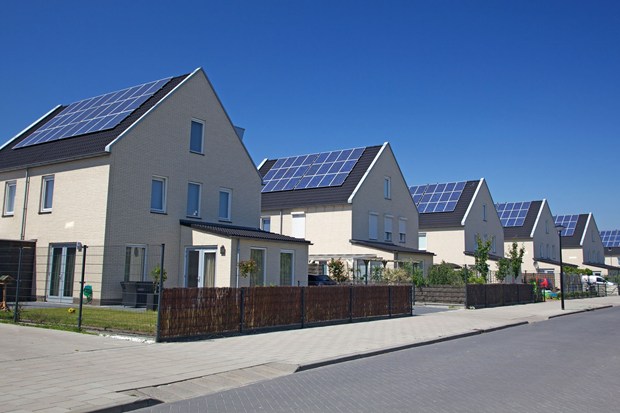
The six houses that make up the “eco hamlet” of Pentre Solar look and feel very different. They are built using light, bright timber sourced from a nearby valley. The houses are carefully insulated, airtight and powered by solar panels.
Over the next few weeks the first tenants, local people from Pembrokeshire county council’s housing list, will move into what is being billed as the only development of its kind in the UK.
Their fuel bills are expected to be a fraction of their neighbours’ – and they will even get the use of a shared electric car for the school run, the shopping trip to nearby Cardigan, or even for a jolly to one of the many glorious local beaches…….
If the project, which has been backed by the Welsh government, does work, the hope is that similar developments could be rolled out across Wales and eventually across the UK.
Western Solar’s first venture was a solar farm, five miles from the eco hamlet. Doubts that it was sunny enough in this part of the British Isles (after all, the nearby village of Eglwyswrw made headlines last year after it rained for more than 80 days in a row) proved unfounded and the project thrived…….
Using technology borrowed from Germany, Western Solar built a prototype eco home called TŷSolar (Tŷis Welsh for house). The idea was to produce a high-quality, brilliantly insulated, airtight house made of locally sourced timber and powered by solar energy…….
GM Commits to 100 Percent Renewable Energy by 2050 15.09.2016 GM pledges to source global electricity from wind, sun and landfill gas, joins RE100
DETROIT – General Motors plans to generate or source all electrical power for its 350 operations in 59 countries with 100 percent renewable energy — such as wind, sun and landfill gas — by 2050.
“Establishing a 100 percent renewable energy goal helps us better serve society by reducing environmental impact,” said GM Chairman and CEO Mary Barra. “This pursuit of renewable energy benefits our customers and communities through cleaner air while strengthening our business through lower and more stable energy costs.”
This new renewable energy goal, along with the pursuit of electrified vehicles and efficient manufacturing, is part of the company’s overall approach to strengthening its business, improving communities and addressing climate change. GM is also joining RE100, a global collaborative initiative of businesses committed to 100 percent renewable electricity, working to increase demand for clean power.
In 2015, GM required 9 terawatt hours of electricity to build its vehicles and power its offices, technical centers and warehouses around the world. To meet its new renewable energy goal, GM will continue to improve the energy efficiency of its operations while transitioning to clean sources for its power needs.
Today GM saves $5 million annually from using renewable energy, a number it anticipates will increase as more projects come online and the supply of renewable energy increases. In addition, the company anticipates costs to install and produce renewable energy will continue to decrease, resulting in more bottom-line returns.
The investment will create over 13 million jobs in the sector, the National Energy Administration (NEA) said in a blueprint document that lays out its plan to develop the nation’s energy sector during the five-year 2016 to 2020 period.
The NEA said installed renewable power capacity including wind, hydro, solar and nuclear power would contribute to about half of new electricity generation by 2020.
China’s Green Energy Push
The agency did not disclose more details on where the funds — which equate to about $98 billion each year — would be spent.
The investment reflects Beijing’s continued focus on curbing the use of fossil fuels, which have fostered the country’s economic growth over the past decade, as it ramps up its war on pollution.
Last month, the National Development and Reform Commission (NDRC), the country’s economic planner, said in its own five-year plan that solar power would receive 1 trillion yuan of spending, as the country seeks to boost capacity by five times.
The spending comes as the cost of building large-scale solar plants has dropped by as much as 40 per cent since 2010. China became the world’s top solar generator last year.
Israel to build world’s tallest solar tower in symbol of renewable energy ambition, Independent, 5 Jan 17 With Israel traditionally running its economy on fossil fuels, renewable energy has long been hobbled by bureaucracy and a lack of incentives. In sunny Israel, solar energy supplies only a small percentage of the nation’s power needs, leaving it far behind countries with cloudier and colder climates.
Now the fledgling solar industry is trying to make a leap forward with a large-scale project boasting the world’s tallest solar tower, as a symbol of Israel’s renewal energy ambitions.
The country is starting to make an effort, setting a goal of generating 10 percent of its energy from renewable sources by 2020, up from the current 2.5 percent.
The Ashalim project, deep in the Negev desert, is made up of three plots, with a fourth planned for the future, each with a different solar technology. Together, the fields will be Israel’s largest renewable energy project when completed by 2018. They are set to generate some 310 megawatts of power, about 1.6 percent of the country’s energy needs — enough for about 130,000 households, or roughly 5 percent of Israel’s population, according to Israel’s Electricity Authority. …….
Another solar-thermal plot at Ashalim will be able to store energy even when the sun goes down. A third plot will use photovoltaic solar technology to produce energy.
Yaron Szilas, CEO of Shikun & Binui Renewable Energy, the lead developer of the second solar-thermal plot, said combining the three technologies was a wise move because each has its own advantage. The amount of electricity it produces will be comparable to large-scale solar fields in California and Chile……..
Israel has developed some of the world’s most advanced solar energy equipment and enjoys a nearly endless supply of sunshine. But Israeli solar companies, frustrated by government bureaucracy, have mostly taken their expertise abroad.
Countries with cooler climates have outpaced Israel. Germany, for example, gets nearly 30 percent of its energy from renewable sources.
Tesla Flips the Switch on the Gigafactory Musk meets a deadline: Battery-cell production begins at what will soon be the world’s biggest factory—with thousands of additional jobs. Bloomberg, by Tom Randall January 5, 2017 The Gigafactory has been activated.
Tesla’s solar roofs could revolutionize the industry
Hidden in the scrubland east of Reno, Nev., where cowboys gamble and wild horses still roam—a diamond-shaped factory of outlandish proportions is emerging from the sweat and promises of Tesla CEO Elon Musk. It’s known as the Gigafactory, and today its first battery cells are rolling off production lines to power the company’s energy storage products and, before long, the Model 3 electric car. 1
The start of mass production 2 is a huge milestone in Tesla’s quest to electrify transportation, and it brings to America a manufacturing industry—battery cells—that’s long been dominated by China, Japan, and South Korea. More than 2,900 people are already working at the 4.9 million square-foot facility, 3 and more than 4,000 jobs (including temporary construction work) will be added this year through the partnership between Tesla and Panasonic. 4
By 2018, the Gigafactory, which is less than a third complete, will double the world’s production capacity for lithium-ion batteries and employ 6,500 full-time Reno-based workers, according to a new hiring forecast from Tesla. The company’s shares, having touched their highest point since August, closed up $10 at $226.99 in New York trading.
The full activation of the Gigafactory carries existential significance for Tesla, representing a new sense of urgency at a company known for its unreachable deadlines. After missing almost every aggressive product milestone it set for itself over the last decade, Tesla must prove to investors and customers that it can stay on schedule for its first mass-produced car.
There are promising signs. ………
The storage products fit into Musk’s long-term vision of transforming Tesla from an an electric car company to a clean-energy company. That’s the same motivation behind his recently concluded deal to acquire SolarCity Corp., the largest U.S. rooftop solar installer. Last week, Tesla reached a deal with Panasonic to expand its relationship to produce solar cells in Buffalo, N.Y., bringing some 1,400 jobs to the region.
At a time when President-elect Donald Trump has taken to Twitter to skewer manufacturers for moving jobs to Mexico or China, Tesla stands apart as an all-American carmaker, battery maker, and solar producer. About 95 percent of the Model 3’s components will be made in the U.S., and 25,000 of the company’s 30,000 employees are based there. Musk, who visited Trump recently in New York City, was named to a strategy group to advise the new Republican president. ……. https://www.bloomberg.com/news/articles/2017-01-04/tesla-flips-the-switch-on-the-gigafactory
State of The Transition, December 2016: As fossil fuel diehards take over The White House, the evidence of a fast-moving global energy transition has never been clearer Jeremy Leggett, January 3, 2017 As captains of the fossil fuel industries and their lobbyists prepare to take over the White House – appointed by a President elected by a minority, claiming to represent the people on an anti-elite ticket yet possessing by far the highest cumulative wealth of any cabinet ever – they will face evidence breaking out all around them of a fast-moving global energy transition threatening to strand the fossil fuels they seek to boost.
“World energy hits a turning point”, a Bloomberg headline read on 16th December. “Solar power, for the first time, is becoming the cheapest form of new electricity,” the article marvelled. Analysis of the average cost of new wind and solar in 58 emerging-market economies – including China, India, and Brazil – showed solar at $1.65 million per megawatt and wind at $1.66.
Google leads the giant corporations eagerly going with this flow. The largest corporate buyer of renewable energy announced on 6th December that it expects to hit its target of 100% renewable power in, wait for it, 2017. Google is a huge consumer of power, and going solar means deep emissions cuts, especially when solar infrastructure is hooked up with all the digital efficiency-enhancement fandangoes that Silicon Valley giants are zeroing in on in the fast emerging era of artificial intelligence in an internet of things.
Google’s emissions reductions will be meaningful even considering full product life cycles. Solar panels made today pay back the energy used to make them in little more than a year, a Belgian research team from the University of Louvain reported in December. “For every doubling of installed photovoltaic capacity”, Atse Louwen and his colleagues write, “energy use decreases by 13 and 12% and greenhouse gas footprints by 17 and 24%, for poly- and monocrystalline based photovoltaic systems, respectively.” This means that solar panels now return more energy than American oil: an average energy-return on energy-invested of around 14 (and rising) versus around 11 (and falling).
This is excellent news not just for rich Californians but for the developing world, where “solar lanterns and rooftop photovoltaics are becoming the energy of choice”, so Bloomberg reported. In India, “the millions not connected to the grid may never connect” now, dooming much coal to be stranded underground in the process. The cumulative market of new Indian households accessing small-scale energy is potentially 200 gigawatts, with only a tiny fraction currently served.
In Myanmar the government needs no further persuasion: it announced plans to bring solar to all as soon as 2030. The technical advances in batteries and electric vehicles also became ever clearer in December. “Diesel faces global crash as electric cars shine”, the Financial Times announced. According to a UBS report, this whole category of oil use will be gone from the global market within ten years.
The positives of EVs synergise with the negatives of air pollution to create a perfect storm for diesel. At the C40 cities summit, Paris, Mexico City, Madrid and Athens all vowed to ban diesel vehicles by 2025. In China, the worst air pollution this year put 24 cities on red alert, with schools shut and flights grounded. Half a billion people were affected by this “airpocalypse”. In Chengdu, protestors took to the streets, putting smog masks on statues in the city centre. A heavy handed response by the police suggested that the government is super-sensitive to this issue.
Which is not to say that the Chinese authorities aren’t trying to abate the problem at source. I have summarised their rapid advances in renewables in earlier monthly reports. This month, a presentation in London by Zhang Gang, Counsellor of the State Council of China, revealed that China’s efforts to use electricity more efficiently, cutting the need for coal, now involve 317 million smart meters in operation across 100% of urban areas and 70% of rural areas. These are hooked up in smart co-ordination, spanning all aspects of grids, at all scales, in a vast project involving 230 million users. Part of this co-ordination involves China’s first expressway fast-charging EV network, stretching for 1,262 km between Beijing and Shanghai.
No other country comes remotely close to this kind of smart-grid deployment. On 12th December, the International Energy Agency issued a report concluding that China’s coal fired power plants “make no economic sense”. Small wonder.
India is on a similar rapid transition path. On 12th December the Central Electricity Authority announced that India does not need more coal-based capacity addition until 2022. The Authority now plans for non-hydro renewables to meet 43% of electricity as soon as 2027. Such an ambition would have been inconceivable until recently. On 20th, Bloomberg analysed the widening gap between projected and actual demand in the world’s third largest emitter, and put their conclusion in an encouraging headline: “India’s energy forecasts are falling short and climate could win.”
What are investors to make of all this? Well, it is rare for a report to hold the potential to change the world. But one published on 14th December did. The Recommendations of the Task Force on Climate-related Financial Disclosures (TCFD) aim to give investors, lenders and insurers visibility of how climate-change risk will affect individual businesses, and a roadmap for reacting to it. The report presents the results of a year of deliberations by 32 representatives of companies with market capitalisation of $1.5 trillion and financial institutions responsible for assets of $20 trillion. Their intention is for the capital markets to behave consistently with the aims of the Paris Agreement on climate change, which is to say progressively retreat from fossil fuels, and increasingly favour clean-energy investments, not least renewables………..
How has Big Energy coped on the transition frontier as 2016 came to a close? Two snapshots. The utility industry continues to be split into companies seeking to defend the fast shrinking status quo, and those now rushing to be part of the new world. One of the latter, Engie (formerly GdF Suez) announced that it sees the oil price falling to $10 as a result of current trends in energy markets, and the wave of clean-energy investments it and other major corporates are making. That would be interesting, should it transpire. For example, on 1st December BP gave the green light to a $9bn investment in a deepwater oilfield, rather appropriately named Mad Dog 2, due onstream (cue laughter, based on the industry’s record of delivering major projects on time) in 2021. Good luck to them in recouping their investment if Engie’s view of the world comes to pass.
My conclusion, as the new year begins, is that the global energy transition is progressing faster than many people think, and is probably irreversible. Trump’s prospects of resurrecting coal, and giving the oil and gas industry the expansionist dream ticket most of it wants, are very low.
There is a caveat, of course: that he doesn’t manage to blunder into a world war. All bets would be off then.
China is also seeking market dominance in clean energy technology.
The nation’s ambient air pollution and its greenhouse gas emissions would both decline if China could produce more electricity using clean renewables rather than relying on coal. It has been the largest producer of solar photovoltaic cells in the world since 2007, and overtook Germany as the nation with the largest installed photovoltaic capacity in 2015.
As the price of renewable power equipment declines, the law of demand predicts that more U.S. companies will go green.
In mid-November, while Americans were preoccupied with election returns, China sent some of its clearest signals yet that it will continue to pursue an international leadership role on issues including climate.At an international climate change summit in Marrakech, the Chinese government reasserted its commitment to reduce its greenhouse gas emissions. The government announced that its aggregate emissions will peak by 2030 or earlier, and that its emissions per dollar of economic output will decline sharply.
For 25 years I have taught my economics students that climate change represents the ultimate “free rider problem.” To slow global climate change, we need to reduce aggregate global emissions.
Yet each individual nation’s efforts are too small to “solve” the problem, so it has only weak incentives to take costly mitigation actions, and strong incentives to “free ride” on the benefits of emission reductions by other countries.
Why, then, is China is pressing ahead with low-carbon initiatives?
My research suggests several motives. Chinese leaders want to improve the quality of life in their nation’s cities by reducing air pollution; win large shares of promising export markets for green technologies; and increase China’s “soft power” in international relations.
Taking aggressive action to cut carbon emissions helps China in all three areas.
Reducing Coal’s Cruel Impacts
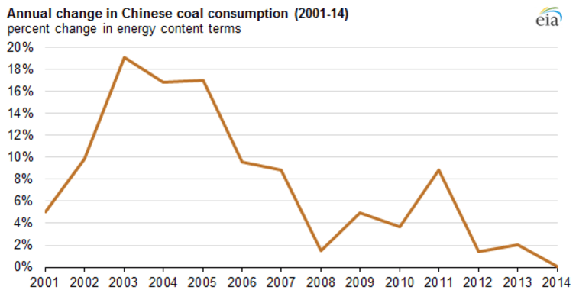
Much of the staggering rise in China’s carbon dioxide emissions in recent decades came from burning coal to produce electricity for the nation’s industrial sector. While this growth has created millions of jobs and wealth for the nation, coal-fired power plants are major sources of greenhouse gases and conventional air pollutants that affect millions of people.
Using data from around the world, economists have found that when countries develop economically they move up an “energy ladder.”
The richer a country grows, the more likely it is to swap out cheap polluting fuels in favor of cleaner, more expensive fuels. A natural experiment that occurred in Turkey as natural gas pipelines were built throughout the nation between 2001 and 2014 showed as people gained access to natural gas, air quality improved and mortality rates declined.
China has more coal than natural gas resources, but as its citizens grow wealthier, their willingness to pay to avoid pollution increases. This trend will encourage substitution toward cleaner fuels. As such, China’s political leaders will likely prioritize policies that substitute natural gas for coal, which should reduce air pollutants and greenhouse gas emissions……….
China is also seeking market dominance in clean energy technology.
The nation’s ambient air pollution and its greenhouse gas emissions would both decline if China could produce more electricity using clean renewables rather than relying on coal. It has been the largest producer of solar photovoltaic cells in the world since 2007, and overtook Germany as the nation with the largest installed photovoltaic capacity in 2015.
U.S industrial regulators have accused China of engaging in predation and dumping low-cost solar panels that compete with U.S products.
But environmentalists should cheer that potential buyers in importing nations now face lower prices — especially global companies like Wal-Mart which are pledging to shrink their carbon footprints. As the price of renewable power equipment declines, the law of demand predicts that more U.S. companies will go green.
There is a key synergy between electric vehicles and green power generation.
For decades, the world’s media have portrayed China as a bully and trade cheat abroad and a repressive power at home. In cutting carbon emissions, the Communist Party seeks to boost its own political legitimacy in the international arena as well as with the Chinese people.
By committing to pursue ambitious environmental goals, Chinese leaders hope to signal to both domestic constituents and international actors that China is an international leader and cares about its own people. A “leading nation” plays an active role in international relations, helps to keep the peace and promotes global public goods.
New Arizona Policy Would Mandate Solar After Dark, Clean Technica December 30th, 2016 by Susan KraemerA way to incentivize the use of clean energy like solar after dark — instead of gas peakers — to cover peak loads has been proposed in a white paper commissioned by Arizona’s Residential Utility Consumer Office, through a revision of state Renewable Energy Standards (RES).
Co-author Lon Huber, a Director with Strategen Consulting, was tasked with inventing a solution to the duck curve.
Huber told Utility Dive this week that his proposed Clean Peak Standard (CPS) should push developers to cover the need for generation at specific — peak — times.
“It adds more renewables, but it adds renewables when the system most needs capacity so it uses renewables to deal with system cost drivers and saves ratepayers money when electricity prices are highest.”
Under a Clean Peak Standard, during an identified peak demand period, a solar contract would have to deliver a percentage of its generation between certain — peak — hours.
A 25% CPS for example would mean that 25% of MWh generated during the identified peak demand period would have to be from “qualifying clean peak resources.” Currently, coal or gas peaker plants provide that peak generation.
So How Would Solar After Dark Work?
While so-called “spilled solar” at midday is already a concern, there are slim pickings so far in covering the evening peak with solar generation: battery storage or thermal solar.
It is in Arizona, where the largest US dispatchable solar after dark project is sited, that this proposal is being considered. Solana is a thermal solar plant with the most energy storage in the US after pumped hydro — 1,680 MWh daily.
Arizona, along with Nevada, has been at the forefront of the battles over net-metering between utilities and rooftop solar, that hinges on too much solar by day, increasing the duck curve after dark.
Just this week the Arizona Corporation Commission (ACC) approved a drastic drop in net metering rates to shadow average utility-scale solar rates. Since utility-scale solar wholesale prices are much lower than rooftop prices, due to efficiencies of scale, that is a huge blow to rooftop in the state.
The decision “balances the economic benefits of grid-scale solar — which provides clean power to all of our customers at far less cost — with the desire of some customers to install solar on their rooftops,” said Arizona Public Service (APS) in a written statement.
Peak Loads are After Dark Now
Arizona is far from the only state trying to work out an arrangement that is fair to both utilities and those who invest in their own rooftop solar. …….
A thermal solar project like Crescent Dunes in Nevada can generate solar at any time of day or night, from stored solar energy in tanks of molten salts.
This Clean Solar Peak policy valuing stored clean energy is one foreseen by Nancy LaPlaca, who was Policy Advisor to former Commissioner Paul Newman at the ACC when it approved the solar storage contract between APS and Solana in 2013.
“We are underestimating the value of storage, as well as grid security,” she said to me at the time. “If the grid goes down in Phoenix on a very hot day, we will see the value of local storage that doesn’t depend on a long transmission line.”https://cleantechnica.com/2016/12/30/new-arizona-policy-mandate-solar-dark/
US Doubles Down On Wave Energy, $40 Mil For New Test Bed, Clean Technica December 31st, 2016 by Tina CaseyIt looks like the US is about to get much, much more serious about developing its vast wave energy potential. Researchers have been working at several relatively modest sites in Hawaii and the Pacific Northwest, and now the Energy Department has announced funding for a new, $40 million utility scale test site in the waters of the continental US, off the coast of Oregon.
Why Wave Energy?
The new wave energy test site will be built and operated under the auspices of Oregon State University’s Northwest National Marine Renewable Energy Center.
In a press release announcing the plan to invest up to $40 million in the nation’s first utility scale wave energy test site, the Energy Department noted that more than half of the population of the US lives within 50 miles of a coastline.
All things being equal, coastal populations are expected to grow, but getting zero emission energy to coastal regions is becoming more complex and difficult. Aging coastal nuclear power plants will most likely not be replaced, and population density limits the potential for utility scale wind farms and solar arrays on land.
Another limitation for land-based renewable energy in coastal areas is the need for new long distance transmission lines. Plans have been in place for years to bring wind power from the wind rich midwest to points east, but the new lines have had to battle against fossil fuel interests as well as local stakeholders.
One solution is to tap the waters of the US coastlines.
That’s beginning to happen in the wind energy sector on the east coast, where the relatively shallow waters of the Continental Shelf are amenable to offshore wind turbine technology.
The nation’s first offshore wind farm just went online off the coast of Rhode Island, and the Obama Administration has mapped out an ambitious plan to harvest wind energy all along the eastern seaboard. It looks like New York State’s Long Island is next in line for development.
The west coast is a different kettle of fish. The Continental Shelf drops off quickly, and the waters are too deep for conventional offshore wind turbines to be set on the ocean floor.
As a solution, the Energy Department has been pumping some significant dollars into R&D to commercialize floating wind turbines.
With the new investment of $40 million the agency appears to be broadening its focus to accelerate wave energy development, too.
The payoff could be huge, so to speak: Recent studies estimate that America’s technically recoverable wave energy resource ranges between approximately 900–1,230 terawatt hours (TWh) per year…For context, approximately 90,000 homes can be powered by 1 TWh per year. This means that even if only a few percent of the potential is recovered, millions of homes could be powered by wave energy as the technology progresses.
The New Wave Energy Test Facility
The new facility will be called the Pacific Marine Energy Center South Energy Test Site. Along with federal dollars, unspecified non-federal funding will go into the construction………
We’ve seen a lot of commentary on the fact that utility-scale solar power has become the least expensive source of electricity in many places. There is more than that to be found in the data inLazard’s Levelized Cost of Energy Analysis, Version 10.0, however, and what it tells us is that solar and wind power have benefits apart from the simple facts that their costs are low.
We have always needed a variety of power sources. Conventional baseload power provided by coal-burning and nuclear plants lacks flexibility and is, in fact, a really bad match for grid demand. Baseload generation cannot be ramped up or down as demand changes, and this is one reason why such power plants never provided all of our electricity. There always had to be other, more flexible generating facilities available.
The greatest need for power is often on warm, sunny afternoons, when air conditioners are running in work spaces, stores, and homes, in addition to normal human activities. These have been the times when peaking plants could make their money. With high demand, come the high prices they need to be profitable.
As solar photovoltaics (PV) have come on the market in quantity, however, sunny afternoons suddenly bring the sun as a competing power source. The early evening, after the sun has gone down, is still potentially a time of high demand, when solar power does not cut into the use of fossil-fuel peaking plants. This situation, however, is clearly coming to an end.
According to Lazard, the levelized cost of utility-scale solar power with storage is $92 per megawatt-hour (MWh). This means that solar-plus-storage can be highly competitive, even after dark, with natural gas peaking plants, which have levelized costs ranging from $165 to $217 per MWh. It is even competitive to a degree with gas-powered reciprocating engines, whose costs are from $68 to $101 per MWh.
There is more to this story, however. It happens that wind power is usually strongest when the sun is not shining brightly, and solar power output is often highest when the wind does not blow much. A storage system that is charged by the sun could be charged by the wind when the sun does not shine. This means that a solar-plus-storage system can be made more valuable by storing excess power from wind as needed.
The fact that power from solar-plus-storage is becoming relatively inexpensive makes it likely that the combination will increasingly be used instead of peaking plants using fossil fuels. This will increase production of batteries, and it will increase research and development into storage technologies. And these changes imply further reductions in costs.
The declines in costs of energy storage have already been impressive. Tesla lithium-ion batteries are delivering about double the amount of electricity that they had been providing when they were first introduced, and their cost has not increased appreciably. This implies that the cost of the electricity from them has been roughly halved. Other battery technologies have alsoseenexciting developments. For example the ViZn flow battery shows a number of improvements over earlier designs at considerably lower costs. Salt water batteries, such as those from Aquion Energy, alsocome to mind. As fast as the price of electricity from solar PVs has been dropping, we should not be surprised if the costs of solar-plus-storage or wind-plus-storage drop considerably faster.
There are other advantages implicit in adding storage to the power supply. One is that the power can be ramped up or down much faster than it can be with conventional approaches to equipment. Power demands on batteries and some other storage solutions can be ramped up or down in fractions of a second.
Indeed, the storage component moves us into a situation where solar and wind, with support from other types of renewable energy, can take on larger baseload power systems. Clearly, if utility-scale solar + storage = $92/MWh, it will always be less expensive than the $97 to $136 per MWh cost of nuclear power. It is competitive with power from coal. The only fossil fuel remaining in Lazard’s analysis that is clearly less expensive than solar-plus-storage is combined cycle natural gas, with a costrange of$48 to $78 MWh, and we have no guarantees those prices will last. And remember, this is not solar power alone, but solar with energy storage.
We seem to be moving into a new age, and it is not merely an age when the sun and wind provide the least expensive power we have. It is an age when the sun and the wind may replace baseload power altogether, not only as the least expensive solution, but as the best general solution. And we might come to that faster than we dreamed possible.
Trump: “I have a problem with wind” https://blog.bulb.co.uk/trump-wind-problem/by haydenNovember 2016 In a recent interview with the New York Times, President-elect Trump claimed there are three reasons to oppose wind power. Perhaps unsurprisingly, we disagree with each of them. We thought we’d break them down and add some facts to a discussion that threatens to undermine one of the most important global efforts of our time.
Here are Trump’s three main points:
Wind turbines kill birds (even the golden eagle)
Wind turbines are bad for the atmosphere due to their steel construction
Energy from wind isn’t commercially viable
You can read the full transcript of the NYT interview here but here’s an excerpt:
TRUMP: The wind is a very deceiving thing. First of all, we don’t make the windmills in the United States. They’re made in Germany and Japan. They’re made out of massive amounts of steel, which goes into the atmosphere, whether it’s in our country or not, it goes into the atmosphere.
The windmills kill birds and the windmills need massive subsidies. In other words, we’re subsidizing wind mills all over this country. I mean, for the most part they don’t work. I don’t think they work at all without subsidy, and that bothers me, and they kill all the birds. You go to a windmill, you know in California they have the, what is it? The golden eagle? And they’re like, if you shoot a golden eagle, they go to jail for five years and yet they kill them by, they actually have to get permits that they’re only allowed to kill 30 or something in one year. The windmills are devastating to the bird population, OK.
With that being said, there’s a place for them. But they do need subsidy. So, if I talk negatively. I’ve been saying the same thing for years about you know, the wind industry. I wouldn’t want to subsidize it. Some environmentalists agree with me very much because of all of the things I just said, including the birds, and some don’t. But it’s hard to explain. I don’t care about anything having to do with anything having to do with anything other than the country.
We wouldn’t normally include such a long quote, but we thought you’d enjoy President-elect Trump’s turn of phrase in its full, unfiltered glory.
Bird protection groups are in favour of wind
To quote the Royal Society for the Protection of Birds; “the RSPB supports a significant growth in offshore and onshore wind power generation in the UK”. It couldn’t be put more succinctly than that.
Climate change is set to have a devastating impact on the environment, which is a far greater threat to birds than wind farms. Of course, governments and wind farm investors should do all they can to minimise the danger to birds. However, this is not a significant hurdle. The RSBP scrutinises hundreds of UK wind farm applications each year, and 94% of those are safe enough for the RSPB to give their blessing.
Steel, of course, takes energy to produce. However, the carbon cost of this energy is dwarfed when other factors are taken into consideration. We can do this by considering the lifecycle carbon emissions associated with each type of electricity generation. This is a common method used to compare technologies on an environmental basis and is recommended by bodies such as Defra because it considers the full impact of each technology by calculating the emissions associated with it from cradle to grave, not just the period where it’s generating electricity.
Over the course of its lifetime, a wind turbine will produce 400 times less carbon per kWh than coal. A study conducted by the Intergovernmental Panel on Climate Change (IPCC) in 2014 put the median carbon cost of onshore wind at an equivalent of 11 grammes of CO2 per kWh over its lifetime. Which is similar to nuclear, hydro, solar and a lot lower than the 820 grammes per kWh of Mr Trump’s beloved coal power.
You can read the full IPCC report here. The key figures are on the right-hand side of page seven.
Wind is commercially viable
The cost of wind per unit of electricity is already on par with the likes of new-build coal and nuclear. According to Lazard Investment Bank, coal costs $65-150 per MWh, compared to $32-77 for wind. This cost advantage already gives wind the edge over coal, before the carbon cost is even considered. It’s easy to criticise wind, claiming the supply is unreliable and dependent on the weather, but this is solved through energy storage. When Denmark was generating 140% of its energy needs through wind power, it simply exported it to be stored as potential energy in Germany and Sweden’s hydro dams.
Plus, the efficiency of wind power is improving at a rate of knots. Bloomberg New Energy Finance estimates the cost of wind will decrease by 19% for every doubling of installed capacity. By comparison, the cost reduction for existing technologies, like coal, is a fraction of a percent.
How much can Trump actually change?
Experts aren’t yet in agreement about the extent to which Trump will be able to reverse recent climate change policy. He could repeal President Obama’s executive orders, which he seems set to do. This would likely move US climate policy decisions from national decision makers to individual states. When Reagan starved the EPA of funding in the 1980s, most policies were made at the state level, rather than federal.
Perhaps the biggest concern, though, is Trump’s inconsistency. He has shown a willingness to reverse direction, which makes it difficult to know quite what’s going to happen. He has previously stated he would pull out of the Paris agreement. But in the New York Times interview above he said he would just “take a look at it.” Everyone is closely watching this space. As Trump tells us, he’s a businessman, so it’s possible he may end up seeing the benefits of new and competitive technology.
Over the past three days wind power accounted for 26 percent of total electricity consumption, almost as much as six nuclear power plants, says Anders Enqvist, Director of Risk Management at Bixia.
Sweden currently has three nuclear plants with ten nuclear reactors in commercial operation, making it the only country in the world that has more than one reactor per million inhabitants, says the Swedish Institute.
In 2015 Sweden added 200 more wind turbines. More wind blows in Sweden during the winter.
Solar leading the charge in Mexico’s clean energy push BN Americas By Adam Critchley – Tuesday, December 27, 2016 Mexico’s installed solar capacity is expected to increase 20-fold by 2019 to 5.4GW, the energy ministry (Sener) said.
Key growth drivers are two supply auctions held in March and September, which will result in 1,691MW and 1,853MW being added, respectively.
Solar dominated the September auction, accounting for 54% of electric power sold and 53% of clean energy certificates (CEC) issued. It was followed by wind with 43% of power and 41% of CECs. Hydroelectric and geothermal accounted for 3% of power and 2% of CECs, respectively.
Mexico’s solar PV capacity is expected to grow 275% this year, or by 390MW, US consultancy GTM Research has said.
Mexico’s installed clean energy capacity grew 6.3% year-on-year in June to 20.2GW, and these types of sources now account for 28.4% of the country’s energy generation mix, Sener said.
Growth has so far been led by wind and co-generation. Wind power capacity is expected to triple over the coming years, largely due to the development of the projects awarded contracts in this year’s auctions. Wind power capacity is expected to total 2,456MW by the end of 2018 and 3,857MW by the end of 2019.







 nuclear-news