Busting the nuclear lobby’s lies about renewable energy: its faster, and more scalable than nuclear
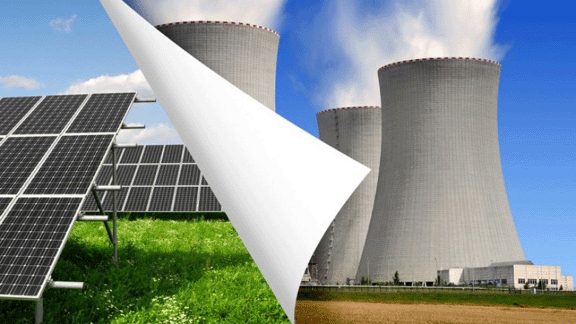 Renewable Energy Is Much Faster To Install & More Scalable Than Nuclear Power https://cleantechnica.com/2018/01/28/renewable-energy-much-faster-install-scalable-nuclear-power/ January 28th, 2018 by Jake Richardson
This article is part of our “CleanTechnica Answer Box” collection. For some reason, there are certain anti-cleantech talking points that get thrown around over and over again that are absolute bunk. We got tired of dealing with the same myths repeatedly and also saw that many other people could use some support responding to these untruths — in discussions on CleanTechnica and elsewhere. So, at the suggestion of a reader, we created this resource in the same vein as Skeptical Science’s responses to global warming & climate change myths.
Myth: We need to build more nuclear power if we want to cut electricity emissions quickly and turn off coal and natural gas power plants.
Short answer: Renewables can grow fast because they can be installed practically everywhere rapidly and simultaneously. Renewable capacity in the magnitude of 1 TW can in principle be added every year. Germany installed 3 GW of PV in one single month in December 2011. Germany has roughly 1% of the world’s population. So, if the entire world installs only 20% the amount of PV that Germany did 5 years ago, it would be at 720 GW per year. At a single utility-scale-PV plant, 120 MWp per month was installed. If only 10% of all cities worldwide installed utility-scale-solar at this scale at the same time, it would lead to approximately the same number just for utility-scale-solar (the world has 4,412 cities with a population of at least 150,000). In fact, if the world only installs one PV module per person per year, this already leads to 1,850 GW per year. Nuclear power plants, meanwhile, take several years to build — and are much more expensive.
One major advantage renewable energy has over nuclear power (and fossil fuels) is that it can typically be installed much faster. Nuclear power plants can require 5–15 years to complete and some have taken 20 or more. (Constructing a new coal power plant cantakes 4 years or more. Building a new gas-powered plant generally takes several years as well.)
Installing a solar power farm can be completed in a number of months, depending upon the size and complexity of the project. Obviously, the much larger ones will require more time, but even they often can be finished in a year or less.
The same is true of wind farms. A 10 MW wind farm can be built in about 2 months and a 50 MW in approximately 6 months.
The speed at which renewables can be built and made operational is impressive. In the year 2017 alone, China installed about 52 GW of solar power. When it comes to wind power, China may install about 403 GW over the next 10 years. As with a large number of any type of construction project, the limiting factor in speed is generally one of financing, will, and labor, and that is certainly no less true with highly distributed wind and solar power projects.
The cost of renewables will likely continue to decrease with greater adoption and acceptance, especially as fossil fuel usage declines. Greater demand and adoption can spur further innovation to make renewables even more efficient, which enhances their effectiveness and the speed at which you can get large amounts of power onto the grid. With renewables, it is possible to have a virtuous cycle which drives increasing affordability and performance, whereas with fossil fuels we have a vicious cycle of climate change emissions, air pollution that harms and kills humans, rising seas, more severe weather, massive coral die-offs, and the contamination of air, soil, water, and food. Nuclear power costs, meanwhile, have risen in recent decades and are priced out of any free market or semi-free market.
Another advantage is that installing solar and wind power is not nearly as dangerous as building a nuclear or coal power plant. In India, an accident at a construction site for a new coal plant killed 32 people and injured many others. A similar accident in China killed 74. Installing solar power and wind power farms almost never results in fatalities.
Renewable energy is more scalable and a better fit to address global warming than nuclear because it costs much less, takes less time to install, and doesn’t carry the burden of potentially causing catastrophic damage — which also comes with sophisticated safety guards that take much time to implement, monitor, and keep up to date.
Electricity produced from sunlight and wind are scalable because these sources are abundantly available and will never run out. In order to combat climate change, we all need clean, renewable energy that can be quickly built and put into operation, but that will also never run out of the primary fuel source.
Another reason why renewables are scalable is their portability and ability to fit the scale needed, no matter how small or how large. Renewable energy systems can be sized precisely to the needs, whether at the small scale where people might use diesel generators or at the gigawatt scale. Community solar projects only require a capital investment and some land near the place where the electricity will be used. Renewables can easily power one community, one home, or even one device (like a light). Consumers can get solar power systems for their RVs, vans, or boats as well.
Because solar power costs have declined dramatically, more and more homeowners are going solar, and they will save money over the long term. (Home energy storage is making this scenario feasible for even more homeowners year by year.) While individual projects are not notable amongst a large grid and generation fleet, the aggregation of small projects that can go up in a matter of weeks or months is considerable.
On a bit of a larger scale, many companies are choosing to install solar power for cost-saving as well as environmental reasons and have shown that sensible, fast renewable energy installations can save huge amounts of money. Again, these projects can go up in a matter of weeks or months — unlike nuclear — and the aggregate of them means a large and quick increase in the amount of clean power on the grid. There’s a reason or two why large corporations don’t install nuclear power plants instead.
Mainstream American companies like PepsiCo, General Motors, Apple, Facebook, Amazon, and Walmart have been using more renewable energy and saving billions of dollars in the process while cleaning up the air and atmosphere.
Renewable energy can be employed by just about anyone at any time if they have the means to do so. Sunlight and wind are free. Installations can be on a watt scale or a gigawatt scale. If we want clean power added to the grid quickly, nothing can come online faster than renewables. In certain places, depending on market penetration and infrastructure, transmission lines or energy storage may be an important complement, but that still doesn’t change that renewables are the quickest option for new and cheap clean power capacity.
UK demand for electricity is falling, not rising
 FT 27th Jan 2018, Electricity Demand Letter: Andrew Warren Chairman, British Energy Efficiency Federation; Your
report “Tough decisions loom on green energy” (January 23) is based on a
false premise. It assumes that demand for electricity will just keep on
rising. Such inexorable growth has always been the official outlook. As
indeed it was a decade ago, when today’s usage level was projected to be up
by 15 per cent or more.
Instead, across 10 years electricity consumption
has dropped by more than 16 per cent, a differential of over 30 per cent
between those forecasts and reality. That dramatic trend has occurred even
without the assistance of any very purposeful drive for greater energy
efficiency – which, as your article grudgingly concedes, is now to be a
prime feature of the prime minister’s new environment policy. That is
surely the best choice to “keep the lights on” of all.
https://www.ft.com/content/cb8471cc-0136-11e8-9650-9c0ad2d7c5b5
Epic crisis in USA’s nuclear industry – Trump’s trying to stop solar power will not save nukes
Trump’s Assault on Solar Masks an Epic Crisis in the Nuclear Industry, The Progressive , by Harvey Wasserman, January 25, 2018 As Donald Trump launches his latest assault on renewable energy—imposing a 30 percent tariff on solar panels imported from China—a major crisis in the nuclear power industry is threatening to shut four high-profile reactors, with more shutdowns to come. These closures could pave the way for thousands of new jobs in wind and solar, offsetting at least some of the losses from Trump’s attack.
Like nearly everything else Trump does, the hike in duties makes no rational sense. Bill McKibben summed it up, tweeting: “Trump imposes 30% tariff on imported solar panels—one more effort to try and slow renewable energy, one more favor for the status quo.”………
the burgeoning U.S. market for cheap Chinese panels has birthed a very large industry. More than a quarter-million Americans now work in photovoltaics, with most of the jobs in building desert arrays or perching the panels on rooftops. Except for the very marginal pressure from Suniva and SolarWorld, solar advocates have focussed on the rapid spread of low-cost panels, even if they come from China.
Powered largely by Chinese product, the cost of a solar-generated watt of power has dropped from $6.00 in the late 1990s to around $0.72 in 2016. Further drops are considered inevitable. At that price, there is virtually no economic margin for any other new energy production construction except wind and natural gas. Even gas—with its uncertain long-term supply—is on the cusp of being priced out.
Thus, the industry’s reactionto Trump’s solar panel tariff has been fierce.
“We are not happy with this decision,” Abigail Ross Hopper, president of the American Solar Energy Association, told Reuters. “It’s just basic economics—if you raise the price of a product, it’s going to decrease demand for that product.” Trump’s move is predicted to drop upcoming solar installations by 10 to 15 percent and cost some 23,000 jobs.
Sustainable energy professor Scott Sklar, in an email to The Progressive, estimated that Trump’s 30 percent tariff will, after four years, “retard the solar market by 9 percent, cause the loss of thousands of U.S. jobs, and not save the two companies that brought the anti-competitive tariff request initially. The tariff was a political statement to China rather than specifically addressing the health of the U.S. solar industry and increasing U.S. solar jobs.”
Two major developments in the nuclear power industry further illustrate the absurdity of Trump’s decision.
In California, the Public Utilities Commission has gutted a major agreement that would have kept two mammoth reactors at Diablo Canyon operating for several more years. The landmark deal—cut between Pacific Gas & Electric, the host communities around San Luis Obispo, the reactors’ union workers and two environmental groups—called for PG&E to collect some $1.3 billion from ratepayers.
But the California commission cut PG&E’s take to about $300 million. To continue running the two fast-deteriorating old reactors would require massive capital repairs. The company also has admitted that all of Diablo’s power can be otherwise produced with zero- and low-carbon green technologies.
While Trump’s tariffs may slightly alter the math, they’re not expected to make photovoltaics, wind, geothermal, or increased efficiency more expensive than the power Diablo might generate in the coming seven years. Thus, Diablo opponents like Linda Sealey of the San Luis-based Mothers for Peace are extremely hopeful for early shutdowns.
“We think this makes it likely they’ll shut as early as 2020,” she told me January 18 on California Solartopia at KPFK radio in Los Angeles. “They just can’t compete.”
A parallel fate may soon overtake Ohio’s ancient Perry and Davis-Besse reactors on Lake Erie. Because the increasingly decrepit nuclear plants have been priced out of the market and face huge capital repairs, their owner FirstEnergy has been desperately begging the Ohio legislature for massive bailouts, which it has so far resisted. As a result FirstEnergy is poised to go bankrupt, and may soon be bought out by financiers expected to insist the two reactors finally shut. A decision is expected in April.
The shutdown of four more major reactors would be a huge blow to the downwardly spiraling atomic energy industry. California’s booming solar business employs more than 100,000 Americans, more than are currently digging coal nationwide. The void left by Diablo’s shutdown would generate thousands of Golden State jobs and billions in renewable revenue.
In northern Ohio, massive wind potential is also poised to create far more jobs than are currently in place at the two reactors, with energy to be generated far more cheaply. Overall, the closure of these four high-profile plants would thus accelerate the already rapid run away from nuclear power toward renewable sources, regardless of any attempt by the Trump Administration to alter the course.
Harvey “Sluggo” Wasserman’s “California Solartopia Show” is broadcast at KPFK-Pacifica 90.7FM in Los Angeles. His “Green Power & Wellness Show” is podcast at prn.fm. His History of the US and Solartopia! are at www.solartopia.org, which will publish his America at the Brink of Rebirthlater this year. http://progressive.org/dispatches/trumps-assault-on-solar-masks-an-epic-crisis-in-nuclear-180125/
Chernobyl – from nuclear wreck to solar power farm
Chernobyl nuclear power plant transformed into a massive solar plant, http://www.news.com.au/technology/environment/chernobyl-nuclear-power-plant-transformed-into-a-massive-solar-plant/news-story/2d8d365ca1a6a7bde0c75c2372e888ed [excellent graphs and photos]
IT was the site of the world’s worst ecological disaster, but Chernobyl has risen from the ashes of its nuclear meltdown and is undergoing a massive makeover. News Corp Australia Network JANUARY 15, 2018 AT ground zero of Ukraine’s Chernobyl tragedy, workers in orange vests are busy erecting hundreds of dark-coloured panels as the country gets ready to launch its first solar plant to revive the abandoned territory.
The new one-megawatt power plant is located just a hundred metres from the new “sarcophagus”, a giant metal dome sealing the remains of the 1986 Chernobyl accident, the worst nuclear disaster in the world.
“This solar power plant can cover the needs of a medium-sized village”, or about 2,000 flats, Yevgen Varyagin, the head of the Ukrainian-German company Solar Chernobyl which carried out the project, told AFP.
Eventually, the region is to produce 100 times the initial solar power, the company says.
The amount of sunshine “here is the same as in the south of Germany,” says Varyagin.
Ukraine, which has stopped buying natural gas from Russia in the last two years, is seeking to exploit the potential of the Chernobyl uninhabited exclusion zone that surrounds the damaged nuclear power plant and cannot be farmed.
CHERNOBYL EXCLUSION ZONE ‘SUITABLE FOR SCIENCE’
Reactor Number Four of the Chernobyl plant exploded April 26, 1986 and the fallout contaminated up to three quarters of Europe, according to some estimates, especially hitting Russia, Ukraine and Belarus.
Following the disaster, Soviet authorities evacuated hundreds of thousands of people and this vast territory, over 2,000 square kilometres wide, has remained abandoned.
The plant continued to operate the remaining reactors, the last of which was shut down in 2000, ending industrial activity in the area.
People cannot return to live in the zone for “more than 24,000 years”, according to the Ukrainian authorities, who nevertheless argue that a prudent industrial use can be possible again.
“This territory obviously cannot be used for agriculture, but it is quite suitable for innovative and scientific projects,” Ostap Semerak, Ukrainian Minister of the Environment and one of the promoters of placing solar projects in Chernobyl, told AFP in 2016.
The installation of a huge dome above the ruins of the damaged reactor just over a year ago made the realisation of the solar project possible.
Funded by the international community, it covered the old concrete structure which had become cracked and unstable, to ensure greater isolation of the highly radioactive magma in the reactor.
As a result, radiation near the plant plummeted to just one-tenth of previous levels, according to official figures
Even so, precautions are still necessary: the solar panels are fixed onto a base of concrete blocks rather than placed on the ground.
The soil remains contaminated, explains Varyagin, whose group is a joint venture between the Ukrainian firm Rodina Energy Group and Germany’s Enerparc AG.
“We can not drill or dig here because of the strict safety rules,” he says.
Last year the consortium completed a 4.2-megawatt solar power plant in the irradiated zone in neighbouring Belarus, not far from Chernobyl.
Ukrainian authorities offered investors nearly 2,500 hectares (25 square kilometres) for potential construction of solar power plants in Chernobyl.
Kiev has received about 60 proposals from foreign companies — including American, Chinese, Danish and French — who are considering participating in future solar developments in the area, according to Olena Kovalchuk, spokeswoman of the State Administration for the zone of Chernobyl.
Investors are attracted by the price that Ukraine has set for solar electricity, which “exceeds on average by 50 per cent of that in Europe”, Oleksandr Kharchenko, executive director of the Energy Industry Research Center, told AFP
He adds that cheap land and the proximity of the power grids makes Chernobyl particularly attractive, though there is still no rush of western investors to the region.
Safety concerns and Ukraine’s notorious bureaucracy and corruption has put some off.
“It is very important to have guarantees that working in the Chernobyl zone will be safe for those who will be doing it,” says Anton Usov, adviser to the European Bank for Reconstruction and Development (EBRD).
The bank does not currently foresee any investment to Ukraine in this field.
Renewable energy prices rapidly falling, becoming competitive with traditional fuels
 City AM , New York, 13th Jan 2018, Renewable energy to be competitive with fossil fuels by 2020 as prices drop. The cost of generating renewable power is falling at an “unprecedented” rate, and by 2020, all renewable technologies will be price competitive with traditional fossil fuels, a new report says.
Since 2010, the cost of generating power from onshore wind has fallen by around a quarter, while solar photovoltaic (PV) electricity costs have dropped by 73 per cent, according to a report published today by the International Renewable Energy Agency (Irena).
Within just two years years, Irena expects solar energy generation costs to halve, and it said the best onshore wind and solar PV projects could be delivering electricity for an equivalent of 3 cents (2 pence) per kilowatt hour (kWh), or less.
The report said the current cost spectrum for fossil fuel power generation ranges from 5 to 17 cents per kWh. In comparison, all current commercial forms of green energy are expected to generate in the range of 3 to 10 cents per kWh by 2020.
“Turning to renewables for new power generation is not simply an environmentally conscious decision, it is now – overwhelmingly – a smart economic one,” said Adnan Amin, Irena’s director general.
http://www.cityam.com/278717/renewable-energy-competitive-fossil-fuels-2020-prices-drop
China becoming the global leader in renewable energy
Guardian 10th Jan 2018, China is moving towards becoming a global leader in renewable technology as
the US pulls away, a new report has said.
China is the world’s biggest emitter of greenhouse gases and still invests in coal but in recent years
it has become the largest investor in domestic renewable energy. The
country is now on track to lead international investment in the sector,
according to the report by the Institute for Energy Economics and Financial
Analysis (IEEFA).
“As the global transition toward renewables gains pace
and as battery storage and electric vehicles technologies pick up momentum,
China is setting itself up to dominate these sectors globally over the next
several dec ades of this century,” said IEEFA. IEEFA identified a record
high spend of more than US$44bn by China on international takeovers and
projects worth more than $1bn – a 38% year-on-year growth.
https://www.theguardian.com/environment/2018/jan/10/china-on-track-to-lead-in-renewables-as-us-retreats-report-says
How tidal energy could help Japan with its nuclear power problem
Technology advances and plunging costs of cheap renewables make base load nuclear power redundant
Cheap renewables undercut nuclear power
The technology advances and plunging costs of cheap renewables make base load nuclear power redundant. Climate News Network, by Paul Brown, LONDON, 29 December, 2017 – Cheap renewables are mounting a serious challenge to nuclear power, which in 2017 has had a difficult year.
Key projects have been abandoned, costs are rising, and politicians in countries which previously championed the industry are withdrawing their support.
Renewables, on the other hand, especially wind and solar power, have continued to expand at an enormous rate. Most importantly, they have got significantly cheaper.
And newer technologies like large-scale battery storage and production of hydrogen are becoming economic, because they harness cheap power from excess renewable capacity.
This latest trend – the production of hydrogen from excess wind and solar power– raises the possibility of replacing natural gas, at least in part, for domestic heating and cooking and for power stations.
The output from renewables can be stored and balanced out. Base load nuclear power is no longer needed
Many existing gas pipelines and domestic networks are equally capable of taking natural gas, biogas and hydrogen, or a mixture of all three.
The speed with which the transition is taking place has exceeded all official estimates. In favourable locations across the world, including the United States, Europe and India, onshore wind and solar farms are the least expensive way of producing electricity.
Even off-shore wind, five years ago more expensive than nuclear power, has developed so quickly that the latest Dutch off-shore farms are to be built without any subsidy at all.
These advances in renewables that are cutting the cost of power are in sharp contrast to continued cost overruns and delays in nuclear power stations.
An analysis of countries’ plans for tackling climate change showed that 108 were looking to expand renewables and just nine wanted to build new nuclear stations.
US blow
The biggest single blow to nuclear power’s expansion came in August: two nuclear reactors under construction in the US state of South Carolina were abandoned when 40% complete. ……
The continued difficulties of nuclear power are reflected in the French government’s declared intention to reduce nuclear’s share in electricity generation from 75% to 50%, by closing old stations and building more renewables.
Long delay
While it will not close old reactors as fast as it originally intended, France does not plan to build any new nuclear plants beyond the one still awaiting completion at Flamanville, which is years late and over budget.
The South Korean government has similarly been promising to halt nuclear expansion and develop more renewables. Japan, still suffering from the after-effects of the Fukushima nuclear disaster of 2011, is abandoning plans to restart some of its older reactors because of public resistance and the expense of upgrading safety.
Even in China and Russia, where state control means market economics have little effect on decision-making, plans to build more nuclear stations appear to be on hold, although no official statements have been made.
This has not stopped the nuclear industries in all these countries trying to export their technologies – notably to the UK, which is inviting all of them except Russia to build their latest nuclear power station design on its shores. If the plans succeed, the UK would have four different designs
The most advanced of these, Hinkley Point C in the west of England, is a set of two reactors of similar design to the badly delayed French reactor at Flamanville. It was originally due to be completed by Christmas 2017, but is now scheduled for 2025, although that is now seen as optimistic……..
The claim to a bright future which the nuclear industry clung to for the last 20 years was that the technology produced large quantities of low carbon electricity at a low price – something that intermittent renewables could not do.
In 2017 it is clear this argument has fallen apart. Nuclear is ever more expensive, and the cost is growing, while renewables are getting cheaper all the time.
But perhaps most important is that, with the development of batteries, biogas and hydrogen, the output from renewables can be stored and balanced out. Base load nuclear power is no longer needed. – Climate News Network https://climatenewsnetwork.net/cheap-renewables-undercut-nuclear-power/
In America Renewable Energy is beating Fossil Fuels
 Report: U.S. Renewables Outpace Fossil Fuels, Nuclear, https://solarindustrymag.com/report-u-s-renewables-outpace-fossil-fuels-nuclear, Joseph Bebon, ecember 26, 2017, The amount of U.S. renewable energy grew during the first 10 months of 2017 while electricity generation from fossil fuels and nuclear power declined, according to a new analysis from the SUN DAY Campaign.
Forget the climate argument: in Central Texas, wind energy means JOBS
 In Central Texas Where Wind Power Means Jobs, Climate Talk Is Beside the Point, Wind turbines bring jobs, tax dollars for new schools, income security for farmers and energy independence. To these Texans, climate change has little to do with it. BY MEERA SUBRAMANIAN, INSIDECLIMATE NEWS
DEC 26, 2017 “……….. Wind’s Ascent
Wind energy development in Nolan County dates back to 2001, when the first wind farmswere constructed in the area. A perfect confluence of events led to the growth of the industry since then.
There was a supportive state government, led by Republicans George W. Bush and then Rick Perry, pushing for wind by putting the regulatory and infrastructure pieces in place to make it successful. The state’s nearly autonomous electric grid meant no troublesome cross-border or federal approval was needed to get wind electricity from places like Sweetwater to the green-leaning urban markets clamoring for renewable energy. And then there were the Texans themselves, ever eager to use their land and diversify their revenue sources, especially as recurring droughts killed off the cotton and the livestock, and oil fields were either going dry or failing to pay for themselves. At the same time, federal incentives came (and went, and came again) in the form of production tax credits that helped the wind industry offset large investment costs.
If Texas were a nation, it would be the sixth-largest wind energy producer in the world. The bulk of that power is coming from the Nolan County region. And so the reddest parts of Texas are responsible for supplying upwards of 12 percent of the state’s energy needs every month with clean, green kilowatts. Occasionally, as happened one day in the blustery month of October this year (a time when those energy-sucking A/C units are switched off and electricity usage is low), it provided more than half of the electricity to the state’s power grid.
The Lure of Wind Industry Jobs
As the wind industry grew through the early 2000s, so did a desperate need for skilled labor. What emerged was the 2008 launch of TSTC’s Wind Energy Technology program, where James enrolled in 2010 and where he returned to teach in 2013 after working in the field for a couple of years.
According to the Bureau of Labor Statistics, wind technician is currently the second-fastest growing job in America (beat out only by solar photovoltaic installer). By the end of last year, there were more than 100,000 jobs related to the wind industry nationwide, at least one-fifth of them in Texas. When the American Wind Energy Association (AWEA) launched a seal of approval for wind technician programs in 2011, TSTC was one of only three schools in the U.S. to receive it.
The students James teaches are a slice of the next generation of wind workers for an industry that, at least in this part of the country, has already established itself. They include veterans and women, those leaning politically right and left, environmentalists and climate change skeptics, the civically engaged and those who never vote. The clean energycomponent seems to be a bonus for some, but it was not the primary reason they chose this field. There is the laid-off gas worker who noticed all the wind turbines on the horizon and thought there must be an opportunity there. The English major who couldn’t find a job and remembered how much she liked the outdoor work on her family’s farm in the Texas panhandle. The two veterans who liked the element of risk and heights and the sweet spot of job independence and camaraderie………..
wind energy had bolstered the local economy.
“In pre-wind, our county taxable value was $500 million,” Ken explained. “In 2008, it was $2.8 billion,” a five-fold increase that translated to new schools and grand expansions at the local hospital. That’s money for the town, but also a steady income for local landowners, some of whom earn up to $1,000 per month from having a single commercial turbine on their property—and most of the region’s world-class wind farms are dotted across private land. Many say they’re “not sure they’d even have the ranch today if the wind didn’t come on,” Ken told me……..
complementary industries are the ecosystem that wind power belongs to—and its reach is growing. Repowering, which vastly increases efficiency by either replacing old turbines for more powerful ones or upgrading components, means more megawatts with the same footprint. It also means a whole new category of jobs. While I was there, evidence of these peripheral industries was everywhere. I watched 80-foot blades swapped out for ones twice as long. (The production tax credits helped these efforts, too.) I visited Global Fiberglass Solutions of Texas, which was setting up shop in an old aluminum recycling plant to process the decommissioned blades—which were being amassed in a 10-acre field—into building panels and other materials…….
The best places for wind are often the places that are struggling to keep rural communities alive.
What was happening in Nolan County proved that the debate about how we generate our kilowatts doesn’t have to be about climate change. It could be about embracing whatever clean energy options are available to help make small-town America economically viable. In this deeply red place, it was the embodiment of President Barack Obama’s all-of-the-above strategy. At the close of 2016, 86 percent of the country’s onshore wind turbines were located in Republican districts, according to the 2016 U.S. Wind Industry Annual Market Report. Indeed, Republican Sens. Rob Portman of Ohio and John Thune of South Dakota were some of the primary advocates responsible for keeping the PTC in place in the final version of the tax overhaul bill, which was signed Dec. 22…….. https://insideclimatenews.org/news/26122017/wind-energy-jobs-booming-texas-clean-renewable-power-climate-change
Survey finds strong support in France for renewable energy, not nuclear
 French people support energy transition, survey reveals, Energy Transition by Energiewende Team19 Dec 2017“……… It is often said that the French people strongly support nuclear energy as a jewel of the French industry. However, a survey commissioned by the French office of the Heinrich Boell Foundation and the French Think tank La Fabrique écologique, carried out by the research institute Harris Interactive, shows that the French people would rather like to pull up the anchor and set sail for a new model based on renewable energy.
Indeed, 91 % of interviewees consider the energy transition as “priority issue” (47%) or a “major issue” (44%). 63% see the energy transition as an opportunity rather than as a threat (11 %). But what should energy transition look like, according to them?
A clear preference for the development of renewable energy
The trend is very clear: 83 % of French people think France should prioritize investments in renewable energy. Only 12% of the interviewees prefer that investments go towards the modernization and life extension of nuclear power plants. 66 % of respondents come out against the construction of new nuclear power plants. It shows that the advertising and constantly repeated arguments that nuclear energy – often described as “clean energy” – is the only adequate solution when it comes to fighting climate change is not having the intended effect on French public opinion.
Also surprising is the fact that the actor in which the French people have the most confidence to lead the energy transition is neither the state (trusted by 49% of the interviewees) nor the energy producers and providers like the state owned EDF (trusted by only 46%). Rather, people trust citizen energy cooperatives (trusted by 78%), as well as NGOs and associations (trusted by 66 %).
A positive view of the Energiewende
Another salient point of the survey is the opinion of the French people about the German energy transition. Respondents perceived the German Energiewende much more positively than their economic and political elites……..
Over half of them see the Energiewende as “a good example for the energy transition.” Last but not least, the French people think France should work more closely with Europe (54%) and with Germany (51%) on energy issues……
The complete results of the survey (in French) are available here: Enquête “Le rapport des Francais à l’énergie” – Harris Interactive
In the press :
- FAZ: Die Franzosen wollen weniger Atomenergie
- Libération: Energie : les Français veulent plus de renouvelable et moins de nucléaire (französisch)
- Alternatives Economiques: Climat : la France est-elle vraiment exemplaire? (französisch) https://energytransition.org/2017/12/french-people-support-energy-transition-survey-reveals/?t=1&cn=ZmxleGlibGVfcmVjc18y&refsrc=email&iid=b0fd4fb85ba34dc690d233cf08200f82&uid=585629311&nid=244+293670920
For the Philippines the low cost, high-value option is renewable energy
Renewable energy – the low cost, high-value option for the Philippines, Manila BulletinBy Eddie O’Connor, Chairman, Global Wind Energy Council and Mainstream Renewable Power “…..One of the perceptions about renewable energy and the transition to a low-carbon economy is that this technology will impose costs on the Philippines that it cannot afford, particularly in the generation of electricity where coal will have to be replaced by wind and solar power.In fact, renewable energy will save the Philippines money, make its economy more competitive, and boost living standards and consumer purchasing power. At the conference the chairman of the National Renewable Energy Board presented a study by the Philippine Electricity Market Corporation that showed that far from being a burden on the country, the existing renewable energy programme has reduced the overall cost of electricity.
This is because unlike coal or gas power, the variable cost of production for wind or solar energy is zero. This happens because the fuel – the wind and the sun – is free. This electricity is used first to satisfy customer demand, before the system operator brings on more expensive coal power. The overall effect is to depress the wholesale cost of electricity on the spot market.
By using this wind and solar power, the grid operator avoids the cost of operating the more expensive coal and oil plant. Over the three years of the PEMC study from 2014-2017 this avoided cost was 18.7billion pesos; a very significant sum………
n the Philippines all the customer sees on their bill is the cost of the tariff supporting new wind and solar power. What they don’t see is the overall savings accrued through this reduction in the price of electricity.
Knowing that, despite the cost of the tariff, the introduction of wind and solar power onto the system actually saves the customer money, the government in Ireland continues to support renewable energy, and we now have 22% of our electricity capacity from these two sources of generation.
The Philippines can follow this trajectory and aim to have 25% of its electricity capacity supplied by wind and solar energy in the coming decade. The savings that will accrue to the customer will be considerable. Funds that would otherwise be spent on coal or oil can be invested in other infrastructure. Consumers will have additional spending power. The economy will get an extra boost.
Electricity made from wind and solar does not require any fuel to be bought from abroad. The wind and sun belongs to the country. It will be there forever. It doesn’t matter what external price shocks impact on oil or coal, the wind will blow and the sun will shine and their unit cost will remain at zero.
By moving ahead of its regional ASEAN partners and setting ambitious targets for wind and solar power, the Philippines can also attract investment in the supply chain. Early movers into renewable energy like Brazil, Germany, China and Morocco have created new industries and thousands of new jobs. Why should the Philippines subsidise mining jobs in Australia and Indonesia when it could be building the plant that will supply its own clean energy sectors and those across the region?…..https://news.mb.com.ph/2017/12/21/renewable-energy-the-low-cost-high-value-option-for-the-philippines/
Australia claims world first: fully solar-powered train

World-first solar train now leaving the platform in Byron Bay with zero emissions, ABC North Coast , By Bruce Mackenzie, 17 Dec 17, What is claimed to be the world’s first fully solar-powered train is operating on the New South Wales North Coast.
A refurbished 70-year-old ‘red rattler’ is running on a three-kilometre stretch of disused rail line at the popular tourist destination of Byron Bay.
It made its maiden trip yesterday with almost 100 passengers on board.
Electric bus solar system
The $4-million project is the brainchild of multi-millionaire businessman Brian Flannery, who owns a resort in the area.
“Hopefully it attracts people to Byron Bay,” Mr Flannery said.
“I think international tourists will come here to have a look at this world’s first solar train.
“So let’s see, in five years’ time they’ll probably still say I’m mad, but it’s a bit of fun.”
Tim Elderton, from the Lithgow Railway Workshop, was tasked with building curved solar panels and a battery system to power the train.
“Of course the major difference is it’s got solar panels on the roof so it can recharge itself.
“For those cloudy days we’ve also got 30 kilowatts of solar panels in this [station’s] roof here so we can also plug it in.
“On a sunny day like today we can do about four or five trips before we have to plug it in.”……..
Tram infrastructure a possibility
Longer trips than this one — 10 minutes to cover three kilometres or so — would require regular recharging stations along the route, but Mr Flannery said the technology might be suited to inner-city trams.
A lot of the tram networks of course have overhead wires and they’re electric but they’re powered off the grid from overhead,” he said.
“But in a case where you want to build a tramline without that infrastructure, I think you could.
“At various stations you could top the train [or tram] up.” http://www.abc.net.au/news/2017-12-16/world-first-solar-train-the-brainchild-of-byron-bay-millionaire/9265522
Solar power – now a winner for Chile
FT 7th Dec 2017, About 200 megawatts per hour pulse from Latin America’s largest solar
power station into nearby transmission lines that stretch more than 600km
south to the capital Santiago from its location in the Atacama Desert, one
of the driest and sunniest places on earth.
“This is the face of the future of Chile,” says José Ignacio Escobar, general manager in Latin
America for Spain’s Acciona, which built and operates El Romero. “Chile
may be poor in old energy, but it is very rich in renewables. Can you see a
single cloud?” he asks, gesturing towards the indigo sky that is so clear
that the world’s most powerful telescopes are built in the Atacama.
It is only recently that Chile began to harvest the formidable power of the
Atacama’s sun. Just five years ago, the country produced negligible
amounts of renewable energy and was heavily dependent on imports from its
unreliable neighbours, suffering from blackouts and some of the highest
energy prices in the world. But this shortage of fossil fuels has
stimulated an unprecedented boom in investment in renewable — and
especially solar — energy since then, despite a contraction in investment
in almost all other sectors during a period of economic stagnation at the
end of the commodities boom.
https://www.ft.com/content/f175ba48-d96e-11e7-a039-c64b1c09b482
Solar power to take over, on Chernobyl’s nuclear wasteland
 Chernobyl’s nuclear wasteland primed for solar power explosion. Bellona, by Charles Digges, Some would be rightly spooked by the idea of electricity produced by a glowing source emanating from Chernobyl, but thanks to a €100 million investment plan, that’s exactly what’s could happen.
It’s not, however, what you think. The electricity will come from a solar park sprouting in the middle of the carcinogenic wastelands surrounding the site of the 1986 nuclear disaster as part of a joint project between a Kiev engineering firm called Rodina Energy Group and Enerparc, a clean energy company based in Hamburg, Germany.
Ukraine’s minister of ecology, Ostap Semerak, announced a plan last July to revitalize the nearly 2000-kilometer swathe of land encircling the plant that gave nuclear disaster its name.
Long lasting radiation in the area makes farming, forestry, hunting, and just about anything else too dangerous, so renewable energy is seen as something productive to do with the huge empty area.
Luckily, all of the transmission lines that were laid to carry electrons from the notorious plant to Ukraine’s major cities – and that helped feed what is now the country’s 50 percent reliance on nuclear energy – remain largely intact.
When it’s done, the solar park could provide half the energy that originally flowed from Chernobyl, marking an inspiring comeback for an area inhabited by dystopian radioactive wild boar……..
the Chernobyl area could end up producing 2.5 gigawatts of solar produced electricity, pumping out half of what Chernobyl uses to produce before it melted down and exploded – with absolutely none of the danger……..
The European Bank for Reconstruction and Development – which financed Chernobyl’s New Containment Structure – is understandably wary of bankrolling projects in a radioactive exclusion zone. The solar farms, after all, are installed and maintained by people.
This poses some very real difficulties. Workers can only spend a limited amount of time in the exclusion zone, so their shifts are short, which means a bigger workforce is required – as is more money to pay them.
Yet they are challenges worth grappling with. If Ukraine manages to create a renewable energy rebirth on the site of the nuclear disaster that helped fell the Soviet Union, it would be a revolution of an altogether different kind.
1 This Month

of the week – Shut Down Drone Warfare!


Tell the Ukrainian Government to Drop Prosecution of Peace Activist Yurii Sheliazhenko

Petition to revoke the licensing of the Near Surface Nuclear Disposal Facility (NSDF) at Chalk River. https://www.ourcommons.ca/petitions/en/Petition/Details?Petition=e-7247
To see nuclear-related stories in greater depth and intensity – go to https://nuclearinformation.wordpress.com
-
Archives
- April 2026 (103)
- March 2026 (251)
- February 2026 (268)
- January 2026 (308)
- December 2025 (358)
- November 2025 (359)
- October 2025 (376)
- September 2025 (257)
- August 2025 (319)
- July 2025 (230)
- June 2025 (348)
- May 2025 (261)
-
Categories
- 1
- 1 NUCLEAR ISSUES
- business and costs
- climate change
- culture and arts
- ENERGY
- environment
- health
- history
- indigenous issues
- Legal
- marketing of nuclear
- media
- opposition to nuclear
- PERSONAL STORIES
- politics
- politics international
- Religion and ethics
- safety
- secrets,lies and civil liberties
- spinbuster
- technology
- Uranium
- wastes
- weapons and war
- Women
- 2 WORLD
- ACTION
- AFRICA
- Atrocities
- AUSTRALIA
- Christina's notes
- Christina's themes
- culture and arts
- Events
- Fuk 2022
- Fuk 2023
- Fukushima 2017
- Fukushima 2018
- fukushima 2019
- Fukushima 2020
- Fukushima 2021
- general
- global warming
- Humour (God we need it)
- Nuclear
- RARE EARTHS
- Reference
- resources – print
- Resources -audiovicual
- Weekly Newsletter
- World
- World Nuclear
- YouTube
-
RSS
Entries RSS
Comments RSS
 nuclear-news