Despite everything, Japan’s power companies are still loyal to nuclear power
Utilities reaffirm faith in nuclear power despite safety concerns http://www.asahi.com/ajw/articles/AJ201806280047.html, THE ASAHI SHIMBUN, June 28, 2018
Nine power companies said they are eager to restart their nuclear plants at their shareholder meetings on June 27, shunning calls to move toward renewables despite skepticism about the safety of relying on nuclear energy.
At the Kansai Electric Power Co. meeting, major shareholders such as the Kyoto and Osaka city governments called for nuclear power plants to be decommissioned.
“Kansai Electric should stop relying on nuclear power as soon as possible,” said Kyoto Mayor Daisaku Kadokawa.
In reply, Shigeki Iwane, president of Kansai Electric, said, “While giving top priority to the safety of nuclear plants, we intend to continue utilizing nuclear plants.”
He did not rule out the possibility of constructing new reactors.
Kyushu Electric Power Co., which is now operating four reactors, showed reluctance about a major shift to renewables.
A proposal to “significantly bolster” renewable energy was turned down at its shareholder meeting.
We cannot ensure the stability of frequency if we accept solar power more than at the current level,” said Michiaki Uriu, president of Kyushu Electric, noting the output of solar energy generated within the utility’s jurisdiction has reached the ceiling of 8.17 gigawatts.
At the Tokyo Electric Power Company Holdings Inc. meeting, a proposal was made to freeze preparatory work toward the planned resumption of its Kashiwazaki-Kariwa nuclear plant in Niigata Prefecture.
“Why does TEPCO bother to pursue nuclear power generation despite the Fukushima nuclear disaster?” said one shareholder. However, the proposal was rejected.
“The nuclear plant will continue to play an important role,” said Tomoaki Kobayakawa, president of TEPCO Holdings, referring to the Kashiwazaki-Kariwa plant, one of the largest in the world. “We will strive toward the restart by soul-searching and taking a lesson from the unprecedented accident.”
Some shareholders hailed the company’s decision to decommission the Fukushima No. 2 nuclear plant, announced by Kobayakawa, although they said the decision came belatedly.
But others voiced their regret over the decision, saying the plant is too good to be decommissioned.
The Fukushima No. 2 nuclear plant was damaged in the 2011 Great East Japan Earthquake and tsunami, but it managed to avert a meltdown, unlike the Fukushima No. 1 nuclear power plant nearby, where a triple meltdown occurred.
Another shareholder proposal concerned an end to providing financial support to Japan Atomic Power Co., which intends to resume operations at the Tokai No. 2 nuclear plant in Ibaraki Prefecture.
The same proposal was also made and rejected at a shareholder meeting of Tohoku Electric Power Co. the same day. Both TEPCO Holdings and Tohoku Electric fund Japan Atomic Power.
“We have offered debt guarantee to Japan Atomic Power due to the company’s efforts to ensure sustainability and cut fuel costs by restarting the nuclear plant,” said Jiro Masuko, vice president of Tohoku Electric.
All of Japan’s active nuclear power plants were shut down as part of precautionary measures after the 3/11 Fukushima disaster. Since then, nine have been restarted, and further 26 that remain idle could potentially be restarted.
Europe’s first dedicated recycling plant for old solar panels has opened in France.
 Climate Action 26th June 2018 Europe’s first dedicated recycling plant for old solar panels has opened
in France. Veolia, an environmental services company, has opened the plant
in the town of Rousset, near Marseille, after securing a contract with
recycling organisation PV Cycle France.
The new deal means that Veolia will
recycle 1,300 tonnes of solar panels in 2018, which will increase to 4,000
tonnes by 2022, according to news agency Reuters. “This is the first
dedicated solar panel recycling plant in Europe, possibly in the world,”
said Gilles Carsuzaa, head of electronics recycling at Veolia.
According to
Veolia, solar capacity has grown by up to 40 percent a year in France,
equivalent to 84,000 tonnes of material in 2017 alone. The plant will now
ensure a single panel’s complex array of silver, silicon, glass, copper,
and plastics, and copper are dissembled and in working order to make new
solar panels. Solar panels have an estimated lifespan of 25 to 30 years,
meaning that many of the first generation built in the 1990s are now being
decommissioned. Veolia’s initial contract will recycle almost all of the
out-of-date solar panels in France this year.
http://www.climateactionprogramme.org/news/solar-panel-recycling-plant-opens-in-france
Community Energy could bring a revolutionary change to Europe’s clean energy package

 Unearthed 26th June 2018 ,This week national governments will meet in Brussels to vote on a deal –
part of the EU’s clean energy package – that would recognise the right
of people and communities to produce their own energy. It could represent
possibly the biggest systematic change to Europe’s electricity market in
a generation. Unearthed has got hold of the final text of the renewable
energy directive, which could boost the take-up of renewable energy from
households and small producers in the EU. The UK appears unsure as to
whether it will integrate the policies into national law after Brexit.
https://unearthed.greenpeace.org/2018/06/26/eu-makes-it-a-right-for-people-to-sell-renewable-energy-here-are-5-things-you-need-to-know/
UK govt cancels promising Swansea Tidal Lagoon scheme, as it promotes dodgy Wylfa nuclear power plan
Guardian 27th June 2018 Letter Gideon Amos: When I and my fellow planning inspectors spent the best
part of a year examining and reporting on both the principle and the detail
of the project in Swansea, it was clear that this pathfinder project had
important environmental, cultural and regeneration benefits.
Vitally, itwould provide baseload generation capacity to complement our welcome but
increasing reliance on wind energy. In addition, while being “first of a
kind” presents big investment and consenting headaches for a promoter, the
potentially infinite lifespan of the generating station means these early
upfront costs need to be discounted over a much longer timeframe than other
projects.
Failing to weigh these benefits and costs in the Treasury
economist’s balance sheet is a major mistake and one that misses a massive
opportunity to put the planet back at the centre of our nation’s future.
NFLA 27th June 2018 The Nuclear Free Local Authorities (NFLA) is hugely disappointed in the
decision announced on Monday by UK Business and Energy Secretary Greg Clark
to cancel potential financial support for the Swansea Tidal Lagoon scheme.
This is a retrograde step for a nascent and exciting technology, and
compares negatively with the billions being offered to prop up new nuclear
reactor schemes like Wylfa B.
http://www.nuclearpolicy.info/news/cancellation-support-swansea-tidal-lagoon-scheme-error-uk-energy-industrial-strategy-policy/
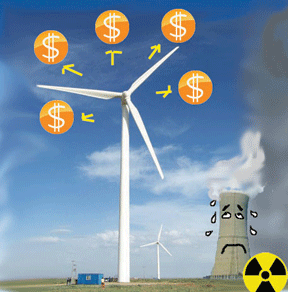
Britain’s wind energy programmes have proved to be cheaper and better climate policy, as against nuclear
 Dave Toke’s Blog 22nd June 2018, The Climate Change Act has been celebrating its 10th anniversary, but there
is surprisingly little to celebrate in the earlier advice of the Committee on Climate Change (CCC). The CCC is the body created to advise the Government on the achievement of the carbon reduction commitments (80 per cent of 1990 levels by 2050).
You would expect the advice of the CCC to speed the Government’s low carbon programme, but in the crucial aspect of
electricity supply policy it has (in the past) actually damaged it! Looking back on its past, it looks like the Committee gave completely the wrong advice to the Government, advice which, alas, they still seem to be following now. In particular, in the ‘Renewable Energy Review’ issued in 2011 (which I criticised at the time), the CCC, urged the Government to cut
back the targets for offshore wind and instead focus on nuclear power.
They told the Government not to be put off by the Fukushima disaster that had happened earlier that year. According to the Times Report on May 9th 2011 ”The Committee on Climate Change says heavy reliance on offshore wind could result in unacceptable increases in fuel bills.’ David Kennedy, the then Chief Executive of CCC said that ‘Nuclear looks like it will be the lowest cost for the next decade or two’. Indeed the Review stated that nuclear power was currently ‘the most cost effective of the low carbon technologies’.That conclusion, given the cost of onshore wind, was highly challengable at the time, especially as given the existing record of nuclear power plant that had been built in the UK and the roll-out of
onshore wind.
Whereas the deployment of renewable energy has soared ahead, despite the best efforts of many in the Conservatives to block it, nuclear power plans set out in 2010 have proved to be fantasy. And, of course, offshore wind costs have tumbled rapidly making the CCC’s earlier pronouncements looking especially silly.
http://realfeed-intariffs.blogspot.com/2018/06/how-committee-on-climate-change-gave.html
French nuclear corporation EDF hedges its bets: now starting 2 renewable energy programmes
Renews 22nd June 2018 Energy giant EDF is celebrating a UK double after cutting the ribbon on two
renewables projects this week. The company’s chairman and chief executive
Jean-Bernard Levy was present for the official opening of both the 41.5MW
Blyth offshore wind farm off the Northumberland coast and the 49MW West
Burton B battery storage facility.
The Blyth project (pictured) features
five MHI Vestas V164-8.0MW turbines optimised to 8.3MW. The West Burton B
facility will operate within the new frequency control system to be
deployed across the UK to improve national grid stability. Levy said:
“These two innovative projects demonstrate our expertise in renewable
energies and electricity storage. They contribute greatly to
decarbonisation of the energy mix in the UK, our second largest market
after France.”
http://renews.biz/111572/edf-celebrates-uk-one-two/
The Financial Times launching a new guide to the “energy transition
FT 15th June 2018 , The Financial Times has launched a new guide to the “energy transition” –
the long-term restructuring of the energy system away from fossil fuels and
towards renewables. In the first of six instalments, the FT delves into the
role of the energy producers, examining “how new technologies and
environmental concerns are transforming the energy mix across the world’.
The guide includes articles on how coal is fading in the developed world
but is far from dead in Asia, why renewables and high costs are challenging
the case for nuclear power, and how natural gas is vying for a big role in
the shift to low-carbon economy. The next instalment, on the role of
citizens, will be published on 31 July.
https://www.ft.com/reports/energy-transition-guide
Reinventing Power: America’s Renewable Energy Boom
changed their lives and benefitted the diverse regions where they live.
“After I lost my job, I had about three days of sulking, and then I got
up and decided to listen to some of my co-workers’ advice to look into
wind turbines,” he said in Reinventing Power: America’s Renewable
Energy Boom, a new film (to be widely released this summer) from the Sierra
Club about the energy revolution in America.
recession. Bruce’s circumstances are not unusual: In the U.S., jobs in
sectors that have traditionally boosted the economy are disappearing. Coal
is environmentally damaging and expensive to mine. Car companies are
looking at an eventual slow-down in sales. Across both sectors and many
more, automation is putting people out of work.
employ over 800,000 people across the country, and are some of the
fastest-growing industries. As these resources scale, they’re becoming
economically viable–solar is around 50% cheaper than coal–and
wide-scale adoption of wind and solar could help curb America’s carbon
emissions. And they’re adaptable across a range of communities:
Reinventing Power traces the establishment of the country’s first
offshore wind farm near the tiny Rhode Island community of Block Island and
delves into community solar programs in Austin and wind power on Northern
Cheyenne Indian Reservation in Montana and a farm in North Carolina, The
film also follows the retraining of former coal miners and auto workers for
jobs in renewables throughout the U.S.
https://amp.fastcompany.com/40580983/this-new-doc-shows-how-renewable-energy-recharges-communities
For energy security, flexibility trumps baseload – the German experience
 ‘Baseload Is Poison’ And 5 Other Lessons From Germany’s Energy Transition https://www.forbes.com/sites/jeffmcmahon/2018/06/10/baseload-is-poison-and-5-other-lessons-from-germanys-energy-transition/#59113a2d6f88https://www.forbes.com/sites/jeffmcmahon/2018/06/10/baseload-is-poison-and-5-other-lessons-from-germanys-energy-transition/#59113a2d6f88 Jun 10, 2018
Baseload power is not the answer to the variability of renewable energy, a German energy official said Friday, and energy storage may not be the answer either.
Germany has achieved moments in its Energiewende, or Energy Transition, in which renewables met 100 percent of demand without the aid of baseload power or batteries, said Thorsten Herdan, a director general for energy policy at the German Federal Ministry for Economic Affairs and Energy. Germany was able to do that, he argued, because of its system’s flexibility.
1. Flexibility Trumps Baseload
“What we need for this fluctuating renewable energy in the electricity mix is not baseload. Baseload is poison for our electricity transition in Germany,” Herdan said in a briefing at the Dirksen Senate Office Building in Washington, D.C. “What you need is flexibility, because the sun is shining and then you have PV production, wind is blowing and you have wind production. So it’s not according to demand, it’s according to weather conditions, which means they are there in any case and then you need to have flexibility to fill the gap.”
Baseload power was traditionally supplied by coal and nuclear plants, with peaks in demand met by natural-gas plants.
But flexibility can displace the old notion of baseload and peak, Herdan said, and flexibility can take many forms, including gas peaker plants, batteries, demand management or regional exchanges. It’s most important to keep in mind, he argued, that flexiblity is the goal, not any one of the forms it takes.
2. Flexibility Trumps Storage
Herdan appeared in a briefing on Germany’s Energy Transition hosted by the Environmental and Energy Study Institute. Asked whether an energy transition like Germany’s will increase the demand for energy storage, Herdan said, “I don’t know whether the demand for storage will increase. What I know is the demand for flexibility will increase, will increase dramatically… and if storage proves to be the cheapest flexibility, and the market chooses storage, then of course storage will increase.
“It’s always coming down to flexibility. That’s what we need and storage is one sort of that.”
But other sorts may prove cheaper:
3. Flexibility Can Be Geographic
Energy storage is not necessarily the cheapest form of flexibility. Germany is building transmission lines into Norway so the two countries can exchange electricity between Germany’s northern wind farms and Norway’s 937 hydropower stations.
“That’s the cheapest flexibility you can think of. We don’t need to build, for that, storage facilities which are much more expensive,” he said. “If you integrate yourself the various states in the U.S. you can see that you can help each other.”
4. Markets Should Be Transparent
To manage flexibility, electricity providers need real-time information about electricity production and demand, Herdan said, and that information should also include the price for the various forms of flexibility.
“All you have to do is create a market, an electricity market, where prices tell the truth,” he said.
“I’m talking to everyone in the world about transparency, I tell them, try to get your data on electricity production real-time. We didn’t have that for a long time, and all the various lobby groups told us a lot of interesting stories. So we decided we needed to have in real time the electricity produced in every second from every source so that we know what’s going on.”
5. Flexibility Provides Reliability
Germany moved from almost no renewable energy in the 1990s to 37 percent today—its single largest block of power, almost all of it generated from wind and solar photovoltaic. Anxieties about a loss of grid reliability have not materialized, Herdan said:
“The grid is extremely stable. We have grid disruption in a year of about 12 minutes. So, 12 minutes a year is effectively nothing,” he said, citing Germany’s average duration of electric supply disruption. The comparable number in the U.S., where power producers boast of their reliability, is 114 minutes.
“So we could cope with the question of whether we can adopt a high share of renewables, the volatile ones in our grid, and we would like to talk with you about how we achieved that, what we did right, what we did wrong, and how can we perhaps achieve that in the States.”
6. Powerful Price Signals Help
Germany has more than 100 Gigawatts of renewable capacity, more than enough to meet a demand that fluctuates between 40 and 85GW. One day in May, renewables were meeting 100 percent of demand, Herdan said, and the price of electricity dropped below zero.
“At the time the renewables were at 100 percent, the price went down and it was negative, so we had a negative price, and what we say is, fine, there is nothing bad in negative prices because that very clearly tells the other generators how to behave,” he said. “That forced the generators, specifically the coal generators, to change their behavior, shut them down or reduce them or whatever is possible.”
Market transparency and real-time data allow prices to send such immediate signals to power producers.
“That is something that we established last year and that we heavily use in order to not be told by lobby groups that offshore wind power is the best one, or coal generators are the most flexible ones, we can see what happens, and we can tell them how they should behave or the market tells them how they should behave.”
Herdan cautioned that Germany’s example is not a model for every country. Germany has decided not to use nuclear power, for example, and few countries share that commitment. But he contends that Germany’s example reveals an underlying principle about the importance of flexiblity.
“Of course as I said in the beginning it’s different in the various countries around the world and also in the U.S., but this principle—that if you create renewable energy you need to have flexibility and no baseload—that is valid for each and every country in the world.”
Caroline Lucas: Backing Wylfa Nuclear Power Station Is The Wrong Move At The Wrong Time
Huffington Post 5th June 2018, Behind its shiny green veneer, this government has overseen
the funding stream for clean energy fall to its lowest levels in a decade.
The context for this public payout for new nuclear is an energy market
that’s making it blindingly obvious that renewables are the future. Solar
and wind are now the cheapest forms of new electricity generation, and new
technology means that power from the sun, sea and wind, balanced with
batteries and interconnection, are able to be the backbone of British
energy in the future.
Onshore wind – which the Government has all but
banned – could have a strike price a whopping £37.50 lower than Wylfa’s.
The frequent retort to those of us who oppose nuclear is centred on the
need for ‘baseload’ power – but such arguments are increasingly weak.
We know that battery technology is coming on leaps and bounds – and even
the ex-head of National Grid, Steve Holliday, has said that “the idea of
large power stations for baseload is outdated”, and noted that “from a
consumer’s point of view, the solar on the rooftop is going to be the
baseload”.
But it’s not just the government’s skewed financial
priorities that make Wylfa the wrong move at the wrong time. At the heart
of the problems with nuclear energy is the stark fact that there is still
no solution to the nuclear waste problem.
https://www.huffingtonpost.co.uk/entry/wylfa_uk_5b164eafe4b093ac33a17a41
UK govt’s new funding of nuclear projects contrasts with its lack of support for renewable project in Wales
NFLA 5th June 2018 , The Nuclear Free Local Authorities (NFLA) is very disappointed, but not at
all surprised, with the announcement by UK Energy Minister Greg Barker to
offer £5 billion of taxpayer money to assist with the funding of the Wylfa
B new nuclear reactor in Anglesey.
Whilst going against years of previous
government policy, it also compares unfavourably with the expected lack of
Government support of an exciting new renewable energy project in Wales –
the proposed development of the Swansea tidal lagoon scheme, and future
projects planned in Cardiff Bay and off the north Wales coast.
At present this scheme looks to be on a life support machine, though the Government
delayed the expected announcement to ditch the project and the thousands of
jobs that could be created.
http://www.nuclearpolicy.info/news/wylfa-b-swansea-bay-tidal-lagoon-developing-low-carbon-energy-solutions/
UK wind power – much cheaper than planned Wylfa nuclear power plant
 ‘Cheap’ power at Wylfa nuclear plant blown away by wind, The Times, Emily Gosden, Energy Editor, 2 June 18 The electricity generated by the Wylfa nuclear plant could be about a fifth
cheaper than Hinkley Point’s but is likely to be much more expensive than
power from the latest offshore wind farms. It is understood that a figure
of close to £75 per megawatt-hour is under discussion as the “strike
price” that Hitachi, the Japanese conglomerate developing the Anglesey
plant, would be guaranteed by the government for the electricity it
produces. The difference between the guaranteed price and the wholesale
price — currently £50 per MWh — would be paid for by consumers through
levies on their energy bills.
Ministers are preparing to announce next week
the outline of a deal to fund the proposed Wylfa plant, which could cost in
excess of £15 billion. The twin-reactor plant could generate 2.9 gigawatts
of electricity, enough to power five million homes. It is due to start
generating in the mid 2020s. The government plans to invest directly in
Wylfa, as well as to offer extensive guarantee loans for the project. These
measures are designed to cut the cost of the project and so lower the price
that consumers will have to cover.
Critics of nuclear power are likely to
draw unfavourable comparisons with offshore wind. Two projects in UK waters
were awarded guarantees prices of £57.50 per MWh last year. Some onshore
wind and solar projects are being built without any subsidy.
https://www.thetimes.co.uk/article/cheap-power-at-nuclear-plant-blown-away-by-wind-3bzc2h5qm
International Renewable Energy Agency reports on companies across 75 nations sourcing renewable energy
Edie 29th May 2018,A new report from the International Renewable Energy Agency (IRENA) found
that corporates have actively sourced renewable energy equivalent to the overall demand of France, but renewables demand could soar if companies turned voluntary agreements into active goals.
The new IRENA report, published at last week’s Clean Energy Ministerial meeting in Copenhagen,
found that more than 2,400 companies across 75 nations sourced 465TWh of renewable energy in 2017. The report found that more than half of the companies studied are voluntarily procuring and investing in onsite generation or purchasing agreements to power their operations with renewable electricity.
Of the companies listed in the study, more than 200 are sourcing 50% or more of their energy from renewables. According to IRENA, 100% of active corporate sourcing of renewable electricity is “already feasible”, but the report found that just 17% of the companies listed had a renewable electricity target in place and three-quarters of these targets are set to expire before 2020.
MS Tûranor PlanetSolar – huge solar-powered ship
Business Insider 26th May 2018, This huge seacraft is developed by Swiss company PlanetSolar, who wanted to
create a vessel which was environmentally friendly and produced
zero-emissions. Developed in 2010, the MS Tûranor PlanetSolar is the
largest solar-powered boat ever built. Its 500 solar panels can provide 120
kilowatts of energy, allowing the ship to travel around 5 knots.
http://uk.businessinsider.com/this-huge-seacraft-is-entirely-powered-by-solar-energy-planet-solar-2018-5

1 This Month

of the week – Shut Down Drone Warfare!


Tell the Ukrainian Government to Drop Prosecution of Peace Activist Yurii Sheliazhenko

Petition to revoke the licensing of the Near Surface Nuclear Disposal Facility (NSDF) at Chalk River. https://www.ourcommons.ca/petitions/en/Petition/Details?Petition=e-7247
To see nuclear-related stories in greater depth and intensity – go to https://nuclearinformation.wordpress.com
-
Archives
- April 2026 (103)
- March 2026 (251)
- February 2026 (268)
- January 2026 (308)
- December 2025 (358)
- November 2025 (359)
- October 2025 (376)
- September 2025 (257)
- August 2025 (319)
- July 2025 (230)
- June 2025 (348)
- May 2025 (261)
-
Categories
- 1
- 1 NUCLEAR ISSUES
- business and costs
- climate change
- culture and arts
- ENERGY
- environment
- health
- history
- indigenous issues
- Legal
- marketing of nuclear
- media
- opposition to nuclear
- PERSONAL STORIES
- politics
- politics international
- Religion and ethics
- safety
- secrets,lies and civil liberties
- spinbuster
- technology
- Uranium
- wastes
- weapons and war
- Women
- 2 WORLD
- ACTION
- AFRICA
- Atrocities
- AUSTRALIA
- Christina's notes
- Christina's themes
- culture and arts
- Events
- Fuk 2022
- Fuk 2023
- Fukushima 2017
- Fukushima 2018
- fukushima 2019
- Fukushima 2020
- Fukushima 2021
- general
- global warming
- Humour (God we need it)
- Nuclear
- RARE EARTHS
- Reference
- resources – print
- Resources -audiovicual
- Weekly Newsletter
- World
- World Nuclear
- YouTube
-
RSS
Entries RSS
Comments RSS
 nuclear-news