Renewables output outpacing coal and nuclear in USA
Renewables output outpacing coal and nuclear in US https://www.windpowermonthly.com/article/1690384/renewables-output-outpacing-coal-nuclear-us, 27 July 2020 by Craig Richard
Renewable energy sources outperformed coal and nuclear in the US during the first five months of the year, according to analysis of Energy Information Administration (EIA) data. The fastest growing energy sources during this period were wind and solar, according to analysis by renewables advocacy group the Sun Day Campaign.
Wind generated 11.1% more electricity (144.8GWh) than it did in the same period one year earlier , and accounted for 9.4% of the United States‘ total generation between January and May — up 1.4 percentage points from the first five months of 2019.
According to Windpower Intelligence, the research and data division of Windpower Monthly, the US’ wind power fleet reached nearly 109.3GW by the end of May 2020 — an increase of 11.7% year on year.
Meanwhile, solar generated 23.1% more electricity in the first five months of 2020 (50.6GWh) than it did in the same period one year earlier, and accounted for 3.3% of the US’ total electricity generation in this time — up half a percentage point from January-May 2019.
Combined, renewable energy sources — also including hydropower, biomass and geothermal — generated 331.2GWh in the first five months of the year. This is more than both coal (258.9GWh, down 33.9% year on year) and nuclear (327.6GWh, down 1%).
However, natural gas still produced the most electricity in the first five months of the year — 606.9GWh, up 7.9% year on year.
The Sun Day Campaign’s executive director Kenneth Bossong said: “With each passing month, it is becoming ever more probable that renewables will outpace both this year and then begin closing the gap with natural gas.”
Nuclear power is excluded from European Commission’s strategies for a Green Deal
 New EC ‘Green Deal’ strategies ignore nuclear power, Nuclear Engineering 13 July 2020 The European Commission (EC) on 8 July presented two strategies as part of its Green Deal – “An EU Strategy for Energy System Integration”, and “A hydrogen strategy for a climate-neutral Europe”.The 21-page strategy for Energy System Integration aims to provide the framework for the green energy transition. The EC said: “The current model where energy consumption in transport, industry, gas and buildings is happening in ‘silos’ – each with separate value chains, rules, infrastructure, planning and operations – cannot deliver climate neutrality by 2050 in a cost efficient way; the changing costs of innovative solutions have to be integrated in the way we operate our energy system. New links between sectors must be created and technological progress exploited.”
There are three main pillars to this strategy:
- First, a more ‘circular’ energy system, with energy efficiency at its core.
- Second, a greater direct electrification of end-use sectors – a network of one million electric vehicle charging points will be among the visible results, along with the expansion of solar and wind power.
- For those sectors where electrification is difficult, the strategy promotes clean fuels, including renewable hydrogen and sustainable biofuels and biogas. The Commission will propose a new classification and certification system for renewable and low-carbon fuels………..
To help deliver on this Strategy, the Commission announced the launch of the European Clean Hydrogen Alliance with industry leaders, civil society, national and regional ministers and the European Investment Bank. The Alliance will build up an investment pipeline for scaled-up production and will support demand for clean hydrogen in the EU.
“To target support at the cleanest available technologies, the Commission will work to introduce common standards, terminology and certification, based on life-cycle carbon emissions, anchored in existing climate and energy legislation, and in line with the EU taxonomy for sustainable investments.”
Neither of the reports made any mention of nuclear power either as part of energy system integration or as an energy source for the production of hydrogen. …
Renewable generation eclipses coal, nuclear for 2nd straight month in April
Renewable generation eclipses coal, nuclear for 2nd straight month in April, S and P Global Market Intelligence, Krizka Danielle Del Rosario, 26 June 20, Although U.S. net generation in April fell 6.6% below the same month in 2019, renewable generation has continued to grow as a source of the nation’s supply and surpassed nuclear and coal for the second month in a row.
Renewables accounted for 23.3% of the total, expanding its lead on nuclear generation as the second-largest source of power supply. Nuclear generation made up 21.5% of the nation’s electricity, while gas-fired generation remained the largest supplier of power with a 39.3% share……. https://www.spglobal.com/marketintelligence/en/news-insights/blog/essential-energy-insights-june-11-2020
How we can manage the intermittency of renewables and attain 100% renewables
|
Yes. In fact, many ways are possible, including
Interestingly, in June 2020, several large power companies, including Centrica and E.ON, sent an open letter calling on National Grid to accelerate the deployment of smart electric vehicle (EV) charging infrastructure, energy storage and other flexibility services in order to manage the Grid more rationally. The utilities’ letter stated that a number of options existed to reduce its current reliance on curtailing renewables, from long-duration storage to industrial-scale demand response. They stated that EVs, smart electric heaters and home solar batteries “could all be providing services at this time if the right signals and instructions were being administered”. They added “flexible technologies and storage assets will be needed to integrate a higher level of renewable generation into the system to produce carbon savings. Harnessing the potential of these technologies is critical to ensuring green energy supply isn’t unnecessarily wasted”. https://www.greentechmedia.com/articles/read/smart-flexibility-could-slash-uk-coronavirus-curtailment-costs Indeed, throughout the UK,local authorities and local companies are in fact steaming ahead with their own initiatives. See box below. In addition, the recent UK pressure group, 100percentrenewableuk, was also set up to press for these developments. www.100percentrenewableuk.org Some examples of innovative flexible RE technologies Continue reading |


UK’s expensive problem of nuclear power’s inflexibility
Because of the inflexibility of the AGRs, RE suppliers are shut off first. This is explained in a recent report by the newly-formed pressure group, 100 percentrenewable uk, which explains that the inflexible nature of nuclear power is instrumental in forcing the National Grid to turn off large amounts of wind power (ie in the jargon to be ‘constrained’) in Scotland when there is too much electricity on the network.
This appears nonsensical as the Grid is turning off cheap renewables to preserve expensive nuclear, and then paying large compensation payments to them to do so.
UK Electricity: Renewables and the problem with inflexible nuclear, Ian Fairlea, June 21, 2020
In recent years, the share of the UK’s electricity supplied by renewable energy (RE) sources has increased substantially to the point that RE is now the second largest source after gas: It now supplies 20% to 25% of our electrical needs. This is greater than the amount supplied by nuclear – about 15% to 18%. Coal, hydroelectric, and mainly gas (~40%) constitute the other sources. See chart [on original] for Britain’s electrical power supplies in 2019.
Why are AGR reactors inflexible? Continue reading
To protect our planet – we need to transform, not grow, the economy

“So, we have to get away from our obsession with economic growth – we really need to start managing our economies in a way that protects our climate and natural resources, even if this means less, no or even negative growth.”
Overconsumption and growth economy key drivers of environmental crises https://www.eurekalert.org/pub_releases/2020-06/uons-oag061820.php
21 June, 20, , Scientists’ warning on affluence, UNIVERSITY OF NEW SOUTH WALES, A group of researchers, led by a UNSW sustainability scientist, have reviewed existing academic discussions on the link between wealth, economy and associated impacts, reaching a clear conclusion: technology will only get us so far when working towards sustainability – we need far-reaching lifestyle changes and different economic paradigms.
In their review, published today in Nature Communications and entitled Scientists’ Warning on Affluence, the researchers have summarised the available evidence, identifying possible solution approaches.
“Recent scientists’ warnings have done a great job at describing the many perils our natural world is facing through crises in climate, biodiversity and food systems, to name but a few,” says lead author Professor Tommy Wiedmann from UNSW Engineering.
“However, none of these warnings has explicitly considered the role of growth-oriented economies and the pursuit of affluence. In our scientists’ warning, we identify the underlying forces of overconsumption and spell out the measures that are needed to tackle the overwhelming ‘power’ of consumption and the economic growth paradigm – that’s the gap we fill.
“The key conclusion from our review is that we cannot rely on technology alone to solve existential environmental problems – like climate change, biodiversity loss and pollution – but that we also have to change our affluent lifestyles and reduce overconsumption, in combination with structural change.”
During the past 40 years, worldwide wealth growth has continuously outpaced any efficiency gains.
“Technology can help us to consume more efficiently, i.e. to save energy and resources, but these technological improvements cannot keep pace with our ever-increasing levels of consumption,” Prof Wiedmann says.
Reducing overconsumption in the world’s richest
Co-author Julia Steinberger, Professor of Ecological Economics at the University of Leeds, says affluence is often portrayed as something to aspire to.
“But our paper has shown that it’s actually dangerous and leads to planetary-scale destruction. To protect ourselves from the worsening climate crisis, we must reduce inequality and challenge the notion that riches, and those who possess them, are inherently good.”
In fact, the researchers say the world’s affluent citizens are responsible for most environmental impacts and are central to any future prospect of retreating to safer conditions.
“Consumption of affluent households worldwide is by far the strongest determinant – and the strongest accelerator – of increased global environmental and social impacts,” co-author Lorenz Keysser from ETH Zurich says.
“Current discussions on how to address the ecological crises within science, policy making and social movements need to recognize the responsibility of the most affluent for these crises.”
The researchers say overconsumption and affluence need to be addressed through lifestyle changes.
“It’s hardly ever acknowledged, but any transition towards sustainability can only be effective if technological advancements are complemented by far-reaching lifestyle changes,” says co-author Manfred Lenzen, Professor of Sustainability Research at the University of Sydney.
“I am often asked to explain this issue at social gatherings. Usually I say that what we see or associate with our current environmental issues (cars, power, planes) is just the tip of our personal iceberg. It’s all the stuff we consume and the environmental destruction embodied in that stuff that forms the iceberg’s submerged part. Unfortunately, once we understand this, the implications for our lifestyle are often so confronting that denial kicks in.”
No level of growth is sustainable
However, the scientists say responsibility for change doesn’t just sit with individuals – broader structural changes are needed.
“Individuals’ attempts at such lifestyle transitions may be doomed to fail, because existing societies, economies and cultures incentivise consumption expansion,” Prof Wiedmann says.
A change in economic paradigms is therefore sorely needed.
“The structural imperative for growth in competitive market economies leads to decision makers being locked into bolstering economic growth, and inhibiting necessary societal changes,” Prof Wiedmann says.
“So, we have to get away from our obsession with economic growth – we really need to start managing our economies in a way that protects our climate and natural resources, even if this means less, no or even negative growth.
“In Australia, this discussion isn’t happening at all – economic growth is the one and only mantra preached by both main political parties. It’s very different in New Zealand – their Wellbeing Budget 2019 is one example of how government investment can be directed in a more sustainable direction, by transforming the economy rather than growing it.”
The researchers say that “green growth” or “sustainable growth” is a myth.
“As long as there is growth – both economically and in population – technology cannot keep up with reducing impacts, the overall environmental impacts with only increase,” Prof Wiedmann says.
One way to enforce these lifestyle changes could be to reduce overconsumption by the super-rich, e.g. through taxation policies.
“‘Degrowth’ proponents go a step further and suggest a more radical social change that leads away from capitalism to other forms of economic and social governance,” Prof Wiedmann says.
“Policies may include, for example, eco-taxes, green investments, wealth redistribution through taxation and a maximum income, a guaranteed basic income and reduced working hours.”
Modelling an alternative future
Prof Wiedmann’s team now wants to model scenarios for sustainable transformations – that means exploring different pathways of development with a computer model to see what we need to do to achieve the best possible outcome.
“We have already started doing this with a recent piece of research that showed a fairer, greener and more prosperous Australia is possible – so long as political leaders don’t focus just on economic growth.
“We hope that this review shows a different perspective on what matters, and supports us in overcoming deeply entrenched views on how humans have to dominate nature, and on how our economies have to grow ever more. We can’t keep behaving as if we had a spare planet available.”
New Mexico utility to exit nuclear power, go for renewable energy instead
|
June 15, 2020 A New Mexico utility will exit current leases for nuclear power and will instead develop renewable power by 2040, Kallanish Energy reports. PNM said it will allow leases for 114 megawatts of electricity power from the Palo Verde Nuclear Generating Station in Arizona to expire. Replacing that reduced capacity will allow PNM “to integrate more renewable resources that provide the best value to customers and support the path to emissions-free energy,” said the company that is a subsidiary of PNM Resources. “The increase in renewables combined with ongoing nuclear ownership will maximize cost savings to customers and is essential to achieving our plans of emissions-free energy by 2040,” said Pat Vincent-Collawn, PNM Resources chairman, president, and CEO, in a statement……… The company provides power to 790,000 customers in New Mexico and Texas. https://www.kallanishenergy.com/2020/06/15/new-mexico-utlity-to-allow-nuclear-leases-to-expire/ |
|
Renewable energy for South Africa – cost-efficient and quick – forget coal and nuclear
 Global advances in renewable energy sector should halt SA’s rush to nuclear, Let’s avoid any major financial and technological disasters such as Medupi and Kusile happening again Business Live 17 JUNE 2020 , SA is once again on the cusp of another major electricity production decision. We had better get this one right. Mineral resources & energy minister Gwede Mantashe recently announced that the government is pressing ahead with a nuclear build programme for SA as early as 2024. This despite ample reported evidence that renewables, particularly solar, can be built both rapidly and cost effectively in incremental amounts up to the scale envisaged (2,500MW) to closely match any supply/demand curve.
It is therefore of some concern that those major companies in SA that have been interfacing with the renewables fraternity for their internal electricity production will respond to the one month deadline to raise reservations in a responsible manner with sound factual numbers. We certainly need to avoid any major financial and technological disasters such as Medupi and Kusile happening again.
The coming decade looks set to become a golden one for renewables globally and could well cement their position irreversibly as the way forward for a threefold purpose: global electricity needs, containing the global temperature rise, and avoiding the drastic climate change…….
The good news is that the driver for electricity production through renewables is no longer climate change but economics. A recent announcement of the lowest competitive tariff globally for a large-scale solar PV (photovoltaic) project in Abu Dhabi certainly illustrates this. It particularly signals the resetting of economies after the Covid-19 lockdown, especially in terms of any incremental increase in the supply/demand curve going forward.
Most significantly, the rapid construction capability of small- to large-scale renewable technologies avoids the long lead times of the large-scale fossil fuel and nuclear projects, with their difficult financial funding constraints. In addition, it shows that matching the supply/demand curve is relatively straightforward.
With favourable economics as the driver, this raises the issue of stranded assets. Increased reporting on the abandonment of coal plants has become relevant. The stranded asset value of fossil fuel electricity production, explained in a recent Cambridge Econometrics paper in Nature Climate Change, is said to be in the range $1-trillion to $4-trillion. Big numbers. …….
For SA, renewables would surely help overcome load-shedding and the planned closure of our ageing coal fleet. However, the political opposition to significant introduction of renewables capacity (by trade unions) could well be a limitation for this route………. https://www.businesslive.co.za/bd/opinion/2020-06-17-global-advances-in-renewable-energy-sector-should-halt-sas-rush-to-nuclear/
COVID-19 recovery plans – excellent opportunity for global renewable energy develoment
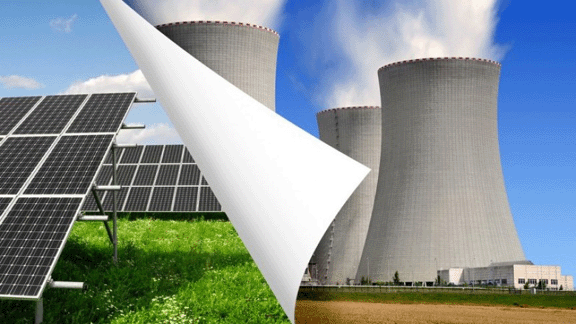 Current 12th June 2020, With renewable energy more cost-efficient than ever before, there is a clear opportunity to forward decarbonisation in COVID-19 recovery plans. A new report entitled Global Trends in Renewable Energy Investment 2020, put together by the UN Environment Programme (UNEP), the Frankfurt School-UNEP Collaborating Centre and BloombergNEF (BNEF), outlines that globally 2019 saw the highest investment in offshore wind in one year and highest solar power capacity additions in one year, while looking into investment trends for 2020.
Post-pandemic packages could green up our energy systems for environmental and economic benefit.

message was a grim, possibly self-serving, prediction, that sun, wind and water power would only ever meet four per cent of the country’s needs.
As Germany transitions to renewables, massive nuclear cooling towers are demolished
WATCH GERMANY BLOW UP TWO NUCLEAR COOLING TOWERS AS MINISTER SAYS ‘THE FUTURE LIES IN RENEWABLE ENERGIES‘ NEWSWEEK, BY JASON MURDOCK ON 5/15/20 Drone footage shows the moment when two massive cooling towers at a former nuclear power plant in Germany were demolished in a controlled explosion.
Operator EnBW confirmed a demolition at the Philippsburg site, in southwest Germany, was initiated by targeted blasts in lower area of the towers and took place shortly after 6 a.m. yesterday, a scene which lacked spectators due to COVID-19 restrictions.
Officials described the change as being an “important milestone” in the nation’s energy transition, moving it one step closer to a greater reliance on renewables. Germany aims to see all nuclear plant reactors taken offline by the end of 2022.
The Philippsburg power plants’ reactors were previously shuttered in 2011 and 2019 as part of those plans, the Associated Press reported.
According to EnBW, the land will soon be used by TransnetBW, a subsidiary managing the state’s electricity grid, to house a converter that will bring power generated from renewable energies from the north to the south.
“Two relics of the nuclear power era are gone: a visible sign that the nuclear phase-out is progressing in Germany,” tweeted environment minister Svenja Schulze. “The last nuclear power plant will also be switched off by 2022. The future lies in renewable energies that are safer, cheaper and more sustainable.”……..
The Baden-Württemberg ministry explains on its website the move posed challenges for its industrial region, as its energy supply was once 50 percent from nuclear. Officials are now investing in renewable sources, including wind, solar and hydro. ……. https://www.newsweek.com/europe-germany-philippsburg-nuclear-power-cooling-towers-demolition-explosion-video-1504280
World’s Sixth Largest Economy, Going Nuclear-Free
Diablo Canyon nuclear plant to be shut down, power replaced by renewables, efficiency, storage https://foe.org/news/2016-06-diablo-canyon-nuclear-plant-to-be-shut-down/ California, World’s Sixth Largest Economy, Going Nuclear-Free, BERKELEY, CALIF. – An historic agreement has been reached between Pacific Gas and Electric, Friends of the Earth, and other environmental and labor organizations to replace the Diablo Canyon nuclear reactors with greenhouse-gas-free renewable energy, efficiency and energy storage resources. Friends of the Earth says the agreement provides a clear blueprint for fighting climate change by replacing nuclear and fossil fuel energy with safe, clean, cost-competitive renewable energy. Continue reading
South Korea, Germany to bolster ties in transition towards renewable energy
S. Korea, Germany to bolster ties in transition towards renewable energy
The cooperation came as a follow-up to an agreement reached by Industry Minister Sung Yun-mo and German counterpart Peter Altmaier in Berlin last year, in which they vowed to bolster cooperation in the energy segment.
Seoul and Berlin will especially focus efforts on cooperating deeper on their shift towards renewable energy, while phasing out nuclear energy…….
The two countries are both making efforts to reduce their coal-based power generation as well, with Germany planning to break away from the resource by 2038. South Korea also vowed to “significantly reduce” its consumption of coal. https://en.yna.co.kr/view/AEN20200512003700320?fbclid=IwAR1RpCGPA8_id6MKRdp3q4xHlK6-BjaQOf5lbJL5TIhbKP6kHqekyrZmMagcolin@yna.co.kr
Wind and solar power thriving in pandemic, but nuclear power going down the drain
 Nuclear is Getting Hammered by Green Power and the Pandemic, Plant operators are forced to switch uneconomic units off because of low prices and slumping demand. Bloomberg Green, May 4, 2020, “………Nations around the world have set tough targets to reduce greenhouse gases with the help of clean energy to meet commitments set out in the 2015 Paris Agreement.
In China, the coronavirus caused reduced output at CGN Power Co.’s atomic plants after the Lunar New Year holiday. Without taking into account the two reactors that came into operation in 2019, output at the remaining 22 units fell 4.7% in the first quarter from a year earlier, the company said.
After correcting for weather effects, full lockdowns reduced daily electricity demand by at least 15% in France, India, Italy, Spain, the U.K. and northwest U.S., the International Energy Agency said in a report on April 30. Global power consumption will decline as much as 5% this year, or the most since the Great Depression, according to the group advising the richest nations.
That will hurt all power sources, although use of renewables will still post a 1% gain this year, IEA said. Nuclear could drop by 3% from 2019 due to lower demand and delays to planned maintenance and construction of several projects, IEA said.
For example, EDF’s U.K. unit is undertaking more work than usual at its reactors, with five out of 15 units halted for long-term repairs. Output is below normal for the time of year. The company declined to comment on whether it was altering production due to rising renewables.
……. At Vattenfall, workers will permanently shut another old reactor at Ringhals by the end of the year, just after one unit was closed down in December. It would have been too costly to make the investments needed to keep them running any longer, the company has said.
And Hall, the boss, has a clear vision. While 5 billion kronor ($510 million) will be invested to secure safe operations at its nuclear and hydro plants this year and next, as much as 25 billion kronor will go to wind.
“We want to build more fossil-free generation and that is predominantly wind.” https://www.bloomberg.com/news/articles/2020-05-04/nuclear-is-getting-hammered-by-green-power-and-the-pandemic
Michael Moore’s sham attack on renewable energy has had rigorous debunking
Rolling Stone 1st May 2020, Bill McKibben: ‘A Bomb in the Center of the Climate Movement’: Michael Moore Damages Our Most Important Goal. Basically, Moore and his colleagues
have made a film attacking renewable energy as a sham and arguing that the environmental movement is just a tool of corporations trying to make money off green energy.
“One of the most dangerous things right now is the illusion that alternative technologies, like wind and solar, are somehow different from fossil fuels,” Ozzie Zehner, one of the film’s producers, tells the camera. When visiting a solar facility, he insists: “You use more fossil fuels to do this than you’re getting benefit from it. You would have been better off just burning the fossil fuels.”
That’s not true, not in the least — the time it takes for a solar panel to pay back the energy used to build it is well under four years. Since it lasts three decades, it means 90 percent of the power it produces is pollution-free, compared with zero percent of the power from burning fossil fuels.
It turns out that pretty much everything else about the movie was wrong — there have been at least 24 debunkings, many of them painfully rigorous; as one scientist wrote in a particularly scathing takedown, “Planet of the Humans is deeply useless. Watch anything else.”
Moore’s fellow filmmaker Josh Fox, in an epic unraveling of the film’s endless lies, got in one of the best shots: “Releasing this on the eve of Earth Day’s 50th anniversary is like Bernie Sanders endorsing Donald Trump while chugging hydroxychloroquine.”
Here’s long-time solar activist (and, oh yeah, the guy who wrote “Heart of Gold“) Neil Young:
“The amount of damage this film tries to create (succeeding in the VERY short term) will ultimately bring light to the real facts, which are turning up everywhere in response to Michael Moore’s new erroneous and headline grabbing TV publicity tour of misinformation. A very damaging film to the human struggle for a better way of living, Moore’s film completely destroys whatever reputation he has earned so far.”
Inside Climate News 30th April 2020, 6 Things Michael Moore’s ‘Planet of the Humans’ Gets Wrong. The documentary’s “facts” are deceptive and misleading, not to mention way out
of date. Filmmaker Michael Moore’s new documentary purports to expose hypocrisy at the heart of the renewable energy movement. But the video, released on YouTube last week, is a mess of deceptive and outdated anecdotes, and a succession of ridiculous arguments. It will almost
certainly do far more harm than good in the struggle to reduce carbon emissions.
Observer 3rd May 2020, Planet of the Humans is an environmental documentary that has enraged
renewable energy experts and environmentalists, with some calling for its high-profile executive producer, Michael Moore, to apologise. It was released for free less than two weeks ago, and at the time of writing had had close to 5m views on YouTube. Across its 102 minutes, the film’s
producer and narrator, Jeff Gibbs, weaves a disjointed narrative that renewable energy is just as bad  as fossil fuels, high-profile environmentalists are corrupted by capitalism and population growth is the great unspoken enemy. “It is truly demoralising how much damage this film has done at a moment when many are ready for deep change,” said the Canadian activist and journalist Naomi Klein.
1 This Month

of the week – Shut Down Drone Warfare!


Tell the Ukrainian Government to Drop Prosecution of Peace Activist Yurii Sheliazhenko

Petition to revoke the licensing of the Near Surface Nuclear Disposal Facility (NSDF) at Chalk River. https://www.ourcommons.ca/petitions/en/Petition/Details?Petition=e-7247
To see nuclear-related stories in greater depth and intensity – go to https://nuclearinformation.wordpress.com
-
Archives
- April 2026 (79)
- March 2026 (251)
- February 2026 (268)
- January 2026 (308)
- December 2025 (358)
- November 2025 (359)
- October 2025 (376)
- September 2025 (257)
- August 2025 (319)
- July 2025 (230)
- June 2025 (348)
- May 2025 (261)
-
Categories
- 1
- 1 NUCLEAR ISSUES
- business and costs
- climate change
- culture and arts
- ENERGY
- environment
- health
- history
- indigenous issues
- Legal
- marketing of nuclear
- media
- opposition to nuclear
- PERSONAL STORIES
- politics
- politics international
- Religion and ethics
- safety
- secrets,lies and civil liberties
- spinbuster
- technology
- Uranium
- wastes
- weapons and war
- Women
- 2 WORLD
- ACTION
- AFRICA
- Atrocities
- AUSTRALIA
- Christina's notes
- Christina's themes
- culture and arts
- Events
- Fuk 2022
- Fuk 2023
- Fukushima 2017
- Fukushima 2018
- fukushima 2019
- Fukushima 2020
- Fukushima 2021
- general
- global warming
- Humour (God we need it)
- Nuclear
- RARE EARTHS
- Reference
- resources – print
- Resources -audiovicual
- Weekly Newsletter
- World
- World Nuclear
- YouTube
-
RSS
Entries RSS
Comments RSS
 nuclear-news